January 8, 1870
Celebrate the 100th anniversary of the 19th Amendment with stories about the people and events that led to the passage of women’s suffrage in the United States.
The Woman’s Journal was a women’s rights publication that produced its first issue on January 8, 1870. One of the most significant and popular publications of the women’s suffrage movement, it ran in various forms from 1870 to 1931.
Founded by suffragist Lucy Stone and her husband Henry Browne Blackwell in Boston, Massachusetts, the Woman's Journal aimed to provide a broad segment of women with information on the women’s rights movement and the suffrage cause. Content included speeches, debates, and women’s convention notes, all under the broader banner of the mission:
“devoted to the interests of Woman – to her educational, industrial, legal and political equality, and especially to her right of suffrage.”
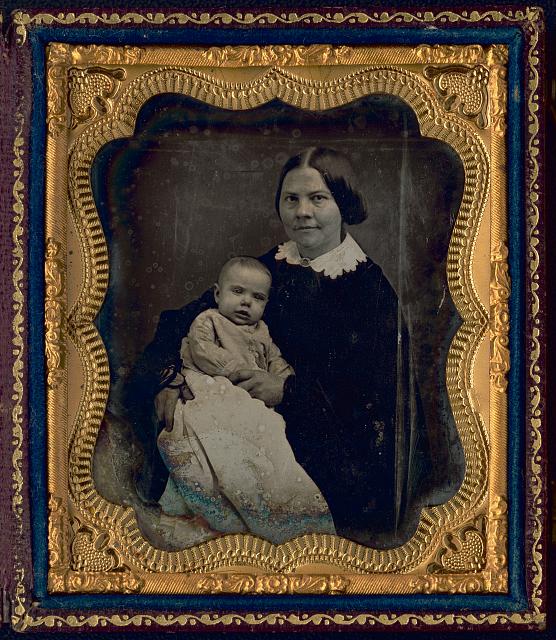
Lucy Stone with daughter Alice Stone Blackwell. Library of Congress Prints and Photographs Division.
The Journal’s first issue aligned with a significant anniversary in the suffrage timeline, as Susan B. Anthony and Elizabeth Cady Stanton’s journal, The Revolution, had published its first copy on January 8, 1868, two years prior.
The Woman’s Journal was a weekly publication and published every Saturday in Boston and Chicago. In addition to Stone, editors of the first issue included Mary Livermore, Julia Ward Howe, William Lloyd Garrison and, T.W. Higginson.
Stone and Blackwell’s daughter Alice Stone Blackwell started as an editor in 1881 and became sole editor in 1909 after her mother and father’s deaths, where she remained in the position until 1917.
The Woman’s Journal was funded with a $10,000 seed donation from benefactor Elizabeth Eddy and sustained itself through advertisements and subscriptions. At the time of the first publication, subscriptions started at an annual price of $3.00, with deals offered to readers who brought in more subscribers.
Though ad sales were sparse, the journal notably did not allocate space for tobacco, liquor, or medicinal advertisements.
The Journal’s leadership did attempt to reach a larger audience by hiring suffragists licensed as “newsboys” to hawk the publication on the Boston Common.
The inaugural issue of The Woman's Journal included articles such as “Woman as a Preacher,” which contended that women could and should be leaders in their religious communities; a history of “Women’s Rights in France During the Last Century”; and investigative pieces “What the Women of California are Doing” and “Can Women Hold Office in Iowa?”.
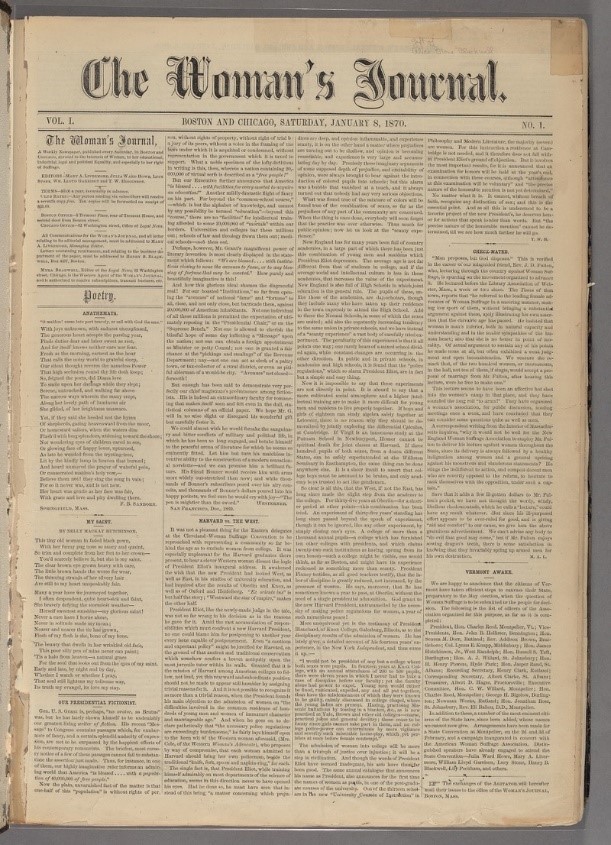
Front page of the first issue of the Woman’s Journal, published January 8, 1870, from Harvard Library.
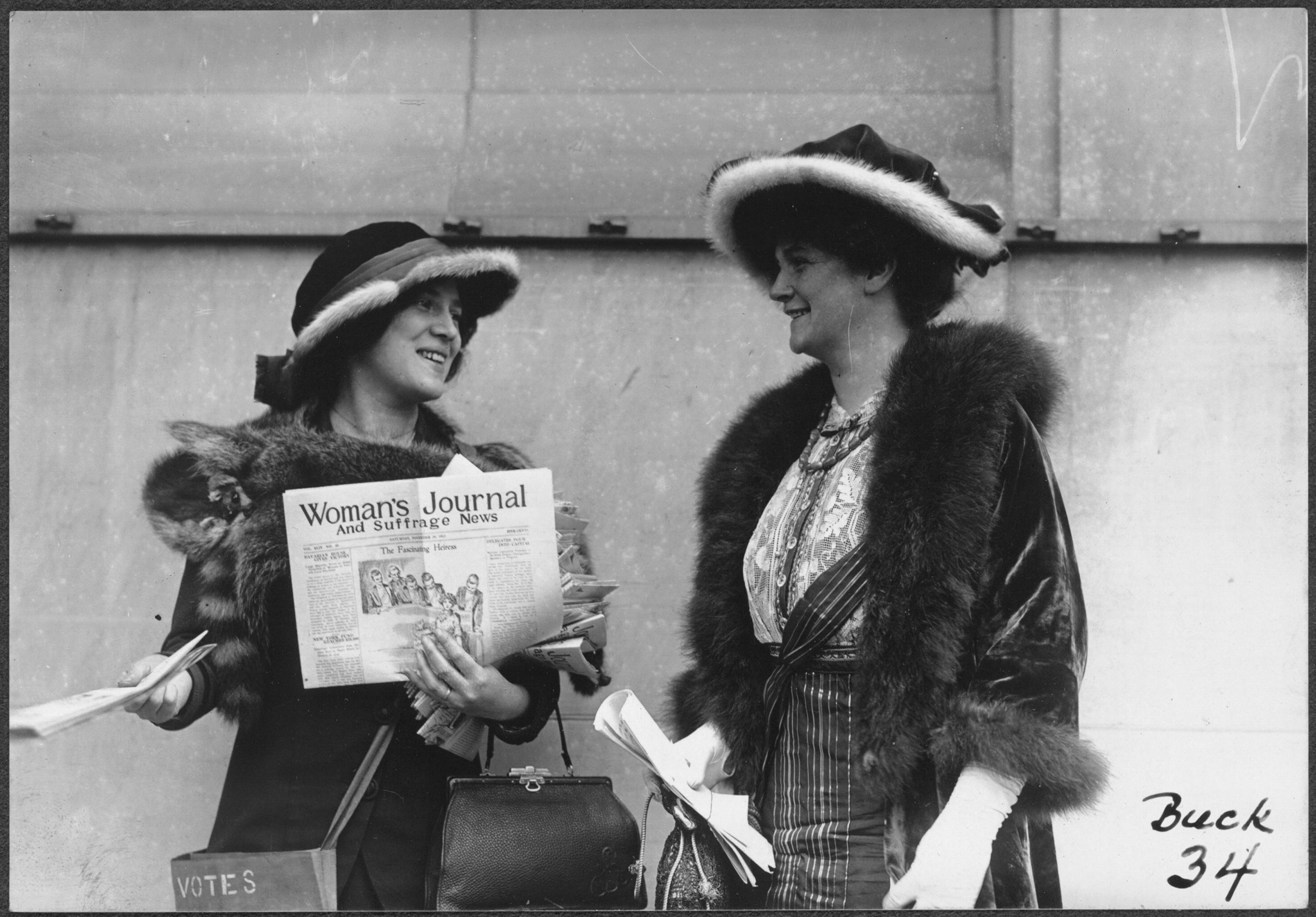
Suffragist Margaret Foley distributing the Woman’s Journal and Suffrage News, 1913. Library of Congress Prints and Photographs Division.
In 1916, the Journal hired Margaret Foley – a well-known speaker on women’s issues – to travel and host speaking engagements in the South and Midwest to promote the publication.
During its six decades, the Journal was absorbed and affiliated with numerous other suffrage journals, newsletters and periodicals. When the Journal was founded, it incorporated the Woman’s Advocate, and in 1910 it joined with the National American Woman Suffrage Association’s (NAWSA) in-house publication, the Progress. From 1910-1912, NAWSA contributed financial support and managerial oversight, and the Journal was subtitled as the “official organ of the National American Woman Suffrage Association.” From 1912 to 1916, the Journal was referred to as the Woman’s Journal and Suffrage News.
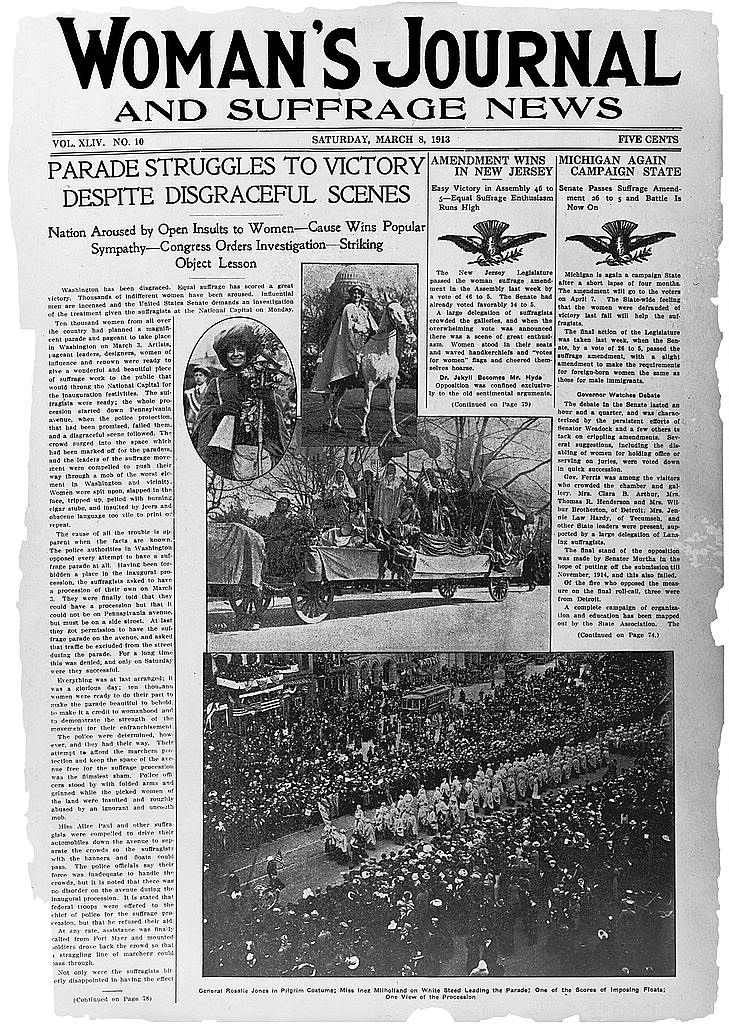
Front page of the ‘Woman’s Journal and Suffrage News” with the headline: ‘Parade struggles to victory despite disgraceful scenes,’ shows images of the women’s suffrage parade in Washington, March 3, 1913.
Library of Congress Prints and Photographs Division.
In response to prolonged financial instability, in 1917, the Woman’s Journal was sold to Carrie Chapman Catt’s Leslie Woman Suffrage Commission, which proceeded to merge the Journal, the Woman Voter, and National Suffrage News to form a new title, The Woman Citizen.
The Woman Citizen took the place as NAWSA’s official publication and published until the late 1920s, when it was again called the Woman’s Journal. This iteration of the publication ran until 1931.
Learn more
The full archives of the Woman’s Journal are now available through Harvard Library’s online digitized collection.
2020 marked the centennial of women’s suffrage in the United States.