• Skip to primary navigation
  • Skip to main content
  • Skip to footer

Alert

Alert: Central Library surface parking lots closed from midnight to noon on Saturday, May 30. More Info

Alert

Update: Elevator outages, maintenance and upgrades at Central Library More Info

Home - Arlington County Virginia - Logo
MENUMENU
  • Join Now
  • My Account
    • Login
    • My Checkouts
    • My Holds
    • My Lists
    • My Reading History
    • About Borrowing
    • About Holds
    • About My Account
  • Hours & Locations
    • All Hours & Locations
    • Holiday Closings
  • News
    • Library News
    • Director's Blog
    • Get Email Updates
  • Contact Us

Arlington Public Library

MENUMENU
  • Search
  • Collections
  • Library Services
  • Events
  • Community Engagement
  • Join Now
  • My Account
    • Login
    • About Borrowing
    • About Holds
    • About My Account
  • Hours & Locations
    • All Hours & Locations
    • Holiday Closings
  • News
    • Library Blog
    • Get Email Updates
  • Contact Us

Web Editor

Kathryn Stone: Speaking Out

Post Published: December 31, 2020

Graphic image of a megaphone

Join us for a new series of stories from the Center for Local History highlighting members of our community who made a difference in ways that helped shape our history and created positive change. 

Their voices were not always loud, but what they said or did had a significant impact on our community.

Kathryn Stone

Kathryn Stone, the first woman from Northern Virginia elected to the Virginia General Assembly, was one of a small minority of voices in Virginia that courageously fought against the state’s policy of “massive resistance” to school desegregation.  Arguing to keep the public schools open and begin desegregation, she accused long-time proponent of segregation, Senator Harry F. Byrd, Jr. and his organization of fostering “a spirit of lawlessness and disrespect for constitutional government.”
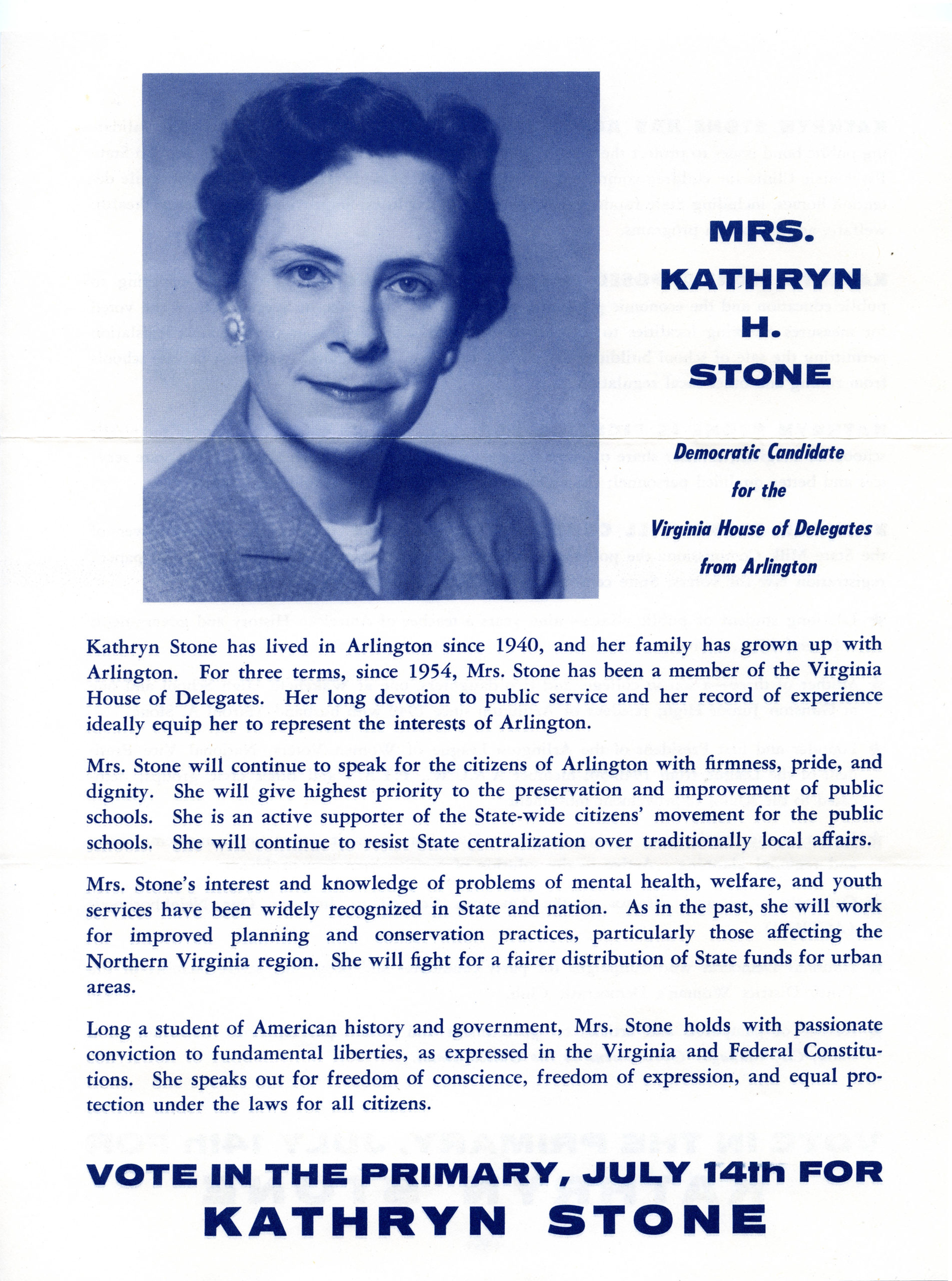
Campaign flyer for Kathryn Stone, candidate for House of Delegates in 1959.

"Vote for Kathryn Stone" flyer

A solitary voice, she warned the General Assembly against passing a series of bills aimed at stopping the NAACP from bringing desegregation lawsuits to court which, she argued, curbed freedom of speech and assembly:

“You are stooping in panic as you desert the Bill of Rights, which was born in the mind and hearts of the greatest Virginians.”

As a lawmaker, Stone also played an influential role in the creation of the Virginia community college system and was a leader in legislation to improve youth services, mental health, education, and welfare, but first and foremost, she will always be remembered as a symbol of progressive change and as an undaunted champion of the cause to end segregation in the schools.

Do you have a question about this story, or a personal experience to share? 

Use this form to send a message to the Charlie Clark Center for Local History.

Center For Local History - Blog Post Message Form

Do you have a question about this story, or a personal experience to share? Use this form to send a message to the Center for Local History.

"*" indicates required fields
This field is for validation purposes and should be left unchanged.

Share Your Story

December 31, 2020 by Web Editor

Leonard “Doc” Muse: Taking a Stand

Post Published: December 17, 2020

Graphic image of a megaphone

Join us for a new series of stories from the Center for Local History highlighting members of our community who made a difference in ways that helped shape our history and created positive change. 

Their voices were not always loud, but what they said or did had a significant impact on our community.

Leonard “Doc” Muse

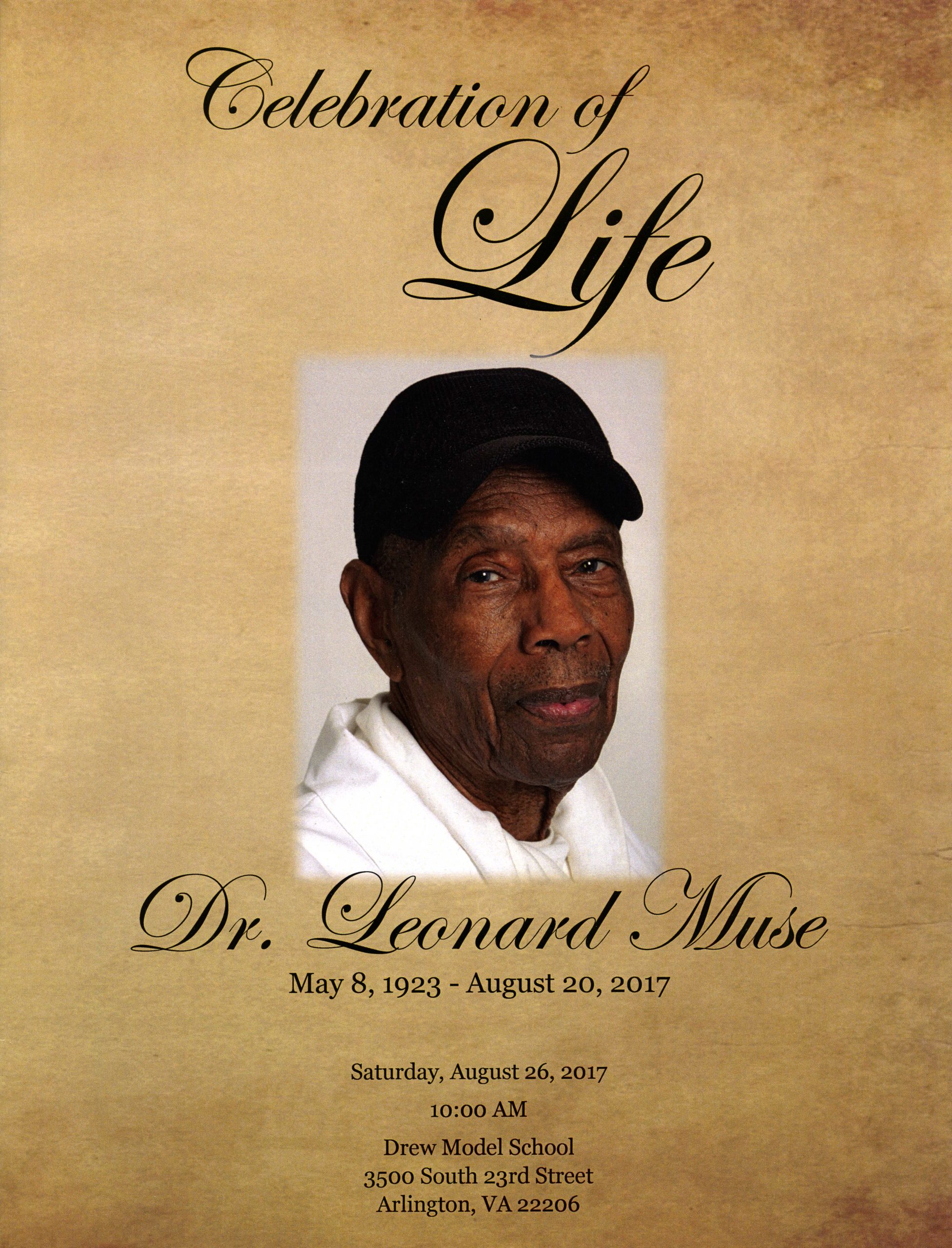
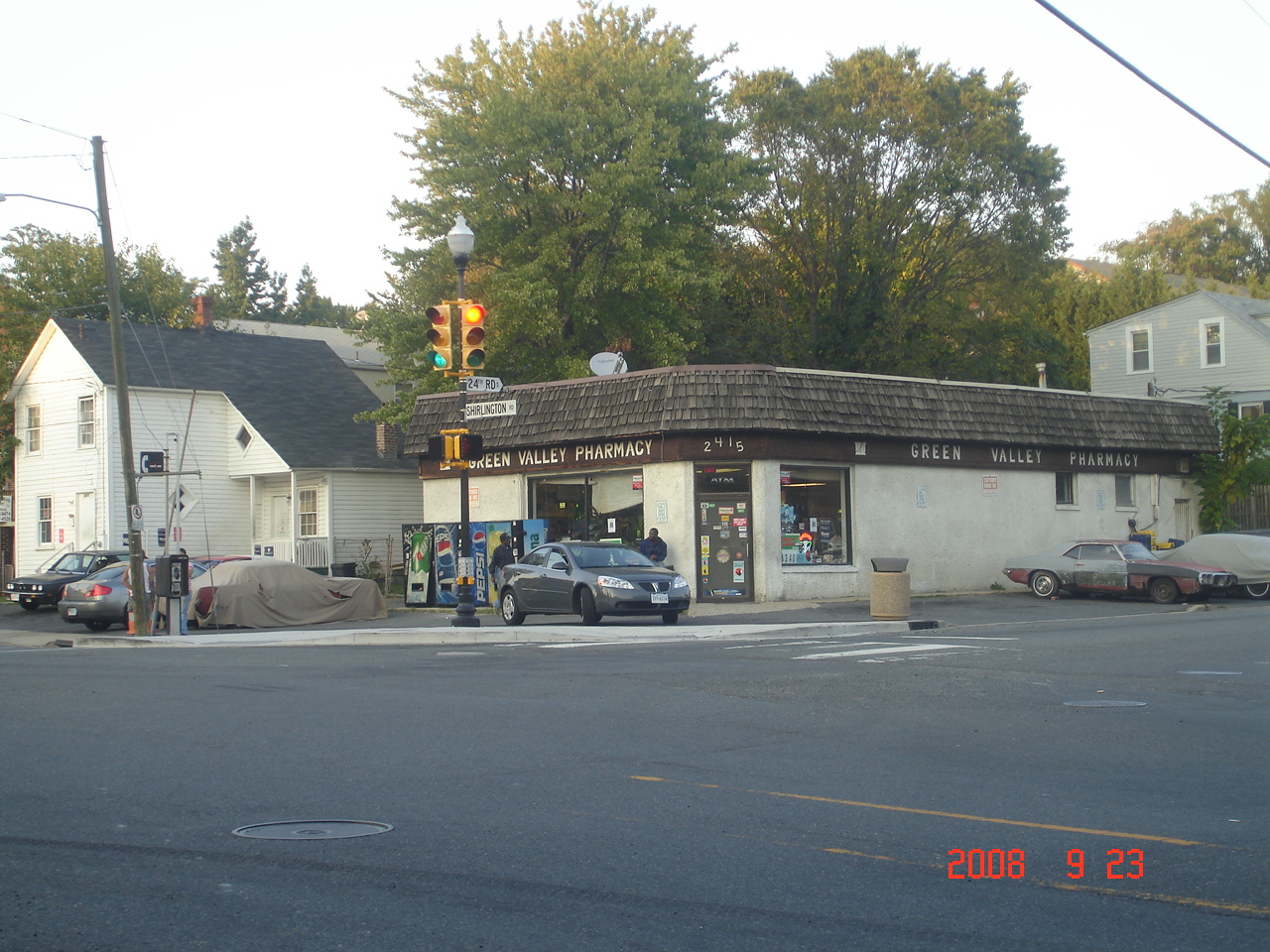
Leonard “Doc” Muse (1923-2017), was an African-American pharmacist and social activist, and the owner of Green Valley Pharmacy, a neighborhood institution whose importance extended far beyond that of a typical pharmacy.

Memorial program for Dr. Leonard Muse, 8/26/2017

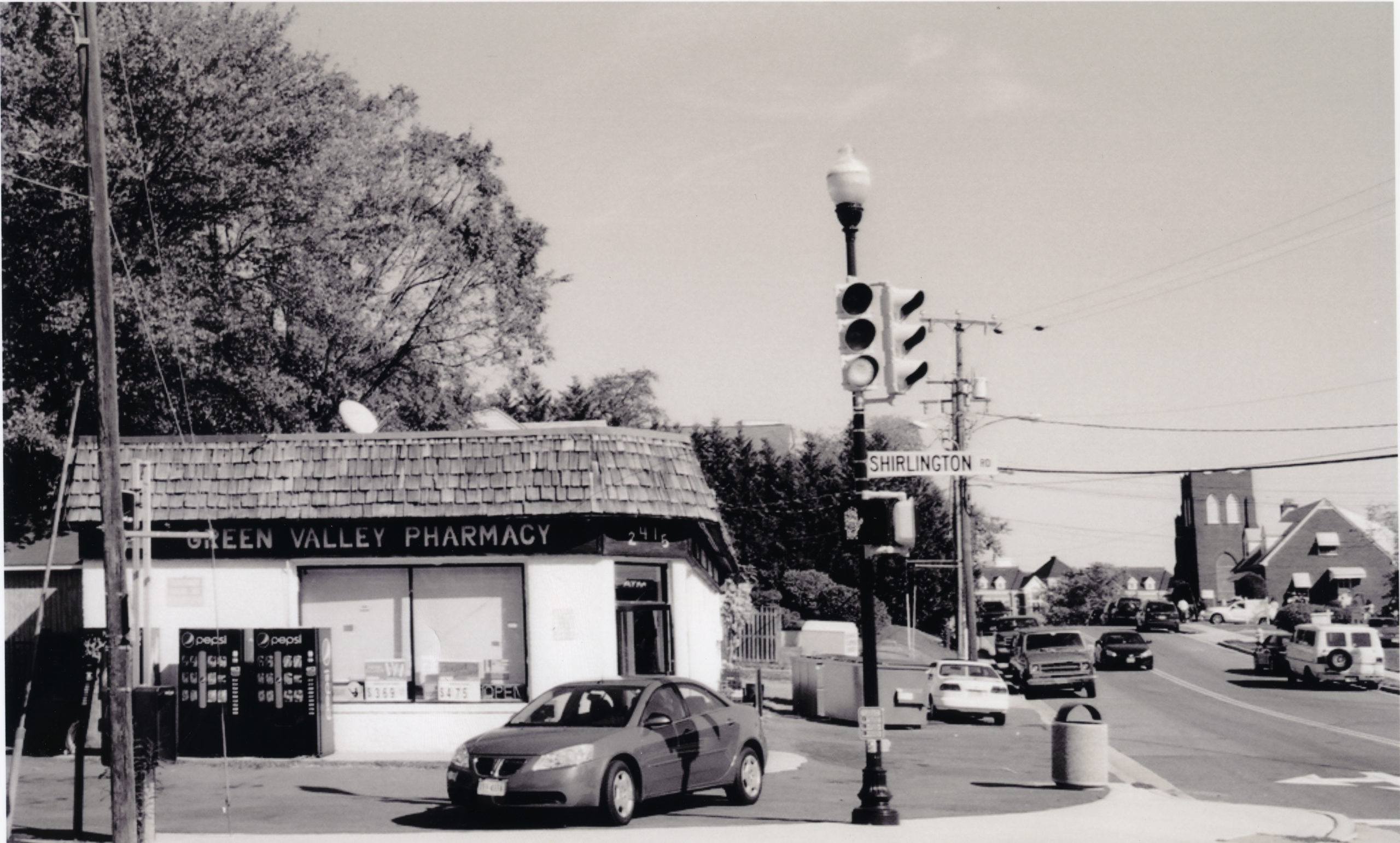
Muse was born in Florida, served in World War II, and then used his GI benefits to attend the Howard University School of Pharmacy. In 1952, along with partner Waverly Jones, he purchased the property which was formerly Hyman’s Grocery, and opened the Green Valley Pharmacy. In addition to being a drug store and filling prescriptions for the neighborhood, it functioned as a gathering place featuring a lunch counter which provided free meals every Wednesday afternoon and on occasion providing free prescriptions for those unable to afford them.

With this role in the community came the challenge of dealing with myriad interests and pressures, but Muse negotiated these rough waters with determination and skill.

Green Valley Pharmacy, 2010. Taken for Center for Local History Student Photo Contest.

Green Valley Pharmacy

In an oral history conducted by the Center for Local History, when asked about his motivation to become a pharmacist, Muse said:

“Oh, it’s a long story.  I was a kid, and the lady next door…asked me to go and get a prescription filled for her…I got there, I was tired, and I went to sit down, and that guy told me, “You can’t sit here.”  So I went out and sat on the sidewalk until they filled the prescription.  And I had the idea, I said, well, we need a pharmacy where we can sit wherever we want to –“.

Green Valley Pharmacy was named as a Historic Landmark by the Arlington County Board in 2013, and Muse received a Community Appreciation Award from the Arlington NAACP, and continuing to work and be a constant presence until his death in 2017.

GreenValleyPharm2008close

Green Valley Pharmacy 2008

Do you have a question about this story, or a personal experience to share? 

Use this form to send a message to the Charlie Clark Center for Local History.

Center For Local History - Blog Post Message Form

Do you have a question about this story, or a personal experience to share? Use this form to send a message to the Center for Local History.

"*" indicates required fields
This field is for validation purposes and should be left unchanged.

Share Your Story

December 17, 2020 by Web Editor Tagged With: Green Valley

Arlington’s Own Fast and Furious

Post Published: December 10, 2020

Virginia has a long history of horse and car racing, and Arlington County has had a role in both of these historically popular pastimes.

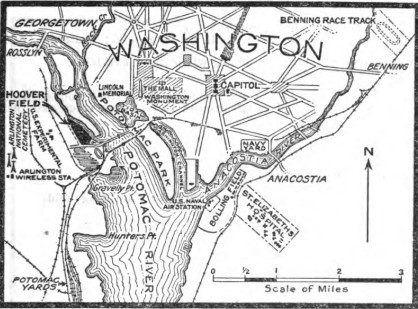
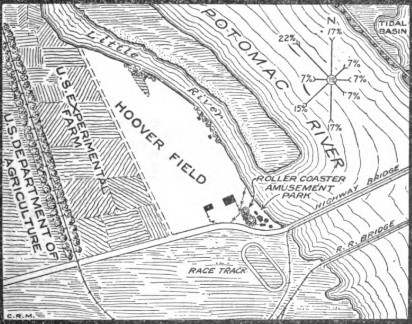
Beginning in the 1890s, Arlington (then known as Alexandria County) was home to a half-mile-long racetrack that drew thrill-seekers and daredevils from the County and beyond. The track, located on the grounds of what would become the Washington Airport next to the Hoover Airport, was on the land south of 14th Street bridge now occupied by the Pentagon.

Racing venues like Alexander Island in Arlington, and the St. Asaph Racetrack in Alexandria also became the focus of nationwide anti-gambling measures around the turn of the century.

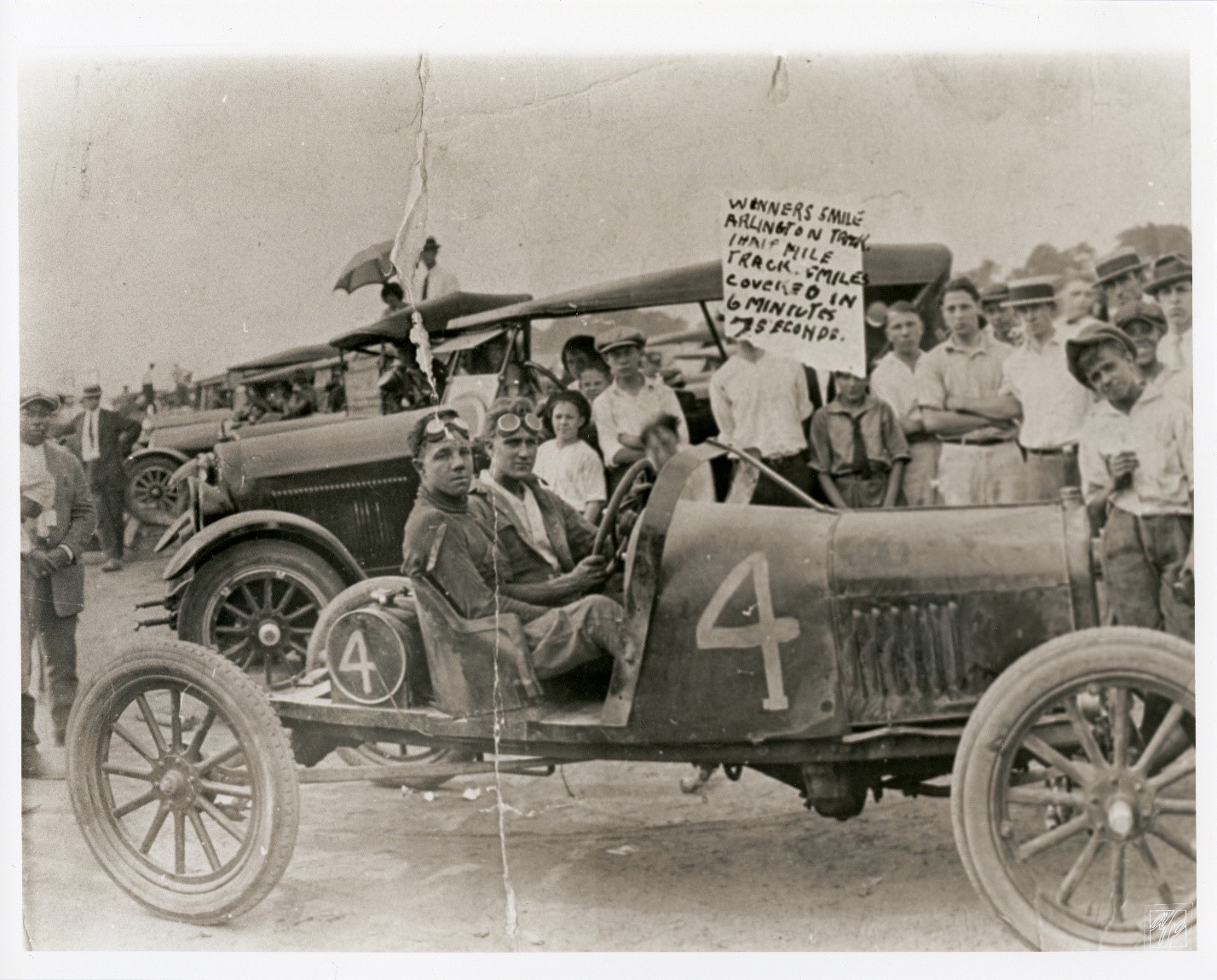
Old Number 4

Winners in “Old Number 4” at the Arlington racetrack, circa the early 1920s. According to the note on the photo, the 5-mile race on the half-mile-long track was covered in 6 minutes and 7 seconds – meaning the amateur driver nearly overcame the 50-mile-an-hour speed barrier.

A Racetrack for Arlington’s “Miniature Monte Carlo”

Arlington’s racetrack has its origins in the controversial history of the now extinct Jackson City neighborhood, and its then twin, Rosslyn. In the late 19th century, the two areas were considered hubs of criminality, associated with betting, gambling, and other unsavory activities.

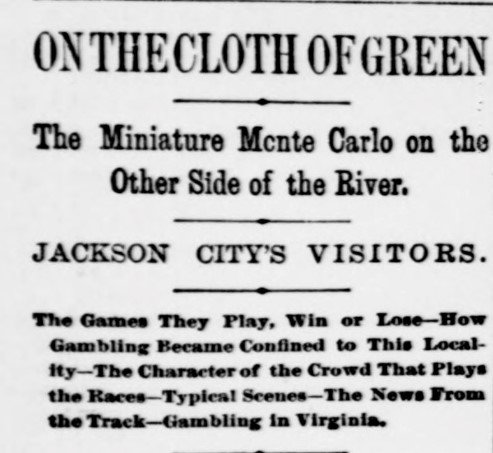
Jackson City was even referred to as a “Miniature Monte Carlo.” Following the post-Civil War ban on gambling in Washington, D.C., the neighborhoods drew customers across the Potomac to Rosslyn, conveniently located by the Aqueduct Bridge, and to Jackson City at the Long Bridge.

Evening Star Clipping

An article from the Washington, D.C., Evening Star on January 30, 1892, alludes to the controversial nature of the Jackson City area in Arlington. Image courtesy of the Library of Congress.

In the 1890s, Virginia lawmakers attempted to control the gambling that had overtaken the state, but corrupt legislators slipped in a loophole to allow an exemption for driving clubs, agricultural organizations, and grange organizations. Thanks to this provision, the Jones family in Arlington was able to secure a charter from the Grange Camp Association of Virginia and began investing in a racetrack in Jackson City.

Over the years, the racetrack would sometimes be referred to as the “Alexander Island” racetrack, referring to the also-controversial piece of land it sat on, which was considered Virginia at low tide and Washington, D.C., at high tide.

When a judge ruled the racetrack could stand, this set the precedent for the area formerly being considered part of Virginia – as horse betting was illegal in the District. This decision was later reversed in the 1930s, but Alexander Island ultimately came under the Pentagon’s jurisdiction a decade later and is now the present-day site of the Connector Parking Lot.

The City of Alexandria’s Racetrack Rises

Around the same time the Arlington racetrack got its start, investors in the city of Alexandria were also capitalizing on the loose gambling laws. A Gentlemen’s Driving Club was chartered in 1888, and by 1894 this would materialize into the St. Asaph Racetrack – the more notorious track in the Northern Virginia region.

This track was backed by the Hill family and other numerous high-profile investors, among them Virginia Senator George Mushback, who had helped pass legislation allowing for gambling to continue.

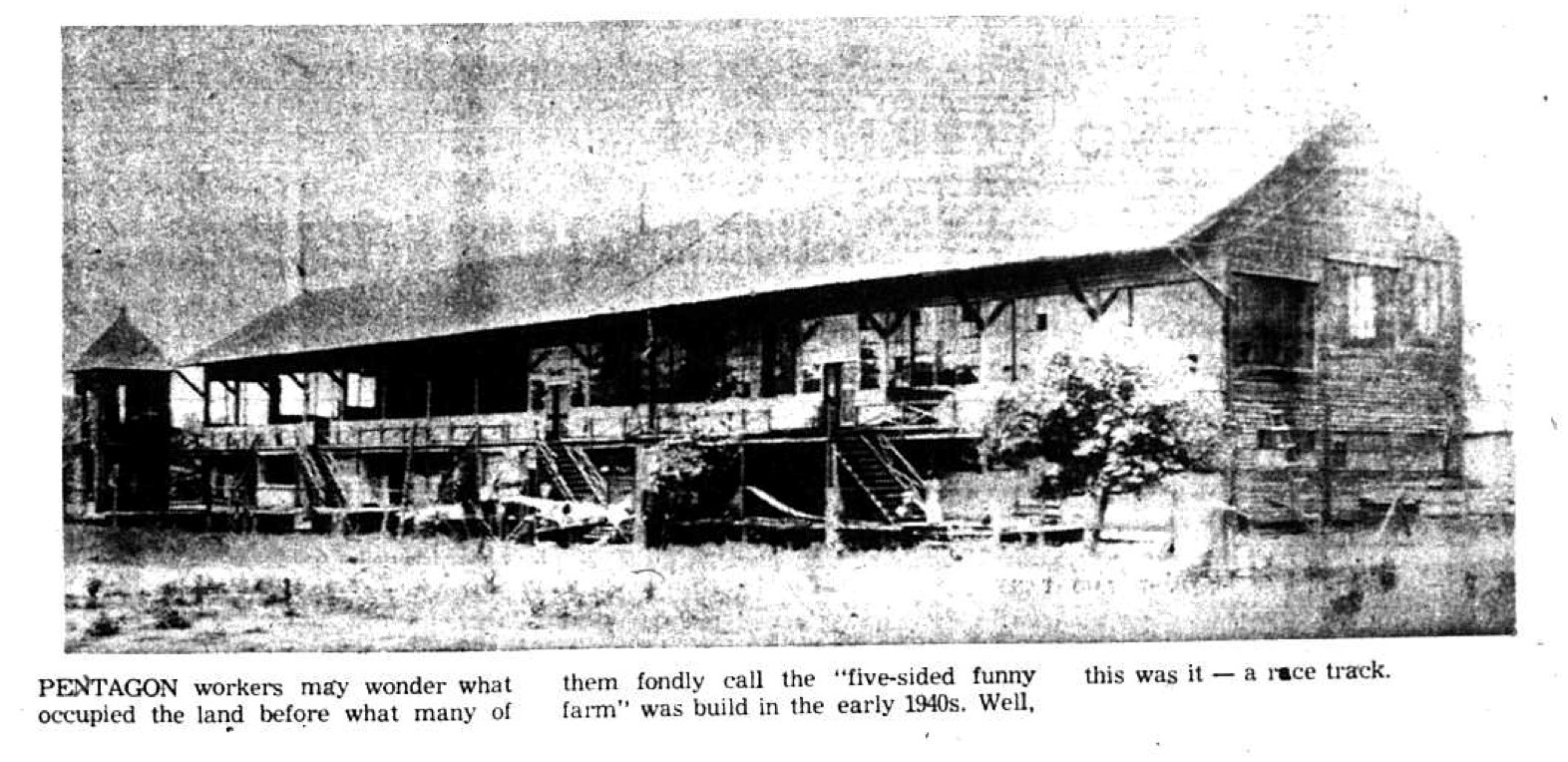
Arlington- Yesterday and Today

Photo from the Northern Virginia Sun, October 8, 1970, for an article titled “Arlington-- Yesterday and Today.” Though the caption and title suggest this was the Arlington racetrack, this photo is of the St. Asaph grandstand.

Located in the Del Rey neighborhood, the St. Asaph racetrack was extremely popular, drawing in thousands of dollars on its racing days. The operation made an estimated $150,000 per year – bolstered by its poolroom, where gamblers could stay connected and bet on other races via the establishment’s telegraph wires. The track was ¾ miles long and was frequently noted for the beauty of the landscape and architecture.

By 1895, the competing Arlington and city of Alexandria tracks and their investors had reached an agreement to race on alternate days, keeping both in business. In 1897, horse racing was outlawed outright by the state, though betting for out-of-state races at St. Asaph continued with the racetrack’s extensive telegraph setup. In 1898, during the Spanish-American War, St. Asaph’s was also used by the U.S. Army as a mobilization camp.

July 6 Map Pt.1
July 6 Map Pt.2

Maps from July 6, 1927, Airway Bulletin (No. 124) show Arlington’s racetrack adjacent to Hoover Field. Image courtesy of the University of California.

Drama, Debauchery, and Depositions

The scale of the St. Asaph’s track eventually made it a target for Crandall Mackey, who after being elected the commonwealth’s attorney in 1903, set his sights on eliminating crime in the region. Mackey had become a prominent figure in both Rosslyn and Jackson City, shutting down the area’s illegal bars, bordellos, and casinos over his tenure, and the racetrack was next on his list.

After Mushback’s death, Mackey swooped in to take down the racetrack and its not-so-savory reputation. In May of 1904, he staged a dramatic raid on the track, backed by a posse with sledgehammers and axes who destroyed slot machines and other equipment.

However, the track soon resumed business as usual. Mackey would eventually obtain 19 warrants against the track’s owners, igniting an extended courtroom battle against some of the region’s richest and most prominent figures. Mackey was ultimately successful in 1905 when the St. Asaph racetrack shut down for good.

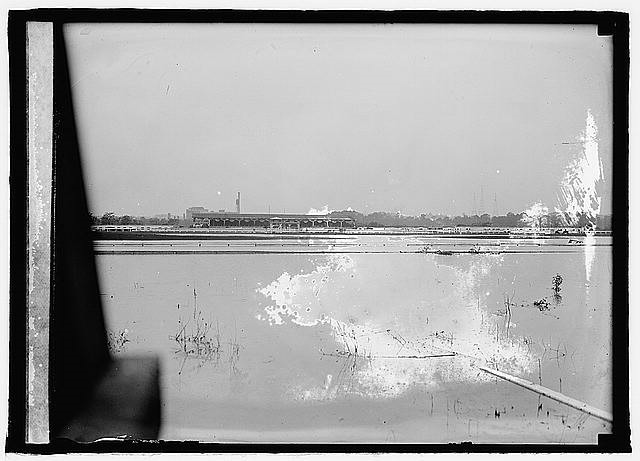
Flood with Racetrack

“Flood with racetrack in the background,” Image of the abandoned St. Asaph Racetrack, 1924, with the Arlington radio towers in the background. Image courtesy of the Library of Congress.

Memories of the Arlington Racetrack

It’s unclear why the Jackson City racetrack eluded Mackey’s “shotgun justice,” but it managed to disassociate itself from the historical notoriety of its Alexandria counterpart.

In the early 1900s, the Arlington racetrack remained a place for spectators to take in the thrills of the burgeoning sport of car racing. It was also near another popular spot for Arlingtonians to pass the time, the Arlington Beach, which featured a dance hall and amusement park rides.

Want to learn more about early 20th Arlington? Check out “Shotgun Justice: One Prosecutor’s Crusade Against Crime and Corruption in Alexandria & Arlington,” available at the Library.

Do you have a question about this story, or a personal experience to share? 

Use this form to send a message to the Charlie Clark Center for Local History.

Center For Local History - Blog Post Message Form

Do you have a question about this story, or a personal experience to share? Use this form to send a message to the Center for Local History.

"*" indicates required fields
This field is for validation purposes and should be left unchanged.

Share Your Story

December 10, 2020 by Web Editor

Fire Station #8: Taking a Stand

Post Published: December 3, 2020

Graphic image of a megaphone

Join us for a new series of stories from the Center for Local History highlighting members of our community who made a difference in ways that helped shape our history and created positive change. 

Their voices were not always loud, but what they said or did had a significant impact on our community.

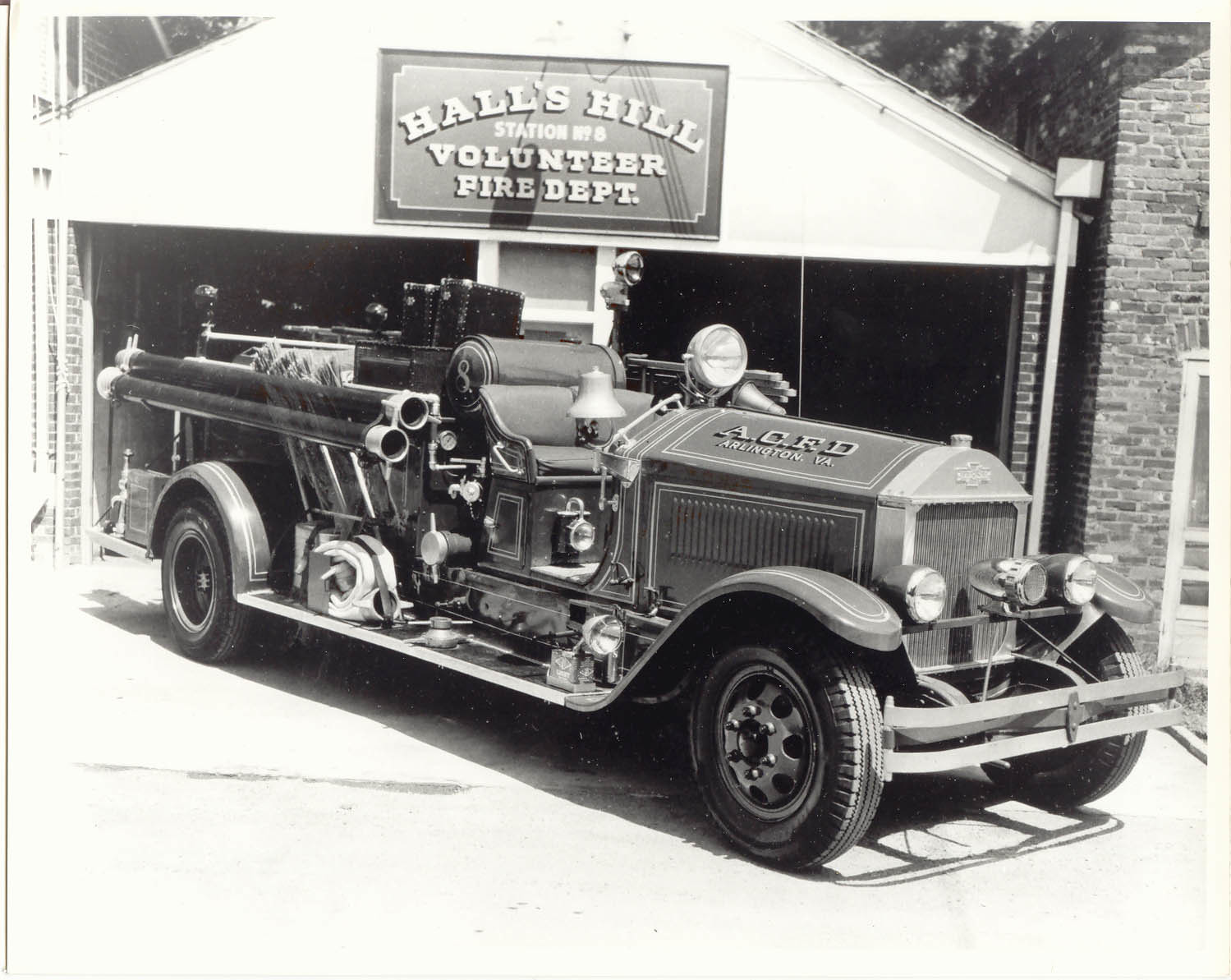
19641398703_2d453b3e75_h

Hall's Hill Pumper

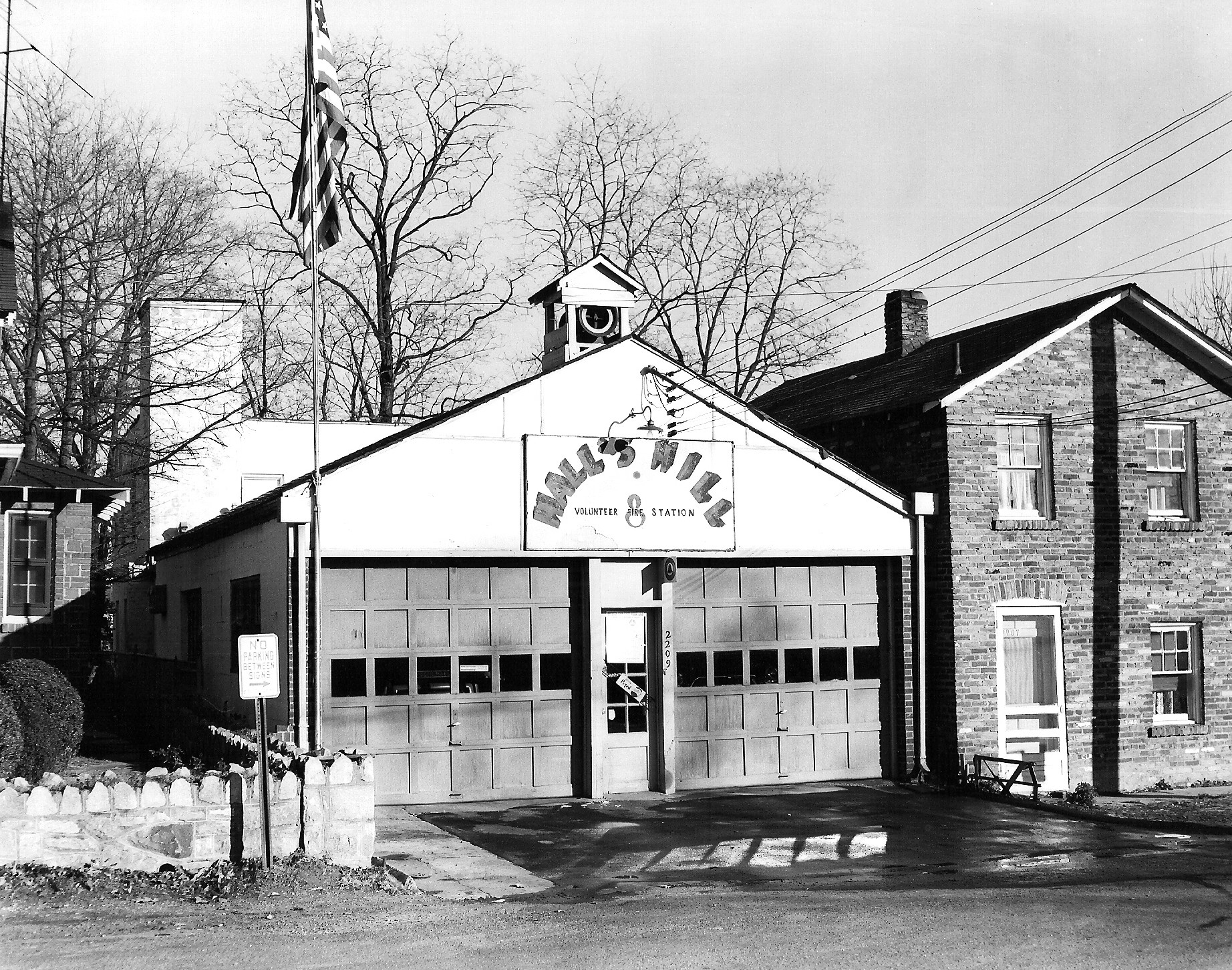
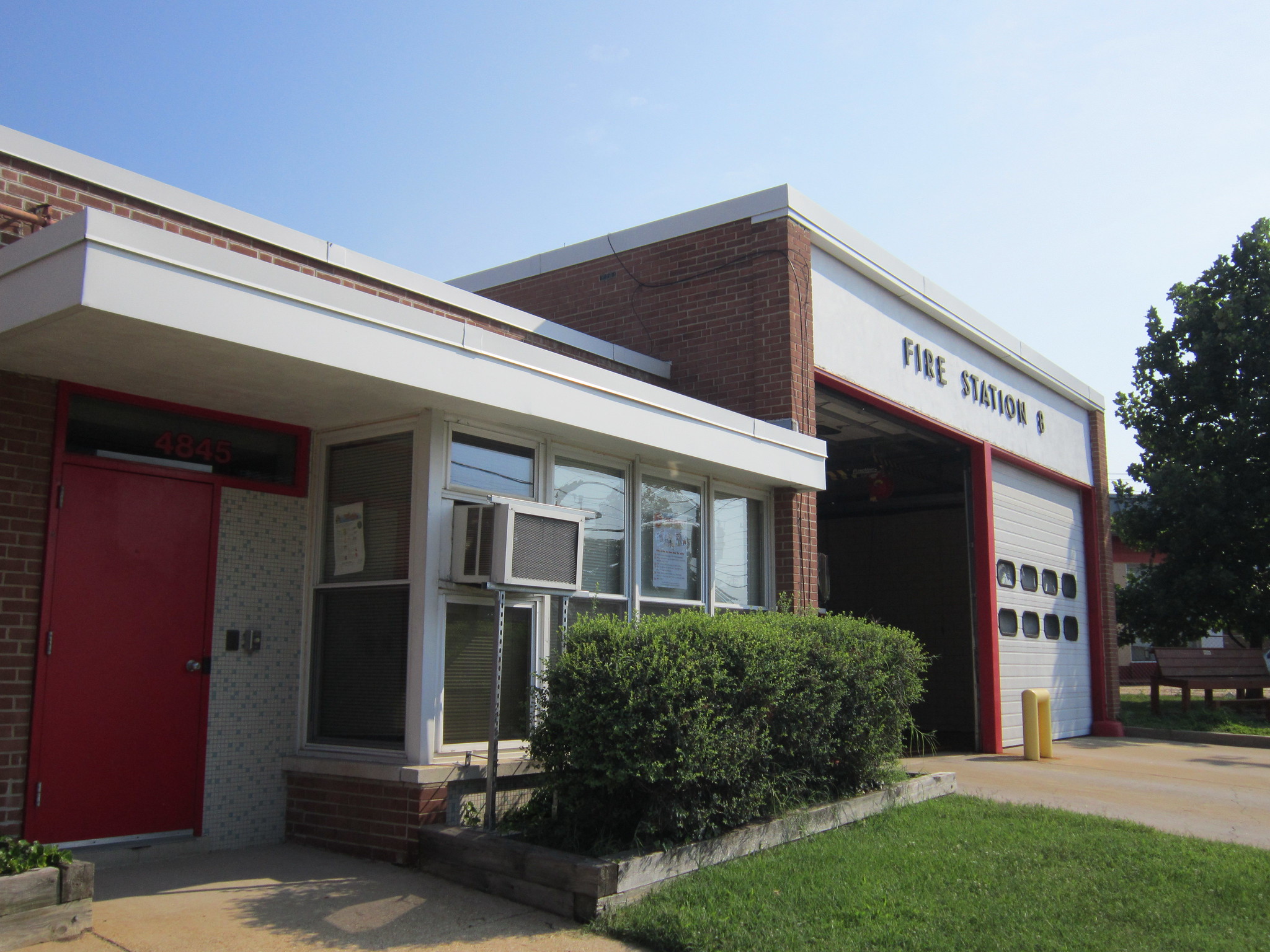
Fire Station #8

With a history that goes back over a century (est. 1918), it’s impossible to overstate the role that Fire Station #8 has played in the lives of the citizens of Hall’s Hill and Arlington County.  Facing underfunding, inadequate and outdated equipment, and institutional and individual prejudice, the firefighters stood up and faced down these and, other challenges, setting an aspirational standard for generations to come.

The following excerpts from an interview with former Fire Dept. #8 firefighter Lt. Hartman Reed depicts the struggles faced at that time:

“What can I say about the vehicles that we had were very old. Now, this is 1952 when I first came on, the fire trucks were a 1928 and a 1932 trucks...I’m not sure we even had a windshield on the thing...They wanted to say that you didn’t have the ability. Being black you didn’t have the ability, the courage, the knowledge...some of the dispatchers were that nasty, I guess you want to say, not to send you (to the fire)...we had a fire in our jurisdiction. We were first do right behind us, somewhere… I wasn’t on the fire, but I knew the other shift rode it - went. We were told when we changed shifts.

They went on the fire and the man’s house was on fire, and wouldn’t let them in. He wouldn’t let anybody in until…the second do company, which was either Falls Church or Cherrydale came in there, and they had to put the fire out.  This man was going to let his house burn down before he let us go into his house. It was that bad.“

20254062042_20dbb0cb4f_k

East Arlington VFD

Further reading:

https://library.arlingtonva.us/2015/08/04/legacy-halls-hill-vfd-and-station-no-8/

https://library.arlingtonva.us/2018/02/27/oral-history-interview-with-firefighter-julian-syphax/

https://arlingtonfirejournal.blogspot.com/2018/02

20074374370_087f698af9_k

Fire Station 8, 2209 Culpeper St

20236125066_d5e4cec400_k

Fire Station 8, 2015

Do you have a question about this story, or a personal experience to share? 

Use this form to send a message to the Charlie Clark Center for Local History.

Center For Local History - Blog Post Message Form

Do you have a question about this story, or a personal experience to share? Use this form to send a message to the Center for Local History.

"*" indicates required fields
This field is for validation purposes and should be left unchanged.

Share Your Story

December 3, 2020 by Web Editor

The Library Director’s 2020 End-of-Year Playlist

Post Published: November 30, 2020

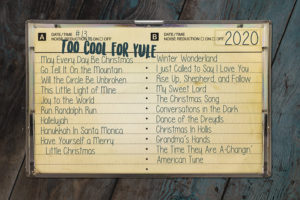
"Too Cool for Yule"

Funky Cassette Tape
Cassette Case Playlist

When I was younger, I made mixtapes for my friends, my siblings, my work colleagues, and often, just for me. For those under 35 who might not have had the experience of methodically pouring over your record and tape collection or waiting patiently by the radio for the replay of that one tune that really captures the essence of the person you are making the tape for, the hours you can spend with your two-slot cassette player are some of the most intimate and lonely, exhilarating and exhausting, optimistic and indulgent, and simply joyful experiences you can have (just ask your parents). Each tape is a story of a person. Some are goofy. Some are sobering. Some are topical. And some are just a hodgepodge of inanity. But each one is special. Every mixtape is a piece of your heart and glimpse of the “you” you are when no one is looking.

For the past 13 years, I have published a “Too Cool for Yule” playlist, as my love letter to the County and the people we serve. And while (sadly) Spotify has replaced the cassette tape, making the process easier, like much of 2020, this playlist was more difficult than ever to create.

How can I truly honor those that have left us too soon, the sacrifices we have all had to make, and the growing uncertainty of what next year will bring? How can I capture both the compassion and caring our neighbors have shown for one another throughout the pandemic, and our fervent wish for brighter days to come? So this was my attempt:

Open playlist in Spotify

From the mournful twang of Pete Seeger to the unbridled joy of Little Richard. With solemnity from the Boston Camerata and the eccentricity of Tom Lehrer, we hope this playlist has something for everyone. If you are alone for the holidays, please know, we are here for you. And let us hit pause for a moment to reflect on the immortal words of John Prine:

No Libra sun, no Halloween
No giving thanks for all the Christmas joy you bring
But what it is, though old so new
To fill your heart like no three words could ever do

I just called to say I love you
I just called to say how much I care
I just called to say I love you
And I mean it from the bottom of my heart

As one of my wise colleagues recently told me, even though many of us cannot celebrate the holidays this year, if we’re lucky, there will be many, many more to come.

Stay safe, stay hopeful.

Diane

Scrawled signature of Diane Kresh

November 30, 2020 by Web Editor Tagged With: yule blog

Oral History: The Arlington Food Assistance Center

Post Published: November 19, 2020

Interviews with Ann Rudd and Andy Lee

Arlington Voices the Oral History Collection

Oral histories are used to understand historical events, actors, and movements from the point of view of real people’s personal experiences.

The Arlington Food Assistance Center (AFAC) was founded in 1988 under the goal of “obtaining and distributing groceries, directly and free of charge, to people living in Arlington, VA, who cannot afford to purchase enough food to meet their basic needs.” Its formal mission statement as of 2020 is “to feed our neighbors in need by providing dignified access to nutritious supplemental groceries.”

Established by a small public-private committee, the organization began distributing food in a Red Cross van, which was purchased at the Capital Area Community Food Bank in Northeast D.C. The group initially delivered to a small, rotating list of families provided by local churches. Its early founders were Anne Rudd, William Knull, and Anna Barber, who had attended Rock Spring Congregational Church together.

AFAC Certificate

AFAC's Certificate of Incorporation, June 30, 1988.

After over a year of operating out of the van, the First Baptist Church of Clarendon offered AFAC its first fixed operating site, increasing the number of clients the organization could serve. In 1992, AFAC acquired its own full-time operating site at 2900 North Washington Boulevard. The organization moved to its current headquarters at 2708 S. Nelson Street in June 1997 to accommodate its growing operation. More than 30 years after its founding, AFAC now serves more than 3,000 families per month.

In these oral history interviews, founder Anne Rudd and longtime AFAC volunteer Andy Lee describe the early days of AFAC and how the organization grew to become a cornerstone of the Arlington community.

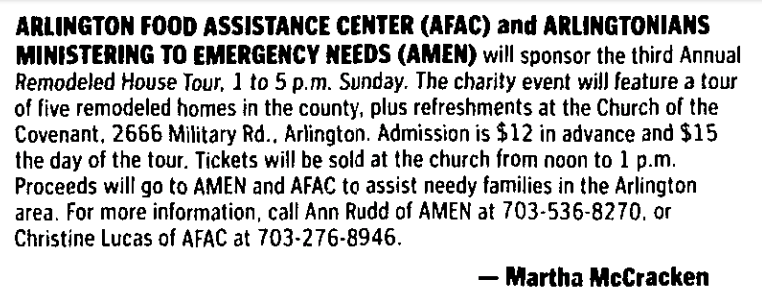
AFAC News Clipping

Example of a fundraising effort held by AFAC, advertised in the Washington Post, October  12, 2000. Image courtesy of the Washington Post.

Narrator: Ann Rudd
Interviewer: Michelle Jones
Date: November 20, 2013

https://library.arlingtonva.us/wp-content/uploads/2020/11/Rudd_Ann_20131120.mp3

Michelle Jones: And how do you really get started? That’s a large—that’s a large job to accomplish.

Ann Rudd: Well I know that they started out—they were using the churches for storage of food.

MJ: Oh.

AR: They were—they used the Baptist church in Clarendon. And they used the Unitarian church and they used Little Falls Presbyterian.

MJ: And what you—

AR: They were sites where people picked up food. Twenty-five years ago was what? Something around three sites.

MJ: So this is around 1988?

AR: Yes. Yeah, so it’s been twenty-five years.

MJ: Okay. So um—Well how did you get—information out to the community?

AR: Well they worked through the county with the Department of Human Services, churches, and community organizations, you had to be referred-you could get food the first time.

MJ: Is that how you received funds? Or how—

AR: No!

MJ: — how did you get started and find a place and—? (speaking at same time)

AR: They did not—they just started calling churches to find a place. As for the money, it was donations. People donated food.

MJ: And what was your involvement in getting all of this going? Were you more on the ground trying to get donations and actual goods or—

AR: I think I was more-or-less contacting churches to see if they would let us set up there. So I think it was those three churches, but it was mainly on the Baptist church when Clarendon was the main place. And it was only open on Saturday morning.

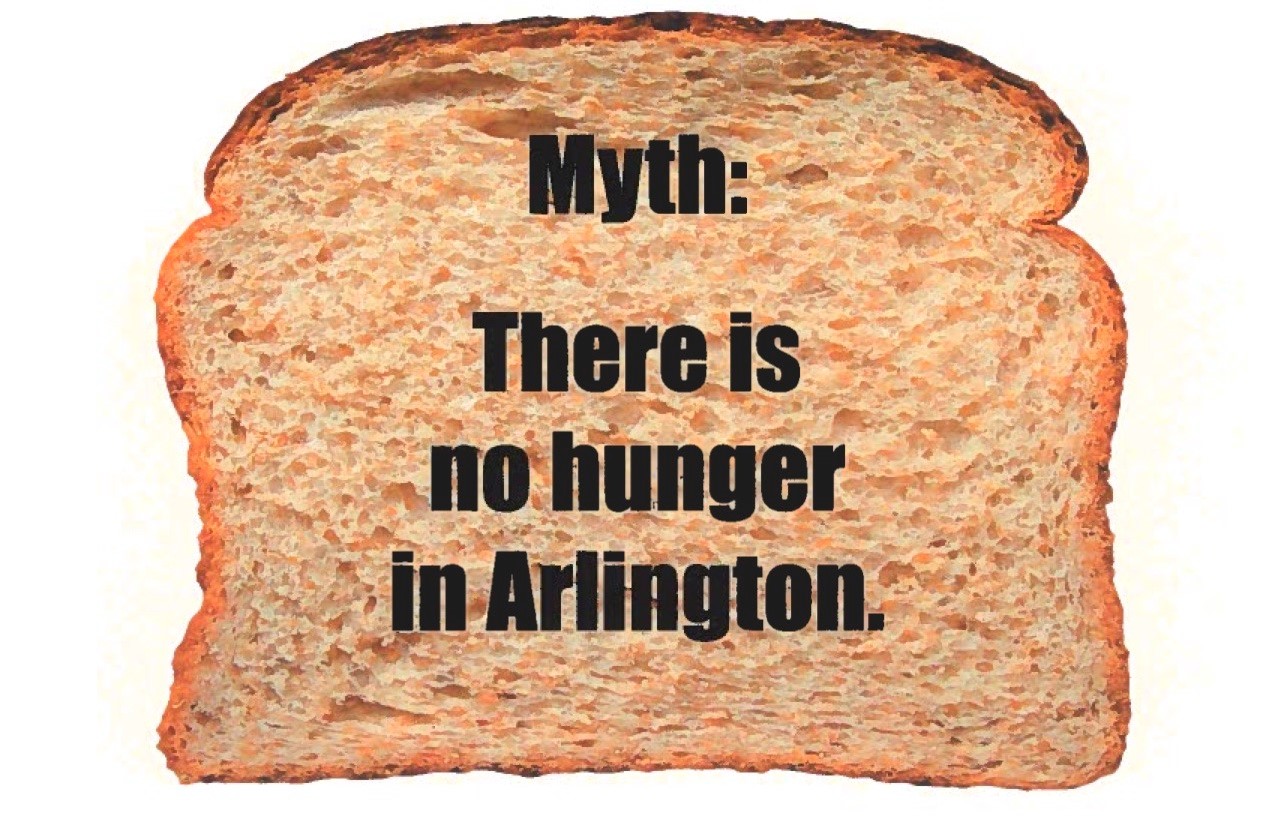
AFAC Info Myth 1
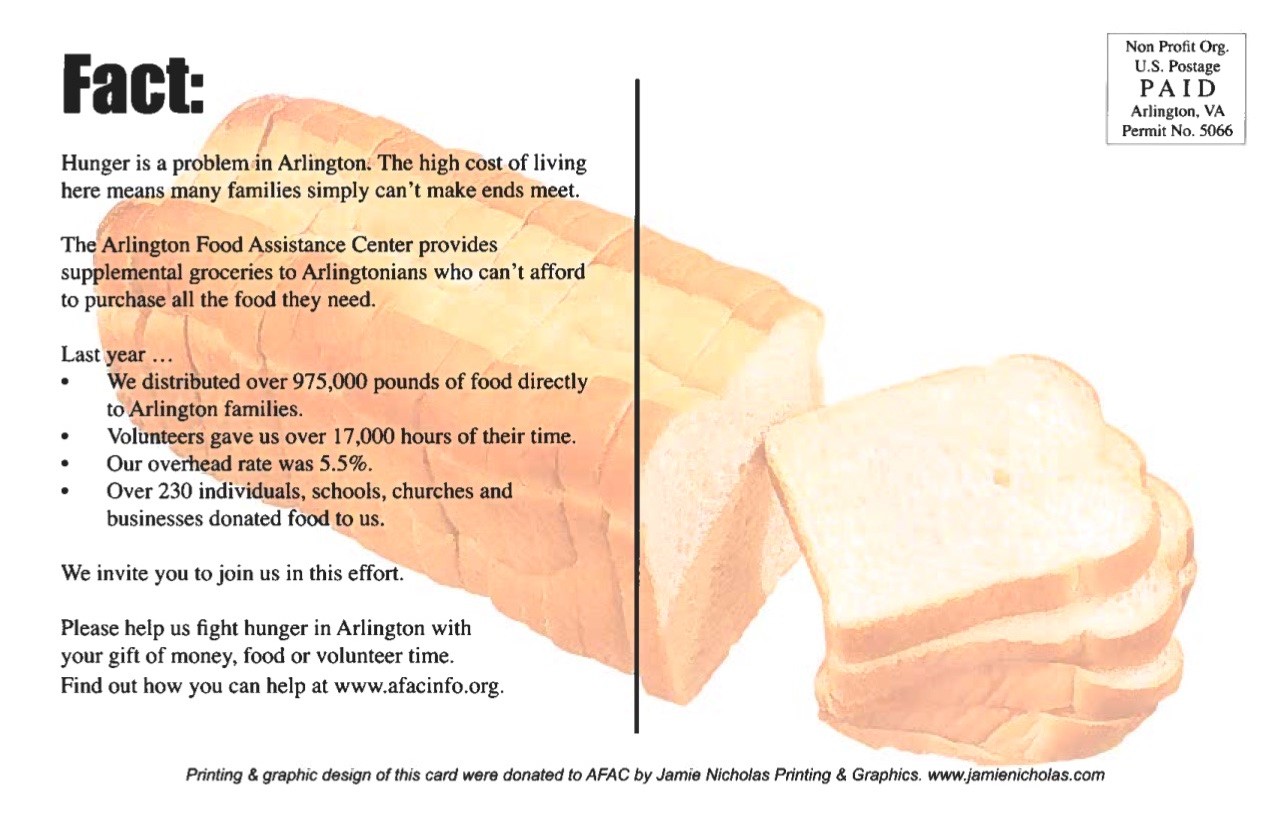
AFAC Info Myth 2

AFAC informational mailer distributed to community members.

Narrator: Andrew “Andy” Lee
Interviewer: Anne Webb
Date: September 30, 2013

https://library.arlingtonva.us/wp-content/uploads/2020/11/Lee_Andy-1.mp3

Anne Webb: So—what—but you started volunteering when AFAC was still rather small and you’ve seen it grow exponentially. Tell me about your role in all those changes.

Andy Lee: Absolutely. Sure. When I first started volunteering we were serving —serving I think around 70 families per week.

AW: Um-hm (affirmative)

AL: We had one bagging on Friday night and then one distribution on Saturday morning. AFAC was housed in the basement of what was then, Clarendon Baptist Church, and subsequently, as we grew and hired our first staff, we needed office space so Bill Knull at the time, who was president of the board, found a location at 10th and Washington which was at the time we found it, it was being used as a motorcycle repair shop, so it was an absolute mess. … We remained there for several years and then the vision was that we need to expand further as our client load increased and we also need to be closer to our clients. Being in Clarendon the majority of our clients at the time were in Arna Valley, which no longer exists as far as low-income housing but that’s where a lot of our clients were, as well as in the Columbia Pike corridor.

So, we found a location in Shirlington working with real estate agents, Bill Knull primarily, looking at different sites and the current location on South Nelson Street, proved to be for the most part meeting the majority of our needs and so we moved in there I believe in 1996 or 1997 timeframe after some reconstruction of the infrastructure of the building and we’ve been there ever since.

In an addition, we had two primary satellite distribution sites, Clarendon Methodist Church as well as the Gunston Community Center while I was on the board. That has since expanded to multiple different locations, you know we are doing outbound. But at the time South Nelson Street was our primary location as well as the two satellite sites that we had.

As far as the client loads, as I said, when I started, we were about 70 families a week. I think at the peak last year we were around 1,600 families per week on average. I think it’s down now a little bit. But it’s still very high compared to what it used to be.

AFAC Logo 2020

The AFAC logo as of 2020. Image courtesy of AFAC.

These interviews are available at the Center for Local History. Oral history interviews with Fred Jones, Robert Gallagher, Roberta, and John Overholt, and Ed Nolan also detail the history and work of AFAC.

Want to learn more? Record Group 313 in the Center for Local History also holds documents from and related to AFAC dating from 1948 to 2018

The goal of the Arlington Voices project is to showcase the Center for Local History’s oral history collection in a publicly accessible and shareable way.

The Arlington Public Library began collecting oral histories of long-time residents in the 1970s, and since then the scope of the collection has expanded to capture the diverse voices of Arlington’s community. In 2016, staff members and volunteers recorded many additional hours of interviews, building the collection to 575 catalogued oral histories.

To browse our list of narrators indexed by interview subject, check out our community archive. To read a full transcript of an interview, visit the Center for Local History located at Central Library.

November 19, 2020 by Web Editor

Charles Rinker: Speaking Out

Post Published: November 12, 2020

A Tireless Proponent for Fair and Affordable Housing

Graphic image of a megaphone

Join us for a new series of stories from the Center for Local History highlighting members of our community who made a difference in ways that helped shape our history and created positive change. 

Their voices were not always loud, but what they said or did had a significant impact on our community.

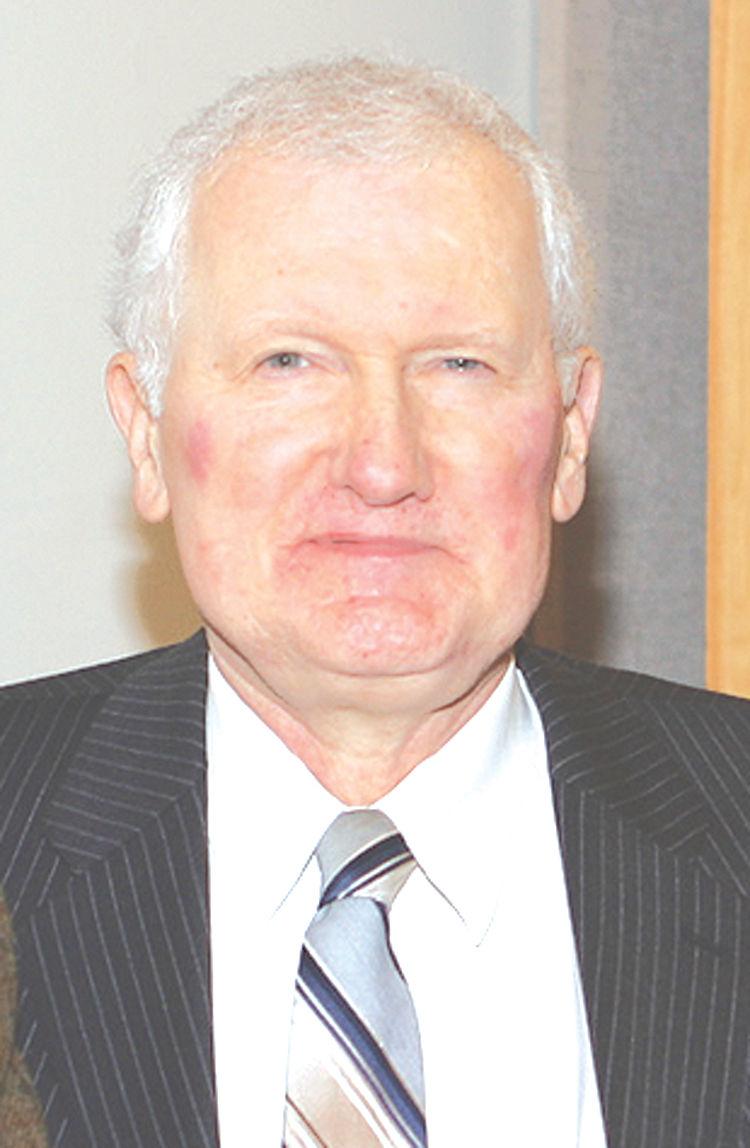
Charles Rinker

Charles Rinker (1940-2015) was a tireless proponent for fair and affordable housing in Arlington County. His reach also extended to Alexandria, Falls Church, and Fairfax County in Virginia as well as Montgomery County and Baltimore in Maryland.

Rinker_Pic

His ability to meld economic savvy with public advocacy and popular sentiment made him a powerful and highly effective presence in organizations he helped found and establish such as AHC, Inc. (Arlington Housing Corp.), Arlington New Directions Coalition, A-HOME (Arlington Home Ownership Made Easier), TOAC (Tenants of Arlington County) and BRAVO (Buyer and Renters Arlington Voice).

Never reluctant to confront institutional resistance, Rinker’s ethos could perhaps best be summarized by his statements:

“If private profit is made in such a way as it deprives others in the society of the necessities of life—food, shelter, clothing, health, etc.—then it’s wrong, no matter what face one tries to put on it.”

“Ultimately we need more than the criticism of friends and neighbors to deter the displacement of low-and-moderate income households…but moral indignation from the community would be a good start.”

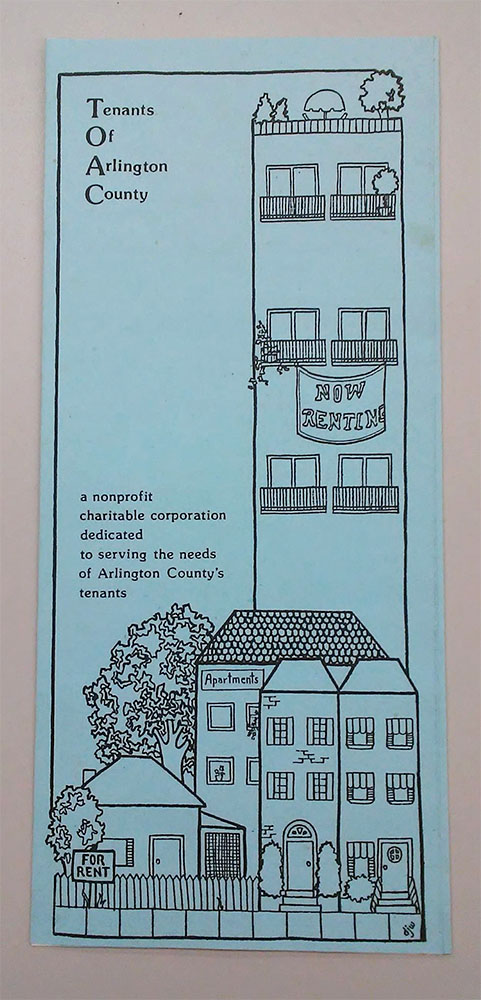
Tenants Rights pamphlet

TOAC (Tenants of Arlington County) pamphlet

Do you have a question about this story, or a personal experience to share? 

Use this form to send a message to the Charlie Clark Center for Local History.

Center For Local History - Blog Post Message Form

Do you have a question about this story, or a personal experience to share? Use this form to send a message to the Center for Local History.

"*" indicates required fields
This field is for validation purposes and should be left unchanged.

Share Your Story

November 12, 2020 by Web Editor

Voting in Arlington: Then & Now

Post Published: October 29, 2020

November 3 is fast approaching and voting this year has taken an unprecedented turn in the wake of the pandemic, with thousands of Arlingtonians voting early or sending in absentee ballots. The voting process in Arlington and beyond has historically been anything but static – here’s a look at how the voting process has changed over the years.

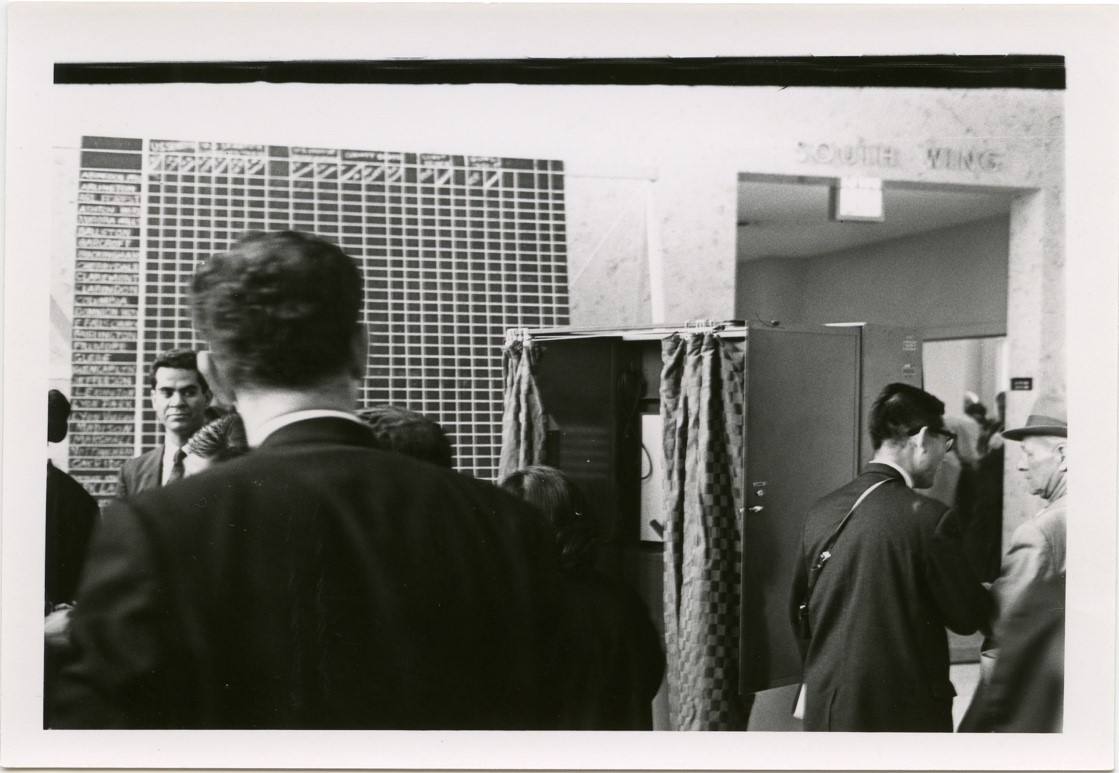
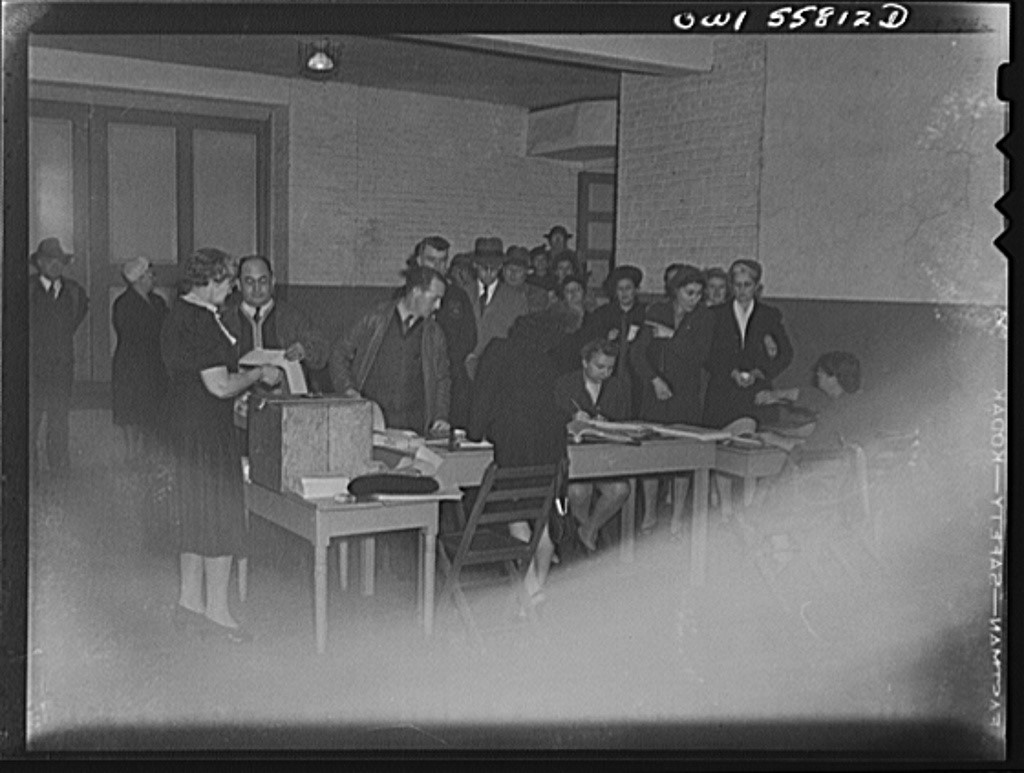
People Standing Around

“People standing around a voting booth,” Arlington County, 1968. PG 214

Vote Sign

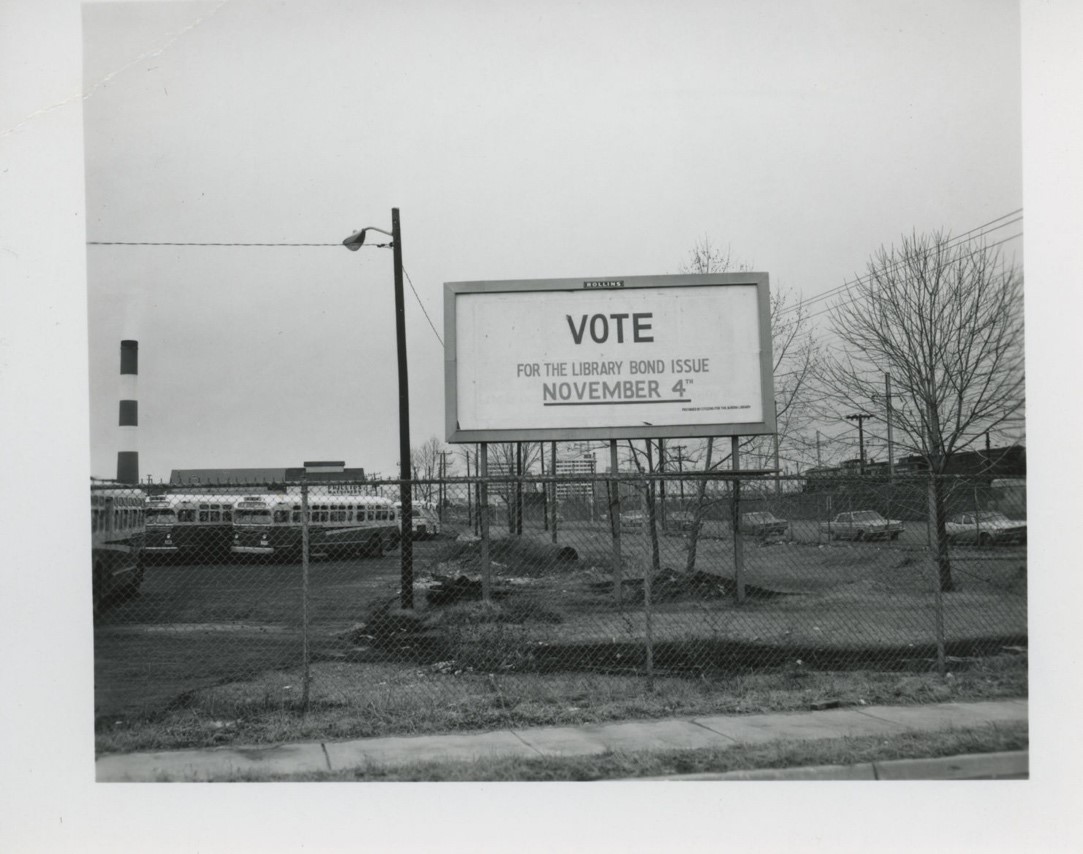
Sign that says “Vote for the Library Bond, November 4.” Arlington County, 1959. RG 29

Arlington’s First Elections

According to historian C.B. Rose, no one living in what is now Arlington would have been able to vote until these early settlements were incorporated around 1645. Voting likely increased when the land of present-day Arlington was established as Fairfax County and received its own Court House in the town of Alexandria in 1752. At this point in time, all voting had to take place at a Court House, which limited eligible voters who lived far away from these buildings.

The first American elections were conducted by voice vote, or with paper ballots also known as “party tickets.” Unlike the “Australian” or “blanket ballots” that were used in the latter half of the 19th century, these early ballots only carried the name of candidates from a single party. These ballots would then be counted by local party and election officials.

In 1869, a change to the Constitution meant that “secret” ballots were now required and required voters to register prior to elections. A registrar was assigned for 1,000 voters along with an accompanying polling place – an early version of the precinct system.

The Struggle for Women’s Suffrage

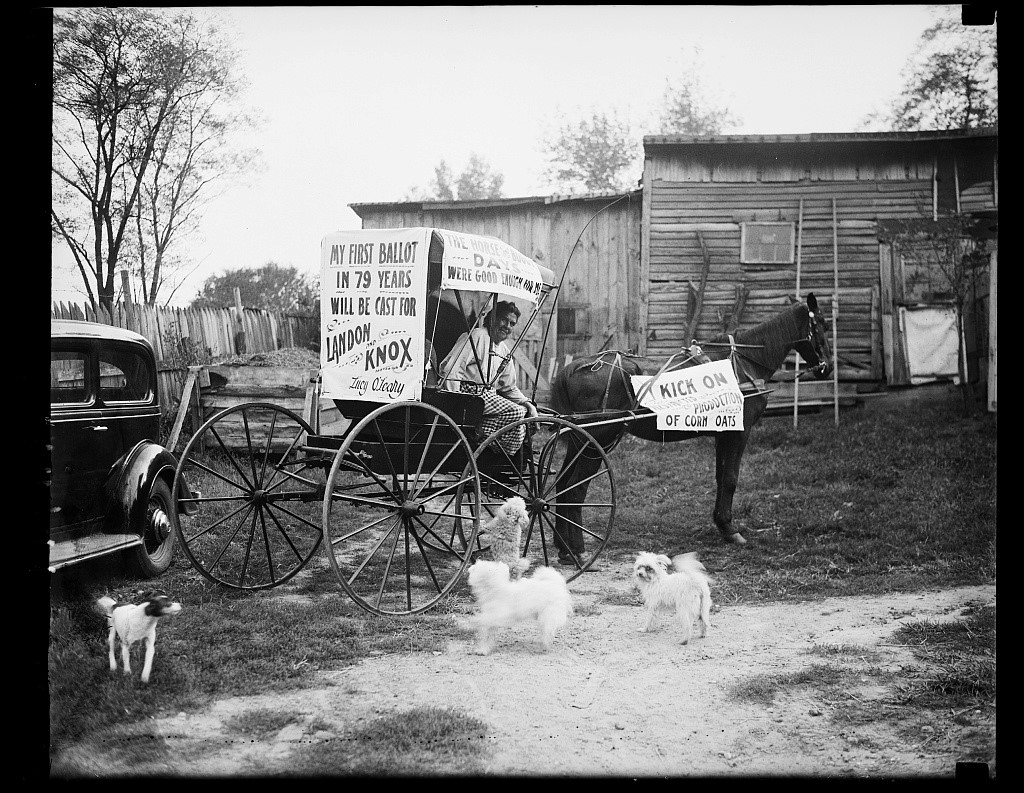
Voting for First Time at 79

“Votes for first time at 79. Arlington, VA, Oct. 15. This is Mrs. O'Leary (not the Mrs. O'Leary who kissed the cow who kicked over the lantern to start the Chicago fire) but Mrs. Lucy O'Leary of this town who will cast her first vote on November 3 at age 79, for Gov. Landon. She now lives on small government pension with the aid of a small garden.” Arlington County, October 15, 1936. Image courtesy of the Library of Congress.

In these early elections, only a fraction of the population was permitted to vote, initially granting the right solely to propertied white men. Because of these limitations, throughout the 19th and 20th centuries, women’s suffrage was a major reform issue nationwide.

Gertrude Crocker was among those on the front lines fighting for women’s right to vote, and would later become a prominent Arlington citizen, owning and operating the Little Tea House. Crocker was among the “Silent Sentinels,” who, on January 10, 1917, participated in the first picket protest outside of the White House.

The 19th Amendment was adopted on August 18, 1920, after decades of advocacy. But after the milestone of women’s suffrage came another portion of the journey for equal voting rights for all. Though women had achieved the right to vote, large portions of the country’s non-white population were still disenfranchised.

Read our series on important figures and events leading up to the passage of the 19th Amendment.

Election

“Citizens at the Wilson High School waiting to vote in the national presidential election. The election started at 7:45 a.m., and a continuous stream of people, mostly men, came in. The women came later in the day.” Arlington County, November 7, 1944. Image courtesy of the Library of Congress.

Fighting Discrimination and Voter Suppression

Though the legal milestones of the 15th and 19th were achieved, in practice, African American voters faced innumerable barriers to voting – from Jim Crow laws, voter suppression tactics, and overt violence.

Shortly after the passage of the 15th amendment, Virginia instituted a poll tax to restrict African American men from voting in 1876. This law was repealed in 1882, but in 1901 the state’s General Assembly called for a new constitution granted suffrage solely to white men.

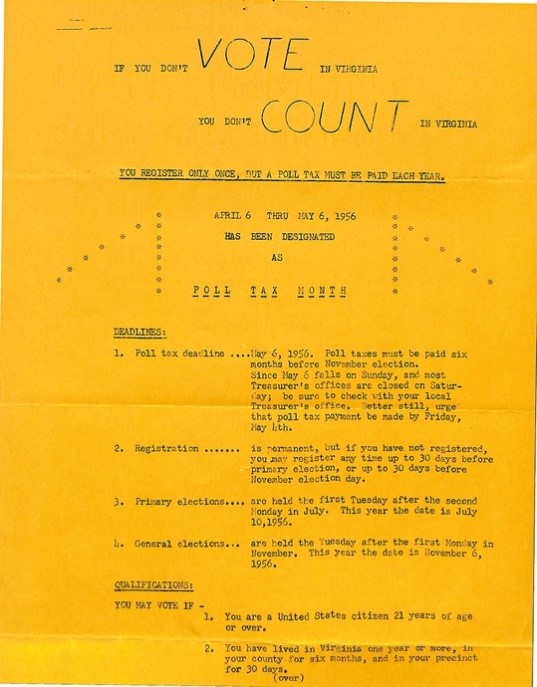
A new constitution passed in 1902 and required voters to pay a tax of $1.50 six months prior to an election for each of the three years preceding an election. This disenfranchised approximately 90% of the state’s African American voting population and nearly 50% of the white men who had previously been registered to vote in Virginia. The 1902 constitution also created an administrative structure that was difficult for any average citizen to navigate. Virginia maintained poll taxes until 1966.

Read more about voter suppression and how local activists responded to these policies in Arlington in “If You Don’t Vote, You Don’t Count”

Local activists and groups such as the Arlington chapter of the NAACP worked tirelessly to combat voter suppression, instituting outreach campaigns and legal challenges to the poll tax. In a suit from Arlingtonian Portia Haskins against the Virginia Board of Elections and the Arlington County general registrar, the court ruled in her favor in 1966, determining that “[t]he provisions of Virginia’s dual voter registration…which treat persons who are registered only for federal elections differently from persons registered for all elections violate the equal protection laws of the 14th Amendment.”

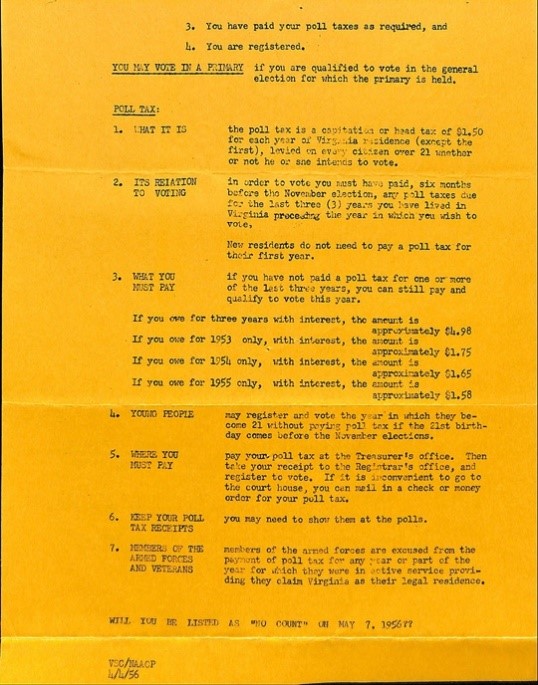
Poll Tax 1
Poll Tax 2

Poll Tax Month: a 1956 Virginia Poll Tax Flyer created by the NAACP, explaining what the poll tax was and how it related to being able to vote in both local and federal elections. View item information in Project DAPS.

The Modern Age of Voting

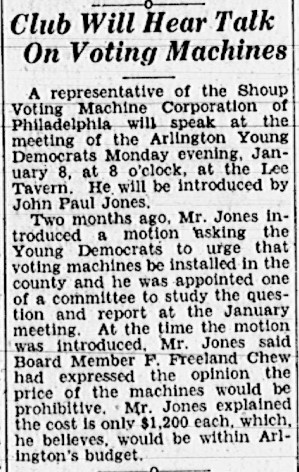
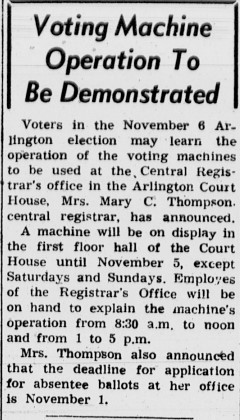
The last century has also seen technological developments in how we place our votes. From paper ballots, voting machines were introduced in the mid-20th century to modernize the voting process. Today, further developments, such as digital scanners introduced in 2015, continue to streamline how we vote and how our votes are counted.

Arlington County has also seen incredible growth from its humble electoral beginnings. The County now has 54 voter precincts and accompanying polling places. Almost every aspect of voting has changed in the centuries since the County’s beginnings: from who had the right to vote, to how voting was carried out. Be sure to cast your ballot on November 3!

Voting Machine

An early mention of the use of voting machines in Arlington. From the Northern Virginia Sun, January 5, 1940.

Voting Machine Demo

An early opportunity for voter to try out a voting machine. From the Northern Virginia Sun, October 18, 1951.

For more information on the history of Arlington voting, see the Arlington Historical Society’s Virtual Exhibit: A Short History of Voting in Arlington.

Election day 2020 is on November 3! Early voting will be taking place until October 31, and all mail-in ballots must be postmarked by November 3 or returned in person by November 3 at 7 p.m. Ballot drop-offs are available throughout the County. Information about in-person voting locations and other voter information in Arlington can be found through the County’s elections website.

To learn more about Arlington's history, visit the Center for Local History on the first floor of the Central Library.

Do you have a question about this story, or a personal experience to share? 

Use this form to send a message to the Center for Local History.

Center For Local History - Blog Post Message Form

Do you have a question about this story, or a personal experience to share? Use this form to send a message to the Center for Local History.

"*" indicates required fields
This field is for validation purposes and should be left unchanged.

Share Your Story

October 29, 2020 by Web Editor

Portia Haskins: Taking a Stand

Post Published: October 22, 2020

Graphic image of a megaphone

Join us for a new series of stories from the Center for Local History highlighting members of our community who made a difference in ways that helped shape our history and created positive change. 

Their voices were not always loud, but what they said or did had a significant impact on our community.

Portia Haskins

In 1965, Hall’s Hill/High View Park resident Portia Haskins filed suit against the Virginia Board of Elections and the Arlington County general registrar after learning she was required to re-register in order to vote in the upcoming election, despite having already paid her poll taxes in February and having registered for federal elections the previous year.

On April 1, 1966, in the case Portia A. Haskins v. Levin Nock Davis et al., a Federal District Court ruled in Haskins’ favor arguing that “[t]he provisions of Virginia’s dual voter registration…which treat persons who are registered only for federal elections differently from persons registered for all elections violate the equal protection laws of the 14th Amendment.” This landmark decision eliminated what was essentially a selectively administered and enforced poll tax imposed chiefly on African-American voters in Arlington County.

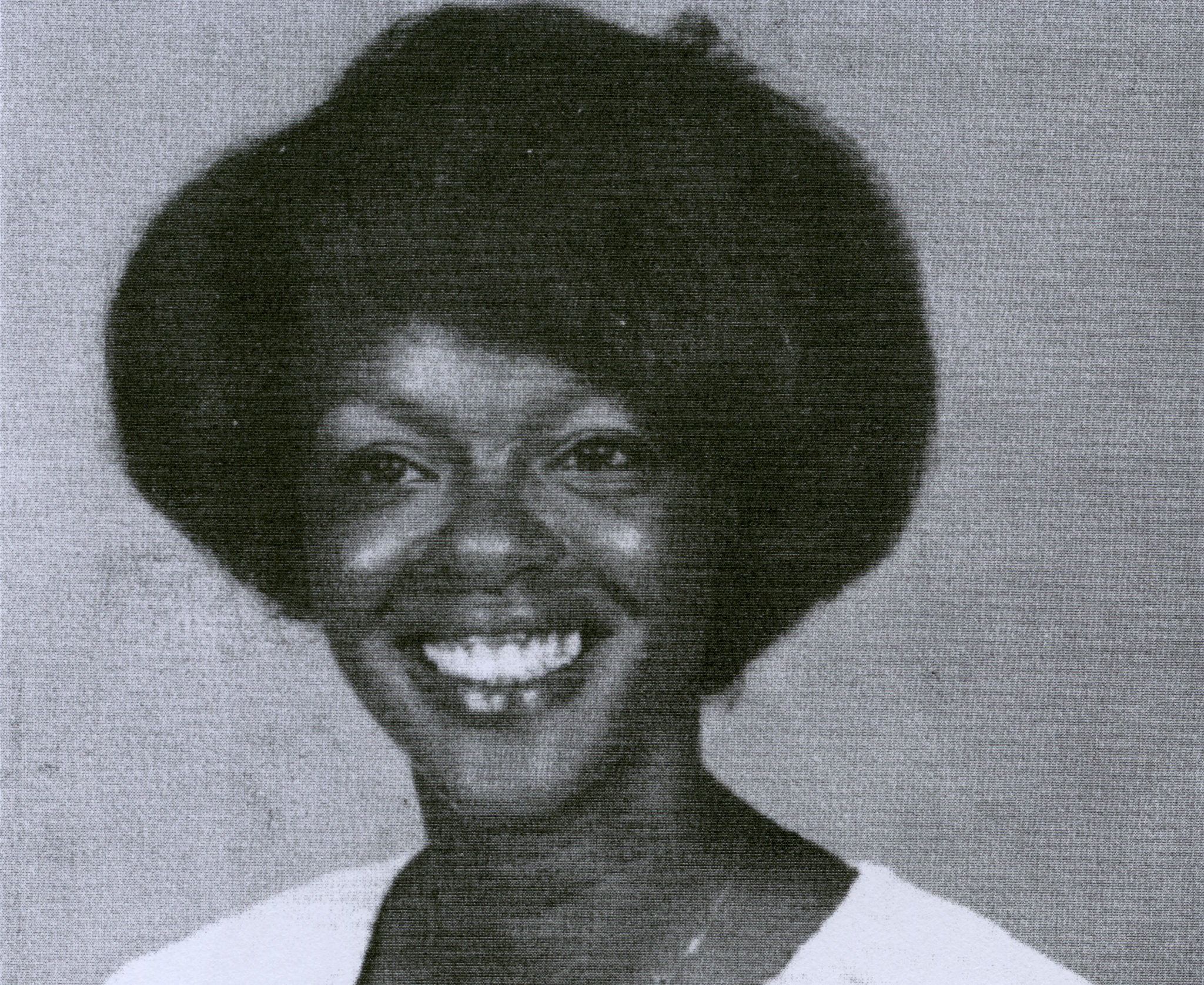
PortiaHaskins

Photograph of Portia Haskins. Date of Photo Unknown.

Recent events have shown that progress is a process and part of an ongoing struggle.  Accomplishments both great and small are seldom an endpoint but are a constant series of steps forward which cannot be taken for granted.

Portia Haskins has recently completed and published a book on the history of Mt. Salvation Baptist Church.

Do you have a question about this story, or a personal experience to share? 

Use this form to send a message to the Charlie Clark Center for Local History.

Center For Local History - Blog Post Message Form

Do you have a question about this story, or a personal experience to share? Use this form to send a message to the Center for Local History.

"*" indicates required fields
This field is for validation purposes and should be left unchanged.

Share Your Story

October 22, 2020 by Web Editor

Dr. Roland Bruner: Taking a Stand

Post Published: October 12, 2020

"He provided free medical services to the most disadvantaged in Arlington..."

Graphic image of a megaphone

Join us for a new series of stories from the Center for Local History highlighting members of our community who made a difference in ways that helped shape our history and created positive change. 

Their voices were not always loud, but what they said or did had a significant impact on our community.

Dr. Roland Bruner

Dr. Roland Herman Bruner (1902-1978) was an obstetrician, lecturer, and the first African-American doctor to be hired by Arlington County’s Department of Health’s Prenatal Clinic in a time of bigotry, racism, and segregation.

Bruner received a Bachelor of Science degree from Howard University in 1928 and a Medical Degree in 1932. One of just 24 students to receive the offer of an internship at Freedmen’s Hospital in Washington D.C., he joined the staff thereafter completing his internship.

On July 29, 1934, Bruner and his wife Georgia purchased a property in Green Valley/Nauck at 2018 S. Glebe Rd. where he opened a private practice specializing in obstetrics. This allowed African-American women to deliver children in Arlington rather than having to travel to the Freedmen’s Hospital in the District of Columbia. He bartered with patients and often provided free services to the most disadvantaged, even delivering babies at the homes of people turned away by a segregated medical establishment.

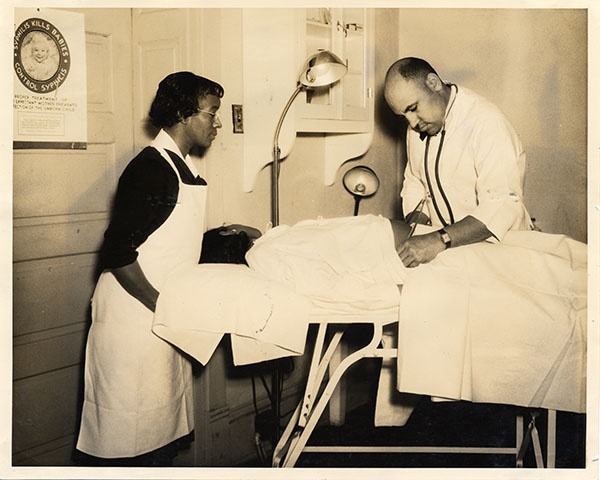
Dr. Bruner examines a patient while a nurse assists.

Dr. Bruner and a nurse perform an obstetrics exam for a patient at the Arlington County Department of Health, 1938. Image had the caption "Prenatal Clinic" under it in the 1938 Rural Health Conservation Scrapbook. Photo Source: RG 21, Records of the Arlington County Department of Health: 21-1-"1938"-9

In 1935 Bruner became a part-time member of the clinical faculty of Howard University College of Medicine, where he would serve until 1951. He became a notable lecturer in the fields of women’s health and prenatal care and in 1938 he became the first African-American doctor employed by Arlington County’s Department of Health’s Prenatal Clinic. Bruner also played a vital role in the establishment of a Planned Parenthood clinic in Arlington. With a private practice spanning 45 years from 1933-1978, Dr. Roland Herman Bruner served multiple generations in his community.

In 2001, Arlington Housing Corporation (AHC) purchased Dr. Bruner’s home from the Bruner family, renovating the property into a development comprising 7 townhomes known as Bruner Place. The home was relocated on the property.

Bruner's daughter, Dr. Denise E. Bruner, is a practicing physician in Arlington County specializing in bariatrics and anti-aging.

Do you have a question about this story, or a personal experience to share? 

Use this form to send a message to the Charlie Clark Center for Local History.

Center For Local History - Blog Post Message Form

Do you have a question about this story, or a personal experience to share? Use this form to send a message to the Center for Local History.

"*" indicates required fields
This field is for validation purposes and should be left unchanged.

Share Your Story

October 12, 2020 by Web Editor Tagged With: Green Valley

  • « Go to Previous Page
  • Page 1
  • Interim pages omitted …
  • Page 4
  • Page 5
  • Page 6
  • Page 7
  • Page 8
  • Interim pages omitted …
  • Page 40
  • Go to Next Page »

Footer

About Us

  • Mission & Vision
  • Charlie Clark Center for Local History
  • News Room
  • Get Email Updates

Administration

  • Policies
  • Library Staff
  • Job Opportunities
  • Propose a Program or Partnership

Support Your Library

  • Friends of the Library
  • Giving Opportunities
  • Donating Materials
  • Volunteer Opportunities

Our Mission

We champion the power of stories, information and ideas.

We create space for culture and connection.

We embrace inclusion and diverse points of view.


Download the Library App

Download the Library App

Arlington County | Terms & Conditions | Accessibility | Site Map
· Copyright © 2026 Arlington County Government ·