• Skip to primary navigation
  • Skip to main content
  • Skip to footer

Alert

Holiday: All library locations closed Fri., June 19, for Juneteenth. More Info

Alert

Update: Elevator outages, maintenance and upgrades at Central Library More Info

Alert

Storytimes Will “Take a Nap” through June 20 More Info

Home - Arlington County Virginia - Logo
MENUMENU
  • Join Now
  • My Account
    • Login
    • My Checkouts
    • My Holds
    • My Lists
    • My Reading History
    • About Borrowing
    • About Holds
    • About My Account
  • Hours & Locations
    • All Hours & Locations
    • Holiday Closings
  • News
    • Library News
    • Director's Blog
    • Get Email Updates
  • Contact Us

Arlington Public Library

MENUMENU
  • Search
  • Collections
  • Library Services
  • Events
  • Community Engagement
  • Join Now
  • My Account
    • Login
    • About Borrowing
    • About Holds
    • About My Account
  • Hours & Locations
    • All Hours & Locations
    • Holiday Closings
  • News
    • Library Blog
    • Get Email Updates
  • Contact Us

Web Editor

On This Day in LGBTQIA+ History

Post Published: June 1, 2018

Pride Month is celebrated each year in June, to recognize the impact that lesbian, gay, bisexual and transgender individuals have had on our history - locally, nationally, and internationally.

Each day this month, we will share a new person or event that happened on that date in history, related to LGBTQIA+ history.

June 2
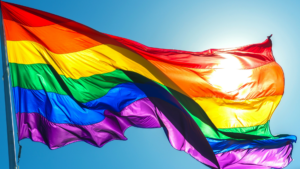
rainbow flag

On this day in 1951, Gilbert Baker, designer of the rainbow pride flag, was born. The original rainbow flag was unveiled at San Francisco Pride in 1978, with colors intended to reflect the diversity of the LGBT community. In 2015, the Museum of Modern Art ranked the rainbow flag as an internationally recognized symbol as important as the recycling symbol.

Learn more in "Pride: The Story of Harvey Milk and the Rainbow Flag."
Read More Each Day on the Library Website

June 1, 2018 by Web Editor

Nguyen Ngoc Bich: Vietnamese Community Leader

Post Published: May 17, 2018

May 17, 2018 by Web Editor

Oral History: Interview with Nguyen Ngoc Bich

Post Published: May 7, 2018

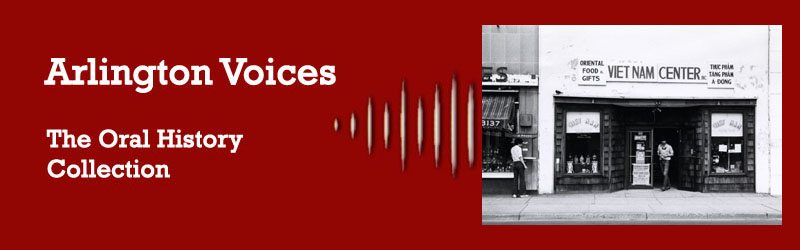
Vietnam Center Photo

Vietnamese Community Leader

In recognition of Asian and Pacific Island American Heritage Month, for May we are sharing community leader Nguyeb Ngoc Bich's oral history describing the Vietnamese refugee community in Arlington from roughly 1975 to 1980.

During that 5-year period, the U.S. population of Vietnamese immigrants - many of whom were refugees - had grown from 15,000 to 245,000. At the same time, the Clarendon neighborhood was transformed from a declining shopping destination to a supportive and bustling enclave, brimming with stores that provided both imported goods and a sense of community for Vietnamese-Americans. This area became known informally as “Little Saigon.”

But as construction on the Metro was completed and leases expired, Vietnamese business owners moved west to the Eden Center in Falls Church. This move was spearheaded by Nguyen Ngoc Bich, who had first come to the U.S. in the 1950s as a student.

In this clip, Mr. Bich describes the economic and social contexts of the rise of Little Saigon.

NARRATOR: Nguyen Ngoc Bich
INTERVIEWER: Andrea Dono
DATE: November 9, 2014

Transcript:

AD: Did you call it Little Saigon, or did you have another name for that area?

NNB:
Little Saigon. Well, because before April 1975 the whole Vietnamese community in the Washington area was probably no more than about 3,000 people. But nonetheless, these three thousand people became the anchor for family. For instance, our family became the anchor for trying to resettle these twenty-some people that we brought from Vietnam and so on and so forth. Because of the fall of South Vietnam the embassy had to close. Then these people also have to find some way to make a living, and so a secretary there at the Embassy of Vietnam, her name is Zu Mak Zu (?), she was the very first one to open what you call the Saigon Market on Wilson Boulevard in the Clarendon area.
I think we were sort of lucky in a sense at the time. They were talking about building the Metro, and so they tore down a lot of things in the Clarendon area, and so the real estate became very, very cheap. Many of the major American establishments moved out. And because of that some of this real estate became available for very cheap. But they gave you a very short contract, like six months or one quarter.

AD: Were most of the buildings in that Little Saigon area mostly commercial, or were there some social services as well?

NNB: No, mostly commercial because the social services for the refugees tend to be run out of American establishments like the US CC, US Catholic Conference, the Catholic university or the Lutheran Services that are on 16th Street. In fact, the Lutheran Services is only three blocks away from the Vietnamese Buddhist temple up there. While most of the things are here, businesses, restaurants, tailor shop, photo shop, jewelry store, bridal things, we had all that. We all congregated around the Clarendon area. At one point we might have—I don’t think maybe 100, probably not 100, easily 70 or 80 establishments that catered to Vietnamese customers. And so a trip to Clarendon gets you not only to go and get what you need but also run into a lot of friends, new friends that we make, and that became the core of the community in this area.

You can find Nguyen Ngoc Bich’s interview in its entirety in the Center for Local History - VA 975.5295 A7243oh ser.12 no.1. Photo: Vietnam Center Clarendon, Source: Photographs of the Arlington Historical Society, PG 230-1096


The goal of the Arlington Voices project is to showcase the Center for Local History’s oral history collection in a publicly accessible and shareable way.

From June 2017 – May 2018, we will post one oral history clip and transcript each month, focusing on Arlington’s history, culture and identity.

What is the oral history collection?

Oral history is a popular method of research used for understanding historical events, actors, and movements from the point of view of people’s personal experiences.

The Arlington Public Library began collecting oral histories of long-time residents in the 1970s, and since then the scope of the collection has expanded to capture the diverse voices of Arlington’s community. In 2016, staff members and volunteers recorded many additional hours of interviews, building the collection to 575 catalogued oral histories.

To browse our list of narrators indexed by interview subject, check out our community archive. To read a full transcript of an interview, visit the Center for Local History located at Central Library.

May 7, 2018 by Web Editor Tagged With: Oral History

Ellen Bozman – A Civic Leader Dedicated to the Community She Loved

Post Published: April 26, 2018

Role Model - Visionary - Trailblazer

On Saturday, April 28, the Arlington County Board will hold a a dedication ceremony from 10-11 a.m. at Courthouse Plaza.

To honor Bozman’s work and legacy, the Courthouse Government Center building will be renamed as the Ellen M. Bozman Government Center.

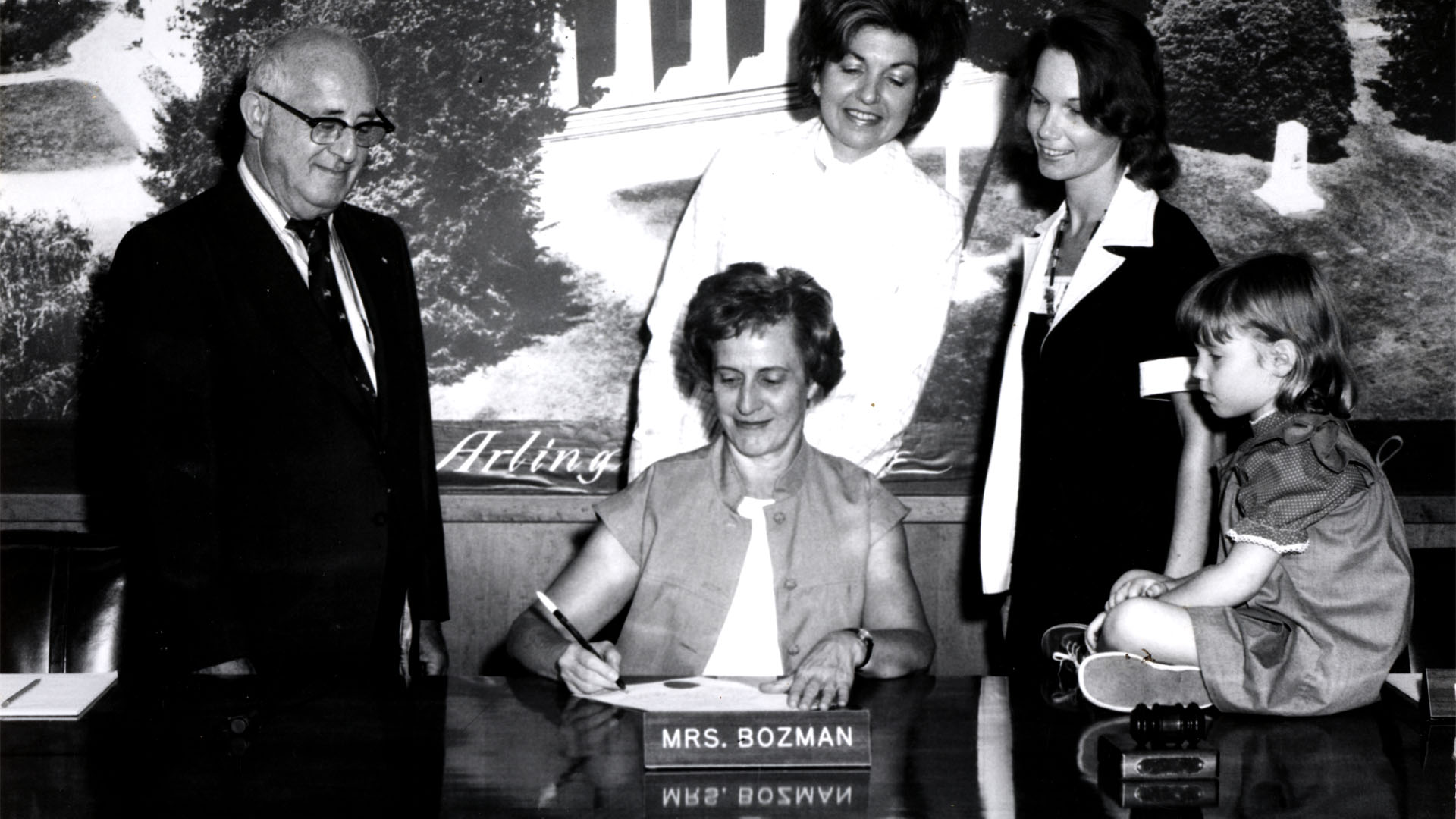
Ellen Bozman working in the County board room, surrounded by a man, two women and a child sitting on the desk

In 1973, Ellen Bozman first ran for the Arlington County Board under the slogan “Let’s keep Arlington a good place to live…and make it better.” During her tenure from 1974 to 1997 as the longest-serving county board member to date, Bozman’s dedicated service and ingenuity fulfilled this goal. Her foresight and leadership guided Arlington as it transitioned from a suburban enclave to bustling urban community, as she advocated for controlled development, instituting services for the elderly and children, and open government.

You can read a short history of Ellen Bozman's life and career in our online exhibit, Women's Work, and see original documents about her work on the County Board in the Center for Local History's Community Archive.

“Ellen Bozman set the bar high for civic service and leadership,” former Arlington County Board member Jay Fisette said. “It is entirely fitting that the County offices be named for Ellen — a visionary who helped guide Arlington’s growth for decades, played a key role in developing Metro here, and who maintained the highest ethical standards throughout her decades of service to this community that she loved. Ellen believed in open, inclusive, competent government as a powerful agent of progress.”

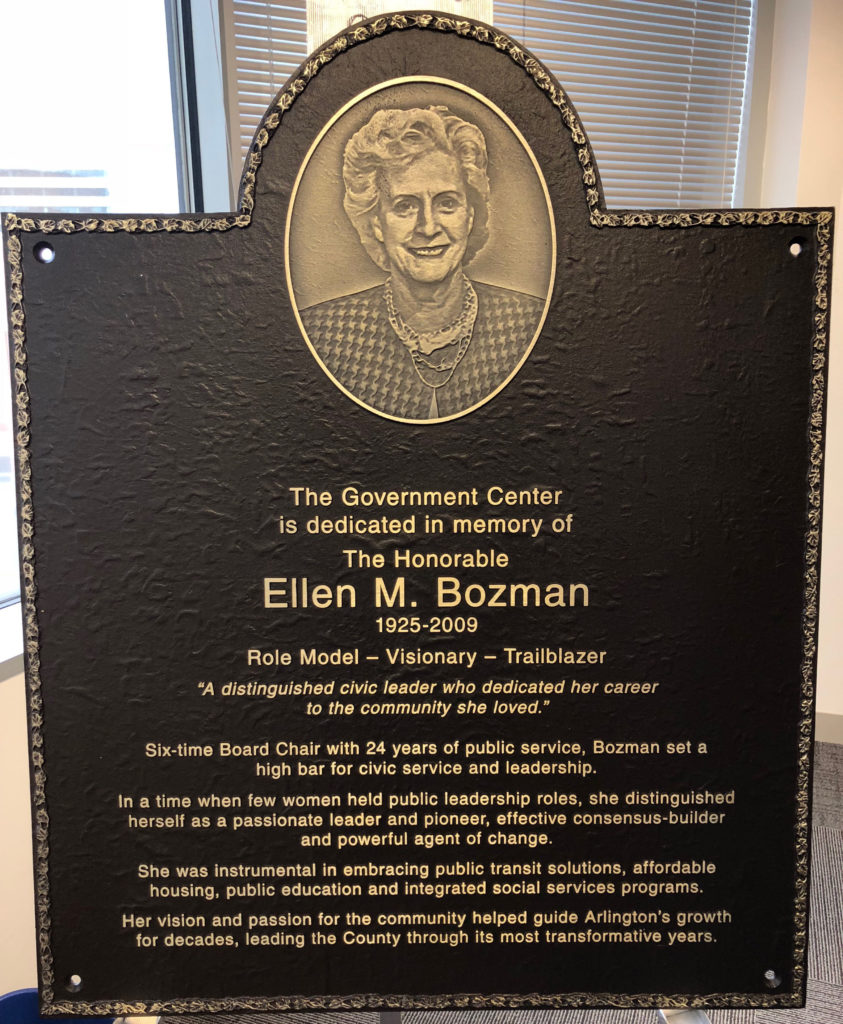
Bozman plaque

In August, 2017, former County Board member Fisette received a petition signed by 62 prominent Arlington residents asking that the Board name the County Office Building for Bozman. The County’s Historical Affairs and Landmark Review Board unanimously approved the naming on September 20, 2017.

The plaque in Bozman's honor reads:

The Government Center is dedicated in memory of

The Honorable
Ellen M. Bozman
1925-2009

Role Model – Visionary – Trailblazer

“A distinguished civic leader who dedicated her career to the community she loved.”

Six-time Board Chair with 24 years of public service, Bozman set a high bar for civic service and leadership.

In a time when few women held public leadership roles, she distinguished herself as a passionate leader and pioneer, effective consensus-builder and powerful agent of change.

She was instrumental in embracing public transit solutions, affordable housing, public education and integrated social services programs.

Her vision and passion for the community helped guide Arlington’s growth for decades, leading the County through its most transformative years.

April 26, 2018 by Web Editor

Oral History: Interview with Ruth “Cas” Cocklin

Post Published: April 22, 2018

Photo of the boy scout's Cleanorama sign

"Up To Her Neck In Solid Waste..."

When the first Earth Day was organized in 1970, the U.S. environmental movement had already begun to gain traction across the country. This was true for Arlington, where civic activists and county leaders began to incorporate environmental assessment into the work of the County Board.

Ruth “Cas” Cocklin, a former president of the Arlington League of Women Voters and an active member of the effort to reform the juvenile justice system, served on the Board’s first Environmental Improvement Commission.

In this clip, Ms. Cocklin explains the early goals of the Commission and her own interest in recycling.

NARRATOR: Ruth C. Cocklin
INTERVIEWER: Edmund Campbell
DATE: November 9, 1989

Transcript:

RCC: About 1972 or '73, Joe Fisher, who was somewhat of an environmentalist, wanted to set up an environmental commission of some sort within the county.

EC: Joe Fisher at that time was a member of the Arlington County Board.

RCC: The Arlington County Board. And there were nine of us on the Commission. The first thing we decided to do was to do an environmental survey of the County which had never been done. It took us almost all year and we divided up into different sectors. Someone doing water, someone doing air, someone doing this that and the other thing, and I chose solid waste because I was interested in newspaper separation and I wanted to see how this worked out. So we published a thick paperback report which is still good reading. We really went very thoroughly into everything, into the quality of the streams in Arlington, into run off into the streams, into all sorts of things.
And as far as solid waste was concerned, into how the trash was picked up at the curb, what happened at the transfer station in South Arlington and then what occurred when it went on to Lorton, the costs, and what possibilities there were for separation.

EC: Am I correct, that some of your friends say you were up to your neck in solid waste?

RCC: Well, Ann Cadman, who is still writing for local papers, did a story for the Northern Virginia Sun on me and my activities, this was when I was involved in newspaper separation, and headlined it, "Up To Her Neck In Solid Waste", which my husband didn't think was particularly good.
There was a great awareness that we needed to reduce the amount of solid waste. We have had a very, very extravagant lifestyle, of packaging things elaborately, throwing all this stuff away; people don't reuse things and in terms of newspapers and in terms of beverage containers, we were particularly anxious to do something.
Finally, I think this was going to come up in the County Board sometime in the late summer and so we got a bunch of volunteers and developed a questionnaire saying "Are you familiar with the need for separation of newspapers?" I don't know whether that was the question, on newspaper separation, "Would you be willing to separate your newspapers? Do you think this should be compulsory or should it be voluntary? Should the County Board do something on this?" We called six hundred Arlington residents. We debated whether to use the voters list or the tax payers list and finally we just used the telephone book. We figured that that would get a wider variety of people.

EC: You mean you telephoned six hundred people?

RCC: Yes. I mean we had a number of people but they were all using the same questions. We telephoned 600. We did it at random on certain pages. We just pulled out certain pages.
So we had people in apartments as well as people in homes. We called 600 people and were absolutely astounded with the results. There were about 10 people, who said, "That's silly", and down went the phone. There were about 20 people who didn't care one way or the other, really didn't have an opinion. The rest of the people said, "Why hasn't Arlington done this before, Alexandria's doing it," and they'd mention someplace in Massachusetts they knew of that was doing it or someplace in Michigan or whatever. "This is silly that we're not doing it." I think, Joe Wholey kept asking us, "Now where did you get this list? What were the questions asked?" and we kept giving him the information and I think he finally was convinced that perhaps people, the citizens, had moved ahead of the elected officials.

You can find Ruth Cas Cocklin’s interview in its entirety in the Center for Local History - VA 975.5295 A7243oh ser.3 no.33. Photo: Boy Scout Troup 622, trash bags, Cleanorama sign
Source: PG 200 Subject Photograph Collection, Series 22 Cleanorama 1972, 200-0904


The goal of the Arlington Voices project is to showcase the Center for Local History’s oral history collection in a publicly accessible and shareable way.

From June 2017 – May 2018, we will post one oral history clip and transcript each month, focusing on Arlington’s history, culture and identity.

What is the oral history collection?

Oral history is a popular method of research used for understanding historical events, actors, and movements from the point of view of people’s personal experiences.

The Arlington Public Library began collecting oral histories of long-time residents in the 1970s, and since then the scope of the collection has expanded to capture the diverse voices of Arlington’s community. In 2016, staff members and volunteers recorded many additional hours of interviews, building the collection to 575 catalogued oral histories.

To browse our list of narrators indexed by interview subject, check out our community archive. To read a full transcript of an interview, visit the Center for Local History located at Central Library.


April 22, 2018 by Web Editor Tagged With: Oral History

Womens Work: Meet Dr. Knipling, Founder of the Outdoor Lab

Post Published: April 12, 2018

Seeking Hands-On Outdoor Experience

After World War II, developers transformed much of Arlington County’s open land into urban neighborhoods, destroying open meadows, forests, and other natural areas. By the mid-1960s, Dr. Phoebe Hall Knipling, Science Supervisor at Arlington Public Schools (and the first person to hold such a position in Virginia), encountered a major challenge to developing the district's science curriculum: her students’ lack of hands-on experiences with nature and wildlife.

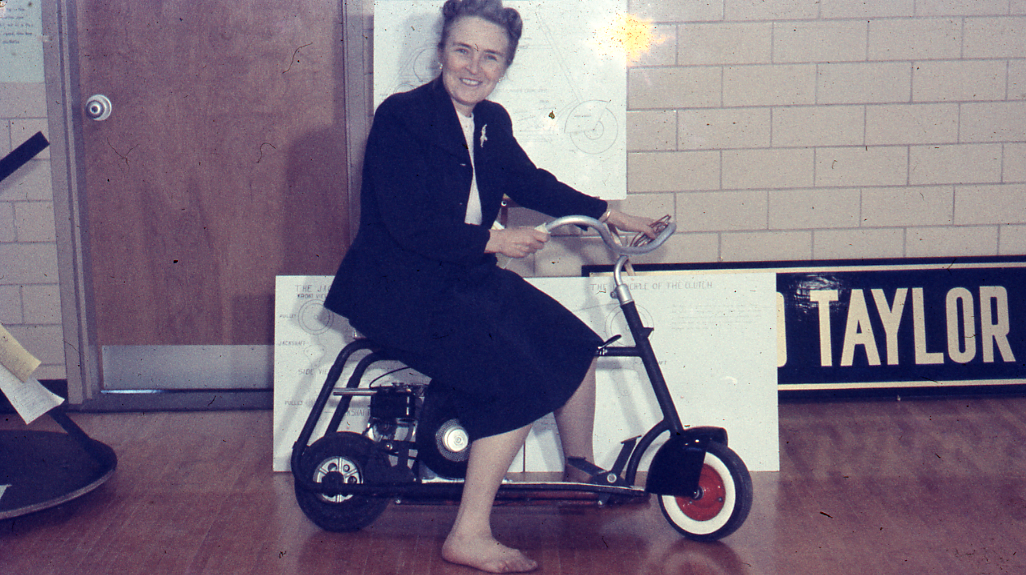
Dr. Phoebe Knipling riding a scooter at a science fair
Dr. Knipling at a student science fair

Beginning in the 1950s, Dr. Knipling worked hard to create a more engaging, participatory science curriculum. She started the school system’s annual science fair, a relatively new educational exercise at the time, and ran a summer science program to take students on excursions through natural areas outside the metropolitan area. But Dr. Knipling found it increasingly difficult to locate natural, relatively untouched areas close to Arlington for these field trips.

Dr. Knipling spent three years searching for an undisturbed area to reserve as an outdoor laboratory exclusively for Arlington County students to observe the forces of nature at work.

You can read more about Dr. Knipling and the Outdoor Lab, and view related archival material including additional photos, in the Center for Local History's online exhibit Women's Work: Stories of Persistence and Influence.


April 12, 2018 by Web Editor

Women’s Work

Post Published: March 19, 2018

Hidden Stories of Persistence and Influence


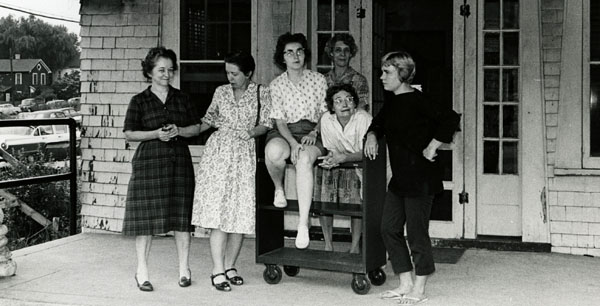
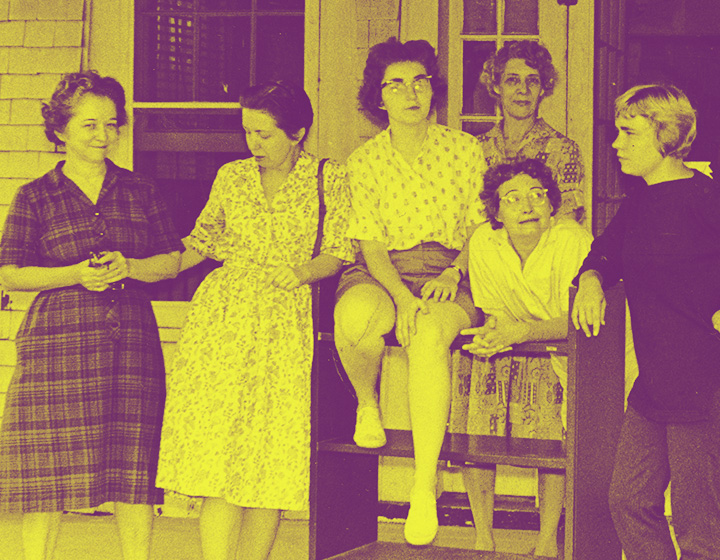
Librarians of Cherrydale Library, August 1961
Librarians of Cherrydale Branch Library, August 1961

Many years ago, I was attending a party for Charlie, a work colleague who was retiring. It came time to cut the cake and he turned to me - one of the few women in the room - and asked me to do it, adding that it was “women’s work, anyway.”

At the time, I was the assistant division chief responsible for a couple of hundred employees. But to him, I was a woman and he was not, and there were tasks - cake cutting among them - that it was my “job” to do.

Rather than demur, I did as I was asked, and yet never forgot the experience.

Today (with a bit of tongue in cheek) and in honor of Women’s History month, Arlington Public Library launches a new digital exhibition: 

Women’s Work: Stories of Persistence and Influence

A New Online Exhibit from the Center for Local History


Women's History Blog Education
Education


Women's History Blog Entrepreneurs
Entrepreneurs


Women's History Blog Libraries
Libraries


Women's History Blog politics
Politics


Women's History Blog Social Activism
Social Activism

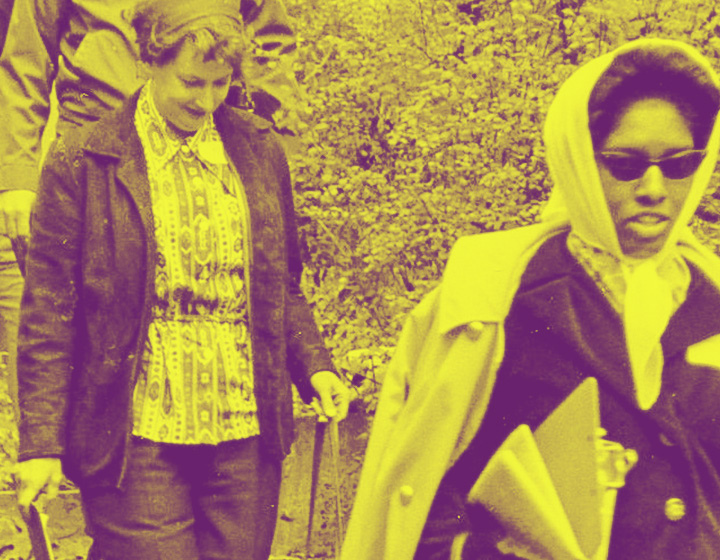
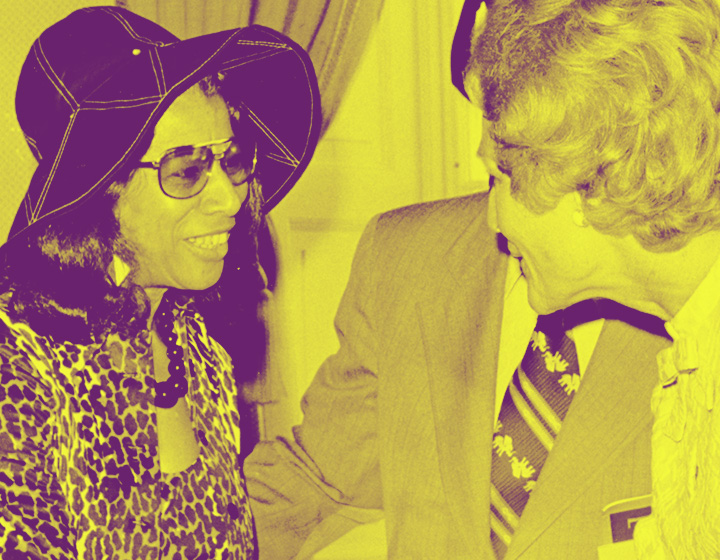
The collection profiles the women who made Arlington the community it is today. Entrepreneurs, activists, educators, politicians, and homemakers, the women of Arlington helped found Arlington’s first hospital, fought to integrate the school system, and established the Black Heritage museum. Even the public library system we enjoy today, a vibrant system comprised of a Central library and seven branches, exists because of the largesse of citizen bequests and the vision and hard work of leaders of Arlington women’s civic and garden clubs who understood only too well that knowledge is a core service. Several years ago, sociologist Robert Putnam warned in “Bowling Alone” that civic engagement was dying and with it the life and hope of communities. But Putnam doesn’t know Arlington’s residents, particularly its women.

As the exhibit unfolds over the upcoming year, through photographs, personal papers, and oral histories, you will find the story of Dr. Phoebe Hall Knipling, science teacher and founder of the Arlington Outdoor Education Association and its 225-acre Lab in Fauquier County, where Arlington students can experience nature and learn how to protect the environment. And Elizabeth Campbell, board member for Arlington Public Schools and founder of WETA-TV, the first public television station in Washington, D.C. And entrepreneur Margarite Reed Syphax, who began a real estate and construction business with her husband William, and who was one of the first black business women to be designated a Certified Property Manager.

This first release presents several stories and over the next year, we will continue to add more. But this collection will never be complete because a “woman’s work is never done.”

Diane

Scrawled DK signature


If you know of an Arlington woman who should be included in this exhibition or if you possess artifacts or other source materials of Arlington women that you would like to donate to the community archive, please contact the staff of the Center for Local History.

March 19, 2018 by Web Editor

Oral History: Interview with Elizabeth Campbell

Post Published: February 28, 2018

paper cut image of sound wave next to photo of Elizabeth Campbell

Creating “Time for Science,” Hosting Eleanor Roosevelt

Reading through the oral history interview with Elizabeth Campbell, it’s hard to find a corner of Arlington life that she wasn’t involved in.

Education was a reoccurring theme in her myriad of interests; Mrs. Campbell was the only woman elected when the county adopted an elected school board, she started one of the earliest cooperative pre-schools in the area, and she became president of the Greater Washington Educational Telecommunications Association (GWETA) during its founding.

In this clip Mrs. Campbell is interviewed by her husband Edmund Campbell, and the two discuss her early work with GWETA.

NARRATOR: Edmund D. Campbell
INTERVIEWER: Elizabeth P. Campbell
DATE: September 3, 1984

Transcript:

EDC: The final major subject I want to talk about and get you to talk about briefly concerns the formation and early days particularly of the Greater Washington Educational Telecommunications Association which, in its early days, was almost exclusively an Arlington production. Tell us about that.

EPC: The needs of the schools at that time were particularly great in the area of science in the elementary schools, and I knew that there were two other communities in the nation that were using television to serve their schools, and so when I said I would be President of the Greater Washington Educational Television Association, I said, “We want to begin by serving the schools.” We were able to get the interest of twelve of the Superintendents of schools in the Washington metropolitan area to support a science program provided we could raise the money from foundations to get the programs on the air on a trial basis. We were able to do this, and for three years, we had “Time for Science”, a half hour program received in the fifth and sixth grades in all the Washington Area schools including the District of Columbia.

EDC: Did you have any especially interesting incidents that occurred while you were broadcasting from Yorktown High School?

EPC: Well, you see, all of our programs were live into the schools. We made the programs right there. We did a lot of production with two cameras and one tape machine that had been loaned to us by the Ford Foundation (they finally gave it to us) and so we wanted to have some special programs, particularly for the interest of the high school students because most of our programs were only for the elementary schools. We called and invited Mrs. Eleanor Roosevelt to come out and do a program for us on careers, to inspire young women particularly to go out and have their own careers and also to serve their communities. The secretary said, “Well, Mrs. Roosevelt must have a place in which to rest when she comes out to the studio,” and I said, “All right.” I looked around. We were in very crowded quarters, and outside of the rooms that we used for studios, there was a broom closet, quite a large closet where they kept brooms and cleaning utensils. So we cleaned that out and put a chair in there and a table with a glass of water, and that’s where Mrs. Roosevelt rested. Then after the program was over, she let some of the high school seniors come and talk to her. That was a great thrill for them and for all of us. Unfortunately, we didn’t have the money or didn’t know enough to save that tape, and so we have no record of Mrs. Roosevelt’s being there. But I remember it very well, and it was one of the highlights of my experiences at Yorktown.

You can find Elizabeth Campbell’s interview in its entirety in the Center for Local History – VA 975.5295 A7243oh ser.3 no.27. Photo: Photograph of Elizabeth Campbell; Source: RG 19 Personal Papers of Elizabeth Pfohl Campbell, Subgroup 6 Series 3, 19-5837


The goal of the Arlington Voices project is to showcase the Center for Local History’s oral history collection in a publicly accessible and shareable way.

From June 2017 – May 2018, we will post one oral history clip and transcript each month, focusing on Arlington’s history, culture and identity.

What is the oral history collection?

Oral history is a popular method of research used for understanding historical events, actors, and movements from the point of view of people’s personal experiences.

The Arlington Public Library began collecting oral histories of long-time residents in the 1970s, and since then the scope of the collection has expanded to capture the diverse voices of Arlington’s community. In 2016, staff members and volunteers recorded many additional hours of interviews, building the collection to 575 catalogued oral histories.

To browse our list of narrators indexed by interview subject, check out our community archive. To read a full transcript of an interview, visit the Center for Local History located at Central Library.


February 28, 2018 by Web Editor Tagged With: Oral History

Oral History: Interview with Firefighter Julian Syphax

Post Published: February 27, 2018

paper cut image of sound wave next to photo of 1931 Halls Hill volunteer fire department

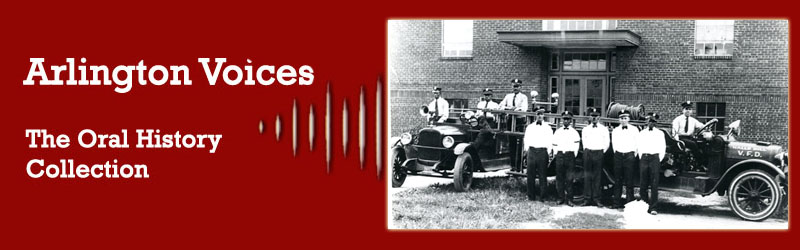
Hall’s Hill Volunteer Fire Department 1931, collection of the Arlington Historical Society

23 Years at Station 8, Hall’s Hill

Julian Syphax was one of the first paid black firefighters in Arlington as well as one of the first paid firefighters at the Hall’s Hill station.

The Arlington County Government began formerly providing fire protection in 1940, creating a career system for what was previously a network of volunteer fire fighting departments in the county. A volunteer-run station was established in Hall’s Hill in 1925, but the employment program was limited to white firefighters only for its first decade.

Julian Syphax, then a young man from Ithaca, New York, moved to Arlington in 1949 and applied for a job as a firefighter at a time when the County was beginning to make positions available to black applicants. Mr. Syphax’s interview is a tremendous source of information for people interested in the experience of desegregation, as well as the history of fire protection in Arlington County.

In this clip, Mr. Syphax reflects on the initial difficulties he and his colleague Alfred had working with the other majority white firefighter stations, as well as his appreciation for his time as a firefighter and the close-knit community of the Hall’s Hill neighborhood.

NARRATOR: Julian Syphax
INTERVIEWER: Judith Knudsen
DATE: May 20, 2016

Transcript:

JS: Well, I can honestly say that at the beginning of our careers, Alfred and I were really let known that they didn’t want us, from the way we were treated at a fire, you know, no—

JK: This is the other firefighters you’re talking?

JS: The other firefighters.

JK: Okay. The white firefighters.

JS: Firefighters did not want us, and, I have to admit, some of the chiefs, some of the people in charge. A lot of times there were fires in our first-due territory, so we were called on. They would call second due and third due before they would call us. I lived at that time, when I got married, across the street from the firehouse, and there was a fire in a barrel in my yard. Somebody had set on fire. And the firehouse was across the street, and they called in Cherrydale, who was second due, and we all stood there and watched them come up Lee Highway from Cherrydale to put the fire out. So it was known that they didn’t want us.
But like I said before, it all turned out to be a very nice job, and from Ithaca, New York, I found that the only reason for the racism was that they didn’t have any communications. But after I found out that they got to know each other, there wasn’t that much different in either one of us, so broke down kind of fast.

JK: So what was the community like just living there? Just aside from that, what do you remember about Hall’s Hill and—

JS: Close, very close. The neighbors, all Hall’s Hill, was very, very close. They had a kind of a—instead of going all the way to the Safeway, there was a little family store that you could get bread and milk, stuff like that, staples. And church. There was a Methodist church that is still there, I think, on Lee Highway. Calloway. Calloway Methodist Church was there, which I would say 80 percent of Hall’s Hill attended. And just a lot of social activity, that everybody knew everybody, and they were very close-knit.

JK: Yeah, what I always hear is if the children misbehave, everybody—

JS: It was a village. Really, that was very true. Took a village to raise your child.

JK: So how long were you at Hall’s Hill? How many years that you were there?

JS: I never changed.

JK: Full-time.

JS: I was at Station 8—

JK: The whole time.

JS: —my whole career for twenty-three years, yeah. That’s why I’m so very thankful and I’m so honored for this. I just don’t have the words to express it.

You can find Julian Syphax’s interview in its entirety in the Center for Local History – VA 975.5295 A7243oh ser.3 no.295. Photo: Hall’s Hill Volunteer Fire Department 1931; Source: Photographs of the Arlington Historical Society, PG 230-4075


The goal of the Arlington Voices project is to showcase the Center for Local History’s oral history collection in a publicly accessible and shareable way.

From June 2017 – May 2018, we will post one oral history clip and transcript each month, focusing on Arlington’s history, culture and identity.

What is the oral history collection?

Oral history is a popular method of research used for understanding historical events, actors, and movements from the point of view of people’s personal experiences.

The Arlington Public Library began collecting oral histories of long-time residents in the 1970s, and since then the scope of the collection has expanded to capture the diverse voices of Arlington’s community. In 2016, staff members and volunteers recorded many additional hours of interviews, building the collection to 575 catalogued oral histories.

To browse our list of narrators indexed by interview subject, check out our community archive. To read a full transcript of an interview, visit the Center for Local History located at Central Library.


February 27, 2018 by Web Editor Tagged With: Oral History

From Freedman’s Village to Queen City

Post Published: January 31, 2018

One Community’s Evolution

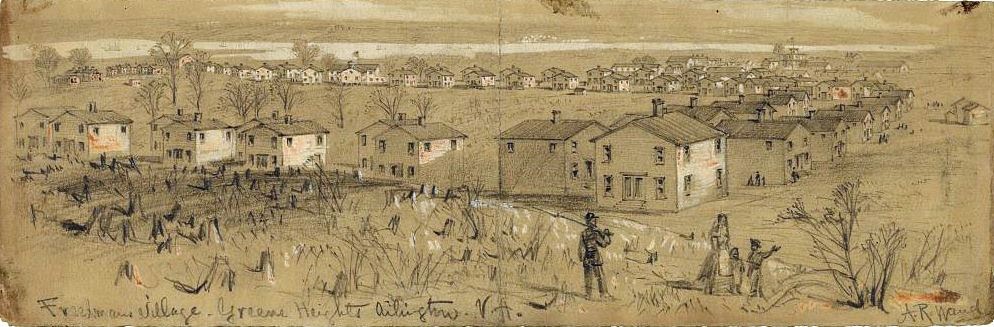
Ink painting on brown canvas of Freedman's Village
African American history is not a separate component of the Arlington story, but a central part of our shared history.”
-- John Paul Liebertz, “A Guide to the African American Heritage of Arlington County Virginia,” Second Edition, 2016


Part 1: Freedman’s Village

On property that today houses the Pentagon and Arlington National Cemetery, a little-known, thriving, African-American community called Freedman’s Village once stood.

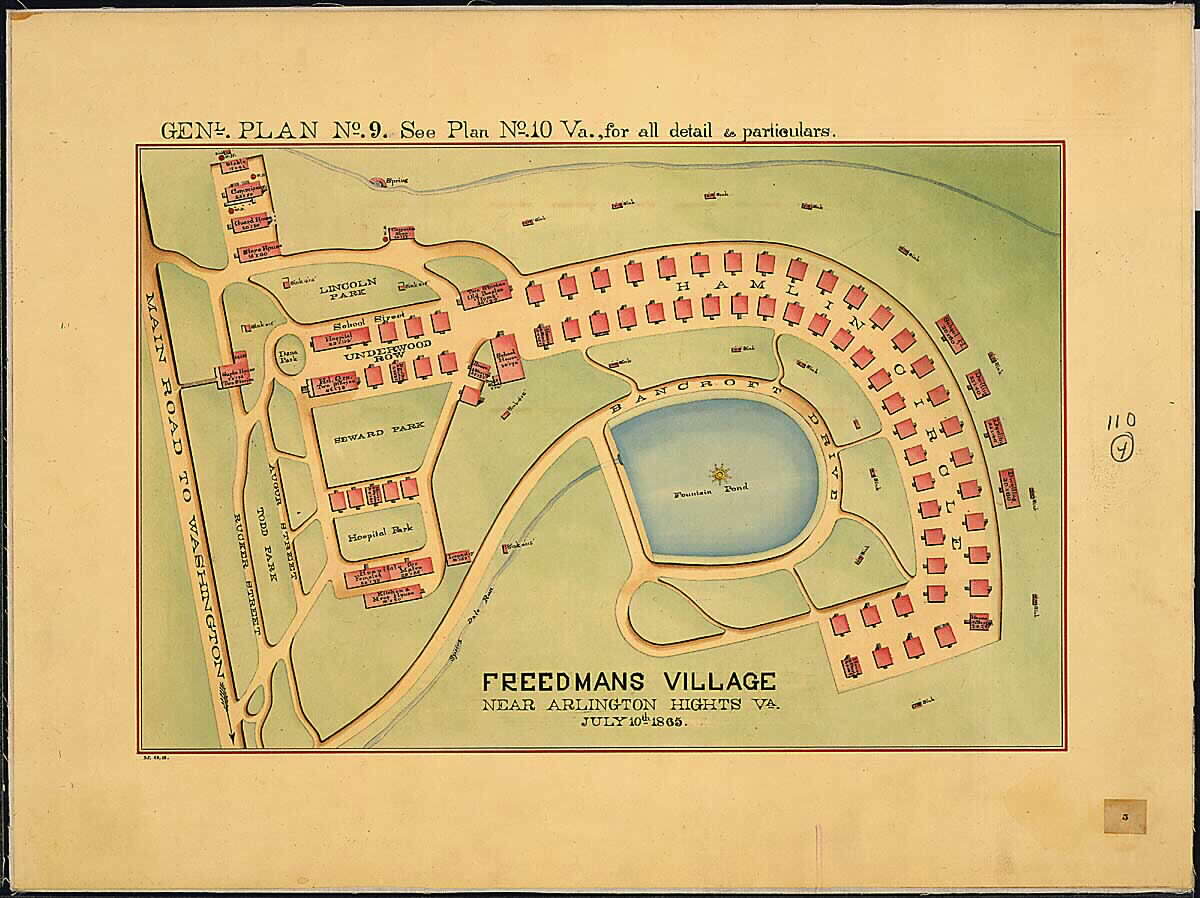
Hand drawn and inked map of Freedman's Village

Freedman's Village - click or tap on image to view larger

Established and formally dedicated by the U.S. Government in 1863, Freedman’s Village was located on land that surrounds Arlington House, a sprawling antebellum plantation inherited by Robert E. Lee’s wife, Mary Anna Randolph Custis, and where the Lee family lived for a number of years.  The main objective of the founding of Freedman’s Village was to provide protection, education, instruction, and employment to its African-American residents.

Situations were at times far from ideal, but Freedman's Village quickly gained a reputation as a haven for “contraband” (escaped slaves) and freepersons due to its rural location, away from the crowded, diseased-ridden city camps in Washington, D.C. , where individuals were less likely to survive. Camp life and living conditions were far from perfect however, and during the early years treatment of residents was questionable. Once this was exposed and an investigation was launched, conditions began to slowly improve.

As time progressed, the residents began to cultivate, improve, and create a community they could call home. Although initially planned as temporary housing, through decades of hard work and communal dedication on behalf of the residents, Freedman’s Village transformed into a developing community, a home, and a place for growth and personal success for many fugitive slaves and freepersons alike who previously had no opportunities or rights in Virginia.

During its various stages of growth and development, Freedman’s Village offered educational, professional, and emotional support for its increasing population. Residents could acquire employable skills, and many found that they finally had access to medical care, clothing, healthy foods, and adequate shelter.

Revelation and Realization of Citizenship

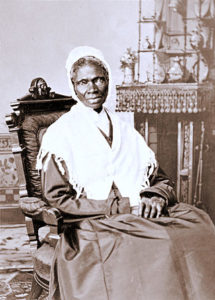
Photo of Sojourner TruthAlong with gaining access to better living conditions, the residents of Freedman’s Village were also learning about their basic human rights as U.S. citizens. The village became an area for revelation and realizations.
One well-known abolitionist, Sojourner Truth, resided in Freedman’s Village for approximately a year, and worked to assist villagers with access to information. During that time, Sojourner Truth worked for the National Freedman’s Relief Association. She counseled the villagers on self-care and self-maintenance, instructed the women in domestic chores, preached the gospel, helped find work for the unemployed, and taught residents how to demand their basic human rights be represented and respected.

Closing Freedman's Village

The population of Freedman’s Village fluctuated continuously, much like any temporary housing community. When it first began in 1863, it was estimated that approximately 1,000 individuals resided in the community. By July 1867, 837 inhabitants were recorded as living in Freedman’s Village. However due to its better-than-average living conditions, and its ability to offer employment and personal support to individuals, the community remained unusually strong for almost 40 years.

The Government attempted to close the village on several occasions. With each looming shutdown, the residents rallied and successfully resisted closure - until 1900, when the Government finally succeeded in closing the village permanently, and payed off residents to vacate the area once and for all.


Part 2: Queen City

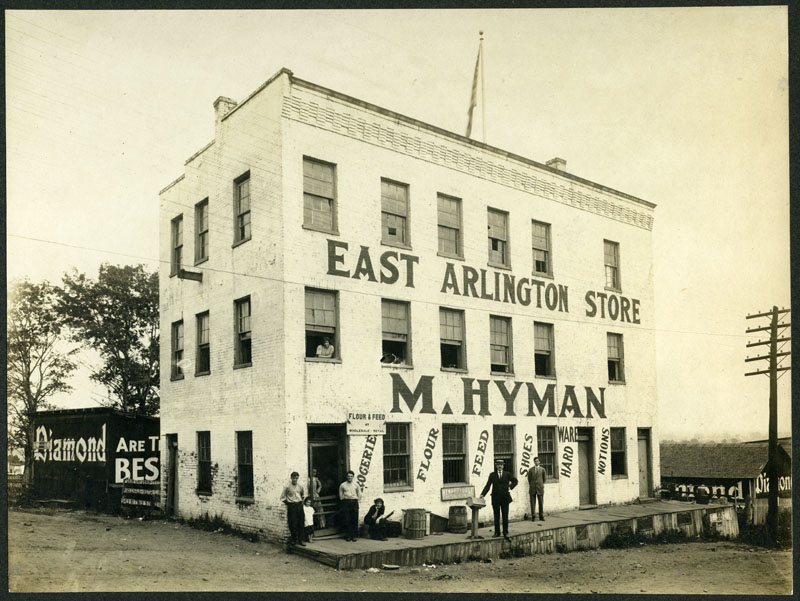
Photo of M. Hyman Store in East Arlington

Click or tap on photo to view larger

Building in East Arlington

As Freedman’s Village began to decline - and especially after it was closed in 1900 -  residents of the Village had to find new places to live. One such area was the nearby community known as East Arlington. Within East Arlington, two acres of land were purchased by the Mount Olive Baptist Church and this subdivision soon became known as Queen City. Located in the northern corner of East Arlington, the homes in the first wave of residency were built by African American owners.

Residents of Queen City created a close-knit community, with men usually working at the nearby brickyards (they could use the Queen City trolley stop to get to work), and women bringing in work such as sewing. Children went to school locally at the Jefferson School on Columbia Pike, and families would attend Mt. Olive or one of the other nearby churches, St. John’s Baptist or Mt. Zion. The local Odd Fellows had annual “Entertainments” at Christmas and the Fourth of July, supported community members in distress, and even made loans.

Queen City was a strong community built on proximity, hard work, social ties, and the realities of Jim Crow. The 1940 census records show 903 people living in 218 residences in the whole of East Arlington.

World War II and Eminent Domain

With the US’s entry in to World War II, the War Department needed to expand. There was no room in Washington, DC, for a building big enough to hold the department, so a new site was selected across the river in Arlington. The building, now known as the Pentagon, was on the land of the outdated Hoover Airport and the federal experimental farm, but additional space would be needed for parking and roads serving the complex. The East Arlington neighborhood - and Queen City within it - was in the way.

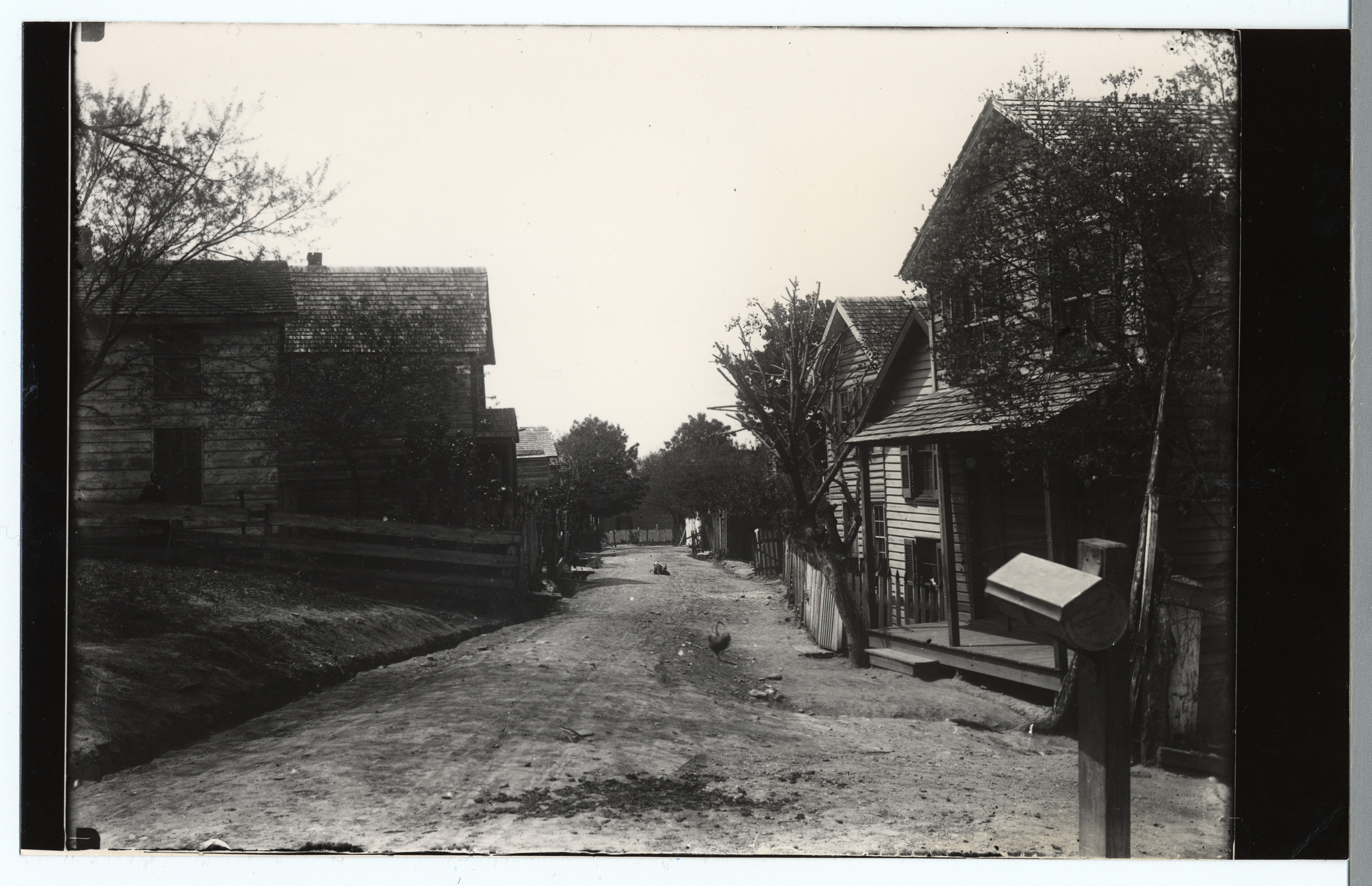
Black and white photo of wooden houses on a dirt road

Queen City - click or tap on photo to view larger

The federal government exercised eminent domain to take over the land in February of 1942. Homeowners were compensated, but unlike the nearby African-American neighborhood of Johnson’s Hill, Queen City did not have paved streets or running water, so property values were lower.

Casualty of Change

Residents were given four to six weeks to leave their homes in an already tight housing market, and African Americans had even fewer housing options than whites. With intervention from Eleanor Roosevelt and the House Military Affairs Committee, temporary trailer park housing was finally set up for residents in nearby Green Valley and Johnson’s Hill - but not before many families lost all their possessions because they had no safe place to store them.

Not all East Arlington residents moved into the trailers. Some moved away, a few had the money to build a new house in Arlington, and some lived with relatives. The biggest casualty was the community as a whole. Interviews with residents who lived through this time talk about the pain and uncertainty the entire community felt. Those strong community ties were diminished, and were mourned by residents for decades afterwards.


To learn more about Freedman's Village, Queen City, and all things Arlington, please visit the Center for Local History at the Arlington Central Library where you can browse our collection of books and articles on African American Heritage in Arlington County.

Read more articles on Arlington's history on the Center for Local History Blog.

For more information regarding the materials and collections available for research, please contact the Center for Local History at 703-228-5966.


January 31, 2018 by Web Editor

  • « Go to Previous Page
  • Page 1
  • Interim pages omitted …
  • Page 17
  • Page 18
  • Page 19
  • Page 20
  • Page 21
  • Interim pages omitted …
  • Page 40
  • Go to Next Page »

Footer

About Us

  • Mission & Vision
  • Charlie Clark Center for Local History
  • News Room
  • Get Email Updates

Administration

  • Policies
  • Library Staff
  • Job Opportunities
  • Propose a Program or Partnership

Support Your Library

  • Friends of the Library
  • Giving Opportunities
  • Donating Materials
  • Volunteer Opportunities

Our Mission

We champion the power of stories, information and ideas.

We create space for culture and connection.

We embrace inclusion and diverse points of view.


Download the Library App

Download the Library App

Arlington County | Terms & Conditions | Accessibility | Site Map
· Copyright © 2026 Arlington County Government ·