• Skip to primary navigation
  • Skip to main content
  • Skip to footer

Alert

Alert: Central Library garage closure and limited elevator access through April 20 More Info

Alert

Book donations will be paused April 13-25 for the FOAL Spring Book Sale More Info

Home - Arlington County Virginia - Logo
MENUMENU
  • Join Now
  • My Account
    • Login
    • My Checkouts
    • My Holds
    • My Lists
    • My Reading History
    • About Borrowing
    • About Holds
    • About My Account
  • Hours & Locations
    • All Hours & Locations
    • Holiday Closings
  • News
    • Library News
    • Director's Blog
    • Get Email Updates
  • Contact Us

Arlington Public Library

MENUMENU
  • Search
  • Collections
  • Library Services
  • Events
  • Community Engagement
  • Join Now
  • My Account
    • Login
    • About Borrowing
    • About Holds
    • About My Account
  • Hours & Locations
    • All Hours & Locations
    • Holiday Closings
  • News
    • Library Blog
    • Get Email Updates
  • Contact Us

Christopher George

Edu-Futuro: Preserving Latino Culture in Arlington

Post Published: October 11, 2024

September 15th marked the beginning of Hispanic Heritage Month, celebrated through the middle of October. We're taking this opportunity to share a CCCLH collection that highlights the history and culture of Arlington’s Latino communities – the Katharine Panfil Records of Edu-Futuro.

A group of students of Escuela Bolivia.

Students of Escuela Bolivia, ca. 2001. 

In 1998, a group of Bolivian parents and teachers in Arlington came together to address a pressing concern that the children in their community would forget the language and traditions of the home they left behind.

They consulted with Bolivian Ambassador Marcelo Pérez Monasterios and met with Superintendent of Arlington Public Schools Robert G. Smith to collaborate on an academic enrichment program that could meet the needs of Arlington’s rapidly growing immigrant population. Thus, Escuela Bolivia (later renamed Edu-Futuro) was born.

Escuela Bolivia began as a Saturday morning academic program that provided Spanish and mathematics education to Latino students. It was also a space for students to learn about Bolivian culture, listen to Bolivian music, eat Bolivian foods, and meet other Bolivian children. The program supported parents as well, offering classes in English and computer skills.

A promotional flyer for Escuela Bolivia Saturday School in Spring 2015.

Promotional flyer for Escuela Bolivia Saturday School, 2015. From RG 394: Katherine Panfil Records of Edu-Futuro.

One of the founding members was educator and longtime Arlington resident Emma Violand-Sanchez. Born and raised in Cochabamba, Bolivia, she came to Lorton, VA, in 1961 at the age of 16 while her father was in political exile—part of the first major wave of immigration to Northern Virginia which occurred during the Bolivian National Revolution. When she enrolled as a senior at Mount Vernon High School in Alexandria, Violand-Sanchez was the only Latin American student.

She earned a four-year scholarship at Radford College, where she majored in foreign languages and education, graduating in 1966. After spending time teaching in Bolivia, Violand-Sanchez returned to the U.S. to pursue a doctorate from George Washington University. During her studies, Arlington Public Schools hired her as a bilingual resource teacher for Patrick Henry and Key Elementary School.

Dr. Violand Sanchez.

In an interview, Dr. Violand-Sanchez expressed her sense of belonging in Arlington: “I can be as American as apple pie as well as Bolivian as salteña.” Photo from Arlington Historical.

A lifelong proponent of bilingual education, Dr. Violand-Sanchez became supervisor of the school system’s English for Speakers of Other Languages/High-Intensity Language Training (ESOL/HILT) program. She was the first Latina teacher in Arlington and later became the first Latina member of the Arlington County School Board.

In the 1980s, Arlington’s Bolivian population continued to grow. As Bolivia suffered from hyperinflation, families sought better opportunities and a higher quality of life in the United States. Many who immigrated in the 1980s were of Quechua descent, most of them hailing from the Valle Alto region of Cochabamba, from towns like Tarata, Arbieto, Cliza, Punata and Tolata. By 2000, Arlington was home to the largest Bolivian community in the United States.

Students of Edu-Futuro, 2012.

Students of Edu-Futuro, ca. 2012.

In this excerpt from a 1999 interview with Dr. Violand-Sanchez, she talks about the many Bolivian community organizations in Arlington at that time, in addition to the Escuela Bolivia program she helped create:

“...We have many community-based organizations that maybe many people don't know about. For example, in the Bolivian community we have several organizations such as the Bolivian Soccer League, we have the Bolivian Cultural Society, we have the Comité pro Bolivia that has more than twenty-four folkloric groups. For the National Day celebration of August 6 [Bolivia Independence Day], we may have as many as 6,000 Bolivians at Wakefield High School. We have a lot of regional committees from Bolivia such as the Comité pro Tarata, which is one region in Cochabamba that has their own group...”

Students and teachers at Edu-Futuro, from the program website.

Students and teachers at Edu-Futuro, from the program website.

Over the years, Escuela Bolivia has continued to expand, becoming an important hub for both the Arlington and Fairfax communities. In 2011, they renamed the organization Edu-Futuro to better reflect the diverse communities they serve, while still maintaining close ties with the program’s Bolivian roots. Today, Edu-Futuro provides countless programs to enrich the education and culture of their students, from college prep to workforce development and civic engagement.

Sources:

  • Emma Violand-Sanchez interview, 1990.
  • Emma Violand-Sanchez interview, 1999.
  • For Area Bolivians, Cherishing the Past, Looking to the Future - The Washington Post
  • Only the Bridge Matters Now | Pulitzer Center
  • RG 394: Katherine Panfil Records of Edu-Futuro


REAL or Re-Encuentro de Arlington Latinos logo.

Call for Donations

The Charlie Clark Center for Local History (CCCLH) seeks community donations of a variety of materials to help document the rich, vibrant history of the Latino community in Arlington County. REAL, or el Re-Encuentro de Arlington Latinos, is a multi-year collecting initiative born out of a desire to include more documentation of the Latino community’s history in the CCCLH’s Arlington Community Archives. Community archives play a vital role in documenting all voices of a community. Learn more about how to participate here.

Help Build Arlington's Community History

The Charlie Clark Center for Local History (CCCLH) collects, preserves and shares resources that illustrate Arlington County’s history, diversity and communities. Learn how you can play an active role in documenting Arlington's history by donating physical and/or digital materials for the Center for Local History’s permanent collection.

Do you have a question about this story, or a personal experience to share? 

Use this form to send a message to the Charlie Clark Center for Local History.

Center For Local History - Blog Post Message Form

Do you have a question about this story, or a personal experience to share? Use this form to send a message to the Center for Local History.

"*" indicates required fields

This field is for validation purposes and should be left unchanged.

Share Your Story

October 11, 2024 by Christopher George

Director’s Message: Still Reading What You Want—Whenever. However. Forever.

Post Published: September 10, 2024

Still Reading What You Want—Whenever. However. Forever. 

The data is in: Arlington residents love to read. 

Arlington Public Library completed one of our most successful Summer Reading Programs ever with 9,617 registered readers and an 80% completion rate (a 21% increase from 2023). Thank you to all who participated.

A library poster with text "Join Summer Reading. Read books, win prizes." and a child reading in the background.

And that's not all:

📲 Circulation topped 1.5 million in Overdrive/Libby in FY24, a significant 39% increase over the previous year.

📈 Patrons placed more than 1.2 million holds, a 20% increase over the previous year.

📚 Arlington Public Library purchased 7,200+ additional print copies of items because of high patron print holds.

🙋‍♀️ We had a 110% increase in form-based book recommendation requests.

🛒 Our librarians received 4,826 patron suggestions for purchase, a 33% increase over the previous year.

🔃 The Library did a refresh project for the Detention Center collection, during which we purchased 1,200+ new items for their collection.

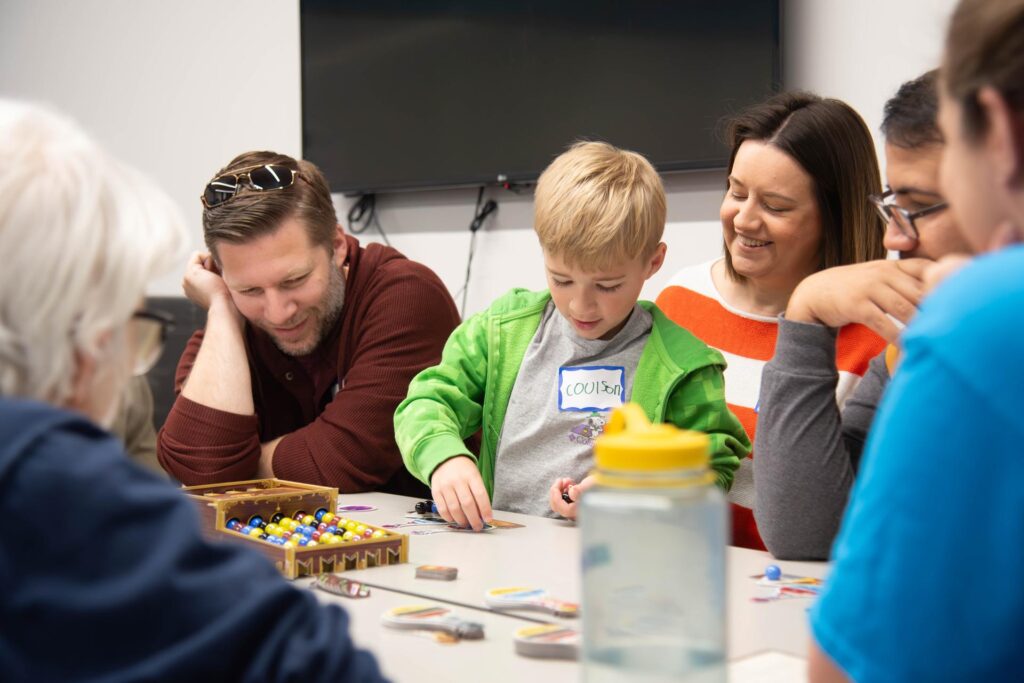
🧩 Our board games and puzzles collection, a great way to encourage fun and social interaction, circulated 7,500+ times.

In recognition of Banned Books Week, Sept. 22–28, the Library hosted a bookmark contest. The theme? What freedom to read and libraries mean to you.

Not surprisingly, imaginative submissions flowed from all age groups. We received hundreds of submissions, and 30 winners were selected.

Composite of four bookmark designs for the 2024 Freedom to Read competition.

Winning entries are being professionally printed and distributed at all library locations during Banned Books Week. Stop by a library and collect your favorites. And congratulations to all participants.

For many, it was a chance to link creativity with personal values and our community ideal of an informed citizenry. One teen said, “This [bookmark contest] gave me the confidence to start competing in other art competitions!"

Let's think about that for a second. "Gave me the confidence..." Isn't that what libraries do each day?

Audience applauds a guitar-playing teen at Columbia Pike Library's Open Mic Night
Columbia Pike Library's recent Open Mic Night event.

Through free diverse collections, programs, on-site experts, empathetic staff and inviting third spaces, each day we encourage Arlington residents to learn new things, face personal and professional challenges, find outlets for their creative interests and grow both as individuals and as members of our community. It is a labor of love and never gets old.

Thank you for reading, growing and for supporting us at Arlington Public Library.

Signatue of Library Director Diane Kresh.

Diane Kresh
Director, Arlington Public Library

September 10, 2024 by Christopher George

Happy Birthday to Smokey Bear!

Post Published: August 29, 2024

Rudolph Wendelin, Arlingtonian and artist for the U.S. Forest Service, was Smokey’s “caretaker” for decades. Celebrate Smokey’s birthday by learning about the artist that made him the bear he is today.

Smokey Bear turned 80 this month!

The beloved fire safety icon was created by the U.S. Forest Service during World War II, when wood was a particularly precious natural resource needed to fuel the war effort. To combat the prevalence of human-caused forest fires, the Forest Service established the Cooperative Forest Fire Prevention (CFFP) program in 1942. The CFFP adopted Smokey as its official symbol two years later when artist Albert Staehle created the first depiction of a caring, protective, hat-wearing bear named Smokey.

The original smokey bear drawing.

The first Smokey Bear poster created by Albert Staehle, 1944.

Many artists followed Staehle in depicting Smokey Bear. Prominent among these was Rudolph (Rudy) Wendelin, whose paintings of Smokey spanned his career with the Forest Service and continued long after his retirement in 1973. Wendelin softened and humanized Smokey's features, making the character more appealing to children, to whom much of the fire prevention campaign was directed.

Born to Austrian immigrants in 1910, Wendelin grew up in Ludell, Kansas, and attended public school in Herndon, Kansas. He began drawing at an early age and was soon earning prizes for his cartoons at county fairs.

After dropping out of the University of Kansas during the Great Depression, Wendelin was hired as a draftsman for the Forest Service regional office in Milwaukee, Wisconsin. He started drawing maps, manuals and guides for the Civilian Conservation Corps (CCC), a New Deal government work relief program. When his exhibits of CCC camps and wildlife conservation projects drew national attention, Wendelin was transferred to Washington, D.C., in 1936.

Rudy Wendelin with his paint brushes.

Rudy Wendelin, among his paint brushes, date unknown. From the Sierra Club website.

After a stint as a Navy artist during World War II, Wendelin returned to the Forest Service in 1946 and was given responsibility for the Smokey Bear project. He went on to create thousands of Smokey depictions that highlighted natural resources, conservation and forest fire prevention.

Wendelin made Smokey a household name, distributing artwork across the country, hosting talks at schools, and creating ads for newspapers, radio, and television. His work earned him many awards, including the Medal of Honor presented by the Daughters of the American Revolution, the Horace Hart Award from the graphic arts industry, and both the Silver and Gold Smokey Bear Awards from the U.S. Department of Agriculture —which he himself had designed.

Smokey Bear in the forest with a gold medal.

“Nature’s Gold Medal Winner.” Painted by Rudy Wendelin in 1988. From the USDA National Agricultural Library Special Collections.

While Smokey Bear’s residence was in D.C. (at his very own zip code, 20252), Wendelin lived across the Potomac with his wife Carrol Bergman at 4516 N. 7th Street in Arlington.

Outside of work, Wendelin was an active board member of Our Savior Lutheran Church and painted religious themes in addition to landscapes and cartoons. He marched alongside his wife in the 1963 March on Washington for Jobs and Freedom as a member of the Lutheran Human Relations Association of America.

In the 1970s, Wendelin also devoted his artistic abilities to protesting the construction of Interstate 66 in the name of protecting his community from automobile pollution and overreliance on fossil fuels. Writing frequently to the editors of the Northern Virginia Sun, he passionately decried what he saw as the shortsightedness of the I-66 project regarding environmental impact.

a cartoon about the changes regarding 1-66.

A political cartoon by Rudy Wendelin on the proposed plans for I-66. Published in the Northern Virginia Sun, August 14, 1973.

Wendelin worked with community organizations like the Arlington Coalition on Transportation (ACT) to envision more sustainable alternatives to I-66. He drew up designs that emphasized public transportation, walkability and green space. After much debate, the highway was built and opened in 1982. But Wendelin’s illustrations offer a glimpse into Arlington as the artist and environmentalist imagined it could be.

A painting of nooks.
A painting of a sculpture garden.
a painting of two people riding bicycles.

Three of ten colored sketches done by Wendelin depicting ACT proposals for the I-66 corridor. From RG 379: Arlington Coalition on Transportation (ACT) Records, 1958-2001.

In both his professional and personal life, Wendelin used art to communicate the importance of preserving nature. His legacy lives on, most of all, in the enduring and endearing figure of Smokey Bear.

Sources:

  • Inventory of the Rudolph Wendelin Papers, 1930 - 2005 - Forest History Society.
  • Lawter, William Clifford. Smokey Bear 20252: A Biography. Lindsay Smith Pub, 1994.
  • Letters to Smokey Bear Reveal Promise of Hope for the Future (usda.gov).
  • Nature's Gold Medal Winner (usda.gov).
  • The Northern Virginia Sun, September 9, 1963.
  • The Northern Virginia Sun, August 14, 1973.
  • RG 379: Arlington Coalition on Transportation (ACT) Records, 1958-2001.
  • Rudolph Wendelin (1910-2000) (sierraclub.org).
  • Story of Smokey (smokeybear.com).

Help Build Arlington's Community History

The Charlie Clark Center for Local History (CCCLH) collects, preserves and shares resources that illustrate Arlington County’s history, diversity and communities. Learn how you can play an active role in documenting Arlington's history by donating physical and/or digital materials for the Center for Local History’s permanent collection.

Do you have a question about this story, or a personal experience to share? 

Use this form to send a message to the Charlie Clark Center for Local History.

Center For Local History - Blog Post Message Form

Do you have a question about this story, or a personal experience to share? Use this form to send a message to the Center for Local History.

"*" indicates required fields

This field is for validation purposes and should be left unchanged.

Share Your Story

August 29, 2024 by Christopher George

Happy Centennial James Baldwin! 

Post Published: August 2, 2024

"We’re in a moment that requires much of us.
To use Frederick Douglass’s words, ‘We will not be saved by the captain, but by the crew.’”
—Dr. Eddie Glaude, Jr., Arlington Reads, Mar. 7, 2024 

This year, Arlington Public Library commemorated the work of James Baldwin, the renowned American writer, social critic and civil rights activist, who was born 100 years ago today, August 2, in Harlem, New York.

His body of work has had a profound impact on contemporary American identity and his words continue to hold America to account on its promises of equality and justice.

A black and white photo of James Baldwin.
Photo credit: Photo of James Baldwin by Rob Croes/Anefo.

In “The Fire Next Time,” published in 1963, Baldwin writes:

"Love takes off the masks that we fear we cannot live without and know we cannot live within. I use the word ‘love’ here not merely in the personal sense but as a state of being, or a state of grace—not in the infantile American sense of being made happy but in the tough and universal sense of quest and daring and growth."

Baldwin's powerful words remain as urgent and relevant today as when they were written.

The library began its celebration of Baldwin with a community read of “The Fire Next Time” and we are delighted to report more than 600 patrons checked it out. Professor Keith Clark, Distinguished Professor of English and African American Studies at George Mason University, provided context and background before the community discussion started.

Dr. Eddie Glaude, Jr., author of “Begin Again: James Baldwin’s America and its Urgent Lessons for our Own,” was our series opener and his remarks set the tone for many provocative conversations we held throughout the spring with each Arlington Reads author: Anna Malaika Tubbs, Jesmyn Ward and George M. Johnson.

Before the evening program, Dr. Glaude visited the Arlington County Detention Facility Library as a special guest.

Sixteen residents in the Community Readiness Unit of the Detention Facility read his book. Dr. Glaude opened by quoting Baldwin, "Hope is invented every day." An inmate asked him, "Was there a time you felt broken?"

Dr. Glaude’s responses echoed Baldwin in both their realistic grasp of our times and the challenges that often keep us from giving rise to our better angels.

“…in order for us to understand what we’ve been called to do, we have to understand that the world conspires to make us small. The world conspires to force us to be comfortable in our narrow silos, to be comfortable with the illusions and the fantasies that secure us in our innocence. The world conspires to make us mean-spirited and selfish and greedy and unloving.

And if that’s true, then the question we have to ask ourselves over and over again is, 'Will we be complicit?' …Our country is asking of us something that we must respond to. We contain multitudes, and we must act like it because we are the only salvation the nation has.”

The institution of the public library answers Dr. Glaude's call to action by being open to all, respectful of differences and committed to freedom of thoughts and beliefs.

Let's together honor Baldwin's vision of community by sharing, caring and listening to one another.

Signatue of Library Director Diane Kresh.

Diane Kresh
Director, Arlington Public Library

August 2, 2024 by Christopher George

Swimming Away The Dog Days

Post Published: July 24, 2024

The Stuart Paine Swimming and Diving Collection began with a mystery.

In 1967, at the age of 14, Stuart Paine began diving at the Springboard Swimming Pool in Springfield, VA, and shortly thereafter started participating in meets with the Northern Virginia Swimming League (NVSL). When Paine won first place in the 1968 NVSL 3-Meter Meet, NVSL recorded him as the first winner of the 3-Meter Meet in their official historical record.

However, Paine was present at the same meet the previous year, so he knew he couldn’t be the first person to win the 3-Meter Meet. This meant the official NVSL record was both inaccurate and incomplete.

A photo of Stuart Paine, who was in the center with a trophy at the 1969 NVSL meet.

Stuart Paine (bottom row, center) showing off his trophy at the 1969 NVSL meet. From RG 395: Stuart Paine Swimming and Diving Collection.

Realizing the discrepancy, Paine wanted to give earlier NVSL winners the recognition that they deserved. This led him to research the early history of the league as well as swimming and diving in Northern Virginia, Washington, D.C., Baltimore, MD, and nearby areas. In 2016, Paine presented his findings to NVSL in a formal request for them to update their records.

In 2023, he donated this report, along with artifacts such as diving medals, patches and photographs, to the Charlie Clark Center for Local History for researchers to access. We consulted the Paine collection to learn about swimming in Arlington through the years.

Swimming in Arlington before the 1950s

Most people living in Arlington before the mid-20th century swam in natural creeks and rivers. Everett E. Norton, who grew up in Columbia Pike in the 1920s and '30s, used to go swimming at Four Mile Run as a child. Later, he would take trips to Fort Myer to swim at the pool there, which required a membership.

Buckingham Pool House in 1991.

Buckingham Pool House in 1991. The swimming pool complex was integral to the original plan for Buckingham Village, envisioned in the late 1930s as a self-contained community that included recreational, entertainment, and educational facilities. This also meant that the pool house was closed to non-residents of Buckingham.

In 1939, with no public swimming pool of its own, Arlington County arranged to transport children to the Washington, D.C., municipal pool in East Potomac Park. Until at least 1947, swimming sessions were segregated by gender. In 1950, Arlington began sending buses of Black children to East Potomac Park for desegregated swimming. Until then, only white children were permitted.

Children lined up to board a school bus.

Several children lined up to board a school bus to go to a public swimming pool in D.C. From RG 32: Documents from the County Manager's Library, 1889-1994.

Opening Pools in Arlington

The era of Northern Virginia community pools began in the summer of 1953 with the opening of Bradlee Towers Pool in Alexandria and Holmes Run Acres in Falls Church. A boom of swimming pool developments followed. Arlington gained its first community pool in 1955 with the opening of the Arlington Forest neighborhood pool.

When Ruth Cocklin moved to Arlington from California in 1954, she was surprised to find that Arlington didn’t have many swimming pools. Because they had few safe and accessible places to learn, many children didn’t know how to swim. Cocklin came together with her neighbors to establish a swimming pool for their neighborhood, which became the Donaldson Run Swimming Pool.

https://library.arlingtonva.us/wp-content/uploads/2024/07/Cocklin_Ruth_19891109.mp3

COCKLIN: “Another thing that I was surprised to find is that a lot of the children (and these were from middle-class families - from professional parents) didn't know how to swim; there was no place to swim. Arlington had no swimming pools.

We belonged to the Fort Myer club, but a number of people in our neighborhood, headed up by Julian Serles and Bob Kovaric and Allan Dean – and my husband was involved with this, Ken Weaver was another one – worked to start a swimming pool for our neighborhood...This became the Donaldson Run Swimming Pool, perhaps the most beautiful one that exists today in Arlington, although there are several neighborhood pools.

The Arlington Forest, I think, was the first one and Donaldson Run was the second, and it took a long time. There was talk of putting it on land on Military Road and the neighbors rose up in horror at that. Eventually they settled on this site on Marcey Road which was at that time a little separated from other people. But the people on Birchwood Place were sure that they were going to be overwhelmed with traffic and it took several years to get it through. And I think the pool finally opened in 1958 and that was a boon.

My children knew how to swim, but a lot of these youngsters simply didn't know a thing at all about it. And I personally think swimming is one of the things everybody should learn, basic swimming at least. Whether you get involved in racing or anything, is another thing.”

INTERVIEWER: “There are three or four of those neighborhood association pools.”

COCKLIN: “Arlington Forest, Overlee, and I think there are a couple of others in Arlington, I'm not sure. But there have been others out in McLean. They still are very, very popular and have long, long waiting lists.”

As new pools continued to open, the Northern Virginia Swimming League was established in May 1956 to organize swim and dive meets among competitive youth representing pools across the area.

The 1950s also marked the establishment and expansion of high schools in Arlington, many of which had swimming pools and swim teams of their own. Wakefield, Yorktown , and Washington-Lee (now Washington-Liberty) all had competitive swim teams by the 1960s. By 1969, all Arlington high schools were desegregated, as were their swim programs.

What’s your favorite place to go swimming in Arlington? Leave a comment and let us know!


Sources

RG 395: Stuart Paine Swimming and Diving Collection, 1892-2023.

Interview with Ruth C. Cocklin. Full transcript online.

Interview with Everett E. Norton. Full transcript online.

Library of Congress: Buckingham Apartment Complex.

Arlington County Website: Buckingham Village Historic District.

Help Build Arlington's Community History

The Center for Local History (CLH) collects, preserves and shares resources that illustrate Arlington County’s history, diversity and communities. Learn how you can play an active role in documenting Arlington's history by donating physical and/or digital materials for the Center for Local History’s permanent collection.

Do you have a question about this story, or a personal experience to share? 

Use this form to send a message to the Charlie Clark Center for Local History.

Center For Local History - Blog Post Message Form

Do you have a question about this story, or a personal experience to share? Use this form to send a message to the Center for Local History.

"*" indicates required fields

This field is for validation purposes and should be left unchanged.

Share Your Story

July 24, 2024 by Christopher George

Pride Month Collection Spotlight: The Jay Fisette Papers

Post Published: June 27, 2024

The Charlie Clark Center for Local History features a new collection of archival materials donated by Jay Fisette, RG 387: Personal Papers of Jay Fisette, 1992-2018.

In 1997, Fisette became the first openly LGBTQ+ person elected to office in the state of Virginia when he won a seat on the Arlington County Board. He served for six terms on the Board between 1998 and 2017 and served as Board Chair five times, making him the second-longest-serving board member in Arlington County’s history after Ellen Bozman (in office 1974-1997).

Headshot of Jay Fisette from 1997.

Headshot of Jay Fisette, newly elected to the Arlington County Board in 1997. All images included in this post are from RG 387: Personal Papers of Jay Fisette.

After moving to Arlington in 1983 to pursue a career in the federal government, Fisette became involved in community service. He joined the Arlington Gay and Lesbian Alliance (now Equality NoVA) in 1988 and successfully advocated for the inclusion of sexual orientation protections in the county’s human rights ordinance. In 1989, he joined the Ashton Heights Civic Association, which helped spark his interest in local politics. From 1990 to 1998, Fisette served as the director of the Whitman-Walker Clinic of Northern Virginia, a non-profit community health center that specialized in HIV/AIDS care.

Fisette first ran for a vacant County Board seat in the 1993 special election. His candidacy and primary victory came as a surprise given that he was open about his sexuality throughout the campaign. Although Fisette lost the general election in 1993, he ran again in 1997 and won 62% of the votes.

Front of Postcard from Jay Fisette campaign.
Back of postcard for Jay Fisette Campaign.

Front and back of a postcard from the 2009 County Board election urging Arlingtonians to vote for Fisette, featuring his dogs Cassie and Chocco.

During his time in office, he continued to dedicate himself to supporting various local and regional organizations including the Arlington Arts Center (now the Museum of Contemporary Art Arlington), Arlingtonians for a Better County, the Arlington Committee of 100, the Virginia Partisans Gay & Lesbian Democratic Club, and many more.

A pamphlet from 1996 created by the Human Rights Campaign.

A pamphlet from 1996 created by the Human Rights Campaign entitled “A Manual for Candidates: Questions you will be asked about lesbian and gay issues during your campaign.”

One of Fisette’s first acts as a County Board member was to write and pass a hate crimes resolution immediately following the death of Matthew Shepard in 1998. He was recognized for his exceptional service as Board Chair while helping guide Arlington County’s response to the September 11th terrorist attack on the Pentagon.

A flyer for Arlington's Day of Remembrance and Appreciation.

A flyer for Arlington’s Day of Remembrance and Appreciation on October 7, 2001.

During his tenure, Fisette prioritized environmental sustainability and fiscal responsibility. A bicycling enthusiast in his personal life, he was a major contributor to Capital BikeShare’s establishment and success in the Washington Metropolitan region.

Jay Fisette on his bike.

Jay Fisette riding his bicycle, 1997.

To learn more about Jay Fisette and his impact on Arlington County, you can listen to his oral history interview or contact us to see the Jay Fisette Papers.

June 27, 2024 by Christopher George

Lessons From Nature

Post Published: April 22, 2024

Dr. Phoebe Hall Knipling and Valerie B. Kitchens were Arlington women who advocated for environmental conservation and education.

Today marks the 54th anniversary of Earth Day, first celebrated on April 22, 1970. Earth Day commemorates the birth of the modern environmental movement and invites us to renew our commitment to protecting the planet.

Environmental activism in Arlington predates the first celebration of Earth Day by over a decade. World War II triggered a major shift toward industrialization in Northern Virginia – Arlington County’s population soared while urbanization and development increased. As open land quickly diminished, some Arlingtonians began to recognize the need to improve environmental awareness and conserve the disappearing natural landscape. Two such pioneers were Dr. Phoebe Hall Knipling and Valerie B. Kitchens.

Dr. Phoebe Hall Knipling

Dr. Phoebie Knipling riding a scooter at a Public School Science Fair.

Phoebe Knipling riding a scooter at the Arlington Public Schools Science Fair, 1959. From RG 111: Arlington Outdoor Education Association Records, 1947-2017.

Dr. Phoebe Hall Knipling (1910-1988) was the first female Science Supervisor for Arlington Public Schools (APS) and the first woman to hold such a position in the state of Virginia. In the late 1950s, Dr. Knipling started a summer science enrichment program that incorporated outdoor education for students.

This program transported students to various public and private lands in Northern Virginia to study life sciences, astronomy, geology, meteorology, agronomy and conservation, among other subjects that benefitted from firsthand encounters with nature.

A map of a valley in Virginia.

Students, Stars, and Outdoor Education pamphlet, page 2. From RG 111.

As open, natural lands became increasingly unavailable, Dr. Knipling argued that it was necessary for APS to acquire their own land for outdoor education. With the help of community representatives, parents of APS students and five school staff members, she established the Arlington Outdoor Education Association (AOEA) as a volunteer-run nonprofit on July 3, 1967, to create an outdoor lab exclusively for APS student use.

On March 14, 1968, the AOEA purchased a 200-acre site in Fauquier County at the foothills of the Blue Ridge Mountains. The site featured a spring-fed stream, a pond, hiking trails, a natural amphitheater and diverse plant and animal life. At Dr. Knipling’s suggestion, the land became known both as Tahl which means “Wonderful Valley” and as Floraunaretum, meaning "interaction of flora and fauna in an outdoor setting."

Visitors exploring a stream at the Arlington Outdoor Education Association Lab.

Visitors exploring a stream at the Arlington Outdoor Education Association Outdoor Lab, 1975. From RG 111.

After Dr. Knipling retired in 1975, the AOEA board voted to rename the property the Phoebe Hall Knipling Outdoor Lab to honor her years of service to science education in Arlington County. Currently, four APS classes visit the Outdoor Lab every week in addition to three week-long summer camps.

 Learn more about Dr. Phoebe Hall Knipling and the Arlington Outdoor Education Association.

Valerie B. Kitchens

A "Clear Water" bumper sticker.

Valerie Kitchens’ “Clean Water” bumper sticker. From RG 348: Valerie Kitchens Papers, 1967-2010.

Valerie B. Kitchens (1937-2013) was a local activist for conservation, wildlife, parks and other political issues that affected Arlington County and Northern Virginia. Born in Cresskill, New Jersey, she earned a master’s degree in Foreign Affairs from Georgetown University in 1964.

In the late 1960s, Kitchens attended the U.S. Department of Agriculture’s graduate school and became active in the Audubon Naturalist Society, contributing articles and research on the endangered Eastern Bluebird. She served as President of the Northern Virginia Chapter of the Virginia Society of Ornithology and was involved in local birdwatching groups.

A blueprint plan for a birdhouse.

Plans for a Bluebird house distributed by Valerie and her husband, Allen, in the late 1960s for the Audubon Naturalist Society. From RG 348

As an active member of Friends of Arlington Parks from the late 1970s through early 1990s, Kitchens fought to preserve Arlington’s natural and historic landscape, including what is now Fort C.F. Smith Park. She served on the Board of Directors for the Arlington Outdoor Education Association in the mid-1980s, supporting the Outdoor Lab that Dr. Knipling established in 1967.

Kitchens continued to appreciate and protect the natural beauty of Northern Virginia until her death in 2013.

Learn more about Valerie B. Kitchens.

Help Build Arlington's Community History

The Center for Local History (CLH) collects, preserves and shares resources that illustrate Arlington County’s history, diversity and communities. Learn how you can play an active role in documenting Arlington's history by donating physical and/or digital materials for the Center for Local History’s permanent collection.

Do you have a question about this story, or a personal experience to share? 

Use this form to send a message to the Charlie Clark Center for Local History.

Center For Local History - Blog Post Message Form

Do you have a question about this story, or a personal experience to share? Use this form to send a message to the Center for Local History.

"*" indicates required fields

This field is for validation purposes and should be left unchanged.

Share Your Story

April 22, 2024 by Christopher George

Director’s Message for National Library Week

Post Published: April 11, 2024

Libraries: Where You Belong

Diane Kresh stands in her office doorway wearing an Arlington Public Library t-shirt. Pictures from across her career are pinned to the doorway.

This is a special year for me: my 50th year working in libraries.

When I began working at the Library of Congress in 1974, there were no computers, no Internet, no social media, no Alexa to wake me up in the morning, no telework, no eAudiobooks.

Then the nation was a couple of years past the enactment of Title IX which has made possible the careers of outstanding women athletes. More than 12 million people tuned in to watch the rematch between Caitlin Clark's Iowa Hawkeyes and Angel Reese's LSU Tigers — a new record for a women's college basketball game. (Sports and books have been some of my favorite pastimes.)

Over the past 50 years, libraries also have undergone significant change.

The outside of Central Library framed by plants and cherry blossoms, with banner text reading "Read whatever you want. Whenever. However."
The entrance of Central Library as captured this spring.

The replacement of the manually generated catalog card with machine-readable data was a major disruption. An essential resource for nearly 200 years, the passing of the venerable card catalog made way for online cataloging of library collections, now available on an app on your phone.

In 1990, the American Library Association implemented a policy to ensure equal access to information for all persons by recommending removing barriers like fees and overdue charges. Arlington Public Library eliminated fines and fees for overdue books in July 2020.

Banned Books Week was established by the American Library Association in 1992 in response to a surge in book bans in libraries and schools. In the U.S. today, book bans and challenges have risen at an unprecedented rate. Especially affected are books written by LGBTQIA+ and BIPOC authors. Arlington Public Library became a Book Sanctuary in September 2023.

View this post on Instagram

A post shared by ArlingtonVALib (@arlingtonvalib)

From the beginning of my career, I have stood up for intellectual freedom. I believe books change lives and connect us to the world. Books and what they teach create more opportunities for us, our community and the world. Books and their stories promote tolerance, acceptance and understanding.

And I can’t say it often enough, libraries are more than books. They are “third places,” not home, not school or work. They are community hubs that connect people to information and connect people to people. For young people, librarians are “third” adults – not teachers or parents – trusted adults who will listen with compassion and without judgment.

A child jumps double dutch in a children's event at Aurora Hills library.
A recent Double Dutch Double Feature event at Aurora Hills Library.

For older adults, we offer a variety of programs to make connections (like book clubs, mindfulness practices and chair yoga) and learn new things (such as digital preservation, knitting and foreign languages). And the list goes on …

I have devoted 50 years of my life to what I still believe is essential, affirming work. Libraries are central players for the public good. Libraries are places of belonging. Libraries are free. Libraries are open to all.

Join us this week to celebrate books, those who write them and those who make them available to you.

Signatue of Library Director Diane Kresh.

Diane Kresh
Director, Arlington Public Library

April 11, 2024 by Christopher George

Life of an Arlington Hall Student

Post Published: March 25, 2024

For Women’s History Month, learn what life was like for Paula Strother, a student at Arlington Hall Junior College for Women, from her 1940s scrapbook.

Paula Strother's scrapbook

A peek into what Paula Strother’s scrapbook looked like upon donation. Documents and pictures that could be safely removed have since been rehoused to prevent further damage from the acidic paper. This and all the images following are taken from RG 312: Eric Dobson Collected Materials.

Eric Dobson is always searching for artifacts of Arlington’s history to donate to the Center for Local History for preservation and research. One of his many discoveries was this scrapbook, compiled by Arlington Hall student Paula Strother.

A picture of 18-year-old Paula Strother taken in 1940.

A picture of 18-year-old Paula Strother taken ca. 1940 while she was attending Arlington Hall.

Paula Claire Strother was born on August 24, 1922, to Claire (née Farmer) and Paul Strother in Mt. Sterling, Kentucky. She attended Arlington Hall for her junior year of college from 1940-1941. Arlington Hall was founded in 1927 as a private post-secondary women’s educational institution, which had acquired the name “Arlington Hall Junior College for Women” by the time Paula enrolled. The school suffered financial problems in the 1930s during the Great Depression and became a non-profit institution in 1940.

Paula Strother and her friend in front of Arlington Hall's historic main building.

A photograph of Paula’s friends in front of Arlington Hall’s historic main building, ca. 1940-1941.

Arlington Hall was a finishing school that aimed to instruct young women in social graces as a preparation for entry into society. This is reflected in Paula’s packed class schedule, which shows that she took lessons in speech, hygiene and “physical grace and charm” alongside more conventional courses in French, history, biology and English.

Paula was less than fond of her busy course load. In letters to her parents, she often complained about studying for exams and felt her teachers’ grades were too harsh. In one letter to her mother, Paula sums up her feelings quite succinctly: “College — Bah!”

A document sent to Paula Strother's parents detailing social permissions.

A document sent to Paula’s parents detailing the “social permissions” granted to students based on their grade and academic standing.

Life at Arlington Hall was regimented. There were strict rules about how students could spend their time outside of school functions. They were expected to abide by curfews, travel in groups or with escorts and avoid “fraternity houses or Cocktail Lounges” altogether. In multiple letters, Paula reveals that she is writing in secret, hiding in the bathroom after “lights out.”

Disobedient students were forbidden to leave the school grounds — “campused,” as Paula calls it. She experienced this when she was punished for smoking in her dorm and cutting class. She made the most of it by forming the “Campused Coquettes Club” in solidarity with other campus-bound women.

Paula Strother's report card from Jan. 25, 1941.

Paula’s report card from January 25, 1941, with two reprimands for smoking and cutting class.

Although she was busy with her classes, Paula still found plenty of opportunities to explore the East Coast, go on dates, attend dances and play bridge. She visited many of the same sights that bring tourists in every year, including the Lincoln Memorial, Mount Vernon and Arlington Cemetery, where Paula saw President Franklin Roosevelt while attending an Armistice Celebration.

On a school trip to New York City, she saw the Rockettes perform at the Radio City Music Hall, caught a play on Broadway and watched the Ice Follies accompanied by Abe Lyman.

Program for the Queen of Hearts Ball on Valentine's Day, 1941.

Program for the Queen of Hearts Ball that Arlington Hall put on around Valentine’s Day, 1941.

Paula chose not to re-enroll at Arlington Hall for her senior year. From her letters, it’s implied she was considering putting her photography skills to work the following year by finding a job at home in Kentucky. Either way, Arlington Hall Junior College for Women would close a year later due to lack of funding.

Following the attack on Pearl Harbor and U.S. entrance into World War II, on June 10, 1942, the U.S. Army took possession of the facility under the War Powers Act for use by its Signals Intelligence Service. The historic main building of the girls' school currently houses classrooms and administrative offices for the Foreign Service Institute, while the western part houses the Army National Guard Readiness Center.

Paula with her friends and teachers.

Paula (second from right) with friends and teachers.

It is worth reflecting that were it not for incredible luck and the generosity of donor Eric Dobson, Paula’s story would have been lost. This is true of many women’s histories, particularly those recorded in formats like scrapbooks that have only recently been acknowledged as important cultural artifacts that capture the daily lives of ordinary people.

Thank you, Eric, and thanks to everyone dedicated to preserving women’s history!

If you’re interested in learning more about Arlington Hall, check out RG 3: Arlington Hall, Collected Archival Materials from the Community Archives. See also the “Spinning Wheel” Arlington Hall yearbook for the class of 1940.
Help Build Arlington's Community History

The Center for Local History (CLH) collects, preserves, and shares resources that illustrate Arlington County’s history, diversity and communities. Learn how you can play an active role in documenting Arlington's history by donating physical and/or digital materials for the Center for Local History’s permanent collection.
Do you have a question about this story, or a personal experience to share? 

Use this form to send a message to the Charlie Clark Center for Local History.

Center For Local History - Blog Post Message Form

Do you have a question about this story, or a personal experience to share? Use this form to send a message to the Center for Local History.

"*" indicates required fields

This field is for validation purposes and should be left unchanged.

Share Your Story

March 25, 2024 by Christopher George

Then and Now: Chinn Funeral Service

Post Published: February 21, 2024

three african-american men standing outside the Chinn Funeral Service building.

Chinn Funeral Service. Green Valley/Nauck, Arlington, 1979. Photo by Lloyd Wolf. From PG 700: Arlington Photographic Documentary Project.

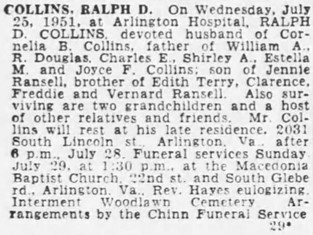
Chinn Funeral Service was established by James Elwood Chinn in Green Valley (formerly known as Nauck) in 1942. As a Black-owned funeral home operating under Jim Crow segregation, Chinn Funeral Service provided an invaluable service to the Black community when white-owned funeral homes refused to serve them.

After apprenticing with James Chinn for three years, Robert Baker, Jr. purchased the business in 1969. His twin brother Rupert soon joined him as a business partner, and they became trusted pillars of the community through their compassionate service and dedication to their neighbors, helping them through times of loss.
In an interview with the Virginia Tech Legacy Business Studio conducted in 2017, Robert’s daughter Tyra Baker – then manager of the family business – described the twins' talent for lessening the burdens of their grieving customers:

"Rupert, he had a really, I don’t know, funny sense of humor. He had a way to make you laugh and smile when you knew you don’t want to, or maybe even shouldn’t. But even in the worst times, he can make you get through it pretty easily. And my dad has always had a calming voice, and you know, I guess the whole community trusted them. So, they would come here, and my dad and Uncle Rupert would make the arrangements for them, help them out, pretty much take over, so that it was very easy for them to get through it."
Robert Baker, Jr. was deeply involved in community organizations such as the Martin Luther King Jr. Community Center, the Nauck Business Association and Shirlington Road Revitalization movement. He earned the NAACP Community Appreciation Award and was awarded Mortician of the Year by the Virginia District Morticians Association. Along with Rupert, both brothers were recipients of the Arlington Best Business Award granted by the Arlington County Board.

Chinn Funeral Service in Present day.

Chinn-Baker Funeral Service, present day. Image courtesy of Google Maps.

Today, Chinn-Baker Funeral Service still operates out of its original building and is run by the descendants of Robert and Rupert Baker. In her interview, Tyra Baker explained that although the surrounding neighborhood has changed since the business was first established, they continue to perform funerals for families that have lived in the area for many generations. “[I]f Chinn buried your grandmother, your great-grandmother, they’ll probably bury your mother and your father. We still have three churches in the area that traditionally have come to Chinn Funeral Home. So, if you are at that church, you probably will come to Chinn Funeral Home.”

Serving the community for more than 80 years, Chinn-Baker Funeral Service hopes to continue meeting the needs of Arlington’s grieving families for many years to come.

  • Tyra Baker Interview, 2017. VA 975.5295 A7243oh ser.13 no. 3.
  • “Black-Owned Businesses: Serving Their Neighbors, Who Were Unwelcomed Elsewhere.” Deeply Rooted.

Help Build Arlington's Community History

The Center for Local History (CLH) collects, preserves, and shares resources that illustrate Arlington County’s history, diversity and communities. Learn how you can play an active role in documenting Arlington's history by donating physical and/or digital materials for the Center for Local History’s permanent collection.

Do you have a question about this story, or a personal experience to share?

Use this form to send a message to the Center for Local History.

Do you have a question about this story, or a personal experience to share? 

Use this form to send a message to the Charlie Clark Center for Local History.

Center For Local History - Blog Post Message Form

Do you have a question about this story, or a personal experience to share? Use this form to send a message to the Center for Local History.

"*" indicates required fields

This field is for validation purposes and should be left unchanged.

Share Your Story

February 21, 2024 by Christopher George

  • « Go to Previous Page
  • Page 1
  • Interim pages omitted …
  • Page 3
  • Page 4
  • Page 5
  • Page 6
  • Go to Next Page »

Footer

About Us

  • Mission & Vision
  • Charlie Clark Center for Local History
  • News Room
  • Get Email Updates

Administration

  • Policies
  • Library Staff
  • Job Opportunities
  • Propose a Program or Partnership

Support Your Library

  • Friends of the Library
  • Giving Opportunities
  • Donating Materials
  • Volunteer Opportunities

Our Mission

We champion the power of stories, information and ideas.

We create space for culture and connection.

We embrace inclusion and diverse points of view.


Download the Library App

Download the Library App

Arlington County | Terms & Conditions | Accessibility | Site Map
· Copyright © 2026 Arlington County Government ·