• Skip to primary navigation
  • Skip to main content
  • Skip to primary sidebar
  • Skip to footer

Alert

Holiday: All library locations closed Fri., June 19, for Juneteenth. More Info

Alert

Update: Elevator outages, maintenance and upgrades at Central Library More Info

Alert

Storytimes Will “Take a Nap” through June 20 More Info

Home - Arlington County Virginia - Logo
MENUMENU
  • Join Now
  • My Account
    • Login
    • My Checkouts
    • My Holds
    • My Lists
    • My Reading History
    • About Borrowing
    • About Holds
    • About My Account
  • Hours & Locations
    • All Hours & Locations
    • Holiday Closings
  • News
    • Library News
    • Director's Blog
    • Get Email Updates
  • Contact Us

Arlington Public Library

MENUMENU
  • Search
  • Collections
  • Library Services
  • Events
  • Community Engagement
  • Join Now
  • My Account
    • Login
    • About Borrowing
    • About Holds
    • About My Account
  • Hours & Locations
    • All Hours & Locations
    • Holiday Closings
  • News
    • Library Blog
    • Get Email Updates
  • Contact Us

News

Edmund Campbell: Speaking Out

Post Published: February 11, 2021

Graphic image of a megaphone

Join us for a new series of stories from the Center for Local History highlighting members of our community who made a difference in ways that helped shape our history and created positive change. 

Their voices were not always loud, but what they said or did had a significant impact on our community.

Edmund Campbell

Edmund Douglas Campbell (1899–1995) was a lawyer, social activist, and Arlington County Board member who advocated for civil rights, school desegregation, and state representation according to population. Campbell vehemently opposed Virginia’s policy of “Massive Resistance” which occurred in the wake of the U.S. Supreme Court decisions in Brown v. Board of Education. In 1954 and 1955, along with his wife Elizabeth, Campbell fought to ensure that Arlington's public schools remain open by organizing the Save Our Schools Committee (comprised of parents and citizens from across Virginia) in defiance of Senator Harry F. Byrd and his allies.
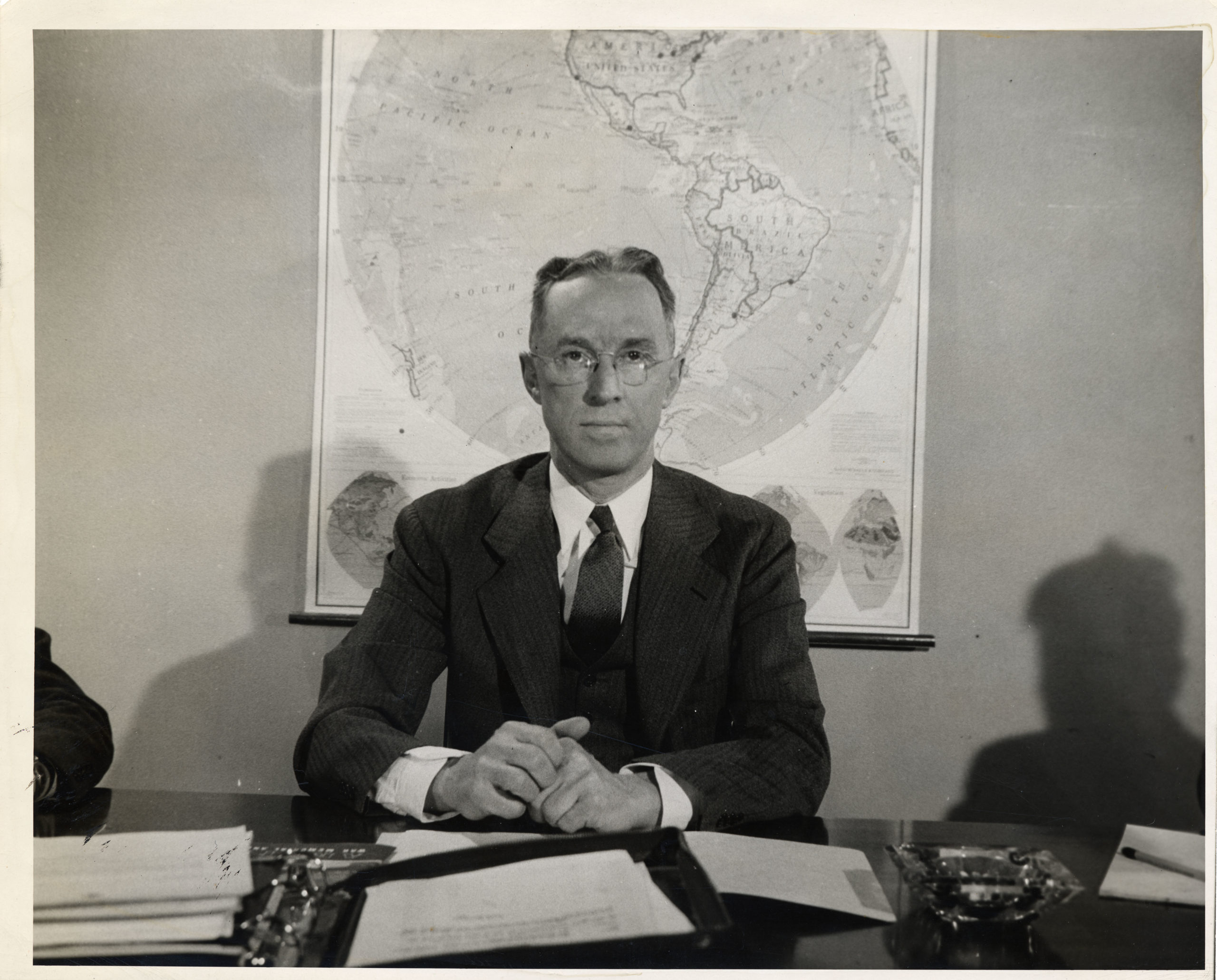
Edmund Campbell

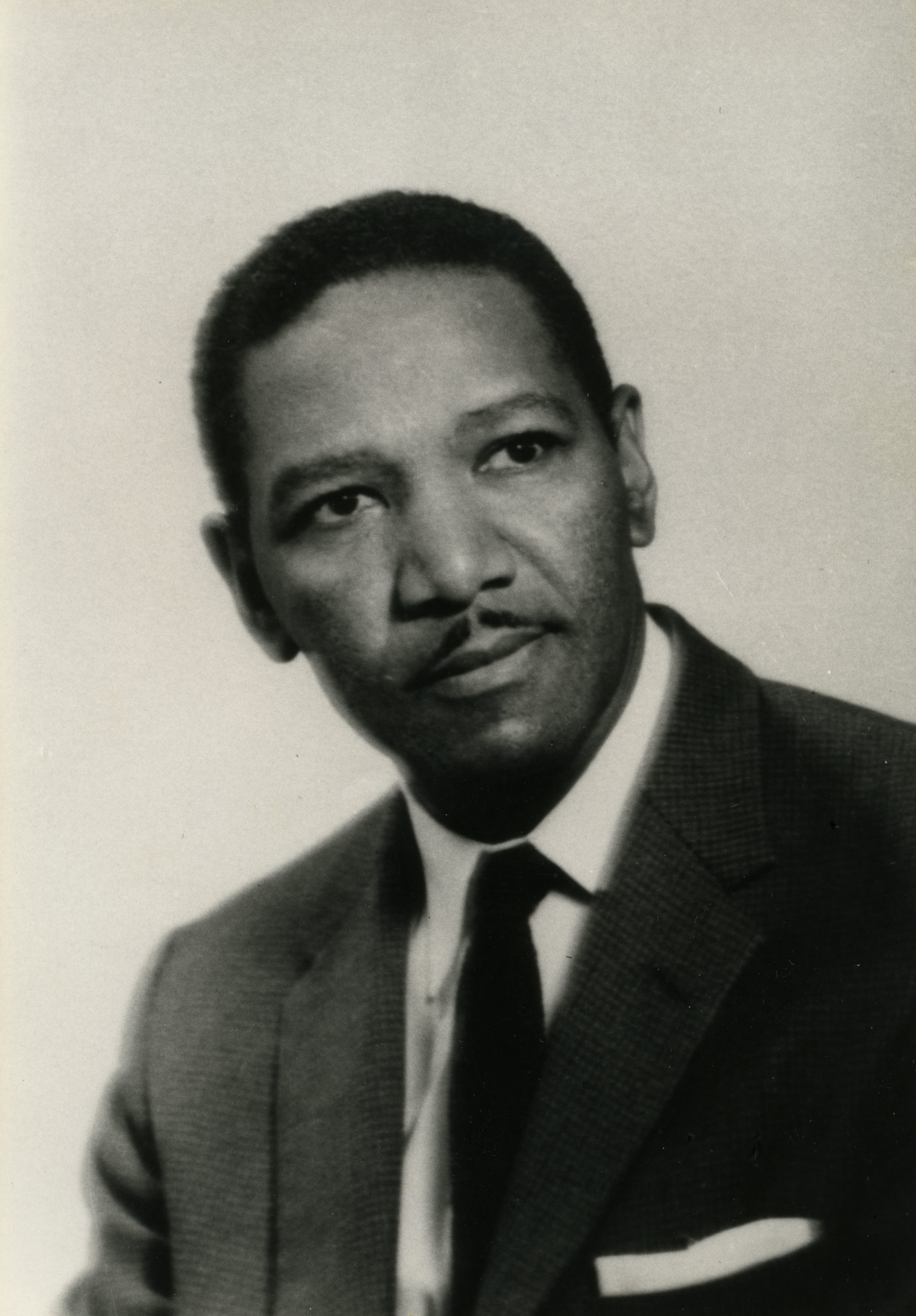
Edmund Campbell sitting at his desk, date unknown

Among his other accomplishments, in 1955, Campbell won a case that overturned a Virginia law prohibiting racially integrated seating in public places. In 1958, following the closure of schools in Norfolk, Charlottesville, and Front Royal, he successfully argued as the lead attorney in James v. Almond, finally ending Virginia's “Massive Resistance" laws that had forced the closing of all public schools which Federal courts had ordered to integrate. Following that decision, the first Black students entered Stratford Junior High School on February 2, 1959.

In the lawsuit Davis v. Mann, the Supreme Court decided in 1964 that Campbell successfully argued that Arlington and Fairfax counties were illegally under-represented in the Virginia legislature, finding that legislative apportioning gave less populated rural areas more legislative influence per voter than more densely populated Northern Virginia as a result of the 1960 census.

In his memoir “Musings of a 95-Year-Old”, Campbell said, "I could not live with myself if I did not stand up publicly for what I knew was right."

Do you have a question about this story, or a personal experience to share? 

Use this form to send a message to the Charlie Clark Center for Local History.

Center For Local History - Blog Post Message Form

Do you have a question about this story, or a personal experience to share? Use this form to send a message to the Center for Local History.

"*" indicates required fields
This field is for validation purposes and should be left unchanged.

Share Your Story

February 11, 2021 by Web Editor

Poetry by Earlene Green Evans

Post Published: February 10, 2021

Earlene Green Evans grew up and attended public schools in Arlington, Virginia, graduating from Hoffman-Boston High School. She received a B.S. degree from Saint Paul’s College in Lawrenceville, Virginia, and an M.S. degree in Library Media from Virginia State University. She worked as a middle and high school librarian until she retired.

Earlene authored a children’s book, "I Love You, Ugly Old Hag," and co-authored three educational books. They are "A Step Beyond: Multimedia Activities For Learning American History"; "Hidden Skeletons and Other Funny Stories," and "3-D Displays For Libraries, Schools, and Media Centers."

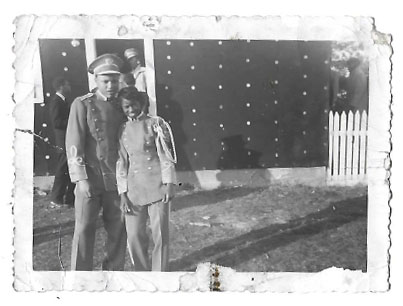
Earlene Green and Godfrey Moore 2

Earlene Green Evans and Godfrey Moore, date unknown

Earlene is a member of Pi Lambda Theta International Honor Society, Virginia Museum of History and Culture, Northwoods Civic Association, Virginia State Alumni Association, Alpha Kappa Alpha Sorority, Inc., and several committees at her church. In addition to writing, Earlene enjoys reading, sewing, and playing the flute. She lives in Henrico County, Virginia with her husband, Alga. They have two adult children and a grandson.

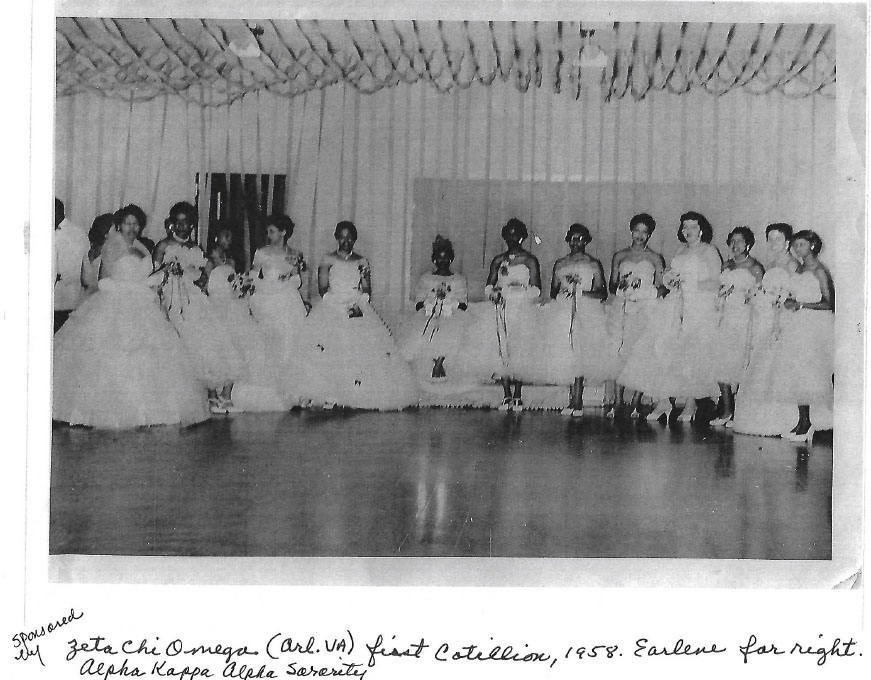
First AKA Cotillion 1958

First AKA Cotillion 1958. Image Caption says "Sponsored by Zeta Chi Omega (Arl. VA) First Cotillion, 1958. Earlene Far Right. Alpha Kappa Alpha Sorority.

Earlene Green Evans started writing the poems about four years ago, and continued to add others to the collection as time went by.  Her latest poem was written in 2019, and she still gets ideas for other poems to this day. Ms. Green writes with wit and charm about what it was like growing up during the fifties in Johnson’s Hill (now Arlington View), a predominantly African American neighborhood at that time.  

She describes the general feeling of cooperation and respect among neighbors and the good manners expected from every child; reflects on the influence that radio and television had on families, describes what school was like, popular fashion trends, what was important in the news both locally and nationally as well as what young people did for fun.

In the following poems from her upcoming poetry book, learn what it was like to go to Hoffman-Boston during "School Desegregation", what it was like to attend a high school “House Party,” and having the first “Neighborhood Television" set.

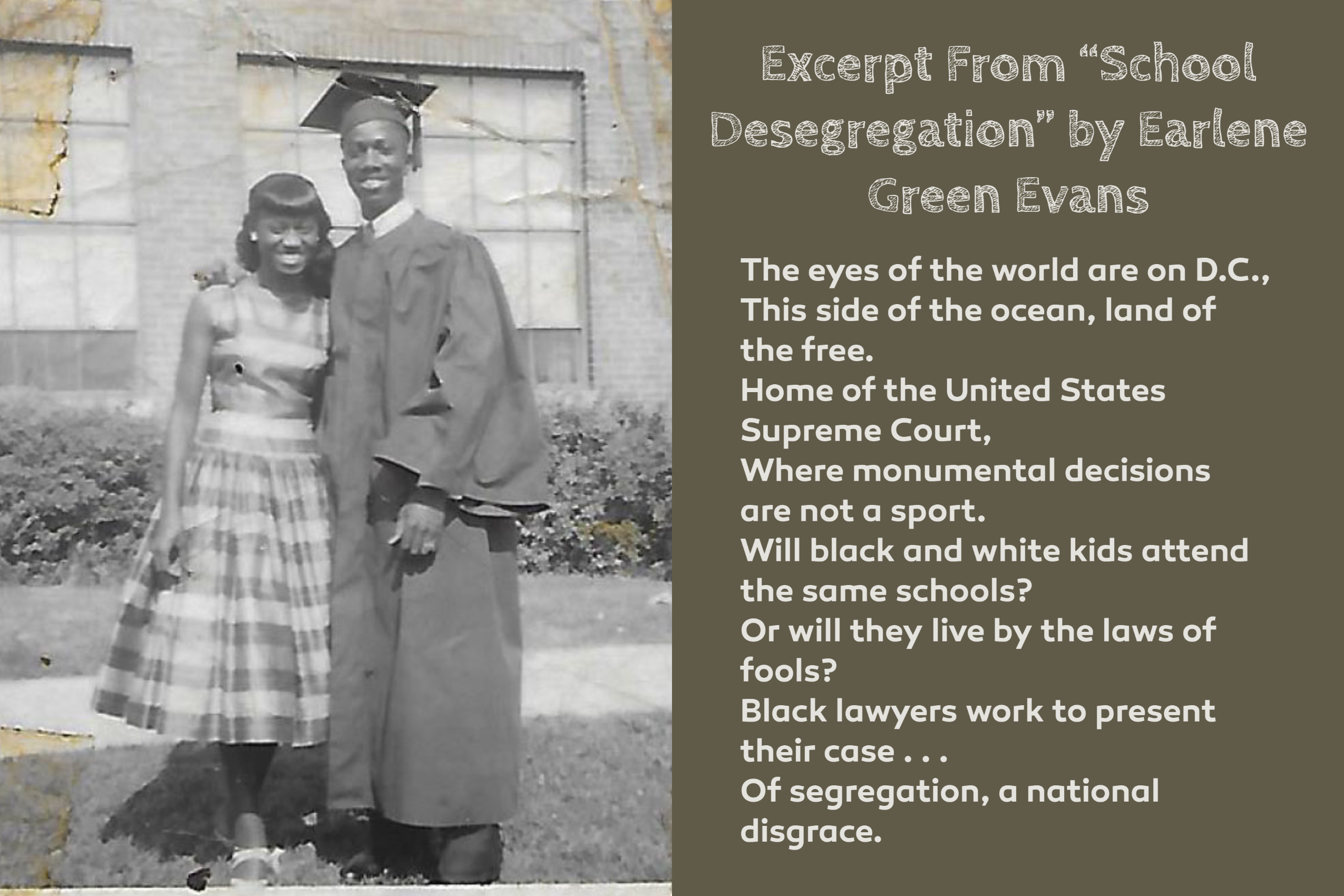
School Desegragation

EarleneEvansSchoolDesegregation

The eyes of the world are on D.C.,
This side of the ocean, land of the free.
Home of the United States Supreme Court,
Where monumental decisions are not a sport.

Will black and white kids attend the same schools?
Or will they live by the laws of fools?
Black lawyers work to present their case . . .
Of segregation, a national disgrace.

Separate, but equal cannot proceed,
Equality, regardless of race or creed.
Spottswood Robinson, Thurgood Marshall and Harold Boulware,
Aim to reverse racial laws, declaring them unfair.

They are key lawyers to Brown versus the Board,
This terrible situation will not be ignored!
A decision is made by the nine in black,
That segregationists are on the wrong track.

Now, every black child in any public school,
Will benefit from this constitutional rule.
Thanks to the judges of the highest court,
Thanks to the lawyers who challenged and Fought.

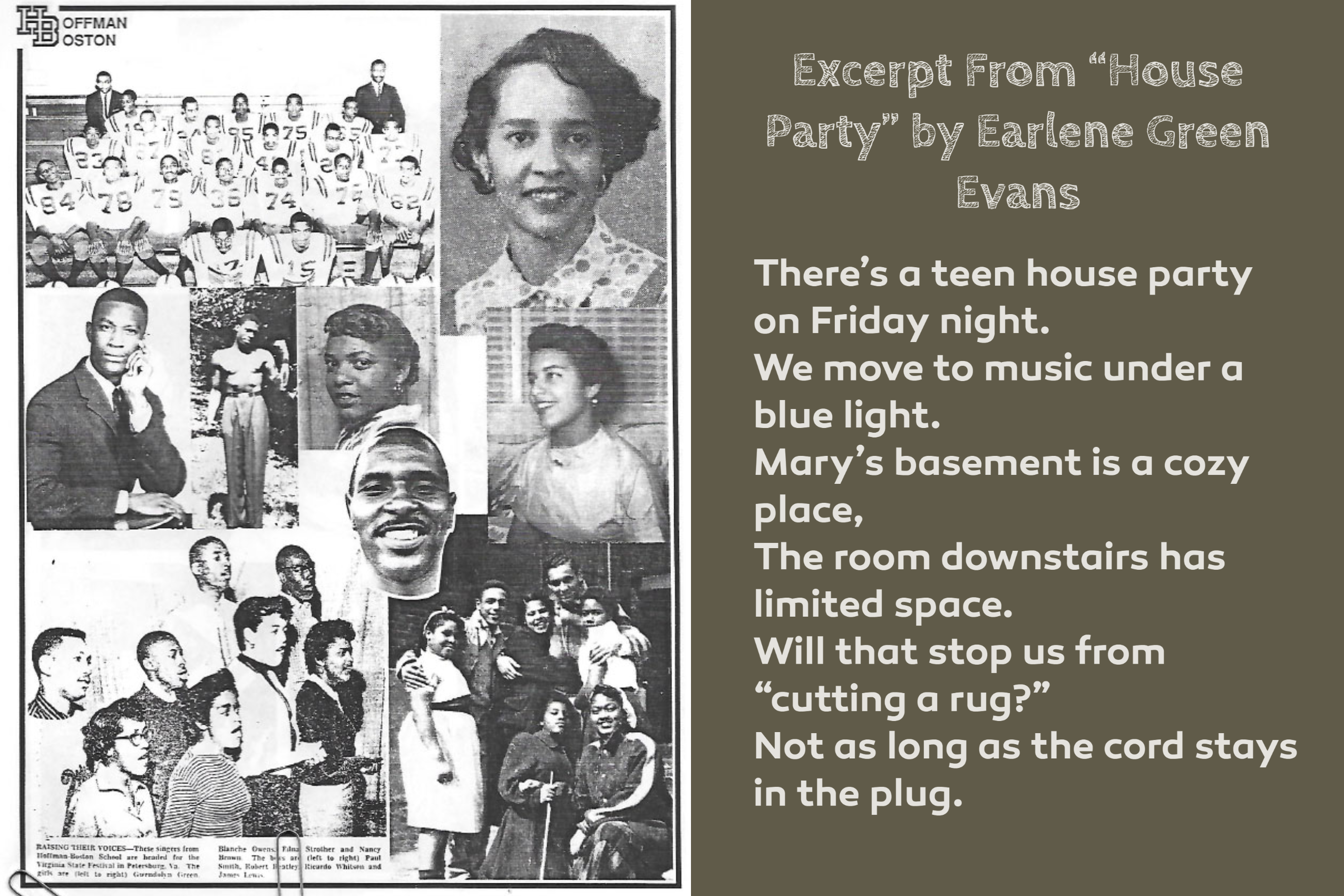
House Party

EarleneEvansHouseParty (1)

There’s a teen house party on Friday night.
We move to music under a blue light.
Mary’s basement is a cozy place,
The room downstairs has limited space.

Will that stop us from “cutting a rug?”
Not as long as the cord stays in the plug.
We bump each other, but we don’t mind,
During the “Mashed Potatoes,” and the forbidden “Grind.”

The “Uptown,” and the “Bird Land” are favorites too,
Performed by members of a Rock and Roll crew.
A scratched record makes an ugly repeat,
Moving the head forward makes the song complete.

Refreshments are provided by Pam and Jade,
We have homemade cookers and lime Kool-Aid.
Everyone stops for a kissing game,
“Spin the Bottle” and hope for your “flame.”

Dancing continues, fast and slow,
Cheers to the couple who “takes the floor.”
The party is fun until Mary’s parents appear,
And remind us that the end is near.

On the last record, we do a slow-moving dance,
And steal a little kiss, taking a chance.
Then tell Mary, our house party host,
We enjoyed the evening to the utmost!

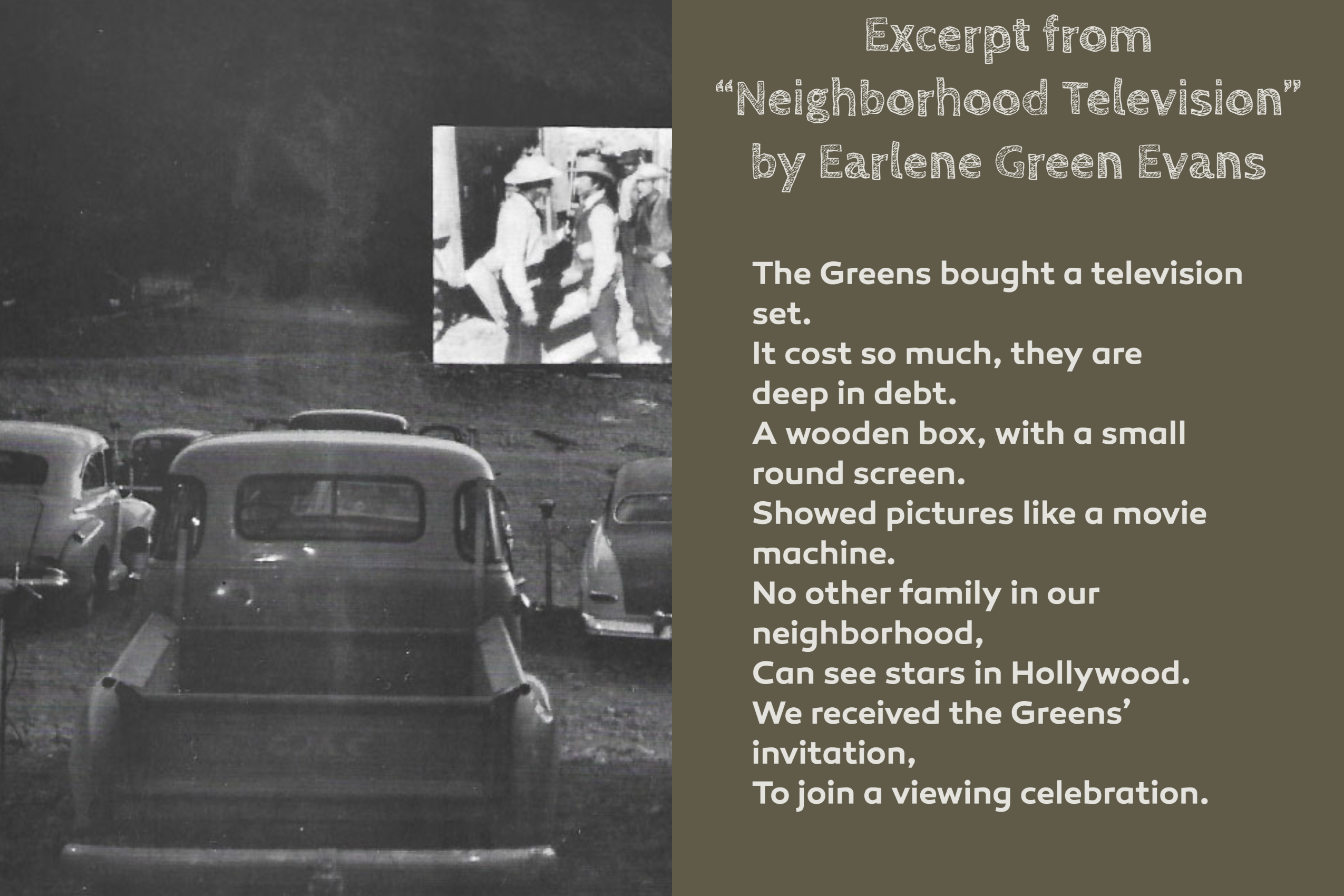
Neighborhood Television

EarleneEvansNeighborhoodTelevision

The Greens bought a television set.
It cost so much, they are deep in debt.
A wooden box, with a small round screen.
Showed pictures like a movie machine.

No other family in our neighborhood,
Can see stars in Hollywood.
We received the Greens’ invitation,
To join a viewing celebration.

We gladly accepted and rushed next door.
Neighbors were sitting all over the floor.
The large crowd squeezed one another,
Lacking air, we thought we would smother.

Bodies were twisted, and turned just right,
To behold a show in black and white.
Eyes bulged and mouths dropped wide.
To see what a TV would provide.

The Lone Ranger chased a mean outlaw.
We joined the action with a big, “Hurrah!”
He took out his lasso, aimed it, and threw,
As zigzag lines interrupted our view.

Mr. Green turned knobs from left to right,
The lines on the screen were an awful sight.
We were calm and patient; we had to wait.
After a minute, the picture was straight.

The lasso missed as the picture started to roll,
This interruption was harder to control.
Frustrated, Mr. Green turned different knobs.
We shifted, squirmed, and suppressed our sobs.

When the rolling stopped, we read on the screen,
Words that could spark a mad mob scene.
The message was clear, it made us shriek . . .
“Tune in to The Lone Ranger again next week!”

February 10, 2021 by Web Editor Tagged With: Hoffman-Boston

Oral History: The First Students to Desegregate Arlington Public Schools

Post Published: February 4, 2021

Interviews with Lance Newman and Michael Jones

Arlington Voices the Oral History Collection

Oral histories are used to understand historical events, actors, and movements from the point of view of real people’s personal experiences.

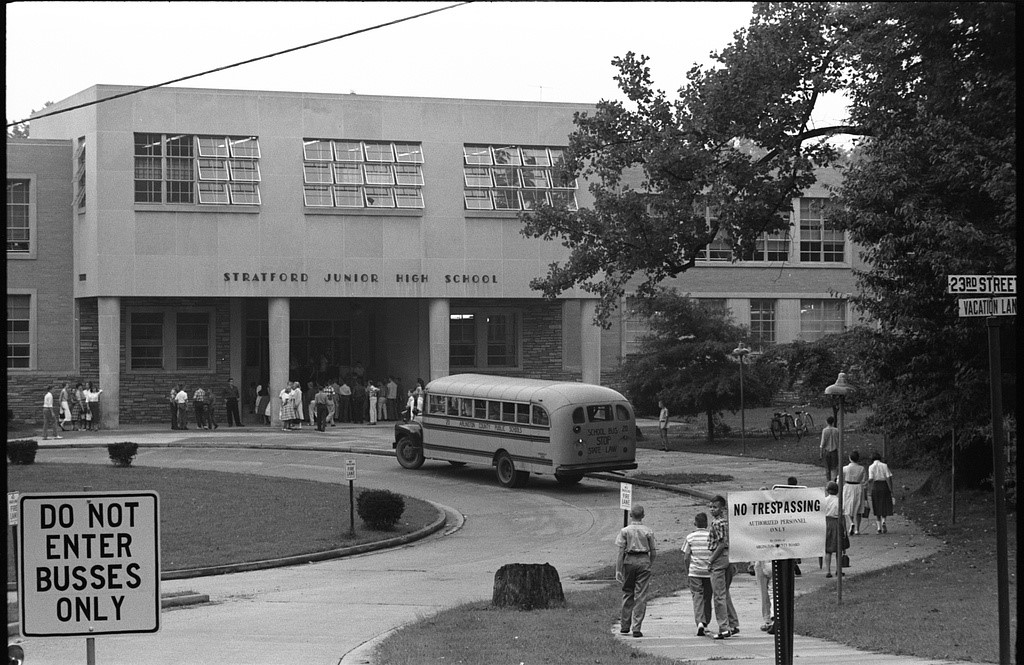
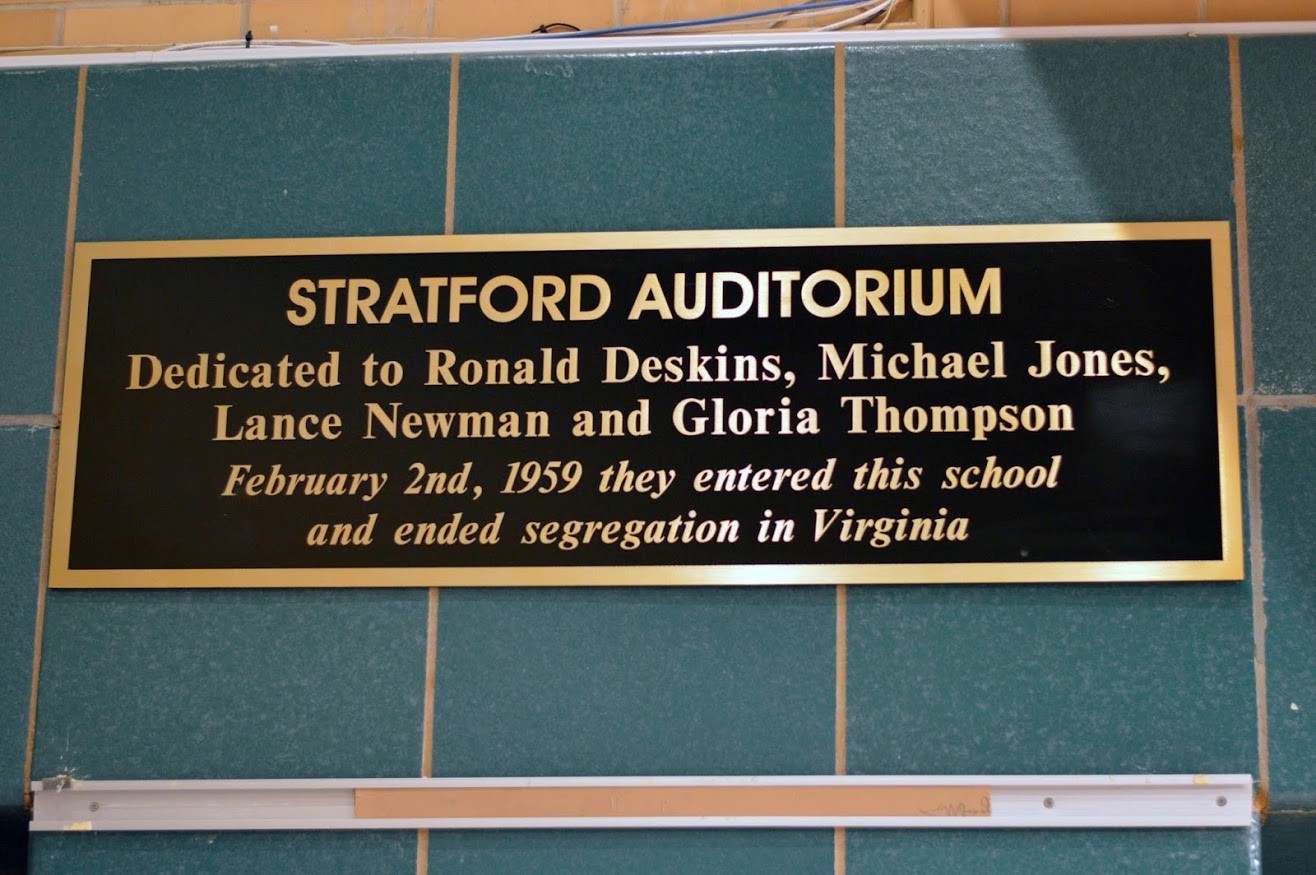
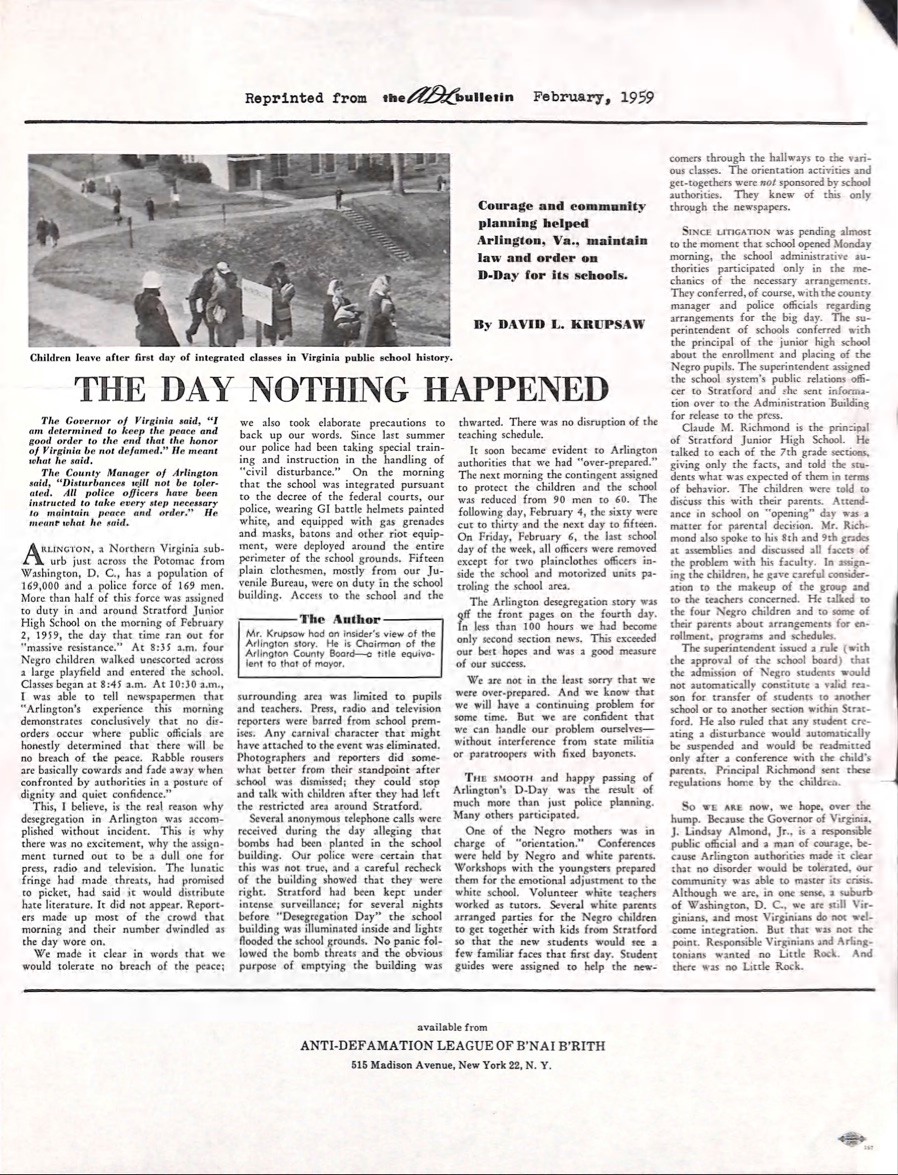
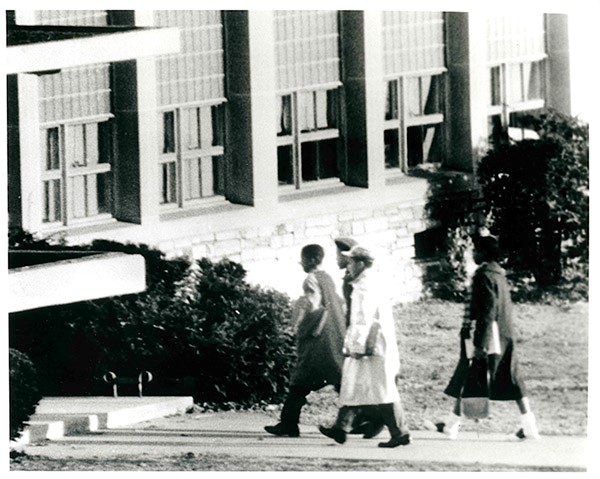
This week marks the 62nd anniversary of the desegregation of Arlington Public Schools. On February 2nd, 1959, four students – Lance Newman, Michael Jones, Ronald Deskins, and Gloria Thompson – entered Stratford Junior High School, making them the first students to desegregate any public school in Virginia.

1959 Article

This 1959 article from the Anti-Defamation League describes the first day of integrated school at Stratford Junior High School in Arlington and the preparations that had been made to make a smooth transition.

This momentous event was the culmination of decades of work from activists and community members who navigated both legal action and other acts of protest to reach this landmark decision.

In the following oral history interviews, Lance Newman (1946-2018) and Michael Jones describe their experiences attending Stratford, what the preparation leading up to February 2nd looked like, and their experiences growing up in the close-knit community of Hall’s Hill. In this segment, Newman and Jones discuss their first days at Stratford.

Narrator: Lance Newman
Interviewer 1: Judith Knudsen
Interviewer 2: Joanna Dressel
Date: February 13, 2016

https://library.arlingtonva.us/wp-content/uploads/2021/02/Newman_Lance_20160213.mp3
Use

From left to right, Michael Jones, Lance Newman, Ronald Deskins, and Gloria Thompson entering Stratford Junior High School on February 2, 1959.

Judith Knudsen: Let’s go back to that first day and describe the first day.

Lance Newman: Okay. Let’s see. I remember getting up, getting ready, and I think my mom was—she was probably—she told me later she was a nervous wreck.

JK: I’m sure.

LN: Yeah. And I was kind of. I wasn’t—because I was there with my buddies. Actually, Ronnie and Michael and I were really good friends because we played softball together. Gloria—I knew Gloria, but I kind of felt sorry for her because she was the only girl. But so, we went down, and we all gathered at Ronnie Deskin’s house. And there were reporters there and then all the people—community leaders. And then, we sat around and they took pictures. We got some pictures, then we piled into Mr. Jones’ car and went down to Stratford, and I guess on Old Dominion Drive they let us out, and we went—we actually went in the back of the school, not the main entrance at the front. I remember going down and getting off—crossing Old Dominion Drive. They had blocked it off—and then walking down the long pathway near the football field and tons—well, it seemed like just a gauntlet of Arlington County police. They were in their riot gear with helmets and their riot gear.

LN: And actually, we were walking in by ourselves. They purposely had us come after school started, so we just went in. We went into the central entrance near the flagpole in the back, went to the principal’s office, Mr. Richmond. They sort of had—they had a conference and they told us what to expect and all of this, tried to calm us, I guess. And then we were escorted down to our first class, and I remember going into—well, he was—my math teacher was Mr. Marks—and going into the class and seeing about thirty or—thirty all-white faces, and it was kind of tense. He was pretty good because he shook our hands and stuff and said, “Kids, this is—” and had us sit down. He had a seat and a desk for us. It was right upfront.

LN: And that was a Monday, I believe. Yeah, it was a Monday. And then, the next day—I mean it went okay. That class—and then I remember the first-period bell ringing and going out in the hallways, and Stratford was a lot bigger than HB*. I went to HB first. And I was going out in the hallway and seeing this mass of humanity changing classes, and people were kind of—pretty much—I think they were kind of staring. People were kind of—you know—wanted to ignore us. But it was tense, and then that day after school, we went back to—I guess actually we went back to my house, and then we had this press conference with the—and I remember the Washington Post and the local television stations were there and had big cameras set up, and a guy interviewed us.

*Note: Hoffman-Boston was, until 1964, the only high school for African American students in Arlington. It remained open until its final graduating class in 1964 and reopened as an elementary school in 2000.

Narrator: Michael Jones
Interviewer: Judith Knudsen
Date: July 17, 2016

https://library.arlingtonva.us/wp-content/uploads/2021/02/Jones_Michael_20160617.mp3
Stratford Junior High

Stratford Junior High School, 1959. Image courtesy of the Library of Congress.

Judith Knudsen: So, what do you remember about the day when you—when it happened? What was—?

Michael Jones: You know, the further we get away the furthest—the more I forget. The only thing I remember is getting up early that morning and crossed my mind—they dressed me and made my hair and all that—made sure my hair and everything was looking good—nice long coat and everything. We were to meet at Ronnie’s house, and then—our house is right where I stayed—my mother lives now. So, Ronnie’s house is in apartments. Well, I’m two minutes away—just across the street—and you go down to his apartment there. So, we went to his apartment, and someone drove us around—drove us to the school. Now, my recollection—and I talked to Ronnie and Lance, and they think it’s different. I always thought—and it’s too bad it’s not to the day where I could—where it would be on YouTube. I could just look it up.

JK: Exactly.

MJ: Yeah. But I always thought we went into our—Vacation Lane—went in that way, straight down that little street there and went up the steps. But they said we went in the other way. But I don’t know. I guess somebody’d go to—but anyway, went in there and we met with Mr. Claude Richmond for a while.

JK: He was the principal.

MJ: He was the principal at the time. He met with us maybe—I guess less than a half an hour before we went into class, and Ronnie and Lance were together, and me and Gloria were together. I think now that’s because Ronnie and Lance went to the Methodist church at the time. Gloria and I went to the Baptist church. So, I think that’s why they put us together in classes. And we went to the first class and—

JK: What was that like?

MJ: I don’t know. You know what? I can not—I don’t remember anything that stood out negative. So, to me, it was just a normal class. We went in there, and I guess I didn’t know anybody, which was difficult when you go—most classes—

JK: Of course. New class.

MJ: Yeah, yeah. I mean, I didn’t know anybody, so when we went into class, I guess we sat pretty close to each other, and that was it. Came out. I guess we had a ride home that first week or so—something like that. Or maybe first—maybe—I don’t know. Came home and it was—it was up. Fairly uneventful year. The only thing that I can think about that first year is some guys used to call us names in the hall, and that’s it. But nothing even bad as you see today—getting beat up or anything—and I guess because the focus—everybody knew the focus was on us at the time. If anything happened, it would be negative on not only them but the school, the state, and everybody else. So, nothing happened, it was uneventful except for those.

JK: And did—my understanding was that you stayed in the same class for all the classes. I mean, you changed classes, but you had the same group, so it was the same group all the way through the day.

MJ: Yeah. Correct. Right. I don’t remember me being in the class by myself that first year. I think Gloria was in all my classes I had.

Michale Jones and Lance Newman

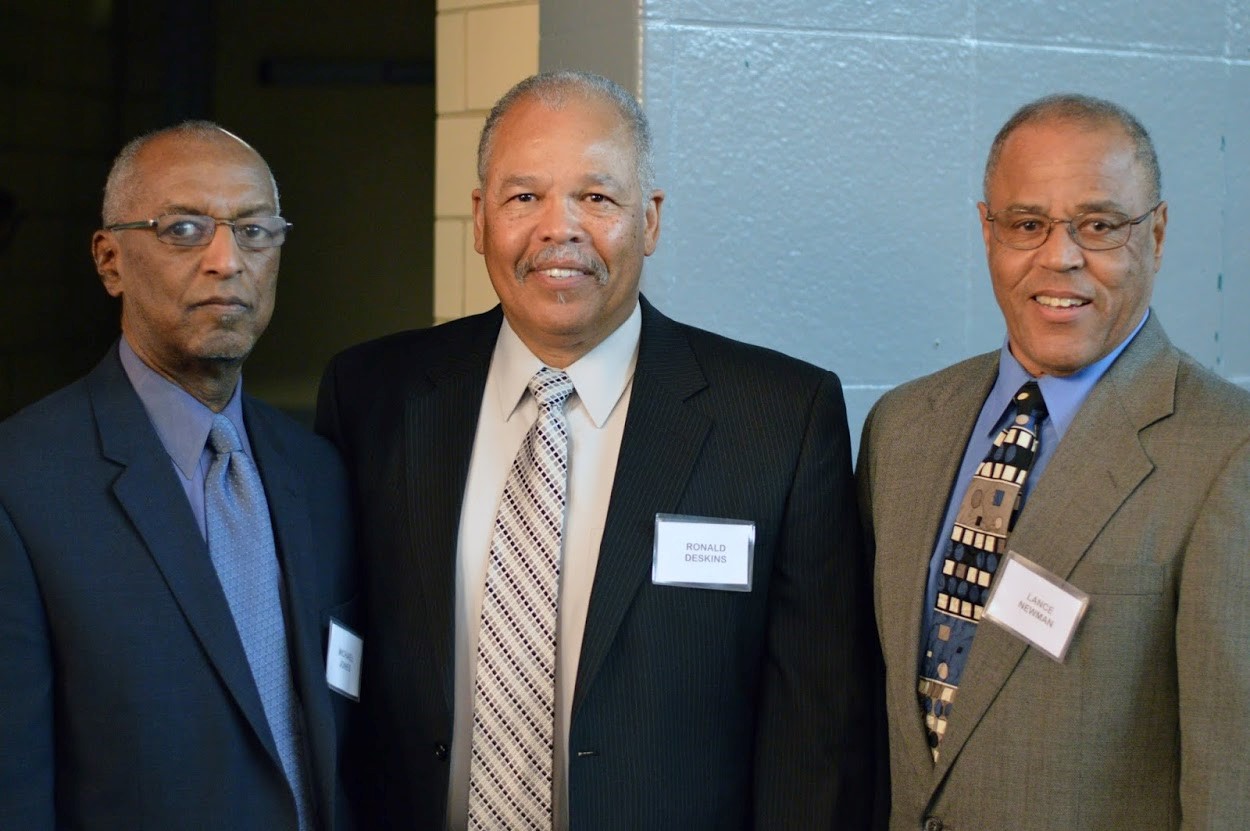
From left to right, Michael Jones, Ronald Deskins, and Lance Newman at the February 2, 2016, County event, “An Evening to Celebrate Arlington’s History Makers.” Photo by Blake Tippens.

Stratford Auditorium

A plaque dedicating the Stratford Auditorium, February 2, 2016. Photo by Blake Tippens.

Learn more:

”The Story of Arlington Public School Desegregation,” tells a detailed narrative about the history of the desegregation of APS

”Oral History: Desegregation of Arlington’s Public Schools” and “A Fight for Educational Equality: Civil Rights Activist Dorothy Hamm” both detail the life and work of Dorothy Hamm, who led the efforts to desegregate APS

Project DAPS is a digital exhibit featuring nearly 2,000 digitized documents and stories related to the desegregation of Arlington Public Schools from the Arlington Public Library’s Community Archives

”Back to Stratford: Honoring Arlington’s History Makers” features a panel discussion with Michael Jones, Lance Newman, Ronald Deskins, and other community members about the desegregation process and it's legacy

The goal of the Arlington Voices project is to showcase the Center for Local History’s oral history collection in a publicly accessible and shareable way.

The Arlington Public Library began collecting oral histories of long-time residents in the 1970s, and since then the scope of the collection has expanded to capture the diverse voices of Arlington’s community. In 2016, staff members and volunteers recorded many additional hours of interviews, building the collection to 575 catalogued oral histories.

To browse our list of narrators indexed by interview subject, check out our community archive. To read a full transcript of an interview, visit the Center for Local History located at Central Library.

February 4, 2021 by Web Editor

George Melvin Richardson: Taking a Stand

Post Published: January 28, 2021

Graphic image of a megaphone

Join us for a new series of stories from the Center for Local History highlighting members of our community who made a difference in ways that helped shape our history and created positive change. 

Their voices were not always loud, but what they said or did had a significant impact on our community.

George Melvin Richardson

George Melvin Richardson (1913-2015) was an African-American educator, school principal, WW II U.S. Army officer, and civic leader. Born in Oklahoma, Richardson graduated from Langston University, Oklahoma’s only historically Black college, and then attended Columbia University in New York where he obtained a master’s degree.

George Richardson, Secondary School Administrator Arlington, VA

A subsequent series of positions in education and public schools in Oklahoma helped lay the groundwork for what was to become a lifetime of educating and mentoring students in his community. After being drafted during WW II, Richardson was stationed in Italy, where he was an Army lieutenant and captain.

Upon returning to the U.S., Richardson and his wife moved to Arlington County where he served as principal of the all-Black Hoffman-Boston High School from 1951 until its closure in 1964. Noticing that Hoffman-Boston lacked many of the facilities and resources of other Arlington County schools, Richardson worked tirelessly to improve and expand the school. In an oral history conducted by staff of the Center for Local History, Richardson said that Hoffman-Boston “wasn’t equipped as well as other schools. Our science department wasn’t equipped as well...We didn’t have an auditorium – the building was not adequate.” His air of quiet authority and steely determination deeply impacted both colleagues and students.

“Hoffman-Boston School,” Richardson said, “There’s a golf course there. The kids will leave their lunch period and won’t come back…They’d go there (and caddy) and get little sandwiches and so forth… I said “You’re here for school. And you’re here for this number of hours.”… I went to the golf course and I told them that I didn’t want them to employ these kids…they belong in school and not at a golf course. So they stopped that.”

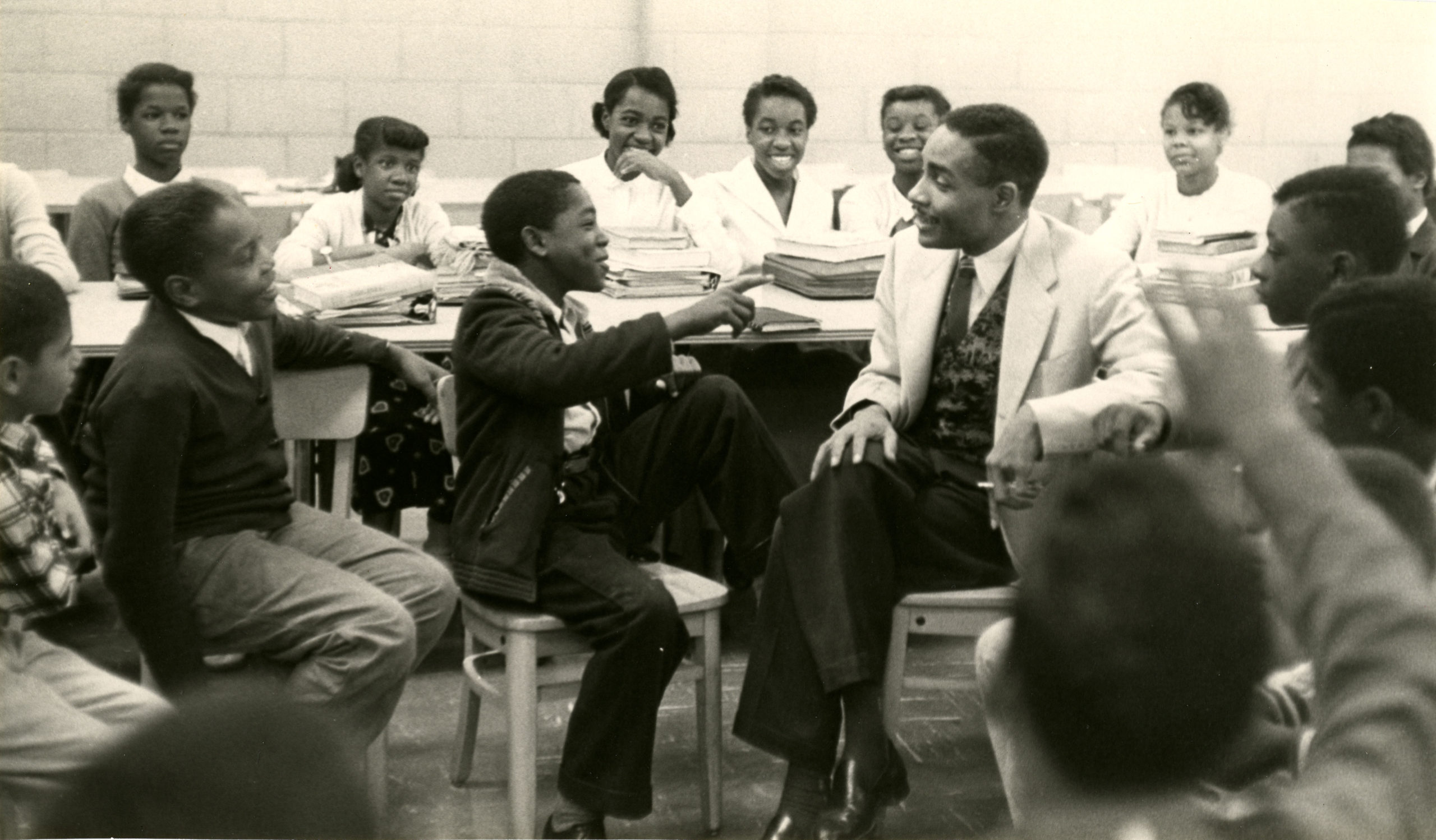
George Richardson talking with several younger Hoffman-Boston students.

George Richardson talking with several younger Hoffman-Boston students.

Richardson was also a pivotal figure in helping to create the Arlington View Neighborhood Conservation Plan (one of the first in the county) and was a member of the executive board of the Arlington Committee of 100. After Hoffman-Boston closed in 1964, Richardson became an assistant principal at Wakefield H.S. and served as an educator in Montgomery County, MD. before retiring to Oklahoma.

Richardson received the Charles P. Monroe Civil Rights Award from the Arlington branch of the NAACP, was inducted into the Wakefield High School Hall of Fame, and received the Outstanding Community Service Award from the Greater Washington Urban League.

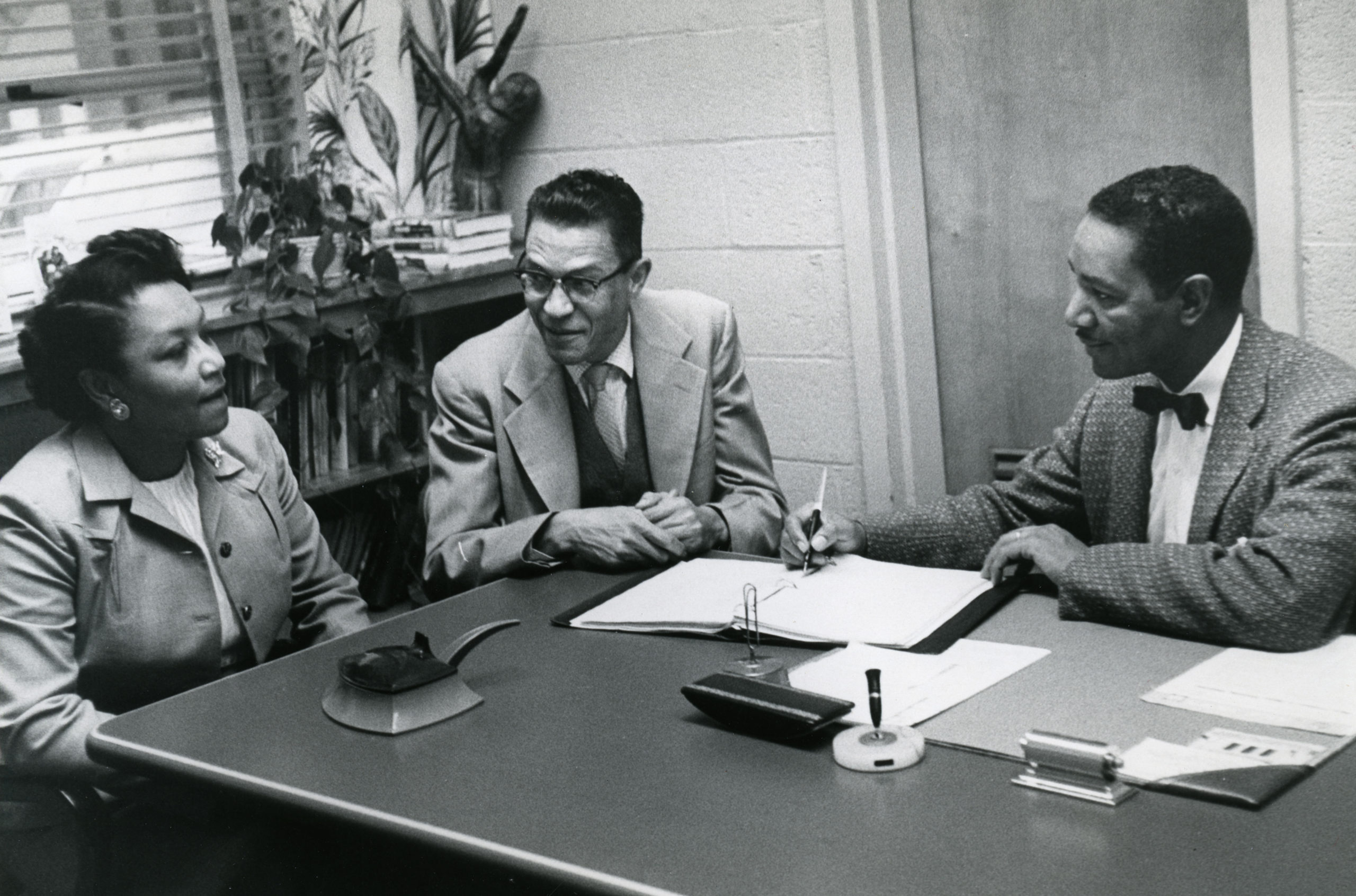
Assistant Principal, Counselor, Mr Richardson

George Richardson, right, with the Assistant Principal and councilor at Hoffman-Boston, seated at a table.

Do you have a question about this story, or a personal experience to share? 

Use this form to send a message to the Charlie Clark Center for Local History.

Center For Local History - Blog Post Message Form

Do you have a question about this story, or a personal experience to share? Use this form to send a message to the Center for Local History.

"*" indicates required fields
This field is for validation purposes and should be left unchanged.

Share Your Story

January 28, 2021 by Web Editor Tagged With: Hoffman-Boston

John Robinson: Taking a Stand

Post Published: January 14, 2021

Graphic image of a megaphone

Join us for a new series of stories from the Center for Local History highlighting members of our community who made a difference in ways that helped shape our history and created positive change. 

Their voices were not always loud, but what they said or did had a significant impact on our community.

John Robinson

John Robinson (1934-2010) was a dedicated community activist who chose to stay and work in the Green Valley neighborhood where he was born and grew up.  He attended Howard University, served in the U.S. Army, and worked briefly with Martin Luther King.  Inspired by King and his work, he founded and was director of the Dr. Marth Luther King Jr. Community Center in Green Valley for over 40 years.

John Robinson 2

A strong believer in equal rights for all, Robinson provided help to those in need whatever their race or age, twenty-four hours a day, seven days a week.  The Center organized clothing and food drives, provided counseling on drug abuse and assistance for low-income people living in Green Valley, as well as other educational programs.

He was there for the community whether it involved drug-related issues, gang violence, or neighborhood conflicts, and his door was always open, sometimes even providing shelter for the homeless in the Center, especially during the winter.

For four decades, Robinson published the Green Valley News, often distributing it door-to-door himself, to help keep residents informed of events in this predominately African-American neighborhood.

John Robinson receiving an award.

John Robinson

Over the years Robinson was recognized for his many achievements from organizations such as the Northern Virginia Branch of the Washington Urban League, Arlington Branch of the NAACP, Alpha Phi Alpha Fraternity, and was a recipient of the William L. Winston Award, the highest honor bestowed by the Arlington County Bar Foundation.  He was also instrumental in the planning of the Arlington County Action Program in the 1960s.

Robinson died in 2010 at age 75. In. 2020, the Arlington County Board officially named the town square in Green Valley the John Robinson, Jr. Town Square in his honor.

John Robinson Town Square

Rendered image of the John Robinson, Jr. Town Square 

Do you have a question about this story, or a personal experience to share? 

Use this form to send a message to the Charlie Clark Center for Local History.

Center For Local History - Blog Post Message Form

Do you have a question about this story, or a personal experience to share? Use this form to send a message to the Center for Local History.

"*" indicates required fields
This field is for validation purposes and should be left unchanged.

Share Your Story

January 14, 2021 by Web Editor Tagged With: Green Valley

Notes on the Arlington Symphony

Post Published: January 7, 2021

Between 1945 and 2005, Arlington County was home to the renowned Arlington Symphony, organized and maintained as a volunteer effort by members of the community.

Over its 60-year run, the symphony performed a wide variety of music across the County and was one of Arlington's first, and longest-running, arts organizations.

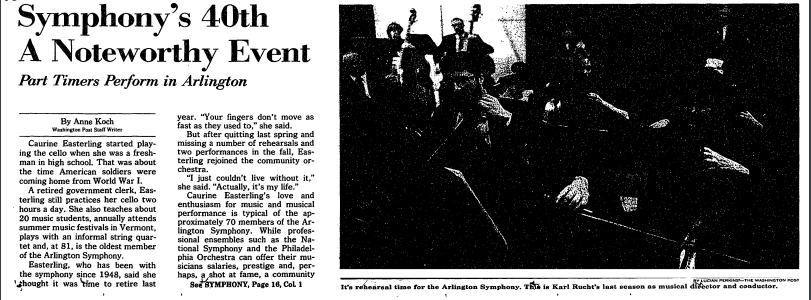
Excerpt from Wash Post

Excerpt from the Washington Post’s 40th-anniversary feature on the Arlington Symphony. Image courtesy of the Washington Post.

First Movement

The Arlington Symphony was organized in the years following World War II, providing a source of respite from the turmoil of the wartime years.

Van Lier Lanning – an Arlington resident – was the leader of these initial organizing efforts. Lanning had also organized and directed the War Production Board orchestra during WWII. Lanning’s vision was to establish a suburban orchestra. This dream materialized in late 1945 as local citizens began to sign on to establish what was called a “civic orchestra.”

A volunteer group of Arlingtonians formed a Steering Committee and recruited players, who also chipped in $10 apiece for the purchase of sheet music. Ellis Chasens, former concertmaster of the War Production Board Orchestra, signed on as the Arlington Symphony’s first concertmaster.

Opening Night

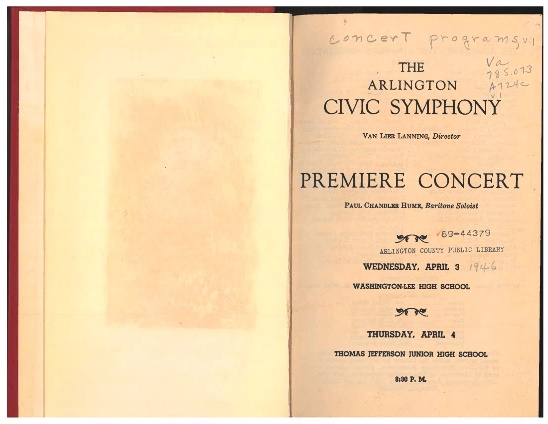
Program Excerpt 1
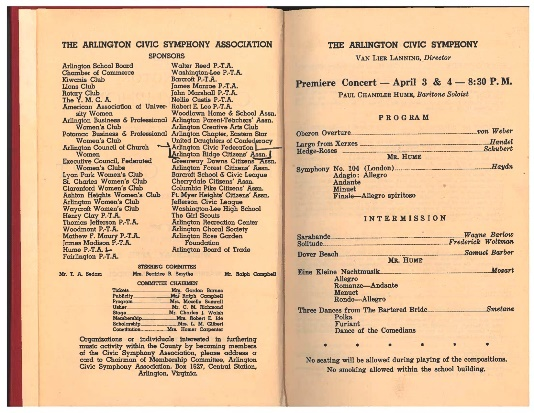
Program Excerpt 2

Program excerpts from the Arlington Symphony’s first concert on April 3, 1946.

The premiere concert took place on Friday, April 3, 1946, at Washington-Lee High School (now Washington-Liberty). This opening night featured baritone soloist Paul Hume,  who went on to serve as the Washington Post’s music critic. The evening was a resounding success, and a second performance followed the next evening. Another performance in June followed, and by fall 1946, plans for a full program were underway.

A program of eight concerts was approved for the following year: four of them would be evening, adults-only, concerts and four would be Sunday afternoon children’s concerts, followed by performances of a youth orchestra. This set the pattern for the orchestra’s early schedules.

Tickets in this first program year were 75 cents for the adult concerts and 30 cents for the children’s concerts. From 1951-1968, programming was free, but tickets were reinstated in later years to accommodate for budgeting gaps.

Numerous conductors served in these early years, but by the 1954-1955 season, the position went unoccupied due to insufficient funds for the part-time work. Later that year, John Wigent signed on to the job. Wigent, a trained clarinetist and double bassist, had previously served as Harry Truman’s pianist and as an organ player at the Arlington Temple in Rosslyn. Karl Rucht signed on as the next director, where he served for more than 15 years. Rucht was known for his drama, flare, and “spectaculars” – including full concert versions of operas, special soloists, and concerts with more than 300 performers on stage.

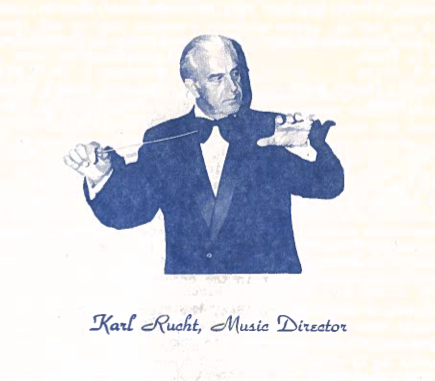
Karl Rucht

Karl Rucht, the Arlington Symphony’s Music Director from 1960-1985.

Style and Substance

One of the Symphony’s signature elements was solo performers, who were featured in the hundreds over the course of the symphony’s seasons. The soloist program was not only a chance to highlight talent, but it also broadened the scope of the Symphony, as they included performers from across the nation and abroad. One of the Symphony’s most popular soloists was Evelyn Swartout, who performed four consecutive years in a row.

The soloist program was also a way to incorporate younger members of the Arlington community, who were sometimes selected from the Association’s scholarship program. In the 1940s, public education in music was limited, and the Symphony filled this gap with its musical programming, even as the move toward public music courses increased in later decades.

Organization and Funding

The Symphony Association, County government, and other civic and social groups often worked together to help support the group’s artistic efforts. Spaces for rehearsals and concerts were provided by the School Board for no or reduced fees, and in 1966, members of the Association met with County Manager Bert Johnson, who provided $3,600 in funding from the County budget. This arrangement lasted for much of the symphony’s lifetime, increasing over the years due to inflation. Other fees were supplemented by Association fundraising and external grants.

The Association’s Board of Directors was incorporated in 1966 and consisted of 26 to 30 members. The group was augmented and supported by a Women’s Committee for the Symphony, as well, which consisted of 114 members by 1980.


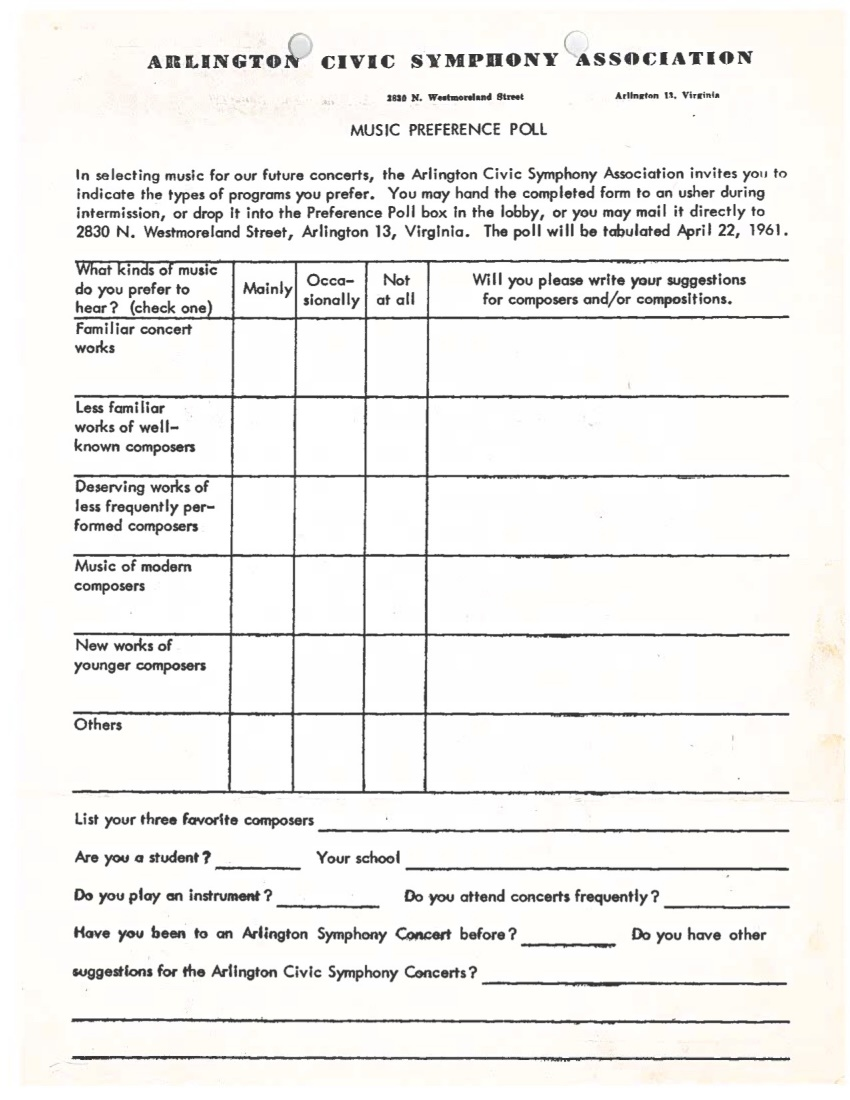
Music Poll

Music preference poll sent out by the Arlington Civic Symphony Association in April 1961.

In 1980, March was designated as “Arlington Symphony Month” by the Arlington County Board.

In 1985, the Arlington Symphony celebrated its 40th anniversary – among its members that season was a 40-year veteran of the symphony, Caurine Easterling. A write-up on the event in the Washington Post notes the symphony’s range of ages – from teenagers to octogenarians – and also notes that this was the final season Karl Rucht served as musical director.

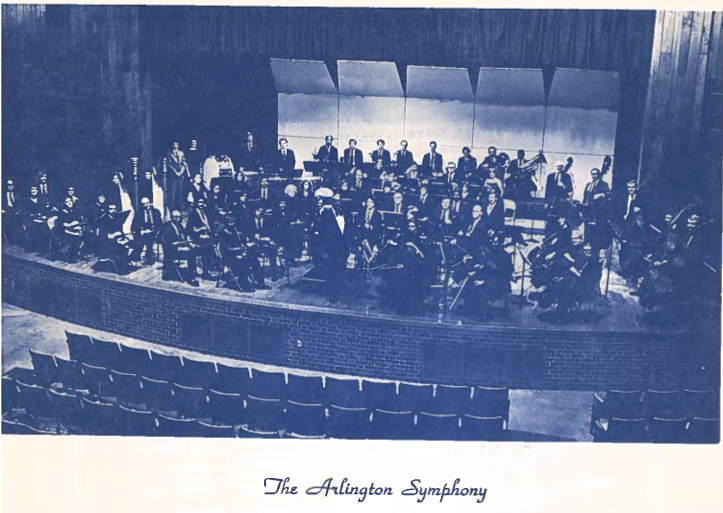
Photo of Symphony from 1980

Photo of the Arlington Symphony, from “The Story of the Arlington Symphony Association: Trials and Triumphs of a Volunteer Effort,” published in 1980.

Final Act

The Arlington Symphony came to a close in 2005 after declaring bankruptcy. Its final music director was Ruben Vartanyan, who served with the symphony for 13 years. In 2006, a group of former Symphony members joined together as the Arlington Philharmonic, and Vartanyan directed the new group’s inaugural concert, leading a performance of Tchaikovsky's Serenade for Strings, Op. 48.

Arlington is still home to the Arlington Philharmonic, as well as the Arlington Concert Band and many other classically-focused musical groups and other musical organizations.

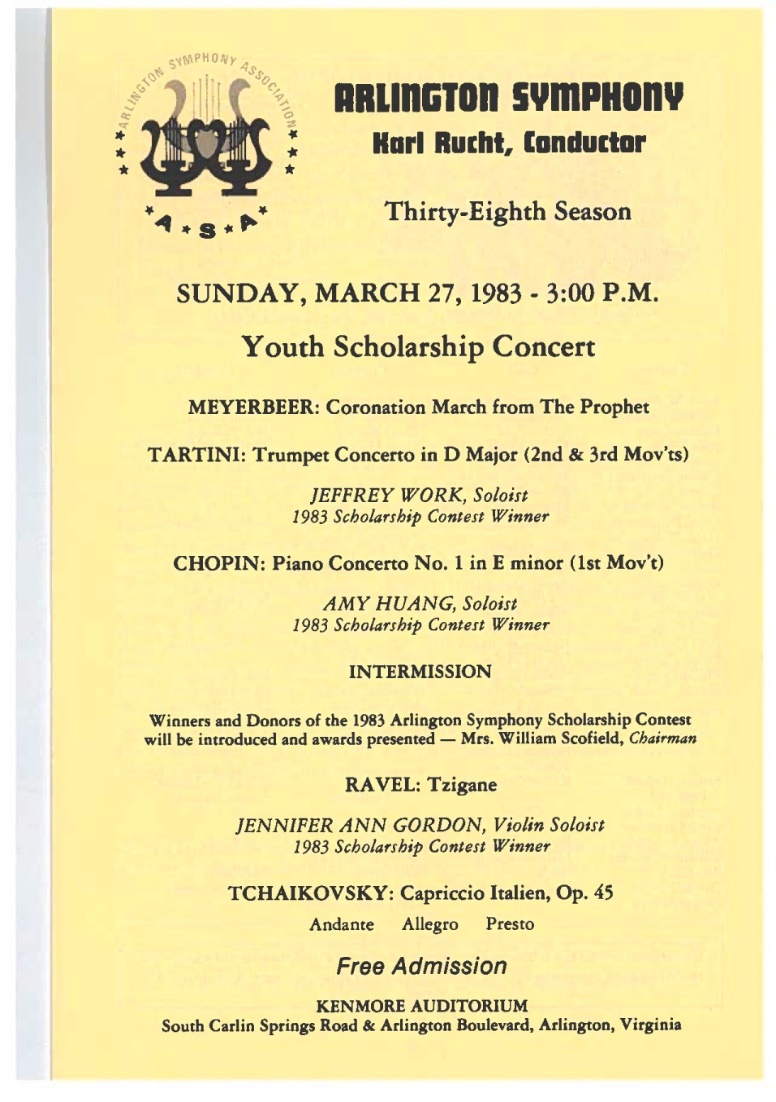
1983 Youth Scholarship Concert Program

Program for a 1983 Youth Scholarship Concert held by the Arlington Symphony.

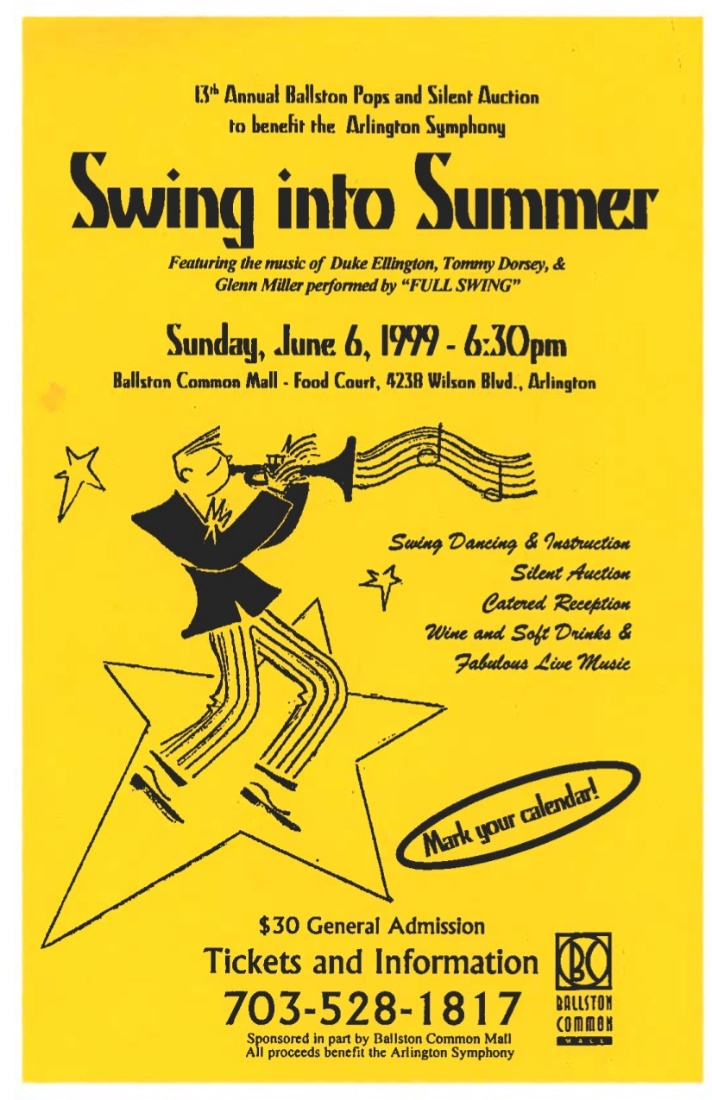
Ad for Symphony

Advertisement for the Arlington Symphony’s 1999 “Swing into Summer” benefit concert.

Want to learn more? Arlington’s Center for Local History holds records of the Arlington Symphony in RG 54, and documents related to the Arlington Symphony are also available in RG 57, the personal papers of Hugh Johnson, who served as one of the Symphony’s presidents.

CLH also has an oral history interview in its collections with Theodore and Jean Taylor, where the couple describes the early days of the symphony and their involvement in the group, including Jean Taylor’s role as president of the Women’s Committee.

To learn more about Arlington's history, visit the Center for Local History on the first floor of the Central Library.

Do you have a question about this story, or a personal experience to share? 

Use this form to send a message to the Center for Local History.

Center For Local History - Blog Post Message Form

Do you have a question about this story, or a personal experience to share? Use this form to send a message to the Center for Local History.

"*" indicates required fields
This field is for validation purposes and should be left unchanged.

Share Your Story

January 7, 2021 by Web Editor

Kathryn Stone: Speaking Out

Post Published: December 31, 2020

Graphic image of a megaphone

Join us for a new series of stories from the Center for Local History highlighting members of our community who made a difference in ways that helped shape our history and created positive change. 

Their voices were not always loud, but what they said or did had a significant impact on our community.

Kathryn Stone

Kathryn Stone, the first woman from Northern Virginia elected to the Virginia General Assembly, was one of a small minority of voices in Virginia that courageously fought against the state’s policy of “massive resistance” to school desegregation.  Arguing to keep the public schools open and begin desegregation, she accused long-time proponent of segregation, Senator Harry F. Byrd, Jr. and his organization of fostering “a spirit of lawlessness and disrespect for constitutional government.”

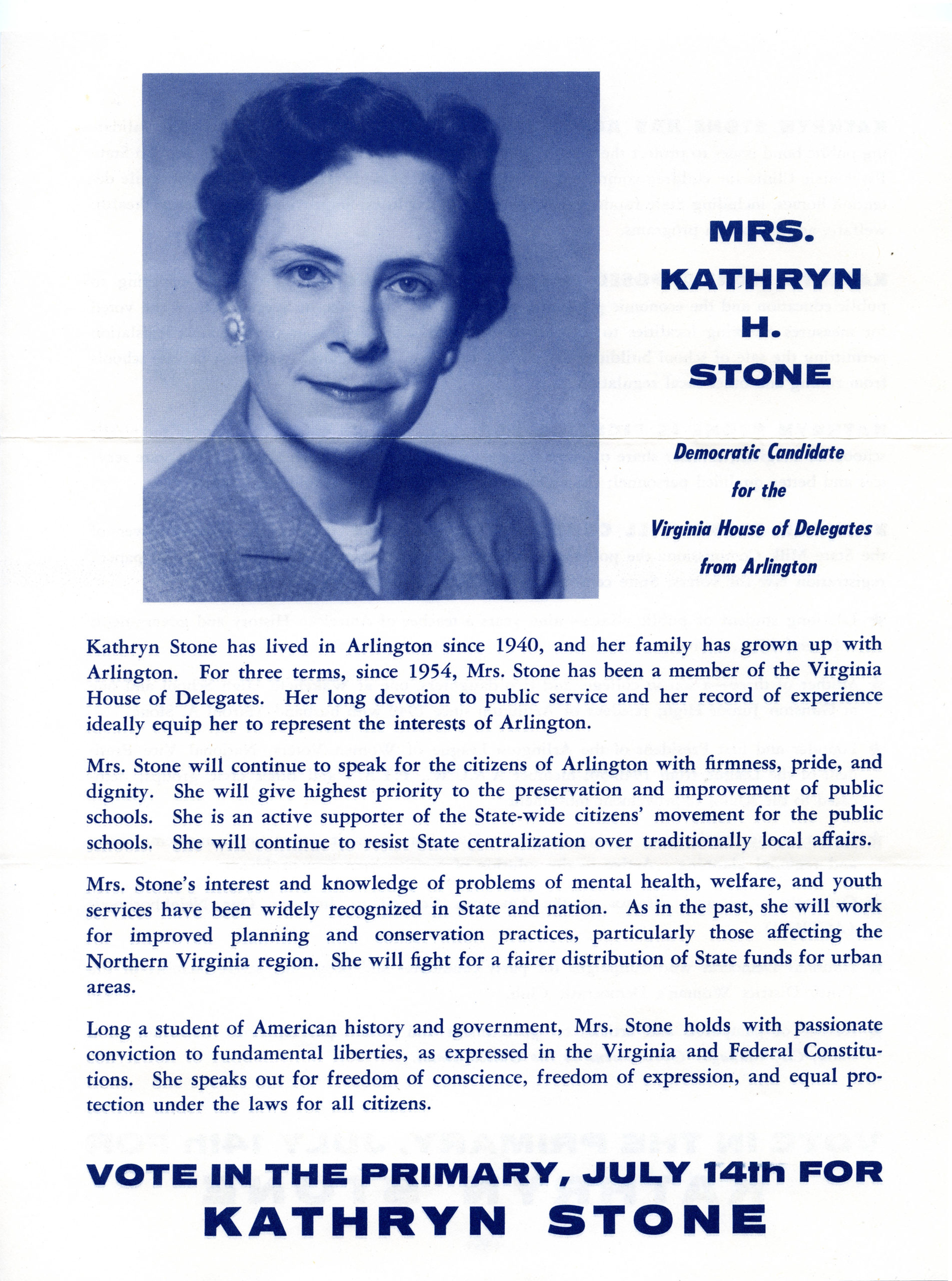
Campaign flyer for Kathryn Stone, candidate for House of Delegates in 1959.

"Vote for Kathryn Stone" flyer

A solitary voice, she warned the General Assembly against passing a series of bills aimed at stopping the NAACP from bringing desegregation lawsuits to court which, she argued, curbed freedom of speech and assembly:

“You are stooping in panic as you desert the Bill of Rights, which was born in the mind and hearts of the greatest Virginians.”

As a lawmaker, Stone also played an influential role in the creation of the Virginia community college system and was a leader in legislation to improve youth services, mental health, education, and welfare, but first and foremost, she will always be remembered as a symbol of progressive change and as an undaunted champion of the cause to end segregation in the schools.

Do you have a question about this story, or a personal experience to share? 

Use this form to send a message to the Charlie Clark Center for Local History.

Center For Local History - Blog Post Message Form

Do you have a question about this story, or a personal experience to share? Use this form to send a message to the Center for Local History.

"*" indicates required fields
This field is for validation purposes and should be left unchanged.

Share Your Story

December 31, 2020 by Web Editor

Leonard “Doc” Muse: Taking a Stand

Post Published: December 17, 2020

Graphic image of a megaphone

Join us for a new series of stories from the Center for Local History highlighting members of our community who made a difference in ways that helped shape our history and created positive change. 

Their voices were not always loud, but what they said or did had a significant impact on our community.

Leonard “Doc” Muse

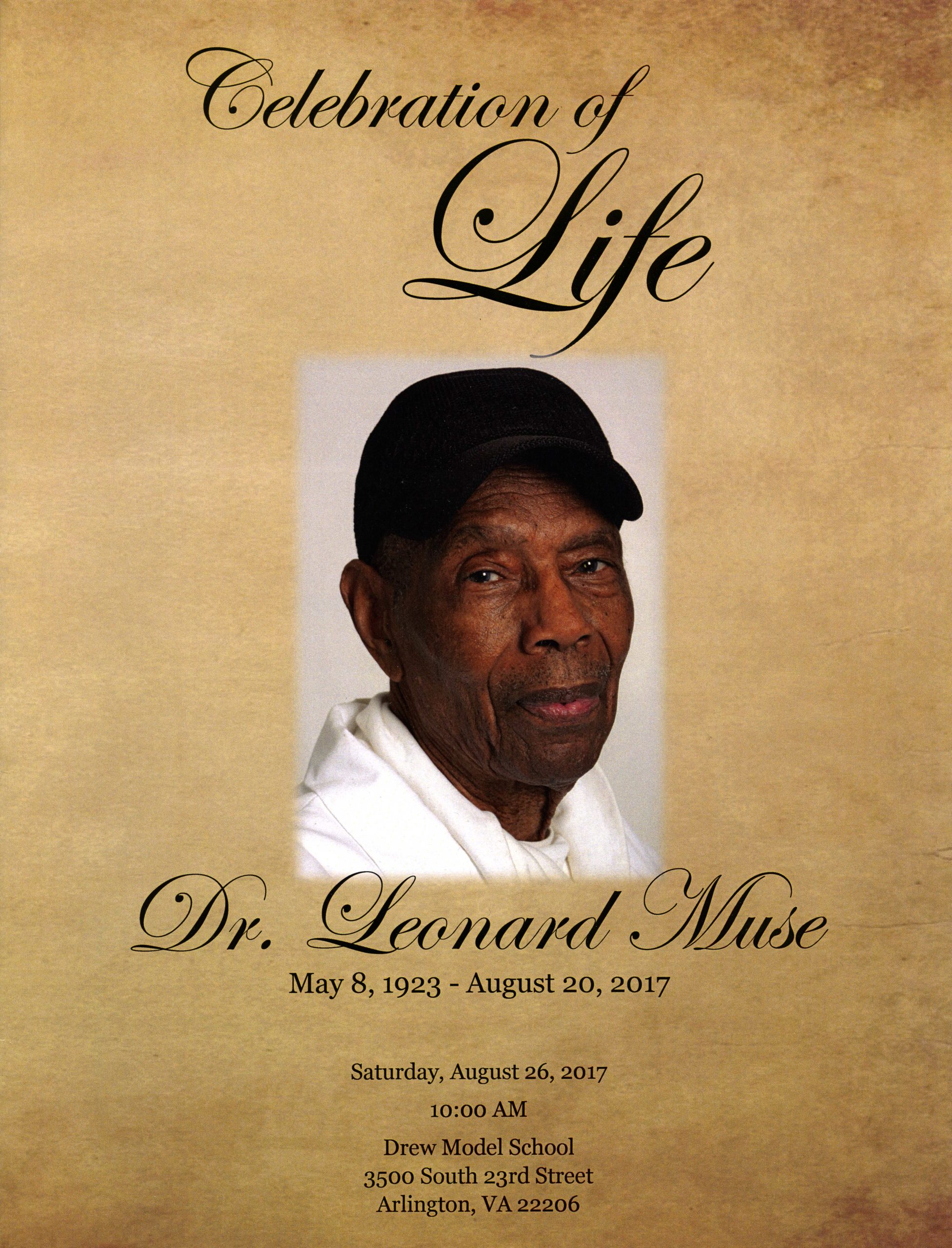
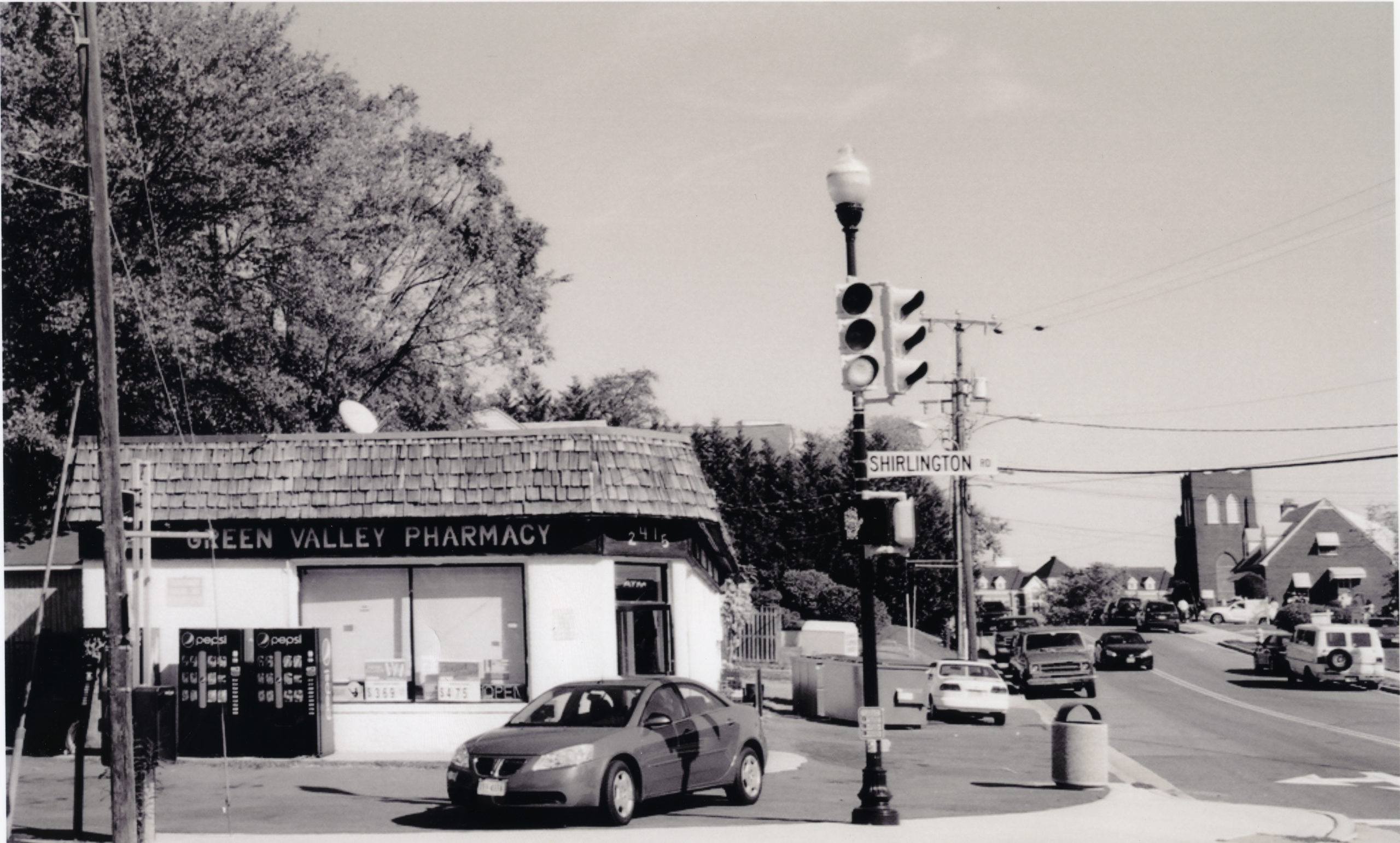
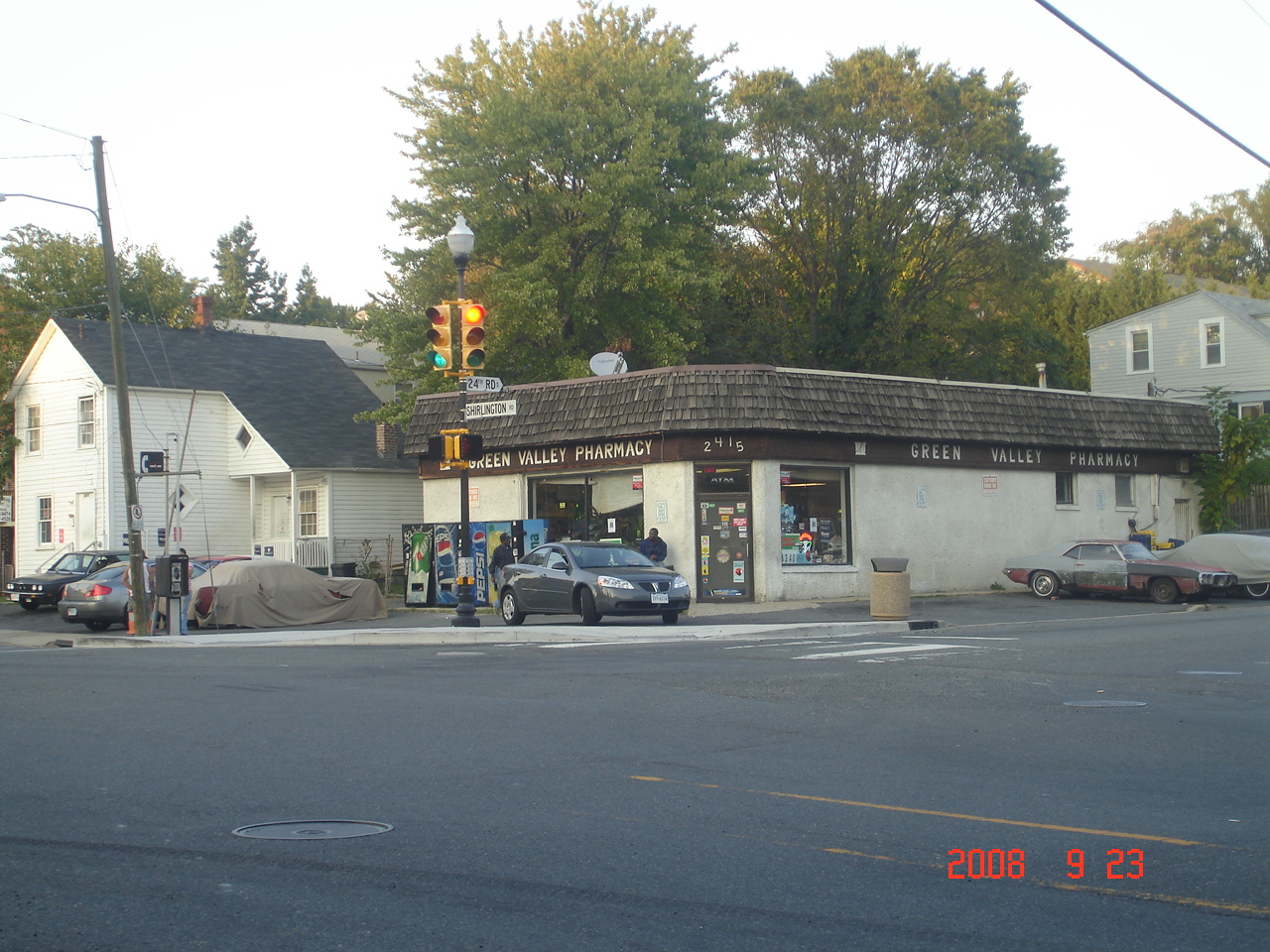
Leonard “Doc” Muse (1923-2017), was an African-American pharmacist and social activist, and the owner of Green Valley Pharmacy, a neighborhood institution whose importance extended far beyond that of a typical pharmacy.

Memorial program for Dr. Leonard Muse, 8/26/2017

Muse was born in Florida, served in World War II, and then used his GI benefits to attend the Howard University School of Pharmacy. In 1952, along with partner Waverly Jones, he purchased the property which was formerly Hyman’s Grocery, and opened the Green Valley Pharmacy. In addition to being a drug store and filling prescriptions for the neighborhood, it functioned as a gathering place featuring a lunch counter which provided free meals every Wednesday afternoon and on occasion providing free prescriptions for those unable to afford them.

With this role in the community came the challenge of dealing with myriad interests and pressures, but Muse negotiated these rough waters with determination and skill.

Green Valley Pharmacy, 2010. Taken for Center for Local History Student Photo Contest.

Green Valley Pharmacy

In an oral history conducted by the Center for Local History, when asked about his motivation to become a pharmacist, Muse said:

“Oh, it’s a long story.  I was a kid, and the lady next door…asked me to go and get a prescription filled for her…I got there, I was tired, and I went to sit down, and that guy told me, “You can’t sit here.”  So I went out and sat on the sidewalk until they filled the prescription.  And I had the idea, I said, well, we need a pharmacy where we can sit wherever we want to –“.

Green Valley Pharmacy was named as a Historic Landmark by the Arlington County Board in 2013, and Muse received a Community Appreciation Award from the Arlington NAACP, and continuing to work and be a constant presence until his death in 2017.

GreenValleyPharm2008close

Green Valley Pharmacy 2008

Do you have a question about this story, or a personal experience to share? 

Use this form to send a message to the Charlie Clark Center for Local History.

Center For Local History - Blog Post Message Form

Do you have a question about this story, or a personal experience to share? Use this form to send a message to the Center for Local History.

"*" indicates required fields

This field is for validation purposes and should be left unchanged.

Share Your Story

December 17, 2020 by Web Editor Tagged With: Green Valley

Arlington’s Own Fast and Furious

Post Published: December 10, 2020

Virginia has a long history of horse and car racing, and Arlington County has had a role in both of these historically popular pastimes.

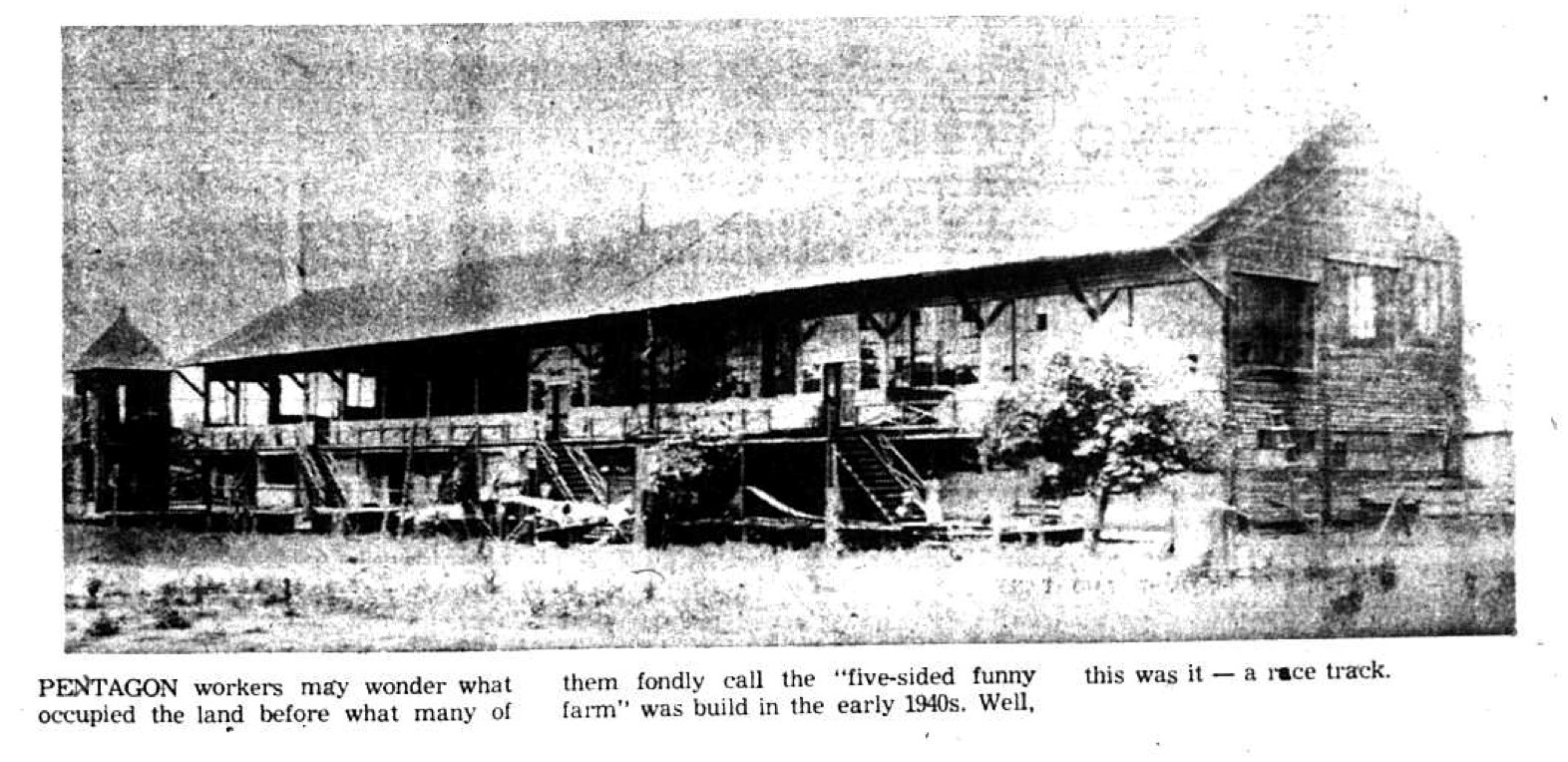
Beginning in the 1890s, Arlington (then known as Alexandria County) was home to a half-mile-long racetrack that drew thrill-seekers and daredevils from the County and beyond. The track, located on the grounds of what would become the Washington Airport next to the Hoover Airport, was on the land south of 14th Street bridge now occupied by the Pentagon.

Racing venues like Alexander Island in Arlington, and the St. Asaph Racetrack in Alexandria also became the focus of nationwide anti-gambling measures around the turn of the century.

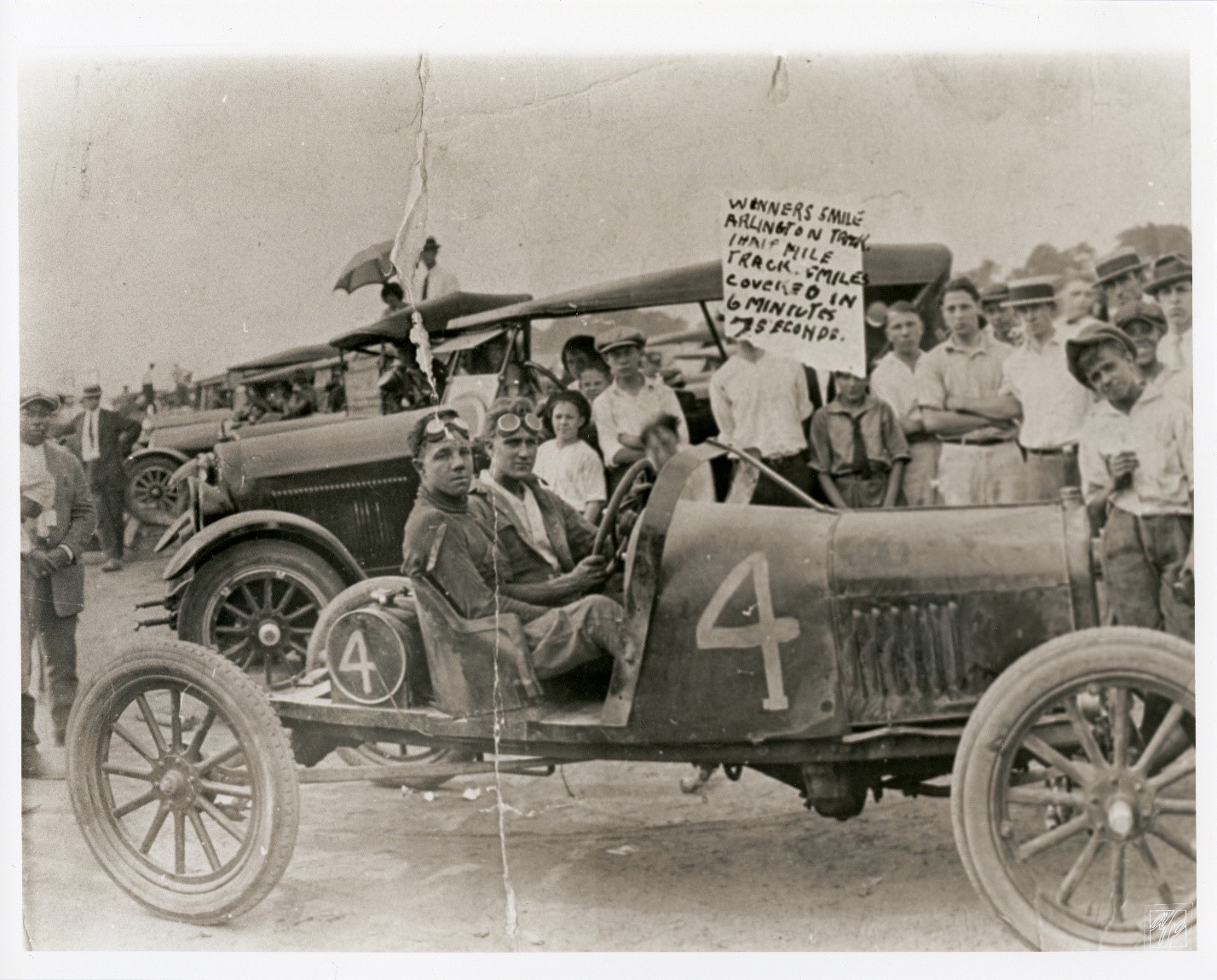
Old Number 4

Winners in “Old Number 4” at the Arlington racetrack, circa the early 1920s. According to the note on the photo, the 5-mile race on the half-mile-long track was covered in 6 minutes and 7 seconds – meaning the amateur driver nearly overcame the 50-mile-an-hour speed barrier.

A Racetrack for Arlington’s “Miniature Monte Carlo”

Arlington’s racetrack has its origins in the controversial history of the now extinct Jackson City neighborhood, and its then twin, Rosslyn. In the late 19th century, the two areas were considered hubs of criminality, associated with betting, gambling, and other unsavory activities.

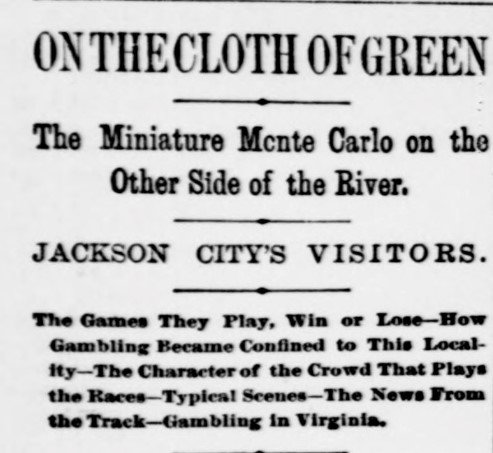
Jackson City was even referred to as a “Miniature Monte Carlo.” Following the post-Civil War ban on gambling in Washington, D.C., the neighborhoods drew customers across the Potomac to Rosslyn, conveniently located by the Aqueduct Bridge, and to Jackson City at the Long Bridge.

Evening Star Clipping

An article from the Washington, D.C., Evening Star on January 30, 1892, alludes to the controversial nature of the Jackson City area in Arlington. Image courtesy of the Library of Congress.

In the 1890s, Virginia lawmakers attempted to control the gambling that had overtaken the state, but corrupt legislators slipped in a loophole to allow an exemption for driving clubs, agricultural organizations, and grange organizations. Thanks to this provision, the Jones family in Arlington was able to secure a charter from the Grange Camp Association of Virginia and began investing in a racetrack in Jackson City.

Over the years, the racetrack would sometimes be referred to as the “Alexander Island” racetrack, referring to the also-controversial piece of land it sat on, which was considered Virginia at low tide and Washington, D.C., at high tide.

When a judge ruled the racetrack could stand, this set the precedent for the area formerly being considered part of Virginia – as horse betting was illegal in the District. This decision was later reversed in the 1930s, but Alexander Island ultimately came under the Pentagon’s jurisdiction a decade later and is now the present-day site of the Connector Parking Lot.

The City of Alexandria’s Racetrack Rises

Around the same time the Arlington racetrack got its start, investors in the city of Alexandria were also capitalizing on the loose gambling laws. A Gentlemen’s Driving Club was chartered in 1888, and by 1894 this would materialize into the St. Asaph Racetrack – the more notorious track in the Northern Virginia region.

This track was backed by the Hill family and other numerous high-profile investors, among them Virginia Senator George Mushback, who had helped pass legislation allowing for gambling to continue.

Arlington- Yesterday and Today

Photo from the Northern Virginia Sun, October 8, 1970, for an article titled “Arlington-- Yesterday and Today.” Though the caption and title suggest this was the Arlington racetrack, this photo is of the St. Asaph grandstand.

Located in the Del Rey neighborhood, the St. Asaph racetrack was extremely popular, drawing in thousands of dollars on its racing days. The operation made an estimated $150,000 per year – bolstered by its poolroom, where gamblers could stay connected and bet on other races via the establishment’s telegraph wires. The track was ¾ miles long and was frequently noted for the beauty of the landscape and architecture.

By 1895, the competing Arlington and city of Alexandria tracks and their investors had reached an agreement to race on alternate days, keeping both in business. In 1897, horse racing was outlawed outright by the state, though betting for out-of-state races at St. Asaph continued with the racetrack’s extensive telegraph setup. In 1898, during the Spanish-American War, St. Asaph’s was also used by the U.S. Army as a mobilization camp.

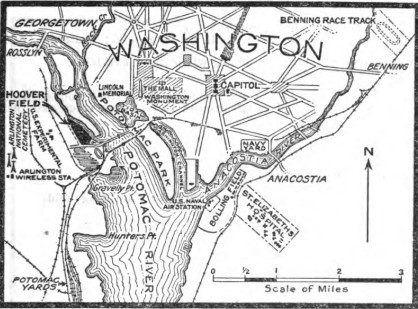
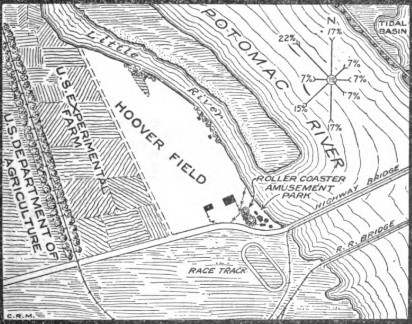
July 6 Map Pt.1
July 6 Map Pt.2

Maps from July 6, 1927, Airway Bulletin (No. 124) show Arlington’s racetrack adjacent to Hoover Field. Image courtesy of the University of California.

Drama, Debauchery, and Depositions

The scale of the St. Asaph’s track eventually made it a target for Crandall Mackey, who after being elected the commonwealth’s attorney in 1903, set his sights on eliminating crime in the region. Mackey had become a prominent figure in both Rosslyn and Jackson City, shutting down the area’s illegal bars, bordellos, and casinos over his tenure, and the racetrack was next on his list.

After Mushback’s death, Mackey swooped in to take down the racetrack and its not-so-savory reputation. In May of 1904, he staged a dramatic raid on the track, backed by a posse with sledgehammers and axes who destroyed slot machines and other equipment.

However, the track soon resumed business as usual. Mackey would eventually obtain 19 warrants against the track’s owners, igniting an extended courtroom battle against some of the region’s richest and most prominent figures. Mackey was ultimately successful in 1905 when the St. Asaph racetrack shut down for good.

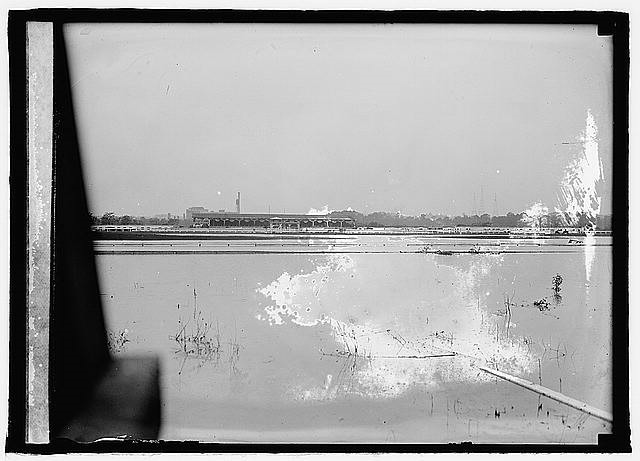
Flood with Racetrack

“Flood with racetrack in the background,” Image of the abandoned St. Asaph Racetrack, 1924, with the Arlington radio towers in the background. Image courtesy of the Library of Congress.

Memories of the Arlington Racetrack

It’s unclear why the Jackson City racetrack eluded Mackey’s “shotgun justice,” but it managed to disassociate itself from the historical notoriety of its Alexandria counterpart.

In the early 1900s, the Arlington racetrack remained a place for spectators to take in the thrills of the burgeoning sport of car racing. It was also near another popular spot for Arlingtonians to pass the time, the Arlington Beach, which featured a dance hall and amusement park rides.

Want to learn more about early 20th Arlington? Check out “Shotgun Justice: One Prosecutor’s Crusade Against Crime and Corruption in Alexandria & Arlington,” available at the Library.

Do you have a question about this story, or a personal experience to share? 

Use this form to send a message to the Charlie Clark Center for Local History.

Center For Local History - Blog Post Message Form

Do you have a question about this story, or a personal experience to share? Use this form to send a message to the Center for Local History.

"*" indicates required fields
This field is for validation purposes and should be left unchanged.

Share Your Story

December 10, 2020 by Web Editor

Fire Station #8: Taking a Stand

Post Published: December 3, 2020

Graphic image of a megaphone

Join us for a new series of stories from the Center for Local History highlighting members of our community who made a difference in ways that helped shape our history and created positive change. 

Their voices were not always loud, but what they said or did had a significant impact on our community.

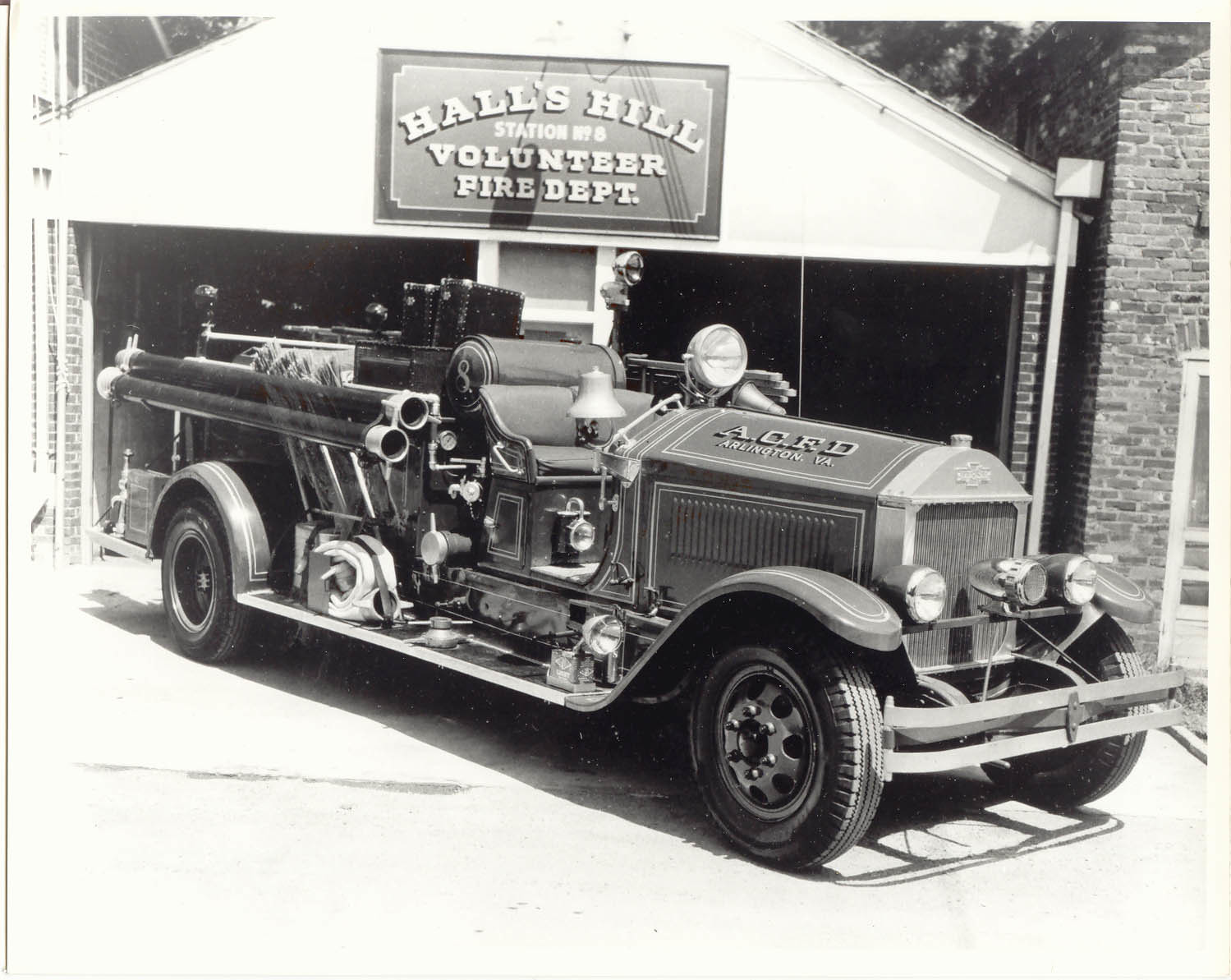
19641398703_2d453b3e75_h

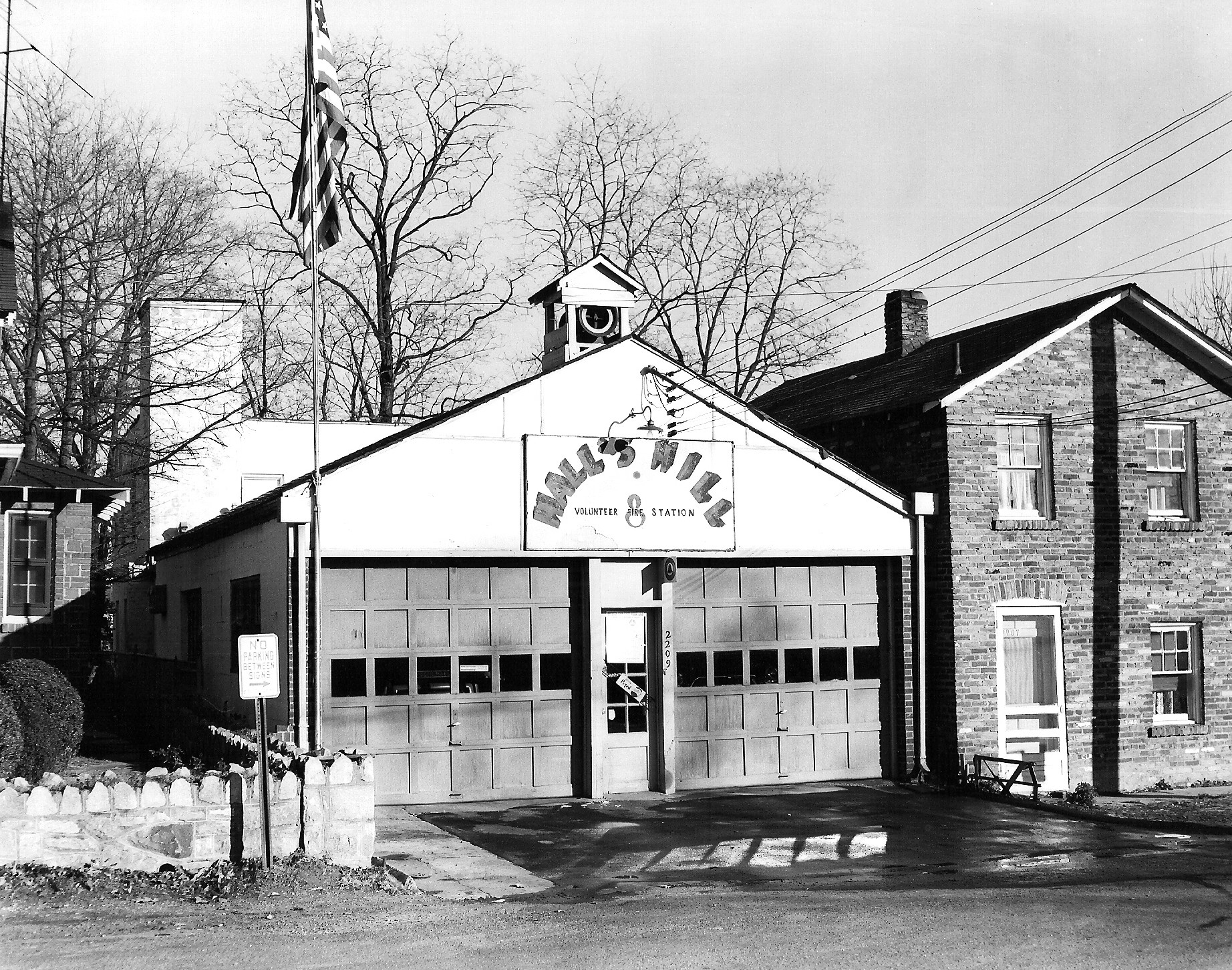
Hall's Hill Pumper

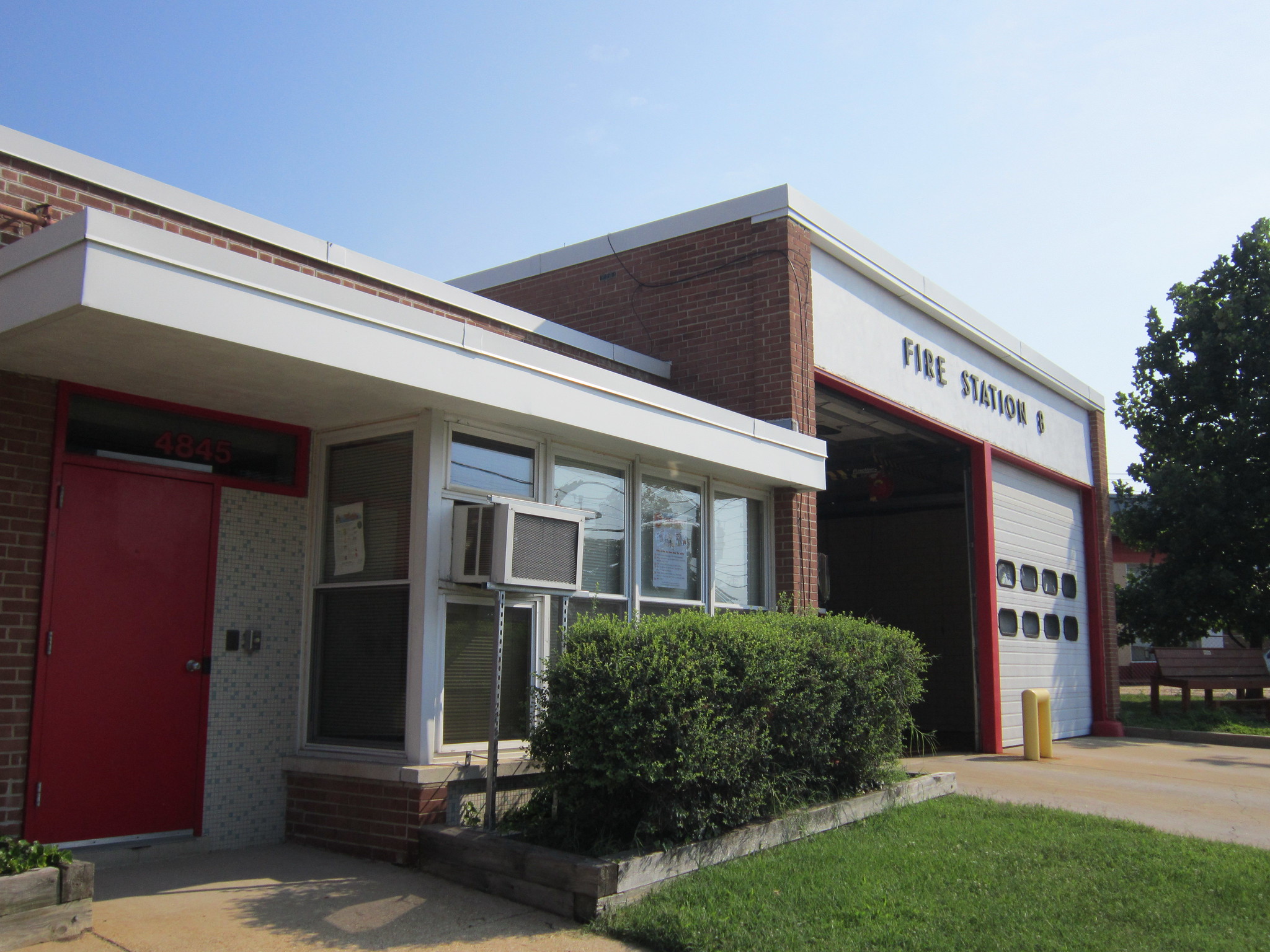
Fire Station #8

With a history that goes back over a century (est. 1918), it’s impossible to overstate the role that Fire Station #8 has played in the lives of the citizens of Hall’s Hill and Arlington County.  Facing underfunding, inadequate and outdated equipment, and institutional and individual prejudice, the firefighters stood up and faced down these and, other challenges, setting an aspirational standard for generations to come.

The following excerpts from an interview with former Fire Dept. #8 firefighter Lt. Hartman Reed depicts the struggles faced at that time:

“What can I say about the vehicles that we had were very old. Now, this is 1952 when I first came on, the fire trucks were a 1928 and a 1932 trucks...I’m not sure we even had a windshield on the thing...They wanted to say that you didn’t have the ability. Being black you didn’t have the ability, the courage, the knowledge...some of the dispatchers were that nasty, I guess you want to say, not to send you (to the fire)...we had a fire in our jurisdiction. We were first do right behind us, somewhere… I wasn’t on the fire, but I knew the other shift rode it - went. We were told when we changed shifts.

They went on the fire and the man’s house was on fire, and wouldn’t let them in. He wouldn’t let anybody in until…the second do company, which was either Falls Church or Cherrydale came in there, and they had to put the fire out.  This man was going to let his house burn down before he let us go into his house. It was that bad.“

20254062042_20dbb0cb4f_k

East Arlington VFD

Further reading:

https://library.arlingtonva.us/2015/08/04/legacy-halls-hill-vfd-and-station-no-8/

https://library.arlingtonva.us/2018/02/27/oral-history-interview-with-firefighter-julian-syphax/

https://arlingtonfirejournal.blogspot.com/2018/02

20074374370_087f698af9_k

Fire Station 8, 2209 Culpeper St

20236125066_d5e4cec400_k

Fire Station 8, 2015

Do you have a question about this story, or a personal experience to share? 

Use this form to send a message to the Charlie Clark Center for Local History.

Center For Local History - Blog Post Message Form

Do you have a question about this story, or a personal experience to share? Use this form to send a message to the Center for Local History.

"*" indicates required fields
This field is for validation purposes and should be left unchanged.

Share Your Story

December 3, 2020 by Web Editor

  • « Go to Previous Page
  • Page 1
  • Interim pages omitted …
  • Page 12
  • Page 13
  • Page 14
  • Page 15
  • Page 16
  • Interim pages omitted …
  • Page 25
  • Go to Next Page »

Primary Sidebar

News

All library locations will be closed for Juneteenth.

Holiday: All library locations closed Fri., June 19, for Juneteenth.

All Library locations and Arlington County … ... about Holiday: All library locations closed Fri., June 19, for Juneteenth.

Read More News
See More Service Updates

Center for Local History

Three men writing on squares of the AIDS Quilt.

New: Explore 2,800+ Arlington Courier Photos

Explore more than 2,800 photos of local life in … ... about New: Explore 2,800+ Arlington Courier Photos

Read More Local History

Director’s Blog

Arlington Public Library staff marching in the 2025 D.C. World Pride Parade.

Director’s Message: Pride Month

Words Matter Arlington Public Library … ... about Director’s Message: Pride Month
More Director's Blog

Footer

About Us

  • Mission & Vision
  • Charlie Clark Center for Local History
  • News Room
  • Get Email Updates

Administration

  • Policies
  • Library Staff
  • Job Opportunities
  • Propose a Program or Partnership

Support Your Library

  • Friends of the Library
  • Giving Opportunities
  • Donating Materials
  • Volunteer Opportunities

Our Mission

We champion the power of stories, information and ideas.

We create space for culture and connection.

We embrace inclusion and diverse points of view.


Download the Library App

Download the Library App

Arlington County | Terms & Conditions | Accessibility | Site Map
· Copyright © 2026 Arlington County Government ·