• Skip to primary navigation
  • Skip to main content
  • Skip to footer

Alert

Holiday: All library locations closed Fri., June 19, for Juneteenth. More Info

Alert

Update: Elevator outages, maintenance and upgrades at Central Library More Info

Alert

Storytimes Will “Take a Nap” through June 20 More Info

Home - Arlington County Virginia - Logo
MENUMENU
  • Join Now
  • My Account
    • Login
    • My Checkouts
    • My Holds
    • My Lists
    • My Reading History
    • About Borrowing
    • About Holds
    • About My Account
  • Hours & Locations
    • All Hours & Locations
    • Holiday Closings
  • News
    • Library News
    • Director's Blog
    • Get Email Updates
  • Contact Us

Arlington Public Library

MENUMENU
  • Search
  • Collections
  • Library Services
  • Events
  • Community Engagement
  • Join Now
  • My Account
    • Login
    • About Borrowing
    • About Holds
    • About My Account
  • Hours & Locations
    • All Hours & Locations
    • Holiday Closings
  • News
    • Library Blog
    • Get Email Updates
  • Contact Us

News Archive

A Lesson in History

Post Published: February 13, 2007

School Integration in Arlington
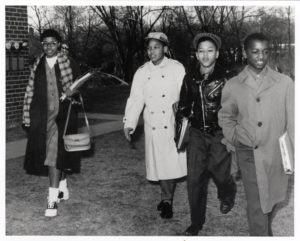
When four African American students, seventh graders Gloria Thompson, Ronald Diskins, Lance Newman and Michael Jones (above, left to right), entered Stratford Junior High School (now H.B. Woodlawn) on February 2, 1959, Stratford became the first white public school in Virginia to admit black students.

In opposition to the state’s plan of “massive resistance,” the Virginia NAACP developed a strategy to focus their energy first where the black population was small, and the Byrd machine weak, and it worked. Arlington, with an African American population of about five percent, fit that description. In addition, it had a strong core of black activists, as well as whites who supported their cause and also did not want the Arlington schools closed down.

On that cold winter day, half of Arlington’s police force, wearing white battle helmets and equipped with gas grenades and masks, were deployed around the entire perimeter of the school grounds. Fifteen plainclothesmen were on duty inside the school building, to which only students and teachers were allowed access. Press and other media, while present in large numbers, were barred from the premises of the school. Because of the precautions taken and the careful groundwork that was laid, the day passed without serious incident.

This date, however, marked the beginning of a process, for it was not until 1971 that Arlington schools were fully integrated.

The Virginia Room holds a wide array of materials on desegregation of the county’s public schools. There are several oral histories, archival collections, photographs, vertical files that include newspaper clippings, and recordings of Library events featuring students and administrators of the time.

What About You?

What do you remember about Arlington at this time? Did you go to Stratford Junior High in the late 1950s or early 1960s? Let us know what you remember!
 

February 13, 2007 by Web Editor

Westover’s Library, 1963 – 2009

Post Published: January 30, 2007

old Westover 1970s

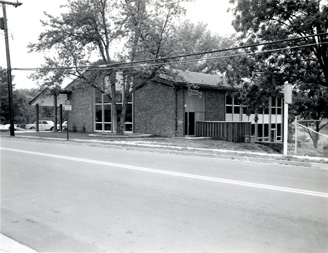
Funded by a bond referendum in 1961, the Westover Branch Library, seen here in the 1970s, was opened to the public in June of 1963.

Prior to this, the Westover branch, founded in 1949, was located in small rented basement rooms at 1530 N. Longfellow Street, but the needs of the community soon outgrew the space. The new location at 1800 N. Lexington Street was designed by J. Russell Bailey, who also designed the Cherrydale branch building and the original Central Library in 1961.

From the Westover Library Dedication program:

“The modern split level design permits the entrance-level circulation desk to serve both the adult area on the upper level and the children’s room on the lower level. The latter opens to a grass terrace for story hour use. Full length windows on the north wall provide good light. Air-conditioning has been installed.”

Local women’s and civic groups planted trees and maintained flower beds on the grounds, and helped purchase new furniture and books for the shelves. The Westover Library had quickly become part of the community. However, that community has kept on growing, and the Westover branch has packed a lot of books and information in a small space to keep up with community needs.

A larger, more modern Westover Branch Library opened in October 2009.


What About You?

What do you remember about Westover library? How about other Arlington branch libraries? Do you have any photographs of those buildings? Let us know what you remember!
 

January 30, 2007 by Web Editor

Mmmmm… Hot Shoppes

Post Published: January 23, 2007

Updated by the Center for Local History on 3/26/2018.

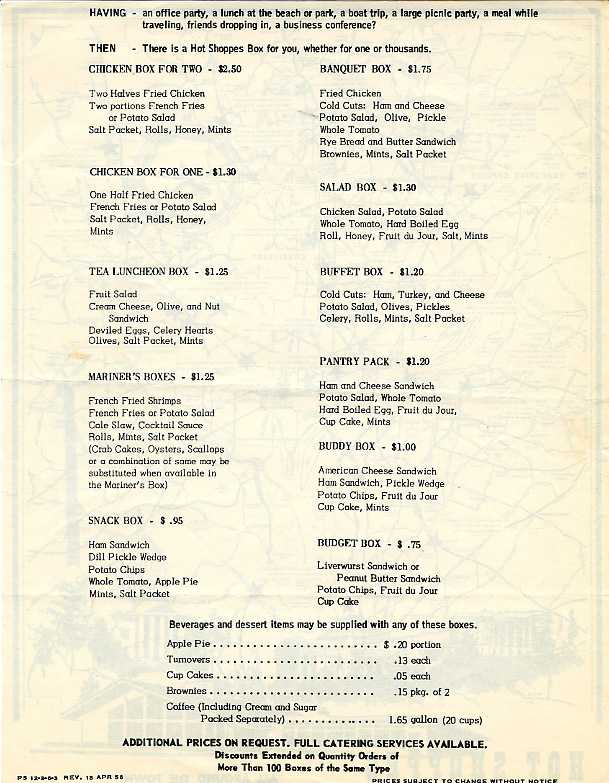
If the phrases “chicken box for two” or “pantry pack” sound familiar to you, then it is probably safe to assume that once upon a time, you were a customer at a Hot Shoppes restaurant.

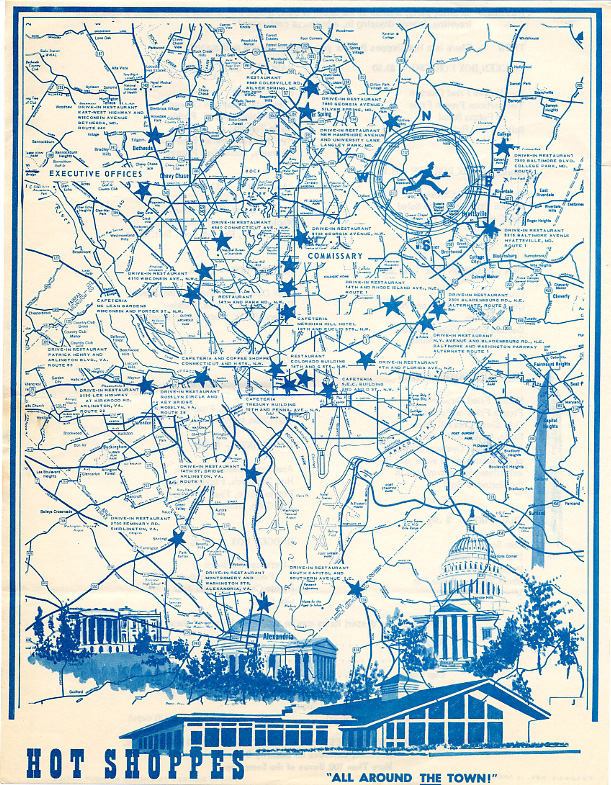
A classic slice of Americana, the first Hot Shoppes was established in Washington D.C. in 1927 by J. Willard Marriott, best known for founding the Marriott Corporation. By 1960, there were 70 Hot Shoppes restaurants in seven states and the District of Columbia. Arlington boasted a number of locations, including Crystal City, Shirlington, and Columbia Pike.

The Columbia Pike location in particular became a venerable Arlington institution, providing a loyal clientele with “Southern Home-style” cooking at affordable prices for 32 years.

Hot Shoppe map
Hot Shoppe map
Hot Shoppe menu
Hot Shoppe menu

There were two located on Columbia Pike. One at 2820 and the other located at 4707 Columbia Pike in the Barcroft neighborhood. Hot Shoppes not only offered quality food, but also served as a neighborhood gathering place where customers felt like they were treated as family and seniors could take advantage of special discount prices. As time went by, the rise of fast food restaurants put increasing pressure on cafeteria style establishments such as Hot Shoppes. The Marriott Corporation began converting most locations into Roy Rogers restaurants in the mid-1970s and the Barcroft location was no exception, changing over around 1978. 4070 Columbia Pike also served as the future site of the second location of Bob & Edith’s Diner, and Sauca. The building was torn down in 2017 for a new mixed use development.

Some Hot Shoppe trivia:

  • The first Hot Shoppe started as a curbside food stand selling A&W; Root Beer and tamales in 1927.
  • In 1967, Hot Shoppes officially changed its name, becoming the Marriott Corporation.
  • Jazz musician Duke Ellington and his band recorded seven versions of the Hot Shoppes theme song which were aired on radio as part of an advertising campaign in 1967-1968.
  • The last Hot Shoppes restaurant, located in a Marlow Heights shopping mall in Washington D.C., closed on December 2, 1999.


What About You?

What do you remember about the Hot Shoppes restaurants? Let us know what you remember!
 

January 23, 2007 by Web Editor

The Three Sisters

Post Published: January 9, 2007

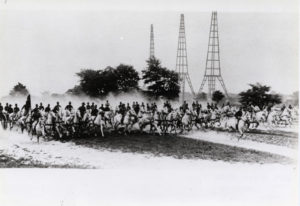
While they may seem quaint or even primitive by modern standards, upon their completion in 1913, the Navy’s Radio Station Arlington Towers were considered to represent the height of cutting edge communications technology.

In their day, “The Three Sisters” as they were known, were the second largest manmade structure in the world behind only the Eiffel Tower, with the tallest of the three standing a full 45 feet higher than the Washington Monument.

Located at the intersection of Columbia Pike and Courthouse Road, the towers were built to launch the Navy’s effort to establish a worldwide communications network. Using the call letters NAA, the towers functioned to provide the first long distance radio conversation, the first transoceanic radio telephone circuit (fittingly, to a French station broadcasting from the Eiffel Tower), and served to introduce the regular broadcasts of time signals, which was important to ships at sea who relied on accurate time checks for navigational purposes.

The towers were taken down in 1941 upon the opening of National Airport as they were considered to be an aviation hazard. Today, the site at Columbia Pike and Courthouse road continues to be occupied by military communications departments, chiefly the Defense Communication Agency. There are photographs like the one above, showing the Three Sisters and cavalry exercises from Fort Myer, and you can find out more information on the towers using newspapers on microfilm, all in the Virginia Room.


What About You?

What do you remember about the Arlington radio towers? What was early radio like in the Washington area? Let us know what you remember!


January 9, 2007 by Web Editor

The Little Tea House

Post Published: January 2, 2007

Little Tea House

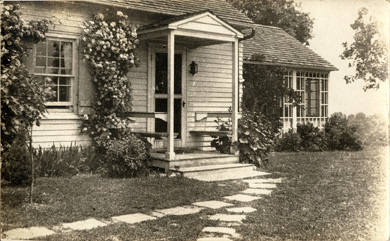
The Little Tea House Restaurant, located on Arlington Ridge Road, opened in 1920 and remained there until 1963 when it was demolished to make room for a high-rise apartment building.

During its heyday, many famous people ate at the restaurant, including Eleanor Roosevelt, Amelia Earhart, and Oliver Wendell Holmes. Known for its lovely gardens and views, it was also one of the first places in Arlington where racially mixed groups could meet.

Gertrude Crocker, who started the restaurant, was active in women’s issues throughout her life and started the restaurant so she could be independent and her own “boss.” When Mrs. Crocker leased, and later sold, the business to Gertrude Allison, it became known for a period as Allison’s Little Tea House.

The Virginia Room’s Oral History Project includes an interview with Ellen C. Puterbaugh, daughter of Gertrude Crocker, and the Arlington Community Archives has a photograph collection, PG 215, of images of the Little Tea House dating primarily from the 1920s.

What About You?

Do you remember the Little Tea House? Did you ever eat there? Let us know what you remember!
 

January 2, 2007 by Web Editor

Where Are We?

Post Published: December 12, 2006

We Need Your Help!

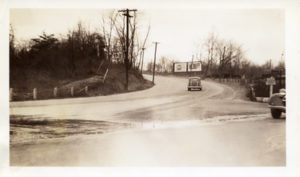
Do you recognize this intersection?

This photograph above was taken around 1937. The signpost on the far right reads “Clarendon” in the center and “Ballston” on the bottom, but we have not identified the road or neighborhood where this photograph was taken.

The original photograph is here in the Center for Local History at the Central Library, if you are interested in taking a closer look. The Library holds many photographs where the people and places are unknown. The staff always welcomes input on these unidentified works.

What About You?

Do you recognize this intersection? Do you have old photographs of a similar location? Let us know what you remember!


December 12, 2006 by Web Editor

The Rucker Legacy

Post Published: December 5, 2006

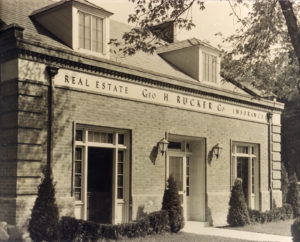
For a century the company called Rucker Reality has been part of the Arlington business community.

The company was founded in 1906 by George H. Rucker who was the county clerk of Alexandria County from 1899 until his death in 1919. Rucker and his wife Elizabeth began purchasing land in the county in 1899, and by 1906 they had acquired a large tract that he filed for subdividing as “Rucker’s Addition to Clarendon.” That same year Rucker started an insurance business and was a founding officer of Virginia Real Estate Title Company. By 1909, the company had grown and he asked two of his brothers-in-law, Ashton C. Jones and N.A. Rees to join him in the business.

When George Rucker died suddenly in 1919, at the height of his business career, Ashton Jones replaced Rucker in managing the business and in 1920 created the subdivision Ashton Heights. The company was also involved in developing many areas such as Lee Heights, Cherrydale, Tara-Leeway Heights, Ballston and the Westover Shopping Center.

Over the years the company diversified and eventually became the George H. Rucker Realty Corporation. Today, all ownership shares of the privately held company are still owned entirely by descendents of the founders, except for some stock option incentive shares held by the company president and CEO. The Virginia Room holds copies of many important Rucker Realty documents and has some photos of their Clarendon offices.


What About You?

Did you or your family have dealings with Rucker Realty? Let us know what you remember!


December 5, 2006 by Web Editor

Keeping the County Healthy

Post Published: November 28, 2006

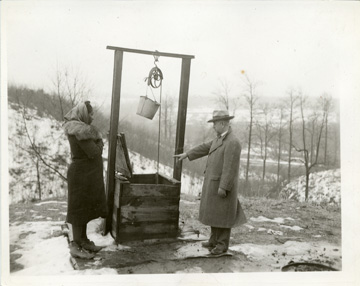
In 1919, the Arlington County Department of Health was one of the first full-time county departments for health services in the nation. 

Health dept well inspection

A home well inspection, 1942.

Unique for this type of county service, the Department received most of its funding from private rather than public resources.

The Department of Health was organized to improve the county’s state of public health by enforcing laws regulating sanitation and disease. Over the years, the Department evolved into a social agency serving the community and enhancing the quality of life through many local social programs.

Researchers interested in the early development and organization of municipal health systems and health care services should find this collection (RG 21) from the library’s Community Archives very valuable. The photograph above, a well house inspection from 1942, is from that collection. Information about RG 21 can be found in the library catalog and a full finding aid is available in the Virginia Room.

Today, the Department of Health has become the Arlington County Department of Human Services. 


What About You?
What do you remember about the Health Department? How did you interact with them? Let us know what you remember!


November 28, 2006 by Web Editor

Home Cooking

Post Published: November 21, 2006

The first observance of Thanksgiving in America actually took place in Virginia.

Kid cookingt

A children’s cooking class sponsored by Arlington’s Department of Recreation and Parks.

However, it was religious in nature and involved no form of feasting. On December 4, 1619, a group of 38 English settlers arrived at Berkeley Plantation on the James River, in the area of what is now known as Charles City, Virginia. The charter of the group required that the day of arrival be observed yearly “as a day of Thanksgiving to God.” (In the fall of 1621, the first Thanksgiving in New England was celebrated in Plymouth, Massachusetts and involved much feasting which lasted for three days.)

Today, of course, feasting is very much a part of the holiday. For your Thanksgiving dinner you might enjoy the following recipes from “The Virginia House-wife” by Mary Randolph, 1824, using the traditional sweet potato.

Sweet Potato Pudding

Boil one pound of sweet potatoes very tender, rub them while hot through a colander, add six eggs, well beaten, three quarters of a pound of powdered sugar, three quarters of butter, and some grated nutmeg and lemon-peel, with a glass of brandy; put a paste in the dish, and when the pudding is done, sprinkle the top with sugar, and cover it with bits of citron.

Sweet Potato Buns

Boil and mash a potato, rub into it as much flour as will make it like bread, add spice and sugar to your taste, with a spoonful of yeast; when it has risen well, work in a piece of butter; bake it in small rolls, to be eaten hot with butter.


What About You?
What do you remember about Thanksgiving in Arlington? What was on your table? Let us know what you remember!


November 21, 2006 by Web Editor

All Aboard: The Clarendon Train Station

Post Published: November 14, 2006

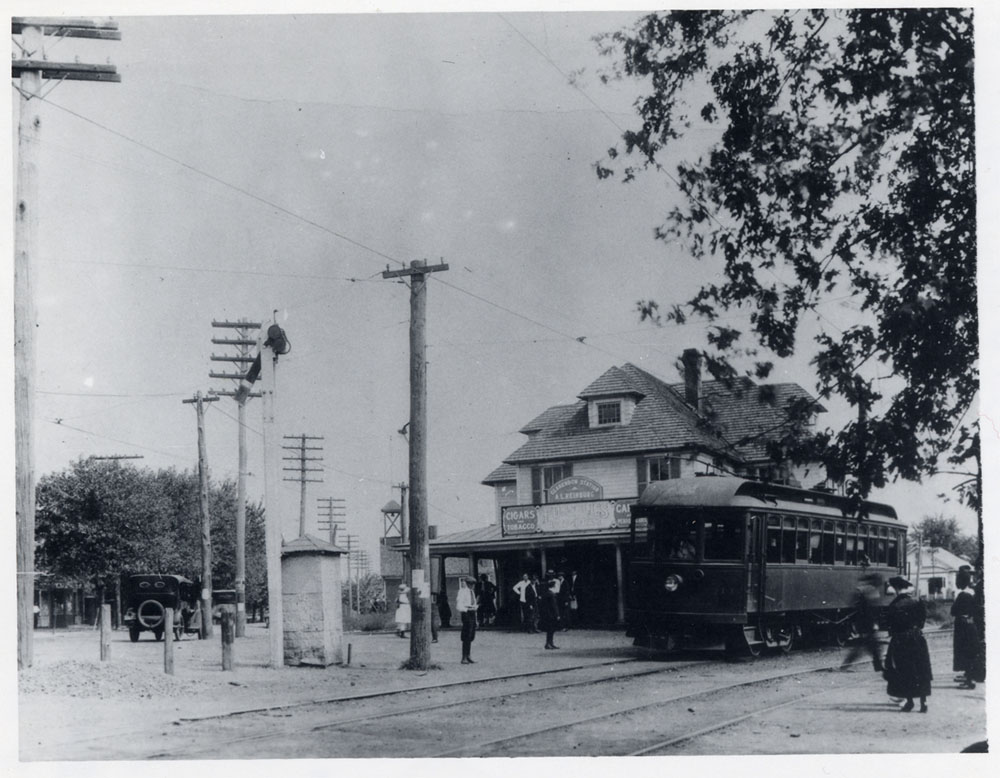
Finding the best way to get from one location to another was as much of a concern to Arlington residents over 100 years ago as it is today.

Black and white photo of trolley station with trolley to the right of the building

Clarendon trolley car and station, ca. 1910.

This photograph of the Clarendon train station, ca. 1910, was located at the hub of commercial Clarendon, at the intersection of Fairfax Drive and Wilson Boulevard.

The Washington-Virginia Railway and the Washington & Old Dominion Railway traversed Northern Virginia and the District of Columbia, providing passengers with a variety of options. Whether one chose to travel as far as Bluemont on the Washington and Old Dominion Railway or took the Mount Vernon Line to a more local destination, passengers were offered a wide range of alternatives.

The Center for Local History holds many photographs of trains, trolleys, and the stations they served, as well as railroad maps showing track routes and stops.

From their inception in 1892, peaking in the 1920s, through to their eventual decline in the 1940s, these routes were of vital importance to the communities they served and continue to trace paths not only of travel and transport but of a history and heritage that is vital to an understanding of the development and growth of Arlington.

This blog post was originally written in 2006 and was updated in 2021.

Do you have a question about this story, or a personal experience to share? 

Use this form to send a message to the Center for Local History.

Center For Local History - Blog Post Message Form

Do you have a question about this story, or a personal experience to share? Use this form to send a message to the Center for Local History.

"*" indicates required fields

This field is for validation purposes and should be left unchanged.

Share Your Story

November 14, 2006 by Web Editor

  • « Go to Previous Page
  • Page 1
  • Interim pages omitted …
  • Page 3
  • Page 4
  • Page 5
  • Page 6
  • Page 7
  • Go to Next Page »

Footer

About Us

  • Mission & Vision
  • Charlie Clark Center for Local History
  • News Room
  • Get Email Updates

Administration

  • Policies
  • Library Staff
  • Job Opportunities
  • Propose a Program or Partnership

Support Your Library

  • Friends of the Library
  • Giving Opportunities
  • Donating Materials
  • Volunteer Opportunities

Our Mission

We champion the power of stories, information and ideas.

We create space for culture and connection.

We embrace inclusion and diverse points of view.


Download the Library App

Download the Library App

Arlington County | Terms & Conditions | Accessibility | Site Map
· Copyright © 2026 Arlington County Government ·