• Skip to primary navigation
  • Skip to main content
  • Skip to footer

Alert

Update: Elevator outages, maintenance and upgrades at Central Library More Info

Home - Arlington County Virginia - Logo
MENUMENU
  • Join Now
  • My Account
    • Login
    • My Checkouts
    • My Holds
    • My Lists
    • My Reading History
    • About Borrowing
    • About Holds
    • About My Account
  • Hours & Locations
    • All Hours & Locations
    • Holiday Closings
  • News
    • Library News
    • Director's Blog
    • Get Email Updates
  • Contact Us

Arlington Public Library

MENUMENU
  • Search
  • Collections
  • Library Services
  • Events
  • Community Engagement
  • Join Now
  • My Account
    • Login
    • About Borrowing
    • About Holds
    • About My Account
  • Hours & Locations
    • All Hours & Locations
    • Holiday Closings
  • News
    • Library Blog
    • Get Email Updates
  • Contact Us

local history news

Mystery Photo: Football Edition

Post Published: September 19, 2013

Can You Help Us Identify This Photograph?

The Center for Local History is looking for your help in learning more about this photo, found in the attic of a house on 21st Street South – the Arlington Ridge/Aurora Highlands neighborhood.

In the photo, a football team stands in front of a public school:

early football team

Finds like this are fascinating to us, because they pose so many questions… Who are these young men? What school are they from?  And when was the photo taken?

The thirteen young men appear to be high-school aged, and they are wearing turn-of-the-century or early-twentieth-century football gear. The two men in suits are presumably coaches. They stand before an arched doorway labeled “Public School.” The back row of young men seem to be standing on miniature chairs. One man holds a football, upon which is painted “04.” The “04” suggests that they were either playing in 1904, or were from the class of 1904. But what other details back up that assumption? How do we know that “04” wasn’t painted onto the ball for some other reason?

Figuring out the date of a photo can be tricky, but fun. 

Different historians, archivists, and history buffs have preferred methods. Some like to date pictures by finding the latest-model car in a street scene. Hairstyles and clothing can be good indications, though they can be misleading. In professional sports, uniforms change slightly but noticeably over the years, but these boys aren’t wearing uniforms.

Man with nose guard around his neck

Their gear, however, does present some clues. The minimal padding, sewn into their clothes and not worn separately, suggest that this was from the earliest days of football– “harnessed” leather pads that pulled on over the head began appearing around the turn of the century. Likewise, their boots suggest something from football’s earliest days.

The most interesting detail is the nose guards that several of the men are wearing.

While we have helmets with face masks to protect the mouth and nose today, there were no such protections in the early years of football. Instead, some players wore nose guards like the one seen to the right, which during play strapped around the players’ heads and protected the nose and teeth. At first we thought it resembled this nose guard, patented by Frank Wilcox in 1904, but the strap on Wilcox’s design is a bit lower. We eventually found our nose guard patented by the Morrill Company in 1891, which according to this page from the University of Michigan was for sale in the “Spaulding [sic] catalog” in 1902. Thus, we find support for the 1904 date.

But what team was this, and where were they photographed?

Our first thought was that the nearby Hume School (now the Arlington Historical Society) and other Arlington-area schools from that time period have somewhat similar arched entrances. But none that we are aware of have the stonework “Public School” over them.

More importantly, there was no public high school in the county at that time, so young men of this age would likely be going to school– and perhaps playing football for that school– at high schools in the District.

With all the above in mind, we turn it over to you, the public.

What clues can you glean from this picture? Do you recognize anyone? Can you identify the archway behind these men? Is there anything in the above post that seems off-base?

What can you tell us about this picture?

September 19, 2013 by Web Editor Tagged With: local history news

Introducing the Center for Local History at Arlington Public Library

Post Published: May 28, 2013

We’re Saying goodbye to the name “Virginia Room”…

This year has brought big changes to Central Library, with building-wide renovation and redesign.

CLHbannerSmall

The Local History Team has used these renovations as an opportunity to re-evaluate how we present our mission and projects to the public. After much consideration, as of our reopening this week, the “Virginia Room” name is being retired.

We are now the Center for Local History at Arlington Public Library.


What’s in a name?

Simply put, the name “Virginia Room” was insufficient to convey the scope of the work that we do and the resources we offer.

Our mission has not changed: we are still dedicated to collecting, preserving, and sharing the history of our community.

Our rich historical collections and range of projects offer the Arlington community the ability to not only learn about and research their history, but also contribute to its telling. We are, and have always been, much more than just a room; now our name will reflect this.

By changing our name to the Center for Local History we hope to provide a better explanation of who we are: our many projects and the mission that links them.


What is it you do, anyway?

The Center for Local History has three primary components:

  • The Virginiana Collection, located in our research room, is a special collection of library holdings including books, newsletters, maps, oral histories, and other materials pertaining to the history of the Arlington area specifically and Virginia more generally. These materials are not available to be checked out, but can be used by researchers during our research room hours.
  • The Arlington Community Archives, which collects and preserves documents about the history of Arlington County, its citizens, and organizations. The collection focuses on personal papers, photographs, and archival records of local organizations, clubs, and associations. Most of these holdings are kept off-site at our archives, but can be requested by researchers for perusal in our research room.
  • Finally, our Digital Initiatives include efforts to improve access to our holdings by digitizing them and making them accessible to the community online. This includes the digitization of holdings, the creation of online exhibits, and the preservation of born-digital holdings in the archives.

Later this summer, we will add another element to our Digital Initiatives program, as the Library’s Digital Projects Lab will become part of the Center for Local History.

The Digital Projects Lab will provide a variety of software and hardware to allow anyone to come in and share their own pieces of Arlington history, through scanning family photographs or recording oral histories, along with providing a space and resources to create digital projects.

The Center for Local History at the Arlington Public Library is located on the first floor of Central Library. We hope you will come and visit us, explore our collections and follow all the exciting new projects coming up this year and beyond.

unboxed

This blog post represents the first in our new series, Unboxed, where we will give a behind-the-scenes view of new and interesting Center for Local History projects. 

We have a lot of exciting projects in the pipeline, and this blog series will be a place where we can let you behind the scenes, show you what we’ve got in the works, and what we’re working on. Hope you follow along and enjoy it!


The Center for Local History at the Arlington Public Library

Website: library.arlingtonva.us/localhistory

Phone: 703-228-5966

Email: localhistory@arlingtonva.us

Research Room
1015 N. Quincy Street
Arlington, Virginia 22201

Sunday: Closed
Monday: 10 a.m. – 5 p.m
Tuesday: 10 a.m. – 5 p.m.
Wednesday: 1 p.m. – 9 p.m
Thursday: 10 a.m. – 5 p.m
Friday: Closed
Saturday: 10 a.m. – 5 p.m.


May 28, 2013 by Web Editor Tagged With: local history news

What Went Up Came Down, 1997

Post Published: February 21, 2013

1960s Courthouse Demolished Sixteen Years Ago

[iframe width=”100%” scrolling=”no” url=”http://libcat.arlingtonva.us/iii/cpro/EmbedSlideShowPage.external?lang=eng&sp=l6&suite=def” frameborder=”0″]


At 7 a.m. on Feb. 23, 1997, the shell of the old Arlington County Courthouse came down in an impressive, yet controlled, implosion. Located across the street from the current courthouse and correctional center, the building was opened in 1960 with great fanfare, as it was a vast improvement over the original courthouse from 1898. However, the 1960 building had lots of asbestos and no sprinkler or fire alarm system, and a major fire in 1990 was its death knell. The county completed the current courthouse building in 1995, and the 1960 building was used by the fire department for training exercises until its demolition. The area is now a parking lot.

This series of photographs by County Photographer Deborah Ernst give a dramatic view of the implosion and the rubble it left behind.


February 21, 2013 by Web Editor Tagged With: local history news

Do You Know What Your Street Used To Be Named?

Post Published: January 15, 2013

How Arlington Made Sense of its Street Names and Paved the Way for Our First Federal Building

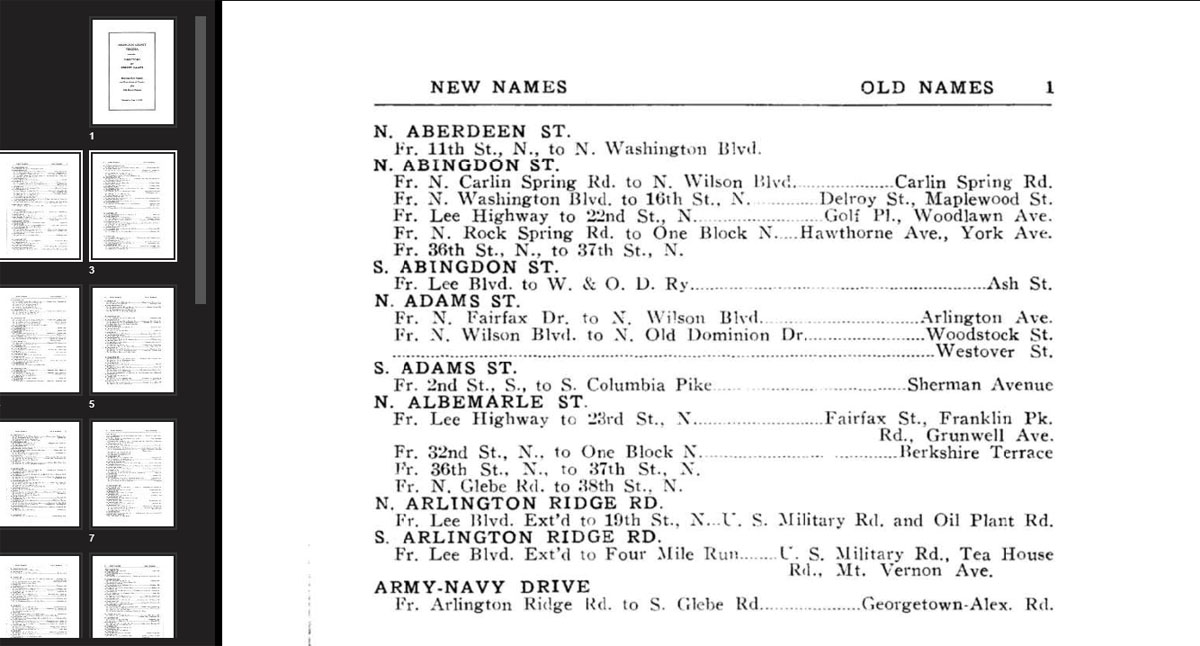
The 1935 Arlington County Directory of Street Names represents a unique moment in Arlington history-- a time when many Arlingtonians had to re-learn the names of their streets and those of their neighbors.

page 1 from the Arlington County Virginia Directory of Street Names, 1935

Page 1 from the Arlington County Virginia Directory of Street Names, 1935, screenshot of scanned document opened in the Community Archives.

In 1932, Arlington County had already begun a boom in population that would only continue over the next several decades. Between 1900 and 1930, the population of the once-rural area had grown by over 350%--from 6,430 to 23,278--despite the annexation of sizable portions of land by the city of Alexandria in 1915 and 1929.

New streetcar suburbs began popping up all around Arlington County--between 1900 and 1910 alone, plats for seventy new subdivisions were entered into the County Deed Books.

However, these new developments sprang up with little to no coordination or central planning, and by 1932, this was beginning to create problems. The developments formed what was, in effect, a confusing archipelago of small, unconnected towns, and street names were frequently repeated throughout the county. There were, by one account, as many as twenty-five different roads named "Arlington," for example, as well as many roads known as "Washington," "Virginia," and "Lee."

Visitors found the county difficult to navigate, neighborhood names had to be attached to mailing addresses to ensure that letters arrived at the right building, and some DC-area businesses even refused to deliver to customers in Arlington. There were also concerns about the Fire Department being dispatched to a house at the same address in the wrong subdivision.

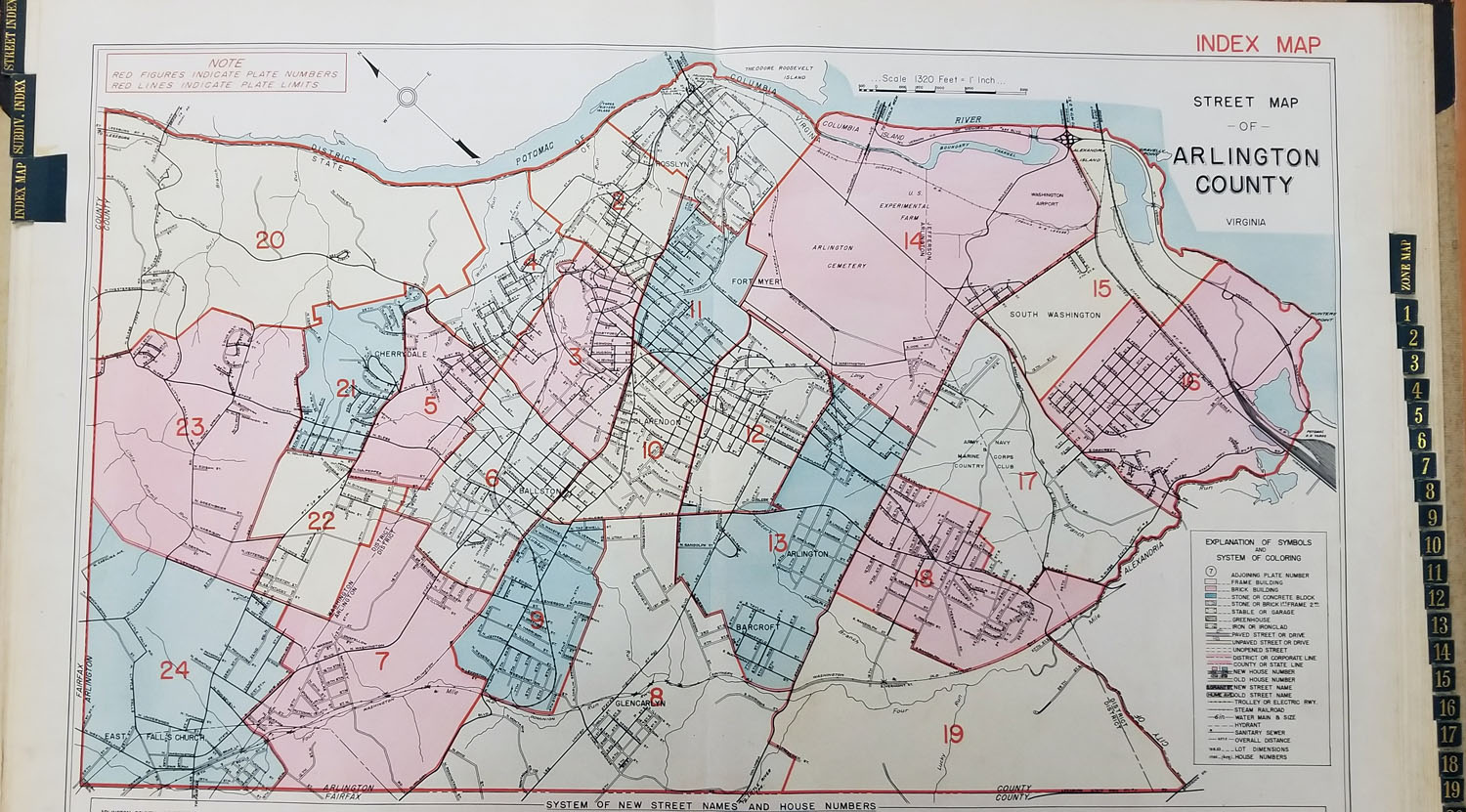
Street map of Arlington

1935 Arlington County Franklin Insurance Property Atlas

The newly-established “County Board-County Manager” Government of Arlington decided very quickly to try to rectify this situation. One of the primary issues motivating them seems to have been the desire to see a Post Office in Arlington, as mail service to Arlington had been routed through Washington D.C. since 1925, and the Post Office Department had dictated that no Post Office would be allocated to Arlington until its street naming scheme was more coherent and logical. To this end, a Street Naming Committee was established, tasked with rationalizing the county's street naming scheme.

Initially, the committee considered simply eliminating duplicate street names, leaving one street with each repeated name. The committee quickly decided that this approach was insufficient, and that a more general, systemic plan was necessary. Soliciting feedback from the county’s residents, the committee got a variety of proposals, from continuing DC’s alphabetical/numeric scheme to having the residents of each street vote on a street name.

Eventually, the committee decided on essentially the county’s current street naming scheme:

  • The county is divided into two sections, North and South Arlington, generally separated by Arlington Boulevard (US Route 50).
  • Numbered streets generally run east-west, parallel to Arlington Boulevard, and North and South designations follow numbered street names.
  • Named streets generally run north-south, and North and South designations precede named street names. These streets are generally named in alphabetical order from east to west, skipping the letters X, Y, and Z. When the end of the alphabet is reached, it is repeated with additional syllables-- thus Oak and Quinn Streets are to the east of Oakland and Quincy, which are in turn east of Ohio and Quantico Streets.
  • Boulevards, Drives, and Roads are generally major thoroughfares with historically recognized names, most of which were not renamed. Generally, these are the only through streets, unlike numbered and named streets, which tend to be broken up at times and intended primarily for local neighborhood traffic.
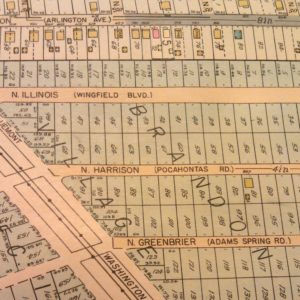
Photo of name change map

The Committee’s recommendations were put forward for public comment, and were approved with several small amendments in August of 1934--thirty months after the project began. In 1936, Arlington County was assigned a local Postmaster for the first time in over ten years, and the next year, the Postmaster General of the United States of America was on hand for the dedication of the cornerstone of the new Post Office in Clarendon--the first federal government building in Arlington County.

For people researching Arlington before 1934, the street name change can present challenges. This searchable PDF of the Arlington County Virginia Directory of Street Names, which opens by clicking or tapping on the cover image, can help with navigation of Arlington before the change.

To learn more about Arlington's history, visit the Center for Local History on the first floor of the Central Library.

Do you have a question about this story, or a personal experience to share? 

Use this form to send a message to the Center for Local History.

Center For Local History - Blog Post Message Form

Do you have a question about this story, or a personal experience to share? Use this form to send a message to the Center for Local History.

"*" indicates required fields

This field is for validation purposes and should be left unchanged.

Share Your Story

January 15, 2013 by Web Editor Tagged With: local history news

Our Back Pages: The Nearby Hideaways

Post Published: November 15, 2012

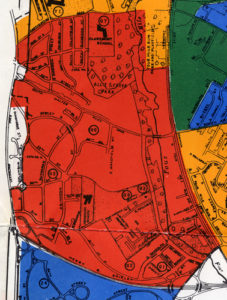
Shirlington Shelter Map

Nuclear attack was a constant boogeyman of the Cold War.

In the 1950s and 1960s especially, American citizenry was encouraged to be proactive in protecting themselves from nuclear fallout (remember “Duck and Cover”?).

Arlington was no exception. In late 1960s, the Northern Virginia Regional Planning Commission, which covered the cities of Alexandria, Fairfax and Falls Church and Arlington, Fairfax, Loudon and Prince William Counties, developed a civil defense plan for a possible nuclear attack. These plans included a fallout shelter program, mapping shelters in regard to population centers and how to get people to those shelters.

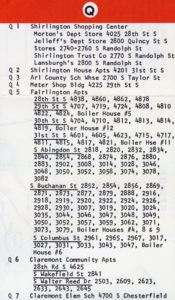
The Northern Virginia Region Community Shelter Program, published in 1968, outlined these plans and processes, and also published maps of shelter locations for subsets of the region. The Arlington Edition of the map sectioned the county into color-coded zones so users could find a shelter in their area and contained tips on creating and stocking your own shelter. The above image shows the fallout shelter locations for Shirlington, and the image below lists the names of these shelters. The map itself has the following introduction:

“In case of danger from fallout from a nuclear attack upon this country, you and your family would need to know WHERE TO GO and WHAT TO DO. This Community Shelter Plan contains this information for every citizen. It is based on making the best possible use of the fallout protection now available. If you and your family take action, as this Plan recommends, you will have maximum chance for survival from fallout effects.”

List of Shirlington fallout shelters, 1968.

What about you?

Did you have a fallout shelter in your home or neighborhood? Do you remember preparing for “the Big One”? We want to hear from you.


November 15, 2012 by Web Editor Tagged With: local history news

From Marching Bands to Indie Rock: The Story of Gerald Lewis Recording

Post Published: September 23, 2012

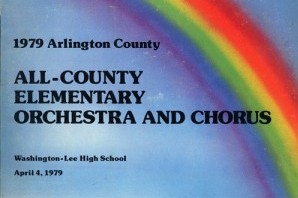
1979 Arlington County All-County Elementary Orchestra and Chorus album cover

In today’s music scene, it isn’t uncommon for those involved to wear many hats.

Artists crossover from performing to producing, find parallel careers in film, literature, and the visual arts with regularity. In earlier times, this phenomenon was less prevalent, excepting well-known performers such as Elvis and Frank Sinatra. Arlington’s own Gerald M. Lewis had a rich and varied career, being involved in many different aspects of music including performing, instruction, production, and recording.

From 1954-1979, Mr. Lewis served as a band director for Gunston and Stratford Junior High Schools, and Wakefield and Washington-Lee High Schools. At his home on 216 S. Pershing Drive, Lewis also owned and operated Gerald Lewis Recording. Housed in a mobile home adjacent to his residence, Gerald Lewis Recording was a mobile recording unit that offered him the ability to record performers and public events on location.

Operating from 1964-1991, a remarkably diverse customer base utilized Mr. Lewis’ recording service. Local Virginia and Maryland schools and churches recorded public events and concerts, including performances from high school marching bands and public speakers.

Local recording artists also took advantage of Lewis’ expertise. In 1985, Teen-Beat Records artists Unrest used the mobile studio to master their debut 7” single “So You Want To Be a Rock ‘n’ Roll Star”/ “Zelda” (Side A) – “The Hill” (Side B), which was also the first Teen-Beat vinyl release. Unrest band member and Teen-Beat impresario Mark Robinson recalls, “He [Lewis] essentially was the broker for Teen-Beat to press our first record. He put the master tape together, sent it to the pressing plant, etc. I paid him, and he paid the pressing plant. I found his number in the Yellow Pages. He also recorded and pressed up the Arlington All-County Orchestra record that I was on back in 4th or 5th grade, so I knew that this guy knew how to make a record.”

In 1996, Mr. Lewis and his wife Elizabeth, a music teacher at Wakefield High School, moved to Tennessee where he continued to be involved in music, directing, arranging, and playing trombone for the Pleasant Hill Ensemble until his passing in March of 2008, at the age of 82.

What about you?

Do you have any memories of Mr. Lewis or his recording services?

September 23, 2012 by Web Editor Tagged With: local history news

A Garden to Remember

Post Published: July 26, 2012

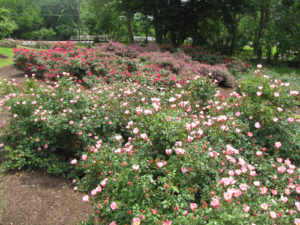
Photgraph by Pamela Powers

The Bon Air Memorial Rose Garden, located at the corner of N. Lexington  St. and Wilson Boulevard, was conceived by Nell Broyhill as a memorial for the many Arlingtonians who served and died in World War II.

In 1941, Ms.  Broyhill assembled a group of women from Arlington churches, civic groups and associations and formed the Arlington Rose Garden Association, now called the Arlington Rose Foundation. After ten years of fundraising they finally realized their dream when the rose garden opened on the grounds of what was then Arlington Hospital (now Virginia Hospital Center) in 1951.

Ten years later the garden was moved to Bon Air Park; the transfer was completed in 1964. Today the garden is maintained by the Arlington’s Department of Parks, Recreation and Community Resources. It contains approximately 135 different rose varieties and 2,500 plants on about one acre.

In the center of the garden is the famous Peace rose and the Veterans’ Honor ™ rose. The Peace rose is a yellow blend Hybrid Tea developed by Frances Meilland in France in 1935. When World War II began Meilland sent the rose to friends in Germany, Italy and the U.S. in the hopes of ensuring its survival. Called the Peace rose in the U.S. to commemorate the end of the war, it was formally introduced on April 19, 1945, the day Berlin fell.

The Veterans’ Honor ™ rose, a dark red hybrid tea rose, was created by Jackson and Perkins in 1999 to commemorate America’s veterans.

The Foundation sponsors an annual rose competition for growers. This year’s district competition, which includes 70 competitive categories, will be at held at Merrifield Garden Center- Fair Oaks location on September 22nd from  1 to 6 pm and September 23rd from  11am to 4 pm. See  www. arlingtonrose.org  for more details as well as for information about the Arlington Rose Foundation’s activities and rose advice.

Plans are also underway for a Bon Air Memorial Rose garden celebration day on Saturday, October 6. Along with docent-led tours, rose rooting classes and poetry inspired by roses, the legacy and unique gift that Ms. Broyhill bestowed to Arlington will be on prime display.

What About You?

What are your favorite memories of Bon Air Rose Garden? Or other wonderful rose gardens in Arlington?


July 26, 2012 by Web Editor Tagged With: local history news

Clarendon’s Trophy

Post Published: June 21, 2012

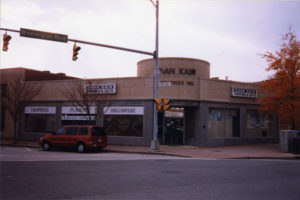
Dan Kan Trophies, 1998


The building at 3100 Washington Boulevard in Clarendon is a visually arresting structure.

This Streamline Moderne-style storefront was the home of Dan Kain Trophies, which was the store in Arlington for trophies, ribbons and plaques for many years. Although Dan Kain Trophies is now located in Merrifield in Fairfax County, it still has a major impact on the community; so much so that although the building is currently a restaurant called Lyon Hall, many Arlingtonians still call it the Dan Kain Building.

The Dan Kain Building, shown above in 1998, was constructed in the mid-1940s for Frank Lyon, who rented it out to a series of businesses selling appliances, electronics and finally furniture. In 1963, Dan Kain moved his trophy business, which he had established in his home, into the building, and Dan Kan Trophies stayed there for 40 years, providing not just Arlington but northern Virginia with signs, trophies and other materials for government and private groups. In 1973, ads appeared in the Washington Post for “Special Prices for Bowling Leagues.” With its specialized products, friendly service and unique home, Dan Kain Trophies became an institution.

In 1988, the County Board unanimously approved the Dan Kain Building as a Local Historic District. It is an excellent example of the Streamline Moderne style of architecture, with its lack of ornamentation, streamlining, and distinctive wrap around to North Highland Street. The interior was renovated in 2004, and Dan Kan Trophies, now owned by longtime employee Jim Preziotti, left Washington Boulevard to relocate to 2207 N. Pershing Drive.

A GSA federal contract in 2009 to make trophies and signs was an indication of the business’s continuing vitality. However, the economy’s downturn hurt Dan Kain Trophies; budgets set aside for trophies, medals and plaques were diminished as belts were tightened. When the Pershing Drive location was scheduled to be torn down in 2010, the business ended up moving to Merrifield, where rent is cheaper. However, Dan Kain Trophies is still in business, marking people’s milestones and helping preserve memories. And the building to which it is linked still stands proudly, still a vital part of Clarendon’s business district.

What about you?
What are your memories of Dan Kan Trophies and its building?

June 21, 2012 by Web Editor Tagged With: local history news

How to Preserve Arlington’s Past

Post Published: May 25, 2012

The Virginia Room at Central Library is the County’s official history archive.

But how does the Library keep a steady flow of history coming in? Donations, from people like you.

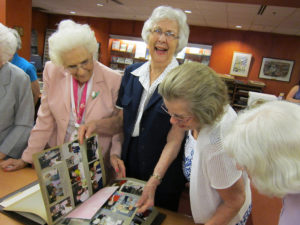
Scott McCaffrey of the Sun Gazette was on hand for a recent donation by the Potomac Women’s Club, just one of several civic groups that now has its newsletters, yearbooks and scrapbooks preserved for future generations of Arlington residents and researchers.

In the case of the Potomac Women’s Club, the records go back to the early 1950s and create a fascinating timeline of both dramatic changes in the County and the evolving influence of women’s organizations nationwide.

See more images from the Potomac Women’s Club donation.


Learn more about the Virginia Room and local history. 


May 25, 2012 by Web Editor Tagged With: local history news

Our Back Pages: Swillers Music

Post Published: May 14, 2012

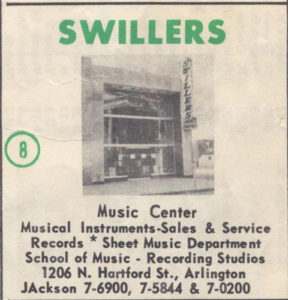
Serving as both a location to find the latest recorded music and a popular gathering spot, Swillers Music is still fondly remembered by longtime Arlington residents. 

Known over the years as Swillers Music, Swillers Music Center, or just Swillers, the store’s location in Clarendon at 1206 N. Hartford St. helped it become a magnet for residents looking for phonograph records of all genres. Turntables, televisions, radios, and related accessories were also kept in stock for the customer’s convenience.

Priding themselves on adding new merchandise on a near daily basis, many local residents found themselves visiting Swillers regularly, enjoying each other’s company, making new friends, or just passing the time. All of this seems quite fitting for a family owned business overseen by president Milton Swiller, vice president Anna Swiller, and treasurer Sydney Swiller.

The first listing for Swillers in an Arlington County directory appeared in 1948, while the last entry is from 1961.

 What About You?

 Do you have any recollections about Swillers Music?  If you do, please share in our comments section. Thanks.


May 14, 2012 by Web Editor Tagged With: local history news

  • « Go to Previous Page
  • Page 1
  • Page 2
  • Page 3
  • Page 4
  • Go to Next Page »

Footer

About Us

  • Mission & Vision
  • Charlie Clark Center for Local History
  • News Room
  • Get Email Updates

Administration

  • Policies
  • Library Staff
  • Job Opportunities
  • Propose a Program or Partnership

Support Your Library

  • Friends of the Library
  • Giving Opportunities
  • Donating Materials
  • Volunteer Opportunities

Our Mission

We champion the power of stories, information and ideas.

We create space for culture and connection.

We embrace inclusion and diverse points of view.


Download the Library App

Download the Library App

Arlington County | Terms & Conditions | Accessibility | Site Map
· Copyright © 2026 Arlington County Government ·