• Skip to primary navigation
  • Skip to main content
  • Skip to footer

Alert

Storytime programs are paused August 15-29. More Info

Alert

Update: Quincy St entrance closed during upgrades at Central Library. More Info

Home - Arlington County Virginia - Logo
MENUMENU
  • Join Now
  • My Account
    • Login
    • My Checkouts
    • My Holds
    • My Lists
    • My Reading History
    • About Borrowing
    • About Holds
    • About My Account
  • Hours & Locations
    • All Hours & Locations
    • Holiday Closings
  • News
    • Library News
    • Director's Blog
    • Get Email Updates
  • Contact Us

Arlington Public Library

MENUMENU
  • Search
  • Collections
  • Library Services
  • Events
  • Community Engagement
  • Join Now
  • My Account
    • Login
    • About Borrowing
    • About Holds
    • About My Account
  • Hours & Locations
    • All Hours & Locations
    • Holiday Closings
  • News
    • Library Blog
    • Get Email Updates
  • Contact Us

September 11

Resilience and Community

Post Published: August 4, 2026

September 11, 2001

“When terrorists slammed into the Pentagon on September 11, they aimed at the heart of the nation’s defense, with a goal of weakening the United States and spreading great international uncertainty. The first response to this blow at the world’s only remaining superpower, and to the tragic aftermath, was led by the same people who respond to every emergency, large and small, every day—local government. At the Pentagon, this meant Arlington County, Virginia.”

Former Arlington County Manager Ron Carlee, remembrance speech on the anniversary of 9/11, Sept. 11, 2002, Charlie Clark Center for Local History


Honoring the Memory of Those Affected by the Attacks

Following 9/11, the Arlington community demonstrated remarkable resilience, compassion and determination. While the lives of those lost can never be restored, the tragedy inspired lasting lessons about unity, service and perseverance—both locally and nationally.

Supported by neighbors, businesses and people across the nation, Arlington emerged stronger—embracing growth and adapting to change while honoring the memory of those affected by the attacks.
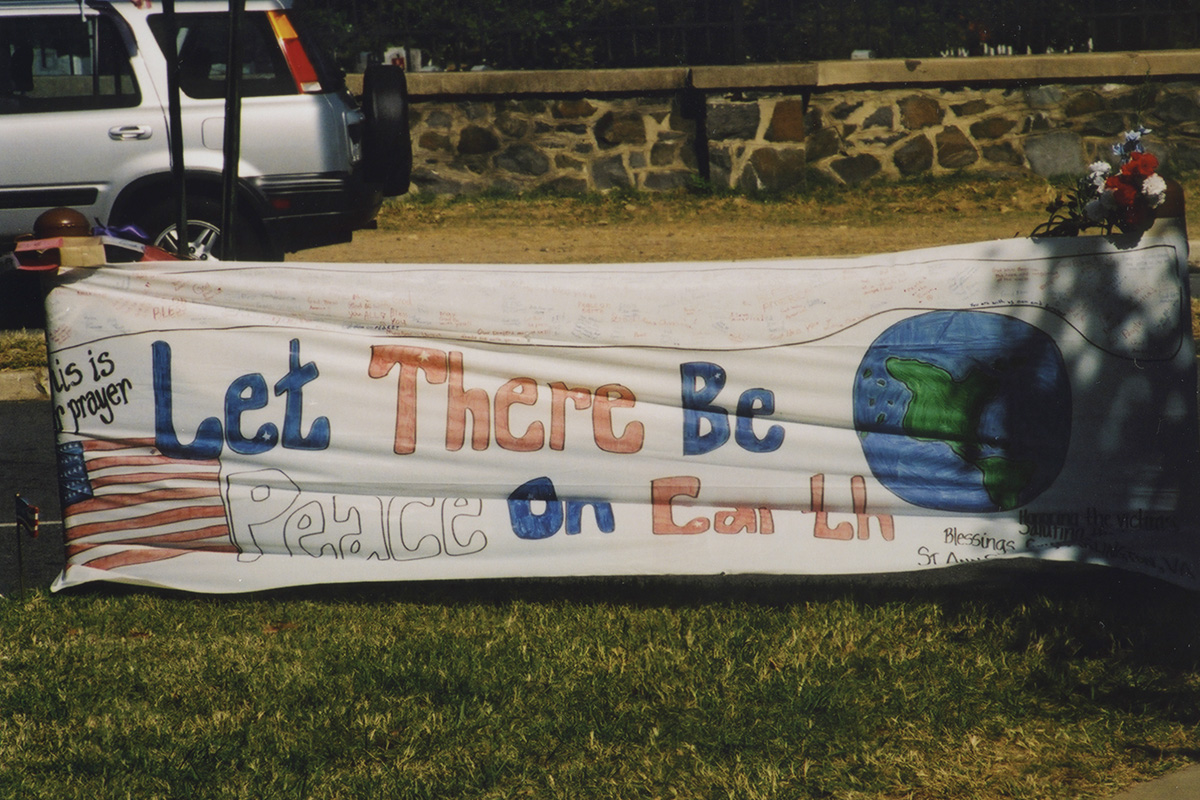
Large banner that reads, “Let there Be Peace on Earth” displayed near the Pentagon following the 9/11 terrorist attacks. Photo credit Diane Kresh. Charlie Clark Center for Local History, 133-01-02-01-130
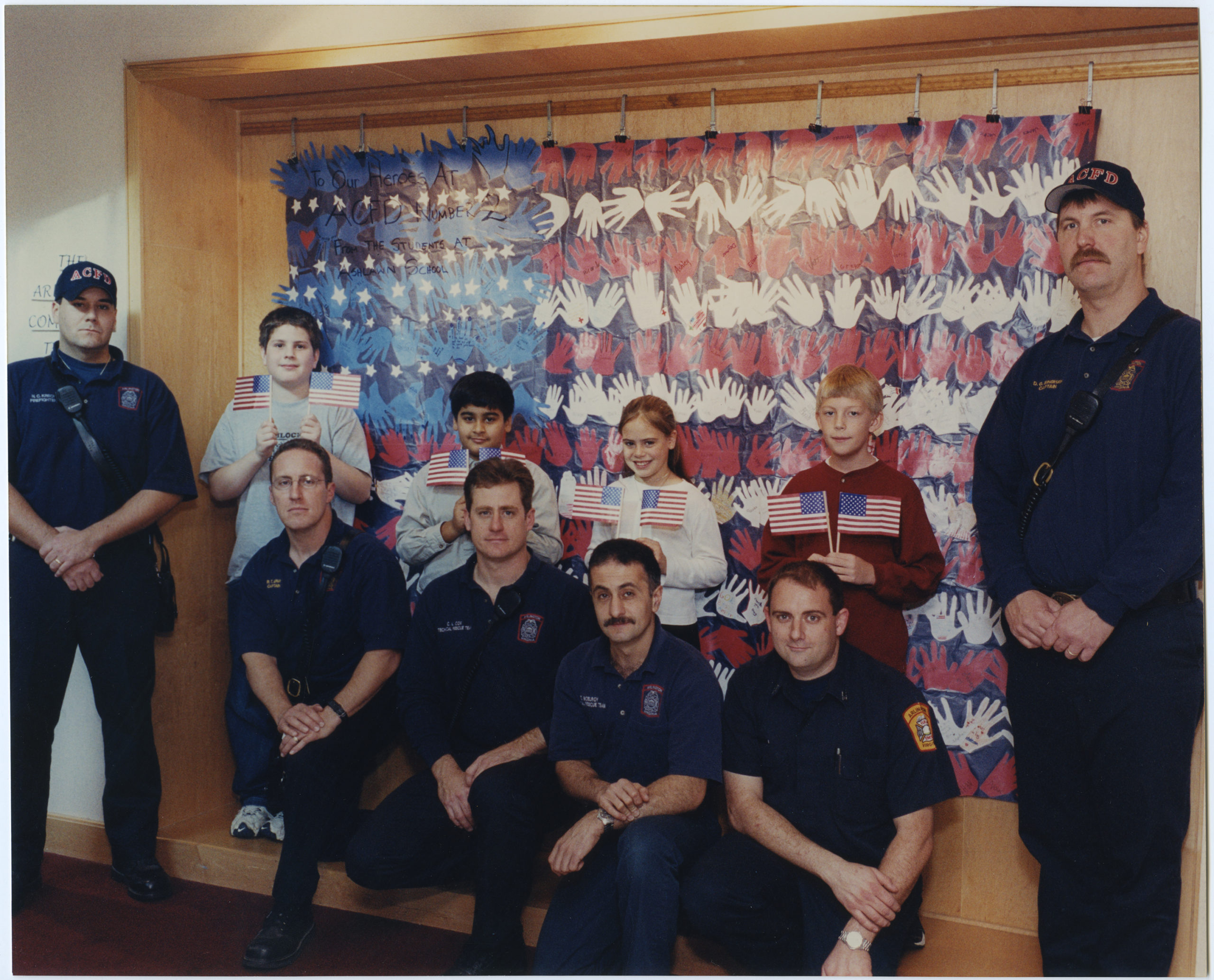
Members of the Arlington County Fire Department with children.

Members of the Arlington County Fire Department pose with children in front of a mural created to thank them for their service. Photo credit Michael DeFina.
Charlie Clark Center for Local History, 133-0104
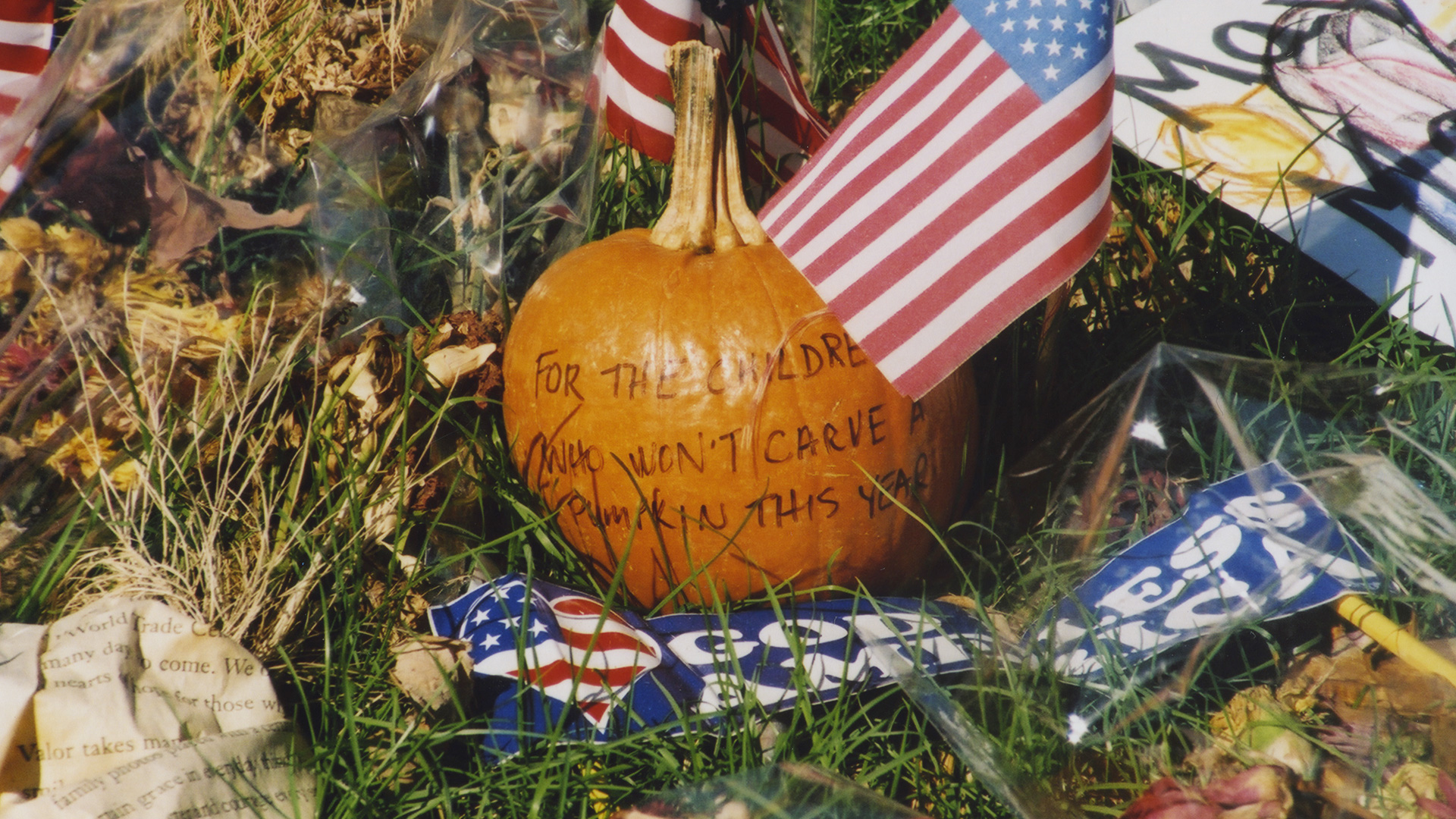
Closeup of a "God Bless America" bumper sticker and a pumpkin that has "For the children who won't carve a pumpkin this year" written on it, among the items at a memorial for the victims of the 9/11 terrorist attack on the Pentagon. Photo credit Diane Kresh. Charlie Clark Center for Local History,133-01-02-01-128
Closeup of a "God Bless America" bumper sticker and a pumpkin that has "For the children who won't carve a pumpkin this year" written on it, among the items at a memorial for the victims of the 9/11 terrorist attack on the Pentagon. Photo credit Diane Kresh. Charlie Clark Center for Local History, 133-01-02-01-128

New Government Services Go Online

In the months after September 11, Fire Department Assistant Chief of Operations James Schwartz, the incident commander at the Pentagon terrorist attack, was appointed to head the County’s newly organized emergency management office.

The new office would better align Arlington for disaster preparedness and response in the future. James Schwartz later served as fire chief from 2004-2015 and was named Deputy County Manager for Public Safety and Technology in 2015 until his retirement in 2021.

Among his many achievements during Schwartz’s career was Arlington Alert, a new text and e-mail paging service for Arlington residents and employees. “Arlington Alert” sends alerts about local traffic, hazardous weather and major events.

In 2002, Arlington County Government created the Arlington Community Emergency Response Team (CERT) in response to 9/11.

CERT is a volunteer program that works with Arlington community members to prepare for and respond to emergencies. Volunteers receive free training in disaster preparedness, triage, first aid, fire suppression, disaster psychology, terrorism awareness and more.
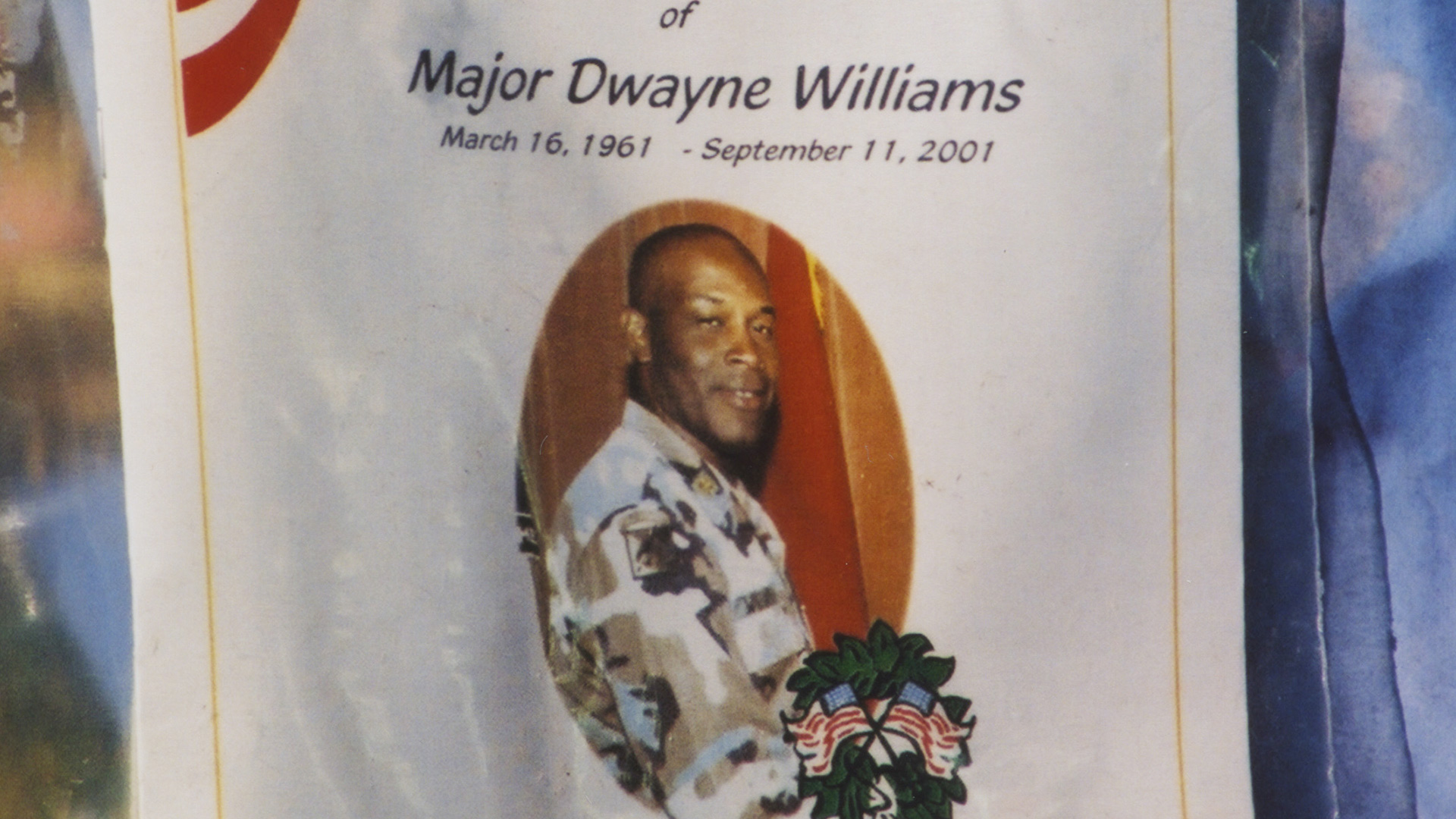
Closeup of a flier for a memorial service for Major Dwayne Williams to be held at Ebenezer African Methodist Episcopal Church in Fort Washington, Maryland on September 28, 2001. The flier is among other items in a large memorial for victims near the grounds of the Pentagon where Williams perished in the 9/11 terrorist attack. Photo credit Diane Kresh. Charlie Clark Center for Local History, 133-01-02-01-127

A Community Comes Together

After 9/11, the Arlington community mourned, provided moral support and gave encouragement to the first responders.

Hundreds of calls came in on the information line, and public shrines appeared near the Pentagon. Starting the first night after the attack, homemade food was delivered to fire stations and other sites throughout the County. However, without proper food preparation methods, homemade food could not be safely consumed.

The Crystal City Sports Pub, located at 529, 23rd St. Arlington, VA 22202, was one of the many businesses donating food and supplies during the rescue and recovery efforts.

Late in the disaster response, County recreation centers were used to engage residents in structured activities such as sharing experiences and creating supportive messages for rescue workers and victims.

Firefighters and rescue workers clearing debris at the impact site of the Pentagon following the attack. Photo credit Michael DeFina.
Charlie Clark Center for Local History, 133-01-01-01-0013

Arlington Remembers

The Pentagon’s outer ring was rebuilt ahead of schedule and completed in August 2002, with broader renovations completed by 2011.

Each year, local communities, the Pentagon and federal government agencies remember the victims of the 9/11 terrorist attacks and commemorate the tremendous efforts by local, state and federal agencies and first responders.

The crash sites in New York, Arlington and Shanksville are now a museum and national memorials.

As people who remember that day still struggle to make sense of the terrorist attacks, an increasing share of young Americans were not yet born or do not have memories of 9/11 itself. Now more than ever, it is important to keep this historic tragedy—and our unified response—in our collective memory.

Want to Learn More?

Visit the Charlie Clark Center for Local History to learn more about 9/11. The Center houses a diverse collection of oral histories, documents, photos and more related to the Pentagon terrorist attack.
Learn More
Scroll Up

August 4, 2026 by Library Communications Officer Tagged With: September 11

The Response in Arlington

Post Published: August 4, 2026

Through Smoke, Fire and Darkness

“We came across numerous bodies at the time—[in] various states. Some of them... you could tell were in their office, and the flames overcame the whole place, and they had no chance whatsoever to get out. Other areas, you could see people that were crawling around on the floor trying to get out, or help others, and they succumbed to the smoke too, and they were just lying in the middle of the floor, in the middle of the hallway, as they tried to get out.”

Dean Tills, Fairfax County Urban Search and Rescue Department,
excerpt from oral history interview, 2012, Charlie Clark Center for Local History


A Changed World

For Arlington County first responders, who for nearly two grueling weeks led the rescue and recovery efforts at the Pentagon, the world after September 11, 2001, would never be the same. They may not have lost any of their own that day, but the 343 firefighters and almost 3,000 victims who perished during the 9/11 terrorist attacks in Arlington, New York City and Shanksville weighed heavily on their minds.

It tested them in ways few could have imagined.

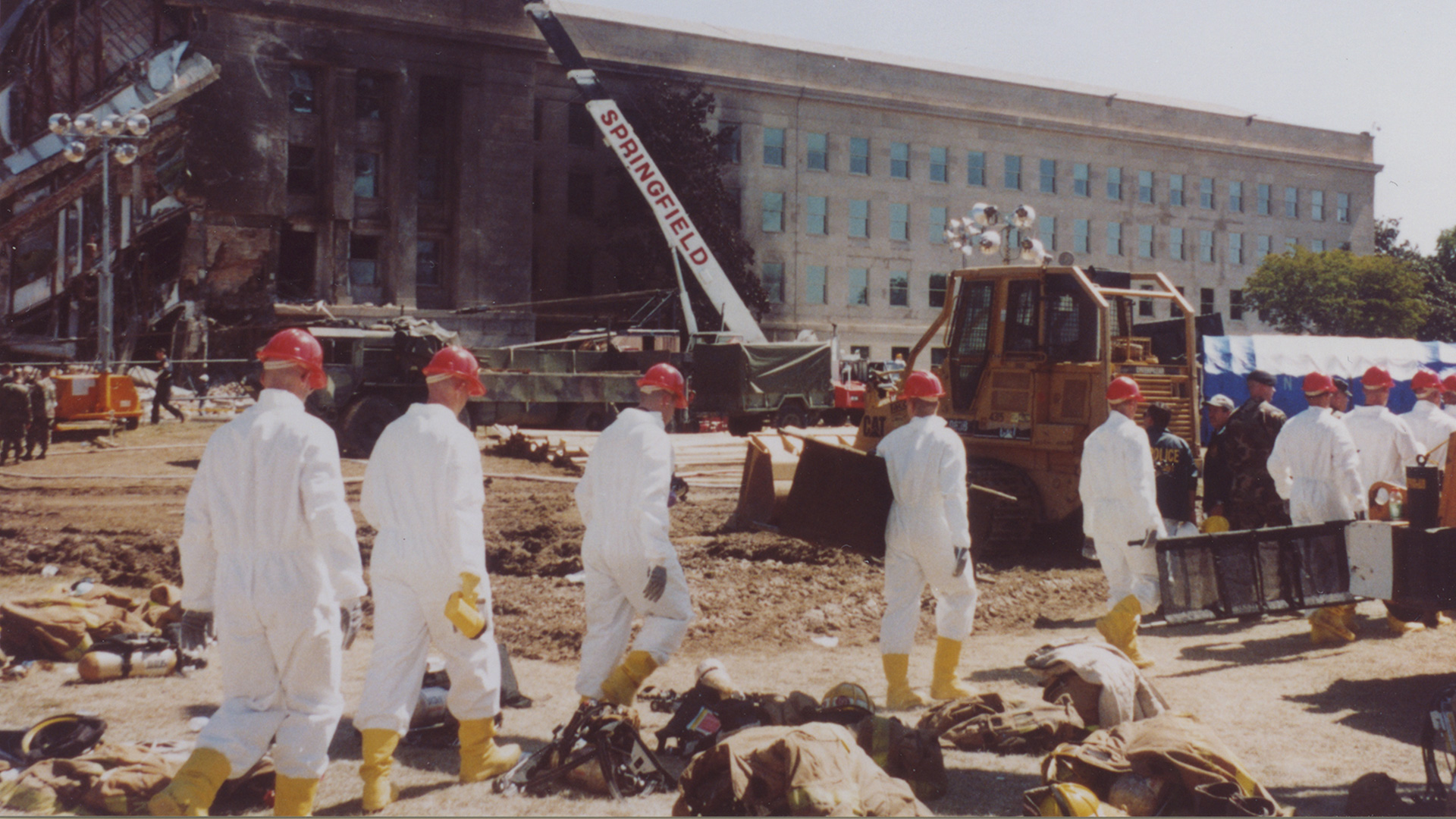
Workers in white suites headed toward the wreckage of the Pentagon the day after the 9/11 attack. Photo credit Michael Defina. Charlie Clark Center for Local History, 133-0066
Workers in white suits headed toward the wreckage of the Pentagon the day after the 9/11 attack. Photo credit Michael DeFina. Charlie Clark Center for Local History, 133-01-01-01-0066
Planning the next steps.

Two firefighters draw plans to work on the impact site at the Pentagon following the 9/11 attack.
Photo credit Michael DeFina. Charlie Clark Center for Local History, 133-01-01-01-0030

Early Civilian and Military Response

Many of the Pentagon’s more than 20,000 civilian and military personnel were already on edge when the attack came. News of the crashes in New York City rang through the corridors, and employees watched their office televisions in disbelief as smoke engulfed the two towers. Then, the unimaginable happened.

When Flight 77 hit its target, it ripped through three of the five outer rings of the building, destroying all five stories of the western façade of the Pentagon and leaving a 100-foot wide hole of destruction.

In the immediate aftermath, Pentagon employees acted selflessly and heroically to help evacuate their shaken and injured colleagues. Their quick actions, before emergency crews arrived on the scene, meant that more people survived that day.

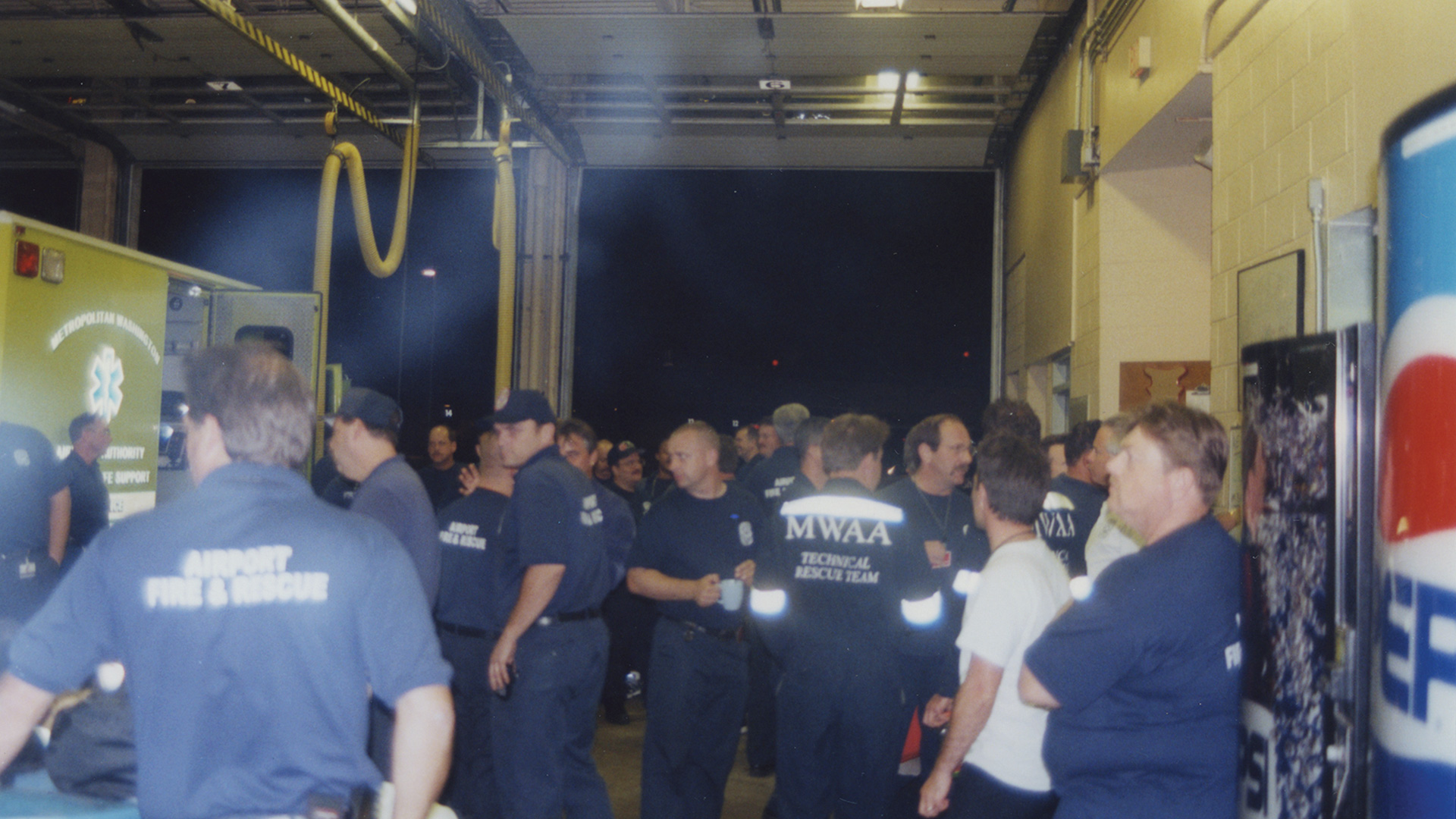
Firefighters taking a much-needed break at the Ronald Reagan Washington National Airport fire station at 10 p.m. on September 11, after a day-long rescue effort at the Pentagon following the attacks. Photo credit Michael Defina. Charlie Clark Center for Local History, 133-01-01-01-0033
Firefighters taking a much-needed break at the Ronald Reagan Washington National Airport fire station at 10 p.m. on September 11, after a day-long rescue effort at the Pentagon following the attacks. Photo credit Michael DeFina. Charlie Clark Center for Local History, 133-01-01-01-0033

Rescue Units Arrive

Arlington’s Emergency Operations Center (EOC) received early warnings from County emergency workers who saw the low-flying plane. The Metropolitan Washington Airports Authority (MWAA) Fire & Rescue Departments, serving Fort Myer and Ronald Reagan Washington National Airport, were notified, both of which had already started to respond. Dispatchers also asked Alexandria, Fairfax County and the District of Columbia fire and EMS services to stage units in readiness near the Pentagon.

The number of departments and volunteers responding, combined with the confusion and chaos at the scene underscored the need for effective command and control. This became the responsibility of Arlington County Fire Department (ACFD) Assistant Chief of Operations James Schwartz, who arrived at the scene within ten minutes of the impact. Schwartz set up an incident command center near the crash site.

Rescue units from Arlington, Fort Myer, Ronald Reagan Washington National Airport and the District of Columbia arrived first at the scene and bore the brunt of the fire battle. The firefighters performed their most critical missions during the first 36 hours—at first to save lives, then to contain the blaze.

For ten days following the attack, until the fire was officially declared extinguished, the ACFD retained control of the crash site. They transferred control of the crime scene to the FBI on September 21 at 7 a.m. The FBI returned control of the site to the Department of Defense on September 26.

By that time, most human remains had been recovered from the site and were transported to the Dover Port Mortuary at Dover Air Force Base in Delaware before being returned to their families.

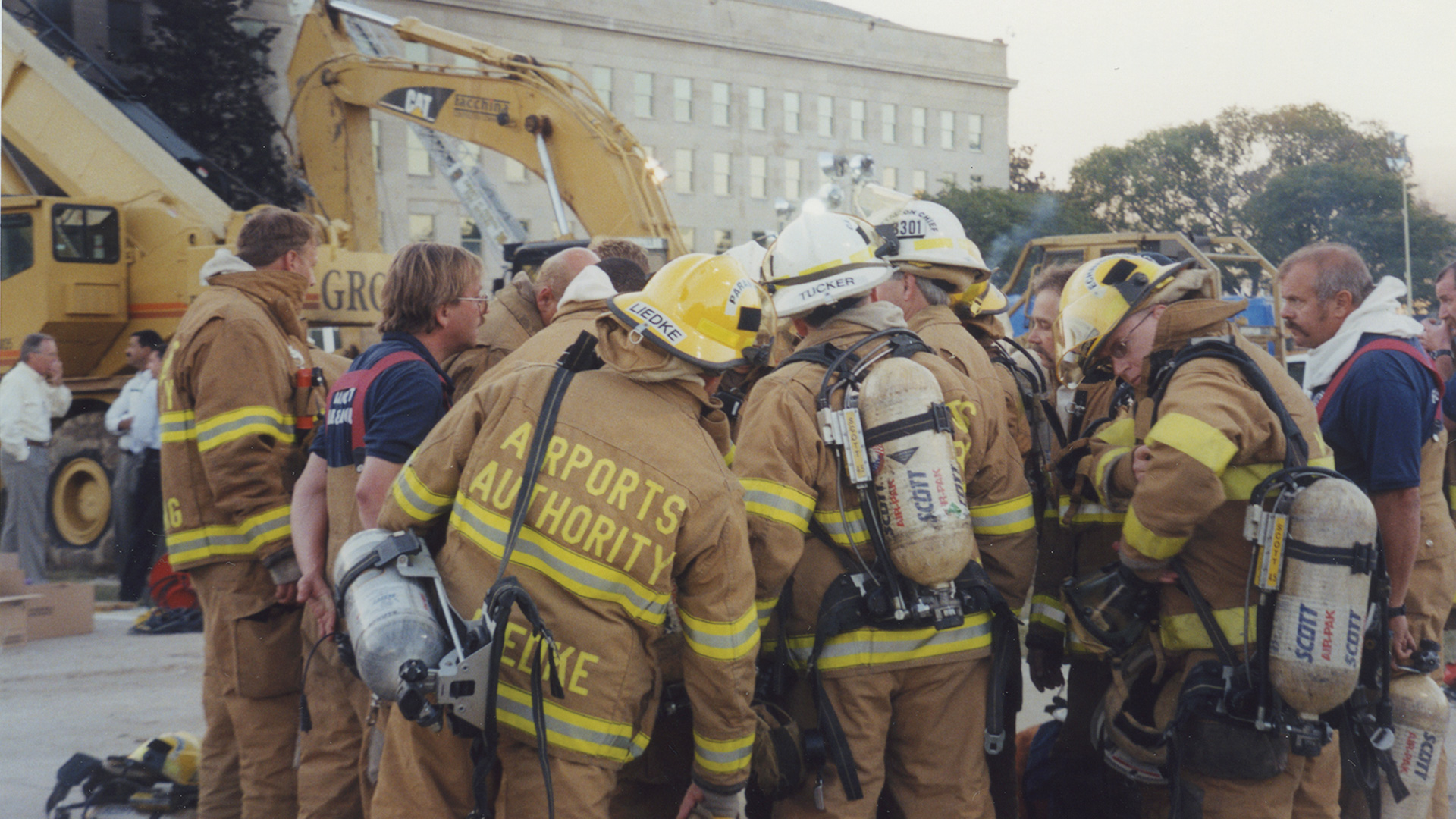
Firefighters huddling together to begin work on the morning of September 12 at the Pentagon, the day after the 9/11 attack. Photo credit Michael Defina. Charlie Clark Center for Local History, 133-01-01-01-0024
Firefighters huddling together to begin work on the morning of September 12 at the Pentagon, the day after the 9/11 attack. Photo credit Michael DeFina. Charlie Clark Center for Local History, 133-01-01-01-0024

Firefighters Faced Multiple Obstacles

The situation for firefighters was daunting, and initial search and rescue missions were extremely dangerous. Searching from room to room for survivors, firefighters used axes, crowbar-like tools, sledgehammers and a hydraulic device to pry doors open.

They encountered heavy smoke and debris everywhere—broken glass, melted plastic, twisted pipes and a layer of black soot covering every surface. The jet fuel burned fiercely and was intensified by the radiant heat coming from the center of the crash site. Estimates of maximum interior temperatures ranged up to 2,000 degrees Fahrenheit.

Rescue units used thermal energy cameras to look for bodies, but unfortunately they found no one alive. Most rescues happened in the early minutes shortly after the incident before the firefighters arrived.

After the fire finally was contained on the afternoon of Sept. 12, David Lange, Battalion Chief of the Fairfax County Fire and Rescue Department, led a crew of firefighters and soldiers to the roof, where they draped a large American flag over the side of the building, just south of the impact point.

The image of the giant flag would become a strong symbol to the first responders and the public of both the tragedy of 9/11 and also of hope and perseverance.

The giant U.S. flag would become a strong symbol to the first responders and the public of both the tragedy of 9/11 and also of hope and perseverance.

An American flag is draped over a portion of the Pentagon near where the structure was hit by a plane during the 9/11 attack. Photo credit Diane Kresh. Charlie Clark center for Local History, 133-01-02-01-107

Want to Learn More?

Click below and find out how the Arlington community demonstrated remarkable resilience, compassion and determination, following the 9/11 terrorist attacks.

Learn More
Scroll Up

August 4, 2026 by Library Communications Officer Tagged With: September 11

Remembering 9/11

Post Published: August 4, 2026

September 11, 2001

“… one thing that I will always remember… we were on the ramp of 395 down to Washington Boulevard, and I looked over to South Joyce Street… if there was ever an image of Armageddon… all I saw were hundreds and hundreds of people walking with nowhere to go. These were civilians, they were military… there was no one telling them where to go, just a block of humanity going down Joyce Street.”

James M. Daly, lieutenant, Arlington County Police Department,
excerpt from oral history interview
, 2006, Charlie Clark Center for Local History


A Nation Forever Changed

On September 11, 2001, the United States suffered a devastating terrorist attack that claimed the lives of nearly 3,000 people. The coordinated hijacking of four commercial airplanes and attacks on symbolic American targets forever changed the nation, leaving behind deep grief and trauma.

Yet amid tragedy, remarkable acts of courage, sacrifice and resilience emerged.

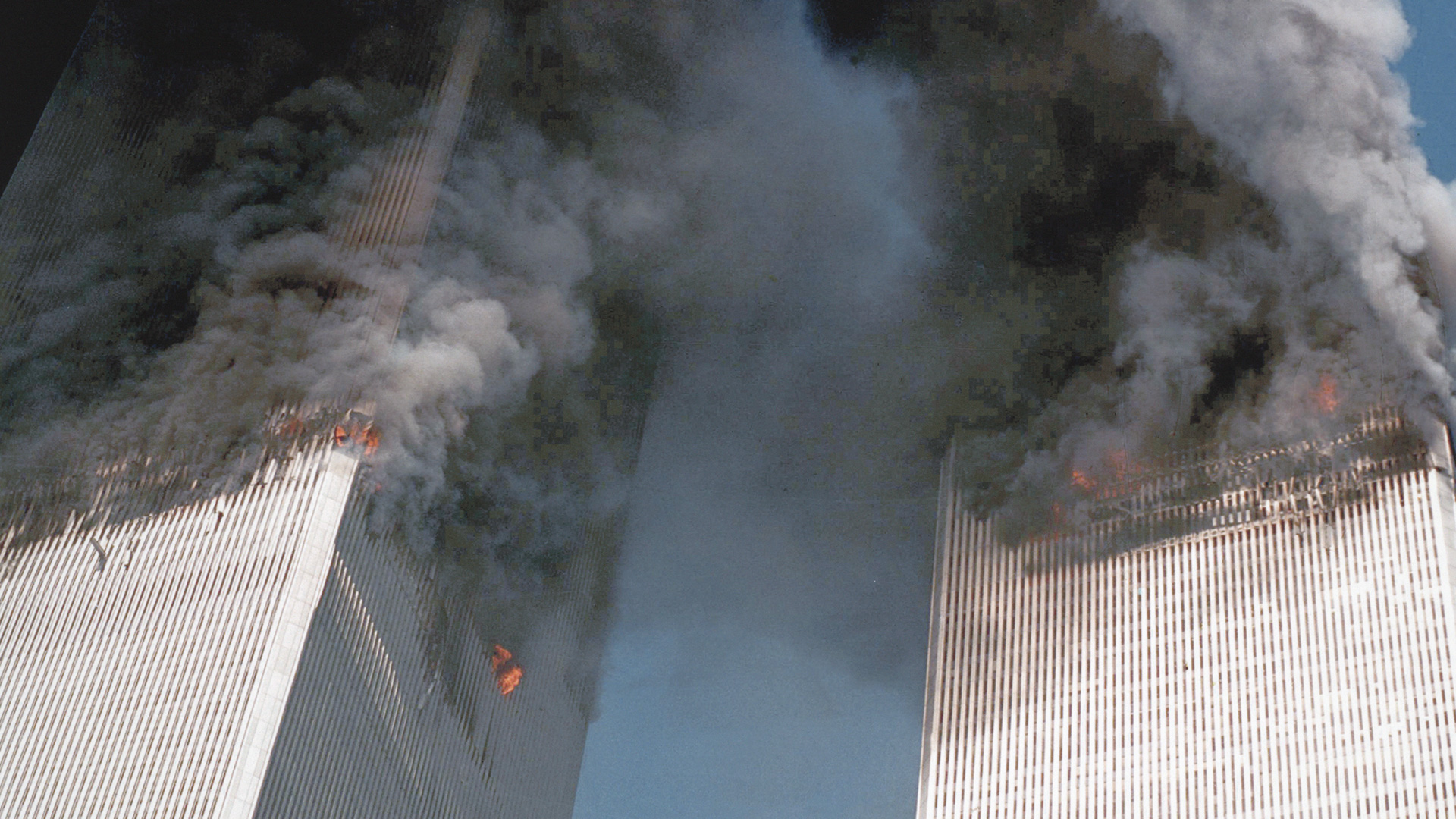
Twin Towers on Fire View of the twin towers on fire, following the September 11 terrorist attacks on the World Trade Center, New York City. Photo credit Juan González. Library of Congress, Prints & Photographs Division, LC-DIG-ppmsca-02099
View of the twin towers on fire, following the September 11, 2001, terrorist attacks on the World Trade Center, New York City. Photo credit Juan González. Library of Congress, Prints & Photographs Division, LC-DIG-ppmsca-02099
Following the September 11 terrorist attacks, former New York City Mayor Rudolph Giuliani ordered the evacuation of Lower Manhattan, resulting in hundreds of thousands of residents, workers and visitors leaving the area.

A tattered American flag waving from broken tree trunk in the foreground, with rescue workers and a car on fire in the distance, following the September 11 terrorist attack on the World Trade Center, New York City. Photo credit Michael Schwartz.
Library of Congress, Prints & Photographs Division, LC-DIG-ppmsca-01834

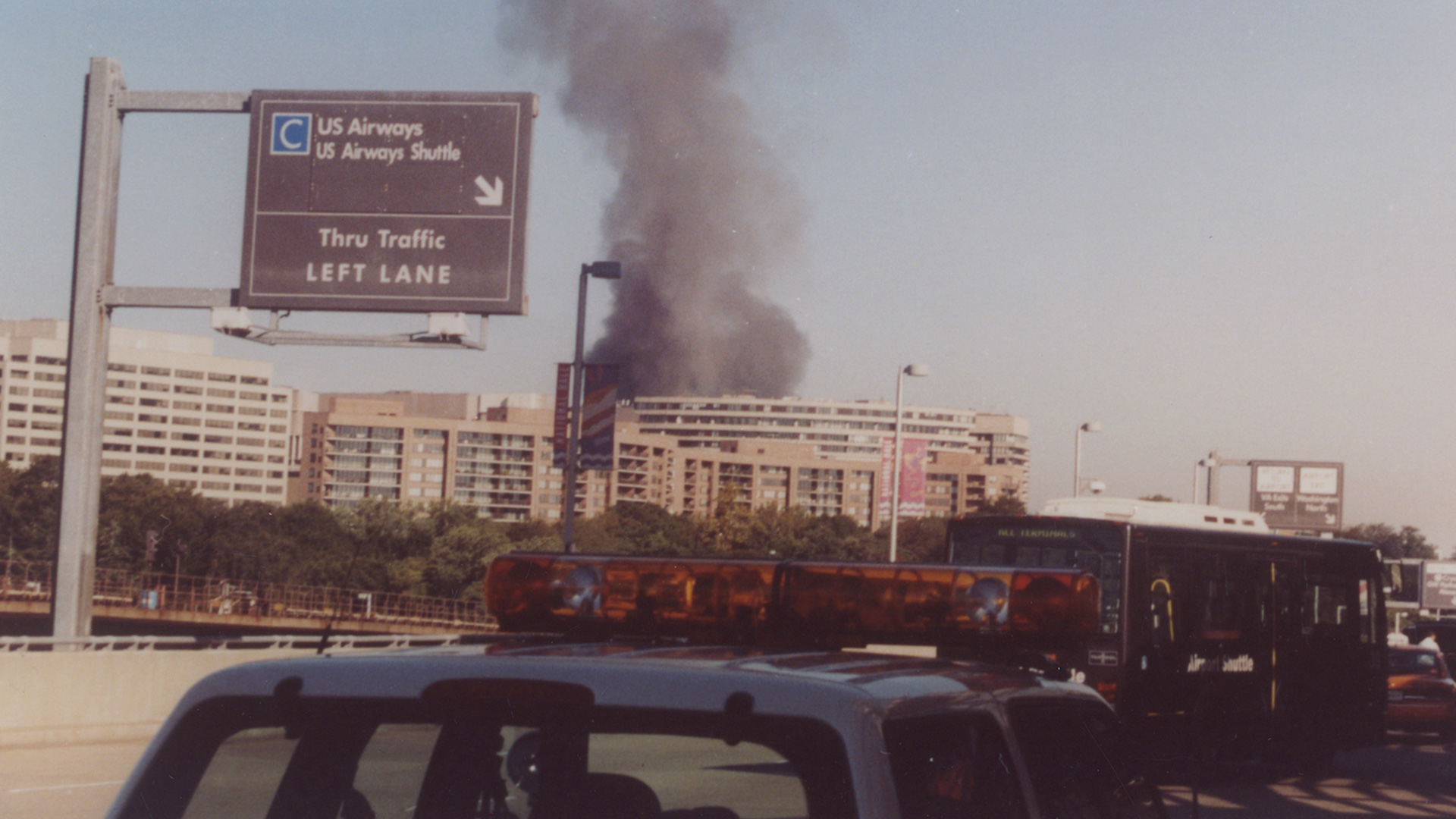
The plume of smoke from the Pentagon attack on September 11, 2001, taken as Michael Defina was en route from Ronald Reagan Washington National Airport. Photo credit Michael Defina. Charlie Clark Center for Local History, 133-01-01-02-0080
The plume of smoke from the Pentagon attack on September 11, 2001, taken as Michael DeFina was en route from Ronald Reagan Washington National Airport. Photo credit Michael DeFina. Charlie Clark Center for Local History, 133-01-01-02-0080

Flight 77

It was 9:37 a.m., Tuesday, September 11, 2001, when the American Airlines Flight 77 crashed into the western side of the Pentagon, adjacent to the heliport, in Arlington, Virginia.

Less than an hour earlier in New York City, two hijacked planes (American Airlines Flight 11 and United Airlines Flight 175) struck the World Trade Center’s North and South Towers, eventually causing both structures and Building 7 to collapse. Everyone on board the planes and hundreds of people inside the buildings, including rescue personnel, were killed.

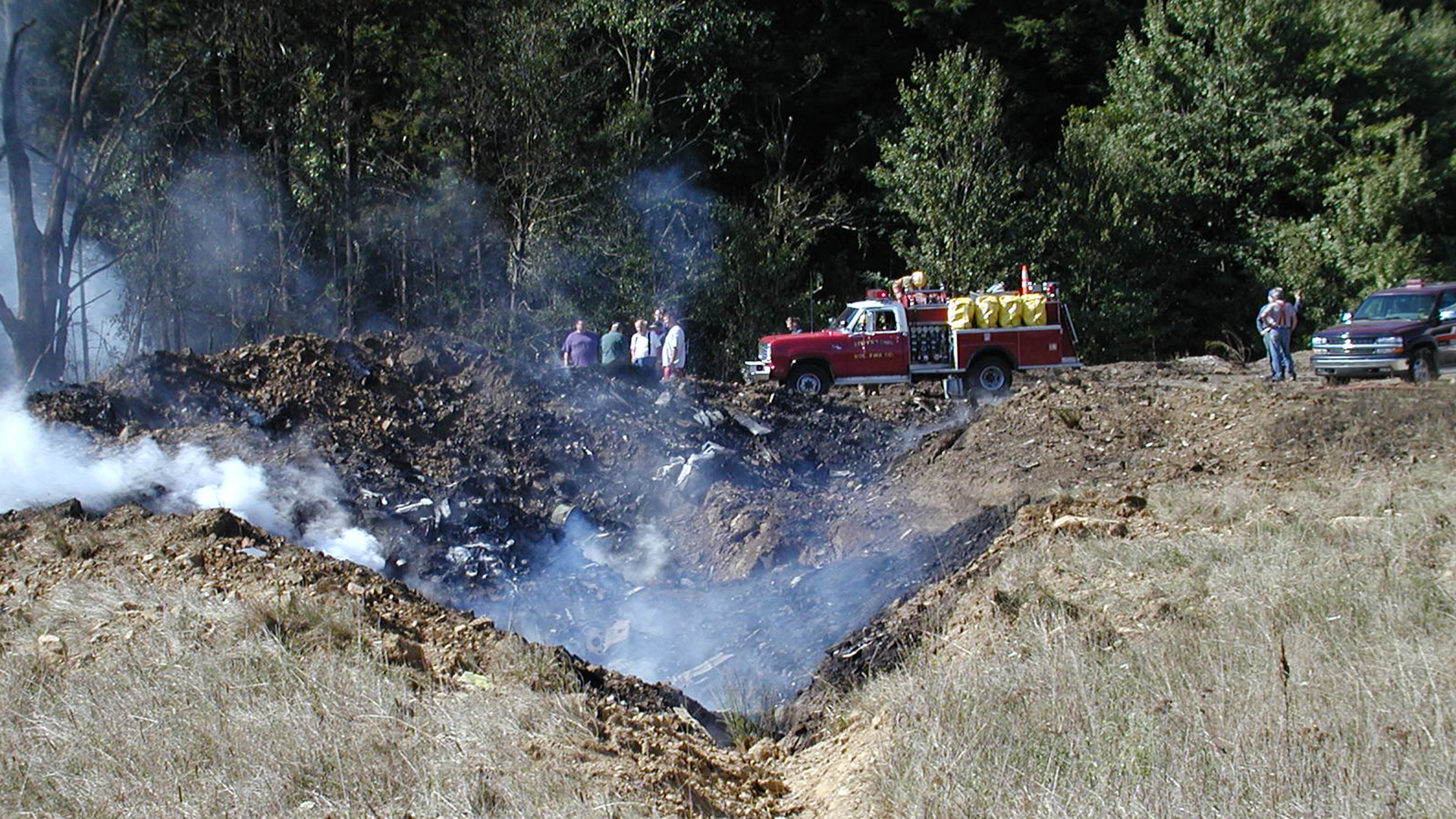
A firetruck and people at the crash site of United Airlines Flight 93, at a field near Shanksville, PA, after it was hijacked on September 11, 2001. Photo credit Mark Stahl. Library of Congress, Prints & Photographs Division, LC-DIG-ppbd-00038 
A firetruck and people at the crash site of United Airlines Flight 93, at a field near Shanksville, PA, after it was hijacked on September 11, 2001. Photo credit Mark Stahl. Library of Congress, Prints & Photographs Division, LC-DIG-ppbd-00038

Flight 93

In the final minutes of United Airlines Flight 93, passengers and crew members attempted to regain control of the aircraft from the hijackers. The plane subsequently crashed into a field near Shanksville, Pennsylvania, at 10:03 a.m., approximately 20 minutes before it would have reached Washington, D.C. All 44 people onboard, including the four hijackers, were killed.

Aerial view of the western side of the Pentagon.

Aerial view of the Pentagon in Arlington, VA, showing the damaged area where the hijacked American Airlines flight 77 crashed during the September 11 terrorist attack. Photo credit United States Department of Defense.
Library of Congress, Prints & Photographs Division, LC-DIG-ppmsca-02093

A Nation In Shock

In Arlington, seconds before the crash, Flight 77 traveled on an east-northeast course above Columbia Pike, at 530 m.p.h., before turning towards the Pentagon. The destructive forces of the plane’s impact and subsequent explosion of 7,000 gallons of jet fuel ripped open the building, leaving behind a path of destruction that killed 189 and injured 106 people inside. Onboard Flight 77, all 64 people, including five hijackers, were killed.

As the events which would come to be known as “9/11” unfolded that day, the region—and the nation—were in shock. The lives of thousands of people, victims and their families, first responders and survivors, would forever be changed.

Want to Learn More?

Click below and find out more about the early civilian an military response, the rescue units and the role of the Arlington County Fire Department during the Pentagon terrorist attack.
Learn More
Scroll Up

August 4, 2026 by Library Communications Officer Tagged With: September 11

Pride Month Collection Spotlight: The Jay Fisette Papers

Post Published: June 27, 2024

The Charlie Clark Center for Local History features a new collection of archival materials donated by Jay Fisette, RG 387: Personal Papers of Jay Fisette, 1992-2018.

In 1997, Fisette became the first openly LGBTQ+ person elected to office in the state of Virginia when he won a seat on the Arlington County Board. He served for six terms on the Board between 1998 and 2017 and served as Board Chair five times, making him the second-longest-serving board member in Arlington County’s history after Ellen Bozman (in office 1974-1997).

Headshot of Jay Fisette from 1997.

Headshot of Jay Fisette, newly elected to the Arlington County Board in 1997. All images included in this post are from RG 387: Personal Papers of Jay Fisette.

After moving to Arlington in 1983 to pursue a career in the federal government, Fisette became involved in community service. He joined the Arlington Gay and Lesbian Alliance (now Equality NoVA) in 1988 and successfully advocated for the inclusion of sexual orientation protections in the county’s human rights ordinance. In 1989, he joined the Ashton Heights Civic Association, which helped spark his interest in local politics. From 1990 to 1998, Fisette served as the director of the Whitman-Walker Clinic of Northern Virginia, a non-profit community health center that specialized in HIV/AIDS care.

Fisette first ran for a vacant County Board seat in the 1993 special election. His candidacy and primary victory came as a surprise given that he was open about his sexuality throughout the campaign. Although Fisette lost the general election in 1993, he ran again in 1997 and won 62% of the votes.

Front of Postcard from Jay Fisette campaign.
Back of postcard for Jay Fisette Campaign.

Front and back of a postcard from the 2009 County Board election urging Arlingtonians to vote for Fisette, featuring his dogs Cassie and Chocco.

During his time in office, he continued to dedicate himself to supporting various local and regional organizations including the Arlington Arts Center (now the Museum of Contemporary Art Arlington), Arlingtonians for a Better County, the Arlington Committee of 100, the Virginia Partisans Gay & Lesbian Democratic Club, and many more.

A pamphlet from 1996 created by the Human Rights Campaign.

A pamphlet from 1996 created by the Human Rights Campaign entitled “A Manual for Candidates: Questions you will be asked about lesbian and gay issues during your campaign.”

One of Fisette’s first acts as a County Board member was to write and pass a hate crimes resolution immediately following the death of Matthew Shepard in 1998. He was recognized for his exceptional service as Board Chair while helping guide Arlington County’s response to the September 11th terrorist attack on the Pentagon.

A flyer for Arlington's Day of Remembrance and Appreciation.

A flyer for Arlington’s Day of Remembrance and Appreciation on October 7, 2001.

During his tenure, Fisette prioritized environmental sustainability and fiscal responsibility. A bicycling enthusiast in his personal life, he was a major contributor to Capital BikeShare’s establishment and success in the Washington Metropolitan region.

Jay Fisette on his bike.

Jay Fisette riding his bicycle, 1997.

To learn more about Jay Fisette and his impact on Arlington County, you can listen to his oral history interview or contact us to see the Jay Fisette Papers.

June 27, 2024 by Christopher George Tagged With: September 11

Remembering September 11 with Photos of First Responders

Post Published: September 9, 2021

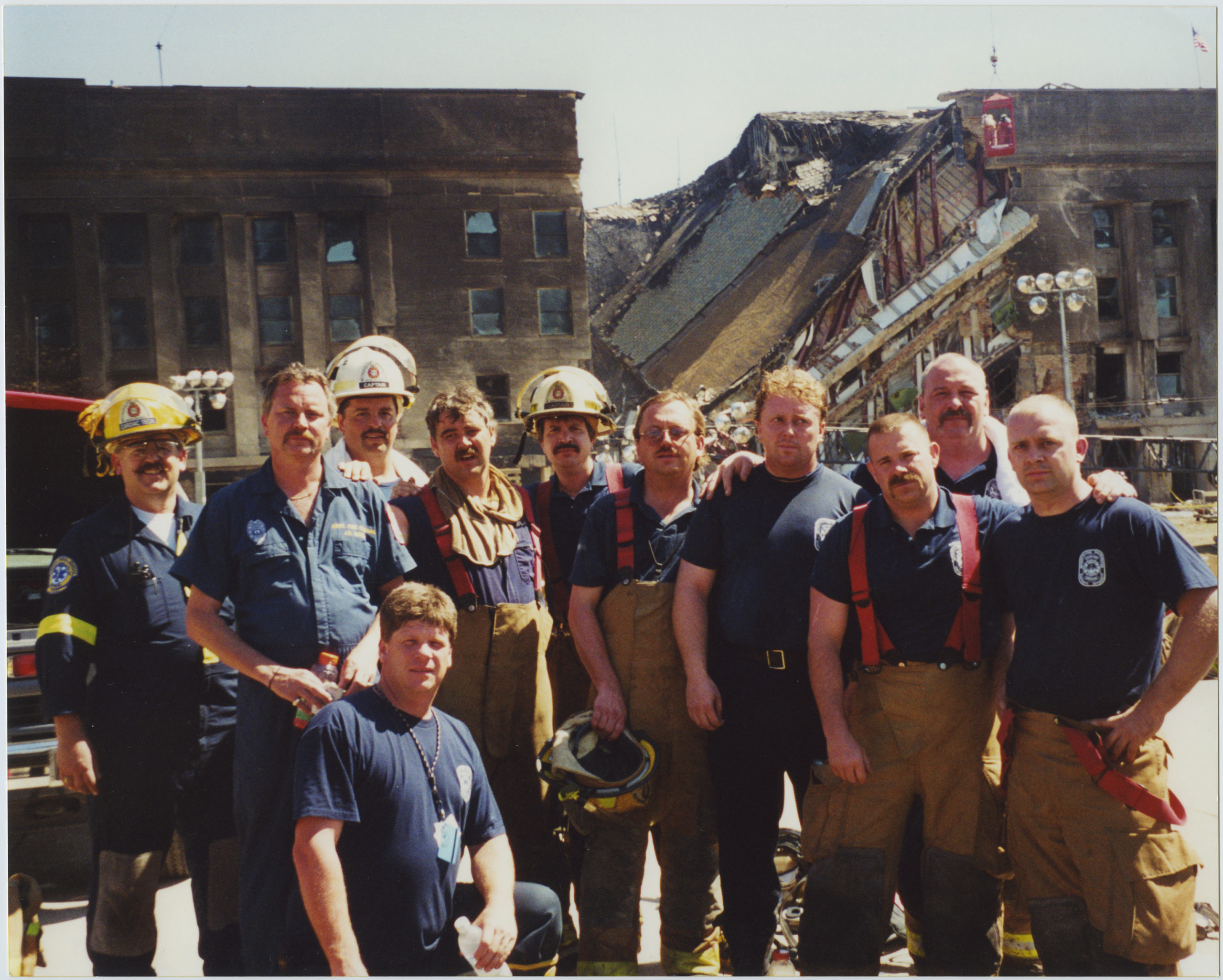
The Center for Local History has recently digitized many additional photographs from the Community Archives taken at the Pentagon at the time of September 11, 2001, by Mike Defina, a fire captain with the Metropolitan Washington Airports Authority Fire and Rescue Department.

Some of the National Airport personnel prior to being deployed to the Pentagon attack site on the morning of September 12.  From left to right:  CCT Mike Fetsko, Deputy Fire Marshal David Norris, Captain John Durrer, Paramedic Captain David Testa, Captain Mike Defino, Tech. Ralph Cornell, Paramedic Mike Murphy, Tech. Troy Hutchinson, Tech. Paul Purcell, Fire Fighter Delcan Hickey, Fire Fighter Nick Buongiorne (kneeling). 2001, 1 print, col., 8 x 10 in.. (opens in new tab)

National Airport personnel deployed to the Pentagon Sept. 12, 2001. L to R: CCT Mike Fetsko, Deputy Fire Marshal David Norris, Captain John Durrer, Paramedic Captain David Testa, Captain Mike Defino, Tech. Ralph Cornell, Paramedic Mike Murphy, Tech. Troy Hutchinson, Tech. Paul Purcell, Firefighter. Photo: Mike Defina. 

These images are just a few of the Community Archives collection Records Related to the September 11, 2001 Terrorist Attacks on the Pentagon, which is made up of textual materials, photographs, some memorabilia, and audio-visual materials. The bulk of the collection dates from 2001-2002 and features photographs of the aftermath and days after the September 11, 2001 terrorist attack on the Pentagon. (Note: some of these photos may contain sensitive or disturbing material).

That morning a westbound plane took off from Dulles airport, was hijacked by terrorists and crashed into the Pentagon. One hundred and eighty-nine people died in the crash, including the 64 passengers on Flight 77. On the same morning two more hijacked planes were flown into the World Trade Center in New York City, and a fourth hijacked plane crashed in rural Pennsylvania. Nearly 3,000 people died in the tragedy, changing both the country and Arlington forever.

Firefighters and first responders from Arlington County, Fort Myer, and Reagan National Airport were essential in coordinating the Pentagon rescue and response, arriving within minutes of the plane crash.

Arlington County Fire Department took the lead, establishing an Incident Command System across the region to respond to the emergency. Firefighters were able to get the fire under control on the first day, but it took three days to fully extinguish.

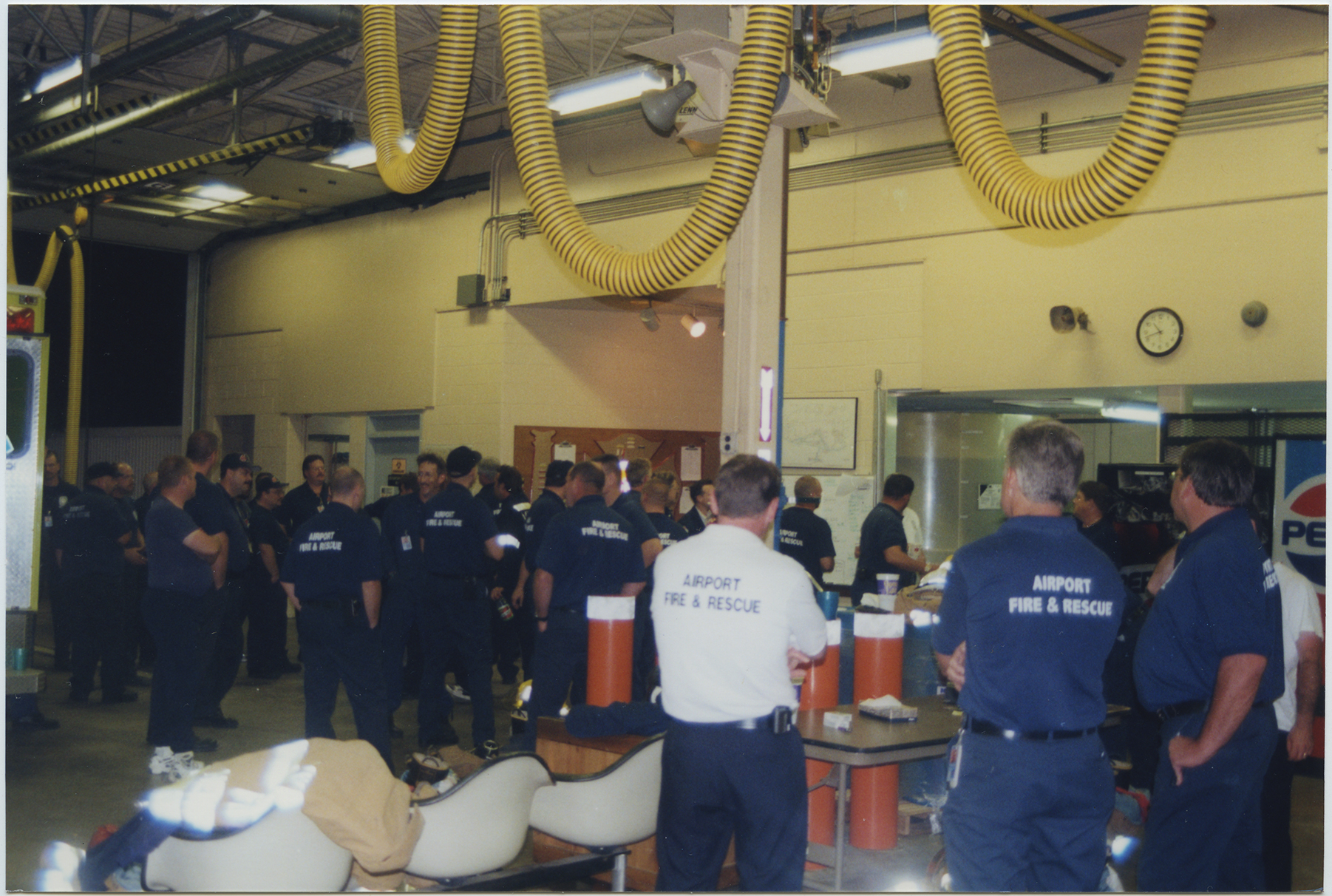
Fire fighters taking a much needed break at the National Airport fire station at 10pm on September 11, after a day long rescue effort at the Pentagon following the attacks. 2001, 1 print, col., 4 x 6 in.. (opens in new tab)

Fire fighters taking a much-needed break at the National Airport fire station at 10 p.m. on September 11, after a daylong rescue effort at the Pentagon. Photo credit: Mike Defina. 

The images in this collection depict both the horrific nature of the crash and Pentagon fires, the resilience and bravery of the first responders, and many spontaneous memorial events.

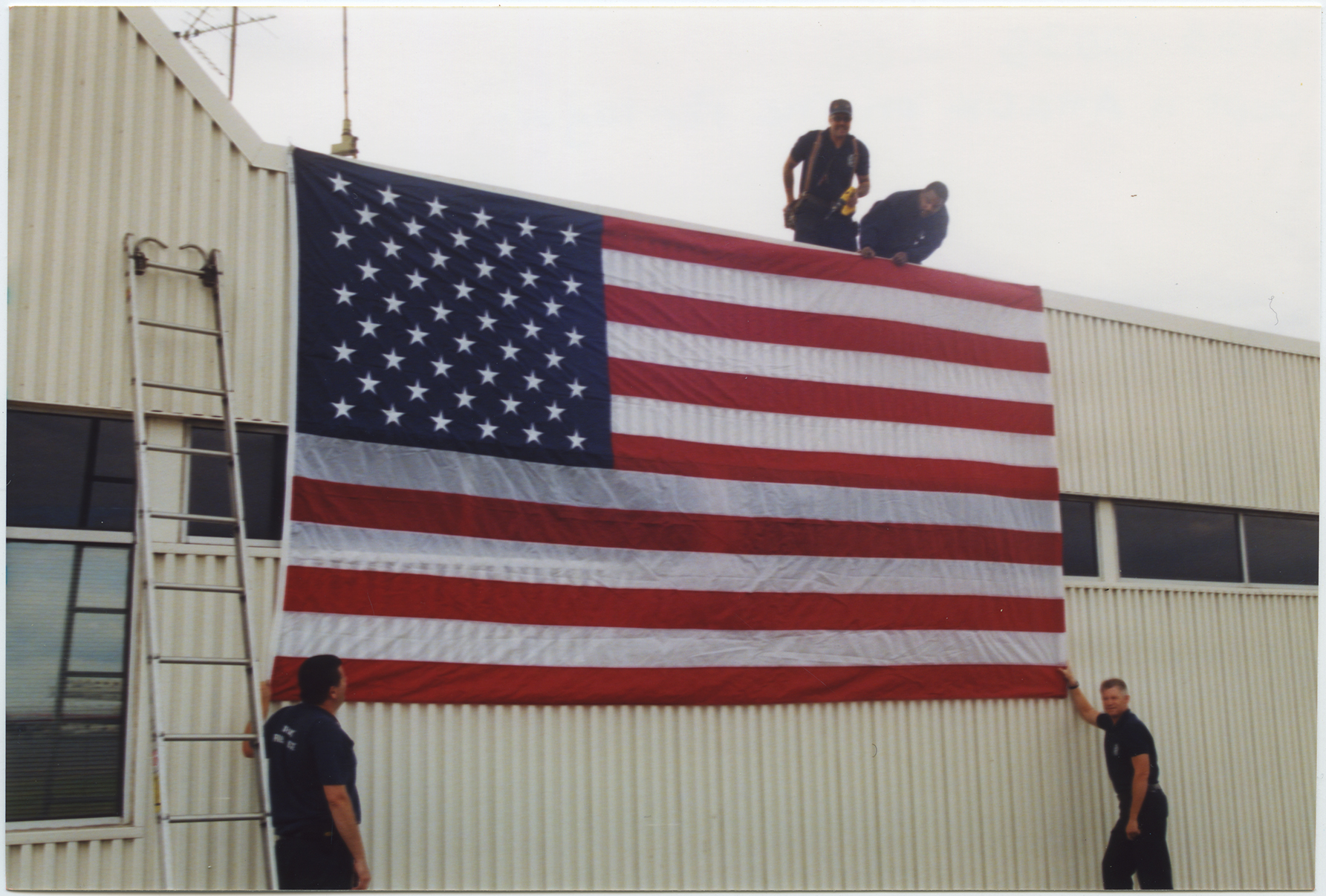
Fire fighters display a large American flag on the front of the National Airport fire station, two days after the 9/11 attack on the Pentagon. 2001, 1 print, col., 4 x 6 in..

Firefighters display a large American flag on the front of the National Airport fire station, two days after the 9/11 attack on the Pentagon. Photo: Mike Defina. 

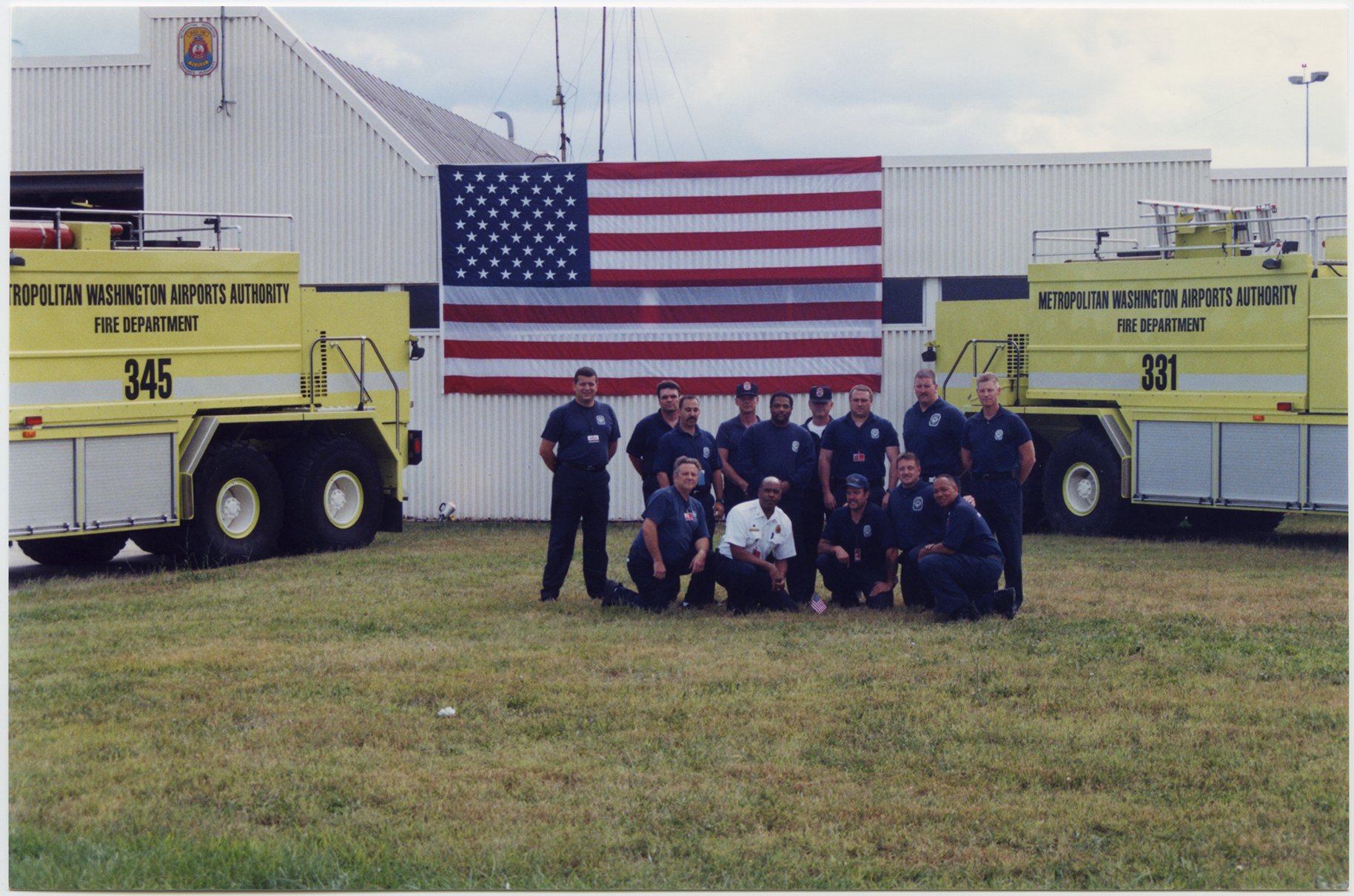
The two foam units, along with their crews, that were on the original call to the Pentagon on September 11, parked in front of the American flag displayed on the front of the National Airport fire station. 2001, 1 print, col., 4 x 6 in.. (opens in new tab)

The two foam units, along with their crews, that were on the original call to the Pentagon on September 11, parked in front of the American flag displayed on the front of the National Airport fire station. Photo: Mike Defina. 

133-125_original_ (opens in new tab)

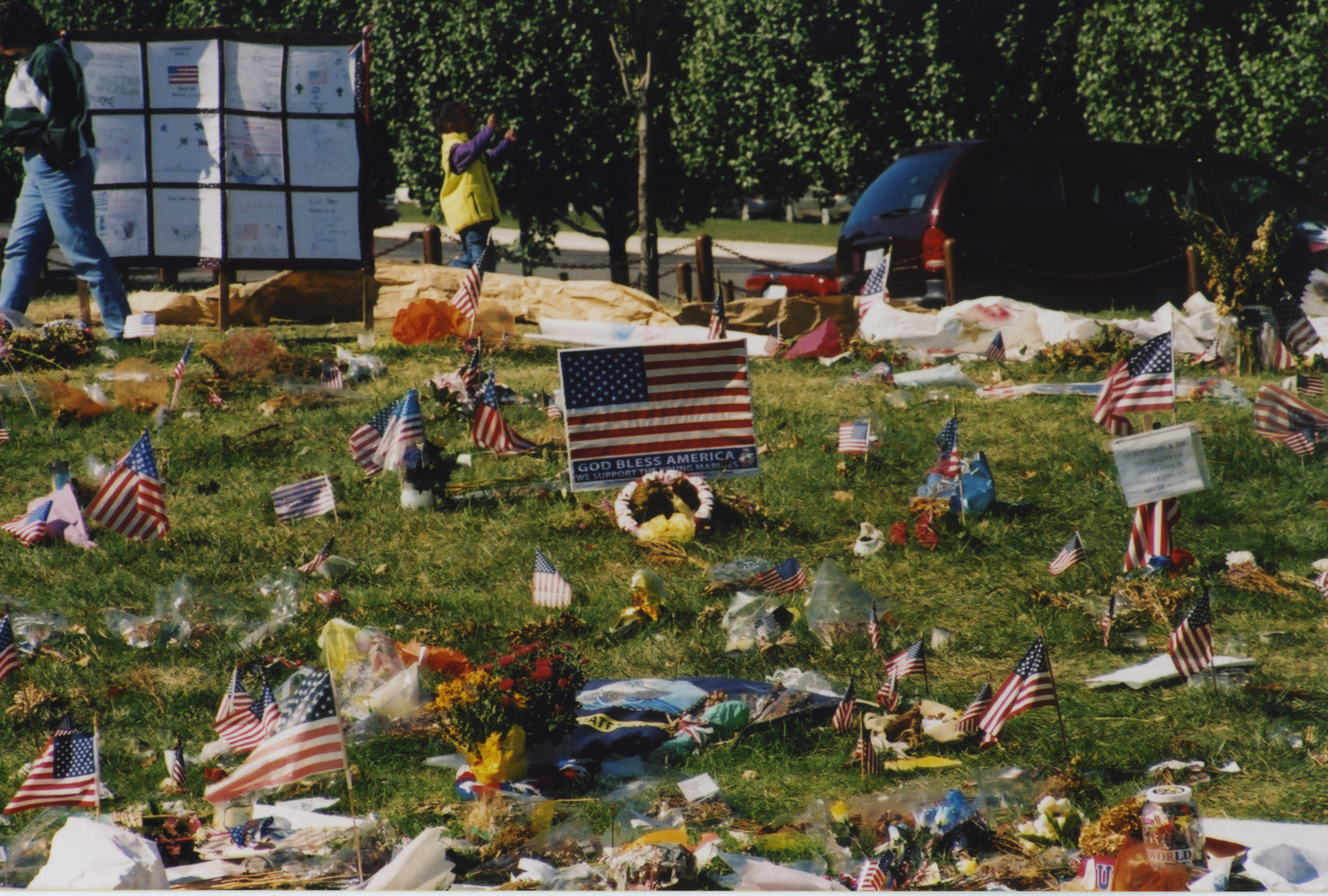
A memorial of flags, flowers, and signs near the Pentagon following the September 11 terrorist attack. Photo: Mike Defina. 

View All Images(opens in new tab)

Additional physical materials in the collection are held in the Arlington Community Archives for research use, including many thank-you cards written by school children to the firefighters of the Arlington Fire Department, County Manager Ron Carlee's papers used during the response, after-action reports, ephemera from memorial services, and VHS tape recordings of memorial events.

While these additional items have yet to be digitized, those who wish to research them may use the online finding aid to determine which boxes or folders would be useful and/or contact the Center for Local History to make a research consultation appointment.

Oral histories from the five-year anniversary of September 11, 2001 are also available online in the Center for Local History's digitized Community Archive.

Members of the Arlington County Fire Department posing with children in front of a mural created to thank them for their service.  2001, 1 print, col., 8 x 10 in.. (opens in new tab)

Arlington County Fire Department members pose with children in front of a mural created to thank them for their service. Photo: Mike Defina. 

Do you have Arlington materials related to the events September 11, 2001 that you would like to donate? 

The Center for Local History (CLH) collects, preserves, and shares historical documents that tell the history of Arlington County, its citizens, organizations, businesses, and social issues. Learn about how you can help to build Arlington's community history on the CLH Donation webpage.

September 9, 2021 by Web Editor Tagged With: September 11

Remembering September 11: Cards for Firefighters

Post Published: September 10, 2019

Eighteen years ago, children from around the country showed their support for Arlington's first responders with homemade cards filled with drawings and words of encouragement.

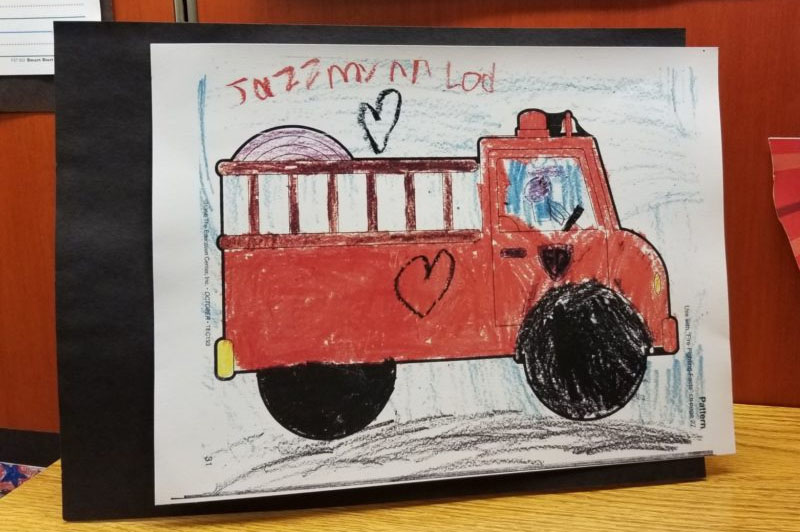
drawing of a firetruck with a heart

Drawing of a red firetruck with heart on the side; child's card from the Center for Local History Community Archives.

On September 11, 2001, terrorists hijacked a west coast-bound plane taking off from nearby Dulles Airport and crashed it into the Pentagon. Within minutes of the attack, firefighters and first responders from Arlington County, Fort Myer, and Reagan National Airport arrived at the scene. Arlington County Fire Department took the lead, establishing an Incident Command System (ICS) across the Washington-metro region to respond to the emergency. Firefighters managed to get the fire under control on the first day, but it took three days to fully extinguish the fire, and reach, as Arlington County Fire Chief Edward Plaugher described it, “the heart of the crash site.”

In total, 189 people died in the attack on the Pentagon, including the 64 passengers and crew on Flight 77.

These attacks devastated our community, but support flowed in to Arlington from around the nation. Children from across the country—from as far as Washington state to as close as Arlington, VA—sent homemade thank you cards to the Arlington County Fire Department in appreciation of their efforts to fight the fire and rescue survivors.

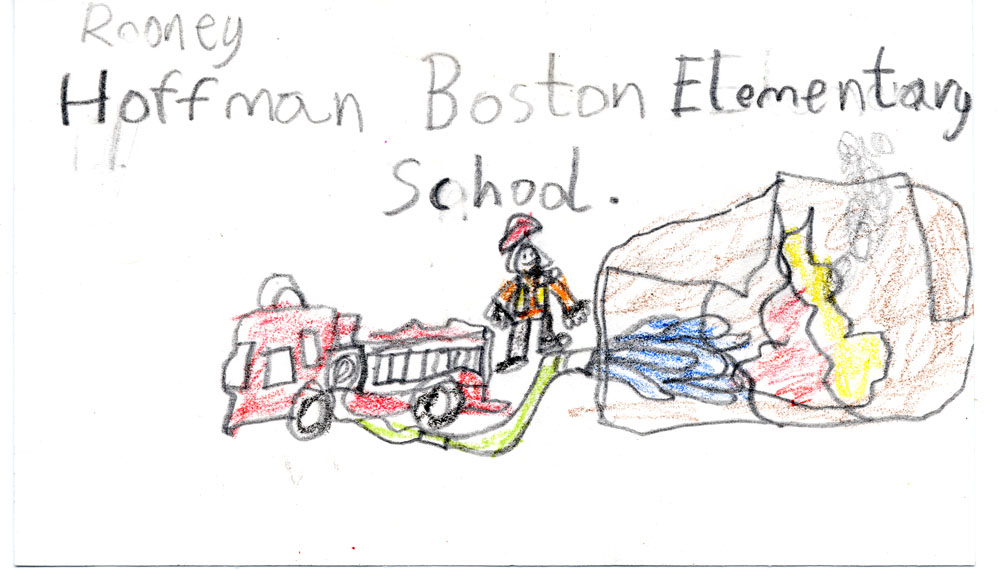
Drawing of firefighter putting out a fire at the Pentagon

Drawing of firefighter using a water-hose from firetruck to put out a fire from a burning building; child's card from the Center for Local History Community Archives.

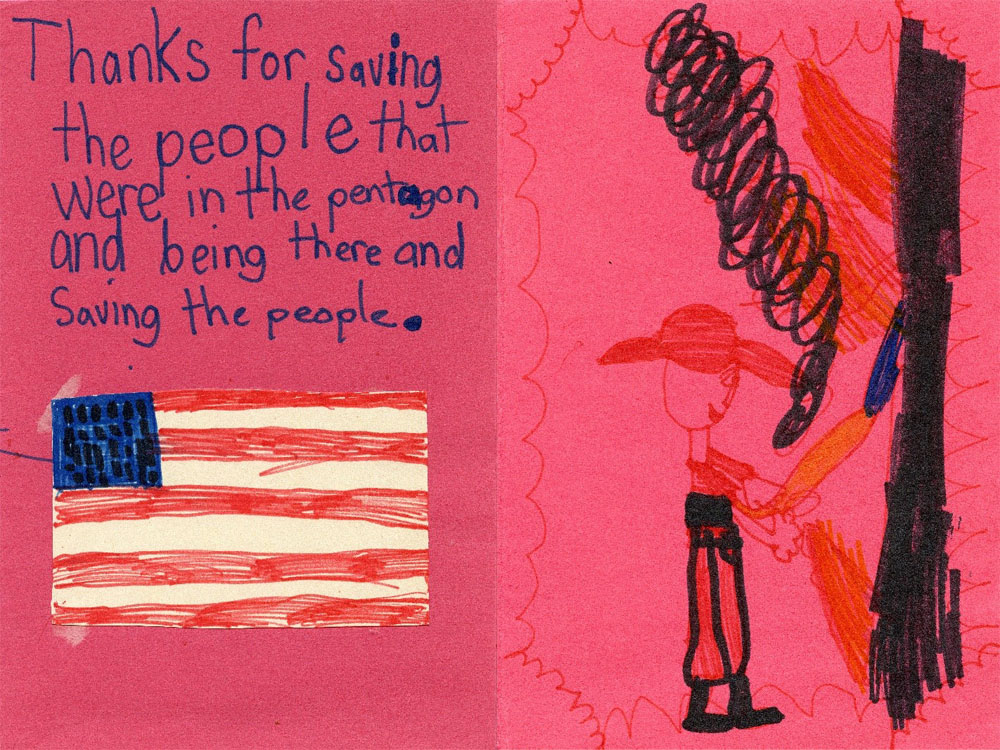
The card pictured below, from a child not named, features an American flag and a firefighter putting out a fire. The child thanks the firefighters for saving lives and being there for the people at the Pentagon. This is a theme for almost all of the cards.

folded card on red construction paper

Child's card from the Center for Local History Community Archives.

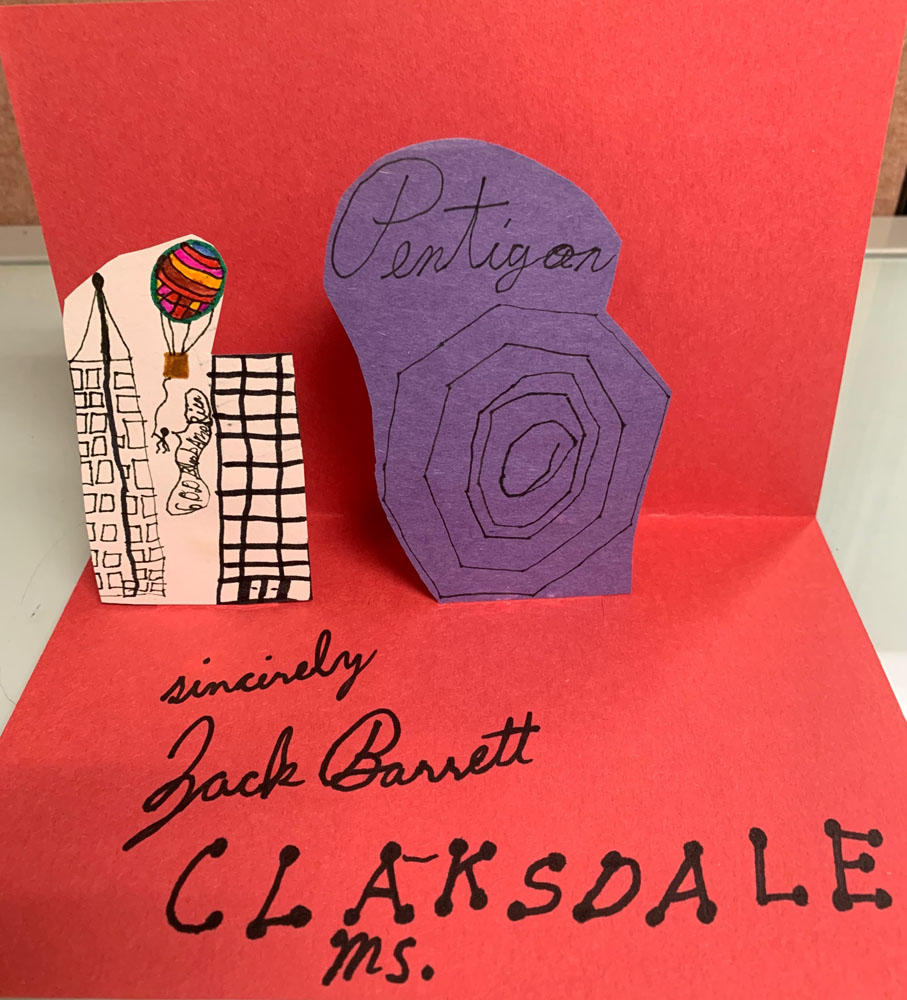
Zack Barrett made a pop-up card thanking the firefighters for keeping our nation running.

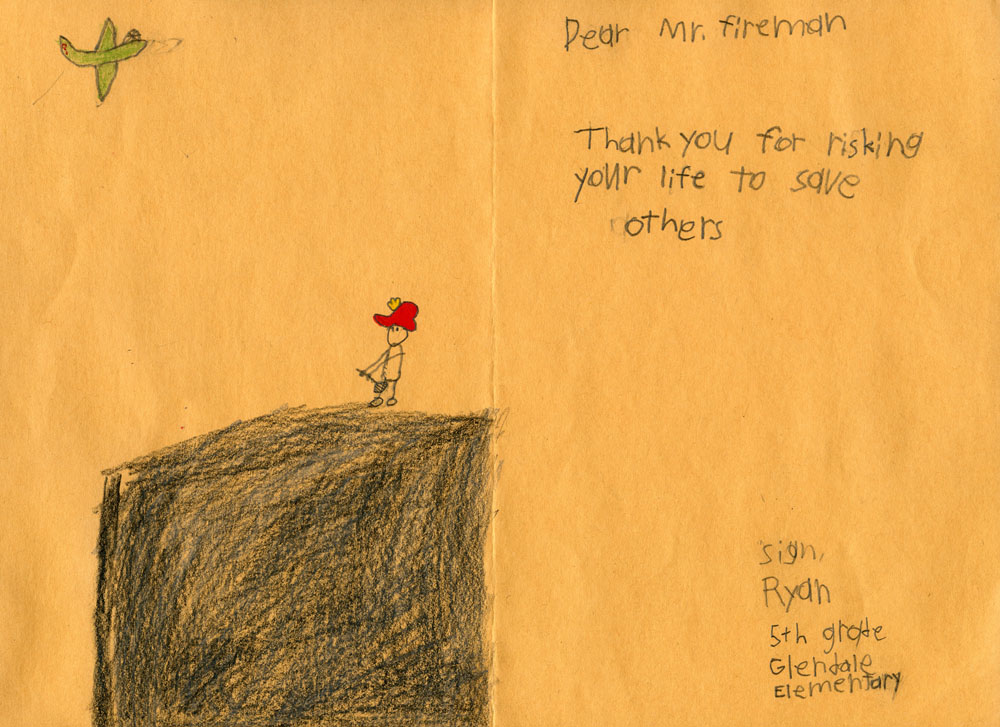
5th grader Ryan drew a picture of a firefighter on top of a building, and thanked them for risking their lives.

Pop-up card of the Pentagon
Drawing of a firefighter standing on a building

Children's cards from the Center for Local History Community Archives.

These, and the hundreds of other unsolicited drawings and letters sent to the Arlington County Fire Department, are preserved in the Community Archive at the Center for Local History.

Some of the young artists and writers no doubt have children of their own today, but the emotions remain as fresh and powerful as the day they were put on paper and mailed from places like Renton, WA, Toledo, OH, Clarksdale, MS - and more locally Ashburn, VA and Washington DC.

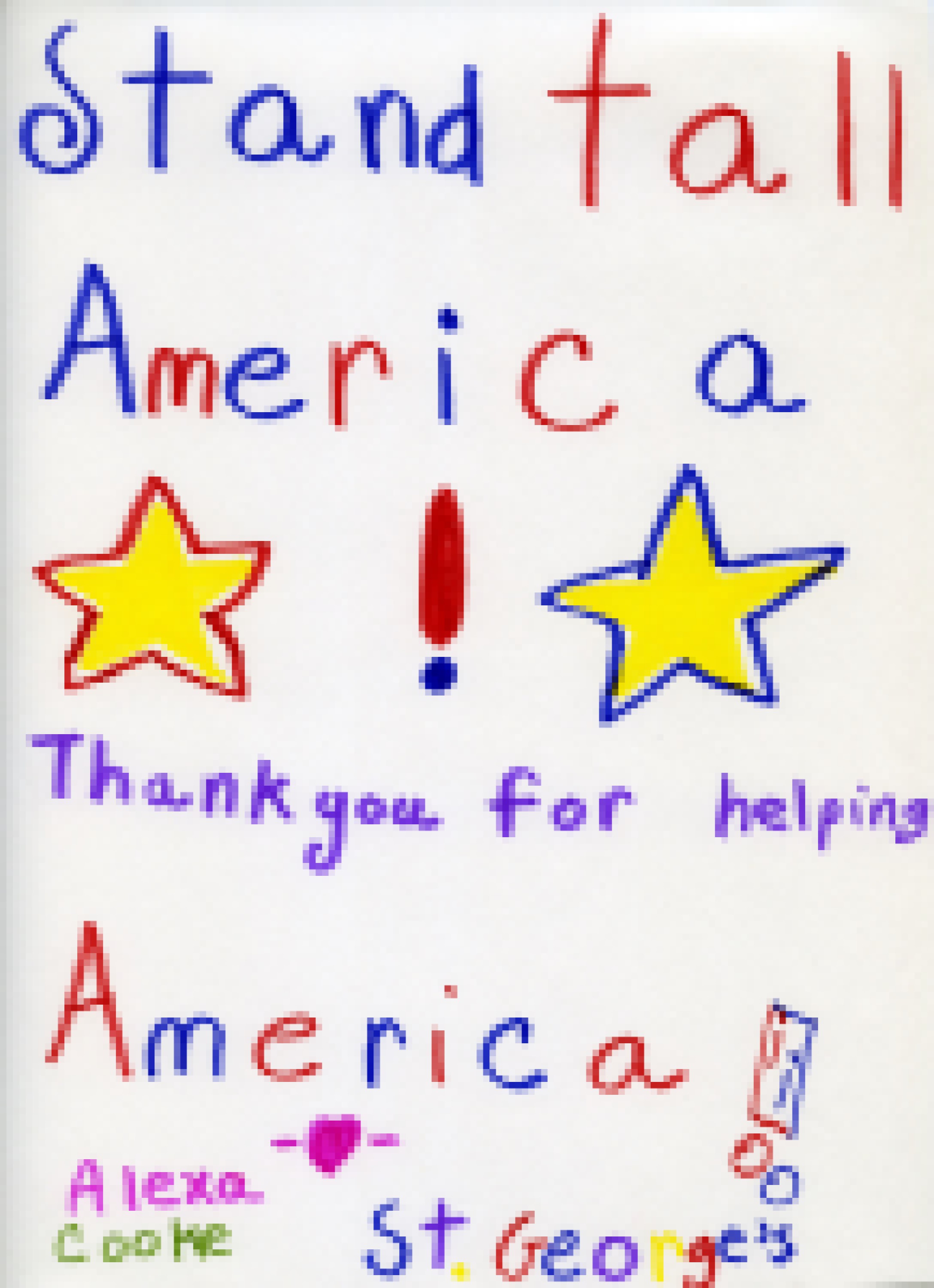
Stand Tall America

Child's card with two yellow stars and an exclamation point that says "Stand tall America! Thank you for helping." From the Center for Local History Community Archives.

Read a detailed account of the Arlington County Fire Department emergency response to the attack on the Pentagon in the blog post, "Attack on the Pentagon - Sept. 11, 2001," published Friday, March 18, 2005 by Arlington Fire Journal & Metro D.C. Fire History.

Listen to oral history interviews with first responders and Arlingtonians about their experiences on Sept. 11, 2001, and the days that followed.

To see more of the Children's Cards, or to learn more about Arlington's history, visit the Center for Local History on the first floor of the Central Library.

Do you have a question about this story, or a personal experience to share? 

Use this form to send a message to the Center for Local History.

Center For Local History - Blog Post Message Form

Do you have a question about this story, or a personal experience to share? Use this form to send a message to the Center for Local History.

"*" indicates required fields

This field is for validation purposes and should be left unchanged.

Share Your Story

September 10, 2019 by Web Editor Tagged With: September 11

Remembering September 11: An Oral History Collection

Post Published: September 6, 2017

Paper cut sound waveform sign with shadow , and photo of September 11 memorial

In 2006, on the 5th anniversary of the 2001 terrorist attacks, the Center for Local History conducted a series of interviews with first responders and Arlingtonians about their experiences on Sept. 11, 2001, and the days that followed.

The three narrators who you’ll hear from in these clips – Gabriella Day-Dominiguez, Elizabeth Davis, and firefighter Dale Varnau – experienced the same events that day, and yet had uniquely personal responses to the tragedy shaped by their identities and roles within the community.

Transcripts:
NARRATOR: Elizabeth Davis
INTERVIEWER: Diane Gates
DATE: August 2, 2006

ED: Our neighborhood is very friendly people but nobody ever seems to talk to anybody else. But on that day everybody was outside of their house. So I was talking to my neighbors and they didn’t know anything and they were asking me and I didn’t know anything. So we ended up having a kind of a barbecue. Nobody really wanted to be alone. Everybody pulled a little bit of something out of their refrigerator and just gathered together.
DG: It was just impromptu
ED: Totally impromptu.
DG: When your neighbors had the cookout or got together to eat did people seem just quiet and somber. Was anyone crying? Were there people there who knew or wondered if they had a friend that was—
ED: There were a lot of people who knew somebody. I don’t think I knew anybody who knew anybody who had been hurt but there a lot of people who worked in the Pentagon or knew somebody who worked in the Pentagon. Even more than that there were people who knew somebody in New York. And at that point of course we didn’t know what was going on. You had no idea of head count. And the phones were so busy it was very hard to get through to people. So there was a lot of “I don’t know if this person is okay” going on.
But the one thing I noticed for the next, might have been two or three weeks, if you remember they had shut down every single plane everyplace, nothing was flying. So we’d be standing outside and you’d hear a plane go overhead and everybody stopped and everybody sort of cocked their head and just listened and you could tell they were thinking is this us or is this them and that wasn’t just the first day or so, that was two or three weeks.

NARRATOR: Gabriella Daya-Dominiguez
INTERVIEWER: Judy Knudsen
DATE: August 24, 2006

GD-D: My husband in the meantime, what was occurring with him at that moment was he was just entering his office. He was about 200 yards from the building. He saw the plane coming very low overhead. He saw it make a U turn and bank right into his building. At that point he said he knew that this was not an accident, this was an attack and all hell broke loose. The pandemonium in the city was already going on. First with the North Tower. People were just standing there staring. They weren’t really running, they were just watching. But by the second tower hitting people started running frantically.
GD-D: And then another twist of the story is the fact that my father is Arabic. I remember feeling a sense of dread that week. I couldn’t eat at all. I remember food tasted like paper. It was just hard to put something in my mouth and I’m not someone who loses my appetite easily. So it was deeply concerning. I felt that there was going to be an Arab backlash and I was worried about my father, although my father is not Muslim, he’s Christian. But it was an Arab group of terrorists that struck the buildings and I was worried about the perception that the world was going to have about Arabs at that time. I remember being terrified. I remember feeling like I didn’t want to talk to anybody. I was afraid to talk to anybody. I just didn’t know how to explain it.

NARRATOR: Dale Varnau
INTERVIEWER: Judy Knudsen
DATE: December 14, 2009

JK: Right. So after it’s over with, how long did it take you to…. I mean, some people were obviously very freaked out, didn’t recover so well, and I have talked to police and firemen. And some people did—Of course a lot of people internalize things, and you don’t know. I mean, how did you feel, say, afterwards, a few years afterwards? Obviously it still affects you.
DV: Yes. The first I-don’t-know-how-long, I was very angry. I was like, “Let’s go get the people that did this to us! This is America!” I’m very patriotic.
I didn’t notice it bothering me for about a year, but after a year I started, “Hey, I haven’t been sleepin’ that well. I’m startin’ to have nightmares about it, relivin’ it.” So it was pretty close to a year before I started feeling anything physical from it.
DV: And people I’ve talked to—you know, my brother’s a Vietnam vet, and he was like, “Well, I saw a hundred times worse.” “Yeah, well, you were trained for it, I wasn’t!” I was trained to fight fires, you know.
JK: Exactly.
DV: So yes, there was about a year delay for me. I knew other people that the next day had problems. There were a couple of guys that day, that while it was goin’ on, basically they wanted to say, “Okay, I’m done, I’m outta here,” and they wanted to go home right then. But it took about a year for it to really build up in me. I was kind of surprised, I guess this is the first time I’ve really talked about it in depth for a while, that I was starting to crack up a little bit a while ago. But yes, it had a delayed effect for me.

You can explore the entire September 11 oral history collection in the Center for Local History - VA 975.5295 A7243oh ser.5 - or read the transcripts online.

You can also explore our current display of letters, which were sent during the days and weeks after September 11, from children all over the county to Arlington rescue workers.

Photo: Arlington Ridge Rd Overlooking Pentagon – Public Memorial; Source: Photographs of the Arlington Historical Society, PG 230-6928

The goal of the Arlington Voices project is to showcase the Center for Local History’s oral history collection in a publicly accessible and shareable way.

The Arlington Public Library began collecting oral histories of long-time residents in the 1970s, and since then the scope of the collection has expanded to capture the diverse voices of Arlington’s community. In 2016, staff members and volunteers recorded many additional hours of interviews, building the collection to 575 catalogued oral histories.

To browse our list of narrators indexed by interview subject, check out our community archive. To read a full transcript of an interview, visit the Center for Local History located at Central Library.

September 6, 2017 by Web Editor Tagged With: September 11

Footer

About Us

  • Mission & Vision
  • Charlie Clark Center for Local History
  • News Room
  • Get Email Updates

Administration

  • Policies
  • Library Staff
  • Job Opportunities
  • Propose a Program or Partnership

Support Your Library

  • Friends of the Library
  • Giving Opportunities
  • Donating Materials
  • Volunteer Opportunities

Our Mission

We champion the power of stories, information and ideas.

We create space for culture and connection.

We embrace inclusion and diverse points of view.


Download the Library App

Download the Library App

Arlington County | Terms & Conditions | Accessibility | Site Map
· Copyright © 2026 Arlington County Government ·