• Skip to primary navigation
  • Skip to main content
  • Skip to footer

Alert

Book donations will be paused April 13-25 for the FOAL Spring Book Sale More Info

Alert

Update: Elevator outages, maintenance and upgrades at Central Library More Info

Home - Arlington County Virginia - Logo
MENUMENU
  • Join Now
  • My Account
    • Login
    • My Checkouts
    • My Holds
    • My Lists
    • My Reading History
    • About Borrowing
    • About Holds
    • About My Account
  • Hours & Locations
    • All Hours & Locations
    • Holiday Closings
  • News
    • Library News
    • Director's Blog
    • Get Email Updates
  • Contact Us

Arlington Public Library

MENUMENU
  • Search
  • Collections
  • Library Services
  • Events
  • Community Engagement
  • Join Now
  • My Account
    • Login
    • About Borrowing
    • About Holds
    • About My Account
  • Hours & Locations
    • All Hours & Locations
    • Holiday Closings
  • News
    • Library Blog
    • Get Email Updates
  • Contact Us

Web Editor

Remembering September 11 with Photos of First Responders

Post Published: September 9, 2021

The Center for Local History has recently digitized many additional photographs from the Community Archives taken at the Pentagon at the time of September 11, 2001, by Mike Defina, a fire captain with the Metropolitan Washington Airports Authority Fire and Rescue Department.
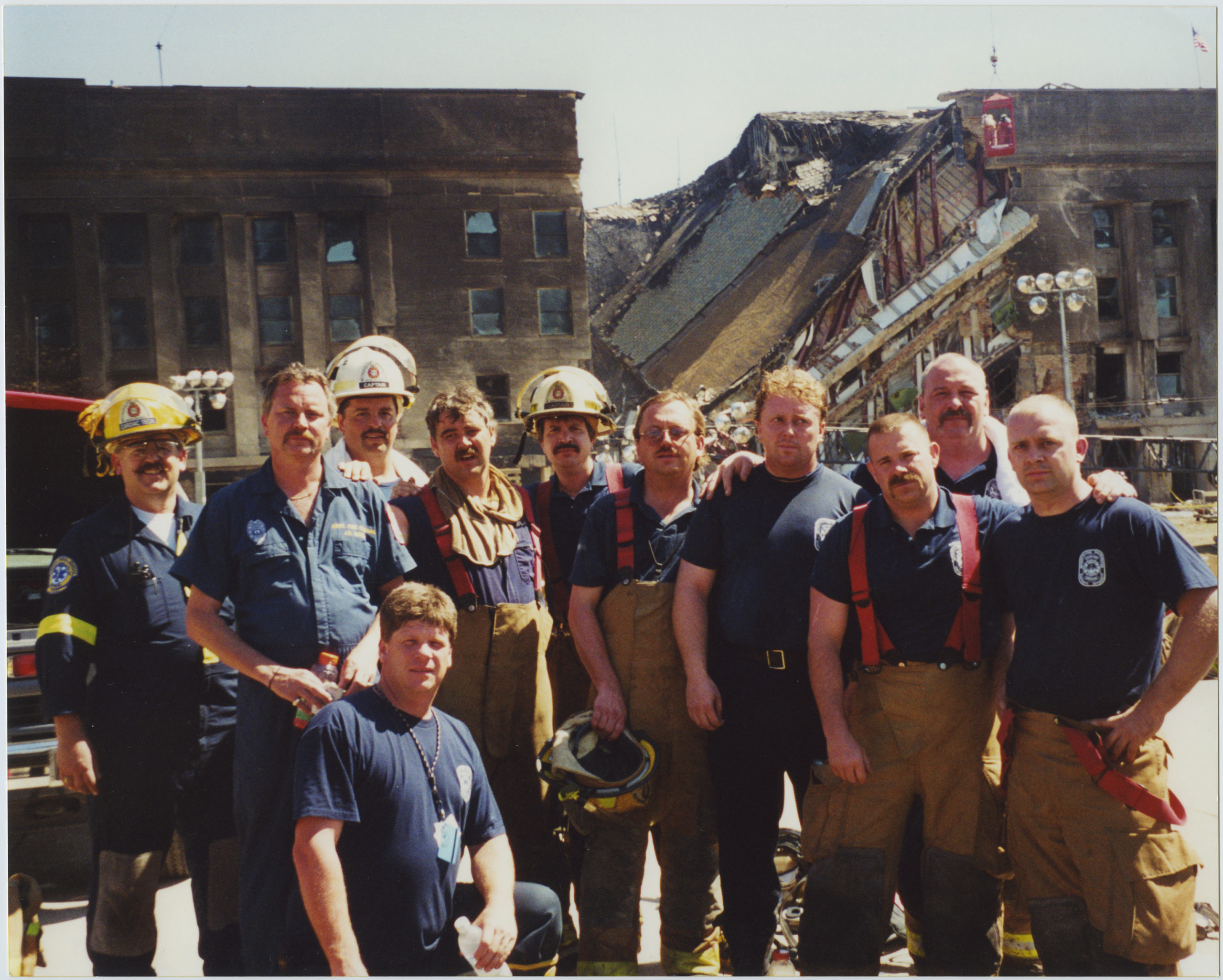
Some of the National Airport personnel prior to being deployed to the Pentagon attack site on the morning of September 12.  From left to right:  CCT Mike Fetsko, Deputy Fire Marshal David Norris, Captain John Durrer, Paramedic Captain David Testa, Captain Mike Defino, Tech. Ralph Cornell, Paramedic Mike Murphy, Tech. Troy Hutchinson, Tech. Paul Purcell, Fire Fighter Delcan Hickey, Fire Fighter Nick Buongiorne (kneeling). 2001, 1 print, col., 8 x 10 in..

National Airport personnel deployed to the Pentagon Sept. 12, 2001. L to R: CCT Mike Fetsko, Deputy Fire Marshal David Norris, Captain John Durrer, Paramedic Captain David Testa, Captain Mike Defino, Tech. Ralph Cornell, Paramedic Mike Murphy, Tech. Troy Hutchinson, Tech. Paul Purcell, Firefighter. Photo: Mike Defina. 

These images are just a few of the Community Archives collection Records Related to the September 11, 2001 Terrorist Attacks on the Pentagon, which is made up of textual materials, photographs, some memorabilia, and audio-visual materials. The bulk of the collection dates from 2001-2002 and features photographs of the aftermath and days after the September 11, 2001 terrorist attack on the Pentagon. (Note: some of these photos may contain sensitive or disturbing material).

That morning a westbound plane took off from Dulles airport, was hijacked by terrorists and crashed into the Pentagon. One hundred and eighty-nine people died in the crash, including the 64 passengers on Flight 77. On the same morning two more hijacked planes were flown into the World Trade Center in New York City, and a fourth hijacked plane crashed in rural Pennsylvania. Nearly 3,000 people died in the tragedy, changing both the country and Arlington forever.

Firefighters and first responders from Arlington County, Fort Myer, and Reagan National Airport were essential in coordinating the Pentagon rescue and response, arriving within minutes of the plane crash.

Arlington County Fire Department took the lead, establishing an Incident Command System across the region to respond to the emergency. Firefighters were able to get the fire under control on the first day, but it took three days to fully extinguish.
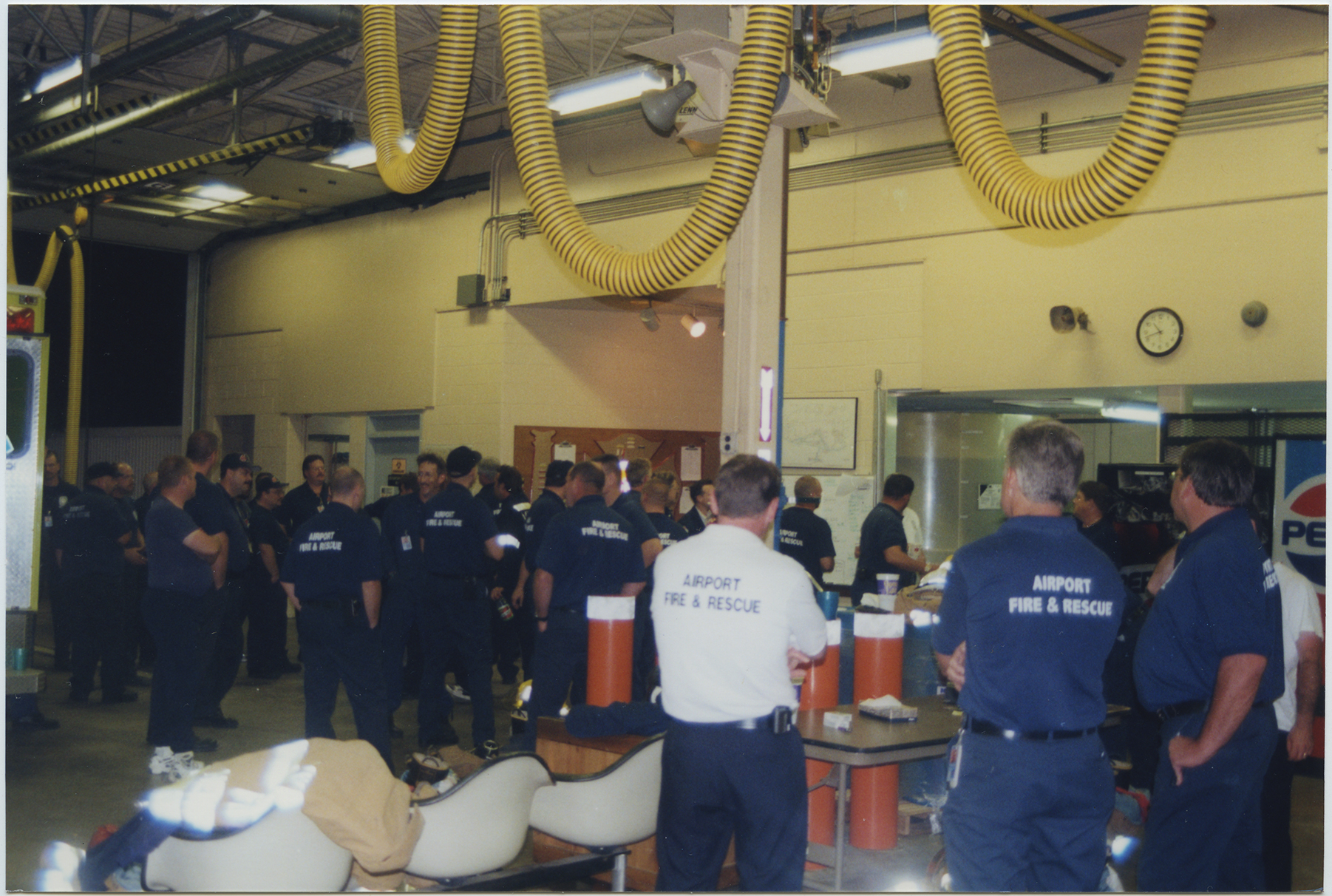
Fire fighters taking a much needed break at the National Airport fire station at 10pm on September 11, after a day long rescue effort at the Pentagon following the attacks. 2001, 1 print, col., 4 x 6 in..

Fire fighters taking a much-needed break at the National Airport fire station at 10 p.m. on September 11, after a daylong rescue effort at the Pentagon. Photo credit: Mike Defina. 

The images in this collection depict both the horrific nature of the crash and Pentagon fires, the resilience and bravery of the first responders, and many spontaneous memorial events.
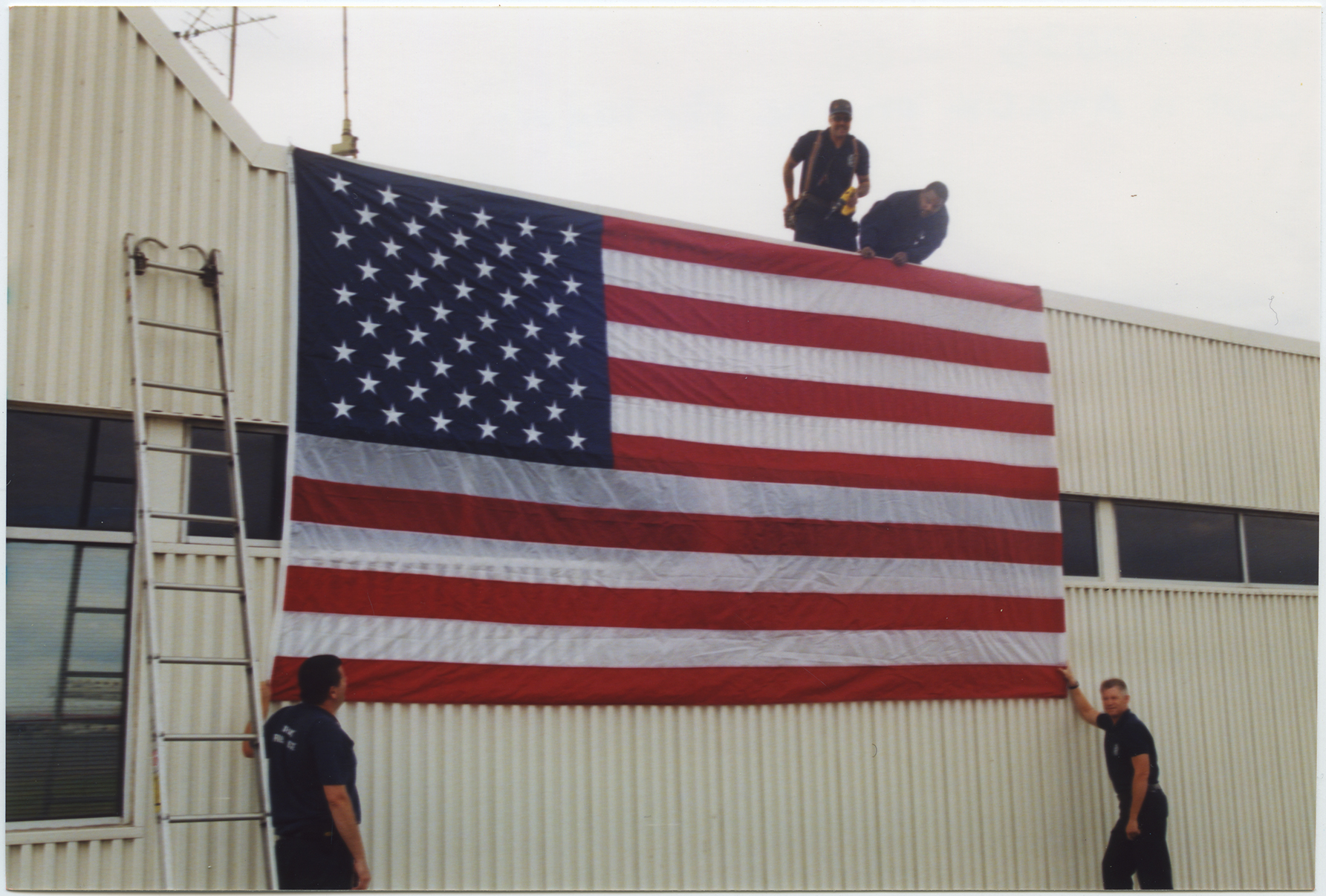
Fire fighters display a large American flag on the front of the National Airport fire station, two days after the 9/11 attack on the Pentagon. 2001, 1 print, col., 4 x 6 in..

Firefighters display a large American flag on the front of the National Airport fire station, two days after the 9/11 attack on the Pentagon. Photo: Mike Defina. 
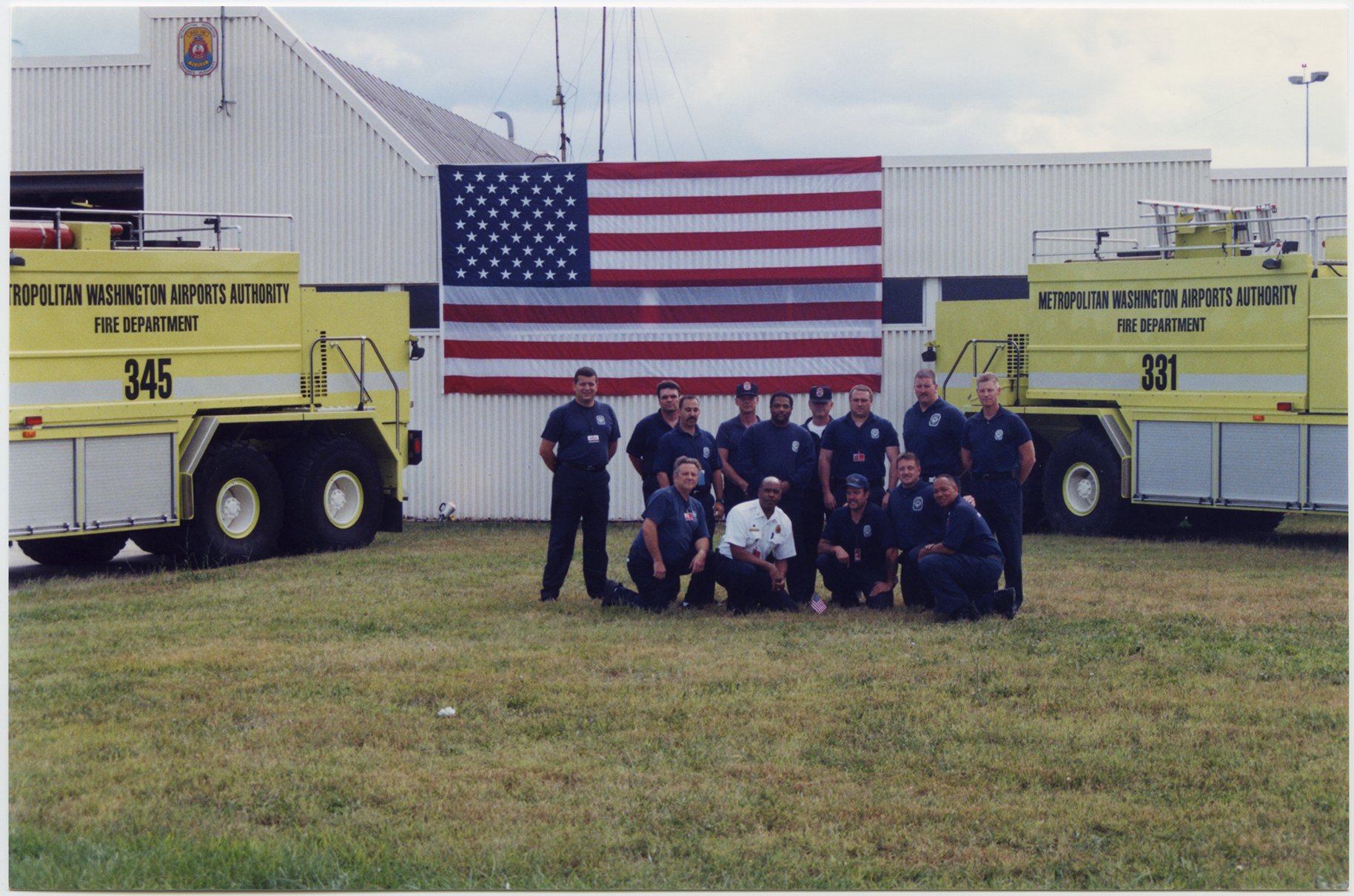
The two foam units, along with their crews, that were on the original call to the Pentagon on September 11, parked in front of the American flag displayed on the front of the National Airport fire station. 2001, 1 print, col., 4 x 6 in..

The two foam units, along with their crews, that were on the original call to the Pentagon on September 11, parked in front of the American flag displayed on the front of the National Airport fire station. Photo: Mike Defina. 
133-125_original_

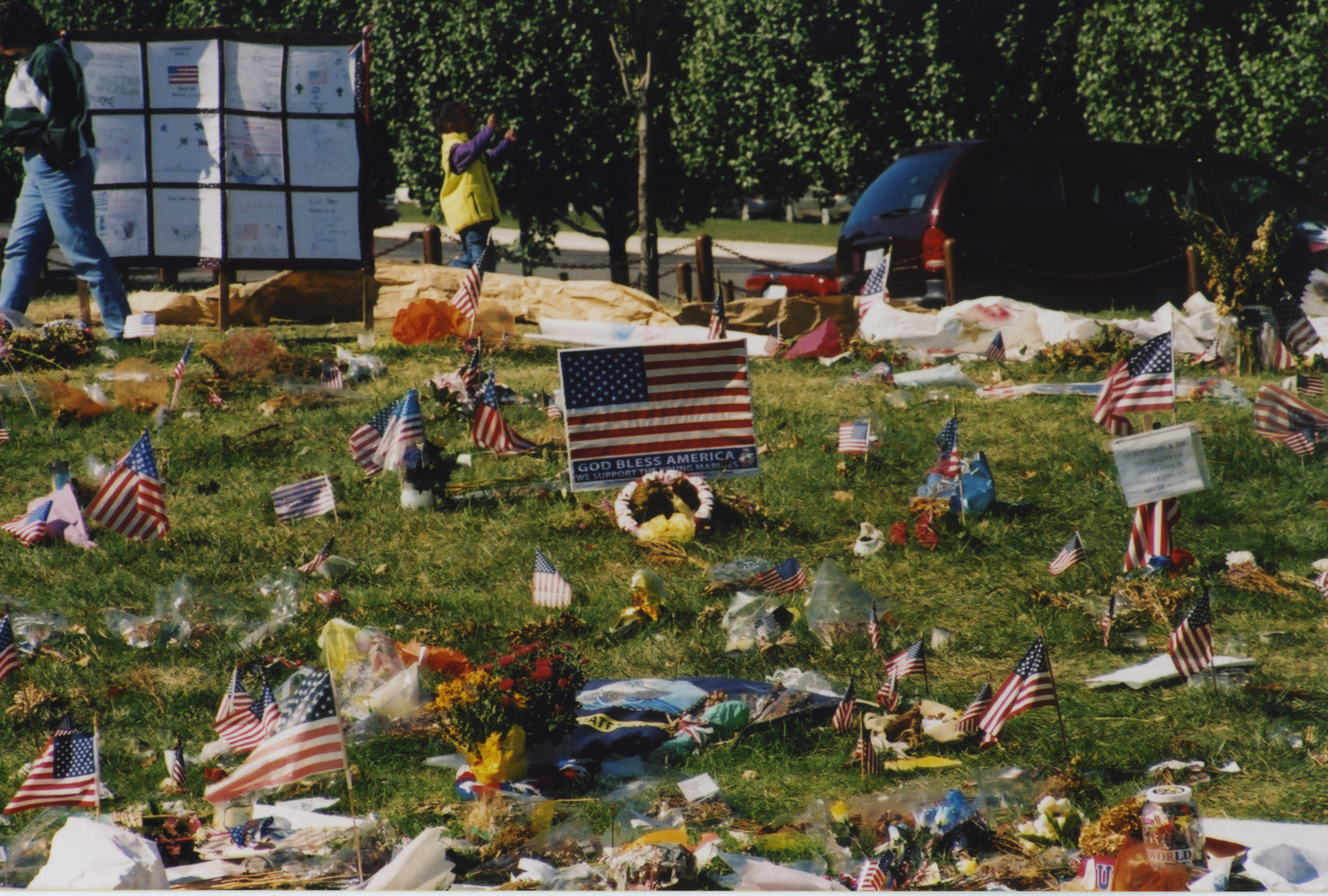
A memorial of flags, flowers, and signs near the Pentagon following the September 11 terrorist attack. Photo: Mike Defina. 

View All Images

Additional physical materials in the collection are held in the Arlington Community Archives for research use, including many thank-you cards written by school children to the firefighters of the Arlington Fire Department, County Manager Ron Carlee's papers used during the response, after-action reports, ephemera from memorial services, and VHS tape recordings of memorial events.

While these additional items have yet to be digitized, those who wish to research them may use the online finding aid to determine which boxes or folders would be useful and/or contact the Center for Local History to make a research consultation appointment.

Oral histories from the five-year anniversary of September 11, 2001 are also available online in the Center for Local History's digitized Community Archive.
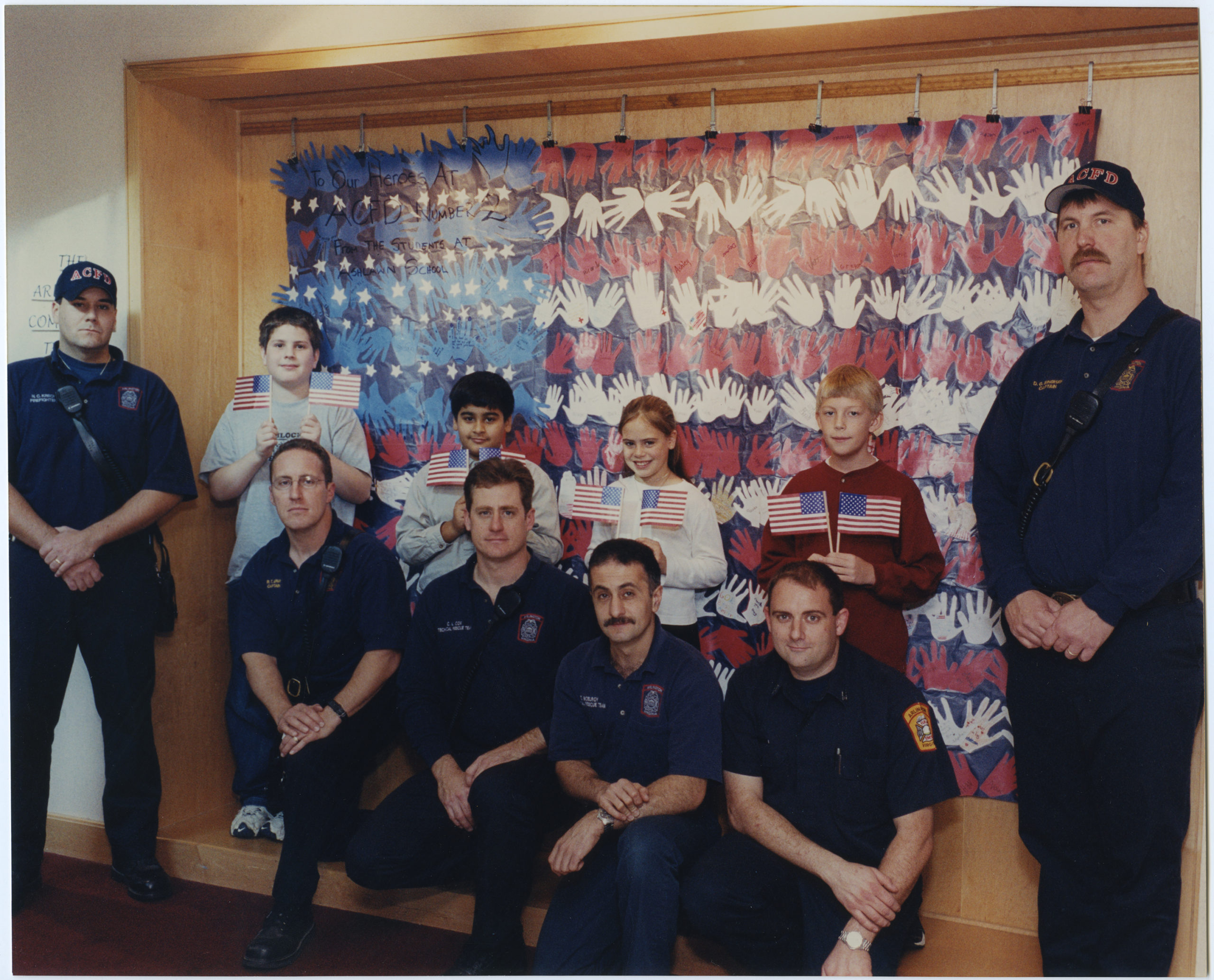
Members of the Arlington County Fire Department posing with children in front of a mural created to thank them for their service.  2001, 1 print, col., 8 x 10 in..

Arlington County Fire Department members pose with children in front of a mural created to thank them for their service. Photo: Mike Defina. 

Do you have Arlington materials related to the events September 11, 2001 that you would like to donate? 

The Center for Local History (CLH) collects, preserves, and shares historical documents that tell the history of Arlington County, its citizens, organizations, businesses, and social issues. Learn about how you can help to build Arlington's community history on the CLH Donation webpage.
September 9, 2021 by Web Editor

Oral History: Buckingham Florist

Post Published: August 19, 2021

Interview with Neil Bassin

Arlington Voices the Oral History Collection

Oral histories are used to understand historical events, actors, and movements from the point of view of real people’s personal experiences.

Arlington has a lengthy history of legacy floral shops, and among those was Buckingham Florist, a mainstay of the Buckingham neighborhood for almost 80 years.

Buckingham Florist was founded by Myer and Jean Bassin in Arlington in 1942, and the couple later opened a second location in Coral Hills, Maryland. The business did floral arrangements for a variety of events and venues, with the nearby Arlington National Cemetery among their primary sites of business.

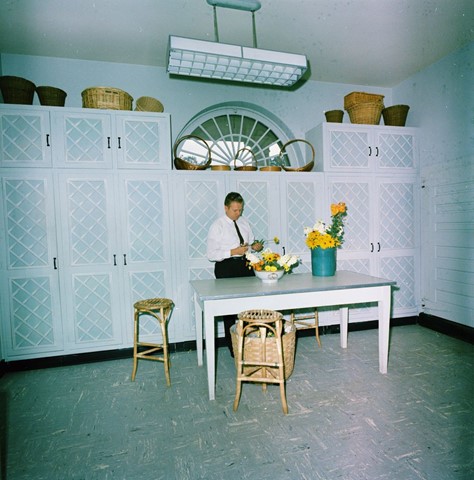
At one point, Buckingham Florist was the primary supplier of flowers for the Tomb of the Unknown Soldier. The shop’s federal connections didn’t stop there, however: one of the shop’s floral designers, Elmer “Rusty” Young, went on to serve as a florist in the White House in the Eisenhower, Kennedy, Johnson, and Nixon administrations. Young was appointed the first White House Chief Floral Designer by Jacqueline Kennedy, and continued in that position throughout the rest of his career.

Picture1

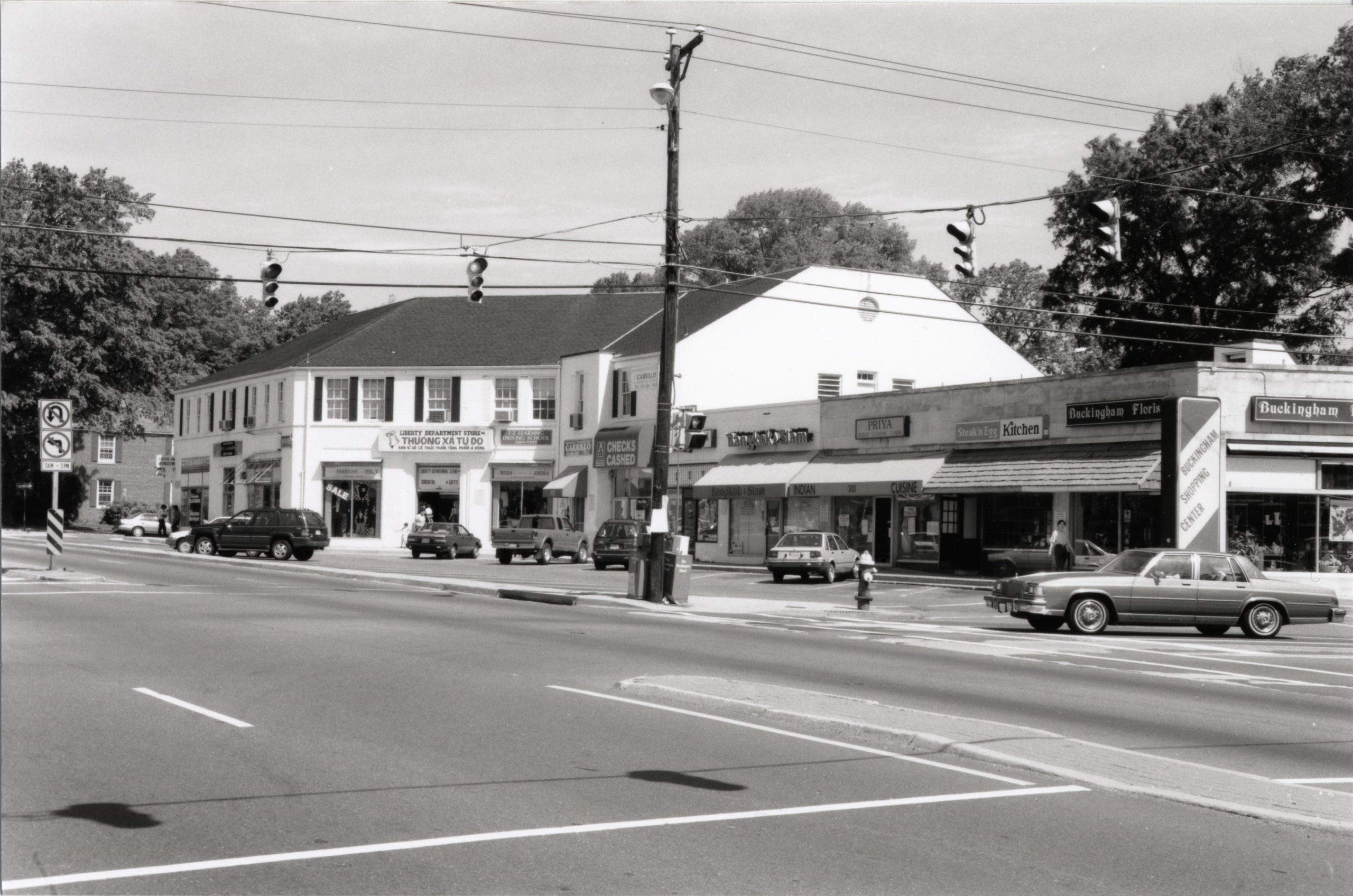
Buckingham Florist, right, in 1996.

The shop moved to its long-term location at 301 North Glebe Road in the bustling Buckingham Shopping Center in the mid-1950s, having previously been located on the south side of Glebe. Myer and Jean Bassin’s son Neil Bassin ran Buckingham Florist throughout the latter half of the 20th century. He sold the shop in the mid-2000s, and the Buckingham storefront closed permanently in 2017.

In this oral history interview, Neil Bassin (1932-2019) discusses the legacy of the business and how the shop supplied its flowers. The interview in full goes on to discuss other topics, such as changes in the floral industry and the business environment of Buckingham throughout the 20th century.

Narrator: Neil Bassin
Interviewer: Virginia Smith
Date: May 14, 2012

Picture2

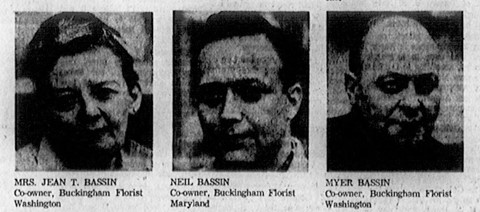
Photos of the Bassin family from the February 8, 1965, issue of the Northern Virginia Sun. Image courtesy of Virginia Chronicle.

Neil Bassin: In most aspects of the florist business, we were very successful because of the location we were in. People knew us. And that’s, I would say, the major factor in why our business was so successful, until the people met me or my mother, or you know. And just personal business, where the people knew us. I mean, we had people when they were born. We had them when they were married, and we had them when they died because the business is over sixty years.

Virginia Smith: That’s a nice legacy, isn’t it? Sixty years of business.

NB: Yeah, it’s a long time.

VS: Tell me who your suppliers were of flowers.

NB: Well, lots. Mostly, downtown florists, wholesalers. And when I first got in, it was downtown wholesalers. They were all—

VS: Is that the name of it? Downtown—?

NB: No.

VS: Oh, multiple—?

NB: They were mostly around one block downtown.

VS: Where was that block?

NB: It was between Fourteenth and Thirteenth on the street before K Street. K Street was a park in those days.

VS: Yes.

NB: Like a little park. And then down Fourteenth Street, on the right was Schaffer’s Retail Florist.

VS: Okay, but Shaffer was a wholesaler also—

NB: Then, Shaffer was a wholesaler. McCallum Sauber was a wholesaler, and they were really instrumental in helping us get in business because my uncle sort of knew the owners. And they did help us. My uncle was very artistic, and he was a big help in getting us into the business. But, there were Paul’s Wholesale Florist and Goody Brothers.

VS: Oh, I know that name.

NB: And around the corner was District Wholesale, and Flowers Incorporated, which was also a wholesale florist. And so they were all in one area until they sold that block and razed that block, where they all moved out and spread out.

Picture5

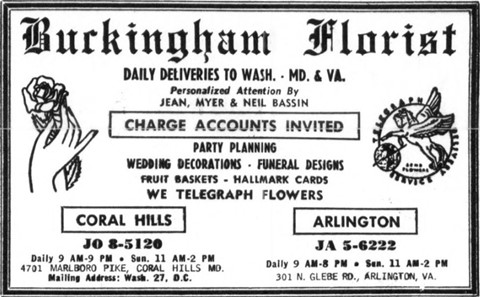
Advertisement for Buckingham Florist in the Washington, D.C., Yellow Pages in 1960. Image courtesy of the Library of Congress.

Picture6

Elmer “Rusty” Young, Chief Floral Designer at the White House, prepares an arrangement in the Floral Room, August 28, 1963. Young was previously a floral designer at Buckingham Florist. Image courtesy of the John F. Kennedy Presidential Library of Museum.

The goal of the Arlington Voices project is to showcase the Center for Local History’s oral history collection in a publicly accessible and shareable way.

The Arlington Public Library began collecting oral histories of long-time residents in the 1970s, and since then the scope of the collection has expanded to capture the diverse voices of Arlington’s community. In 2016, staff members and volunteers recorded many additional hours of interviews, building the collection to 575 catalogued oral histories.

To browse our list of narrators indexed by interview subject, check out our community archive. To read a full transcript of an interview, visit the Center for Local History located at Central Library.

August 19, 2021 by Web Editor

Message from the Library Director on Masks and Social Distancing

Post Published: August 18, 2021

Effective Wednesday, Aug. 18, all individuals, age two and older, who enter Arlington Public Library buildings will be required to wear a mask, regardless of vaccination status.

We are taking this action to protect our community’s health and well-being due to the recent spike in cases of COVID-19 in our area. We also ask that you continue to maintain 6 feet of distance between yourself and people who don’t live in your household. These steps are consistent with actions being taken in Loudoun County, Fairfax and Alexandria library systems.

According to the Centers for Disease Control and Prevention (CDC), the Virginia Department of Health (VDH), and the Arlington County Public Health Division, COVID-19 continues to pose a risk, especially to individuals who are not fully vaccinated.

As always, thank you for your patience and cooperation as we strive to provide safe library services in this difficult time.

Diane

Scrawled signature of Diane Kresh

Diane Kresh
Director
Arlington Public Library

August 18, 2021 by Web Editor

Washington Golf and Country Club

Post Published: August 12, 2021

The Washington Golf and Country Club is considered the oldest golf club in Virginia, and its course now comprises 88 acres of land just off of Glebe Road in North Arlington.

Picture1

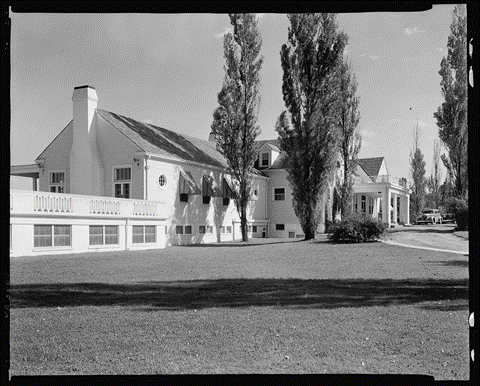
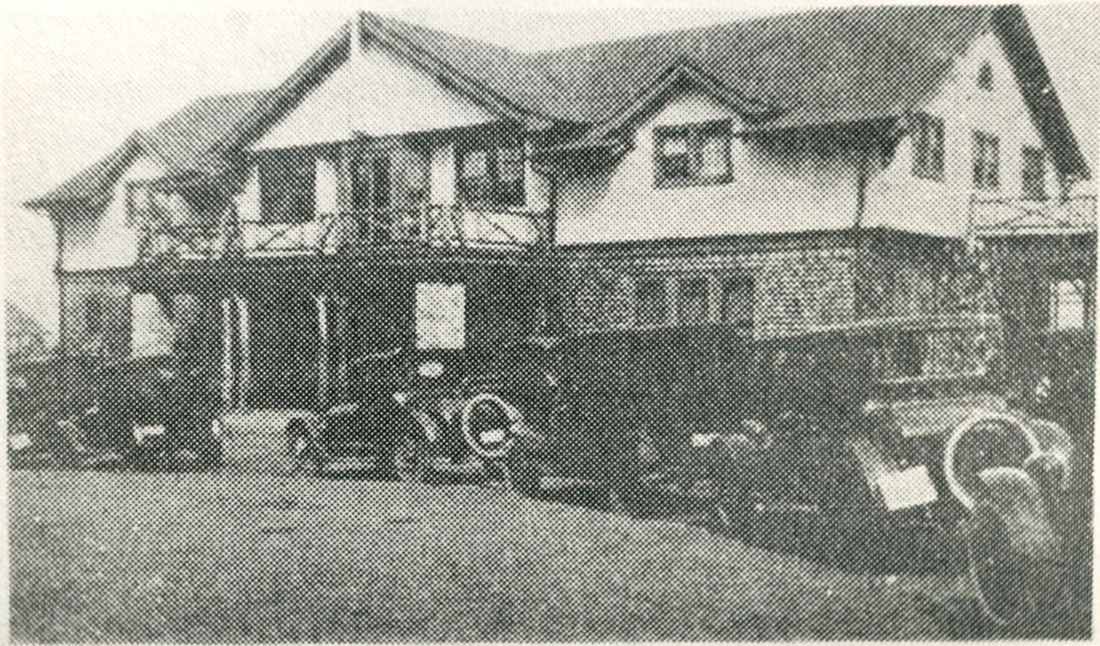
The Washington Golf and Country Club, taken in the late 1930s. Image courtesy of the Library of Congress.

The club was incorporated in 1894 by members of the Metropolitan Club, though evidence exists that it was first organized in 1892. The Club was a social and literary group founded by employees of the Treasury Department and whose members were of the elite echelons of Washington society, including Senators, ambassadors, and other men in high government positions.

This was around the time when golf was becoming a major recreational craze. The 9-hole golf course was built on a 165-acre tract leased from the Hoover family, just north of Rosslyn. The Hoover family home became the de facto clubhouse for the golfers. It was noted that a man named Jackson also lived and worked on the property that became the golf course. Jackson had been enslaved by the Hoover family and later became their servant and then a servant at the golf club.

Picture2

The Washington Golf Club in the 1920s at the Rixey property.

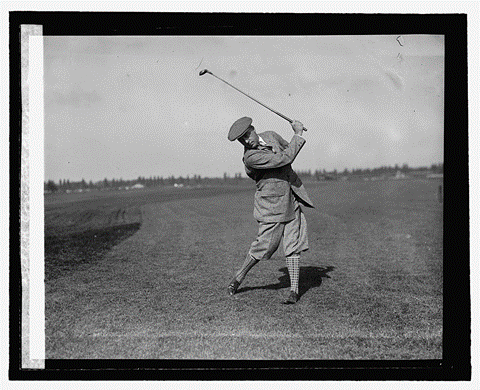
The golf club adhered to a strict set of rules, including regulation dress and a ban on gambling on the premises. An annual fee was between $15-$20, and by 1897 there were nearly 200 members. About 30 women had joined the club by 1898, though they would play on “ladies’ links.”

The club was disbanded in 1907 when the property owners decided to develop the land, and the following year it was incorporated under a new name, the Washington Country Club. Between 1908 and 1920 the club and a now-18-hole course were located at the property of Admiral Rixey, the then-United States Surgeon General.

This property also included tennis courts. Theodore Roosevelt and Howard Taft were honorary members, and Woodrow Wilson was also an active member, leading it to be known as the “Playground of Presidents.”

Picture3

A man identified as A.W. Howard plays at the Washington Golf Club, circa 1925. Image courtesy of the Library of Congress.

In 1915 the club’s name was changed to its current iteration as the Washington Golf and Country Club. In 1936 a fire destroyed the clubhouse and the club’s records, though it was rebuilt on the same foundations by 1937. In 1958, another new clubhouse was built, and the current clubhouse was completed in 2006.

Want to learn more about golf history in the region? Check out Golf and Civil Rights in Washington, DC.

To learn more about Arlington's history, visit the Center for Local History on the first floor of the Central Library.

Do you have a question about this story, or a personal experience to share? 

Use this form to send a message to the Center for Local History.

Center For Local History - Blog Post Message Form

Do you have a question about this story, or a personal experience to share? Use this form to send a message to the Center for Local History.

"*" indicates required fields

This field is for validation purposes and should be left unchanged.

Share Your Story

August 12, 2021 by Web Editor

Oral History: Public Shoe Store

Post Published: July 15, 2021

Interview with Dr. Sholom “Doc” Friedman and Karen Widmayer

Picture5

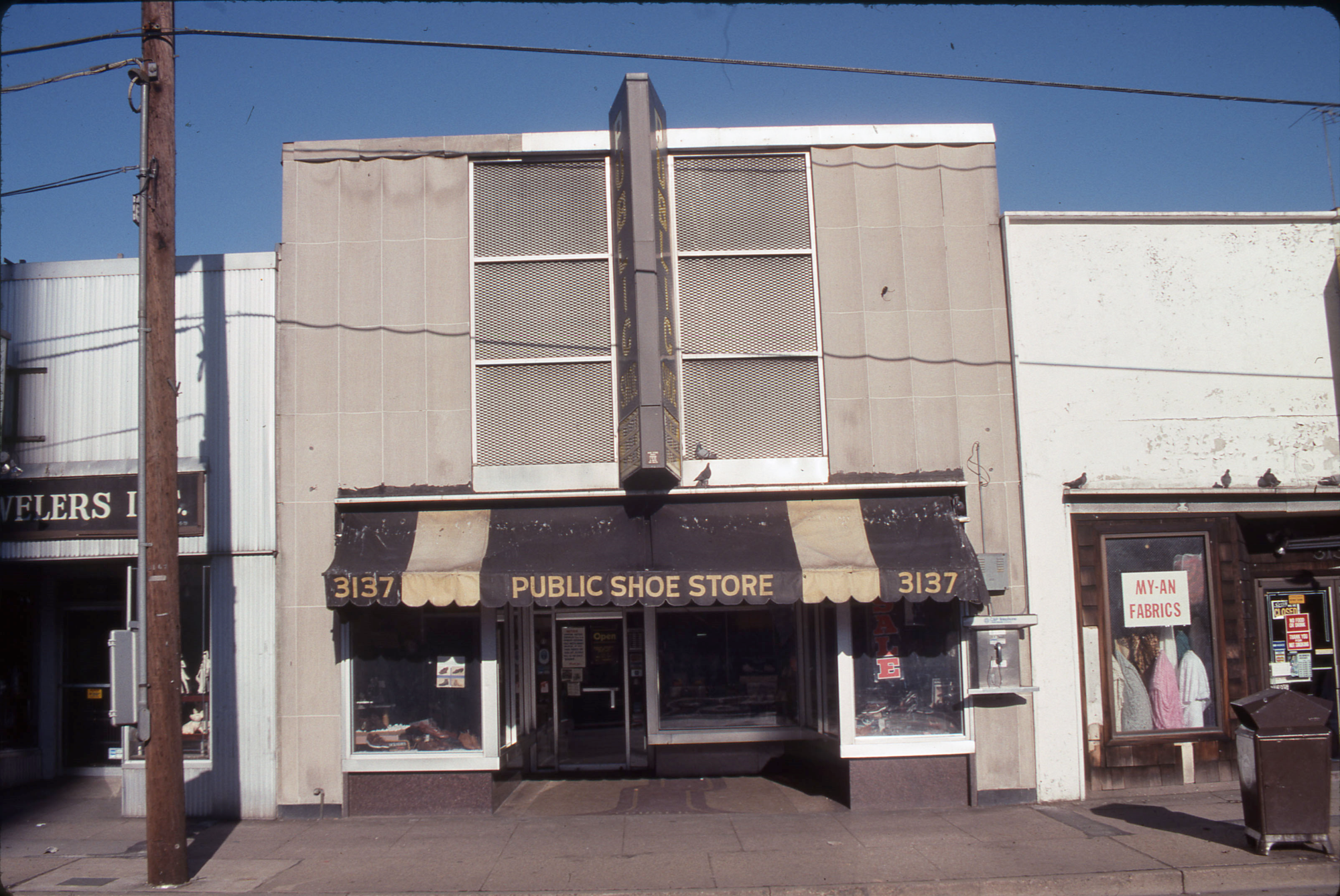
Public Shoe Store, 1983.

Arlington Voices the Oral History Collection

Oral histories are used to understand historical events, actors, and movements from the point of view of real people’s personal experiences.

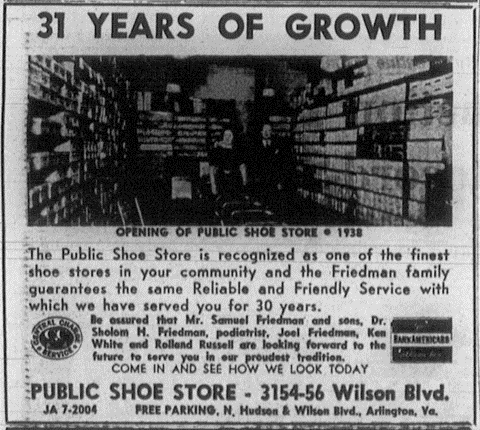
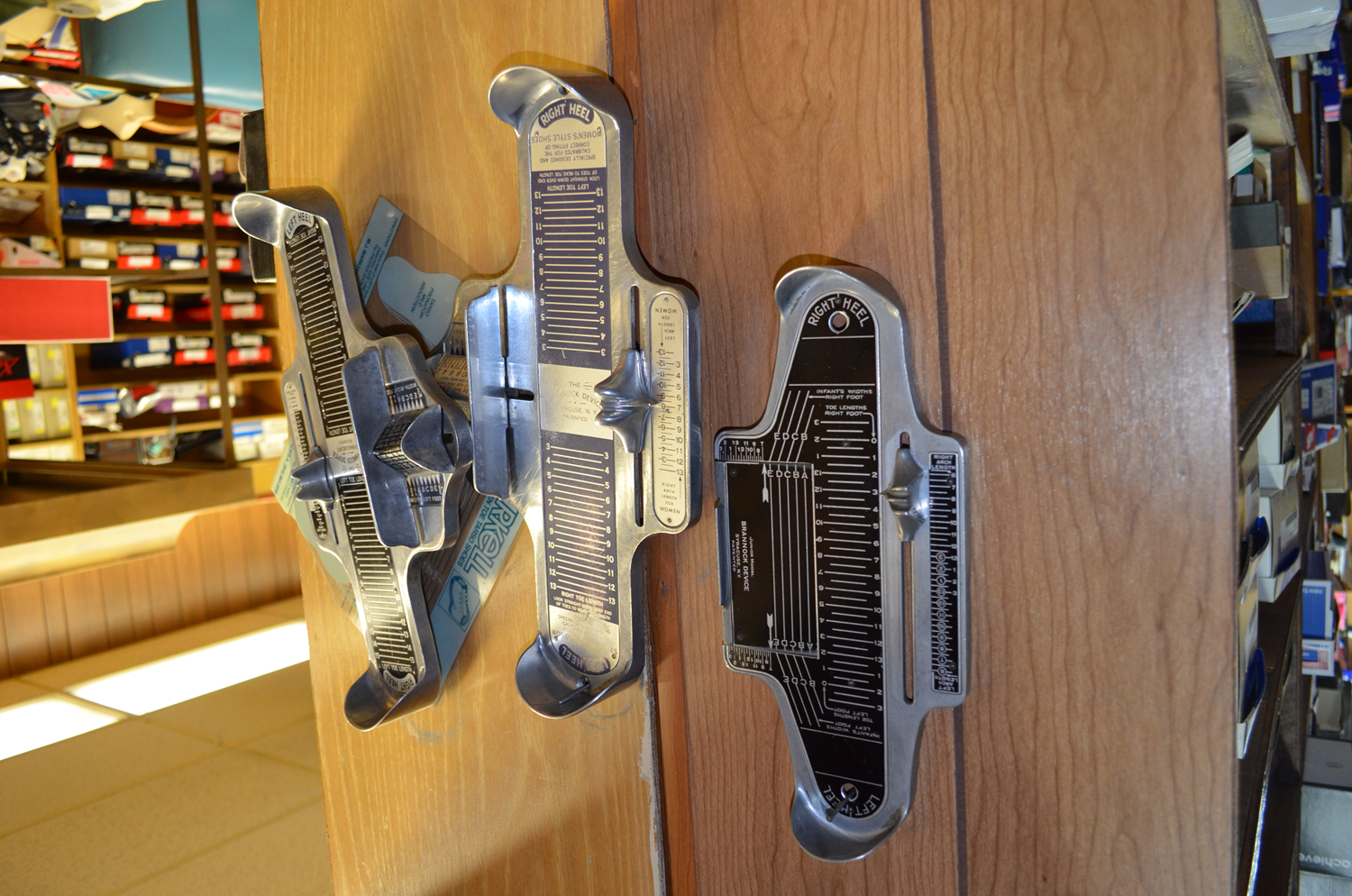
Public Shoe Store in Clarendon was one of the neighborhood’s longest-running and most recognizable businesses, operating from 1938 to 2016. The business was operated by brothers Dr. Sholom H. “Doc” Friedman and Joel Friedman for much of that time, after being founded by the Friedmans’ father Samuel Friedman in the 1930s. Dr. Friedman was a trained podiatrist, and the business was known for specializing in comfort shoes and custom fitting. Dr. Friedman passed away in 2019.

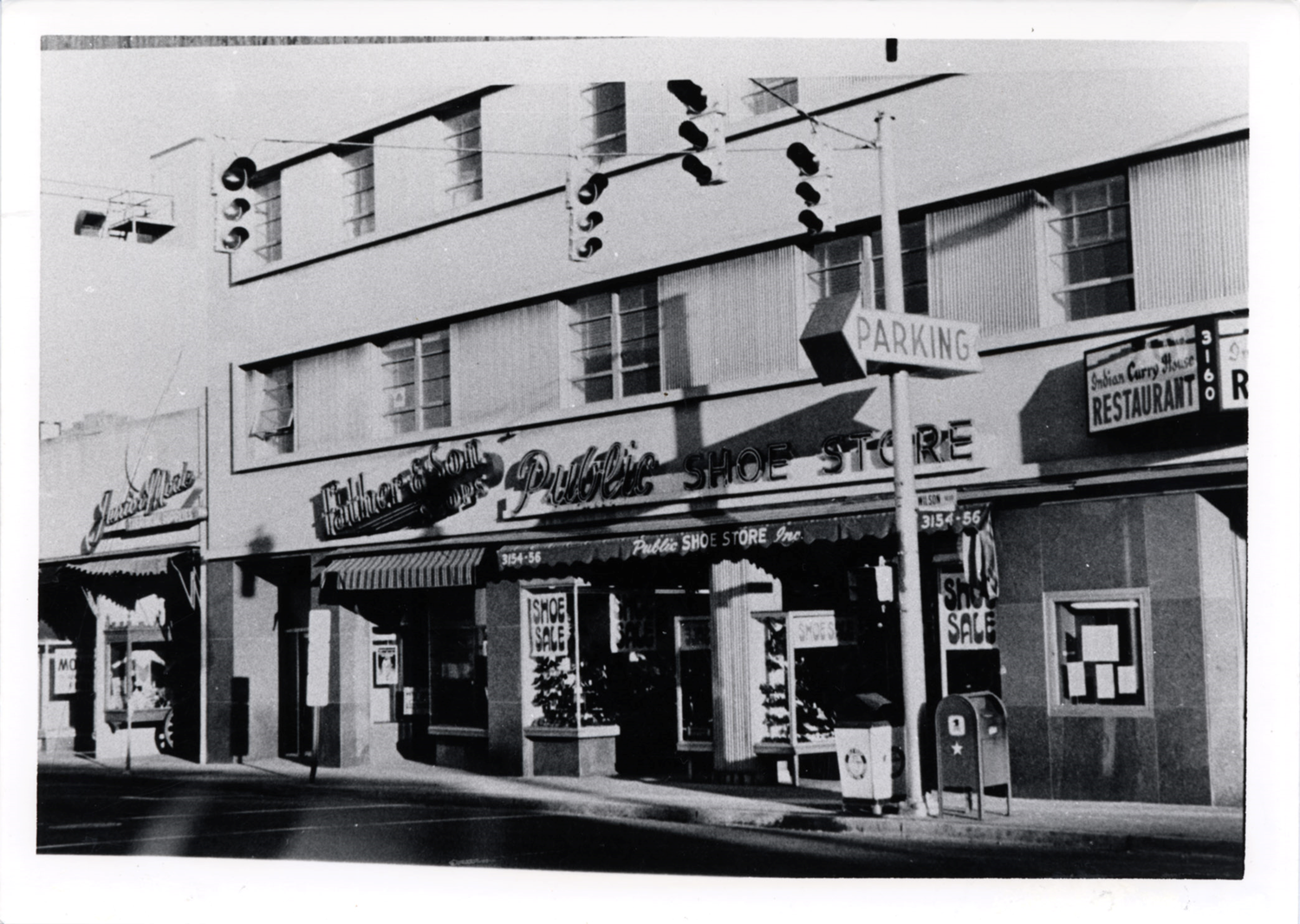
The original location of the store was where the Clarendon Metro station currently stands, but when construction came through the neighborhood the business moved to its longstanding storefront at 3137 Wilson Boulevard. The shoe store was also a meeting place for members of the Arlington-Fairfax Jewish Congregation (now Etz Hayim), who would gather on the second floor of the shop.

Picture1

Advertisement in the Northern Virginia Sun for Public Shoe Store, October 31, 1968. Image courtesy of Virginia Chronicle.

In this oral history, Dr. Sholom “Doc” Friedman and two of his children, Karen Widmayer and Mark Friedman, discuss the history of the shop and the impact it had on the Arlington community. Other details in the interview include how the children often ran the cash registers, and how the shop worked with President Carter's family in the 1970s. Here is a brief excerpt from the interview:

Narrator 1: Dr. Sholom “Doc” Friedman
Narrator 2: Karen Widmayer
Interviewer: Virginia Smith
Date: March 8, 2015

https://library.arlingtonva.us/wp-content/uploads/2021/07/Friedman_Sholom_20150308.mp3
Picture6

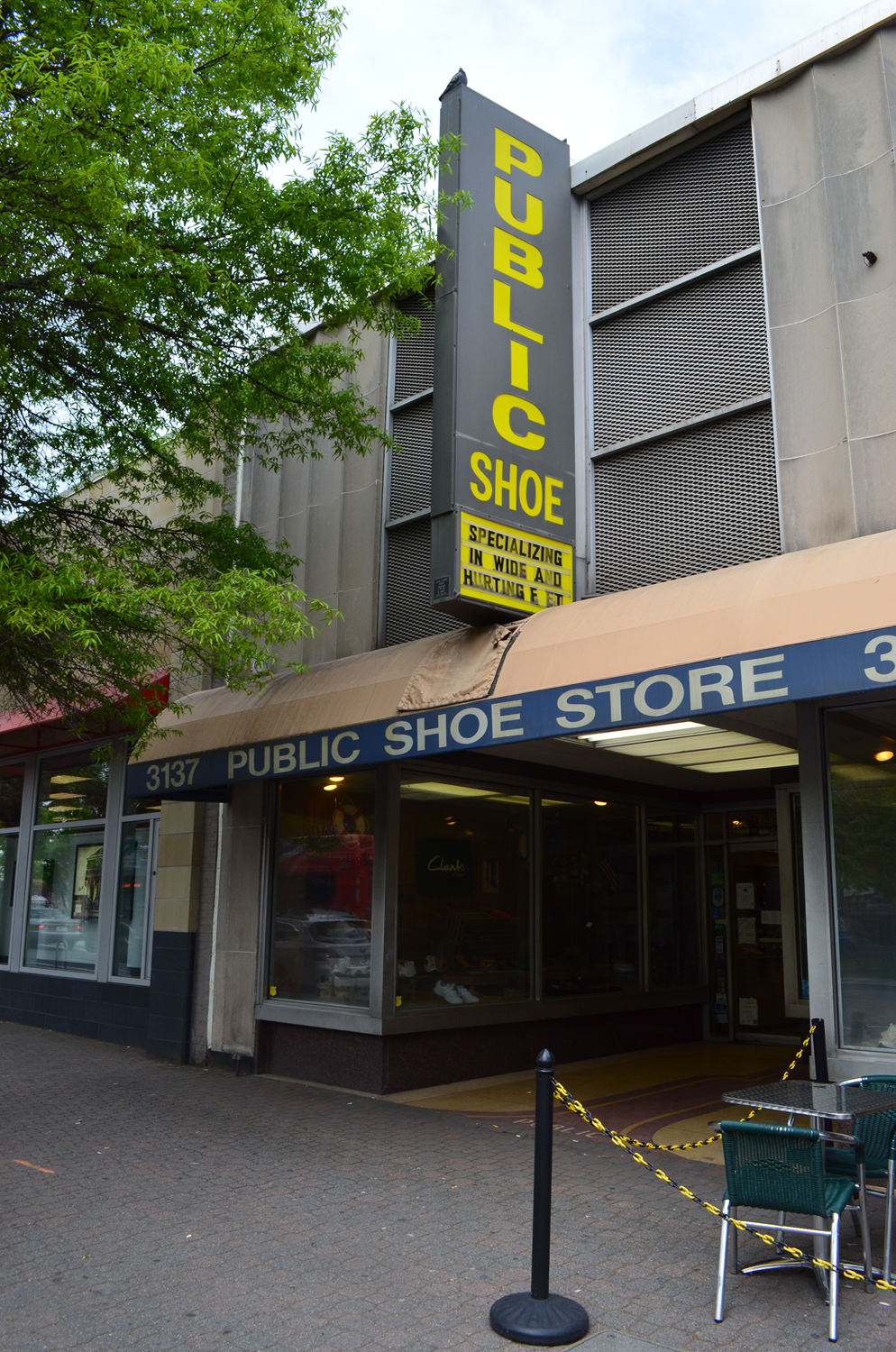
Public Shoe Store exterior in 1990.

Picture7

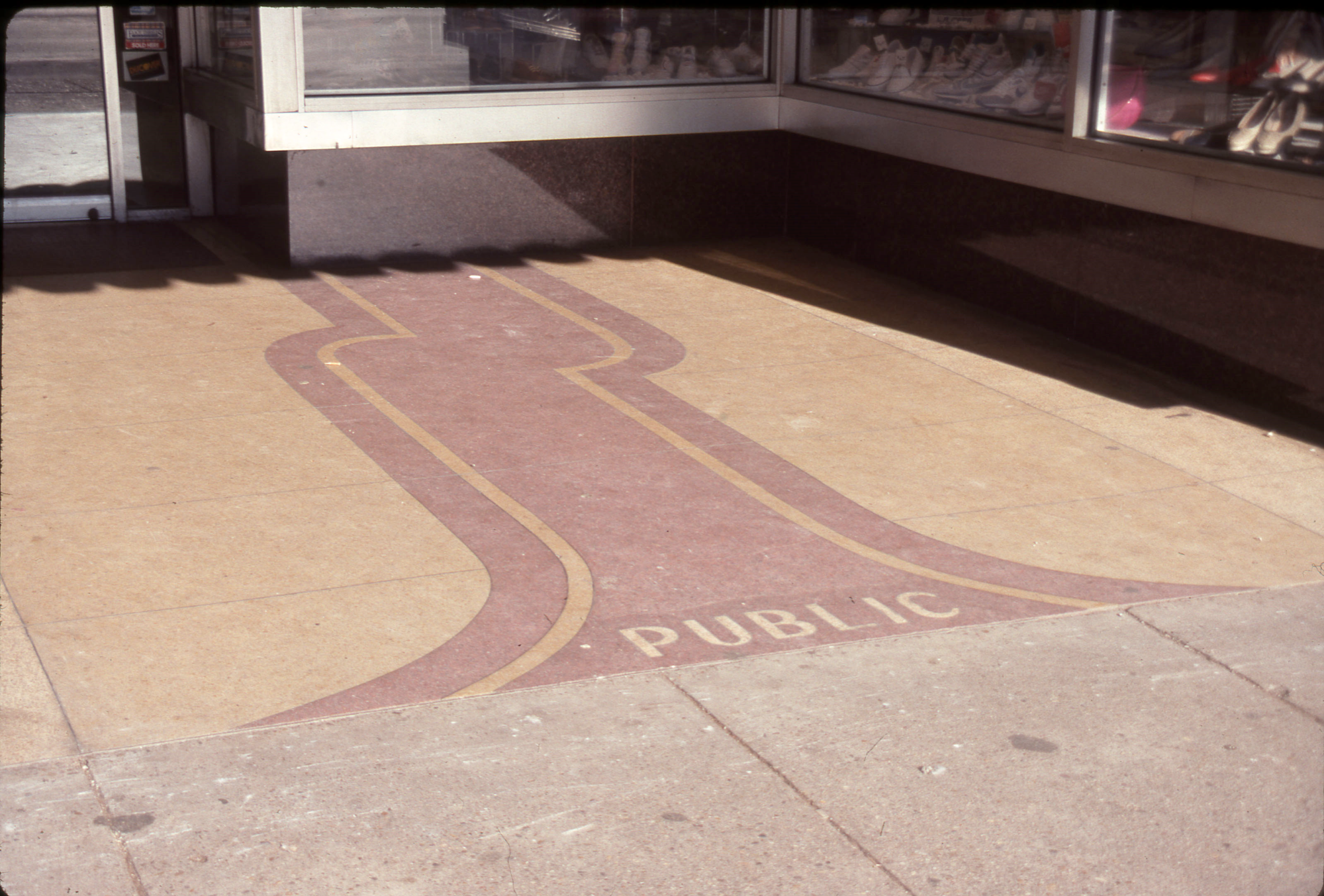
Entrance to Public Shoe Store, 1990.

Virginia Smith: Okay. So how does the building work? What do you do? You set up the retail place in the main floor?

Sholom Friedman: Right.

VS: What’s downstairs?

SF: It used to be stored shoes, but I’ve been decreasing the stock now.

VS: Towards the end of this—the life of the business.

SF: Right.

VS: But that was full downstairs—was inventory.

SF: Right.

VS: And upstairs was—?

SF: Upstairs we had a little balcony.

Karen Widmayer: Yeah, the main floor is all selling floor and stock. And the basement had all stock and some storage. And then there’s a mezzanine level that’s about a quarter of a floor-size up in the back, and that was just some storage space.
SF: Storage, right.

Picture8

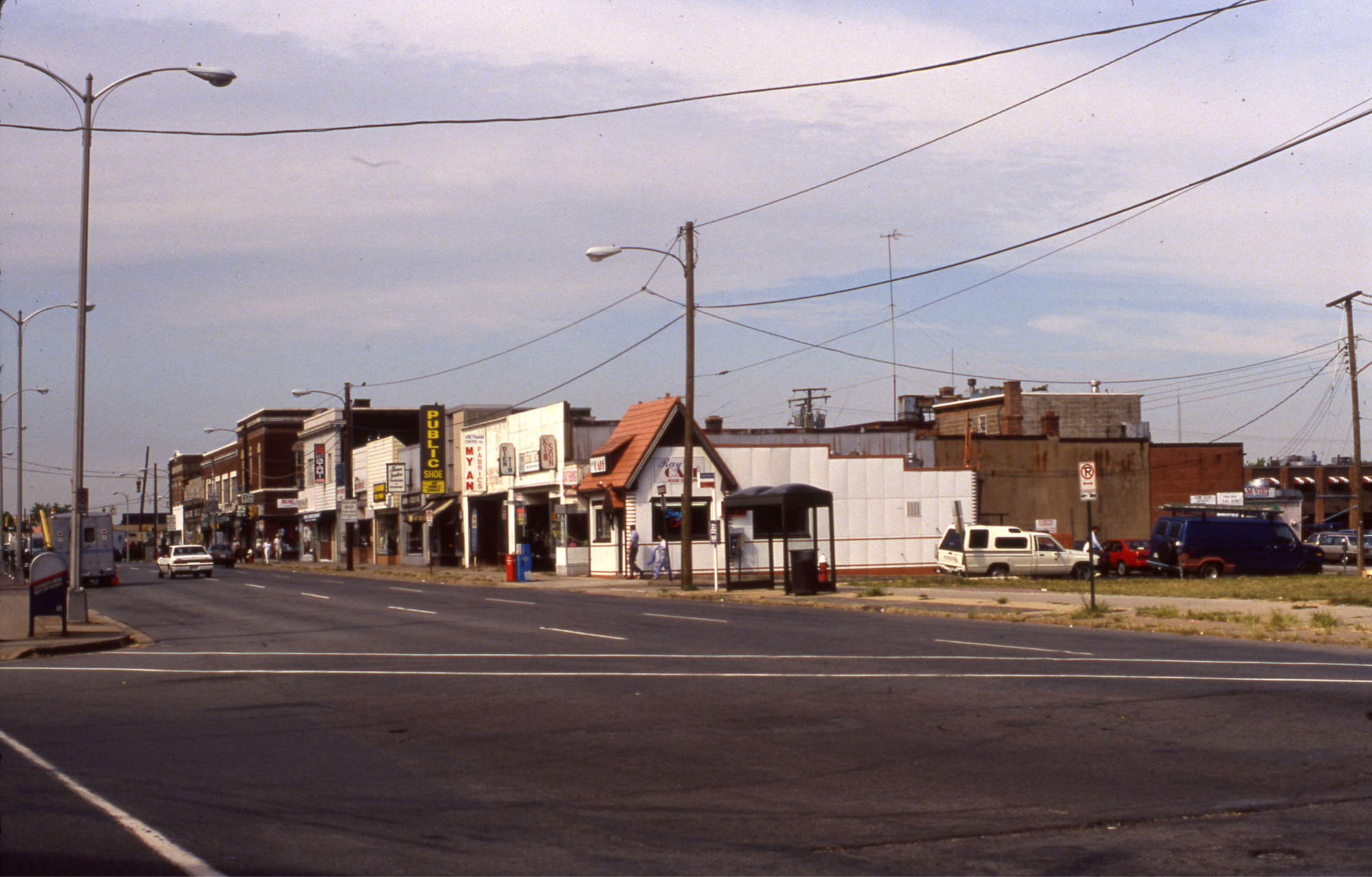
View of Wilson Boulevard from east to west, including the large Public Shoe Store sign, 1991.

VS: So it was all your dad [Samuel Friedman] needed? Large enough?

SF: Oh, yeah. It was a pretty big operation back then.

VS: Sounds like it. What decade would you call your heyday, the best years, or the best decades?

SF: Probably after the war.

VS: So the ‘40s and ‘50s when families were moving and growing and all that sort of stuff.

SF: Right.

KW: Even when I worked there, I mean, there’d be ten or fifteen numbers pulled, people sitting and waiting. I mean, it was crazy on Saturdays.

VS: That’s good business—that was a Saturday.

KW: Yeah, that was still ’60—well, I was—started working there when I was about seven, so that’s late ‘60s and into the early ‘70s. I think at that point, that’s when things started changing a little bit with Arlington and the retail. But the businesses stayed.

Picture2

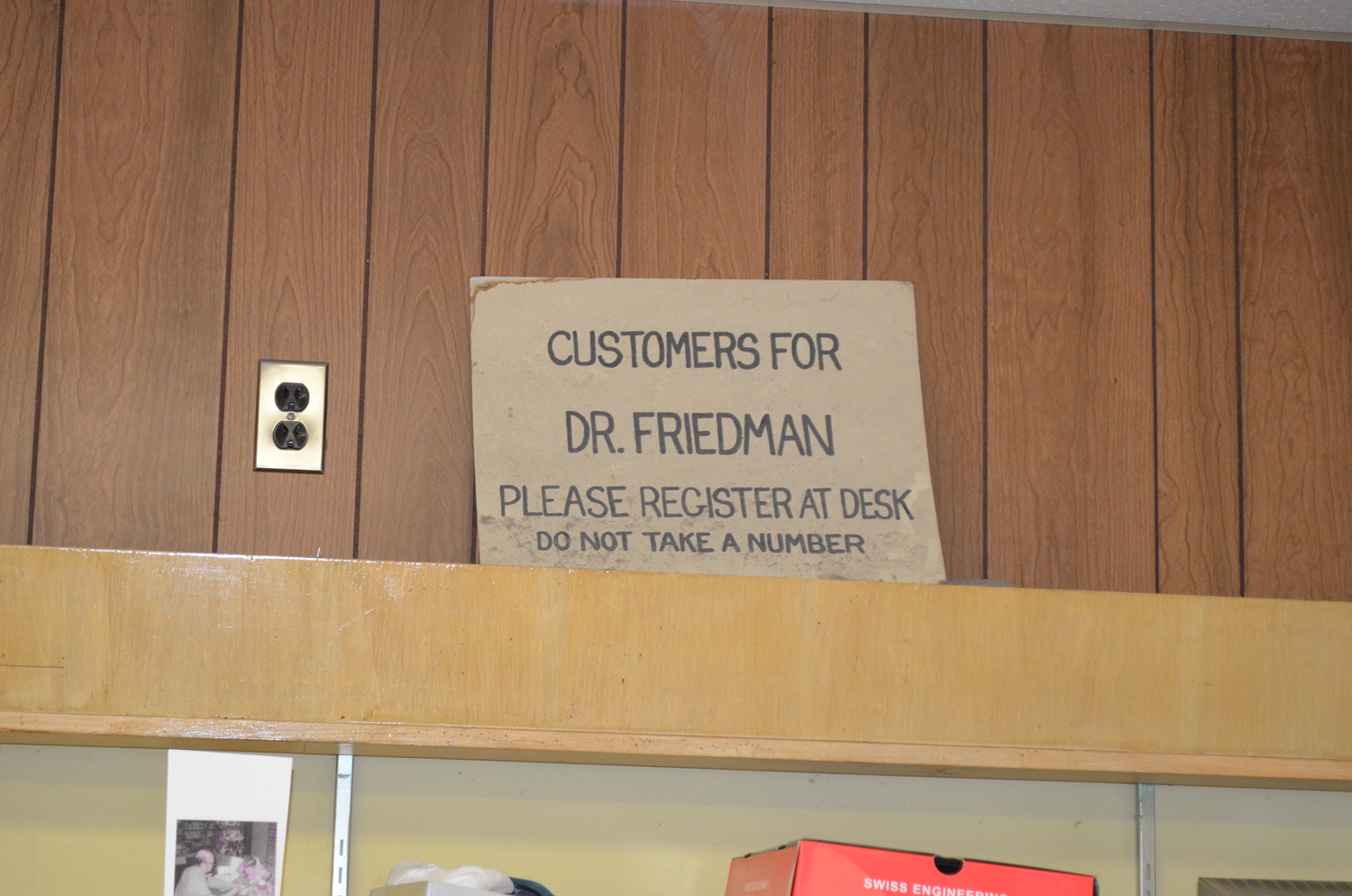
Photos from Public Shoe Store around the time of its closing in 2016.

Picture3

Photos from Public Shoe Store around the time of its closing in 2016.

Picture4

The exterior of Public Shoe Store around the time of its closing in 2016.

The goal of the Arlington Voices project is to showcase the Center for Local History’s oral history collection in a publicly accessible and shareable way.

The Arlington Public Library began collecting oral histories of long-time residents in the 1970s, and since then the scope of the collection has expanded to capture the diverse voices of Arlington’s community. In 2016, staff members and volunteers recorded many additional hours of interviews, building the collection to 575 catalogued oral histories.

To browse our list of narrators indexed by interview subject, check out our community archive. To read a full transcript of an interview, visit the Center for Local History located at Central Library.

July 15, 2021 by Web Editor

An (Un)familiar Tune: Arlington’s Song

Post Published: July 1, 2021

Though many may not know the words to this reverential tune, Arlington has had an official song for more than 50 years.

The County Song Debuts

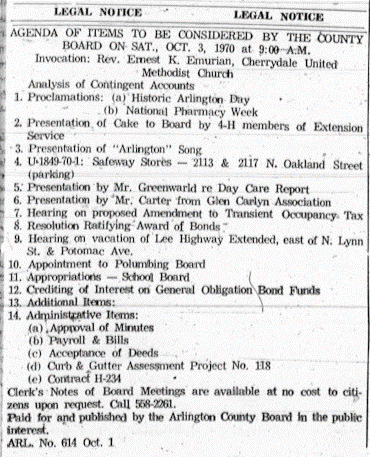
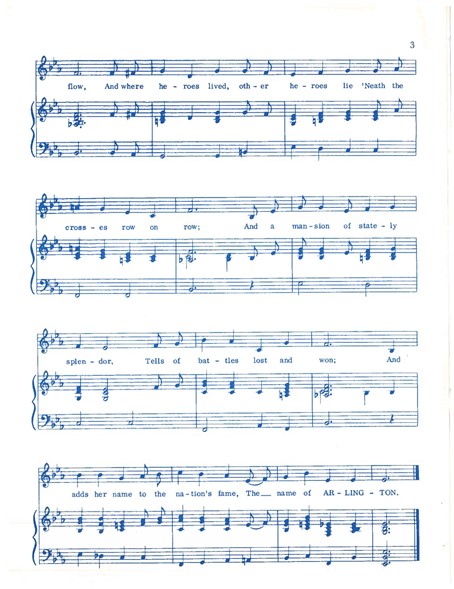
“Arlington,” the County’s official song, was adopted unanimously in October 1970 by the County Board. The musical occasion was marked with a performance of the tune from a chorus of the Masons’ International Order of Job’s Daughters, who were dressed in 18th-century period costume. 10,000 copies of the sheet music and lyrics were later distributed by the Chamber of Commerce throughout the County.

Picture10

Agenda for the October 3, 1970, debut of the Arlington song (see item No. 3). From the October 1, 1970, issue of the Northern Virginia Sun.

The song was composed by the Reverend Ernest K. Emurian (1912-2004), who from 1962 to 1981 was minister of the Cherrydale Methodist Church. In addition to his ecclesiastical duties, Emurian was also known for being a musician, poet, and writer, and wrote geographically inspired tunes about the Virginia cities of Portsmouth and Lynchburg in addition to Arlington, and penned multiple books about national songs and hymns. He was quoted as saying “If a place is worth living in, it’s worth writing a song about.”

Read: The 2015 County article “Official ‘Arlington’: Song Sung Blue and White at 45” delves further in detail about the 1970 Arlington song and Reverend Emurian.

Picture9
Picture8

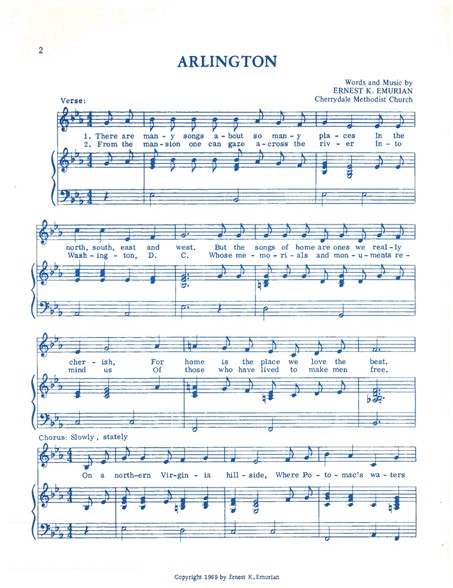
Sheet music and lyrics for the 1970 song “Arlington,” by Ernest Emurian.

The song caught a second wind in the 20th century when in 2000, the County Board reintroduced the tune with a performance featuring some of the daughters of the original Daughters chorus who had performed the 1970 debut of the song. And what might be called a third resurrection occurred in 2016, when Arlington TV recorded and aired a performance with some of the members of the original 1970 chorus.

Watch: The 2016 performance of “Arlington.”

A Prequel Tune

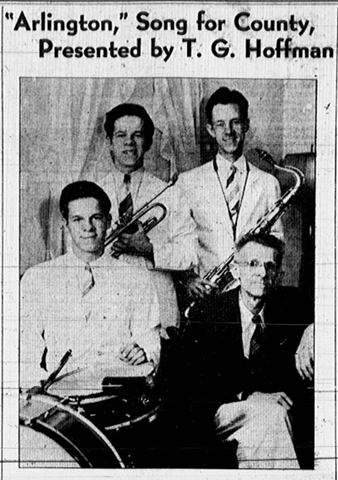
Possibly even more obscure than the official song is a precursor to that 1970 tune written in 1938, though this version was never formally adopted as a piece of official County music. In August 1938, members of the local Hoffman family orchestra presented their song, “Arlington,” to the Chamber of Commerce. The tune was composed by Theodore G. Hoffman, who wrote the song with the intention for it to be used to “’ promote the public interest in and welfare of Arlington County.’”

Hoffman was a German immigrant who performed with his three sons, and who had also composed songs used by the U.S. Army during World War II along with other patriotic compositions throughout his career. A 1938 article describes the song as a march, with the lyrics paying homage to “businessmen, the neighborly spirit of the homeowners, the healthy climate, the atmosphere of happiness and the beauty of Arlington scenery.”

Picture7

Photo from August 5, 1948, Northern Virginia Sun article by Margaret Troxell about T.G. Hoffman, who composed an early song for and about Arlington.

Modern Songs About Arlington

A few mainstream songs from recent years also reference Arlington, such as the Foo Fighters’ “Weenie Beenie,” named after the beloved County eatery, or “Arlington” by Fairfax-based band Emmet Swimming off of its 1996 album Arlington to Boston. However, neither of those tunes quite capture the detail and charming local specificity of the County’s official song.

Do you have a question about this story, or a personal experience to share? 

Use this form to send a message to the Charlie Clark Center for Local History.

Center For Local History - Blog Post Message Form

Do you have a question about this story, or a personal experience to share? Use this form to send a message to the Center for Local History.

"*" indicates required fields

This field is for validation purposes and should be left unchanged.

Share Your Story

July 1, 2021 by Web Editor

Joan Cooper: Taking a Stand

Post Published: June 17, 2021

Graphic image of a megaphone

Join us for a series of stories from the Center for Local History highlighting members of our community who made a difference in ways that helped shape our history and created positive change. 
Their voices were not always loud, but what they said or did had a significant impact on our community.

Joan Cooper

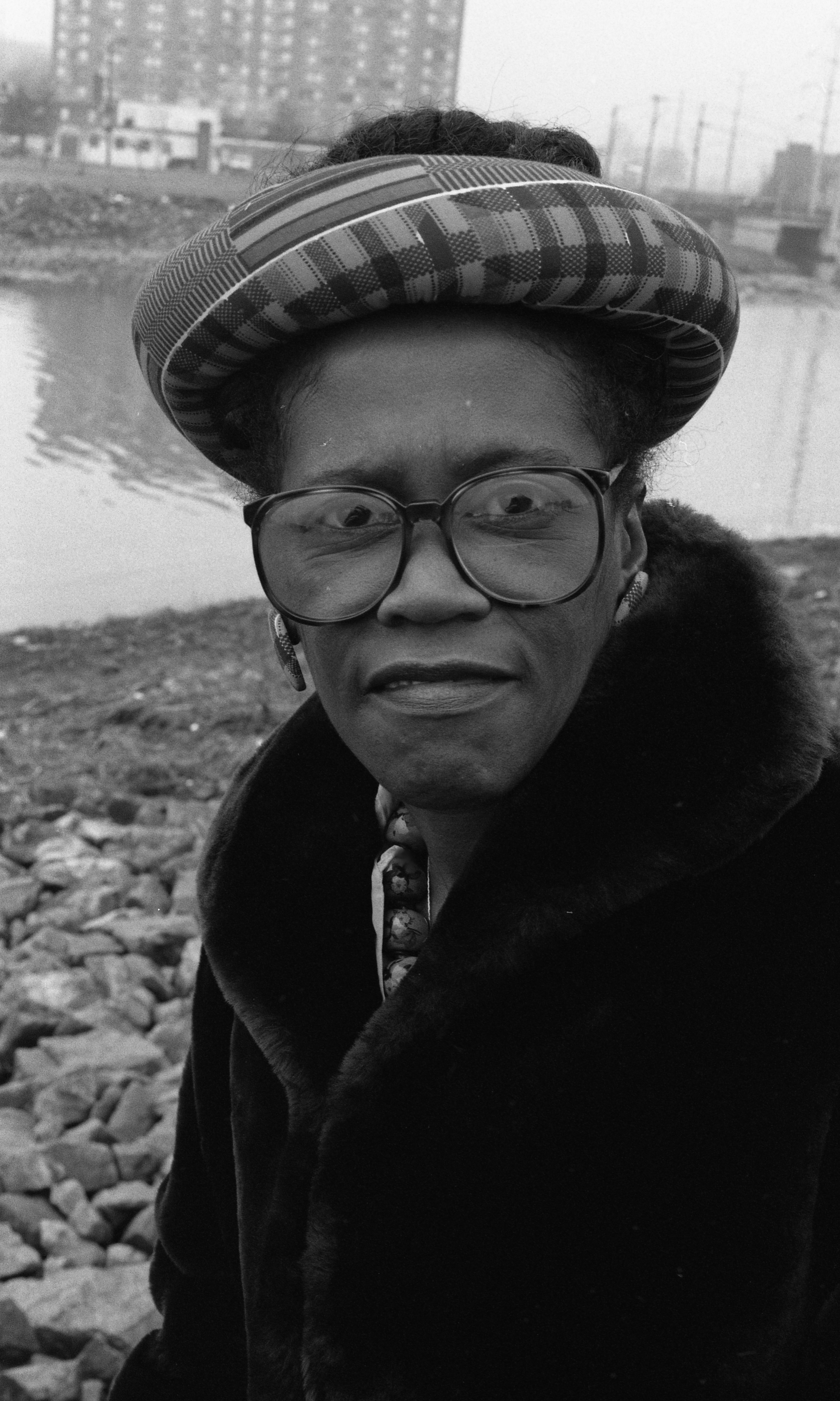
Joan Cooper (1940-2014) was an Arlington social and civic activist, community leader, and passionate anti-drug campaigner. Born and raised in Arlington’s Green Valley/(Nauck) community, Cooper first became an activist in the 1960s as a member of the Action Coordinating Committee to End Segregation in the Suburbs (ACCESS).  In July 1966, ACCESS participated in sit-ins and pickets demanding that fair and equal housing opportunities be made available to all apartment renters in Arlington County.

ernst_2518_004

Joan Cooper, date unknown

Shifting her focus to her immediate community, Cooper tackled issues of drug abuse, crime, and poverty/unemployment, worked to help drive out drug dealers, sought to increase and provide treatment and counseling for addicts, and endeavored to find positive alternatives and activities for young people.
She challenged her community to make changes as well, stating, “People have to realize, that we as community members have to do our job, too.”

In 1970 Cooper led a series of marches and held informal “rap sessions” in Green Valley, focusing on the dangers and extent of drug abuse in the community.  She also founded an antidrug facility called the Community Inn, which functioned as a counseling and treatment referral center.
With her message of “Be persistent, consistent, and insistent,” Cooper helped launch an initiative called “Crackdown on Drugs” in July of 1992. Cooper’s dedication and leadership in this campaign were hailed by then-President George H.W. Bush upon his visit to Drew Model School. Her efforts included driving individuals to drug and alcohol detox programs, helping to patrol corner blocks of the Green Valley neighborhood, and serving as a liaison between residents and police.

In response to what Cooper and others in Green Valley felt was often an inadequate police presence in the area, the Community-Based, Problem-Oriented Police (CB-POP) unit was established at 2430 S. Kenmore St. in March 1992 because of her advocacy.

In that same year, she was named a Notable Woman of Arlington by the County’s Commission on the Status of Women. The Arlington Community Foundation continues to maintain a fund in Cooper’s name which supports a variety of endeavors, including student scholarships, sports programs at local schools, and repair efforts for Lomax A.M.E. Zion Church.

In 1993, Cooper was the first recipient of the William Newman Jr. Spirit of Community Award, given by the Arlington Community Foundation. She also received a William Brittain Jr. Community Appreciation Award from the Arlington branch of the NAACP. In addition, she was a member of the United Way of the National Capital Area and remained an active presence in her community until her passing in 2014.

Do you have a question about this story, or a personal experience to share? 

Use this form to send a message to the Charlie Clark Center for Local History.

Center For Local History - Blog Post Message Form

Do you have a question about this story, or a personal experience to share? Use this form to send a message to the Center for Local History.

"*" indicates required fields

This field is for validation purposes and should be left unchanged.

Share Your Story

June 17, 2021 by Web Editor

Oral History: Arlington’s First Openly LGBTQ Elected Official

Post Published: June 10, 2021

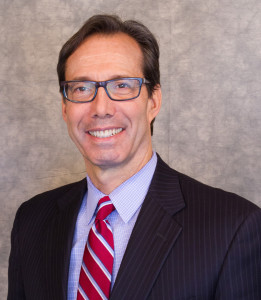
In 1997, Jay Fisette became the first openly LGBTQ+ person elected to office in the state of Virginia when he won a seat on the Arlington County Board.

Fisette served for six terms on the Board, from 1998 to 2017, and served as Board Chair five times, including in his final year on the Board.

Arlington Voices the Oral History Collection

Oral histories are used to understand historical events, actors, and movements from the point of view of real people’s personal experiences.

Fisette focused on numerous issues during his tenure, including strong environmental policies, local affordable housing, and urban planning. He also has held leadership positions in organizations such as the Metropolitan Council of Governments, the Virginia Housing Development Authority, and the Arlington Gay and Lesbian Alliance.

Jay Fisette

In his work with the Alliance, which was founded in 1981 as a local branch of the Virginia Gay Alliance, the group successfully advocated for the inclusion of sexual orientation protections in the County’s human rights ordinance.

Prior to being elected to the Board, Fisette worked as a Government Accountability Office auditor, and as director of the Whitman-Walker Clinic of Northern Virginia, which focuses on helping patients with HIV/AIDS.

Reflecting on his career in Arlington, Fisette said in an announcement stating he would not run for re-election that the County “embraced me as a gay man long before such an endorsement could be presumed, long before it became the norm.”

Jay Fisette Long Bridg

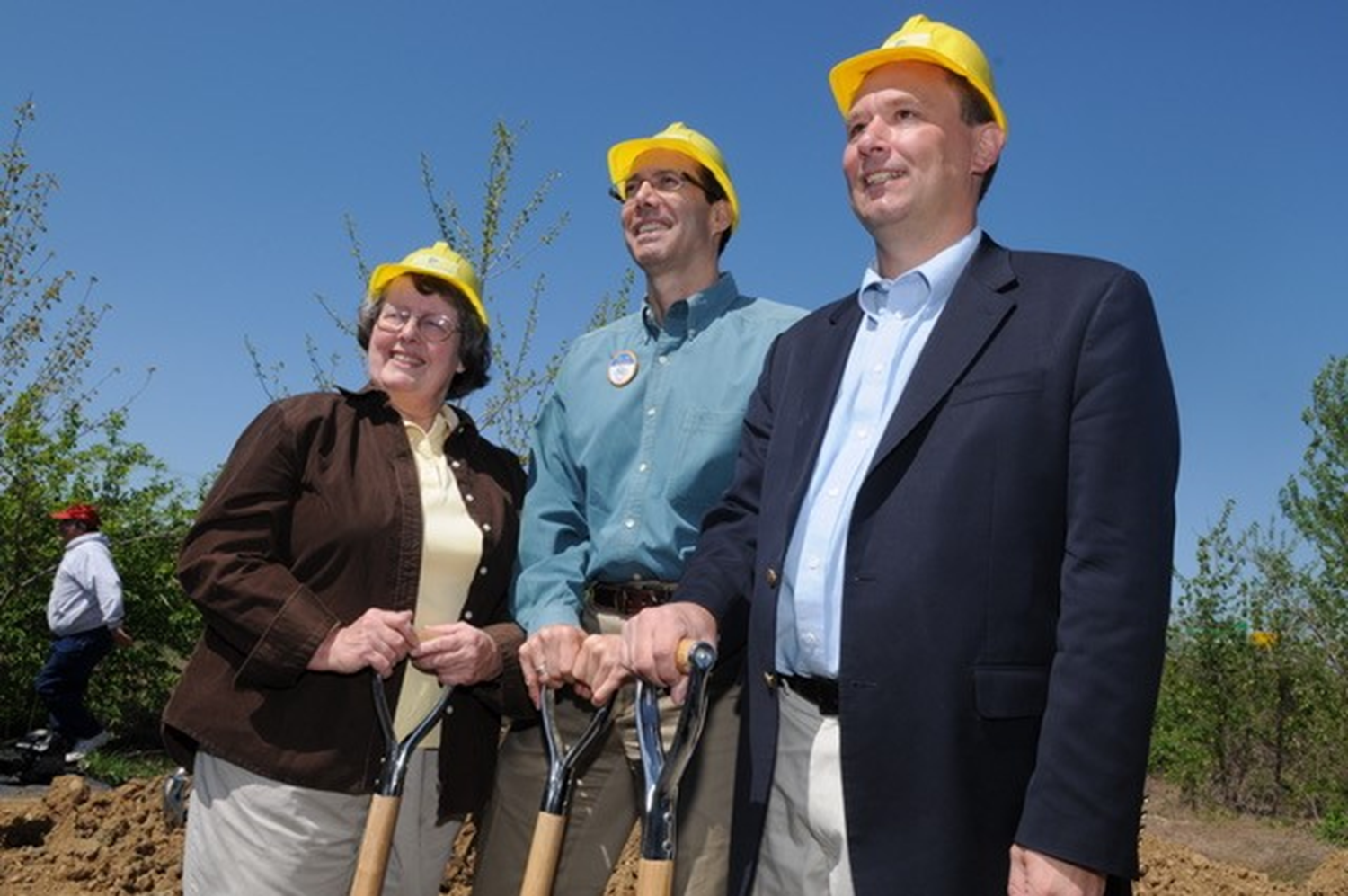
From left to right: Long Bridge Park Design Advisory Committee vice-chairman Carrie Johnson, County Board Chairman Jay Fisette, and Committee Chairman Tobin Smith at the groundbreaking ceremony for Long Bridge Park, April 10, 2010. From RG 199.

In this oral history interview from the Smart Growth documentary series, Jay Fisette discusses his time on the County Board, as well as development in the County.

Narrator: Jay Fisette
Interviewer: Mary Curtius
Date: April 12, 2008
Note: The audio for this interview is currently unavailable.

Mary Curtius: So Jay, what I want to know is what made you run for the board in the first place?

Jay Fisette: That’s a good question. You know I’d always been interested in studying public policy and always thought about it. When I went to California and came out it was possible there. But as a gay man, it just didn’t seem feasible honestly.

MC: Didn’t seem feasible here in Virginia?

JF: To be elected. You know most places in the country you take it off the list. It’s just not practical. But after living here for five years or so, six years, seven years, and getting to know the community it just sort of crept back into my consciousness as something that in a community like this was really feasible and I had a real connection to what I understood to be the values here and the character of this community and sort of just woke up.

Jay Fisette Brochuere

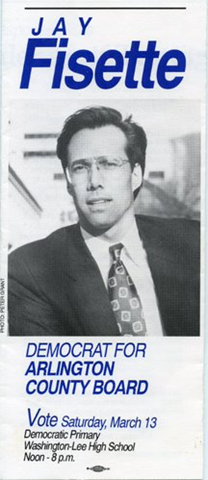
A campaign brochure for Fisette’s first run for County Board in the 1993 special election. Fisette gained 49.4% of the vote but ultimately lost to Republican-endorsed Independent Ben Winslow.

This interview is available at the Center for History, and issues of the Sun and Northern Virginia Sun are available online through the CLH Community Archives and through Virginia Chronicle.

The goal of the Arlington Voices project is to showcase the Center for Local History’s oral history collection in a publicly accessible and shareable way.

The Arlington Public Library began collecting oral histories of long-time residents in the 1970s, and since then the scope of the collection has expanded to capture the diverse voices of Arlington’s community. In 2016, staff members and volunteers recorded many additional hours of interviews, building the collection to 575 catalogued oral histories.

To browse our list of narrators indexed by interview subject, check out our community archive. To read a full transcript of an interview, visit the Center for Local History located at Central Library.

June 10, 2021 by Web Editor

Dorothy Hamm: Speaking Out

Post Published: June 3, 2021

Graphic image of a megaphone

Join us for a new series of stories from the Center for Local History highlighting members of our community who made a difference in ways that helped shape our history and created positive change.

Their voices were not always loud, but what they said or did had a significant impact on our community.

Dorothy Hamm

Dorothy Hamm was born in 1919 in Caroline County, Virginia. The only school that accepted African-American students was six miles away from her home, and in 1926 her family moved to Fairfax County where the children could attend elementary school. When Hamm graduated from primary school, the family found that there was no accessible junior high or high school for African-American students. Because her mother was a government employee, Dorothy attended secondary schools in Washington, D.C., and went on to enroll in Miner Teacher’s College.

Dorothy Hamm Portrait

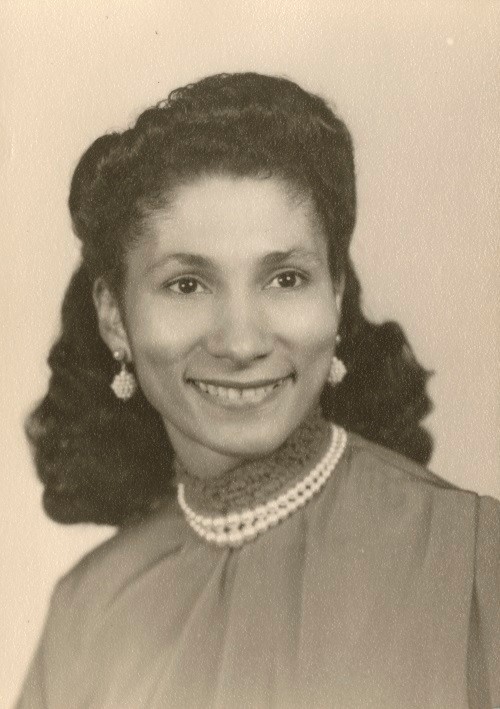
Dorothy Hamm, date unknown. Image courtesy of Carmela Hamm, from the Library of Virginia.

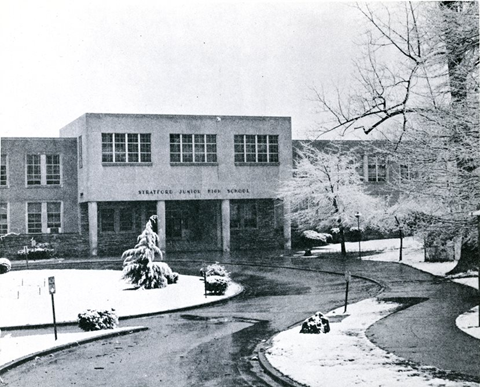
Hamm married Edward Leslie Hamm, Sr., in 1942 and the couple moved to Arlington in 1950, where they raised their three children. In 1954, the Supreme Court ruled segregation illegal in the public schools in Brown vs. Board of Education. In 1956, the Hamms became plaintiffs in the first civil action case filed to integrate the Arlington Public School system. When no action had been taken a year after the suit was filed, Dorothy and her husband took their oldest son, Edward Leslie, Jr., to enroll at Stratford Junior High School, and were not allowed to admit him to the school.

A few days after the opening day of the school year in September 1957, crosses were burned on the lawns of two Arlington families and the Calloway United Methodist Church. The church was a central location for desegregation organizers.

Hamm

Due to the efforts of Dorothy Hamm, in 1959, Stratford Junior High School became the first school in Arlington to desegregate. This made Arlington the first County in Virginia to desegregate its schools.

On January 19, 1959, Senator Harry F. Byrd’s policy of statewide “massive resistance” was outlawed by the Virginia Supreme Court. On February 2, 1959, Ronald Deskins, Michael Jones, Lance Newman, and Gloria Thompson were enrolled in Stratford Junior High. Hamm’s sons entered Stratford later that year.

In 1960, Hamm was a plaintiff in a court action to eliminate the pupil placement form, which was used to exclusively assign African-American students to certain schools to get around the Supreme Court’s ruling on desegregation. In 1961, Hamm was a plaintiff in a court action to integrate the athletic program of the Arlington Public Schools. Hamm’s son had been barred from participating in Stratford’s wrestling program because of the physical contact between Black and white students. As a result of the court action, discrimination in Arlington athletic programs was declared to be illegal.

In 1963, Hamm was the plaintiff in a civil action case to eliminate the poll tax and remove the race designation from public forms and voting records in Arlington County. The same year, she initiated legal action and helped to organize picketing efforts in protest of segregation of Arlington’s theaters. Along with four other protesters, Hamm was arrested for picketing at the Glebe Theater. Their efforts were ultimately successful, and Hamm and her son Edward Leslie, Jr., became the first African-American customers to be admitted to the theater.

Hamm continued her political activism as an officer of elections in the County for more than 27 years and worked with the Congress on Racial Equality (CORE). She and her husband also participated in the 1963 March on Washington and the Poor People’s March on Washington in 1968.

Hamm passed away in 2004, but her legacy in Arlington lives on.

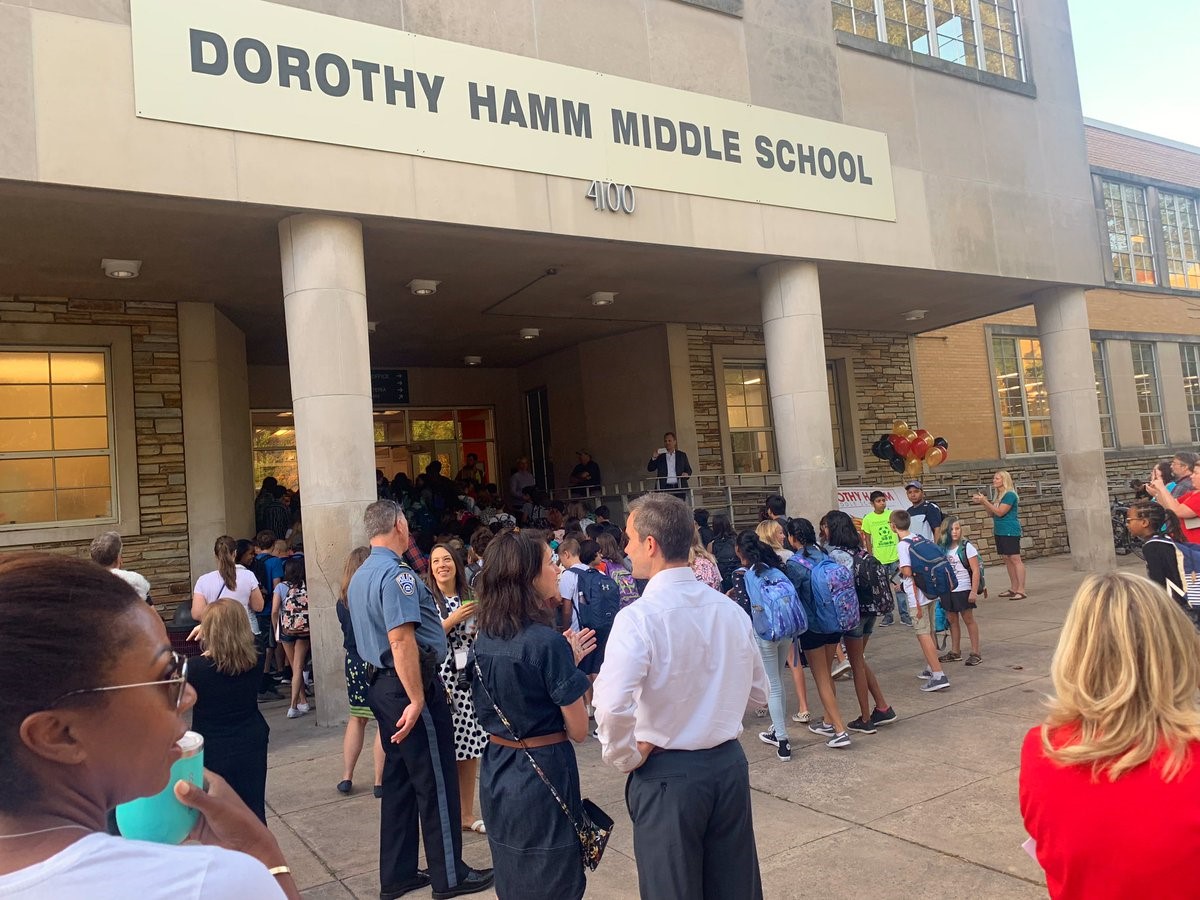
Dorothy Hamm Middle School

Dorothy Hamm Middle School, which was named in Hamm’s honor in 2019. Image courtesy of Arlington Public Schools.

Do you have a question about this story, or a personal experience to share? 

Use this form to send a message to the Charlie Clark Center for Local History.

Center For Local History - Blog Post Message Form

Do you have a question about this story, or a personal experience to share? Use this form to send a message to the Center for Local History.

"*" indicates required fields

This field is for validation purposes and should be left unchanged.

Share Your Story

June 3, 2021 by Web Editor

The History of Arlington’s Logo and Seal

Post Published: May 27, 2021

Arlington is currently in the process of changing its iconography. Let's take a look back at the previous versions of the Arlington Logo as the County begins the process of updating its visual identity.

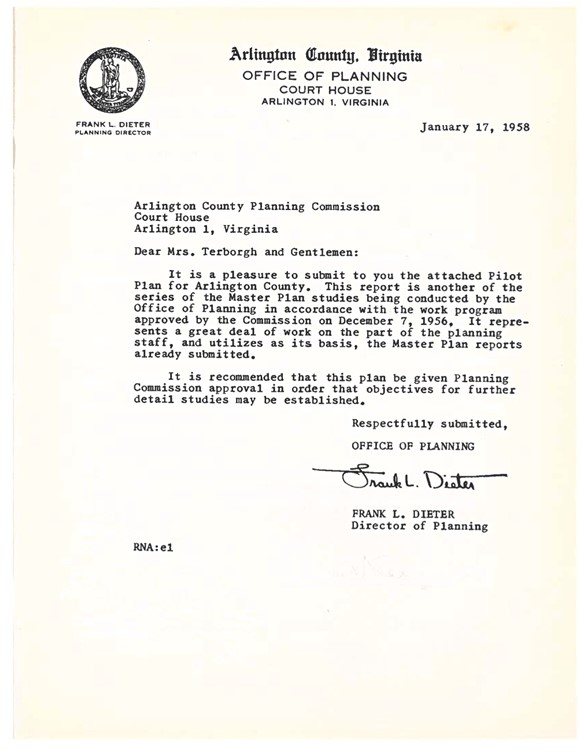
Arlington County was formally designated in 1920, changing its name from Alexandria County in order to distinguish itself from the nearby City of Alexandria. The County initially used the Virginia state seal in official documents, which depicts the Roman goddess Virtus conquering Tyranny. It is accompanied by Virginia's state motto, “Sic Semper Tyrannis,” or “Thus Always to Tyrants.”

Office of Planning Letter

Example of usage of the Virginia state seal in County documents, circa 1958.

Arlington House

Around the mid-1960s, Arlington began using an unofficial County seal. However, the Commonwealth’s Attorney decided that the County Board did not have the authority to adopt a seal. The County Board subsequently authorized the use of a visual signature on documentation, but in 1969 declined to make it a seal based on this legal guidance. Because of this designation, then-County Manager Vernon Ford described the seal as a “decorative medallion.”

The unofficial seal featured Arlington House and the date 1801 in later versions. This was contested by Arlington history expert Eleanor Templeman. The date was chosen to represent the formal establishment of the County of Alexandria, but Templeman argued that it could be incorrectly interpreted as the date of construction of Arlington House, which commenced in 1802. The 1801 date prevailed, however, remaining on the County seal into the 1980s.

The main image on the seal, Arlington House, was the longtime home of Robert E. Lee, leader of the Confederate Army. The building was constructed by slave labor for George Washington Parke Custis, who was George Washington’s step-grandson and Lee’s father-in-law. After the start of the Civil War, the Lee family fled and the property was used by Union troops as a burial site, and the location would eventually become part of Arlington National Cemetery.

Since 1972, the site has formally been known as “Arlington House, the Robert E. Lee Memorial,” reinstating its ties to the Confederate leader. In 2020, legislation was proposed to remove Lee’s name from the historical site, citing the erasure of Black Americans who lived in slavery on the property.

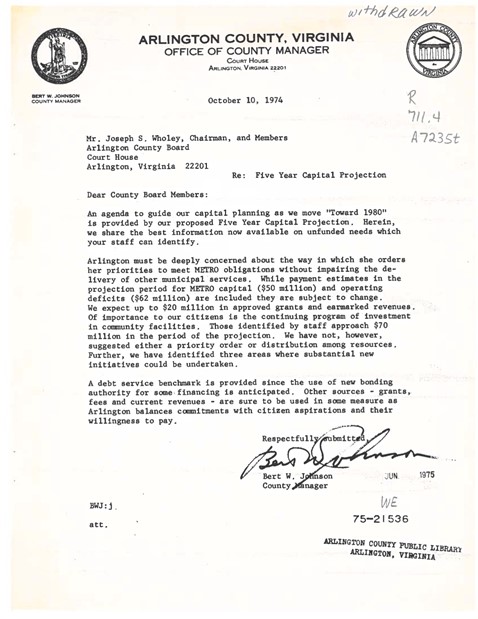
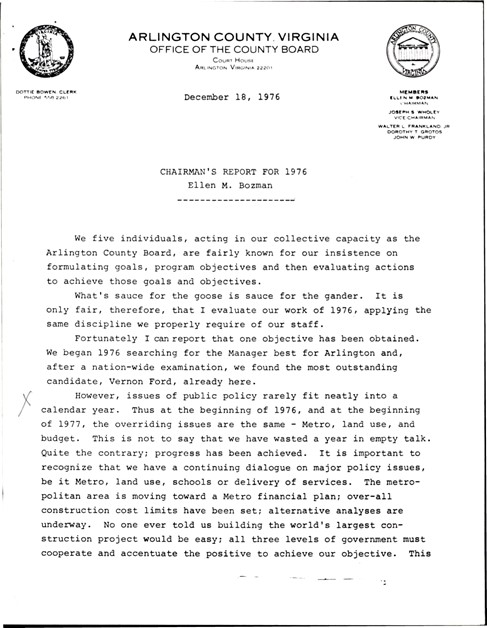
74 State Seal
76 State Seal

Examples of use of the state seal and unofficial County seal, from 1974 and 1976.

The "A" Logo

In 1976, the County began using an unofficial logo in the form of a stylized “A,” with Arlington House also appearing on this image. The logo was designed by Susan Neighbors, a professional illustrator from Arlington, who produced five designs based on County guidance. These options were then voted on by the public at ballot boxes placed at the County libraries, and the “A” logo won the contest.

A Logo 79
A Logo 83

Example of the “A” logo used by the County starting in 1976. Image circa 1979 and 1983.

County Flag Design

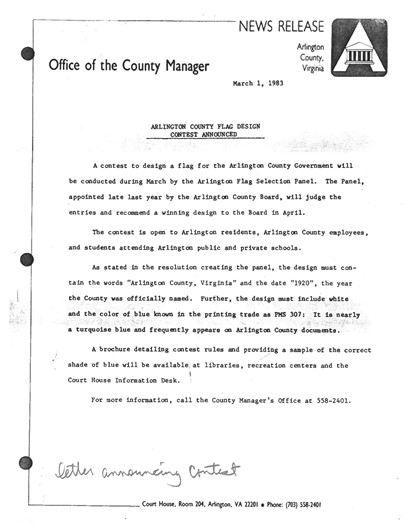
In September 1982, the County set out to adopt an official design for the County flag, and the County Board adopted a resolution for a flag design competition and a Flag Selection Panel to choose the design. In March of 1983, the County released a call for entries for the design of the flag to the public. Design requirements included the use of blue and white colors, and the words “Arlington County, Virginia,” as well as “1920.”

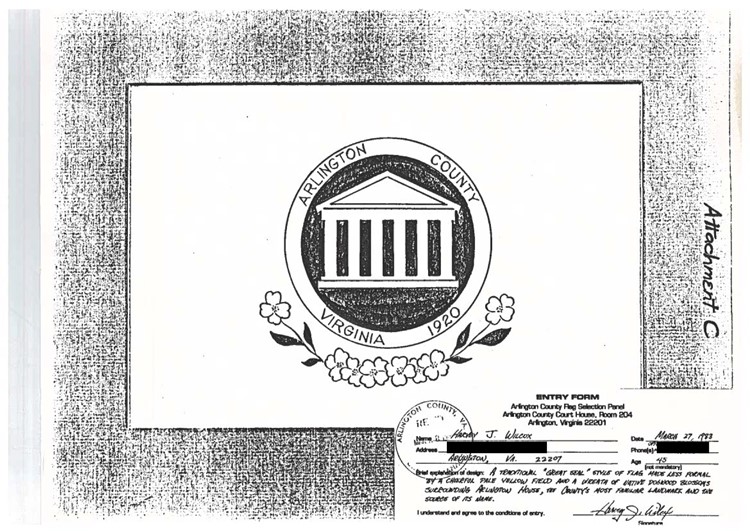
One hundred and ten people submitted designs for the contest, and Harvey J. Wilcox was selected as the winner in April of 1983. Wilcox, a deputy general counsel for the Navy, had no formal design experience and came up with the design while homebound with the flu. His imagery reflected the County’s unofficial logo and seal with a depiction of Arlington House, accompanied by a white ring and sprays of dogwoods underneath. Yellow was chosen as the background color for the flag.

Harvey Wilcox Entry

Harvey Wilcox’s winning entry for the 1983 design contest.

After consulting with the Virginia Attorney General, who issued a different opinion than the one about 20 years prior, the County’s authority to have a flag was dependent on the County having a seal. So, Wilcox’s design then became the County seal, which would subsequently be presented on the County flag.

The inclusion of “1920” from the original design rules was also dropped for the final iteration, due in part to the issues that were raised by Templeman decades before. One of the issues was Arlington had multiple dates in its history that could be considered as equally significant in its history. The County seal and flag were officially adopted on June 18, 1983.

New County Seal 1
New County Seal 2

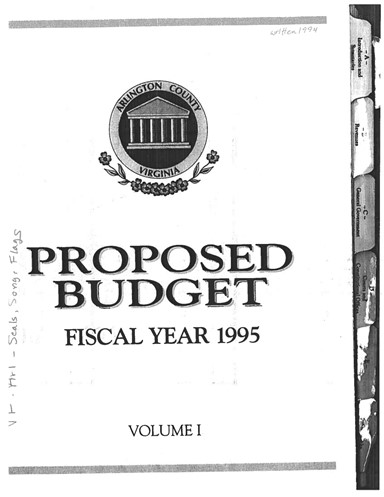
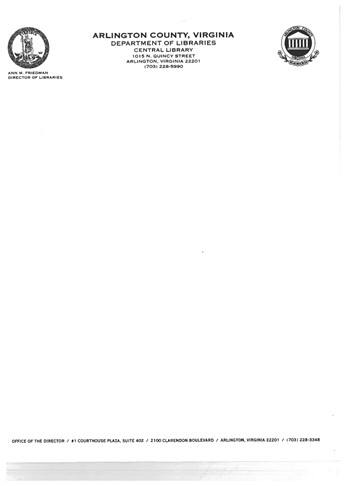
Examples of the new County seal on official documents and letterhead. Images from 1994 and the late 1990s.

The Future of the Logo

The next major step in Arlington’s formal iconography was when the County created and adopted an official logo in 2004. The logo came along with a redesign of the County website that same year and was designed by the D.C. office of Gensler Studio 585. Focus groups were held with design professionals, members of the business community, and members of the general public.

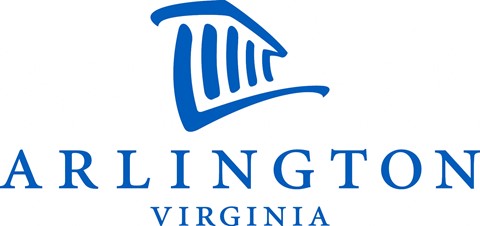
The resulting design was adopted in the summer of 2004, and, like the County seal, included a stylized representation of Arlington House, but the design drew some criticism. In a public poll of more than 1,000 responses conducted by the Arlington Sun Gazette, 81 percent opposed the new design, 15 percent supported it and 3 percent voted, 'it's OK, I guess.’ In October 2004, a petition was circulated calling for the removal of the logo, and it “even inspired a piece of folk art by an artist, who rendered the new logo in dead cicada shells."

County Logo 04

Arlington County’s logo, adopted in 2004.

The County seal and logo were then used concurrently, but for different outlined purposes. In general, the seal is used for items relating to the County Board and for more permanent items (such as the County flag, permanent signage, and certificates).

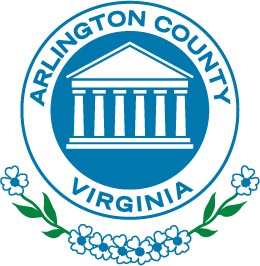
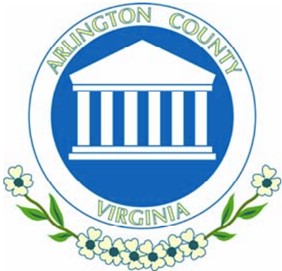
The logo is considered a marketing sign and is used on departmental materials (such as County vehicles and general correspondence). In 2007, the County sought public comment and issued an update to the seal due to persistent inconsistencies in its rendering. The update kept the same imagery on the seal, but restored the original “Arlington blue” and refined it for online use.

In September 2020, the County announced that it would adopt a process to develop a new logo and seal, moving away from imagery related to Arlington House in County iconography. In January 2021, a Logo Review Panel was assembled to review concept submissions from the community, and in April announced five options selected from a pool of more than 250 ideas.

Stay tuned to the County’s homepage to submit your art for the next round of logo design submissions.
Pre 2007 Graphic 1
Pre 2007 Graphic 2

A pre-2007 graphic file of the County seal and the updated version, which is still in use today.

Do you have a question about this story, or a personal experience to share? 

Use this form to send a message to the Charlie Clark Center for Local History.

Center For Local History - Blog Post Message Form

Do you have a question about this story, or a personal experience to share? Use this form to send a message to the Center for Local History.

"*" indicates required fields

This field is for validation purposes and should be left unchanged.

Share Your Story

May 27, 2021 by Web Editor

  • « Go to Previous Page
  • Page 1
  • Page 2
  • Page 3
  • Page 4
  • Page 5
  • Interim pages omitted …
  • Page 40
  • Go to Next Page »

Footer

About Us

  • Mission & Vision
  • Charlie Clark Center for Local History
  • News Room
  • Get Email Updates

Administration

  • Policies
  • Library Staff
  • Job Opportunities
  • Propose a Program or Partnership

Support Your Library

  • Friends of the Library
  • Giving Opportunities
  • Donating Materials
  • Volunteer Opportunities

Our Mission

We champion the power of stories, information and ideas.

We create space for culture and connection.

We embrace inclusion and diverse points of view.


Download the Library App

Download the Library App

Arlington County | Terms & Conditions | Accessibility | Site Map
· Copyright © 2026 Arlington County Government ·