• Skip to primary navigation
  • Skip to main content
  • Skip to primary sidebar
  • Skip to footer

Alert

Update: Elevator outages, maintenance and upgrades at Central Library More Info

Alert

Storytimes Will “Take a Nap” through June 20 More Info

Home - Arlington County Virginia - Logo
MENUMENU
  • Join Now
  • My Account
    • Login
    • My Checkouts
    • My Holds
    • My Lists
    • My Reading History
    • About Borrowing
    • About Holds
    • About My Account
  • Hours & Locations
    • All Hours & Locations
    • Holiday Closings
  • News
    • Library News
    • Director's Blog
    • Get Email Updates
  • Contact Us

Arlington Public Library

MENUMENU
  • Search
  • Collections
  • Library Services
  • Events
  • Community Engagement
  • Join Now
  • My Account
    • Login
    • About Borrowing
    • About Holds
    • About My Account
  • Hours & Locations
    • All Hours & Locations
    • Holiday Closings
  • News
    • Library Blog
    • Get Email Updates
  • Contact Us

News

The First Arlington County Fair

Post Published: January 15, 2020

For over 40 years the Arlington County Fair has been an important community event in both the County and Northern Virginia.

Arlington held its first County Fair in 1977, led by a nonprofit, all-volunteer group, which organized and operated the event.
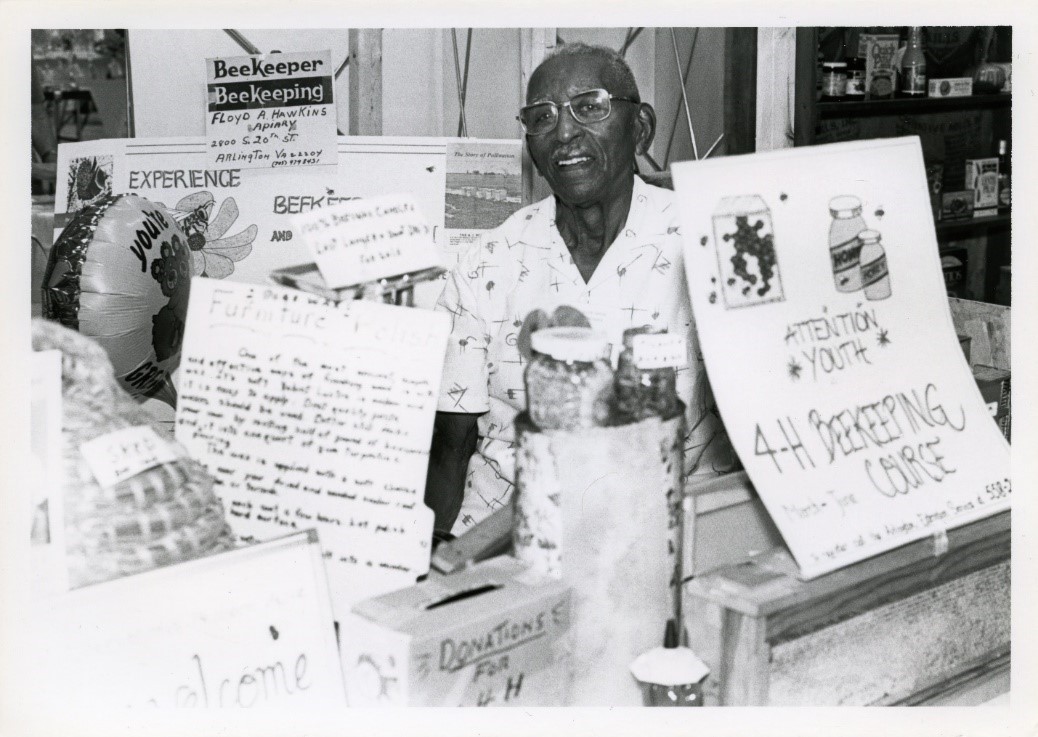
Floyd Hawkins, who at the age of 81 helped start the Arlington County Fair, and served as the Fair’s treasurer for 10 years, from 1977 to 1987.

Floyd Hawkins, who at the age of 81 helped start the Arlington County Fair, and served as the Fair’s treasurer for 10 years, from 1977 to 1987.
The Center for Local History conducted an oral history interview with Hawkins in 1986.

Harvest Day

The idea for the Fair emerged from the County’s community gardens program. Resident gardeners had been planning a Harvest Day to display the produce from the program’s 10 community garden plots. One thing led to another, and the idea expanded to involve more members of the Arlington community.

The First Arlington County Fair

The inaugural Arlington County Fair began on Friday, August 26, 1977, at the Thomas Jefferson Community Center. It started with a ribbon-cutting ceremony at noon and ended at 6 p.m. on Sunday, August 28.

It was noted at the time that Arlington's fair was the only event of this type held between Gaithersburg, MD, and Manassas, VA. It was also billed as one of the country's rare “urban fairs” – combining the elements of a traditional county fair in an urban setting. Anticipation for the Fair brewed around this melding of the new and old, as one reporter noted in an August 25, 1977 Washington Post preview:

“Where can an exceptional chrysanthemum raised on the tenth-floor balcony of the Crystal House apartment complex in Arlington receive its just due? Until this week, nowhere. However, if entered before 9 a.m. Friday it could be a blue-ribbon winner in the First Annual Arlington County Fair.”

Among the activities at the first Arlington County Fair were ribbon competitions in home arts, preserving, crafts, cake decorating, produce, flower arranging, individual flowers, paints, photography, sculpture, clothing, and baked goods. Also featured were exhibits and demonstrations of arts and crafts, as well as booths from groups such as the Arlington Office of Consumer Affairs and the Juvenile and Domestic Relations Court. The Arlington County Fair, according to Ware Page - the first chairman and a local freelancer in consulting and advertising - was designed to appeal to the diversity of Arlington’s population:

“Our fair is unique. It will reflect Arlington’s pluralistic nature. There will be religious groups, business interests, local gardeners, charity and community groups all under one roof.”

While there was a limited livestock showing at the event – two pigs, two sheep, and two goats imported from the 4-H club in Loudoun county – there was plenty of flora and fauna to go around. About 270 families were farming loaned plots established by the community garden program, and many of them participated in activities.

Like today, entrance to the first Arlington County Fair was free, and a variety of items were available for purchase among the many booths and vendors. But another important element of the typical rural fair (and today's County Fair) was missing in 1977 - a midway.
County Fair 4
County Fair 5

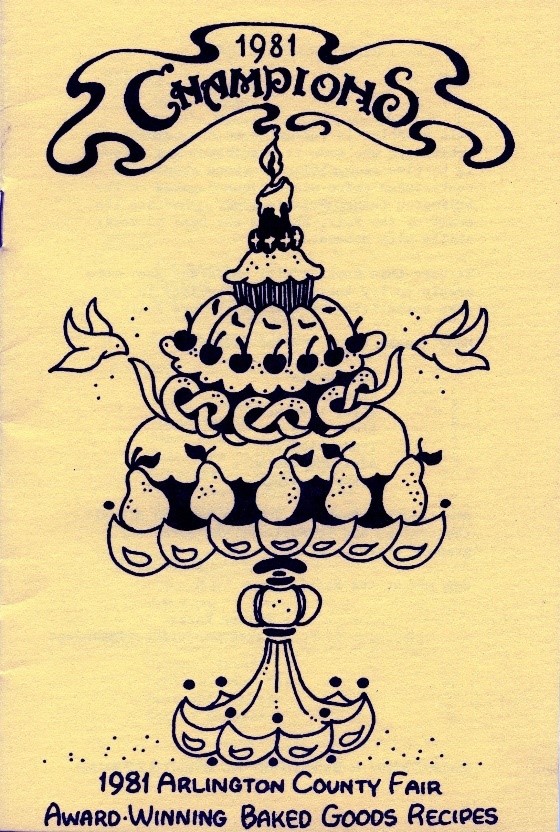
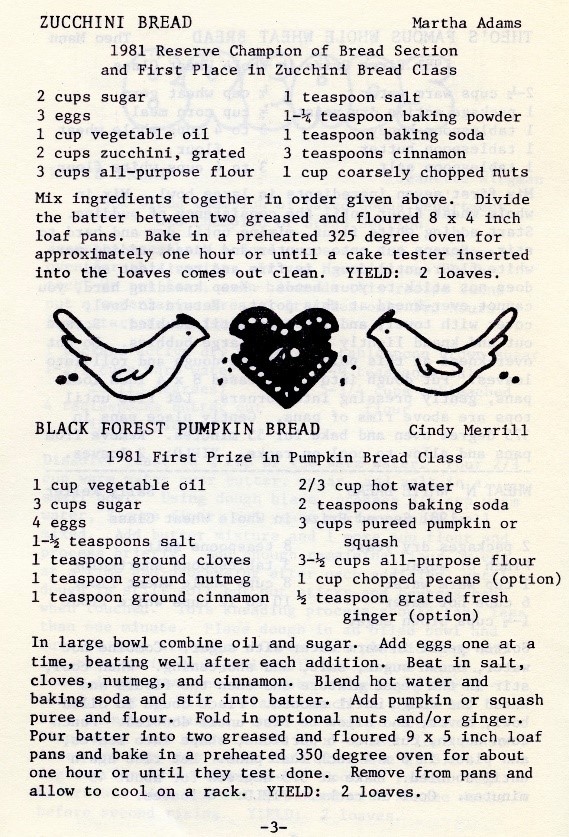
Excerpts from the compilation of winning recipes from the baked goods competition, 1981 Arlington County Fair.
County 2 Photo

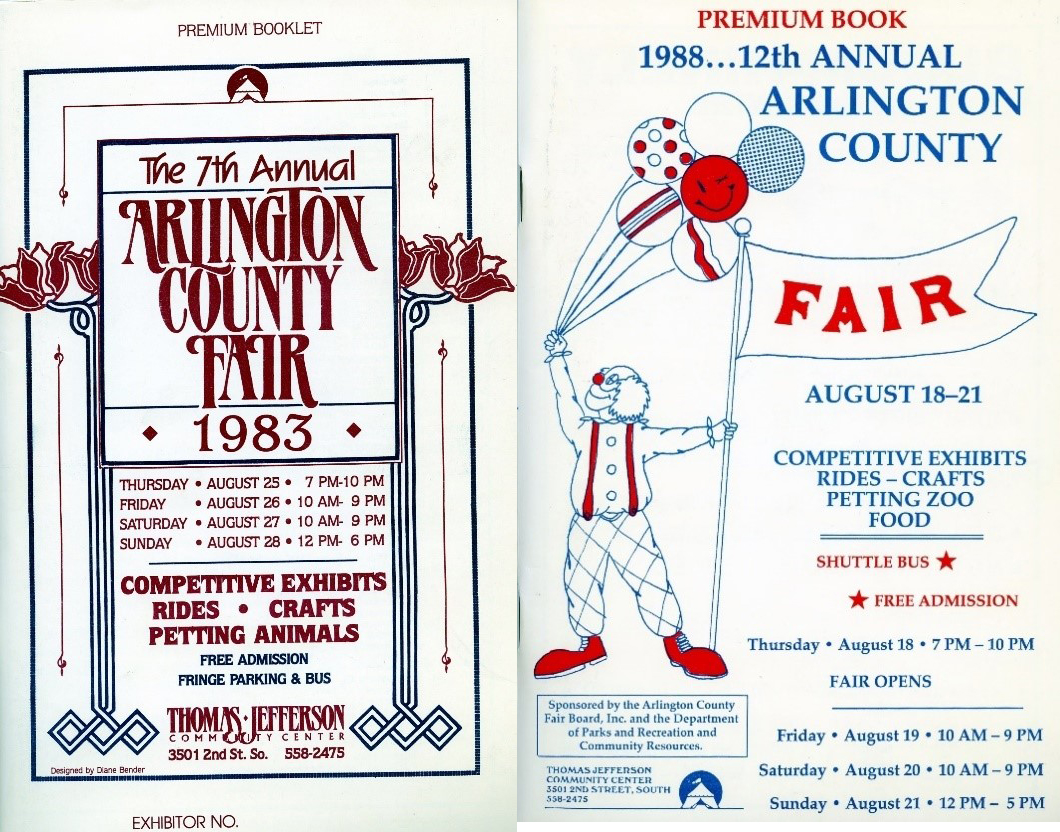
Arlington County Fair "premium booklets" from 1983 and 1988 include information about shuttle buses, competitions and schedules.

Rapid Growth in the 1980s

By 1983, only five years after the Arlington County Fair began, more than 200 booths and exhibitors were registered to exhibit over the Fair weekend. By 1984, the live entertainment boasted a diverse range of performers including a ventriloquist, the Old Dominion Cloggers, barbershop quartet music by the Arlingtones, bluegrass, jazz, big band music, and Hungarian folk songs. Karate demonstrations and aerobic dancing were also performed.

Livestock Out, Thrill Rides In

Livestock mostly ceased making any appearances after 1977, with a few exceptions (such as pony rides and racing piglets). Midway rides were added in later years.
County Fair 6

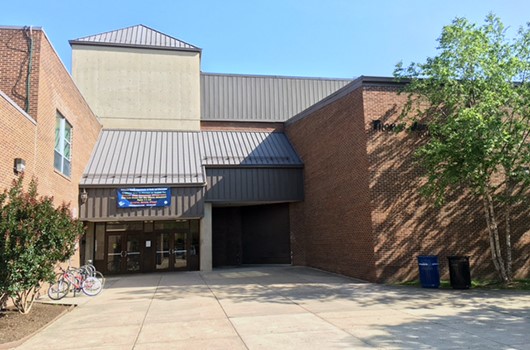
The Thomas Jefferson Community Center, where the Arlington County Fair has taken place since 1977.

"Yesterday, Today & Tomorrow"

The Arlington County Fair has become one of the largest free events on the East Coast, with attendance reaching over 84,000.

After the first few years, each County Fair has had a theme: “Arlington – Yesterday, Today & Tomorrow” (1986); “The Many Faces of Arlington” (2003); “Groovy Since 1977” (2016), which payed tribute to the County Fair’s origins, are just a few.

What will this year's theme be? We'll find out this summer when we see you at the County Fair!

To learn more about Arlington's history, visit the Center for Local History on the first floor of the Central Library.

Do you have a question about this story, or a personal experience to share? 

Use this form to send a message to the Center for Local History.

Center For Local History - Blog Post Message Form

Do you have a question about this story, or a personal experience to share? Use this form to send a message to the Center for Local History.

"*" indicates required fields
This field is for validation purposes and should be left unchanged.

Share Your Story

January 15, 2020 by Web Editor

The Library Director’s 2019 Playlist

Post Published: November 25, 2019

Forever "Too Cool for Yule"

Years ago I began creating a holiday playlist each November, known variously as “Don’t Touch that Dial,” the “Too Cool for Yule” blog, and more simply, the Director’s Playlist.

Each playlist is a collection of seasonal tunes -- from schlock (hopefully not too much of that) to rock and everything in between. By now we have managed to amass quite an eclectic set of “mix tapes.” This year is no exception.

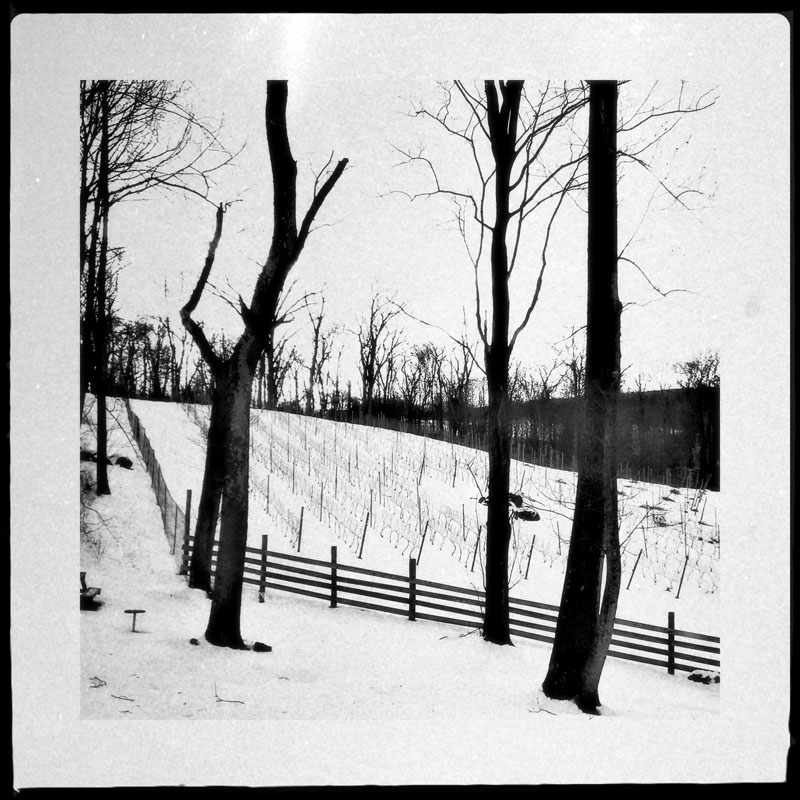
bare trees on a snowy hill next to a wood fence in winter

Before you start clicking and singing along, however, a couple of explanatory notes (pun intended) are in order:

Peter Tork (born Torkelson in 1942 in Washington, DC) died earlier this year.  Known as the keyboardist and bass player of The Monkees, Tork, along with Mickey Dolenz, Michael Nesmith and Davy Jones, formed the mid-sixties American answer to the Beatles and over the course of their career sold over 75 million records worldwide.  Not bad for a made for TV band (track 5).

Soul singer Roberta Flack (track 13) was raised in Arlington, and rose to prominence singing upstairs at Mr. Henry’s, the Capitol Hill bar and restaurant.  Established in 1966 by Henry Jaffe, within two years Jaffe hired a local school teacher to sing in the pub. “She told me that if I could give her work three nights a week, she could quit teaching,” Jaffe later recalled.  The singer, none other than Roberta Flack, would go on to win four Grammys for the songs “Killing Me Softly” and “The First Time Ever I Saw Your Face.”

I’ve closed this playlist as I did last year’s list with a song by Bob Dylan whose lyrics are as relevant today as they were when he wrote them. Released as the title track of his 1964 album of the same name, “The Times they are a Changin'” was Dylan’s attempt to create an anthem of change. Read through the lyrics and see if you agree.

The line it is drawn
The curse it is cast
The slow one now
Will later be fast
As the present now
Will later be past
The order is
Rapidly fadin'
And the first one now
Will later be last
For the times they are a-changin'.

Open playlist in Spotify

Whether you eat Chinese food and see a movie on Christmas Day, attend a church, binge watch “Mindhunter,” curl up with a good book or board game you borrowed from the library, or sit quietly with your thoughts, all of us at Arlington Public Library wish you and yours the very best.

Diane

Scrawled signature of Diane Kresh

November 25, 2019 by Web Editor Tagged With: yule blog

This Week in 19th Amendment History: National Woman’s Rights Convention

Post Published: October 22, 2019

October 23, 1850

Celebrate the 100th anniversary of the 19th Amendment with stories about the people and events that led to the passage of women’s suffrage in the United States.

On October 23, 1850, the first National Woman’s Rights Convention began in Worcester, Massachusetts. Amidst the ringing fervor of the mid-19th-century clarion call for expanding women’s rights – with the right to vote as its central tenet – this day would emerge as a significant step in solidifying the goals and action plan of the women’s suffrage movement in the United States.

Womans convention 2

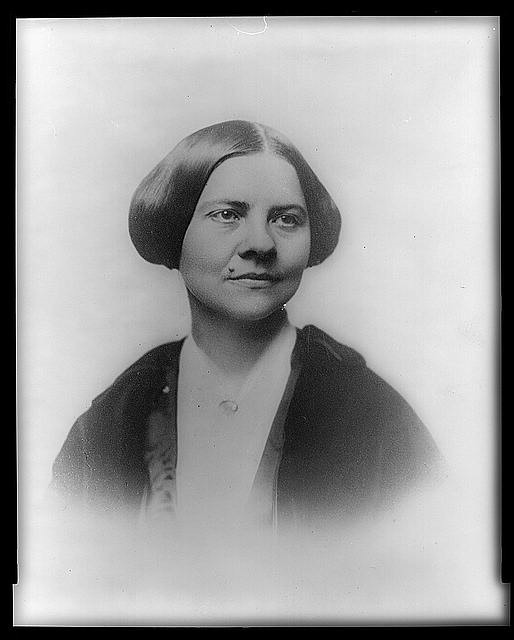
Lucy Stone, one of the Convention’s lead organizers and a speaker at the event.

Held over two days in Worcester, Massachusetts, the 1850 Woman’s Rights Convention was planned by members of the Anti-Slavery Society, among them Lucy Stone, Abby Kelley Foster, Paulina Wright Davis and Harriot Kezia Hunt.

Davis – a New York suffrage advocate who helped petition for the passage of the Married Women’s Property Act of 1848 – would later be elected president of the convention during the event’s proceedings.

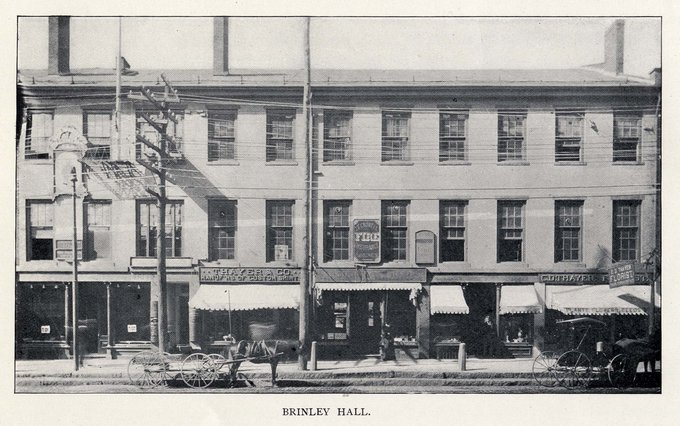
More than 1,000 delegates from 11 states gathered in Worcester’s Brinley Hall for numerous speeches on topics ranging from the right to vote, owning property, and women’s admittance to the fields of higher education, medicine, and the ministry.

Brinley Hall Postcard

Brinley Hall, Worcester, MA, where the National Woman’s Convention was held in 1850 and 1851. Photo from the Massachusetts State Library.

Among the convention’s attendees were Frederick Douglass, William Lloyd Garrison, and Sojourner Truth. Truth and many other prominent suffragists, including Ernestine Rose, Antoinette Brown and Lucretia Mott, delivered speeches over the course of the convention.

The press was largely derisive in its reporting on the convention. The New York Herald, for instance, attacked the speakers’ appearances and portrayed the attendees' demands as ridiculous, framing the convention in their headlines as an “Awful combination of socialism, abolitionism and infidelity. The Pantalettes striking for the Pantaloons. Bible and Constitution Repudiated.”

In a satirical take, the newspaper reported that the Woman’s Rights Convention organizers aimed to:

  1. abolish the Bible
  2. abolish the constitution and the laws of the land
  3. reorganize society upon a social platform of perfect equality in all things, of sexes and colors
  4. establish the most free and miscellaneous amalgamation of sexes and colors
  5. elect Abby Kelley Foster President of the United States and Lucretia Mott Commander-in-chief-of the Army
  6. cut throats ad libitum
  7. abolish the gallows

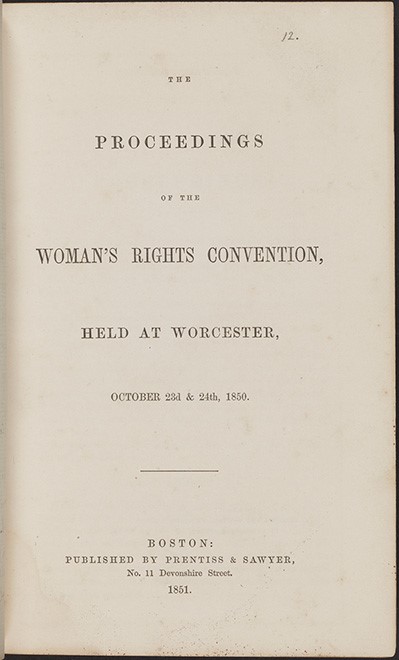
In some ways, this condescending portrayal helped expand the notoriety and message of the convention. The convention’s proceedings were recorded and sold after the event as pamphlets, gaining international readers and recognition.

Womans convention 1

The Proceedings of the Woman’s Rights Convention, held at Worcester, October 23d & 24th, 1850. Boston: Prentiss & Sawyer, 1851. Source: NAWSA Collection, Rare Book and Special Collections Division, Library of Congress (014.00.00)

The British writer and women’s rights advocate Harriet Taylor Mill was significantly inspired by the events of the convention, referencing the organizer’s work in her 1851 piece “The Enfranchisement of Women.”

The 1850 convention would be the first of many national events that would occur annually from this point forward for about a decade, setting a precedent for national suffrage organizing.

The twelfth and final Woman’s Rights Convention would be held in 1869 in Washington, D.C. This would be the last meeting of an organized suffrage front: later in 1869, the movement would split into two groups, divided by the issue of suffrage for other disenfranchised populations.

Under the leadership of Elizabeth Cady Stanton and Susan B. Anthony, the National Woman Suffrage Association directly opposed the 14th and 15th Amendments that would have allowed for African-American men to vote. Lucy Stone and others would go on to form the American Woman Suffrage Association, which supported the 15th Amendment. The suffrage movement would not see widespread unification again until 1890 with the establishment of the National American Woman Suffrage Association, bringing together Stanton, Anthony, Stone, Howe and other suffrage leaders, including Alice Paul and Mary Church Terrell. The group would hold its first convention in 1890 in Washington, D.C.

The 1850 National Woman’s Suffrage Convention represents a historic moment in the suffrage cause, on both scale and in terms of what resulted from the meeting. Although large suffrage conventions had been held in the past – most notably, the 1848 Seneca Falls Convention in New York -- this was the first time a convention of its sort was held on a national level.

This event set an organizing precedent within the suffrage movement for decades to come.

Learn more in “Women’s Suffrage in America: An Eyewitness History” by Elizabeth Frost-Knappman and Kathryn Cullen-DuPont, available at the Library.

2020 marked the centennial of women’s suffrage in the United States. 

October 22, 2019 by Web Editor

Oral History: Presidential Sightings

Post Published: October 9, 2019

Interview with Captain Carl Porter

Arlington Voices the Oral History Collection

Oral histories are used to understand historical events, actors, and movements from the point of view of real people’s personal experiences.

Carl Washburn Porter, a retired Navy captain and veteran of both world wars, lived in Arlington for most of his life.

Porter’s father worked in construction in the area during the early 20th century and Carl worked alongside his father during the summers, often using a horse-drawn wagon to bring construction supplies to job sites throughout the county.

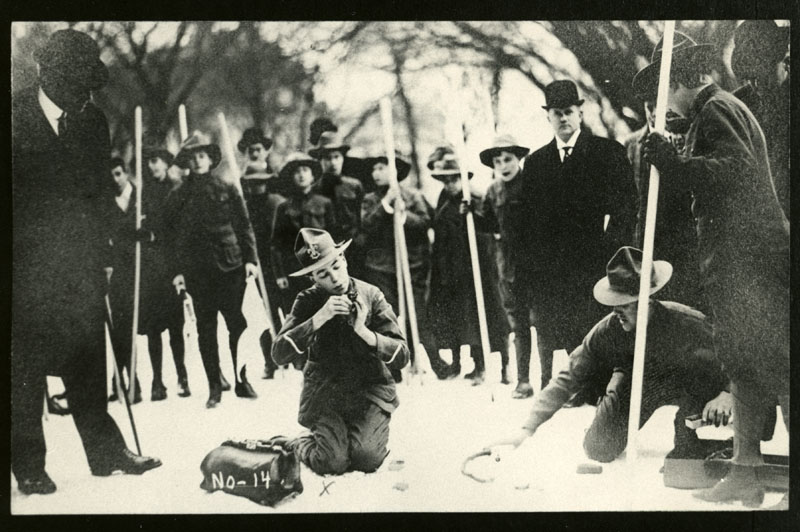
Young Carl Porter kneels in front of a row a Scouts to demonstrate fire building

Carl Porter as Boy Scout, c. 1909. Porter was a member of Troop #1, one of the first Boy Scout troops organized in the United States.

On more than one occasion during his childhood, Porter saw some famous faces in his travels around the area. Porter and his father even met President Wilson when their car broke down on Lee Highway! Porter shares that story, and other tales of Presidential sightings, in the following audio clip:

Narrator: Captain Carl Porter
Interviewer: Arthur W. True
Date: March 5, 1975

CP: While I am speaking of this, I also remember another time that my dad was going up Lee Highway (above Cherrydale) and we had a flat tire; and this was not uncommon in those days. And Dad had pulled over to the far side of the road and just started to work on the car, when another car pulled up behind. Someone got out and walked over, and it was – again, it was President Wilson, who was probably on his way up to the Golf Club – and stopped and asked if they could be of any help in fixing the tire. It shows how times have changed.

While I am mentioning this, I also recall that Theodore Roosevelt (a number of years before that), when he was President, he used to walk around the area between the White House and the Ellipse and Lafayette Park; and I remember seeing him standing out on the street in from of the old Boy’s YMCA on G Street, between 17th and 18th Street, with derby hat, frock coat, and pince-nez glasses. I remember his sons, approximately the same age as my brother and me – they attended Friends School in Washington – but they were, of course, just the same as any other boys: they liked to play baseball and whatnot; and when they went into the White House, they wouldn’t hesitate to barge in the front door and yell, “Ma, where is my baseball glove?” or something like that – any more than youngsters do that we are familiar with, or as we did ourselves.

Porter died in 1989, at age 92. You can find his oral history interview in its entirety in the Center for Local History - VA 975.5295 A7243oh ser.2 no.23.

Photo: Carl Porter, Boy Scout Troop #1, c. 1909.

The goal of the Arlington Voices project is to showcase the Center for Local History’s oral history collection in a publicly accessible and shareable way.

The Arlington Public Library began collecting oral histories of long-time residents in the 1970s, and since then the scope of the collection has expanded to capture the diverse voices of Arlington’s community. In 2016, staff members and volunteers recorded many additional hours of interviews, building the collection to 575 catalogued oral histories.

To browse our list of narrators indexed by interview subject, check out our community archive. To read a full transcript of an interview, visit the Center for Local History located at Central Library.

October 9, 2019 by Web Editor

Oral History: H-B Woodlawn Beginnings

Post Published: September 25, 2019

Arlington Voices the Oral History Collection

Interview with Ray Anderson, H-B Woodlawn Principal

It’s back-to-school season, so we're sharing a segment from a recent oral history recorded with Ray Anderson, former principal of the H-B Woodlawn Secondary Program.

H-B, as it’s commonly known, started in 1971 and spent almost fifty years on Vacation Lane in Cherrydale. This year the H-B Woodlawn Secondary Program moved to an entirely new building in Rosslyn to accommodate the growing number of students who want to attend the school.

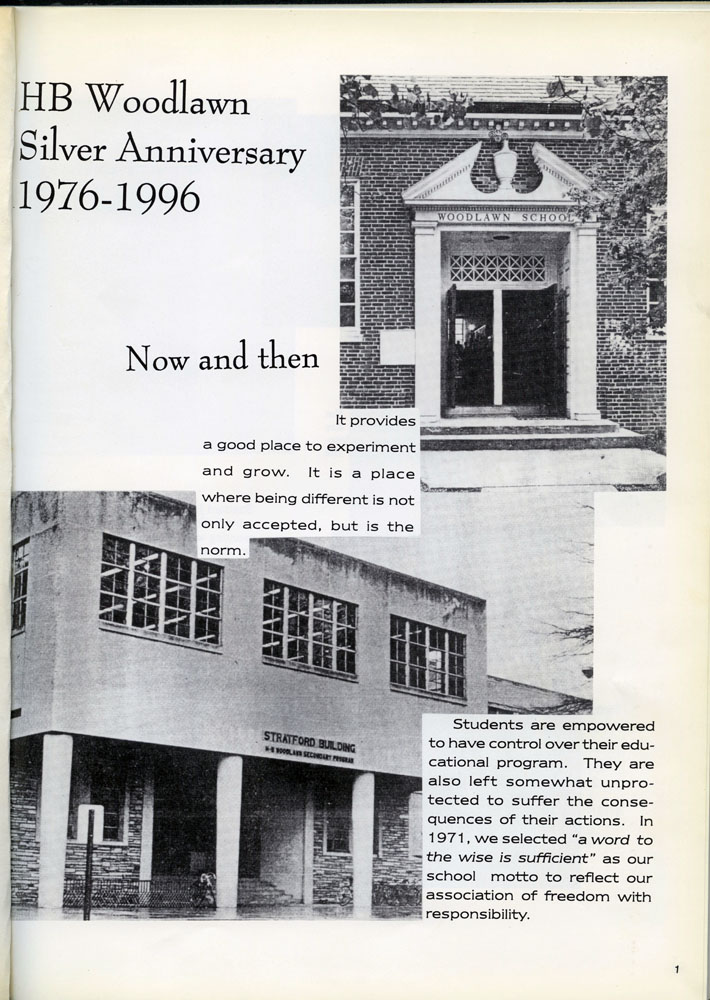
The photo caption from the 1996 H-B Woodlawn yearbook reads, "It provides a good place to experiment and grow. It is a place where being different is not only accepted, but is the norm."

We wish all Arlington students and teachers a good start to the school year!

hbwoodlawn_anderson_yearbook

1996 H.B. Woodlawn yearbook, page 1.

Narrator: Ray Anderson
Interviewer: Emily Curley
Date: January 23, 2019

RA: I decided I—conventional school was too conventional for me and I was lucky enough to write up an idea, after two years, for a separate school. And in fact, I have the memo I wrote with me and in January of 1971, I commented on the racial, economic and social diversity of Arlington [0:07:00] and conditions in the schools and particularly at Wakefield. I made some recommendations about Wakefield and the last half of my memo started, “I recommend a system of rigid and closely supervised discipline.” Wow. Okay? “Since many of our present students and faculty will find that such system inhibits the learning process for them, I further recommend the establishment of a new high school in Arlington.” And then I go on for a couple of pages on what that would be.

It got passed around in Arlington, people wrote me notes and stuff like that. By March of ’71—because this is all reflecting the times, right?—the school board was having a hearing because they had three elementary schools they were closing to open the new Glebe School and they were closing Woodlawn, Langston, and Lee. Lee is now an art center on Lee Highway. Langston is still in the school system and used for educational purposes and a community center as well. And Woodlawn is now the hospice.

So I went to the school board and I gave them this memo, which is entitled, “A Proposal for an Experimental Free High School to be Created by the Arlington County School Board.” And it’s three pages long. That was kind of interesting but I didn’t expect anything to happen.

You can find Ray Anderson's interview in its entirety in the Center for Local History - VA 975.5295 A7243oh ser.3 no.425. Photo: 1996 H.B. Woodlawn yearbook, page 1. Call number: VA/X371.805 H431y 1996. Cover photo: Community Archives, Arlington Structures and Places, 1996-2006, H.B. Woodlawn, 1996, Object 933.

You can learn more about the history of H-B Woodlawn, including the new building in Rosslyn, on the H-B Woodlawn Secondary School website.

September 25, 2019 by Web Editor

Remembering September 11: Cards for Firefighters

Post Published: September 10, 2019

Eighteen years ago, children from around the country showed their support for Arlington's first responders with homemade cards filled with drawings and words of encouragement.

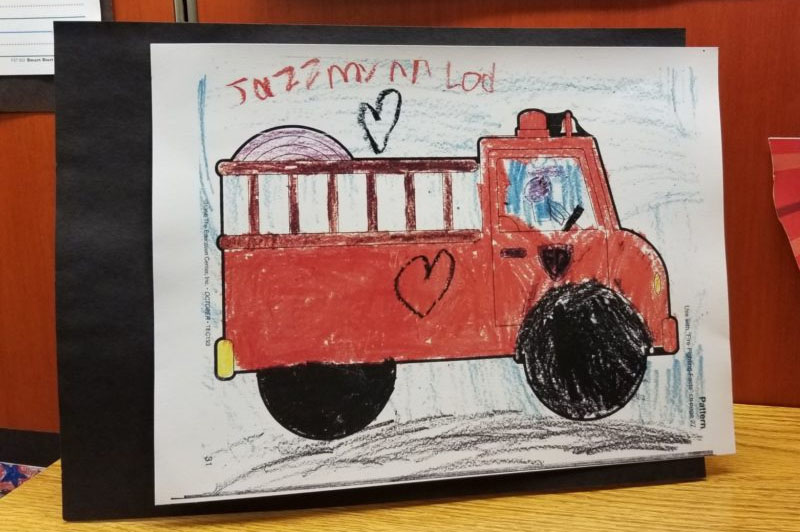
drawing of a firetruck with a heart

Drawing of a red firetruck with heart on the side; child's card from the Center for Local History Community Archives.

On September 11, 2001, terrorists hijacked a west coast-bound plane taking off from nearby Dulles Airport and crashed it into the Pentagon. Within minutes of the attack, firefighters and first responders from Arlington County, Fort Myer, and Reagan National Airport arrived at the scene. Arlington County Fire Department took the lead, establishing an Incident Command System (ICS) across the Washington-metro region to respond to the emergency. Firefighters managed to get the fire under control on the first day, but it took three days to fully extinguish the fire, and reach, as Arlington County Fire Chief Edward Plaugher described it, “the heart of the crash site.”

In total, 189 people died in the attack on the Pentagon, including the 64 passengers and crew on Flight 77.

These attacks devastated our community, but support flowed in to Arlington from around the nation. Children from across the country—from as far as Washington state to as close as Arlington, VA—sent homemade thank you cards to the Arlington County Fire Department in appreciation of their efforts to fight the fire and rescue survivors.

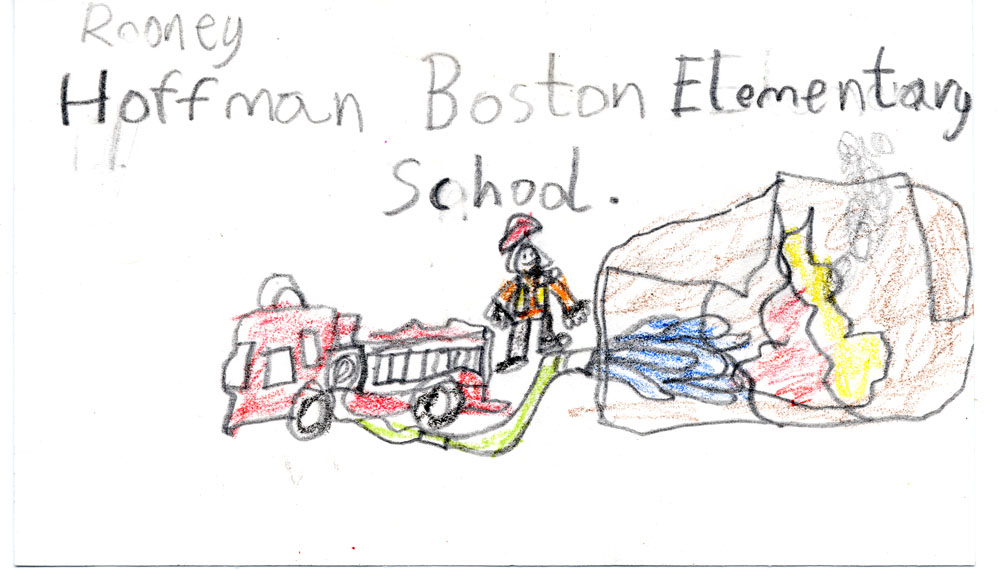
Drawing of firefighter putting out a fire at the Pentagon

Drawing of firefighter using a water-hose from firetruck to put out a fire from a burning building; child's card from the Center for Local History Community Archives.

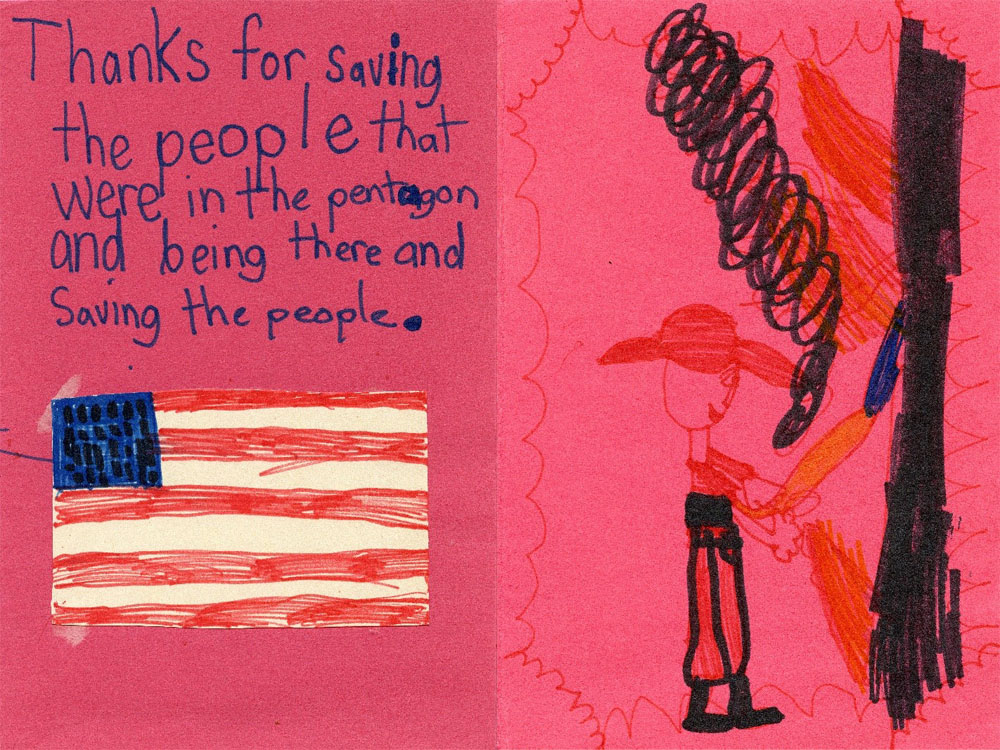
The card pictured below, from a child not named, features an American flag and a firefighter putting out a fire. The child thanks the firefighters for saving lives and being there for the people at the Pentagon. This is a theme for almost all of the cards.

folded card on red construction paper

Child's card from the Center for Local History Community Archives.

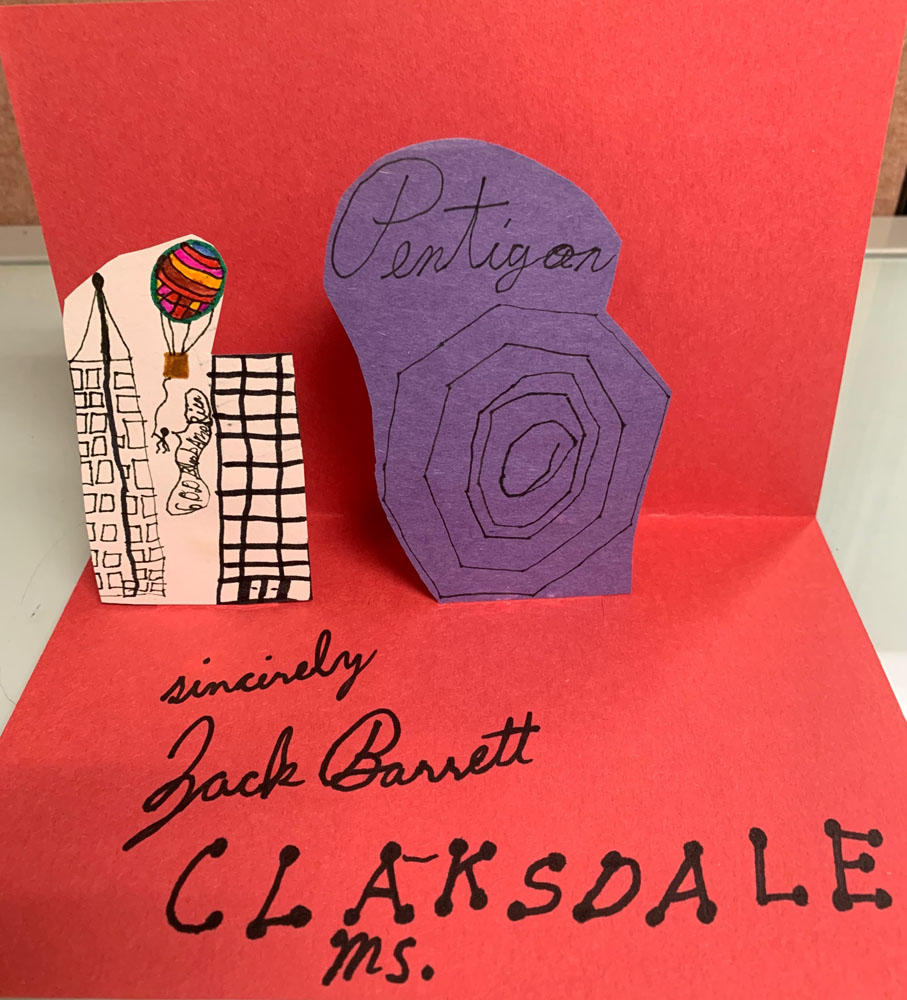
Zack Barrett made a pop-up card thanking the firefighters for keeping our nation running.

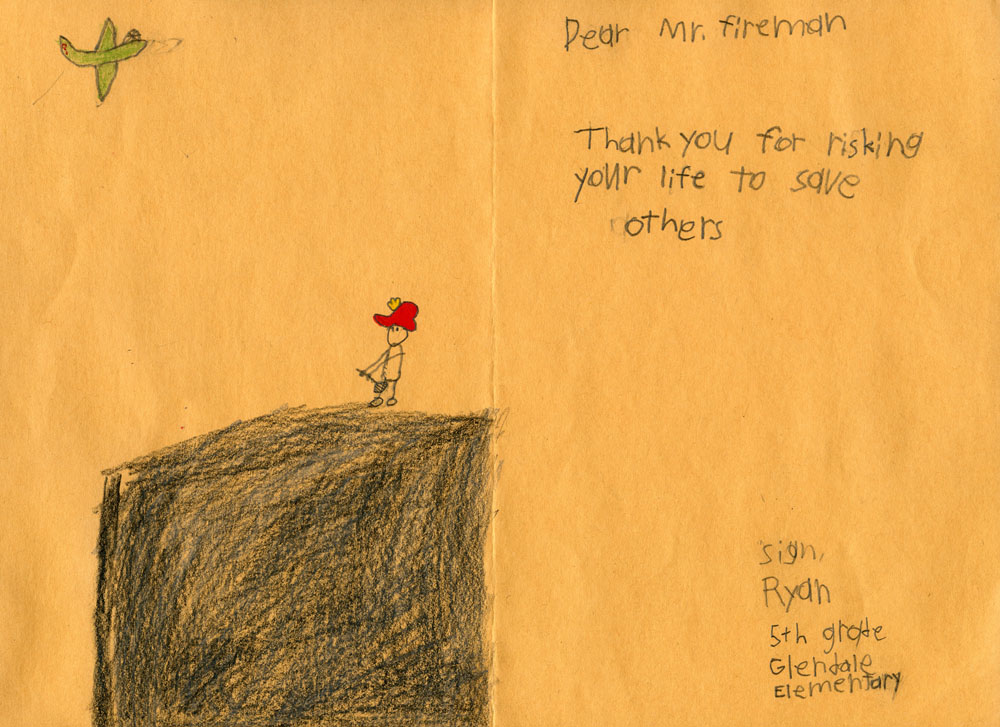
5th grader Ryan drew a picture of a firefighter on top of a building, and thanked them for risking their lives.

Pop-up card of the Pentagon
Drawing of a firefighter standing on a building

Children's cards from the Center for Local History Community Archives.

These, and the hundreds of other unsolicited drawings and letters sent to the Arlington County Fire Department, are preserved in the Community Archive at the Center for Local History.

Some of the young artists and writers no doubt have children of their own today, but the emotions remain as fresh and powerful as the day they were put on paper and mailed from places like Renton, WA, Toledo, OH, Clarksdale, MS - and more locally Ashburn, VA and Washington DC.

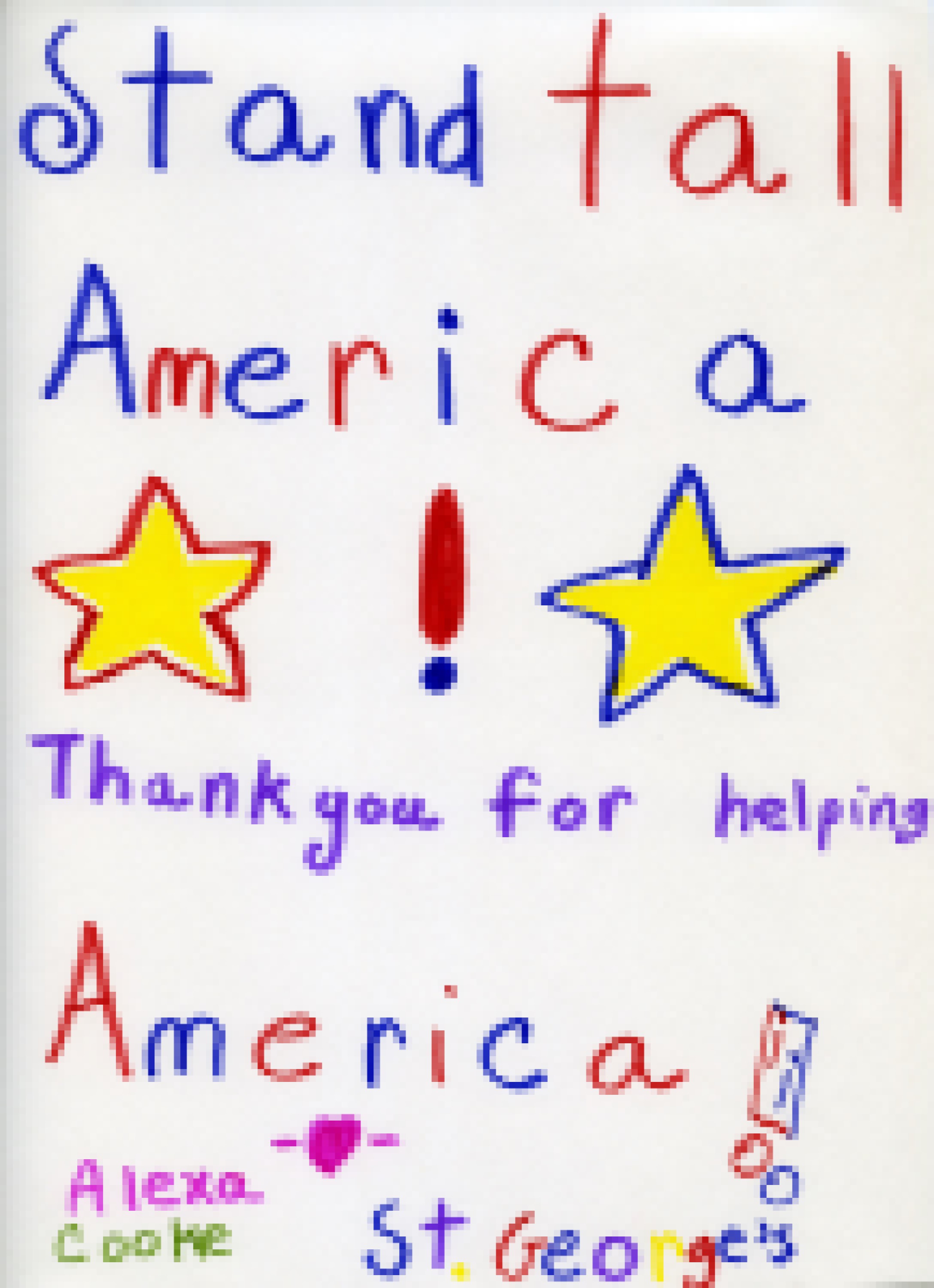
Stand Tall America

Child's card with two yellow stars and an exclamation point that says "Stand tall America! Thank you for helping." From the Center for Local History Community Archives.

Read a detailed account of the Arlington County Fire Department emergency response to the attack on the Pentagon in the blog post, "Attack on the Pentagon - Sept. 11, 2001," published Friday, March 18, 2005 by Arlington Fire Journal & Metro D.C. Fire History.

Listen to oral history interviews with first responders and Arlingtonians about their experiences on Sept. 11, 2001, and the days that followed.

To see more of the Children's Cards, or to learn more about Arlington's history, visit the Center for Local History on the first floor of the Central Library.

Do you have a question about this story, or a personal experience to share? 

Use this form to send a message to the Center for Local History.

Center For Local History - Blog Post Message Form

Do you have a question about this story, or a personal experience to share? Use this form to send a message to the Center for Local History.

"*" indicates required fields

This field is for validation purposes and should be left unchanged.

Share Your Story

September 10, 2019 by Web Editor

The Great Northern Virginia Elephant Hunt

Post Published: August 22, 2019

The year was 1906. The place, Northern Virginia. If you were standing outside on August 21, you might have seen four enormous grey animals with extremely long noses gallop past, destroying buildings and crops between Arlington and Fairfax County. This might also have been your first sighting of an elephant on the loose.

“Barlow’s Elephants” was an animal act featured at the Luna Park amusement park, in Arlington. The four elephants, Annie, Jennie, Queenie, and Tommie, were part of a very popular traveling show that arrived at Luna Park on August 20, 1906.

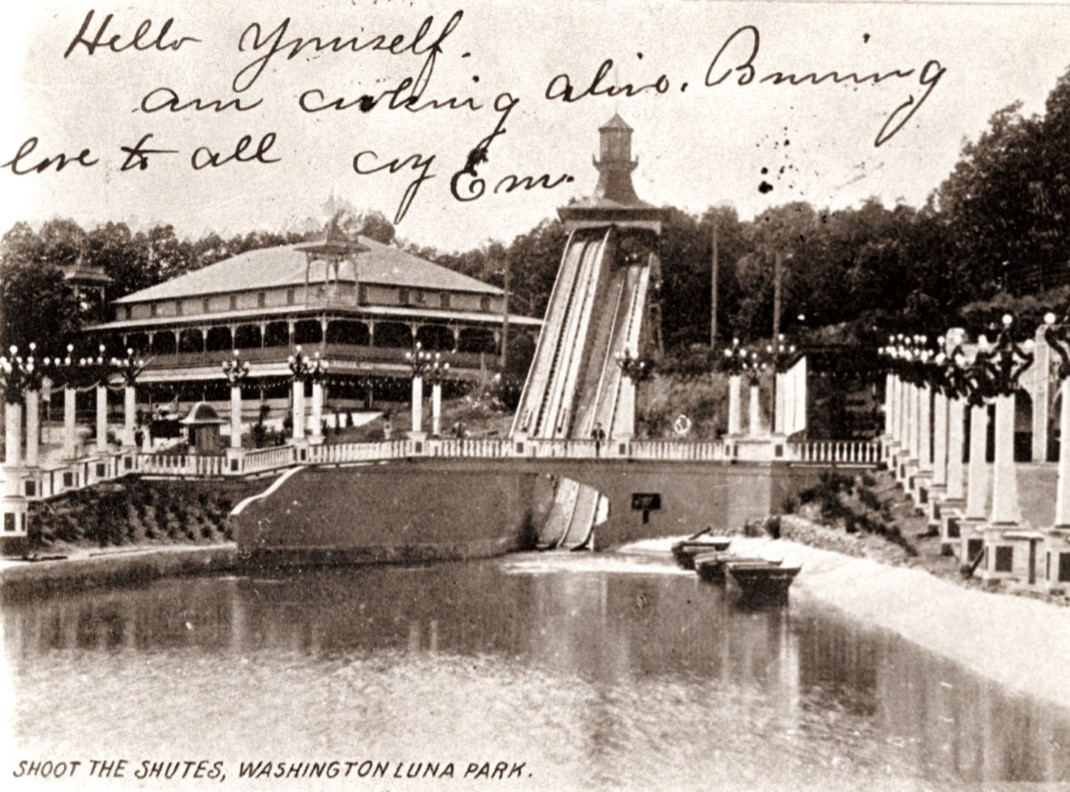
Postcard of Luna Park

Postcard of Shoot the Shutes water amusement at Luna Park. Hand written text might read: "Hello yourself. Am cooking alive. Burning love to all"

The next day, the four elephants escaped from their quarters. Deciding to take matters in their own trunks, they began a tour of the local area. Annie was corralled quickly before she could make a full escape, but Jennie, Queenie, and Tommie remained at large for more than a week.

Peter Barlow, head trainer of “Barlow’s Elephants,” could not catch up with the elephant herd after capturing Annie. So he posted a reward of $500 for the capture of any of the runaways. This inspired the Washington Post to write a short poem in their honor:

“Four little elephants, chained in a row,
They break loose and away they go;
Keepers call it serious “Biz,”
And pachyderm price has surely “Riz.”

A few locals attempted to round up the elephants on their own but were unsuccessful.

Barlow and his crew eventually captured Tommie in Fairfax County, and after eight days, and with help, all four elephants were finally rounded up. The elephants were then loaded on a freight train at Burke Station, and returned safely to Coney Island.

Although we, unfortunately, have no photographs of Annie, Jennie, Queenie or Tommie, we do have images of Luna Park (seen above).

Arlington's Luna Park opened in the summer of 1906 to much fanfare and served as a fun escape for local adults and children for almost a decade. The park stretched along Four Mile Run on South Glebe Road and South Eads Street, covering nearly forty acres (the County’s water pollution plant now occupies this land). Although most of this land was devoted to picnic and playground areas, ten-acres were dedicated to amusement rides, a dance hall, a roller rink, a movie theater, and of course, a space for elephant and other circus animal acts.

To see more items relating to the elephant hunt, visit the Center for Local History on the first floor of the Central Library.

Do you have a question about this story, or a personal experience to share?

Use this form to send a message to the Center for Local History.

Center For Local History - Blog Post Message Form

Do you have a question about this story, or a personal experience to share? Use this form to send a message to the Center for Local History.

"*" indicates required fields
This field is for validation purposes and should be left unchanged.

Share Your Story

August 22, 2019 by Web Editor

Rediscover Grace Murray Hopper

Post Published: August 19, 2019

Mathematician, Navy Veteran, Arlington Resident

Grace Murray Hopper broke down gender barriers throughout her career in the emerging field of computer science.

Ironically, her many accolades even included being named the first computer science "Man of the Year" in 1969 by the Data Processing Management Association.

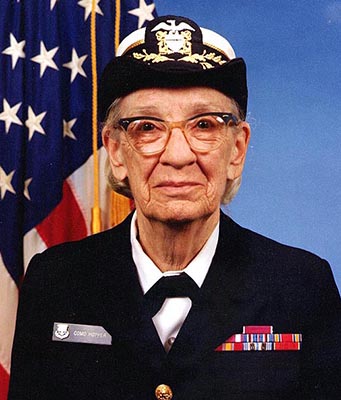
Grace_Hopper

Grace Hopper 1984 - US Government Public Domain

Born in 1906, in New York City, Grace Murray Hopper, nee Grace Brewster Murray was raised in a time most when women were expected to not pursue careers. After the Great Depression employed women were perceived as taking jobs from men deemed to have a greater need to support their families.

However Grace Brewster Murray was raised in a family where education mattered. Murray attended Vassar College for her undergraduate degree in mathematics and physics. She completed her master’s and doctoral degrees in mathematics at Yale in 1930 and 1934, respectively, while continuing to teach at Vassar. Between 1934 and 1937, Yale awarded only seven doctorates in mathematics, and only one to a woman, Murray.

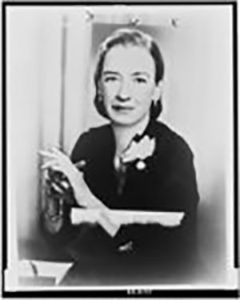
Grace Hopper LOC (002) Resize

Image courtesy of the Library of Congress

Hopper, as she was then known (she married in 1930 and divorced in 1945 but kept her married name for the remainder of her life) taught until 1943 when she felt that she should enlist in the military to support the war effort.

During World War I, women were accepted into the Navy as Yeomen (F), which was the first time women were allowed into the armed forces as anything but nurses. Navy enlistment was once again opened to women in 1942 via the women’s auxiliary WAVES unit (Women Appointed for Voluntary Emergency Service). The Rear Admiral who presented the idea to the Senate stated they expected enlistment “will probably go up around 10,000 before we get through with it,” clearly not expecting the almost 100,000 women who served in the Navy before the end of World War II.

Hopper was accepted on her second enlistment attempt and she graduated at the top of her WAVES class after a 60-day officer training. Gender bias was evident, however, as Hopper received a commission that read “I do hereby appoint him a Lieutenant (junior grade) of the U.S. Naval Reserve.”

When Hopper reported to the Navy Liaison Office at Harvard in 1944, she did not expect to be given only one week to comprehend the workings of the Mark 1 computer. Fortunately, Hopper’s lifelong interest in many disciplines and deep understanding of mathematics provided her the foundation to quickly interpret the groundbreaking technology.

While working on the Mark II computer in 1947, Hopper and her team found a moth inside the inner workings of the machine, which had prevented the relay from operating. Although at the time they did not use the term ‘debugging,’ to describe the incident, this anecdote has been widely used to source the phrase. The remains of the moth are preserved safely inside the group’s log book at the Smithsonian Institution.

In 1949, Hopper entered the private sector to work on the UNIVAC I commercial computer, but remained in the Naval Reserve. The UNIVAC I required original work on a compiler system that would convert one programming language into another. FLOW-MATIC was developed for the UNIVAC system, and via the CODASYL (Committee on Data Systems Language) consortium, Hopper developed COBOL (Common Business-Oriented Language) which was adopted by the Department of Defense and standardized in the 1960s.

Hopper remained in the Naval Reserve after she entered the private sector in 1949 to work on the UNIVAC I commercial computer. Here, she began original work on a compiler system that would convert one programming language into another. FLOW-MATIC was developed for the UNIVAC system, and via the CODASYL (Committee on Data Systems Language) consortium, Hopper developed COBOL (Common Business-Oriented Language) which was adopted by the Department of Defense and standardized in the 1960s.

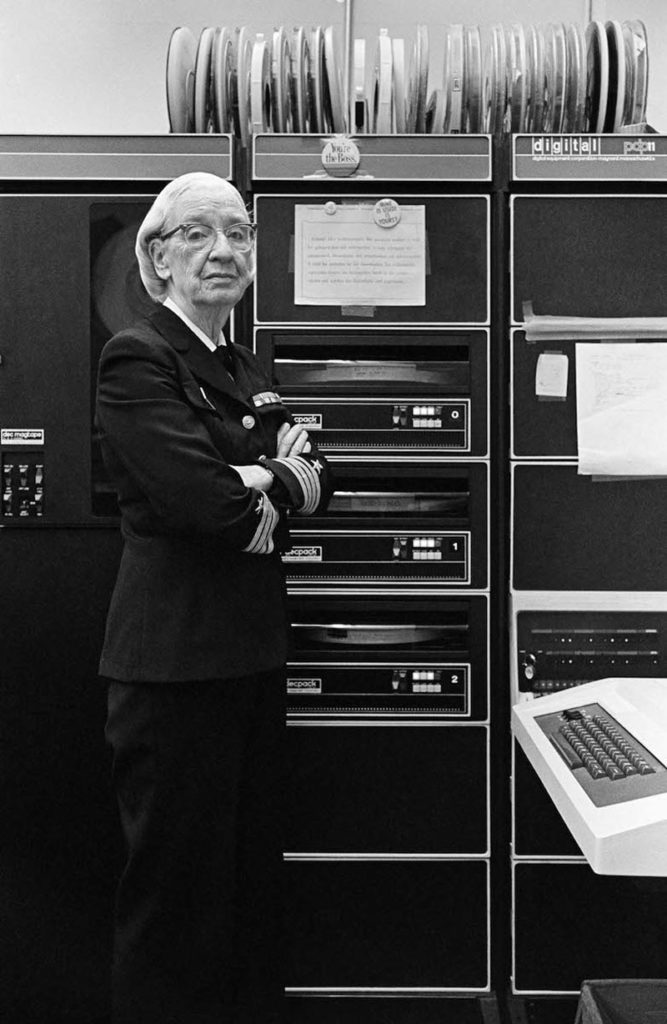
Grace_Murray_Hopper_in_her_office_in_Washington_DC_1978_Lynn_Gilbert

Image courtesy of Lynn Gilbert copyright 1978

Although Hopper attempted to retire from the Naval Reserve as a Commander in 1966, she was recalled to active duty in 1967 and served as the director of the Navy Programming Languages Group as a Captain. Hopper retired a second time in 1971 but was recalled to active duty once again. She was promoted to Commodore, later renamed ‘Rear Admiral (Lower Half),’ making her one of very few female admirals.

Hopper had a passion for collecting, filling three apartments in RiverHouse in Pentagon City with the objects she treasured throughout her extensive travels and career. Six years after her final retirement, Grace Murray Hopper died at her home in RiverHouse on New Year’s Day, 1992. She was buried at Arlington National Cemetery with full military honors and posthumously received the Presidential Medal of Freedom in 2016, one of many military awards she received during her life. Her other awards include the World War II Victory medal, the Defense Distinguished Service medal, two National Defense Service medals and three Armed Forced Reserve medals.

Her biographer, Kathleen Williams, describes her as a person with “an intense focus, a tireless dedication, and an irrepressible urge to innovate.” In addition to her many honorary degrees, titles and accolades, the largest gathering for women in computing is named in her honor, with more than 15,000 women attending each year. Arlington County maintains a park on the grounds of RiverHouse in her honor.

References

Billings, C. W. (1989). Grace Hopper, Navy Admiral & Computer Pioneer. Hillfield, NJ: Enslow.

Grace Murray Hopper (1906-1992): A legacy of innovation and service. (2017, February 27). Retrieved from https://news.yale.edu/2017/02/10/grace-murray-hopper-1906-1992-legacy-innovation-and-service

Lee, J. (n.d.). Grace Brewster Murray Hopper. Retrieved from https://history.computer.org/pioneers/hopper.html

Learn More

“Grace Hopper: Admiral of the Cyber Sea” by Kathleen Williams in Library of Naval Biography, Naval Institute Press, 2012.

“Grace Hopper: Queen of Computer Code” by Laurie Wallmark

“Grace Hopper and the Invention of the Information Age” by Kurt Beyer

Watch a popular video of Grace Hopper lecturing at MIT: https://www.youtube.com/watch?v=ZR0ujwlvbkQ

"Preservation Today: Rediscovering Arlington" is a partnership between the Arlington Public Library and the Arlington County Historic Preservation Program.

Preservation Today: Rediscovering Arlington
Stories from Arlington’s Historic Preservation Program

Arlington’s heritage is a diverse fabric, where people, places, and moments are knitted together into the physical and social landscape of the County.

Arlington County’s Historic Preservation Program is dedicated to protecting this heritage and inspiring placemaking by uncovering and recognizing all these elements in Arlington’s history.

To learn more about historic sites in Arlington, visit the Arlington County Historic Preservation Program.

August 19, 2019 by Web Editor

Putt-Putt Golf Courses

Post Published: July 11, 2019

Mini-golf attracted visitors from across the region to Arlington for over 50 years.

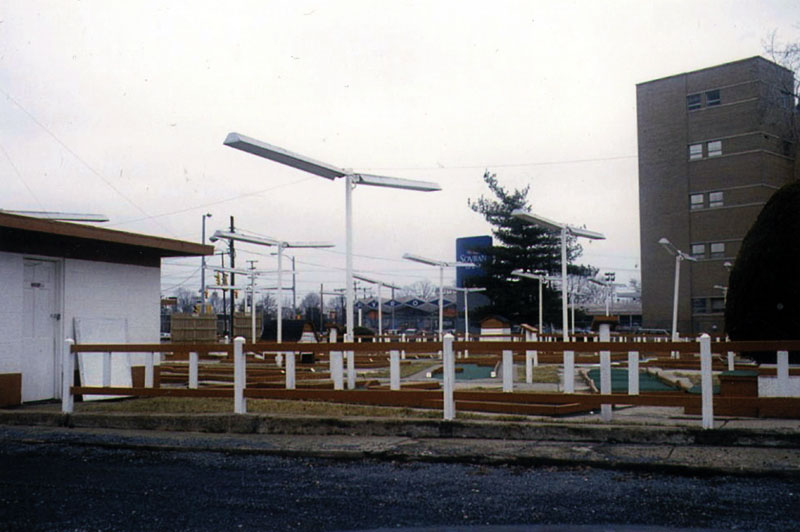
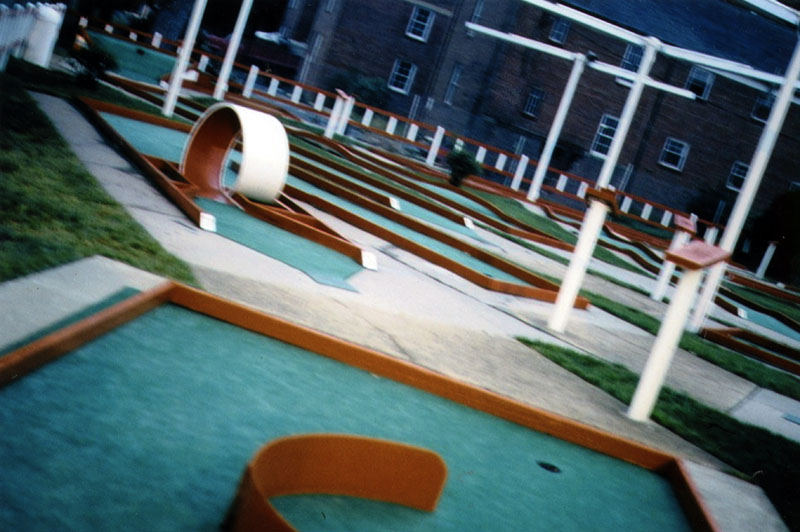
put-put golf course wide view
Putt-putt golf course
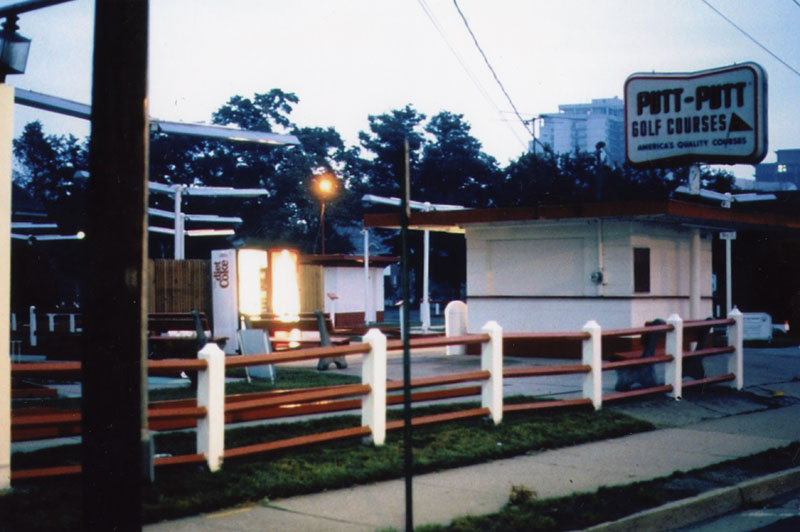
putt-putt-golf course close up

In 1930, Robert P. Balinger opened a miniature golf course on Wilson Blvd. in Ballston. 30 years later, it was replaced by the 36-hole course pictured above.

When Putt-Putt Golf Courses closed for good in 1989, making way for Ballston’s rapid high-rise development, many mourned its loss as a fun, multi-generational activity and hoped it would relocate elsewhere in Arlington.

Unfortunately, the Putt-Putt Golf Courses never found a new home in Arlington, but its memory lives on. Now Arlington putt-putt lovers can go to Upton Hill Park for mini-golf, or sometimes find pop-up mini golf courses like the one in Rosslyn this summer.

Looking for an extra glimpse of Arlington history? In the background of the first image, you can catch a glimpse of Bob Peck Chevrolet, an iconic Arlington landmark from 1964-2008.

To see more items like these, or to learn more about Arlington's history, visit the Center for Local History on the first floor of the Central Library.

Do you have a question about this story, or a personal experience to share? 

Use this form to send a message to the Center for Local History.

Center For Local History - Blog Post Message Form

Do you have a question about this story, or a personal experience to share? Use this form to send a message to the Center for Local History.

"*" indicates required fields
This field is for validation purposes and should be left unchanged.

Share Your Story

July 11, 2019 by Web Editor

What Arlington Treasures Are Hiding In Your Attic or Filing Cabinet?

Post Published: July 10, 2019

Contribute to the Community Archive

Donate your papers and photos to the Center for Local History and help to tell Arlington's story!

Students looking at an old yearbook from the Center for Local History archive
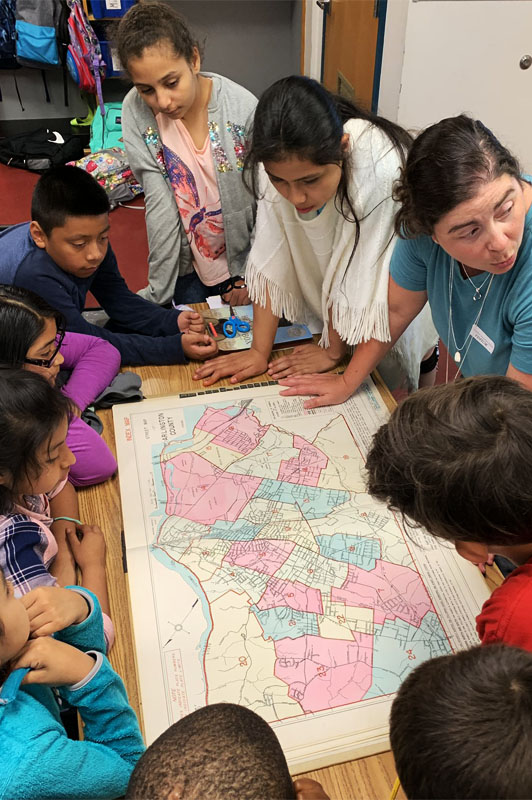
Students looking at a map from the Center for Local History archive

Center for Local History Archivist Heather shows an Arlington yearbook and a 1935 Franklin Property Atlas to a class of 4th graders at Barrett Elementary School.

During Pride Month, we had hoped to share a story from our archive relating to Arlington's LGBTQIA+ community and history. Unfortunately, we were unable to do so because our collection currently has a shortage of materials related to these topics.

We'd love to fix this gap, and many others, so that we may continue to fulfill our mission to document all of Arlington's diverse community. If you have photos, newsletters, flyers, and/or other materials (physical or digital) related to untold Arlington County history - LGBTQIA+ or anything else - we'd love to add it to the Community Archive.

To donate, visit the Center for Local History at Central Library, call us at 703-228-5966, or email us at localhistory@arlingtonva.us.

Learn more about the kinds of materials that can be donated to the Center for Local History.

July 10, 2019 by Web Editor

  • « Go to Previous Page
  • Page 1
  • Interim pages omitted …
  • Page 17
  • Page 18
  • Page 19
  • Page 20
  • Page 21
  • Interim pages omitted …
  • Page 25
  • Go to Next Page »

Primary Sidebar

News

LibraryFest: Happy 250!

July 18, enjoy free all-day fun at LibraryFest!

Join us for a free, all-day community … ... about July 18, enjoy free all-day fun at LibraryFest!

Read More News
See More Service Updates

Center for Local History

Three men writing on squares of the AIDS Quilt.

New: Explore 2,800+ Arlington Courier Photos

Explore more than 2,800 photos of local life in … ... about New: Explore 2,800+ Arlington Courier Photos

Read More Local History

Director’s Blog

Arlington Public Library staff marching in the 2025 D.C. World Pride Parade.

Director’s Message: Pride Month

Words Matter Arlington Public Library … ... about Director’s Message: Pride Month

More Director's Blog

Footer

About Us

  • Mission & Vision
  • Charlie Clark Center for Local History
  • News Room
  • Get Email Updates

Administration

  • Policies
  • Library Staff
  • Job Opportunities
  • Propose a Program or Partnership

Support Your Library

  • Friends of the Library
  • Giving Opportunities
  • Donating Materials
  • Volunteer Opportunities

Our Mission

We champion the power of stories, information and ideas.

We create space for culture and connection.

We embrace inclusion and diverse points of view.


Download the Library App

Download the Library App

Arlington County | Terms & Conditions | Accessibility | Site Map
· Copyright © 2026 Arlington County Government ·