• Skip to primary navigation
  • Skip to main content
  • Skip to primary sidebar
  • Skip to footer

Alert

CLOSING: All Library Locations are closed Tue., Nov. 11 for Veterans Day. More Info

Alert

Help for federal workers & contractors More Info

Home - Arlington County Virginia - Logo
MENUMENU
  • Join Now
  • My Account
    • Login
    • My Checkouts
    • My Holds
    • My Lists
    • My Reading History
    • About Borrowing
    • About Holds
    • About My Account
  • Hours & Locations
    • All Hours & Locations
    • Holiday Closings
  • News
    • Library News
    • Director's Blog
    • Get Email Updates
  • Contact Us

Arlington Public Library

MENUMENU
  • Search
  • Collections
  • Library Services
  • Events
  • Community Engagement
  • Join Now
  • My Account
    • Login
    • About Borrowing
    • About Holds
    • About My Account
  • Hours & Locations
    • All Hours & Locations
    • Holiday Closings
  • News
    • Library Blog
    • Get Email Updates
  • Contact Us

19th Amendment

A Fight for Educational Equality: Civil Rights Activist Dorothy Hamm

Post Published: February 27, 2020

Dorothy Hamm (1919-2004)

Celebrate Black History Month and the 100th anniversary of the 19th Amendment with stories about women who have used their voices and their votes to better their communities and help shape the United States.

For decades, Dorothy Hamm was at the forefront of the civil rights movement in Arlington, working tirelessly to bring equality to the County. She led the charge to successfully desegregate Arlington’s schools and theaters, and was involved in numerous community organizations and leadership positions.

Early Life

Dorothy Hamm was born in 1919 in Caroline County, Virginia, in a family of seven children. The only school that accepted African-American students was six miles away from their home, so in 1926 the family moved to Fairfax County where the children could attend elementary school.

However, Virginia was still a segregated state, and when Hamm graduated from primary school the family found that there was no junior high or high school for African-American students within a thirty-five-mile radius. Instead, because her mother was a government employee, Dorothy was able to attend secondary schools in Washington, D.C. She went on to enroll in Miner Teacher’s College, also in D.C.. She also attended classes at the Cortez Peters School of Business and George Washington University.
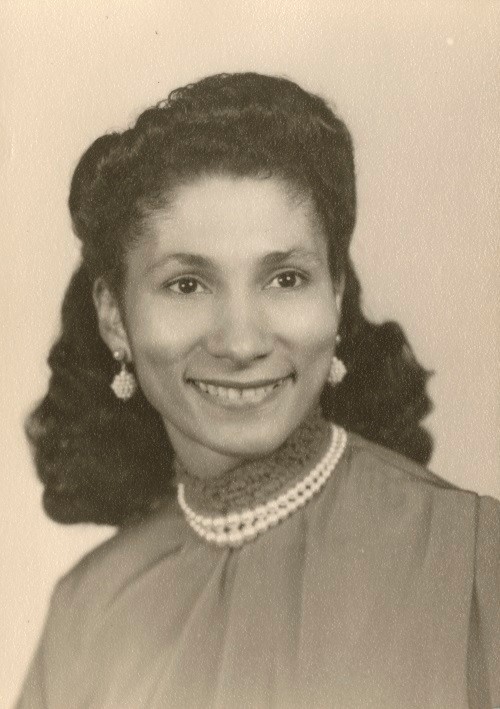
Dorothy Hamm Portrait

Image courtesy of Carmela Hamm, from the Library of Virginia.

Hamm married Edward Leslie Hamm, Sr., in 1942 and the couple moved to Arlington in 1950, where they would raise their three children. During this time, Hamm worked in numerous government positions, including as an administrator in the Army Surgeon General’s Office, where she worked until 1963.

The catalyst for Hamm’s involvement in the civil rights movement came in the form of the 1954 Supreme Court decision that ruled segregation illegal in public schools.

Arlington Public Schools

In 1956, Hamm, along with her husband, became plaintiffs in the first civil action case filed to integrate the Arlington Public School system. When no action towards integration had been taken a year after the suit was filed, Hamm and her husband took their oldest son, Edward Leslie Jr., to enroll at Stratford Junior High School. They, and other African-American students who attempted to enroll in the still segregated Arlington schools, were denied admission that year. In September 1957, a few days after the opening of the school year, crosses were burned on the lawns of two Arlington families, and at the Calloway United Methodist Church, a central location for organizers in the effort to desegregate the schools, and a site of workshops held by ministers, lawyers and educators preparing parents and students for school integration.

Over the course of this process, Hamm recalled in interviews many experiences with discrimination and intimidation.
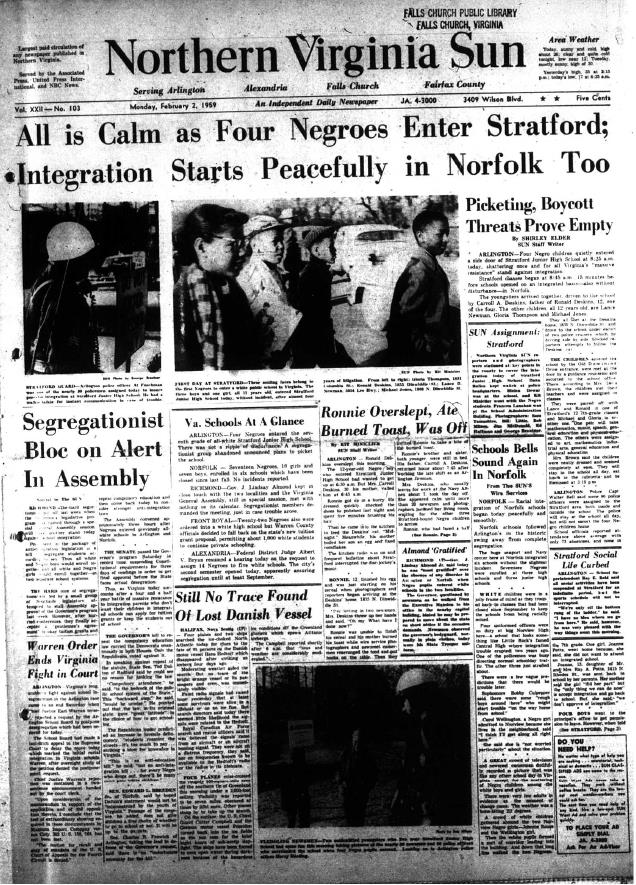
North VA Sun Article

Frontpage of The Northern Virginia Sun, February 2, 1959.
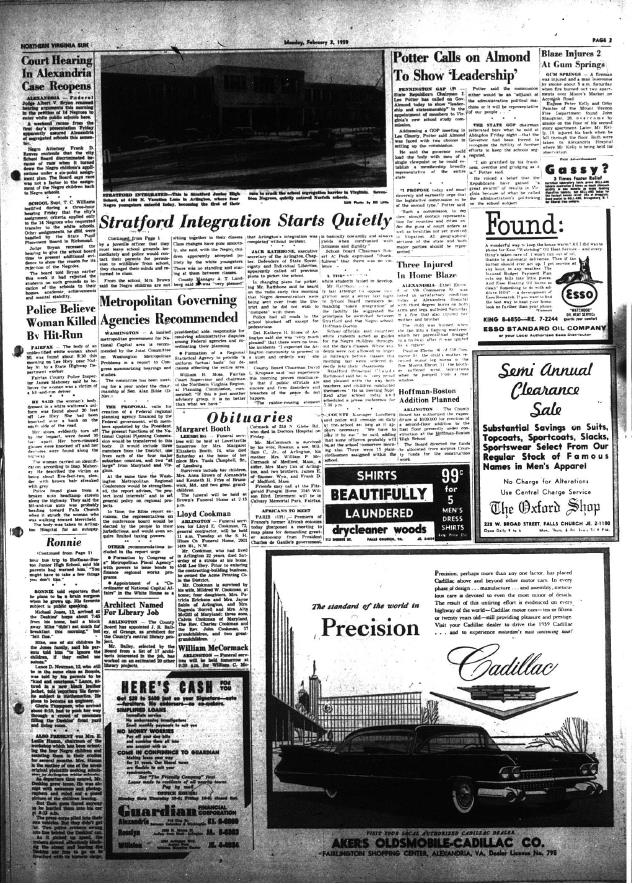
Second page of article Northern Virginia Sun, headline reads "Stratford Integration Starts Quietly."

Page 2 of The Northern Virginia Sun, February 2, 1959.

On January 19, 1959, Senator Harry F. Byrd’s statewide policy of “massive resistance” to the Supreme Court ruling was outlawed by the Virginia Supreme Court.

On February 2, Ronald Deskins, Michael Jones, Lance Newman, and Gloria Thompson were enrolled as the first black students at Stratford Junior High, making Arlington the first county in Virginia to integrate its schools. Hamm’s sons would enter Stratford later that year.

In 1960 Dorothy Hamm was a plaintiff in another case, a court action to eliminate the pupil placement form, which was used to exclusively assign African-American students to certain schools as a means to get around the Supreme Court’s ruling on desegregation.

In 1961, Hamm was again a plaintiff in a court action to integrate the athletic program of the Arlington Public Schools, after Hamm’s son had been barred from participating in Stratford’s wrestling program because of the physical contact between Black and white students. As a result of the court action, discrimination in Arlington athletic programs was declared to be illegal.

Civic Life

In 1963, Hamm was the plaintiff in a civil action case to eliminate the poll tax and remove the race designation from public forms and voting records in Arlington County. (Read "If you Don't Vote, You Don't Count", our story from August 15, 2019, about the history of the poll tax in Arlington County, to learn more.)

The same year, Hamm also became involved in the fight to desegregate Arlington’s theaters. She initiated another civil court suit and helped to organize what would become a year of picketing efforts in protest of segregation. Along with four other protesters, Hamm was arrested for picketing at the Glebe Theater. The theater owner then struck a deal with the protesters that if they ceased picketing for thirty days, he would admit African-American patrons to the theater. This was successful, and Hamm and her son Edward Leslie Jr., became the first African-American customers to be admitted.

Hamm and her husband also participated in the 1963 March on Washington, helping to organize bus transportation to take Arlington residents into the city to take part in the March. In 1968, they also participated in the Poor People’s March on Washington, and helped to provide food and housing for fellow marchers.

Hamm continued her political activism as a delegate to Arlington County and Virginia State conventions in 1964 and was appointed Assistant Registrar and Chief Election Officer in Arlington’s Woodlawn precinct. She also worked with the Congress on Racial Equality (CORE) as they organized in Arlington and served as an officer of elections in Arlington for more than twenty-seven years.

Writing

Dorothy Hamm was also known for her work as a poet and playwright.

In 1976, her play “Our Heritage: Slavery to Freedom 1776-1976” was designated as an official bicentennial event in Arlington County. In 1984, she wrote and directed the play “Our Struggle for Equality,” which was performed by the drama club of Calloway United Methodist Church and later developed into a documentary for television.
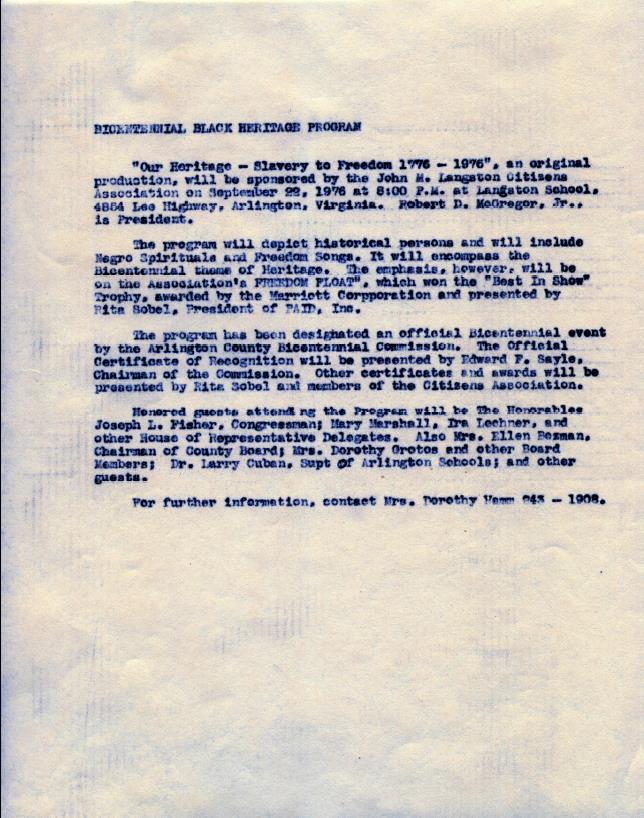
Play Description

Description of Dorothy Hamm’s 1976 play “Our Heritage: Slavery to Freedom 1776-1976,” which was performed as part of Arlington’s bicentennial celebrations. Part of the Dorothy Hamm Papers.

Legacy

Dorothy Hamm died in 2004, but her legacy and mark on Arlington live on. On March 1, 2002, the Virginia Legislature’s House Joint Resolution No. 458 was enacted commending Hamm and her efforts in the civil rights movement.  And in 2019, the Dorothy Hamm Middle School began its first year named in her honor (in the building that formerly was the site of Stratford Junior High and the H-B Woodlawn Secondary Program).

In her autobiography, Hamm wrote about her response to the question of why she fought so hard for equal education and other equal opportunities. She writes:

“Even now, I am asked the same questions. There are many reasons, but one of the most important was my determination to answer the “Why can’t I?” question raised by our eight-year-old son, Bernard Caldwell Hamm. … Finally, I had to truthfully answer his ‘Why can’t I?’ question and explain to him that Stratford was for White children and he could not attend because he was a colored boy. I knew then that with the help of others, I had to fight to help change the ‘Separate but Equal Laws.’”
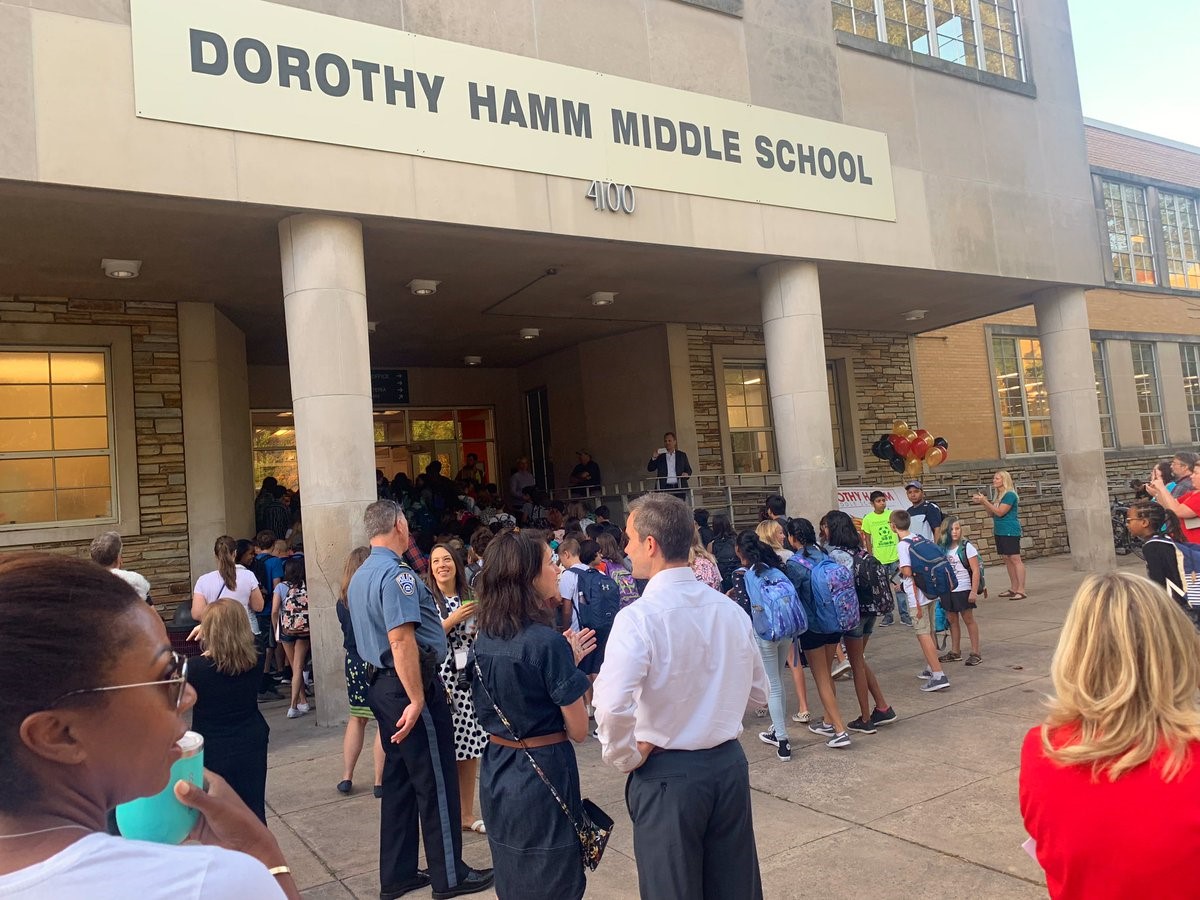
Dorothy Hamm Middle School

Dorothy Hamm Middle School, which was named in Hamm’s honor in 2019. Image courtesy of Arlington Public Schools.

Learn More

“Notable Women of Arlington: Third Series,” published by the Arlington County Commission on the Status of Women.

“Integration of Arlington County Schools: My Story,” by Dorothy Hamm.

Interview Dorothy M. Hamm, conducted in 1986, VA 975.5295 A7243oh ser.3 no.58.

The Dorothy M. Hamm Papers, 1937-1977, VA/ARCH RG 349.
February 27, 2020 by Web Editor

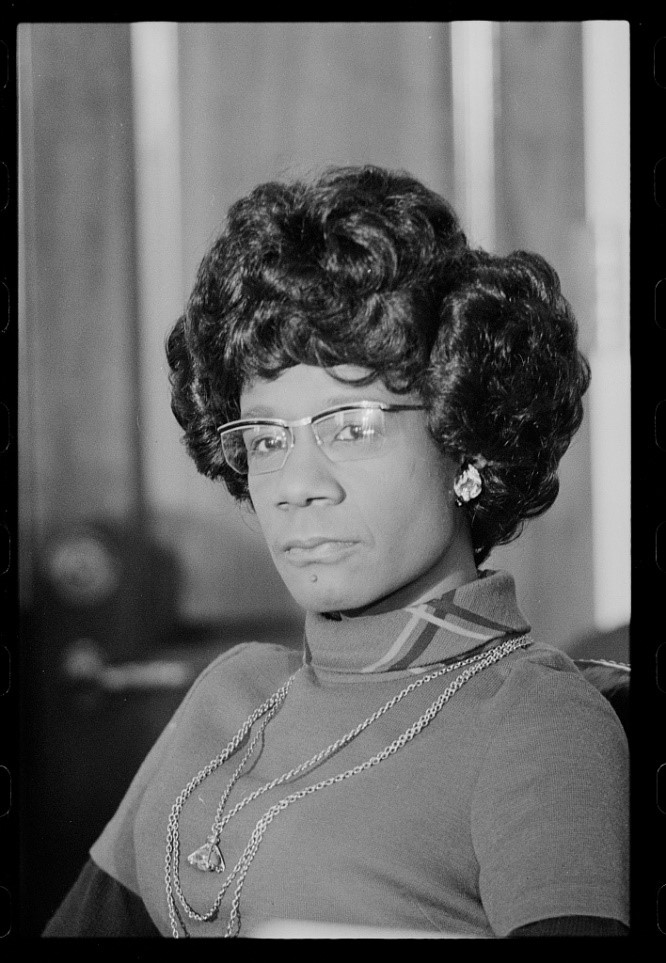
Unbought and Unbossed: U.S. Representative Shirley Chisholm

Post Published: February 20, 2020

Shirley Anita St. Hill Chisholm (1924-2005)

Celebrate Black History Month and the 100th anniversary of the 19th Amendment with stories about women who have used their voices and their votes to better their communities and help shape the United States.

In 1968, Shirley Chisholm made history as the first African-American woman to be elected to Congress. She also broke barriers as the first woman to seek the Democratic presidential nomination in 1972.

Throughout her life, Shirley Chisholm became one of the most influential and iconic policymakers and activists in the United States, and a tireless advocate for women and minority groups.

Shirley Chisholm was born in 1924 in Brooklyn, New York, to immigrant parents from Guyana and Barbados. She graduated cum laude from Brooklyn College in 1946, where she was also a top member of the debate team. After college, she worked as a nursery school teacher and went on to receive a master’s degree from Columbia University in early childhood education. She continued to excel in her field and later served as a consultant to the New York City Division of Day Care.

Shirley Chisholm Black Caucus

Shirley Chisholm at the Black Caucus State of the Union event, 1973. Courtesy of the Library of Congress

As her career progressed, Chisholm was also politically active and participated in many groups that sought to combat racial and gender inequality, including the League of Women Voters, the NAACP, the Urban League, and the Democratic Party Club. In 1964, she was elected to the New York State Legislature, making her the second African-American person to do so. Four years later, in 1968, she ran for and was elected to Congress. After her historic win, considered an upset in her district, she aptly declared: “Just wait, there may be some fireworks.”

Chisholm’s time in Congress was one of prolific work and steadfast determination, marked by her slogan “unbought and unbossed.” Nicknamed “Fighting Shirley,” she focused on causes including racial and gender equality, helping the poor, and putting an end to the Vietnam War. During her time in office, she introduced more than 50 pieces of legislation and continued to achieve milestones, including becoming the first Black woman and the second woman ever to serve on the House Rules Committee in 1977. Chisholm was also one of the co-founders of the National Women’s Political Caucus, which sought to broaden women’s political participation.

Congresswoman Shirley Chisholm

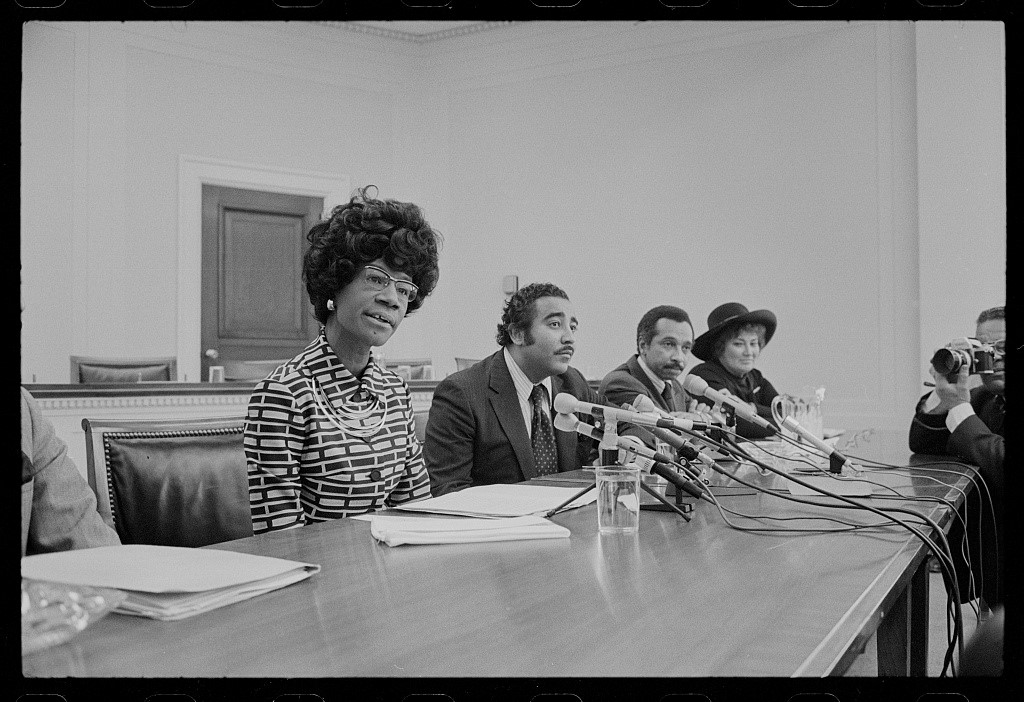
Congresswoman Shirley Chisholm announces her candidacy for the presidential nomination, January 25, 1972. L-R, Shirley Chisholm, Parren Mitchell, Charles Rangel, Bella Abzug. Courtesy of the Library of Congress.

In 1972, Chisholm trailblazed into yet another region of the political realm when she sought the Democratic Party’s presidential nomination, the first woman to do so. Due to discrimination, numerous obstacles were placed in her way: she received little establishment support, and was blocked from taking part in televised primary debates, only making one speech after seeking legal intervention. And while the nomination ultimately went to George McGovern, Chisholm entered 12 primaries and was able to gain 10 percent of the total vote.

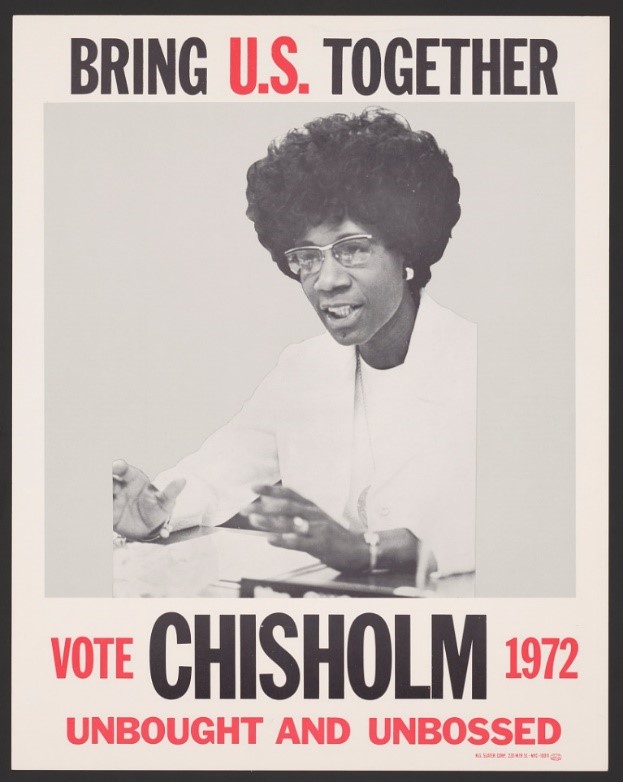
Presidential Campaign Poster

Shirley Chisholm presidential campaign poster, 1972. Courtesy of the Library of Congress.

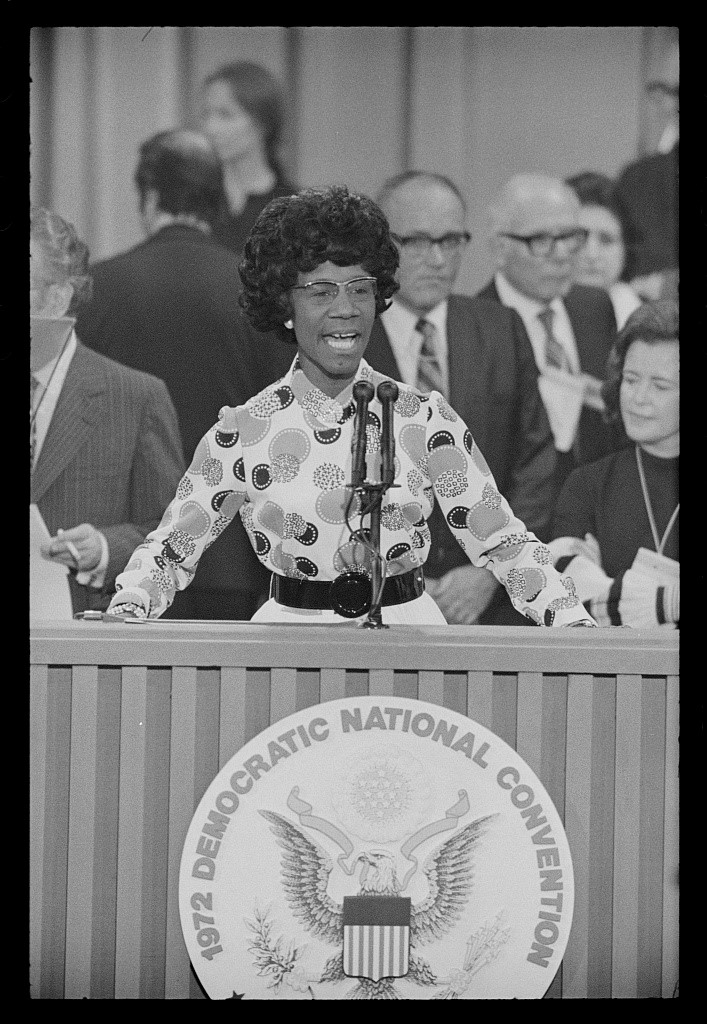
DNC Speech

Shirley Chisholm speaks at the third session of the Democratic National Convention in Miami Beach, July 12, 1972. Courtesy of the Library of Congress.

Chisholm retired from Congress in 1983 but continued to be politically active, co-founding the National Political Congress of Black Women and teaching at Mount Holyoke College.

After a life on the forefront of trailblazing politics, she reflected on her life:

“I’d like them to say that Shirley Chisholm had guts. That’s how I’d like to be remembered.”

Learn more about Shirley Chisholm in her autobiography, "Unbought and Unbossed," available at the Library.

February 20, 2020 by Web Editor

This Week in 19th Amendment History: The Death of Zitkála-Šá

Post Published: January 28, 2020

January 26, 1938

Celebrate the 100th anniversary of the 19th Amendment with stories about the people and events that led to the passage of women’s suffrage in the United States.

In celebration of her work for Native American's voting rights, we are republishing our "Rediscover Zitkála-Šá" post from March 13, 2019. This version of the post includes additional photographs and captions.

On January 26, 1938, Zitkála-Šá, life-long advocate for Native American rights and a resident of 261 North Barton Street in Lyon Park, died at age 61. She was buried under the name Gertrude Simmons Bonnin, in Arlington National Cemetery.

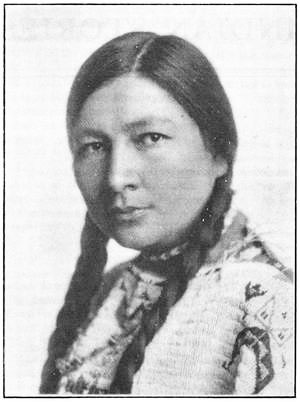
Zitkála-Šá 6

Image of Zitkála-Šá ca. 1921, courtesy of the Library of Congress

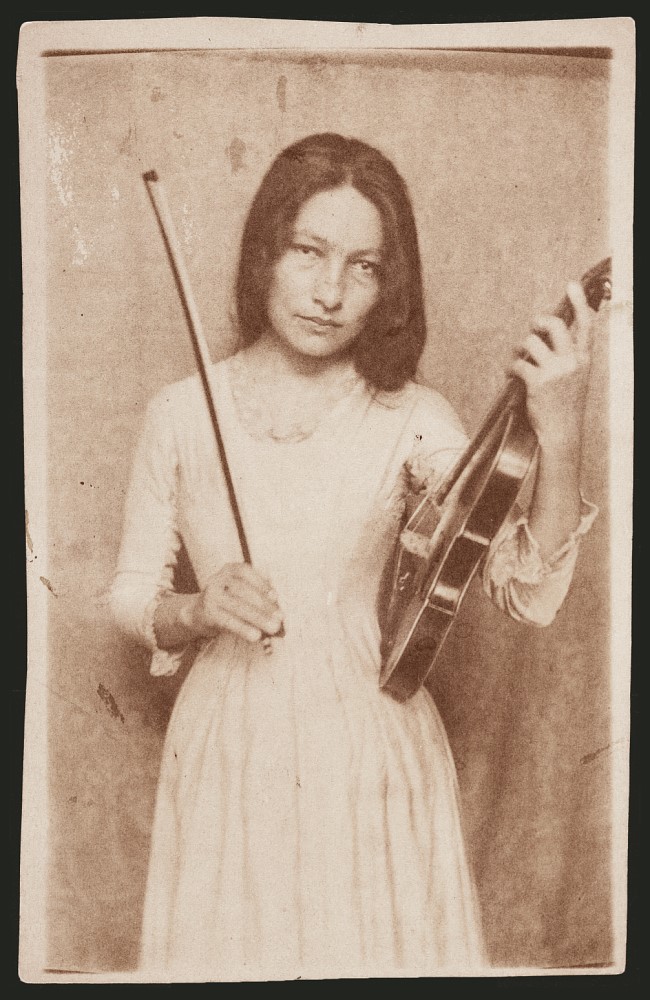
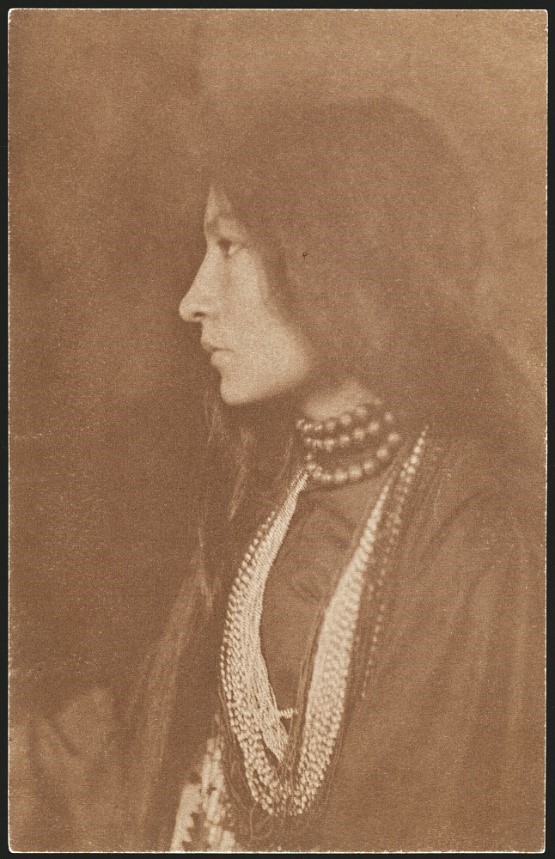
A nationally recognized Native American author and activist, Zitkála-Šá was a vocal proponent for citizenship rights for Native Americans. Born in South Dakota into a Yankton Dakota Sioux family, she thrived on the Yankton Indian Reservation until Quaker missionaries recruited some of the reservation’s children to attend a Quaker manual labor school where she was given the Christian name Gertrude Simmons. Although she enjoyed learning to read and write, she experienced first-hand the damage of having her heritage stripped away.

Feeling torn between her life on the reservation and her forced assimilation into white mainstream culture, Zitkála-Šá pursued higher education and distinguished herself as a public speaker on social and political issues.

“Folded hands lie in my lap, for the time forgot. My heart and I lie small upon the earth like a grain of throbbing sand. Drifting clouds and tinkling waters, together with the warmth of a genial summer day, bespeak with eloquence the loving Mystery round about us.”

"Why I Am A Pagan," Atlantic Monthly, Volume 90, 1902

Zitkála-Šá 4
Zitkála-Šá 5

Zitkála-Ša photographs by Gertrude Käsebier, circa 1898. Image courtesy of the National Museum of American History.

Her largely autobiographical work on indigenous life was published by the Atlantic Monthly and Harper’s Monthly, including “Impressions of an Indian Childhood” and “The Trial Path” among many more. She collected tribal stories and legends into collections and authored poems examining the intersection of nature, Native American life, and mainstream white American life.

In 1910, she began a collaboration with composer William F. Hanson, and the subsequent “The Sun Dance Opera” was the first opera authored by a Native American (under the name Gertrude Simmons).

“It was next to impossible to leave the iron routine after the civilizing machine had once begun its day's buzzing; and as it was inbred in me to suffer in silence rather than to appeal to the ears of one whose open eyes could not see my pain, I have many times trudged in the day's harness heavy-footed, like a dumb sick brute.”

"The School Days of an Indian Girl," Atlantic Monthly, Volume 85, 1900

As a member of the Society of American Indians, Gertrude Simmons (the name she used in records and public affairs) lectured nationally and lobbied for citizenship rights for Native Americans who were not naturalized U.S. citizens by birth but could apply through pathways such as military service, renouncing tribal affiliations, or accepting land allotments. As a previous clerk for the Bureau of Indian Affairs, she criticized the bureau for its mistreatment of Indigenous children placed in national education systems that forced assimilation and Christian values.

Zitkála-Šá 3

Zitkála-Ša photographed by Joseph T. Kelley, 1898 (printed 1901). Image courtesy of the National Portrait Gallery.

In 1916, her husband, Captain Raymond Talefase Bonnin (also of Yankton descent), lost his position at the Bureau of Indian Affairs in Utah and they moved to Washington D.C. where, as editor of the Society of American Indian’s publication American Indian Magazine, Gertrude Simmons Bonnin wrote about and exhibited treatises on many controversial issues. In 1923, she co-authored “Oklahoma’s Poor Rich Indians: An Orgy of Graft and Exploitation of the Five Civilized Tribe, Legalized Robbery” which discussed theft and murder by corporations seeking access to Native American-owned oil-rich lands. The article is credited with influencing the development of the Indian Reorganization Act of 1934, which returned government and land management to Native Americans.

Zitkála-Šá 1

Group at the Artists Carnival and Book Fair of the National League of American Pen Women on April 15, 1920. Zitkála-Ša third from left.  Image courtesy of the Library of Congress.

On November 3, 1925, Gertrude and Raymond Bonnin purchased the stone bungalow at 261 North Barton Street in Arlington. from the first owners, Loyd and Bernice Claire. The Claires had built the house only one year earlier, having bought it from the well-known Lyon & Fitch real estate development. The Lyon & Fitch real estate team sold the Lyon Park subdivision properties with deed restrictions and covenants, including one preventing the property from being sold or rented to non-whites for a period of 99 years. The census recognized people of Native American ancestry as white and therefore the Bonnin's were not prevented from purchasing the property.

In 1924, the Indian Citizenship Act granted citizenship to all Native Americans, but did not automatically afford voting rights. In response, Gertrude Simmons Bonnin co-founded and presided over the National Council of American Indians to unify First Nations in the movement to gain voting rights, healthcare, legal standing, and land rights. She also created the Indian Welfare Committee of the General Federation of Women’s Clubs, speaking often in Washington, Arlington, and Fairfax.

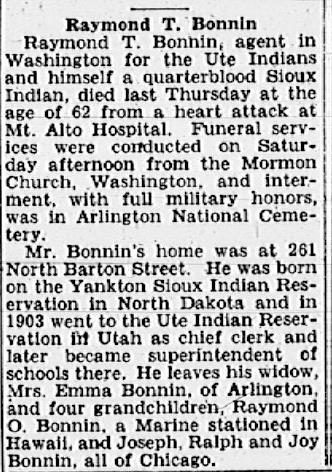
Gertrude Simmons Bonnin spent the remainder of her life in Arlington as president of the Council of American Indians, speaking and writing about the continuing political and social mistreatment of Native Americans. After her death, her husband continued to live in their home until his death in 1942 when the property was left in trust to their grandchildren.

Zitkála-Šá 2

Obituary for Zitkála-Ša’s husband, Raymond T. Bonnin. From The Northern Virginia Sun, October 2, 1942

References

United States of America, Bureau of the Census. Fifteenth Census of the United States, 1930. Washington, D.C.: National Archives and Records Administration, 1930. T626, 2,667 rolls.

Arlington County Land Records Office, various deeds pertaining to Gertrude S. Bonnin and R.T. Bonnin: Deed Book 609, p. 237, book 319, p. 64, and book 174, p. 152.

Zitkála-Šá, “The School Days of an Indian Girl”, Atlantic Monthly, Volume 85, 1900.

Zitkála-Šá, “Why I Am A Pagan”, Atlantic Monthly, Volume 90, 1902.

Further Reading

Lewandowski, Tadeusz. Red Bird, Red Power: The Life and Legacy of Zitkala-Ša, Norman: University of Oklahoma Press, 2016. (Available from the Library)

Susag, Dorothea M., Zitkala-Sa (Gertrude Simmons Bonnin): A Power(full) Literary Voice, Studies in American Indian Literatures, University of Nebraska Press, Series 2, Vol. 5, No. 4 (Winter 1993), pp. 3-24.

Tsjeng, Zing, Forgotten Women: The Leaders. London: Cassell Illustrated, 2018. (Available from the Library)

Capaldi, Gina. Red Bird Sings: the Story of Zitkala-̈Sa, Native American Author, Musician, and Activist, Carolrhoda Books, 2011. (Available from the Library)

2020 marks the centennial of women’s suffrage in the United States.

January 28, 2020 by Web Editor

This Week in 19th Amendment History: First Issue of The Woman’s Journal

Post Published: January 7, 2020

January 8, 1870

Celebrate the 100th anniversary of the 19th Amendment with stories about the people and events that led to the passage of women’s suffrage in the United States.

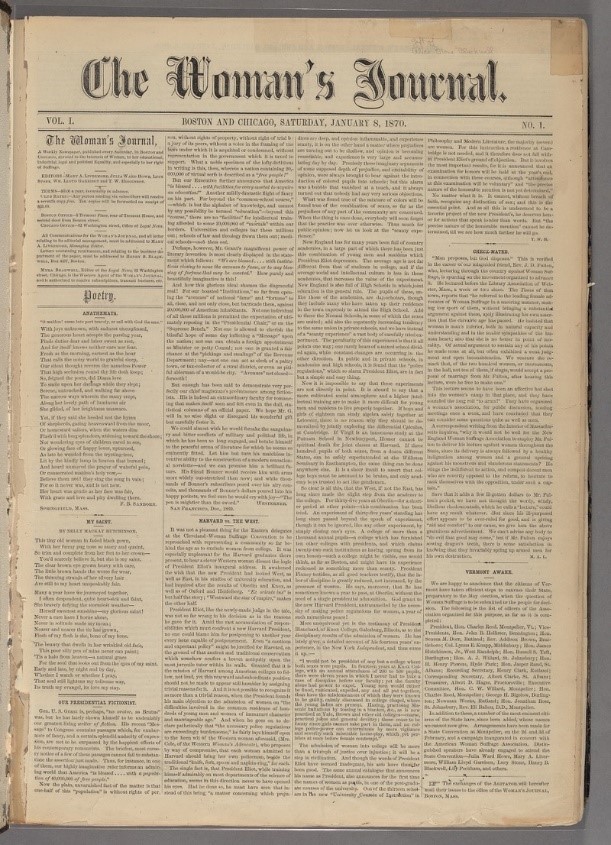
The Woman’s Journal was a women’s rights publication that produced its first issue on January 8, 1870.  One of the most significant and popular publications of the women’s suffrage movement, it ran in various forms from 1870 to 1931.

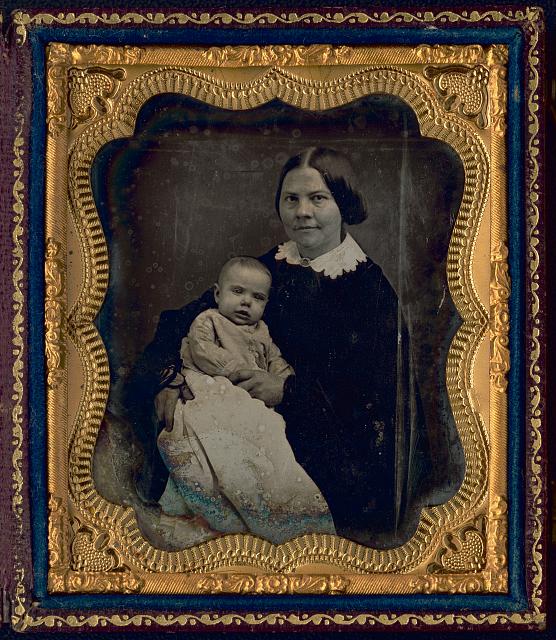
Founded by suffragist Lucy Stone and her husband Henry Browne Blackwell in Boston, Massachusetts, the Woman's Journal aimed to provide a broad segment of women with information on the women’s rights movement and the suffrage cause. Content included speeches, debates, and women’s convention notes, all under the broader banner of the mission:

“devoted to the interests of Woman – to her educational, industrial, legal and political equality, and especially to her right of suffrage.”

Womans Journal 1

Lucy Stone with daughter Alice Stone Blackwell. Library of Congress Prints and Photographs Division.

The Journal’s first issue aligned with a significant anniversary in the suffrage timeline, as Susan B. Anthony and Elizabeth Cady Stanton’s journal, The Revolution, had published its first copy on January 8, 1868, two years prior.

The Woman’s Journal was a weekly publication and published every Saturday in Boston and Chicago. In addition to Stone, editors of the first issue included Mary Livermore, Julia Ward Howe, William Lloyd Garrison and, T.W. Higginson.

Stone and Blackwell’s daughter Alice Stone Blackwell started as an editor in 1881 and became sole editor in 1909 after her mother and father’s deaths, where she remained in the position until 1917.

The Woman’s Journal was funded with a $10,000 seed donation from benefactor Elizabeth Eddy and sustained itself through advertisements and subscriptions. At the time of the first publication, subscriptions started at an annual price of $3.00, with deals offered to readers who brought in more subscribers.

Though ad sales were sparse, the journal notably did not allocate space for tobacco, liquor, or medicinal advertisements.

The Journal’s leadership did attempt to reach a larger audience by hiring suffragists licensed as “newsboys” to hawk the publication on the Boston Common.

The inaugural issue of The Woman's Journal included articles such as “Woman as a Preacher,” which contended that women could and should be leaders in their religious communities; a history of “Women’s Rights in France During the Last Century”; and investigative pieces “What the Women of California are Doing” and “Can Women Hold Office in Iowa?”.

Womans Journal 2

Front page of the first issue of the Woman’s Journal, published January 8, 1870, from Harvard Library.

Womans Journal 3

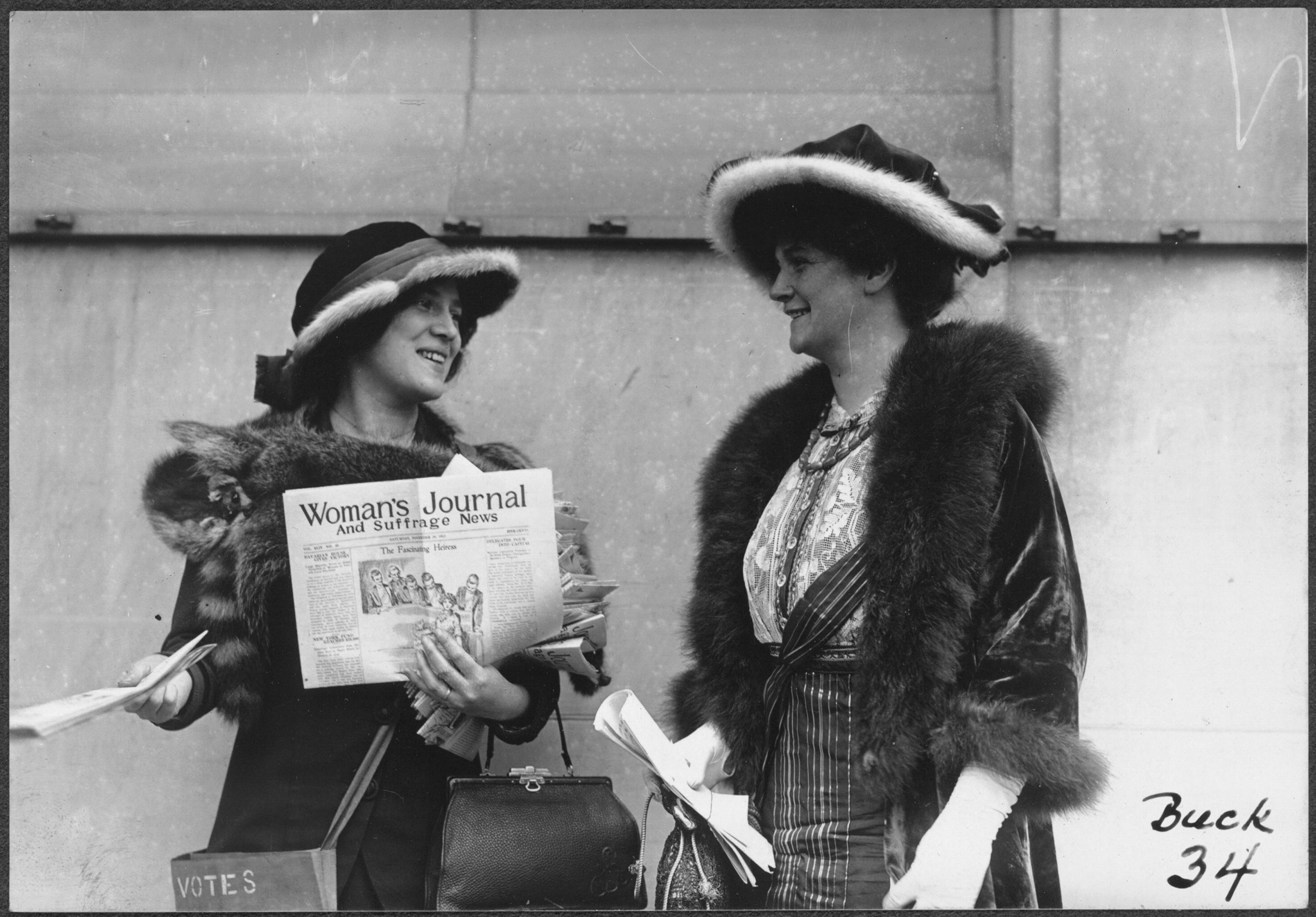
Suffragist Margaret Foley distributing the Woman’s Journal and Suffrage News, 1913. Library of Congress Prints and Photographs Division.

In 1916, the Journal hired Margaret Foley – a well-known speaker on women’s issues – to travel and host speaking engagements in the South and Midwest to promote the publication.

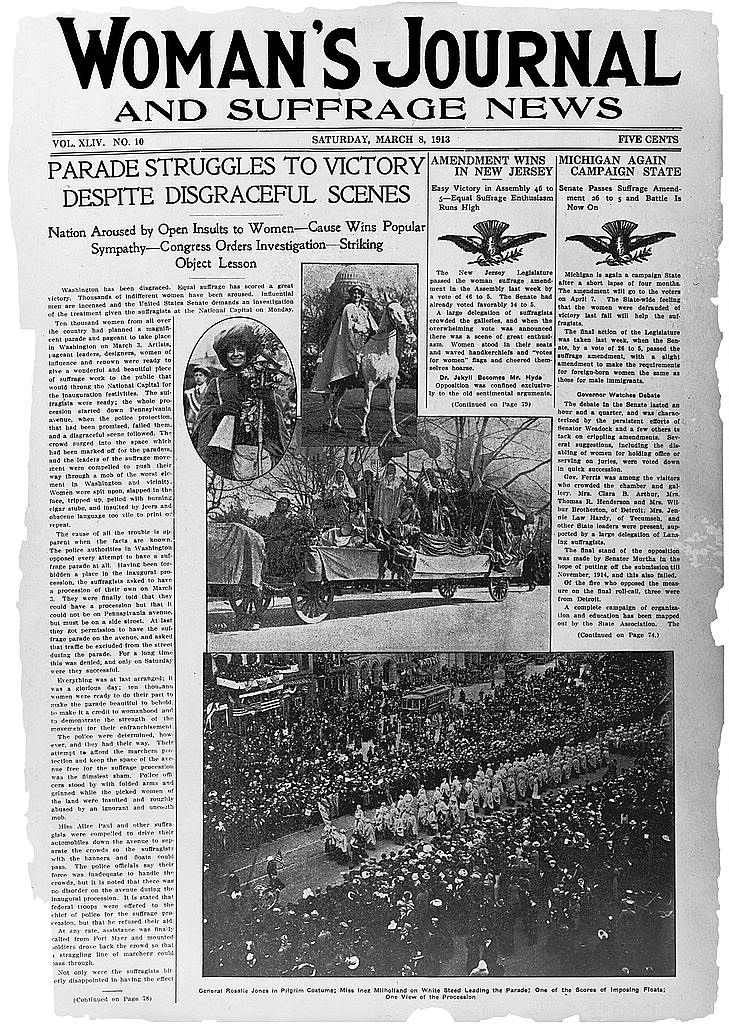
During its six decades, the Journal was absorbed and affiliated with numerous other suffrage journals, newsletters and periodicals. When the Journal was founded, it incorporated the Woman’s Advocate, and in 1910 it joined with the National American Woman Suffrage Association’s (NAWSA) in-house publication, the Progress. From 1910-1912, NAWSA contributed financial support and managerial oversight, and the Journal was subtitled as the “official organ of the National American Woman Suffrage Association.” From 1912 to 1916, the Journal was referred to as the Woman’s Journal and Suffrage News.

Womans Journal 4

Front page of the ‘Woman’s Journal and Suffrage News” with the headline: ‘Parade struggles to victory despite disgraceful scenes,’ shows images of the women’s suffrage parade in Washington, March 3, 1913.
Library of Congress Prints and Photographs Division.

In response to prolonged financial instability, in 1917, the Woman’s Journal was sold to Carrie Chapman Catt’s Leslie Woman Suffrage Commission, which proceeded to merge the Journal, the Woman Voter, and National Suffrage News to form a new title, The Woman Citizen.

The Woman Citizen took the place as NAWSA’s official publication and published until the late 1920s, when it was again called the Woman’s Journal. This iteration of the publication ran until 1931.

Learn more

The full archives of the Woman’s Journal are now available through Harvard Library’s online digitized collection.

2020 marked the centennial of women’s suffrage in the United States. 

January 7, 2020 by Web Editor

This Week in 19th Amendment History: Wyoming Day

Post Published: December 10, 2019

December 10, 1869

Celebrate the 100th anniversary of the 19th Amendment with stories about the people and events that led to the passage of women’s suffrage in the United States.

One hundred and fifty years ago this week, Wyoming made a significant – though complicated – stride on the path toward women’s suffrage.

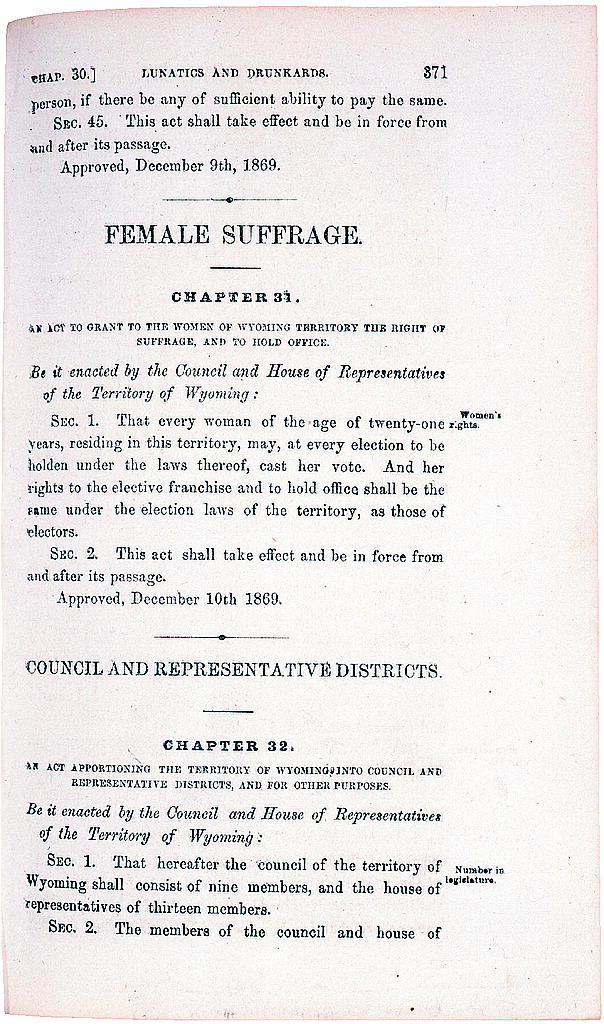
On December 10, 1869, the frontier territory became the first to explicitly grant women the right to vote when governor John Campbell approved “An Act to Grant to the Women of Wyoming Territory the Right of Suffrage and to Hold Office.”

Wyoming Territory

Wyoming had been founded as a territory in July 1868, a time when post Civil War Reconstruction politics determined much of the legislative landscape.

President Grant appointed an almost entirely Republican government in 1869, including the territory’s governor, secretary, and attorney general. These “Radical Republicans” were named after their support for and passage of the 14th Amendment - guaranteeing that former slaves would be citizens and protected equally under the law - and the 15th Amendment - guaranteeing that individuals could not be denied the right to vote based on race or previous slave status.

The question of women's suffrage was also being raised throughout American politics. Suffrage bills in the Washington, Nebraska and Dakota territories had failed in the 1850s and 1860s, as had constitutional amendments that would have granted women the right to vote.

William Bright

The Wyoming bill was introduced by (among others) a saloon keeper turned territorial legislator originally from Alexandria, Virginia. William Bright had fought for the Union Army during the Civil War, and later found his way to Wyoming during the gold rush, where he settled in South Pass.

Bright began his foray into the political scene as a Democrat. Like many of his fellow Democrats after the Civil War, Bright disagreed with the "Radical Republicans" and President Ulysses S. Grant in regards to Reconstruction, and had been known to speak out against them - but he appears not to have opposed the issue to women's suffrage.

Wyoming Day 1

Photo of the suffrage bill.
Library of Congress Prints and Photographs Division.

Despite Wyoming's "Radical Republican" leadership - attorney general Joseph Carey issued an official legal opinion emphasizing the 15th Amendment’s stipulation that no one (man) could be denied the vote on the basis of race - in the September 1869 territorial election only Democrats were elected to the legislature. Wyoming’s delegate to Congress that year was a Democrat.

William Bright was among the Democrats elected to the upper house of the Wyoming legislature (referred to as the Council) and subsequently appointed as president of the Council.

This legislature soon produced a significant series of laws in favor of women’s rights, including a resolution allowing women to sit in on legislative proceedings, a law guaranteeing teachers be paid equally no matter their gender, and a bill ensuring that married women could have property rights independent of their husbands.

Wyoming Day 2

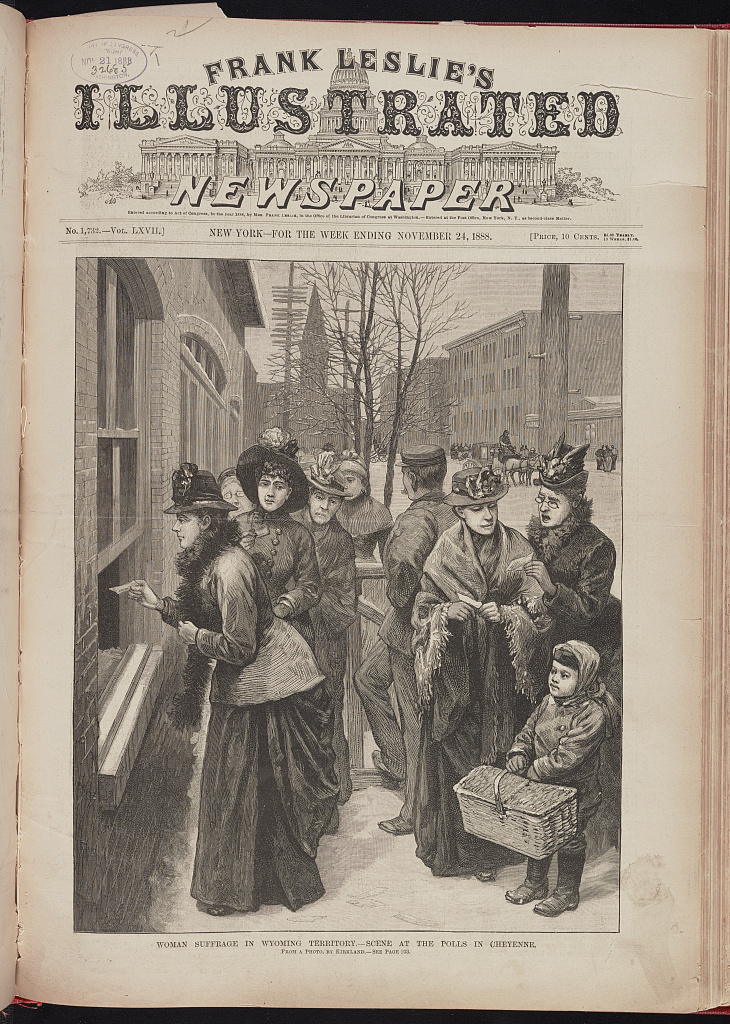
“Scene at the Polls in Cheyenne,” 1888.
Library of Congress Prints and Photographs Division.

The Wyoming Bill

Bright’s suffrage bill followed. Upon introducing the bill, it passed in the Council 6-2. In the House, it faced more pushback. Attempts were made to sabotage the bill through racial prejudice, including by adding an amendment to extend the right to vote to women of color. This amendment was not added to the final bill.

One amendment that did prevail was to raise the voting age for women from 18 to 21. After this addition, the suffrage bill passed 7-4 with one abstention. Governor Campbell signed the bill into law a few days later.

No records were made of the actual proceedings of the legislative session that resulted in the bill’s passage, but newspaper reports reflect a nearly humorous atmosphere accompanying this historic legislation, suggesting that the bill itself may have been perceived as a joke. The Cheyenne-based Wyoming Tribune reported that “amid the greatest hilarity, and after the presentation of various funny amendments and in the full expectation of a gubernatorial veto, an act was passed enfranchising the women of Wyoming.”

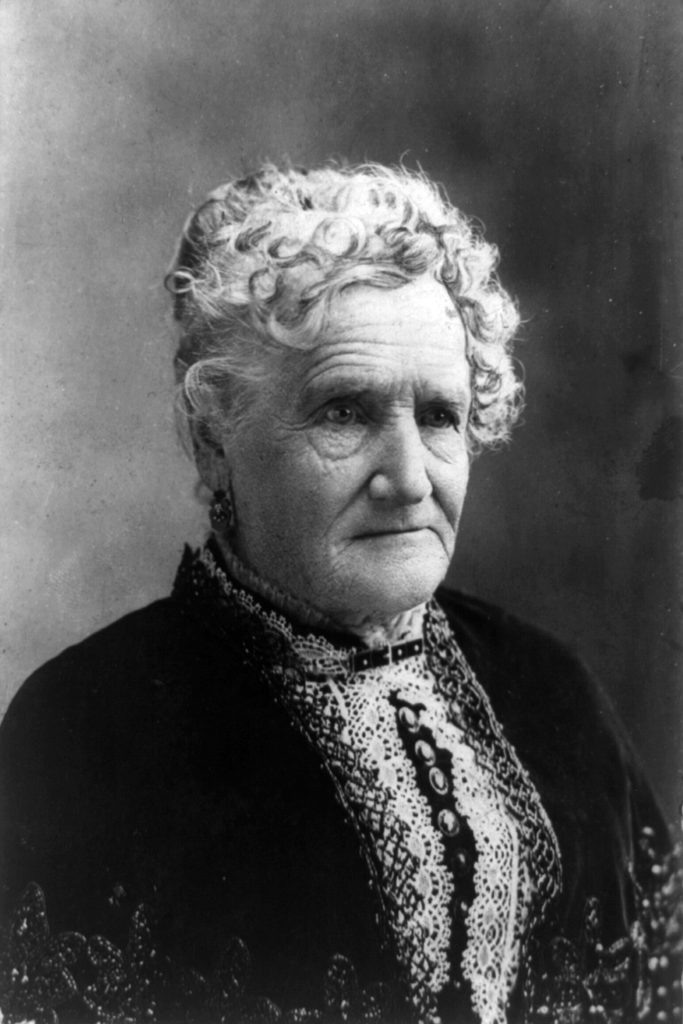
Esther Morris

Mrs. Esther Morris, the 1st woman judge in Wyoming Territory.
Library of Congress Prints and Photographs Division.

Getting the Vote for Women

Though the exact details of what other events directly precipitated the suffrage law are unclear, one frequently-referenced 1926 account credits South Pass resident Esther Hobart Morris as its catalyst.

Morris purportedly hosted a tea party as a forum to present her case for women’s suffrage to legislators, allegedly including Bright. While Morris’s actual role in the bill has been contested, it is notable that following the 1869 passage of the suffrage law, she became the first female justice of the peace in the United States (taking over after her predecessor resigned in protest of the new law).

In September 1870, Wyoming women formally voted in their first election and the territory’s second. On September 6, sixty-nine-year-old Louisa Swain of Laramie, Wyoming, became the first woman in the country to democratically cast a vote. About 300 of the total 600 eligible women voted, and many selected Republicans on their ballots. A Republican took over the position as delegate to Congress, and by 1871 a swath of Republicans broke into the previously Democrat-dominated legislature.

However, all was not smooth sailing in this new era: the newly elected legislature soon passed a bill to repeal the 1869 law, which was vetoed by Governor Campbell, whose veto was then overridden by a two-thirds vote in the House. Once it reached the Council, the bill then failed by one vote, and the suffrage law stood, never to be challenged again.

Why Women's Suffrage?

Various theories have been proposed as to the motivations behind passage of the bill, which at the time was a radical decision.

Was suffrage a publicity stunt designed to bring more settlers (and female settlers in particular) to the territory? In 1869 Wyoming was comprised of only about 6,000 recorded adult men and 1,000 women. It was also the most recently designated territory, and quite remote.

Was the bill a political power move to keep the Democrats in territorial power? Added to any possible political maneuvering was the potential for a reactionary veto by the Republican governor - had that happened, it would have been an embarrassing blow to Campbell and a boon to the Democrats.

Was the bill a sign of the schism growing between the abolitionists/Reconstructionists and the suffragists? Some of the Wyoming legislators argued that white women should have the vote instead of the African-Americans enfranchised under the 15th Amendment, or that they should be prioritized in the steps toward universal suffrage. The divide between those in support of the 15th Amendment and those against it would prove to be significant in the suffrage movement, with famous suffragists such as Elizabeth Cady Stanton and Susan B. Anthony opposing the enfranchisement of African-American men. This divide came to define much of the suffrage movement itself.

The Equality State

Despite the questionable motives surrounding this landmark day, Wyoming – which was later nicknamed “the Equality State” – continued its progressive legislative streak, and in 1889 approved the country’s first state constitution granting full voting rights to women.

In 1924, the state garnered another national first when Nellie Tayloe Ross was elected the first female governor in the United States.

2020 marks the centennial of women’s suffrage in the United States. 

December 10, 2019 by Web Editor

This Week in 19th Amendment History: The Death of Sojourner Truth

Post Published: November 27, 2019

November 26, 1883

Celebrate the 100th anniversary of the 19th Amendment with stories about the people and events that led to the passage of women’s suffrage in the United States.

Born into slavery as Isabella Baumfree (sometimes written as Bomfree) in 1797, Truth was enslaved in Dutch-speaking Ulster County, New York, where she was bought and sold four times throughout her life. In 1827, she escaped with her daughter, Sophia after her master failed to uphold the recently-passed New York Anti-Slavery law, and Truth and her daughter were taken in by an abolitionist family who bought their freedom.

Soon after her escape, Truth sued for the freedom of her five-year-old son Peter, who had been sold illegally under the New York law and transported to Alabama. Truth won the case and secured the return of her son, making her among the first black women to successfully sue a white man in court.

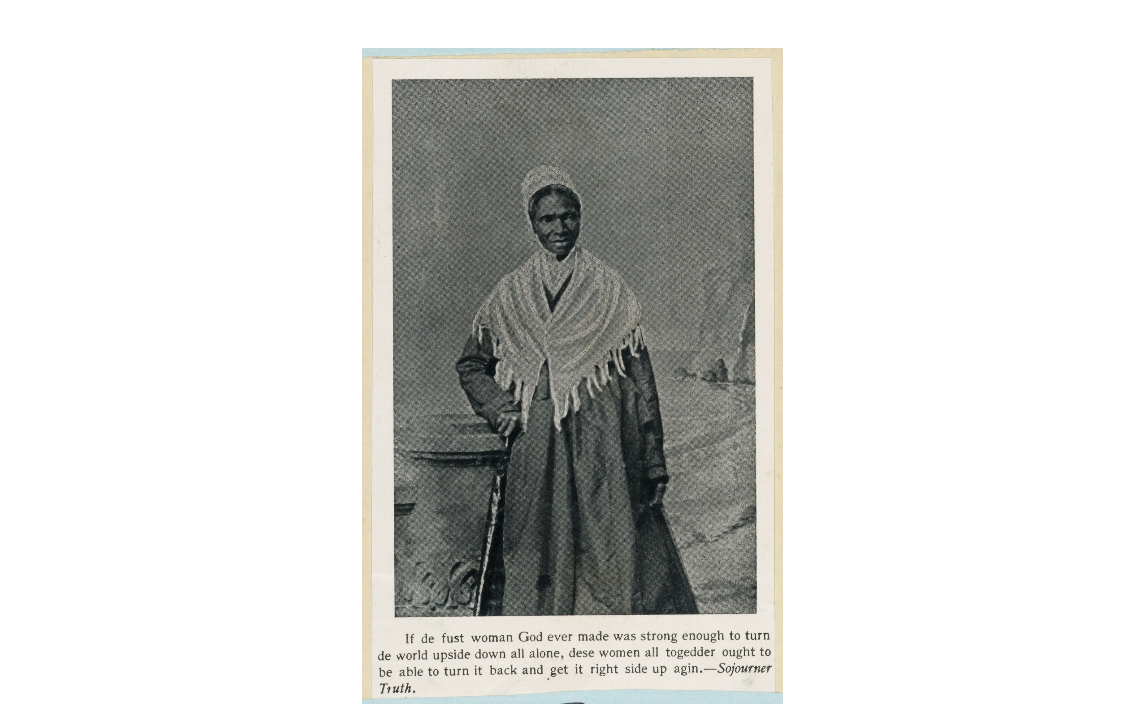
Sojouner Truth 4

Photo of Sojourner Truth. Caption on photo reads: "If de fust woman God ever made was strong enough to turn de world upside down all alone, dese women all togedder ought to be able to turn it back and get it right side up agin." Library of Congress Prints and Photographs Division.

Beginning in 1828, Truth lived in New York City where she joined in the religious revival movement that came to be known as the Second Great Awakening. She became a Christian and worked in a Methodist perfectionist commune which stressed the belief of the equality of all human beings.

Truth renamed herself on June 1, 1843 - the day of Pentecost, which commemorates the Holy Spirit filling Jesus’ disciples - and was christened “Sojourner Truth.”

Working as a traveling preacher, Truth met William Lloyd Garrison and Frederick Douglass, prominent members of the abolitionist movement. She also met suffragists Elizabeth Cady Stanton and Susan B. Anthony over the course of her travels. Later in life, however, Truth distanced herself from the mainstream suffrage movement because activists such as Anthony did not support granting the right to vote to African Americans.

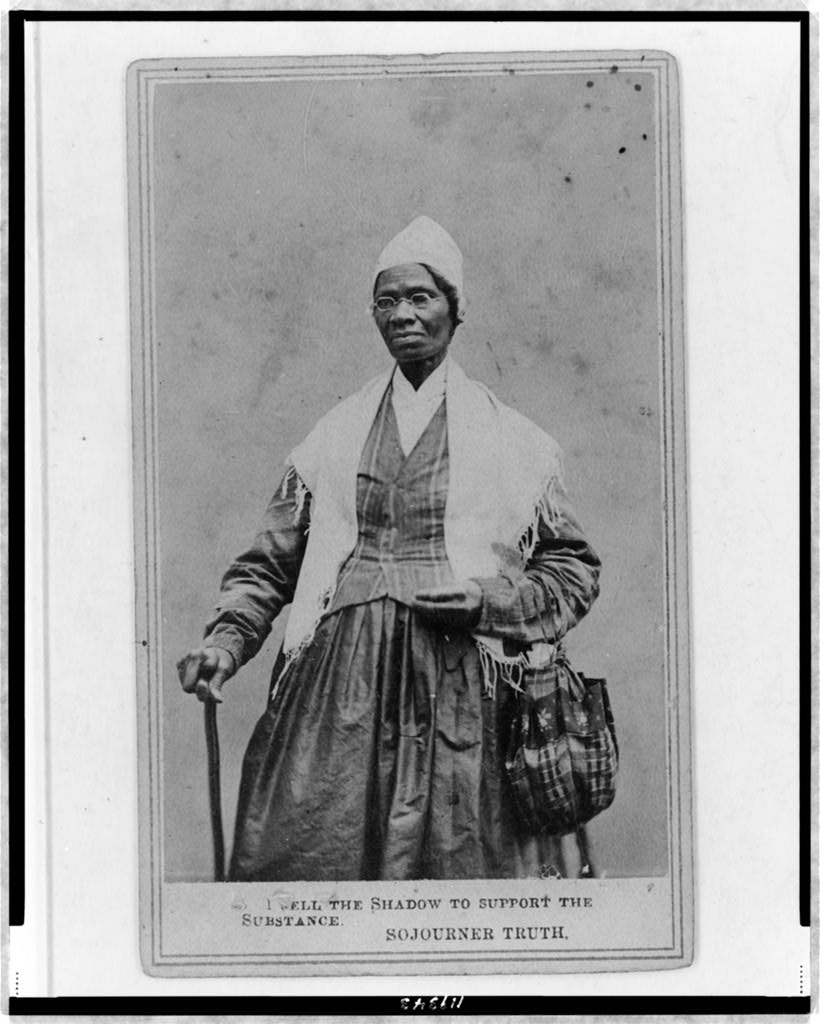
Sojouner Truth 2

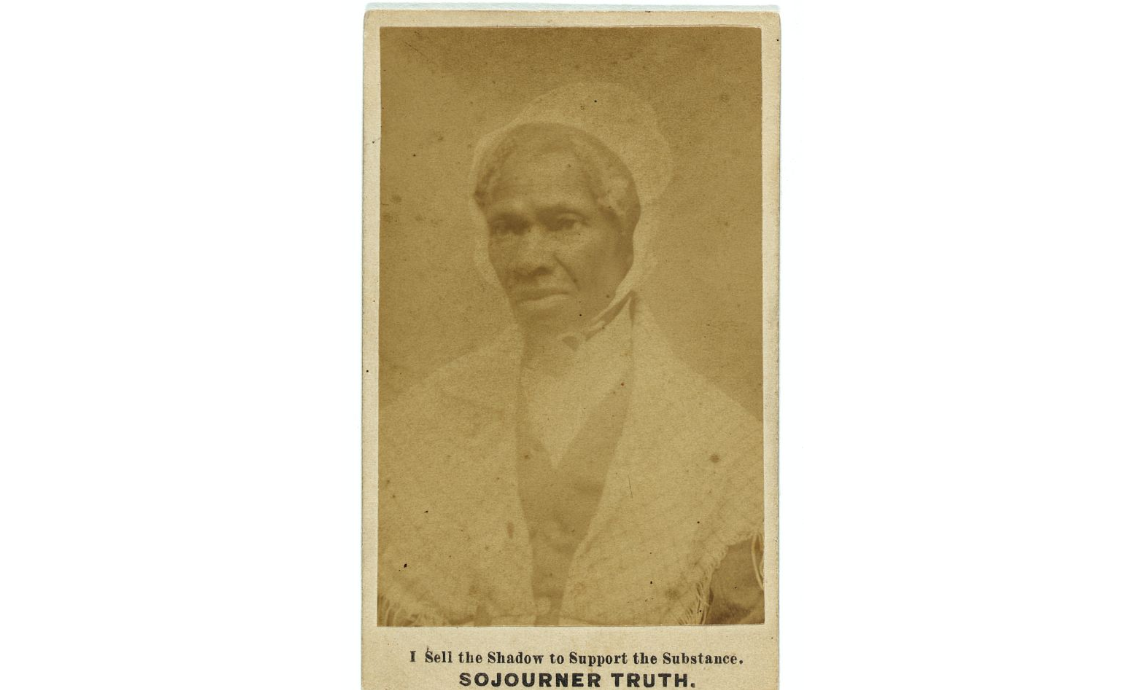
Portrait of Sojourner Truth. Caption on portrait reads: "I sell the shadow to support the substance." Library of Congress Prints and Photographs Division.

Truth rose to national prominence both for her speeches and published works. In 1850, she published her autobiography, “The Narrative of Sojourner Truth,” which reached widespread acclaim and readership. In 1851, Truth embarked on a lecture tour that included a stop at the National Women’s Convention (the second of its kind) in Akron, Ohio, where she delivered what would become the famous “Ain’t I a Woman?” speech.

The speech is best known in its 1863 reproduction by a white abolitionist named Frances Dana Barker Gage, which introduced the line “Ain’t I a Woman?” (originally written as “Ar’n’t I a woman?”). However, this iteration was an extreme reworking of Truth’s original speech, with Gage changing most of Truth’s words and falsely attributing a southern slave dialect. The most authentic version of the speech was published soon after its delivery by Rev. Marius Robinson in the Anti-Slavery Bugle and does not include its famous titular line. From that original 1851 transcript:

“May I say a few words? I want to say a few words about this matter. I am a woman’s rights. I have as much muscle as any man and can do as much work as any man. I have plowed and reaped and husked and chopped and mowed, and can any man do more than that? I have heard much about the sexes being equal; I can carry as much as any man, and can eat as much too, if I can get it. I am as strong as any man that is now. As for intellect, all I can say is, if women have a pint and man a quart - why can’t she have her little pint full? You need not be afraid to give us our rights for fear we will take too much, for we can’t take more than our pint’ll hold.”

Sojouner Truth 3

Portrait of Sojourner Truth. Caption on portrait says: "I sell the shadow to support the substance." Library of Congress Prints and Photographs Division.

In 1857, Truth moved to Battle Creek, Michigan, where she helped escaped slaves cross to the North via the Underground Railroad. When the Civil War commenced, she worked to recruit African American men to fight in the Union Army and collected money and supplies for the troops. Among those who joined the cause was Truth’s grandson, James Caldwell, who was taken prisoner as a member of the Massachusetts Infantry Regiment and spent years in a few prisoner of war camps.

During the Civil War, she continued to lobby against segregation, and spent time in Washington, D.C. In 1864, following a violent incident she faced on a D.C. streetcar, Truth met with Abraham Lincoln to challenge the segregation of streetcars. She also counseled African American soldiers, taught former slaves domestic skills, and sought out jobs for African Americans who were left homeless and without jobs. In a letter written in February 1864, Truth commented on a visit to freedmen during the war: “It is good to live in it & behold the shackles fall from the manacled limbs. Oh if I were ten years younger I would go down with these soldiers here & be the Mother of the Regiment!”

Freedmen's Village

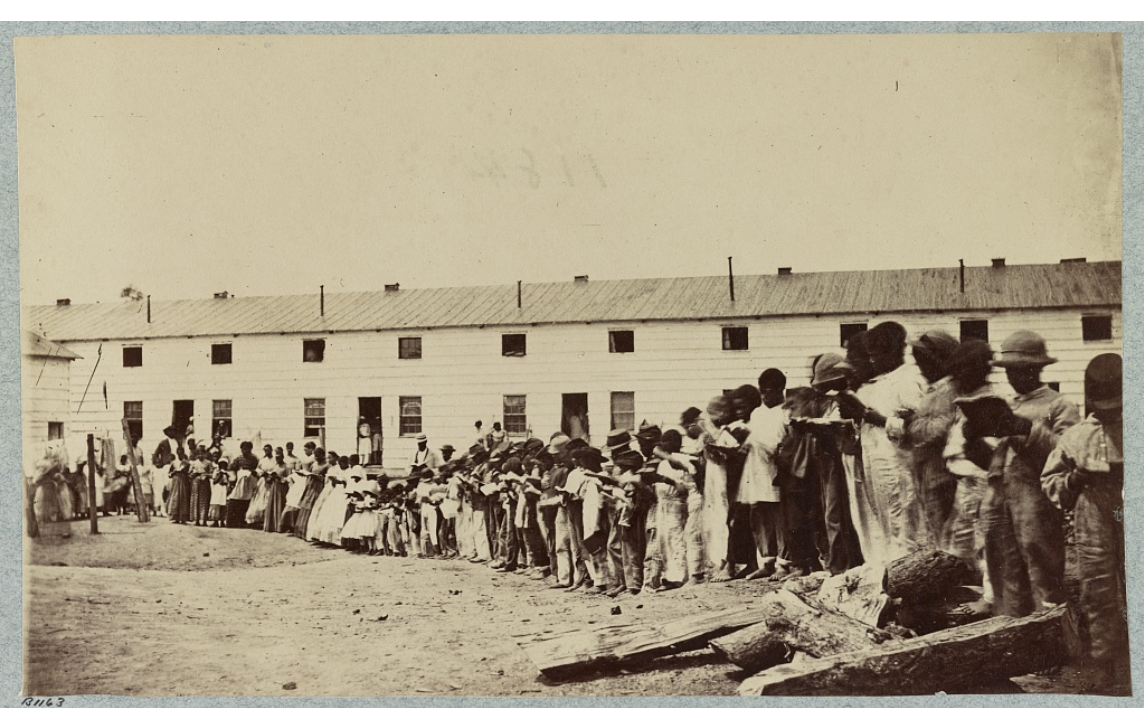
The photograph shows African-American adults and children reading books in front of their barracks. Library of Congress Prints and Photographs Division

In 1865, Truth accepted a position with the National Relief Association at Freedmen’s Village in Arlington Heights. Situated at the intersection between Columbia Pike and South Joyce Street, this stretch of land was a settlement for former slaves between 1863 and 1900. Here, Truth served as “counselor to the freed people,” and provided support at the Freedmen’s Bureau, where she collected provisions for patients in the Freedmen’s Hospital. Truth also advocated securing land grants from the government to former slaves, though these calls largely went unanswered by Congress.

Truth spent her final years in Michigan. She continued to speak on and advocate for the issues of women’s rights, universal suffrage, and prison reform until her death in 1883.

Learn more in “The Narrative of Sojourner Truth,” available at the Library and online.

2020 marked the centennial of women’s suffrage in the United States. 

November 27, 2019 by Web Editor

This Week in 19th Amendment History: The Night of Terror

Post Published: November 12, 2019

November 14, 1917

Celebrate the 100th anniversary of the 19th Amendment with stories about the people and events that led to the passage of women’s suffrage in the United States.

Just over 100 years ago this week, on November 14, 1917, a group of suffragists underwent a horrifying night of torture and abuse that would come to be known as the “Night of Terror.”

33 women protesters were taken to the Occoquan Workhouse in Fairfax County and subjected to brutal treatment by the prison’s guards in retaliation for the women’s ongoing peaceful protest for the right to vote.

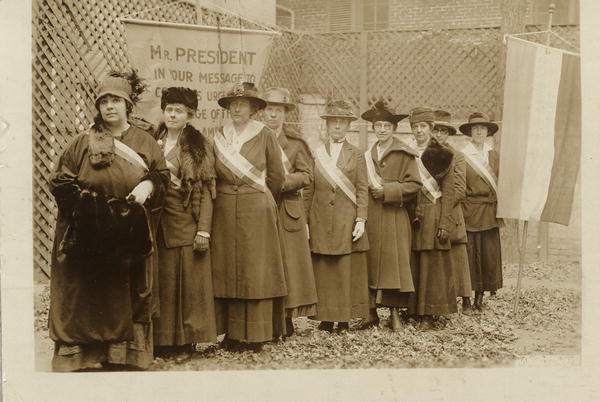
Photograph of nine suffrage pickets standing single file along a tall lattice fence, with suffrage banners. Left to R: Catherine Martinette, Elizabeth Kent, Mary Bartlett Dixon, C. T. Robertson, Cora Week, Amy Jungling, Hattie Kruger, Belle Sheinberg, Julia Emory.

Some of the picket line on Nov. 10, 1917. Left to right: Mrs. Catherine Martinette, Eagle Grove, Iowa. Mrs. William Kent, Kentfield, California. Miss Mary Bartlett Dixon, Easton, Md. Mrs. C.T. Robertson, Salt Lake City, Utah. Miss Cora Week, New York City. Miss Amy Ju[e]ngling, Buffalo, N.Y. Miss Ha. Harris & Ewing, Washington, D.C. (Photographer). Library of Congress Prints and Photographs Division.

The arrest and imprisonment of the women was the culmination of months of organized protest. In response to the reelection of Woodrow Wilson, members of the National Woman’s Party (sometimes referred to as the “Silent Sentinels”) picketed for months outside of the White House. Bolstered by banners, signs, and a consistent physical presence, they called for the president to back a federal amendment granting women the right to vote (by 1917, nine U.S. states had extended voting rights to women).

The protests – carried out on a rotating basis to ensure a constant presence at the White House - had gone smoothly following their start after Wilson’s reelection. Wilson had even invited protesters inside the White House for coffee, although the invitation was declined.

But the mood changed after the U.S. entry into World War I, on April 6, 1917. The heightened patriotic fervor made criticism of the government more and more fraught, and members of the suffrage movement suffered for their outspoken and visible criticism of the president.

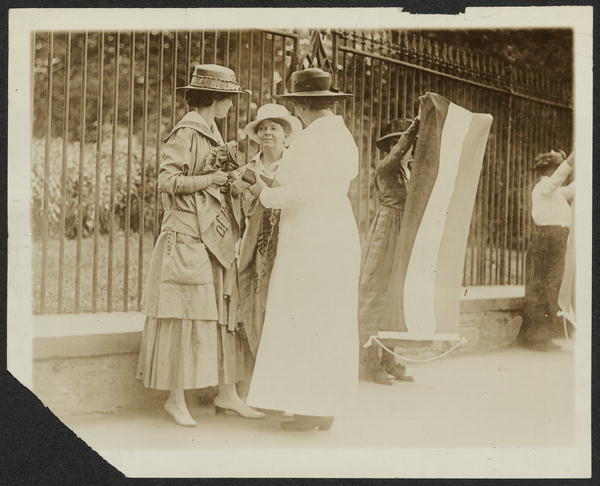
Florence Youmans of Minnesota (left), clutching a suffrage propaganda banner, and Annie Arniel of Delaware (center), being approached in front of the White House gates by an unidentified policewoman, who appears to have seized Arniel's banner, while a third unidentified suffrage picket watches from behind her tri-color purple, white, and gold National Woman's Party flag, and a fourth picket looks away in a different direction.

Policewoman arrests Florence Youmans of Minnesota and Annie Arniel (center) of Delaware for refusing to give up their banners. June 1917. Library of Congress Prints and Photographs Division.

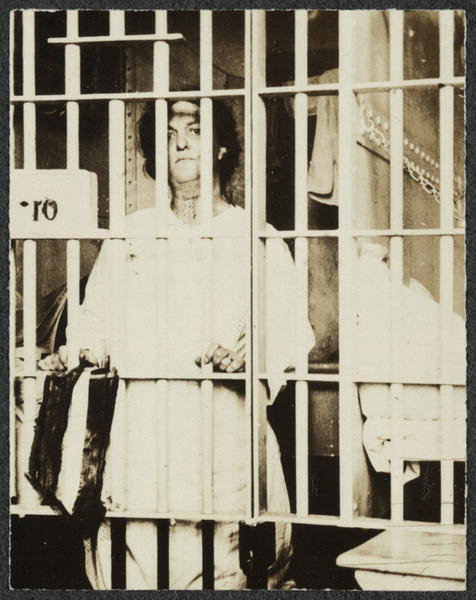
Photograph of Helena Hill Weed, facing forward, standing behind bars in a prison cell.

Helena Hill Weed, of Norwalk, CT, serving 3 day sentence in D.C. prison for carrying banner "Governments derive their just powers from the consent of the governed." July 6-8, 1917. Library of Congress Prints and Photographs Division.

In June 1917, members of the ongoing picket began to get arrested. By October, police issued an ultimatum: if the picket continued, protesters could face sentences of up to six months in prison. Many of the arrested protesters were charged with “obstructing traffic” or given fines.

Hunger strikes emerged in the jails and workhouses where protesters were held, leading to force-feeding and other violent practices carried out by prison staff. In response to this, leader Alice Paul marched from the National Woman’s Party headquarters to the White House with a banner reading: “The time has come to conquer or submit for there is but one choice - we have made it” - the same slogan President Wilson used on posters encouraging Americans to buy war bonds.

Photograph of Alice Paul emerging from National Woman's Party headquarters holding banner, followed by Dora Lewis (with no banner). Unidentified women stand with a banner in doorway of building. Banner Paul carries reads: "The Time Has Come to Conquer or Submit, For Us There Is But One Choice. [I] Have Made It. President Wilson." Paul is leading picket line from headquarters to the White House.

The day after the police announce that future pickets would be given limit of 6 mos. in prison, Alice Paul led picket line with banner reading "The time has come to conquer or submit for there is but one choice - we have made it." October 20, 1917, Harris & Ewing, Washington, D.C. (Photographer). Library of Congress Prints and Photographs Division.

Ten months into the ongoing picketing efforts, on November 13, 1917, 33 women were arrested around the White House. By the next day, they arrived at the Occoquan Workhouse, where, demanding to be recognized as political prisoners, they refused to put on prison uniforms or participate in the mandated work shifts.

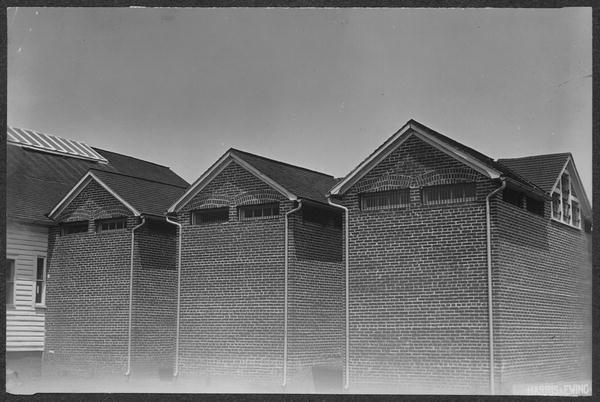
Photograph of the exterior of cell blocks at Occoquan prison.

Cell blocks at Occoquan [Workhouse], ca. 1917, Harris & Ewing, Washington, D.C. (Photographer). Library of Congress Prints and Photographs Division.

The prison guards responded with violence. On orders from Occoquan Superintendent W.H. Whittaker, guards physically assaulted the women and threw them into dark and filthy cells.

One suffragist, Dora Lewis, was violently thrown down, hitting her head on an iron bed. Alice Cosu, who witnessed this, suffered a heart attack and did not receive medical treatment until the next day.  Organizer Lucy Burns was chained with her hands over her head to the bars in her cell and forced to stand for the entirety of the night.  Fellow protester Julia Emory assumed the same position for the night in solidarity.

One of the protesters, Doris Stevens, wrote an account of the “Night of Terror” entitled “Jailed for Freedom,” which chronicled the events of their imprisonment. She included excerpts of Lucy Burn’s accounts, which were recorded clandestinely during her imprisonment on scraps of paper and smuggled out of the workhouse.


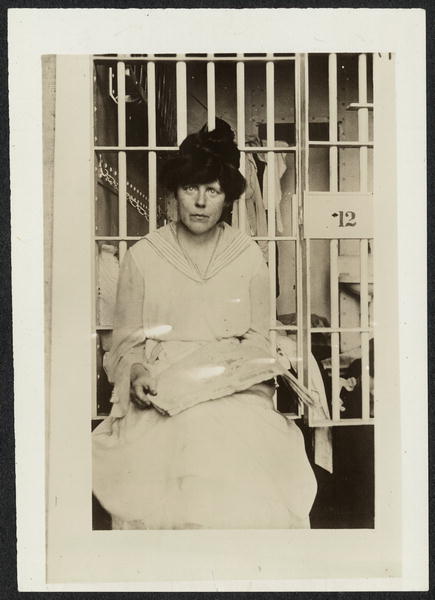
Informal portrait, Lucy Burns, three-quarter length, seated, facing forward, holding a newspaper in her lap in front of a prison cell, likely at Occoquan Workhouse in Virginia.

Miss [Lucy] Burns in Occoquan Workhouse, November 1917, Harris & Ewing, Washington, D.C. (Photographer). Library of Congress Prints and Photographs Division.

Burns writes: “(Whittaker) refused to hear our demand for political rights. Seized by guards from behind, flung off my feet, and shot out of the room. All of us were seized by men guards and dragged to cells in men’s part.”

During their time in Occoquan, many arrestees resorted to hunger strikes. In response to this, the guards force-fed the women raw eggs and milk, causing them to become ill.  At one point, marines from the nearby Quantico Station were brought in to support the Occoquan guards.  By the time the women were released, many were too weak to walk on their own.

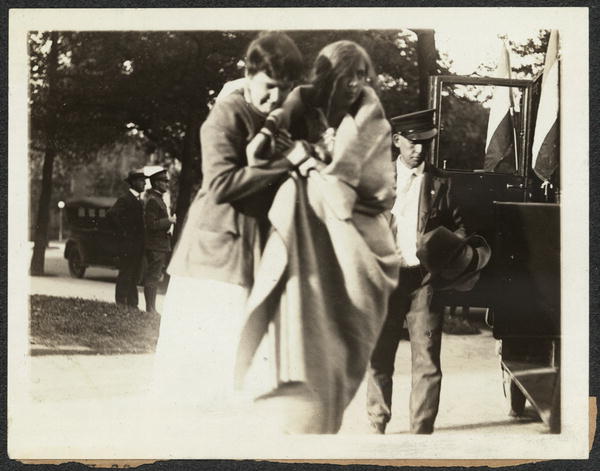
Photograph of a woman escorting Kate Heffelfinger, wrapped in blanket, outside near a car, after release from jail.

Kate Heffelfinger after her release from Occoquan Prison, ca. 1917. Library of Congress Prints and Photographs Division.

The imprisoned suffragists were returned to D.C. after a November 23 ruling determined that, since they were arrested in D.C., it was illegal to incarcerate them in Virginia.  By November 28, they were out on bail, and by March of the following year, all of their arrests had been declared unconstitutional.

In early January 1918, President Wilson expressed his support for the voting rights amendment, which passed in the House but failed in Senate.  It would take until 1920 before the amendment was formally incorporated into the U.S. Constitution. The “Night of Terror” remains a pivotal point in the struggle for suffrage, a true show of the solidarity of the protesters and the lengths to which they would go for their cause – and the lengths their opposition would go to hamper their efforts.

Research sources used in this piece:

  • The Night of Terror: When Suffragists Were Imprisoned and Tortured in 1917 - History.com
  • Wilson and Women's Suffrage - PBS American Experience
  • Suffragist History - Turning Point Suffragist Memorial
  • Women of Protest: Photographs from the Records of the National Woman's Party - Library of Congress
  • History of the Workhouse - Workhouse Art Center
  • "In 1917, the ‘Night of Terror’ at a Virginia prison changed history. Now it’s a site of beauty" - Los Angeles Times
  • "‘Night of terror’: The suffragists who were beaten and tortured for seeking the vote" - Retopolis, Washington Post

Read about Gertrude Crocker, Arlington's own Silent Sentinel suffragette, also jailed multiple time in 1917.

Learn more in these books available at the Library:

  • "The long loneliness: the autobiography of Dorothy Day," by Dorothy Day
  • "Mr. President, how long must we wait?: Alice Paul, Woodrow Wilson, and the fight for the right to vote," by Tina Cassidy
  • "Votes for women!: American suffragists and the battle for the ballot," by Winifred Conkling

2020 marks the centennial of women’s suffrage in the United States. 

November 12, 2019 by Web Editor

This Week in 19th Amendment History: National Woman’s Rights Convention

Post Published: October 22, 2019

October 23, 1850

Celebrate the 100th anniversary of the 19th Amendment with stories about the people and events that led to the passage of women’s suffrage in the United States.

On October 23, 1850, the first National Woman’s Rights Convention began in Worcester, Massachusetts. Amidst the ringing fervor of the mid-19th-century clarion call for expanding women’s rights – with the right to vote as its central tenet – this day would emerge as a significant step in solidifying the goals and action plan of the women’s suffrage movement in the United States.

Womans convention 2

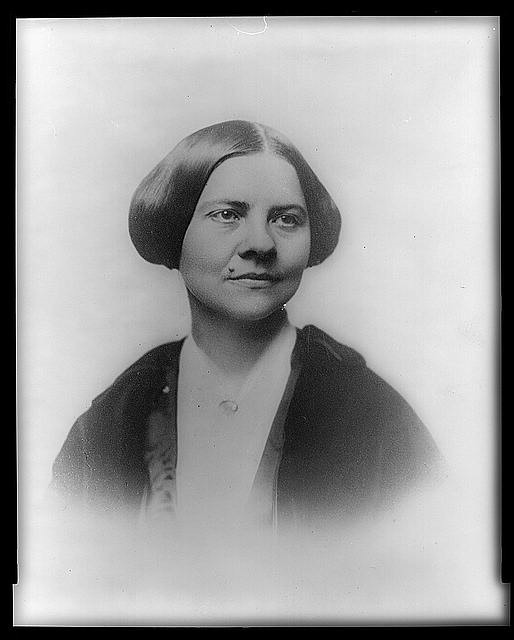
Lucy Stone, one of the Convention’s lead organizers and a speaker at the event.

Held over two days in Worcester, Massachusetts, the 1850 Woman’s Rights Convention was planned by members of the Anti-Slavery Society, among them Lucy Stone, Abby Kelley Foster, Paulina Wright Davis and Harriot Kezia Hunt.

Davis – a New York suffrage advocate who helped petition for the passage of the Married Women’s Property Act of 1848 – would later be elected president of the convention during the event’s proceedings.

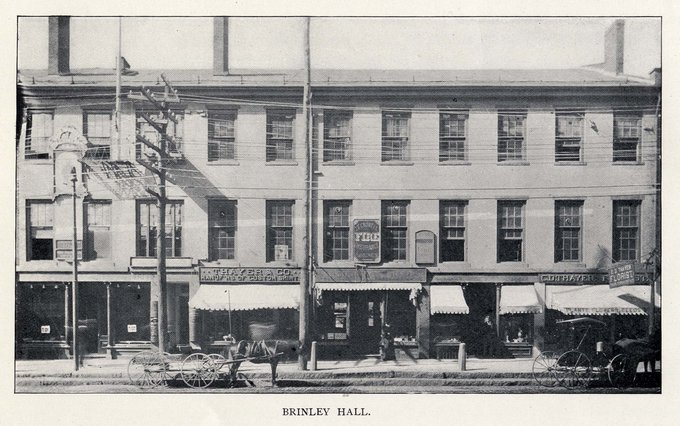
More than 1,000 delegates from 11 states gathered in Worcester’s Brinley Hall for numerous speeches on topics ranging from the right to vote, owning property, and women’s admittance to the fields of higher education, medicine, and the ministry.

Brinley Hall Postcard

Brinley Hall, Worcester, MA, where the National Woman’s Convention was held in 1850 and 1851. Photo from the Massachusetts State Library.

Among the convention’s attendees were Frederick Douglass, William Lloyd Garrison, and Sojourner Truth. Truth and many other prominent suffragists, including Ernestine Rose, Antoinette Brown and Lucretia Mott, delivered speeches over the course of the convention.

The press was largely derisive in its reporting on the convention. The New York Herald, for instance, attacked the speakers’ appearances and portrayed the attendees' demands as ridiculous, framing the convention in their headlines as an “Awful combination of socialism, abolitionism and infidelity. The Pantalettes striking for the Pantaloons. Bible and Constitution Repudiated.”

In a satirical take, the newspaper reported that the Woman’s Rights Convention organizers aimed to:

  1. abolish the Bible
  2. abolish the constitution and the laws of the land
  3. reorganize society upon a social platform of perfect equality in all things, of sexes and colors
  4. establish the most free and miscellaneous amalgamation of sexes and colors
  5. elect Abby Kelley Foster President of the United States and Lucretia Mott Commander-in-chief-of the Army
  6. cut throats ad libitum
  7. abolish the gallows

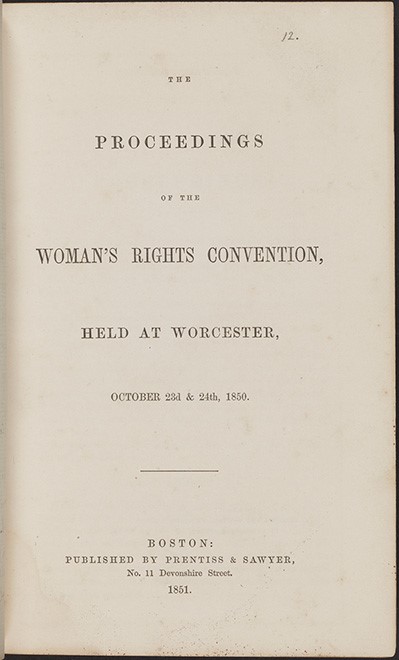
In some ways, this condescending portrayal helped expand the notoriety and message of the convention. The convention’s proceedings were recorded and sold after the event as pamphlets, gaining international readers and recognition.

Womans convention 1

The Proceedings of the Woman’s Rights Convention, held at Worcester, October 23d & 24th, 1850. Boston: Prentiss & Sawyer, 1851. Source: NAWSA Collection, Rare Book and Special Collections Division, Library of Congress (014.00.00)

The British writer and women’s rights advocate Harriet Taylor Mill was significantly inspired by the events of the convention, referencing the organizer’s work in her 1851 piece “The Enfranchisement of Women.”

The 1850 convention would be the first of many national events that would occur annually from this point forward for about a decade, setting a precedent for national suffrage organizing.

The twelfth and final Woman’s Rights Convention would be held in 1869 in Washington, D.C. This would be the last meeting of an organized suffrage front: later in 1869, the movement would split into two groups, divided by the issue of suffrage for other disenfranchised populations.

Under the leadership of Elizabeth Cady Stanton and Susan B. Anthony, the National Woman Suffrage Association directly opposed the 14th and 15th Amendments that would have allowed for African-American men to vote. Lucy Stone and others would go on to form the American Woman Suffrage Association, which supported the 15th Amendment. The suffrage movement would not see widespread unification again until 1890 with the establishment of the National American Woman Suffrage Association, bringing together Stanton, Anthony, Stone, Howe and other suffrage leaders, including Alice Paul and Mary Church Terrell. The group would hold its first convention in 1890 in Washington, D.C.

The 1850 National Woman’s Suffrage Convention represents a historic moment in the suffrage cause, on both scale and in terms of what resulted from the meeting. Although large suffrage conventions had been held in the past – most notably, the 1848 Seneca Falls Convention in New York -- this was the first time a convention of its sort was held on a national level.

This event set an organizing precedent within the suffrage movement for decades to come.

Learn more in “Women’s Suffrage in America: An Eyewitness History” by Elizabeth Frost-Knappman and Kathryn Cullen-DuPont, available at the Library.

2020 marked the centennial of women’s suffrage in the United States. 

October 22, 2019 by Web Editor

This Week in 19th Amendment History: Agatha Tiegel Hanson

Post Published: October 14, 2019

October 17, 1959

Celebrate the 100th anniversary of the 19th Amendment with stories about the people and events that led to the passage of women’s suffrage in the United States.

“Woman should be free as the air to learn what she will and to devote her life to whatever vocation seems good to her.”

On October 17, 1959, Agatha Tiegel Hanson, the first female graduate (and valedictorian) of Gallaudet University and an early champion of both deaf and women’s rights, passed away at age 86.

Hanson was born in 1873 in Pittsburgh, Pennsylvania. She became deaf and lost her eyesight in one eye at the age of 7 due to spinal meningitis. In 1888, at only 15 years old, Hanson enrolled at Gallaudet University in Washington, D.C., which remains to this day the world’s only university designed to be barrier-free for deaf and hard of hearing students. Gallaudet had only provisionally accepted a small group of female students by that time, and none of them had completed the requirements for a degree.

In 1888, when Hanson entered Gallaudet, women were permanently allowed enrollment to the university. Enrollment, however, came with limitations. Because of the dearth of facilities for women, all female students were required to live in House One, an on-campus residence that also served as the president’s home.

Women could only participate in campus extracurriculars by invitation, and were not allowed to participate in debates with male students. Female students were also not permitted to leave the campus alone, and could only attend classes, extracurriculars, and meetings of the campus’s male-led literary societies with a chaperone.

In response to these various barriers placed on women at the university, Hanson organized a women’s debate group that would meet in their residence at House One. Due to the success of this endeavor, by 1889 the university president lifted the ban on women’s activities.

Hanson and a fellow student, May Martin, established O.W.L.S., a secret society for women. The group would meet to debate, discuss poetry and literature, and establish bonds of sisterhood – filling in the social gaps left in their male majority campus. In January of 1892, the group held its first meeting, and Hanson was elected its first president. The group, now known as the Phi Kappa Zeta sorority, still has an active chapter on the Gallaudet campus.

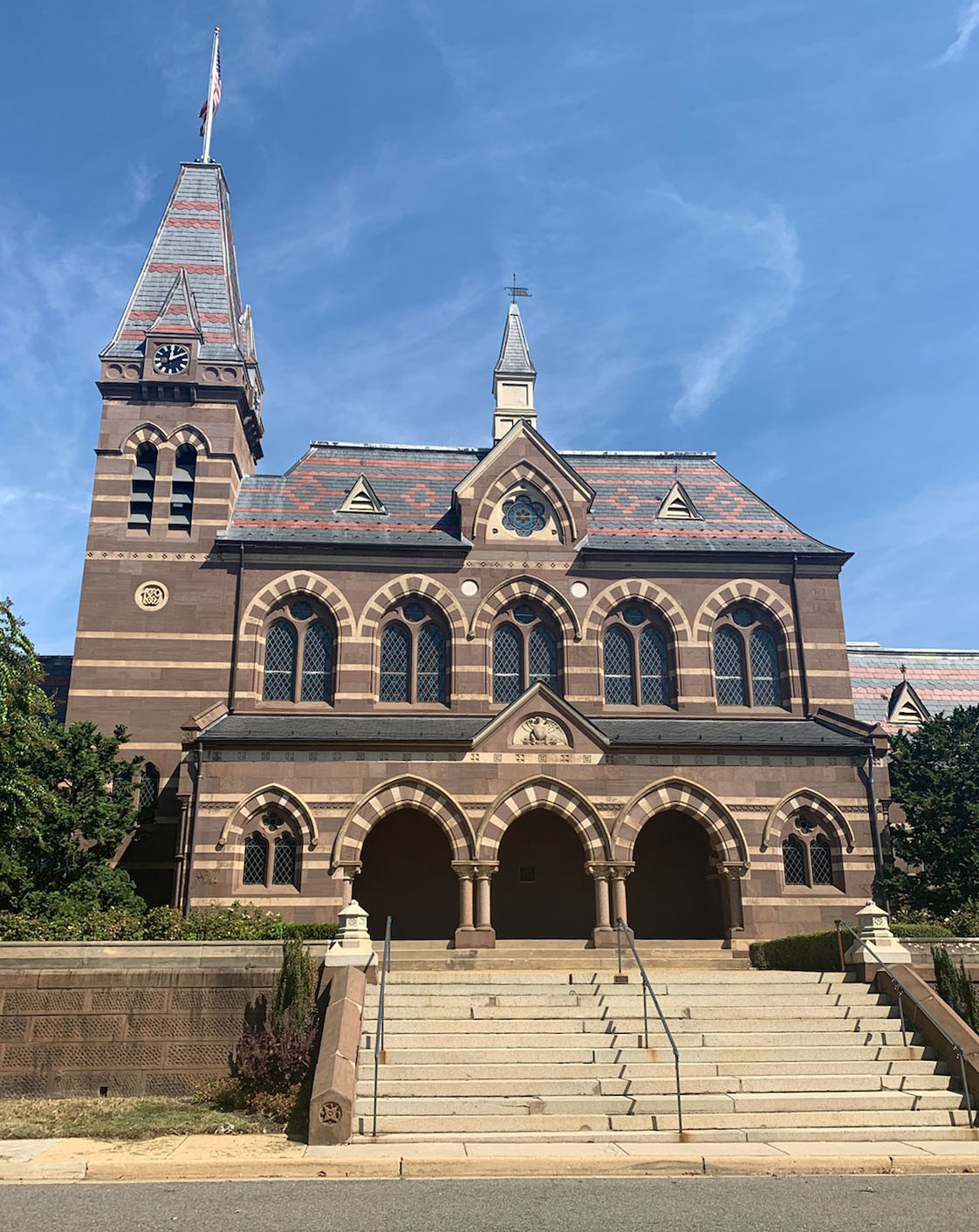
National Deaf Life museum, at Chapel Hall Gallaudet University

National Deaf Life Museum, at Chapel Hall, Gallaudet University, 2019. From 2015-2017 the Museum presented Deaf HERstory, which will become part of their virtual exhibition in the near future. Photo courtesy of Michelle Fernandez.

Hanson graduated from Gallaudet in 1893 as the university’s first woman to receive a Bachelor of Arts degree, and first female valedictorian. Upon graduation, Hanson delivered the commencement speech, entitled “The Intellect of Women,” in which she railed against the structural inequalities that stood between women and success:

"That such repression and restraint upon mental action are artificial has been demonstrated in all ages by women whose independence has bust every fetter and won them recognition in the fields of sciences, theology, literature, politics, and art. It is impossible to estimate the immensity of the influence that woman's mind has exerted on the history of the world, an influence silently wielded and never obtruded, but of a potency inferior to no other. If, during these ages of wrong custom, of false sentiment, she has often retained much of her greatness of intellect and soul, she will better do justice to her inborn powers when she has room and light in which to grow."

Following her graduation from Gallaudet, Hanson went on to teach at the Minnesota School for the Deaf. She later relocated to the Pacific Northwest, where she became involved in the Puget Sound Association of the Deaf, the Episcopal Church’s deaf mission, and the Washington State Association of the Deaf.

Hanson was also a prolific writer, contributing to “The Silent Worker” – a national newspaper serving the deaf community – as well as publishing a book of poetry entitled “Overflow Verses.” She also later served as an editor at the Seattle Observer, a newspaper for the deaf.

Learn more about the disability rights movement in “A Disability History of the United States” by Kim E. Nielsen, available in the Library catalog.

2020 marked the centennial of women’s suffrage in the United States.

October 14, 2019 by Web Editor

On This Day in 19th Amendment History: Mary Church Terrell

Post Published: September 23, 2019

September 23, 1863

Celebrate the 100th anniversary of the 19th Amendment with stories about the people and events that led to the passage of women’s suffrage in the United States.

On September 23, 1863, renowned civil rights activist Mary Church Terrell was born in Memphis, Tennessee. A tireless champion of women’s rights and racial justice, Terrell was especially active in the Washington, D.C. area, where she lived for much of her life.

Mary Church Terrell

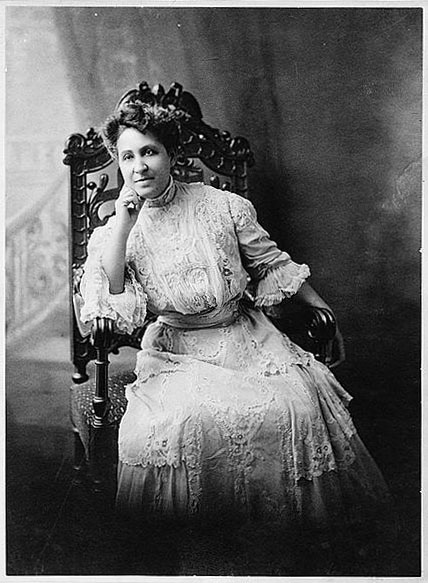
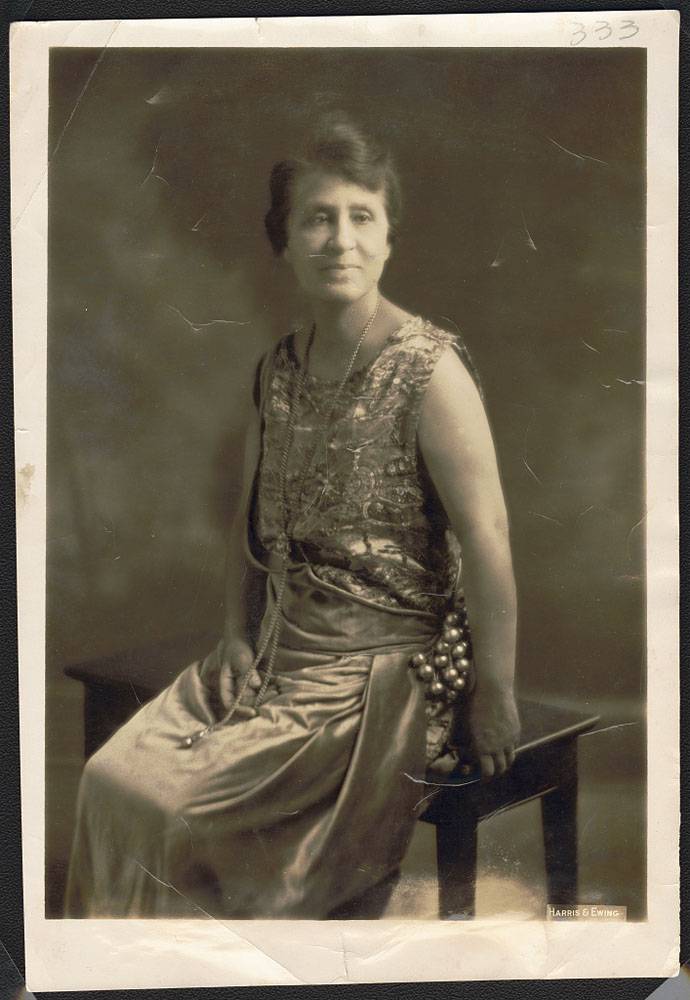
Mary Church Terrell, photo taken between 1880 and 1900, printed later. Library of Congress Prints and Photographs Division.

Mary Church Terrell was born to two former slaves turned successful entrepreneurs. Her father, Robert Church, was known as the South’s first black millionaire.

Her privileged upbringing placed Terrell among the rising black middle and upper classes who used their position to fight racial discrimination. She was one of the first black women to earn a college degree, and her studies at Oberlin College exposed her to the growing suffrage movement in the United States.

In the wake of Plessy v. Ferguson, the 1896 Supreme Court decision that upheld the constitutionality of racial segregation under the “separate but equal” doctrine, black women from across the country gathered at a three-day convention in Washington, D.C. This convention resulted in the birth of the National Association of Colored Women, which consolidated several advocacy groups into one. Terrell was elected the first president of the group at the end of the convention, serving until 1901 and coining the group’s motto, “Lifting as we climb.” As president, she toured the country giving lectures, and wrote various essays that were published in papers across the nation including “Lynching from a Negro’s Point of View,” which ran in the North American Review in 1904. An accomplished educator, Terrell made history as the first black woman on the D.C. Board of Education from 1895-1911.

Terrell was an active member of the National American Woman Suffrage Association (NAWSA), through which she developed a lifelong association with Susan B. Anthony. At the 1898 NAWSA convention, Terrell specifically appealed to the organization to fight for the enfranchisement of black women. Between 1904 and the ratification of the 19th amendment in 1920, she was active in the suffrage cause as a lecturer, writer and organizer in Washington, D.C. and across the nation. In 1904, she was the first black woman to attend the International Congress of Women in Berlin, where she delivered her speech in German, French, and English. She was a founding member of the NAACP, signing onto its charter in 1909.

In 1913, the day before Woodrow Wilson’s inauguration, Terrell led the Delta Sigma Theta sorority of Howard University in a strike organized by NAWSA in support of women’s suffrage. Two presidential terms later, she was involved in the Republican Party’s organizational efforts, campaigning for Warren G. Harding in 1919. Harding won the 1920 election, the first in which (predominantly white) women could vote. While the fight for women’s suffrage was settled, many black women, particularly in the South, remained disenfranchised. It would be decades before the Voting Rights Act overturned discriminatory voter registration laws. Knowing the fight was not over, Terrell remained a dedicated activist for the rest of her life.

Mary Church Terrell, three-quarter length portrait, seated, facing front

Mary Church Terrell, three-quarter length portrait, seated, facing front. Harris & Ewing, photographer, taken between 1920 and 1940. Library of Congress Prints and Photographs Division.

In 1950, long after the fight for suffrage had been won, Terrell again gained visibility as an activist, this time in the fight for racial justice. That January, 86-year-old Terrell entered Thompson’s Restaurant in Washington, D.C., which was still segregated. The restaurant refused to serve Terrell and her companions. This set off a 3-year court battle, ultimately resulting in a unanimous ruling in District of Columbia v. John R. Thompson Co., Inc., which formally desegregated Washington, D.C., restaurants.

Learn more about Mary Church Terrell in “Just Another Southern Town: Mary Church Terrell and the Struggle for Racial Justice in the Nation's Capital” by Joan Quigley, available at the Library.

2020 marked the centennial of women’s suffrage in the United States. 

September 23, 2019 by Web Editor

  • « Go to Previous Page
  • Page 1
  • Page 2

Primary Sidebar

News

Composite consisting of ten book covers.

New November Releases

We're grateful for authors and stories. This … ... about New November Releases

Read More News

Operations Updates

See More Service Updates

Center for Local History

Photo of President Lyndon B. Johnson shaking hands with Martin Luther King, Jr., at the signing of the Voting Rights Act of 1965. Photograph by Yoichi Okamoto. Courtesy of the Lyndon B. Johnson Library.

The Voting Rights Act of 1965: Remarks by Rev. Dr. DeLishia A. Davis

NAACP Arlington Branch president and pastor Dr. … ... about The Voting Rights Act of 1965: Remarks by Rev. Dr. DeLishia A. Davis

Read More Local History

Director’s Blog

Library Director Diane Kresh talking to a FOAL book sale customer.

Director’s Message: We’re Not Going Anywhere

Library Director Diane Kresh talking to a FOAL … ... about Director’s Message: We’re Not Going Anywhere

More Director's Blog

Recent Comments

  • Rick Reeder on Great Books You Might Have Missed in 2024
  • Mary Smaragdis on Great Books You Might Have Missed in 2024
  • Carol_R on Parkington

Footer

About Us

  • Mission & Vision
  • Charlie Clark Center for Local History
  • News Room
  • Get Email Updates

Administration

  • Policies
  • Library Staff
  • Job Opportunities
  • Propose a Program or Partnership

Support Your Library

  • Friends of the Library
  • Giving Opportunities
  • Donating Materials
  • Volunteer Opportunities

Our Mission

We champion the power of stories, information and ideas.

We create space for culture and connection.

We embrace inclusion and diverse points of view.


Download the Library App

Download the Library App

Arlington County | Terms & Conditions | Accessibility | Site Map
· Copyright © 2025 Arlington County Government ·