• Skip to primary navigation
  • Skip to main content
  • Skip to footer
Home - Arlington County Virginia - Logo
MENUMENU
  • Join Now
  • My Account
    • Login
    • My Checkouts
    • My Holds
    • My Lists
    • My Reading History
    • About Borrowing
    • About Holds
    • About My Account
  • Hours & Locations
    • All Hours & Locations
    • Holiday Closings
  • News
    • Library News
    • Director's Blog
    • Get Email Updates
  • Contact Us

Arlington Public Library

MENUMENU
  • Search
  • Collections
  • Library Services
  • Events
  • Community Engagement
  • Join Now
  • My Account
    • Login
    • About Borrowing
    • About Holds
    • About My Account
  • Hours & Locations
    • All Hours & Locations
    • Holiday Closings
  • News
    • Library Blog
    • Get Email Updates
  • Contact Us

Throwback Thursday

The Early History of Arlington’s Libraries

Post Published: August 6, 2020

Arlington’s Libraries have been a mainstay of the county landscape for generations – but how did the library system as we know it come to be?
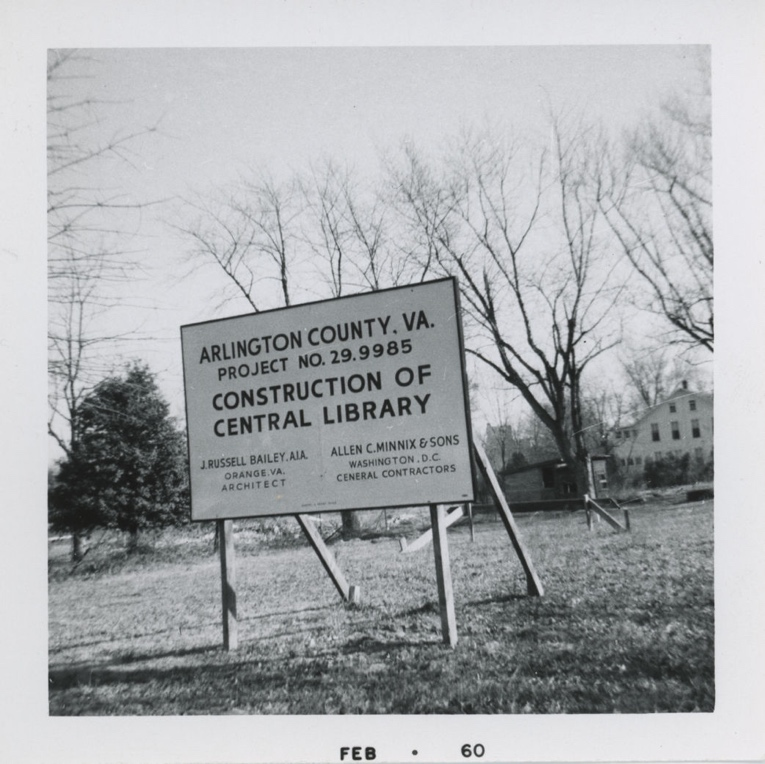
Construction Central Library

Construction signage for Arlington’s Central Library, February 1960.

Before the year 1936, Arlington County had been served by five independent libraries: Glencarlyn, Cherrydale, Clarendon, Aurora Hills, and Arlington/Columbia Pike. These were volunteer-led efforts run independently rather than as a unilateral system, and that individually received limited financial support from the County. These locations were largely established and managed by women members of the Arlington community.

In 1936 however, the Public Library system changed forever. A group of citizens and representatives from those five libraries joined together to form a collective Countywide system and to appeal for increased County financial support. Four delegates from each branch as well as four delegates at large met to discuss the possibility of a cohesive, singular library system and what that would entail.
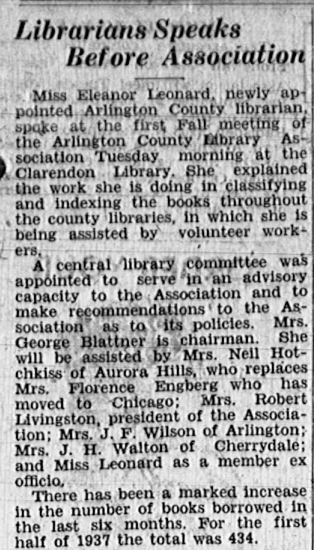
Article From NVA 1
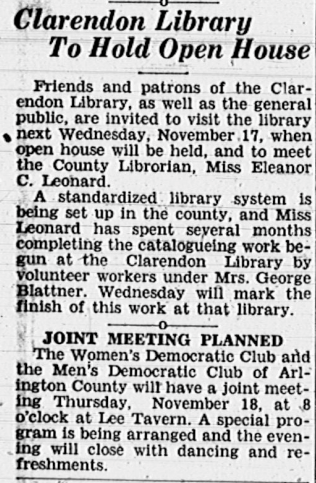
Article From NVA 2

Articles from the Northern Virginia Sun describing the early efforts of Eleanor Leonard and the Arlington County Library Association. From September 17, 1937 (L), and November 11, 1937 (R).

A year later, in 1937, the newly formed Arlington County Library Association began work to establish Arlington’s first library system. In its early days, the Association completed a survey of the County’s libraries, population and resources to help guide their planning process. The group also conducted an “educate-your-county-officials” campaign, and eventually won their support. The County Manager at the time, Frank Hanrahan, agreed to their proposal under the condition that the proposed branches would need to meet ALA standards.

The group also voted unanimously to hire a professional librarian to oversee the formation of the library system. The County government later designated $3,500 to the libraries', $3,000 of which was for operational costs and $500 to pay the salary of the hired librarian.
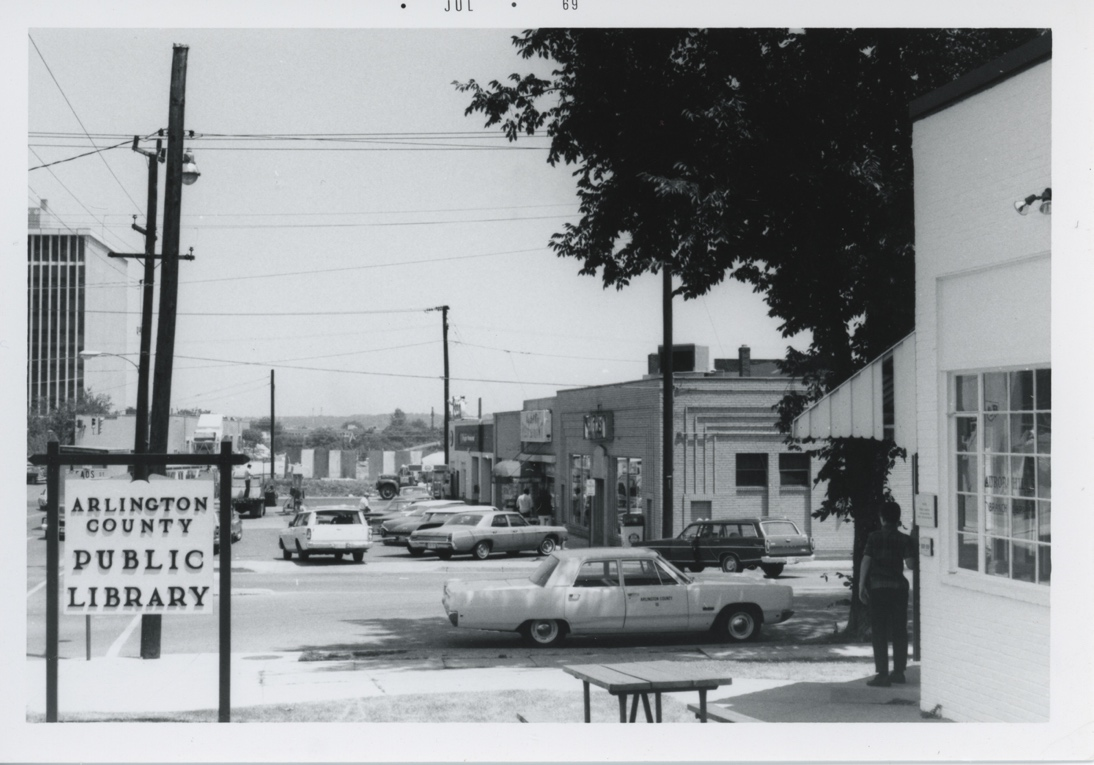
Aurora Hills

The Aurora Hills branch of the Arlington Public Library, July 1969.

In July of 1937, Eleanor Leonard was hired for the librarian position. Among her efforts to standardize and streamline the library system, she discarded damaged material, cataloged the library’s holdings, and trained volunteers in all aspects of library work. By the fall of 1939, the five libraries had been standardized, while the daily work of running the libraries continued to be done by volunteers. By July 1938, 11,328 books had been reclassified and cataloged according to American Library Association standards.
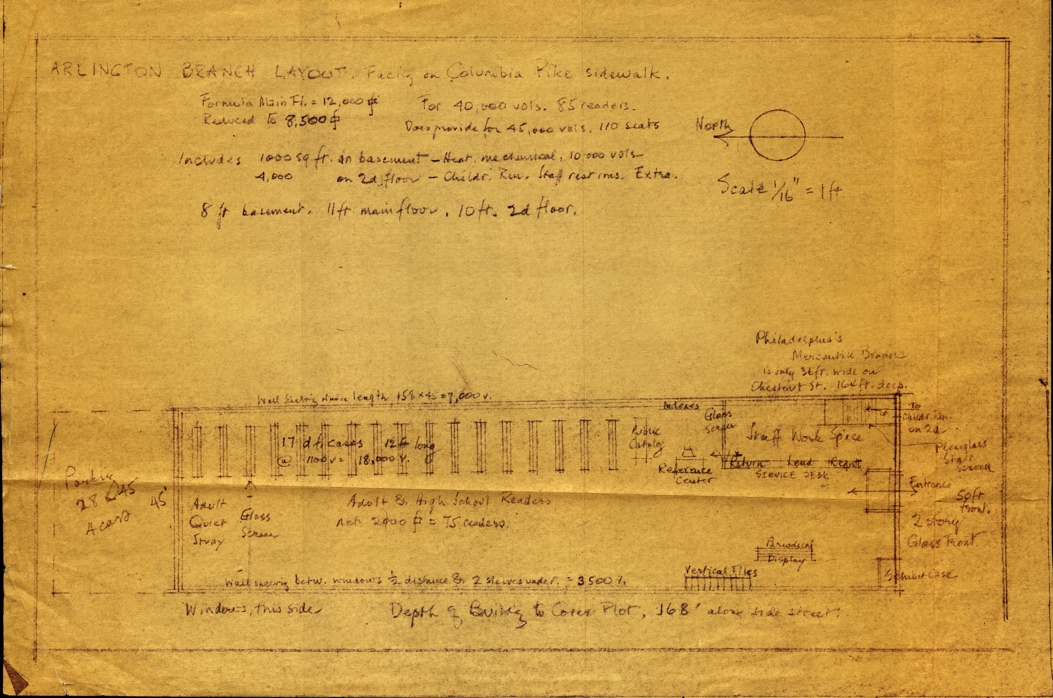
Architecture Columbia Pike

Architectural plans for the Columbia Pike Library, date unknown.

About a decade later, in 1949, eight branches were in operation, among them: Aurora Hills, Cherrydale, Clarendon, Columbia Pike, Glen Carlyn, Holmes, Shirlington (formerly Fairlington), and Westover branches.

The Holmes branch closed in 1949, and the Clarendon location became the Central Library, while the rest of the branches continue to stand where they are today, ready to serve their respective local communities again once the pandemic is over.
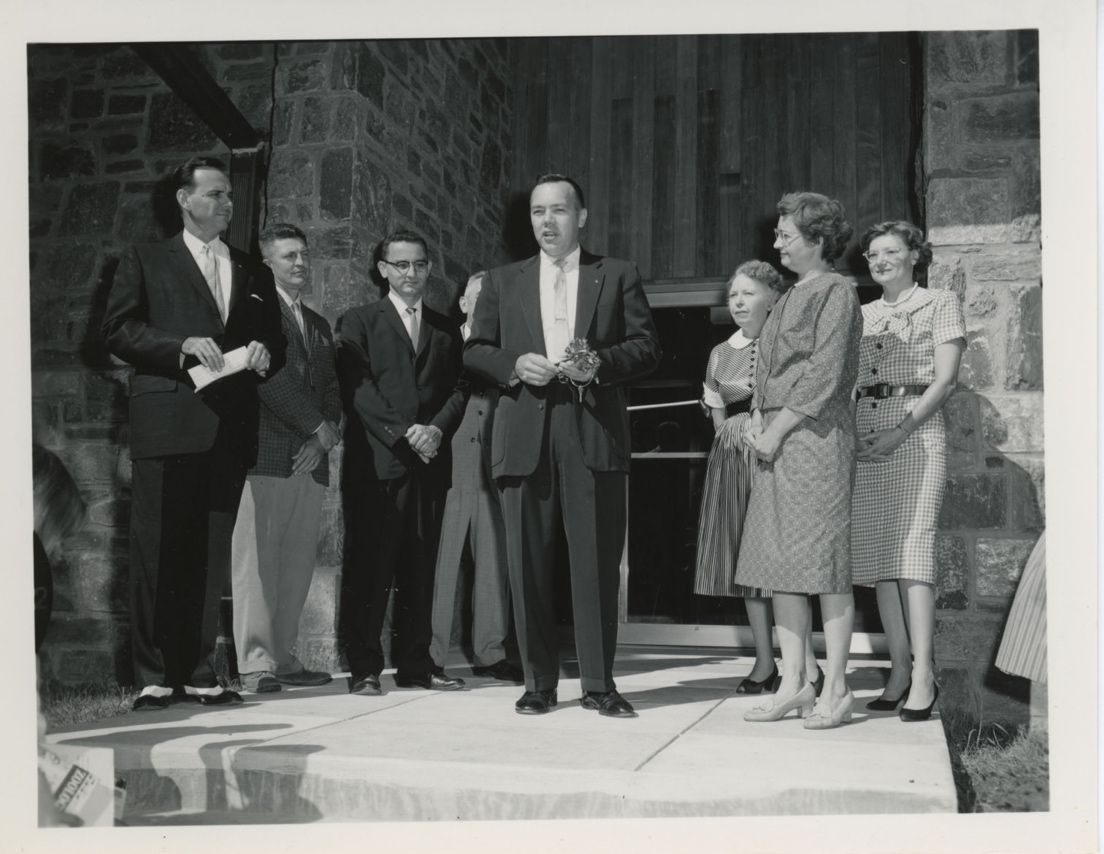
Cherrydale Opening

Cherrydale Library opening celebration, 1961.
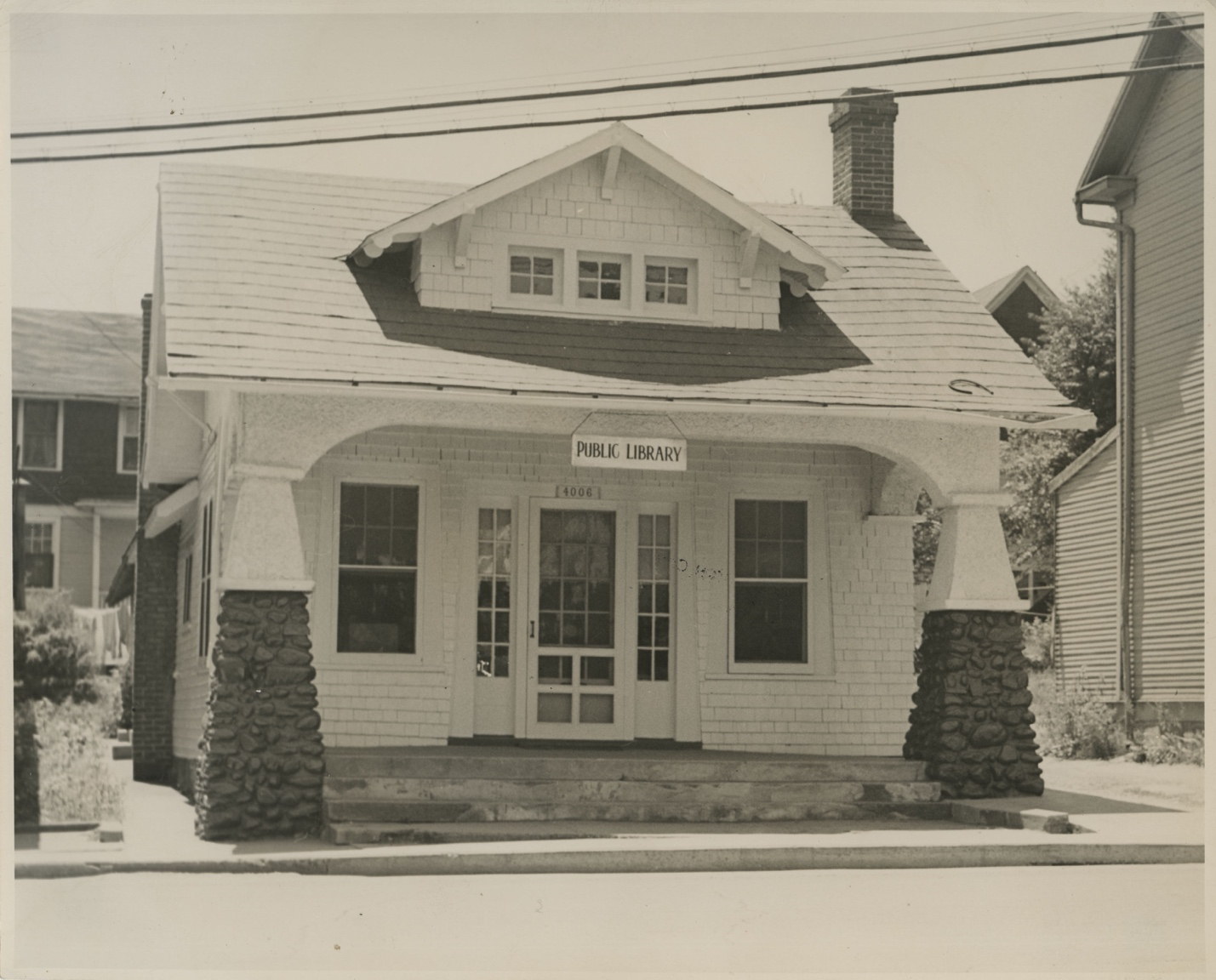
Cherrydale Library

Front side of the Cherrydale Library at 4006 Lee Highway, where it operated from 1946-1961.

This post is a condensed version of the “Libraries” section of the Library’s Women’s Work project, featuring materials from RG 29: Arlington County Public Library Department Records.

To learn more about Arlington's history, visit the Center for Local History on the first floor of the Central Library.

Do you have a question about this story, or a personal experience to share? 

Use this form to send a message to the Center for Local History.

Center For Local History - Blog Post Message Form

Do you have a question about this story, or a personal experience to share? Use this form to send a message to the Center for Local History.

"*" indicates required fields
This field is for validation purposes and should be left unchanged.

Share Your Story

August 6, 2020 by Web Editor

Celebrating Dark Star Park

Post Published: July 30, 2020

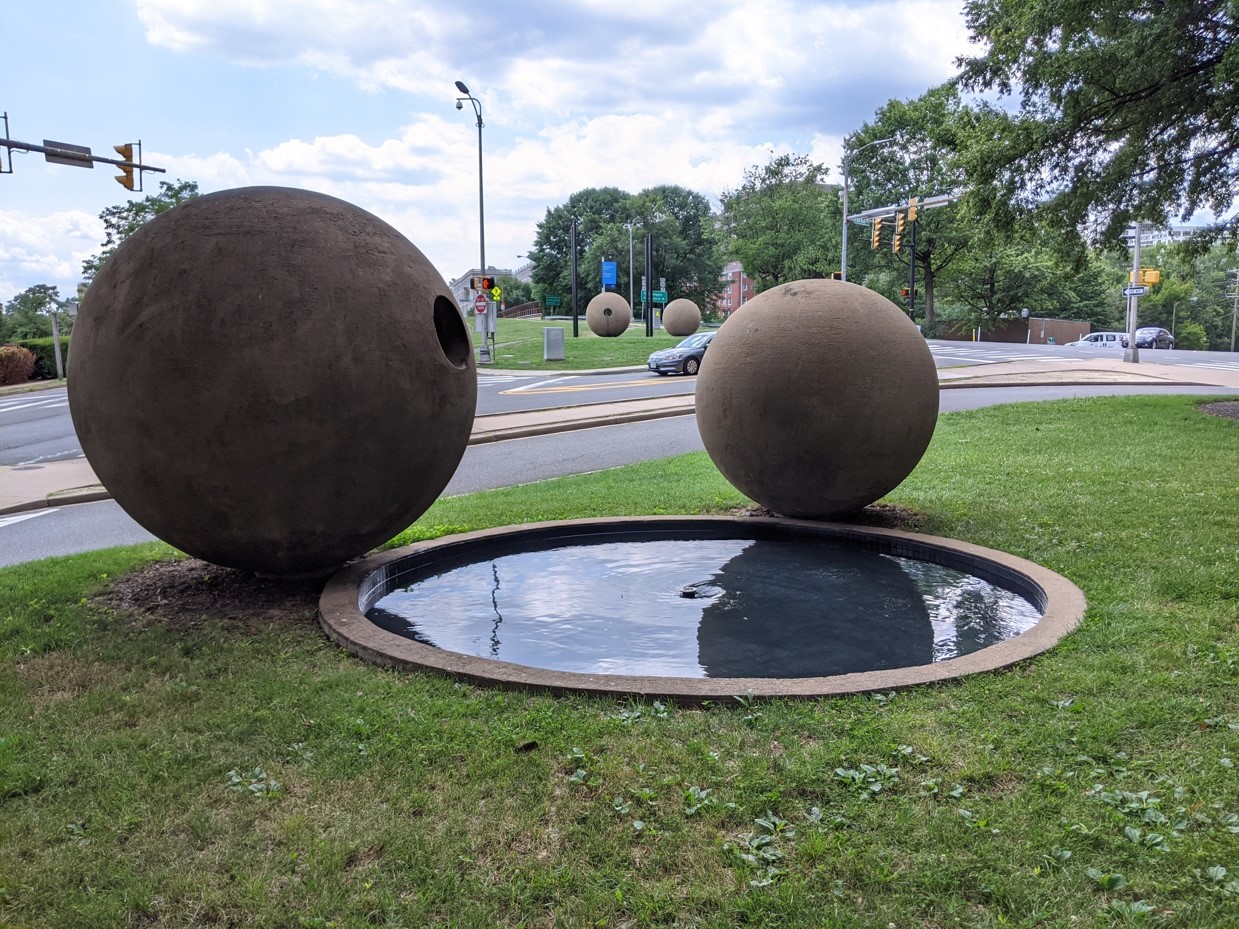
Reflecting Pool

One of the reflecting pools at Dark Star Park. Image courtesy of Camryn Bell.

Embedded between the office buildings, businesses, and roadways of Rosslyn is a unique piece of public art - Dark Star Park. Each summer, at approximately 9:30 a.m. on August 1, morning light strikes the group of large spheres that make up the sculpture to create an eclipse-like effect, which lasts - much like a real eclipse - only for a few minutes.

How did this unusual public sculpture come to be?

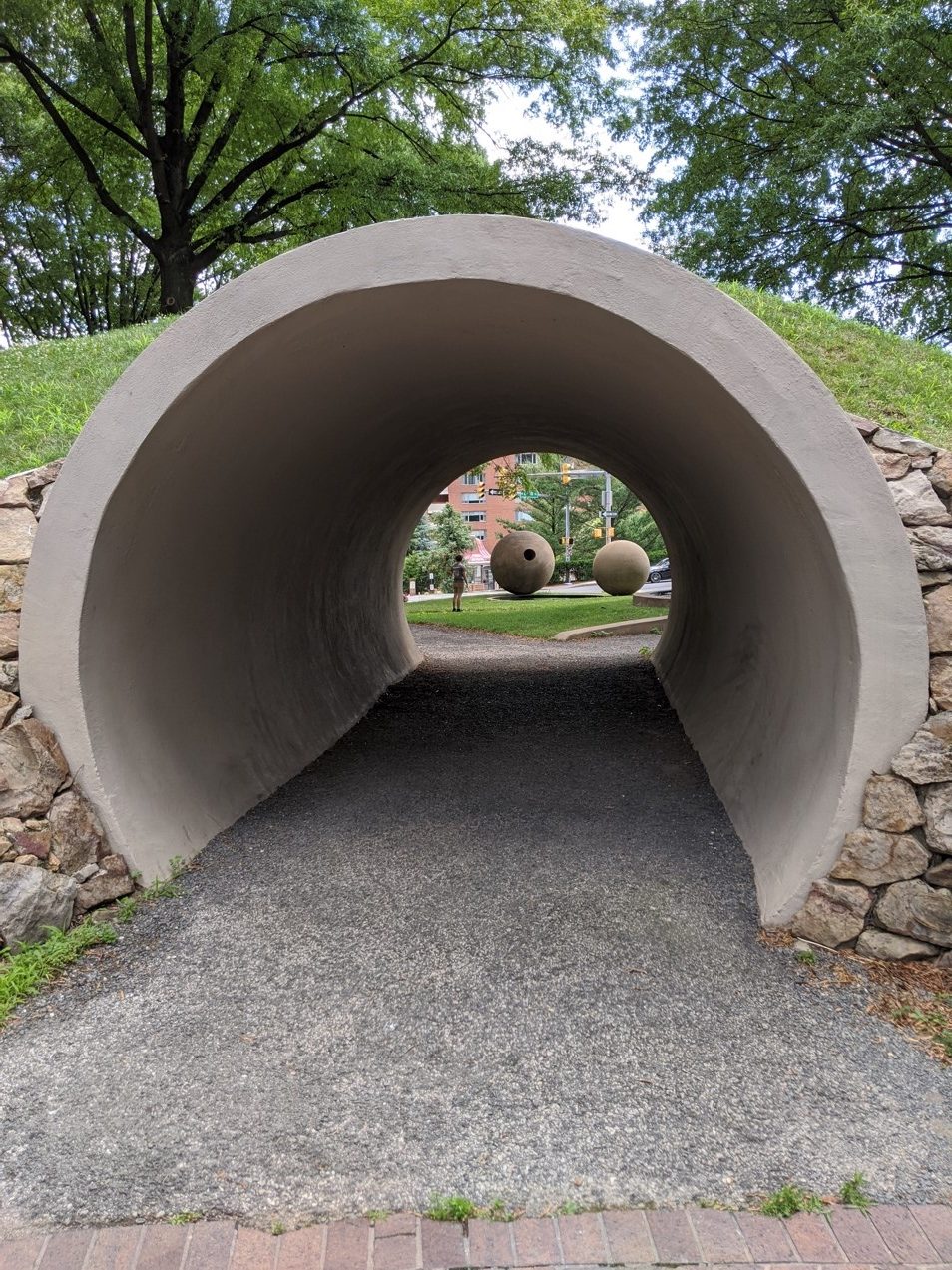
Tunnels

View from one of the tunnels at Dark Star Park. Image courtesy of Camryn Bell.

Dark Star Park 35th Anniversary Celebration – this Arlington TV feature showcases the August 1st, 2019, alignment of light and shadow at the park, and is accompanied by an original score from local artists Janel and Anthony.

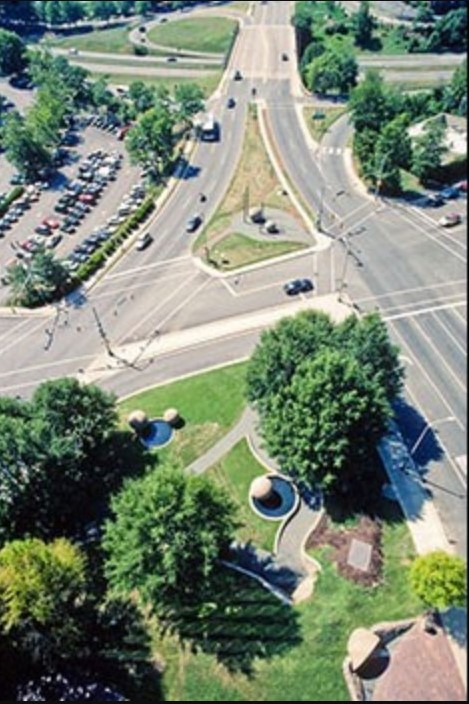
Built in 1984, Dark Star Park is the entry to the Rosslyn neighborhood, at a triangle formed by the intersection of North Fort Myer Drive, North Lynn Street, and N. Meade Street. It was constructed on the site of a former gas station, occupies 0.4 acres of land, and was designed to commemorate the anniversary of the purchase of the land by William Henry Ross, which would later become Rosslyn (Ross served as the neighborhood's namesake).

Dark Star Park seen from above shows an intersection with trees

Aerial view of Dark Star Park. Image courtesy of Arlington County.

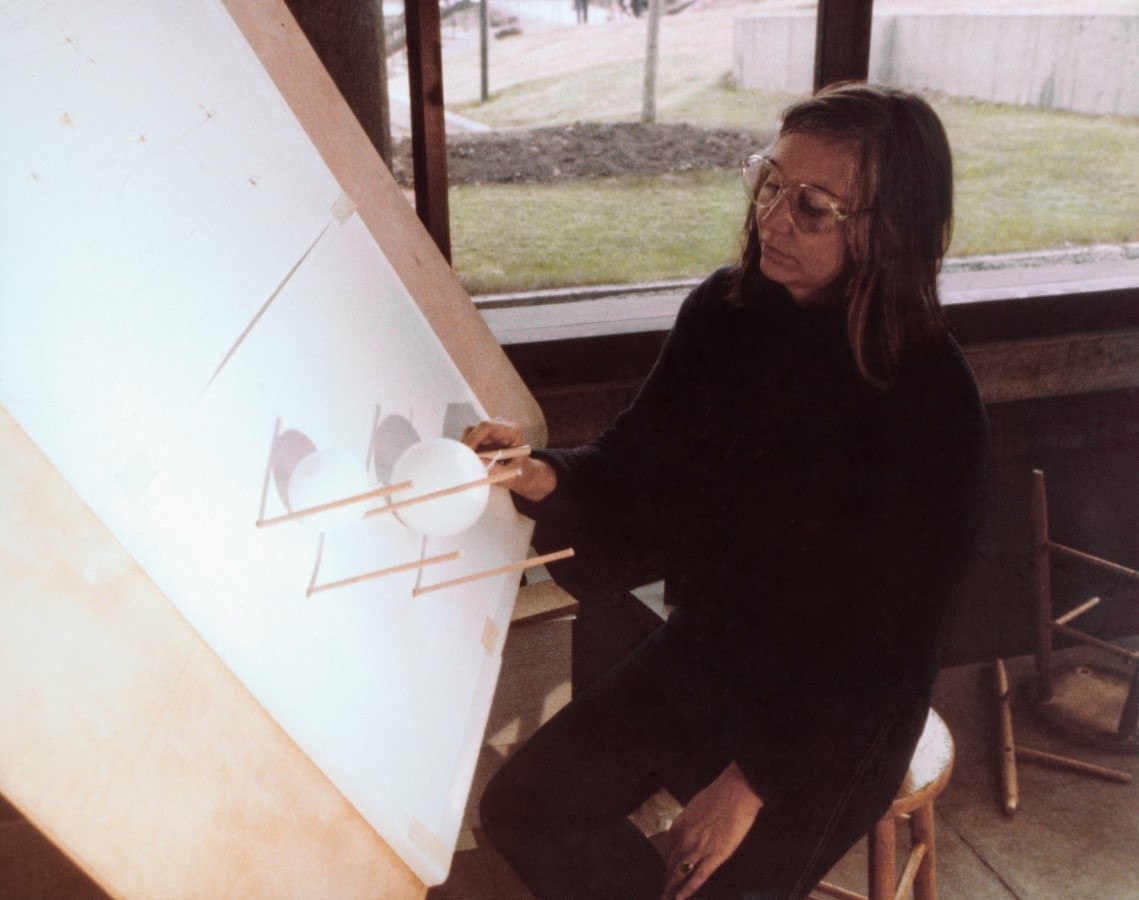
Artist Nancy Holt (1938-2014), who was chosen to helm the project in 1979, was somewhat apprehensive about the project upon entering Rosslyn, in part because the site was a vacant lot overrun with trash. In a 1988 documentary on the park, she said, “I was overwhelmed with how cold and distant a place Rosslyn was … It’s a concrete network here with very little thought about human beings, human scale, human maneuverability.”

Nancy Holt

Nancy Holt designing Dark Star Park. Image courtesy of the Holt/Smithson Foundation via DCist.

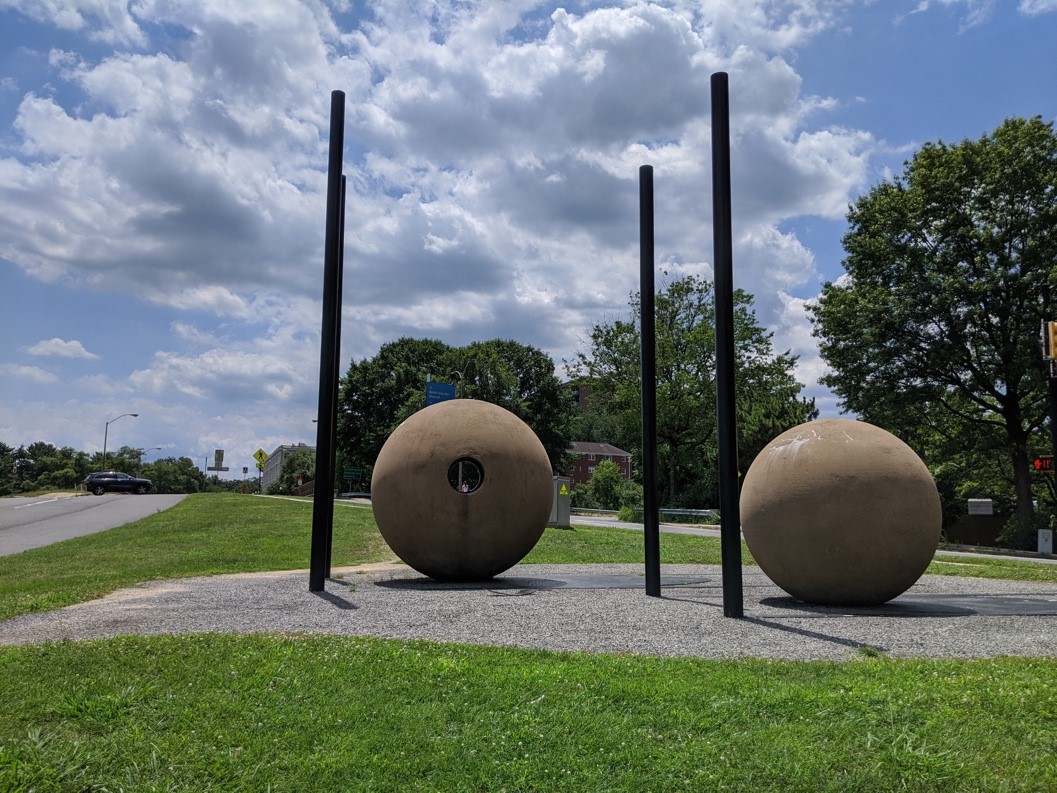
Dark Star Park combines elements of landscape architecture, sculpture, and astronomy. The piece is comprised of five gunite (air-placed concrete) spheres resembling fallen, extinguished stars, as well as two pools, four steel poles, and two tunnels.

Dark Star Park was commissioned by Arlington County during a transitional time in Rosslyn -  the Metro had recently arrived in Arlington, and development was still on the rise. The County funded the project with $200,000 from public and private sources, as well as a National Endowment for the Arts grant. (DCist, July 30, 2019)

Gunite Spheres

Some of the gunite spheres and steel poles at Dark Star Park. Image courtesy of Camryn Bell.

Holt oversaw every aspect of the park’s design and development, and also served as a contractor on the project. She was a preeminent member of the land art movement, which rose to recognition in the 1970s. While practitioners of this style mainly concentrated in open natural spaces – places that could easily accommodate the monumental scale of the works associated with the movement – Holt’s work in Dark Star Park was unique due to its urban setting. In terms of her design approach, Holt said,

“I feel that the need to look at the sky—at the moon and the stars—is very basic, and it is inside all of us. So when I say my work is an exteriorization of my own inner reality, I mean I am giving back to people through art what they already have in them.”

Holt's Sun Tunnels

Some of Holt’s other pieces were located in much larger environments than Dark Star Park. "Sun Tunnels," 1973-1976, is located in the Great Basin Desert of Utah. Image courtesy of the Utah Museum of Fine Arts.

The creation of Dark Star Park marked a significant first for the Arlington area: it was the first work of public art produced by the County. This was prior to the establishment of the County’s formal public art program that was inaugurated with the adoption of a Public Art Policy – nearly 16 years after the creation of Dark Star Park.

In the decades since, Arlington’s public art program has become a robust part of the County landscape.

Dark Star Park itself is also one of the first national examples of “integrated public art,” meaning that the art in the public site is inseparable from its setting and is a total environment to be experienced holistically.

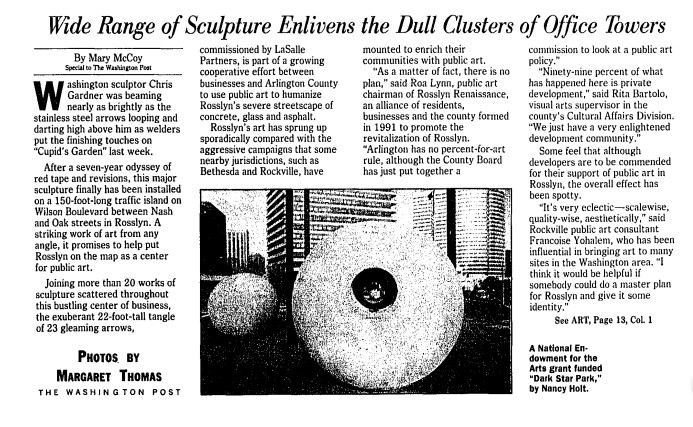
Newspaper Article

Excerpt from December 9, 1993, article by Mary McCoy on public art in Arlington and Dark Star Park. From the Washington Post.

Holt planned the design of Dark Star Park using miniature clay models. She worked with astrophysicists to determine placement of the spheres and poles to align with the light at exactly 9:32 a.m. on the August 1 anniversary – a time of day chosen simply because Holt enjoyed the way the light hit at that moment. The need for exactness in alignment was in part why the park underwent a renovation in 2002, allowing Holt to reorient the spheres that had shifted over the years due to the changes in the Earth’s axis.

One common mistake about Dark Star Park Day is that the August 1 alignment is meant to celebrate the birthday of Grateful Dead lead guitarist Jerry Garcia. This assumption is compounded by the coincidence of the band’s song titled “Dark Star.”

NewsMakers: Dark Star Park – an Arlington TV feature on Dark Star Park from 2009, including a speech from Nancy Holt.

Learn more:

The documentary "Troublemakers" – available at the Library – discusses the history of the land art movement and features Nancy Holt.

The DVD "Art in the Public Eye: The Making of Dark Star Park" by Nancy Holt is available for viewing in the Center for Local History.

Do you have a question about this story, or a personal experience to share? 

Use this form to send a message to the Center for Local History.

Center For Local History - Blog Post Message Form

Do you have a question about this story, or a personal experience to share? Use this form to send a message to the Center for Local History.

"*" indicates required fields
This field is for validation purposes and should be left unchanged.

Share Your Story

July 30, 2020 by Web Editor

Fun in the Sun: Summers of Arlington’s Past

Post Published: July 22, 2020

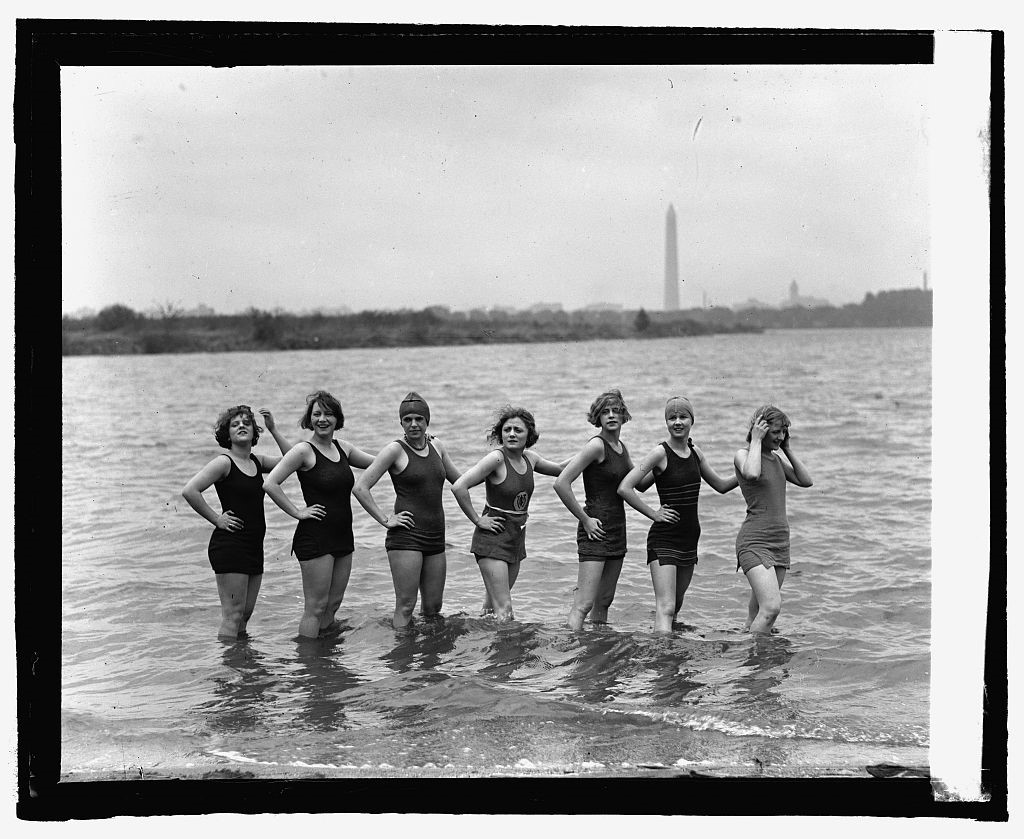
Arlington may not come to mind when you think of a beachy oasis, but in the 1920s, we had one of the region’s premier beaches right here.

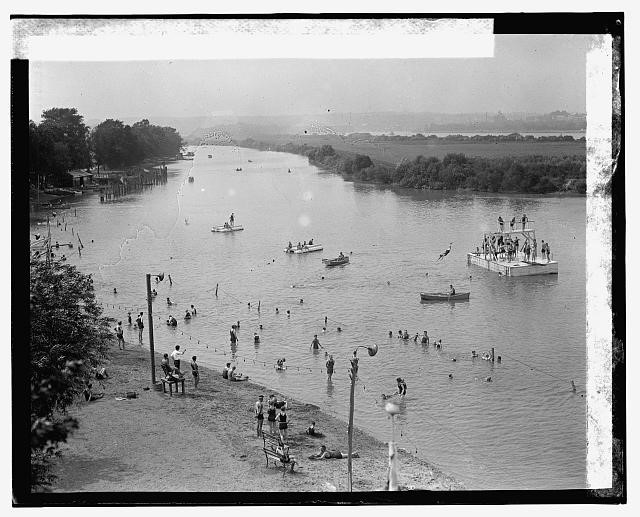
The Arlington Beach and Amusement Park opened on May 30, 1923, on the Potomac River in the area near the Fourteenth Street Bridge (then known as Long Bridge). For nearly a decade, this was a go-to spot on a hot Arlington day.

Beach in 1925

Arlington Beach, circa 1925. Image courtesy of the Library of Congress.

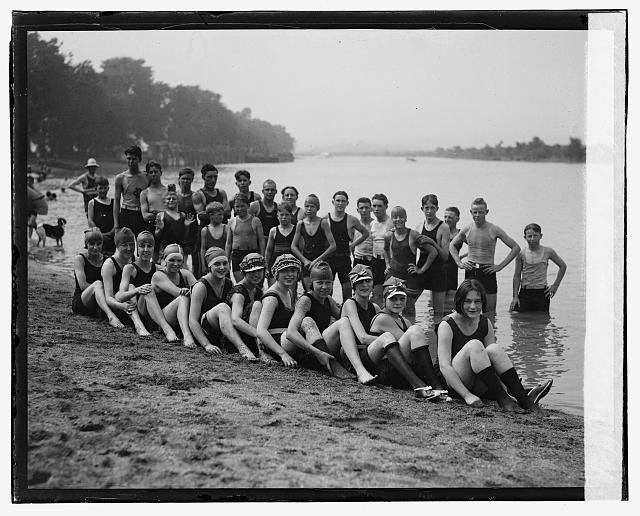
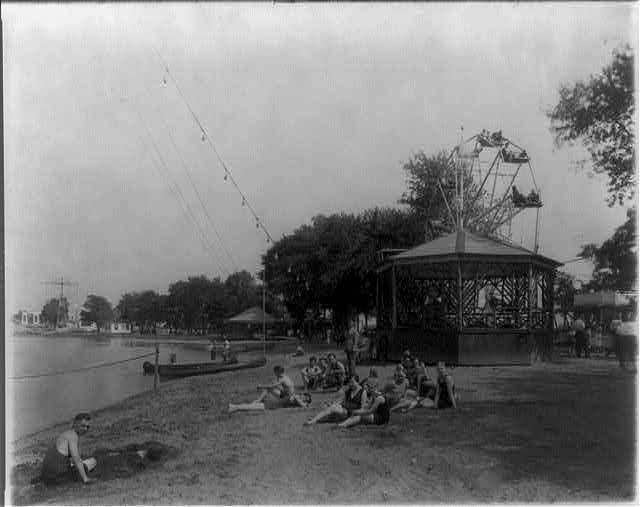
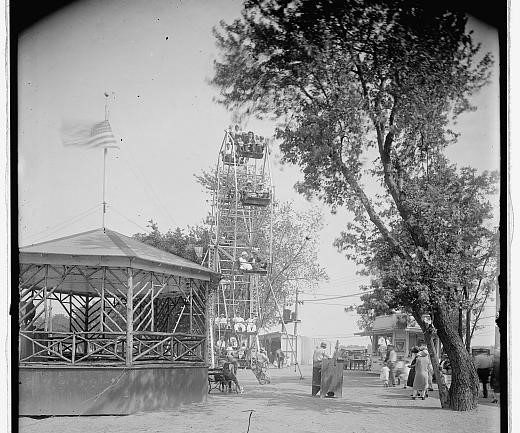
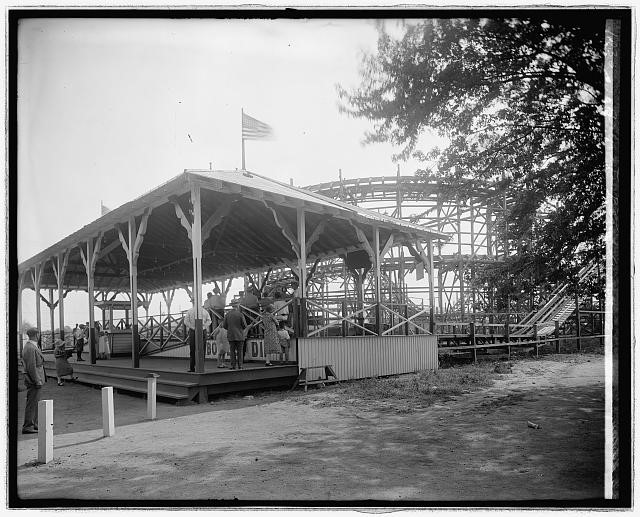
The beach was an immensely popular Arlington spot, with crowds of up to 12,000 during the most sweltering days, according to Arlington Magazine. The location featured both a sandy beach on the shores of the Potomac as well as bathhouses and the accompaniments of a full-scale amusement park: a merry-go-round, Ferris wheel, aerial swings, a rollercoaster called “The Whip,” and a ride called “The Dodgem.” Swimmers could use the beach’s diving board and swim at night under searchlights.

Dance Pavilion

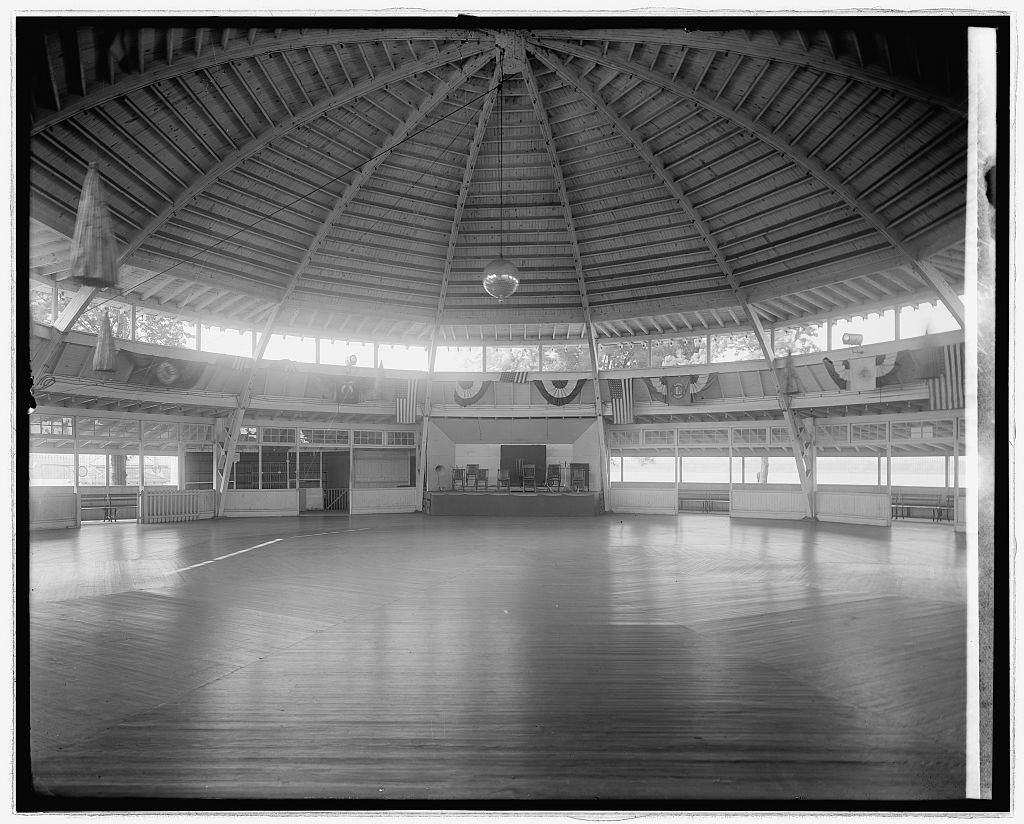
Dance pavilion, Arlington Beach. Image courtesy of the Library of Congress.

The park’s dance pavilion was also one of its major draws in its opening season, providing a spot for people of all ages to spend summer evenings – the Washington Jazz Orchestra even performed here. In line with the rising car culture of the early 20th century, the park also advertised extensive parking facilities – important to draw customers from all around the region.

It’s notable that as popular as the Arlington Beach was, it was among the many segregated recreational areas in the County. Even though it was located near predominantly African American neighborhoods, including East Arlington and Queen City, the beach and amusement park were segregated for the duration of their existence.

Beachgoers

Beachgoers at Arlington Beach, June 16, 1923. Image courtesy of the Library of Congress.

According to a research project on segregation in Arlington conducted by Lindsey Bestebreurtje at George Mason University: “County resident James ‘Jimmy’ Taylor recalled that Black children swam ‘in a creek on Route 50 called Blue Man Junction.’” African American Arlingtonians were also not permitted to use public pools, and the county’s first pool to allow African American children wouldn’t open up until the 1960s.

Interview with Ruth Jones

Center for Local History, Arlington Public Library · July 2017 - Arlington Beach - Ruth Jones

In a 1999 oral history interview with Ingrid Kauffman, Ruth Jones described going to the beach as a teenager. Born in March of 1913, Ruth began to visit Arlington Beach around 1927. Oral histories are used to understand historical events, actors, and movements from the point of view of real people’s personal experiences.

Narrator:  Ruth Jones
Interviewer: Ingrid Kauffman
Date: March 23, 1999

Ingrid Kaufman: And so can you tell us about Arlington Beach?

Ruth Jones: Well, I was just a young girl, 14 or 15 years old and I met my husband, well, he eventually was my husband.

IK: What was his name?

RJ: Raymond Jones. And he lived in Washington. And we started going to Glen Echo and to Arlington Beach and just having a good time for kids, you know. And so they had a roller coaster, a carousel.

IK: How much did that roller coaster cost?

RJ: Ten cents. A ride at your own risk. That’s the truth, too. It was rickety. After I came to Washington, it was only there for 2 years, 2 or 3 years, then they tore it down.

IK: They tore down the roller coaster?

RJ: Everything. And shut the beach down and all, to put the airport there.

Waterfront

Along the waterfront, Arlington Beach, circa 1925. Image courtesy of the Library of Congress.

As Jones describes, the location was eventually compromised by the construction of the nearby Hoover Airport. The traffic at the airfield grew to include both passenger and mail air service, which provided disruptive to the festivities of the beachgoers and park attendees. The Hoover airfield was also notoriously dangerous – and the aviation industry notoriously unregulated at this point – so the proximity of the beach and park also became a safety issue.

Girls 1
Girls 2

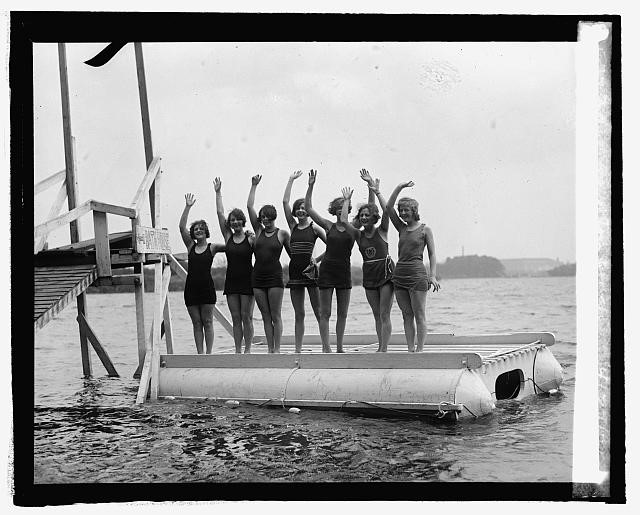
Girls from Keith’s [vaudeville circuit] at Arlington Beach, April 29, 1925. Image courtesy of the Library of Congress.

In 1929, the Washington Air Corporation bought the beach property in order to expand the Washington Airport, which later merged with the Hoover Airport as the Washington-Hoover Airport. However, with the construction of the Washington National Airport (now Ronald Reagan), the Washington-Hoover Airport closed. The former beach grounds were then purchased by the U.S. Department of War and became part of the Pentagon.

Amusement Park

Amusement park, Arlington Beach. Image courtesy of the Library of Congress.

Rides at Arlington Beach

Rides at Arlington Beach. Image courtesy of the Library of Congress.

This article was expanded from previous articles on Arlington Beach from 2008 and 2017.

Do you have a question about this story, or a personal experience to share? 

Use this form to send a message to the Charlie Clark Center for Local History.

Center For Local History - Blog Post Message Form

Do you have a question about this story, or a personal experience to share? Use this form to send a message to the Center for Local History.

"*" indicates required fields
This field is for validation purposes and should be left unchanged.

Share Your Story

July 22, 2020 by Web Editor

Stories of Arlington’s Activists

Post Published: July 8, 2020

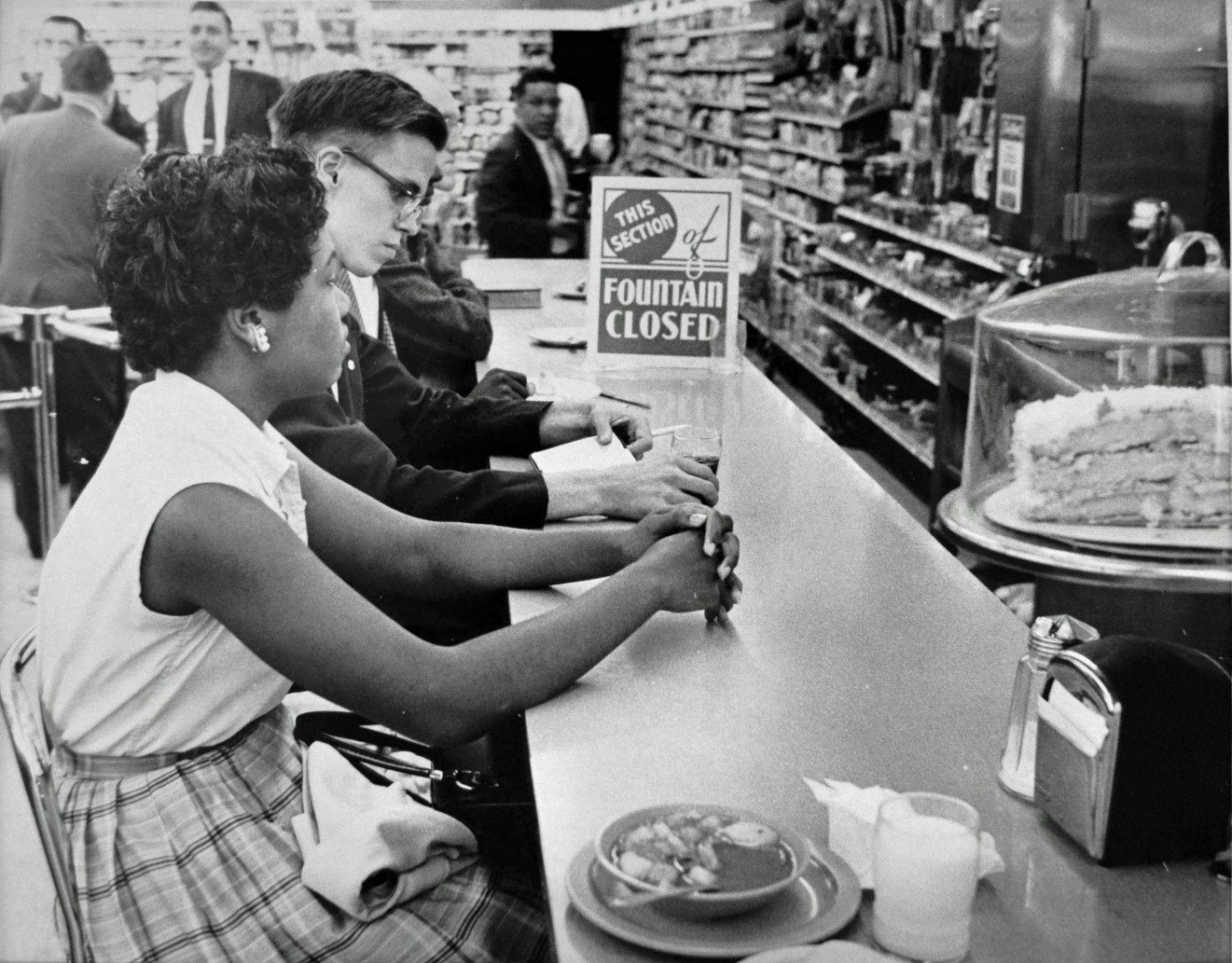
Arlington has a history of dedicated community members fighting against racism, prejudice, and injustice through protests, community organizing, and legal work.

Sitins

June 10, 1960, Gwendolyn Green (later Britt) and David Hartsough sit at the People’s Drug Store counter. Protests such as this happened at counters in seven locations in Arlington including two in Shirlington. DC Public Library, Star Collection, ©Washington Post. Read more about Shirlington.

Collected here are stories about some of those individuals and groups, told through documents donated to the Center for Local History. This is only a small sampling of stories that make up the history of Arlington’s activist community, and we are dedicated to telling the stories of those who have fought in Arlington’s continued struggles against inequalities.

The CLH invites you to play an active role in documenting our history by donating physical and/or digital materials for the Community Archives.

A Fight for Educational Equality: Civil Rights Activist Dorothy Hamm

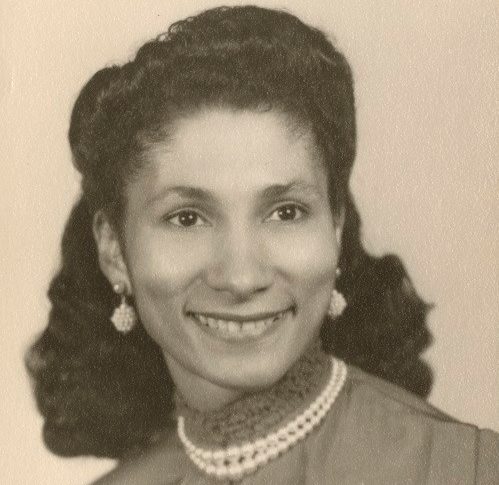
Dorothy Hamm was an Arlingtonian at the forefront of the civil rights movement and leader of the efforts to desegregate the county’s schools and theaters.

Dorothy Hamm Portrait

Image courtesy of Carmela Hamm, from the Library of Virginia.

Excerpt:

In 1956, Hamm, along with her husband, became plaintiffs in the first civil action case filed to integrate the Arlington Public School system. When no action towards integration had been taken a year after the suit was filed, Hamm and her husband took their oldest son, Edward Leslie Jr., to enroll at Stratford Junior High School. They, and other African-American students who attempted to enroll in the still segregated Arlington schools, were denied admission that year. In September 1957, a few days after the opening of the school year, crosses were burned on the lawns of two Arlington families, and at the Calloway United Methodist Church, a central location for organizers in the effort to desegregate the schools, and a site of workshops held by ministers, lawyers, and educators preparing parents and students for school integration.

Over the course of this process, Hamm recalled in interviews many experiences with discrimination and intimidation.

Read the rest of the story.

Oral History: Desegregation of Arlington’s Public Schools

Two stories in this list chronicle the struggle to desegregate Arlington Public Schools told through oral history interviews, historical documents, and legal proceedings.

You can also learn more about the people and events that made up this historic effort in the library’s online exhibition, Project DAPS.

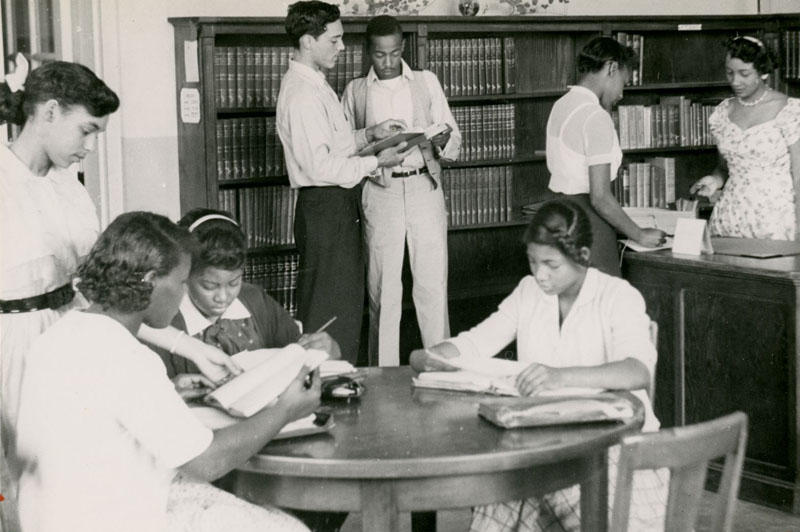
African American students reading in the library

African American students reading in the library.

Excerpt:

In this clip from 1986, Hamm shared her experience trying to register her son for school at Stratford and her activity in lawsuits to desegregate public facilities in Arlington County.

Dorothy Hamm has been honored by the County with the naming of a new middle school in Cherrydale, the Dorothy Hamm Middle School, which opened in September 2019.

Read the rest of the story.

The Story of Arlington Public School Desegregation

black and white photograph of 4 black students entering Stratford Junior High in 1959

Ronald Deskins, Michael Jones, Lance Newman, and Gloria Thompson walked into Stratford Junior High School on February 2, 1959.

Excerpt:

At 8:45 a.m. on February 2, 1959, four young students from the nearby Hall’s Hill neighborhood entered Stratford Junior High School in Arlington, Virginia.

When they stepped into Stratford that day, they became the first students to desegregate a public school in the Commonwealth of Virginia.

Many Arlingtonians know that theirs was the first county in Virginia to desegregate. It is a point of pride. But it’s not the whole story.

Read the rest of the story.

“If You Don’t Vote, You Don’t Count”

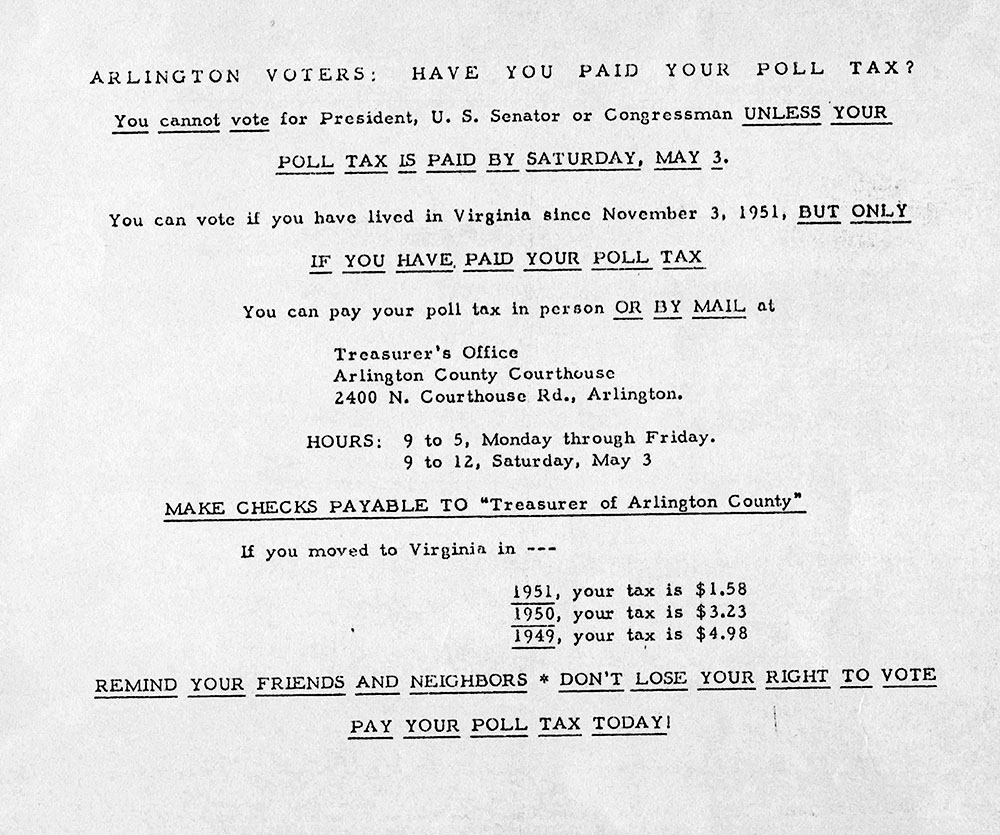
“If You Don’t Vote, You Don’t Count” looks at the poll taxes imposed to restrict voters and prevent African Americans from voting in the county, and the actions taken by local activists to combat this voter suppression.

1951 Flyer reminding voters to pay their 1951 Pol Tax

1951 flyer telling Arlington residents how to pay their poll tax in order to vote in the upcoming election.

Excerpt:

In 1876, after the Fifteenth Amendment granted African-Americans the right to vote, Virginia passed a poll tax to restrict African-American men from voting. Although this law was repealed in 1882, in 1901 the Virginia General Assembly called for a new constitution with the explicit purpose to secure the right of suffrage of the state's white men, and to take away the right to vote from anyone in the state who wasn't white.

The new constitution, which passed in 1902, reinstated the poll tax. This required voters to pay a tax of $1.50 six months prior to an election for each of the three years preceding an election. This disenfranchised approximately 90% of the black men and, counter to the intentions of those who had drafted the new constitution, nearly 50% of the white men who had previously been registered to vote in Virginia. The 1902 constitution also created an administrative structure that was difficult for any average citizen to navigate, further disenfranchising many poor men.

Read the rest of the story.

Our Back Pages: Arlington’s Own Declaration of Civil Rights

Next, read about efforts to continue the efforts of desegregation beyond the schools when a group of Arlington activists drafted their own Declaration of Civil Rights.

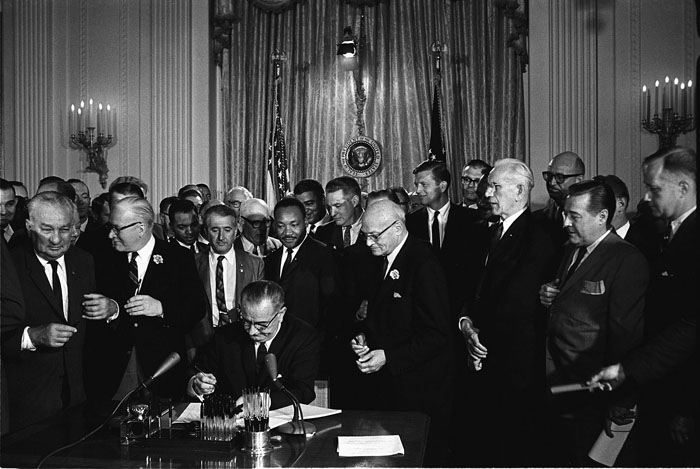
President Lyndon B. Johnson signs the Civil Rights Act of 1964 into law as various Civil Rights leaders look on, including the Reverend Martin Luther King, Jr. Photo courtesy of the LBJ Library, photo by Cecil Stoughton .

President Lyndon B. Johnson signs the Civil Rights Act of 1964 into law as various Civil Rights leaders look on, including the Reverend Martin Luther King, Jr. Photo courtesy of the LBJ Library, photo by Cecil Stoughton.

Excerpt:

Published just a little over a year after Arlington became the first school district in Virginia to desegregate, this document is a powerful reminder that despite those four students integrating Stratford Junior High in 1959, segregation in Arlington was still far from over. Many institutions in Arlington remained segregated, and this document specifically enumerates some of them: from sit-down restaurants and movie theaters to maternity wards, to playgrounds and pony rides for children.

Item six contains one of the leaflet’s most powerful observations: “It is the uncertainty about so many aspects of his life that is trying for a Negro in Arlington. Some years ago he knew exactly what his limitations were. He didn’t like being limited but he knew what to expect. Now he is tired of being unknowing about his status.” In the years leading up to the passage of the Civil Rights Act in 1964, this was indeed the reality for many Blacks in the South.

Read the rest of the story.

To learn more about Arlington's history, visit the Center for Local History on the first floor of the Central Library.

Do you have a question about this story or a personal experience to share? 

Use this form to send a message to the Center for Local History.

Center For Local History - Blog Post Message Form

Do you have a question about this story, or a personal experience to share? Use this form to send a message to the Center for Local History.

"*" indicates required fields
This field is for validation purposes and should be left unchanged.

Share Your Story

July 8, 2020 by Web Editor

The Census: Then & Now

Post Published: June 25, 2020

The 2020 census is currently underway nationally – but what did the census look like in the past?

The U.S. census is a ten-year event in the United States, as stipulated in the constitution in Article I, Section 2, empowering Congress to carry out the census in “such manner as they shall by Law direct.” Every decade, each household gets a chance to count themselves, contributing data that determines nearly $1 trillion of funding that is distributed on the local level as well as congressional apportionment.

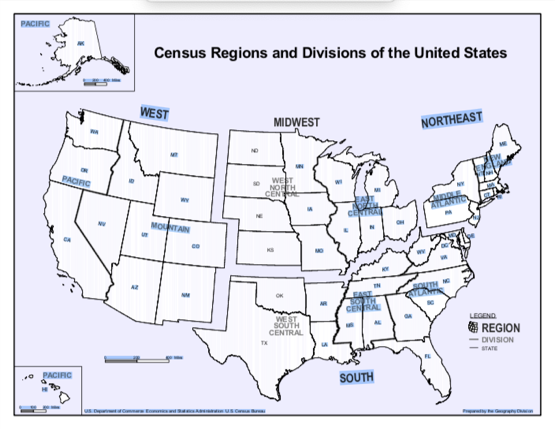
Census Regions Map

Image courtesy of the U.S. Census Bureau.

Early Censuses

The first U.S. census was taken in 1790 and counted 3.9 million residents in the whole of the country. The census has occurred every 10 years since – making it one of the very first and longest-lasting actions made by our early government. The early censuses were conducted by assistant U.S. marshals who were instructed to “make a just and perfect enumeration and description of all persons … according to the best of [their] ability.” Virginia is part of Region 3, Division 2, of the census’ designated statistical regions and is part of the South Atlantic group. Arlington was part of the first 1790 census, however, the residents of what is now Arlington County would have been counted under the regional designation of Fairfax County.

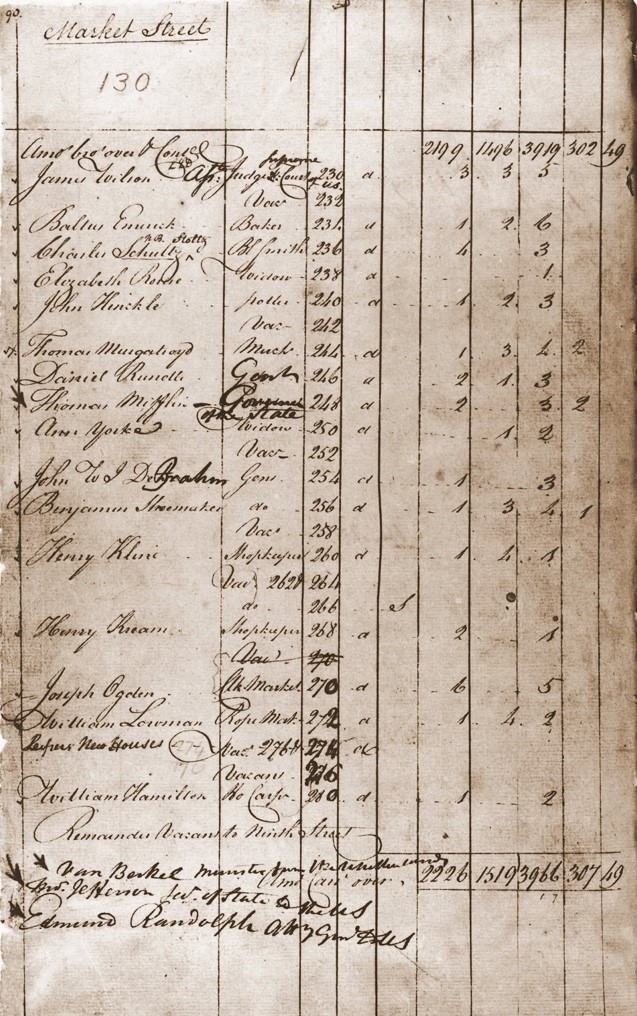
Census Records

A census enumerator’s records from the 1790 census. Image courtesy of the U.S. Census Bureau.

Although you can now take the census by multiple methods, early copies of the census were completed exclusively by paper. Early iterations of the census show a much different set of questions that are now included in a modern-day census.

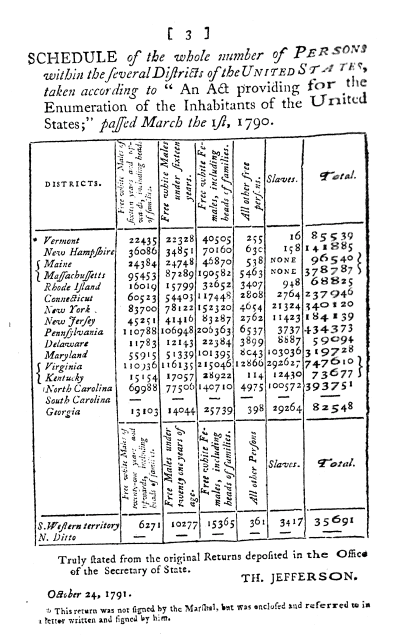
There were only six questions on the first census – the name of the white, male householder, and then the names of all the other people in the household, divided into these categories: Free white males who were at least 16 years old; free white males who were under 16 years old; free white females; all other free persons; and slaves, who under the constitution were counted as three-fifths of a person. These questions highlight the fundamental inequalities that determined life at this point in U.S. history and are cause to reflect on who was counted, how they were counted, and who got to do the counting – all important questions when evaluating census data from a historical lens.

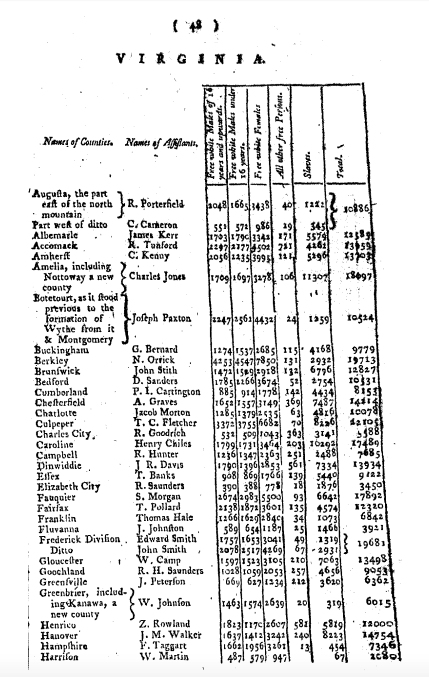
1790 Census 1
1790 Census 2

Excerpts from the 1790 census highlighting Virginia. Image courtesy of the U.S. Census Bureau.

Changes to the Census

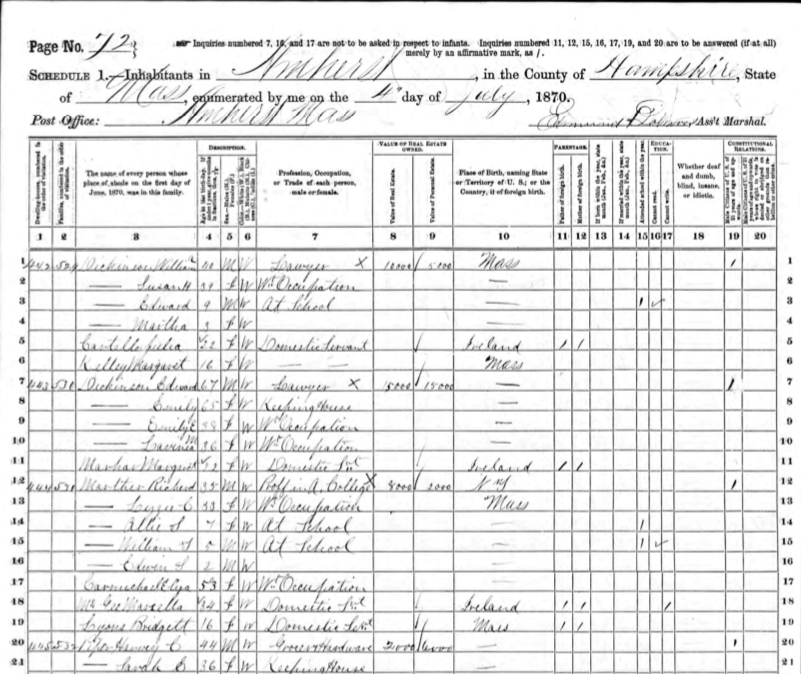
Over the years, the census has changed its format and its questions. The 1870 census was the first to eliminate what was called the “slave questionnaire,” and was reordered after the conclusion of the Civil War to only include schedules for "General Population," "Mortality," "Agriculture," "Products of Industry," and "Social Statistics."

The census only started counting Native Americans in 1860 and started including Native Americans living on reservations in 1890. Other racial categories on the census also developed into the latter half of the 19th century as immigration from non-European countries increased. These categories are an ever-developing part of the census and continue to diversify today. (For a more detailed look at how the U.S. census has historically measured race in the U.S., Science News has an overview of some of the key changes the census has seen.)

1870 Census

An example of an 1870 census schedule. Image courtesy of the U.S. Census Bureau.

Some other technical changes have occurred over the years as well: the 1810 Census collected economic data on the quantity and value of manufactured goods, expanding for the first time on the original six questions. In 1850, the census began collecting "social statistics,” such as information about taxes, education, crime, and value of estate, and mortality data. In 1940, in response to the devastation of the Great Depression, additional questions were asked of a sample of the population, including questions on internal migration, veteran status, and the number of children ever born to women. In recent decades, the census has turned toward more simplified forms – the 2000 census was the shortest since 1820, with only seven questions on the short form, and this trend has continued up to today.

Other changes over the years have included the methods of taking the census: the 1960 census was the first census to be mailed out to households and was the first year the census results were counted by computer. This year’s census is the first with the option to complete the form by phone or online.

Another historical development to this year’s census is it is the first to include a question about same-sex relationships, where respondents can identify as “same-sex husband/wife/spouse” or “same-sex unmarried partner.”

Census Taker 1920

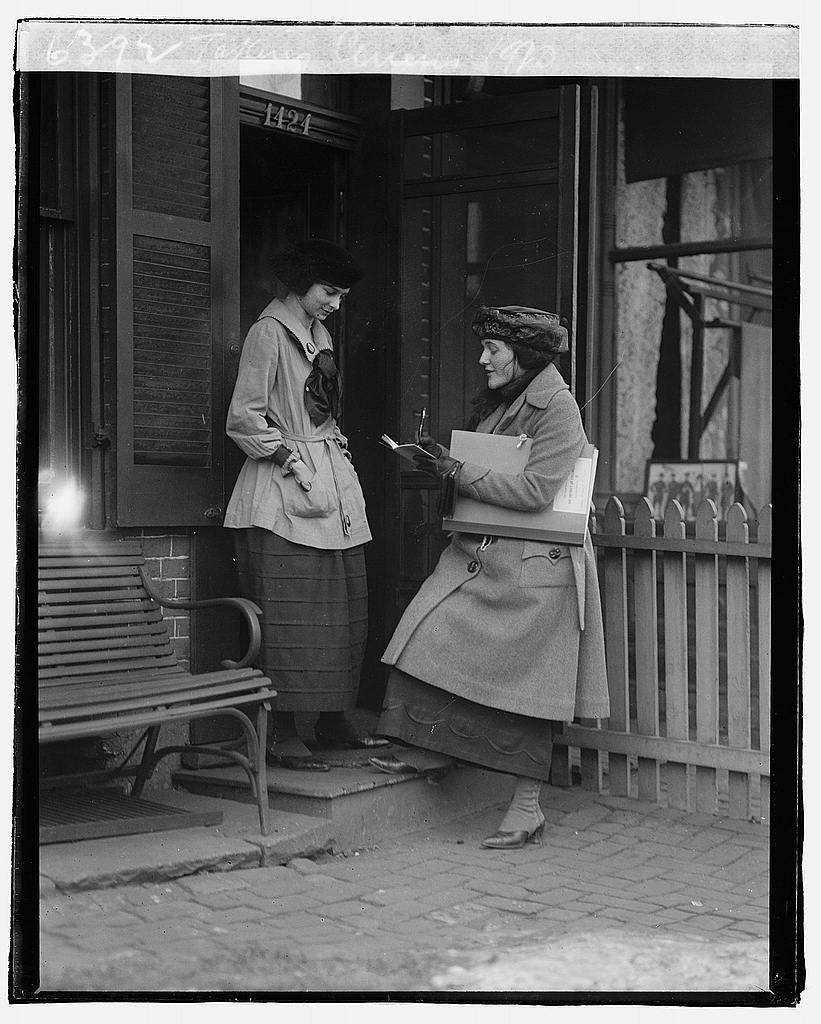
A census-taker circa 1920. Image courtesy of the Library of Congress.

Want to learn more? You can explore historical census data through the county going back to 2000. This site also includes maps and other data related to the history and demographics of Arlington. You can also search through historical census documents through the National Archives’ digital collections.

Do you have a question about this story, or a personal experience to share? 

Use this form to send a message to the Charlie Clark Center for Local History.

Center For Local History - Blog Post Message Form

Do you have a question about this story, or a personal experience to share? Use this form to send a message to the Center for Local History.

"*" indicates required fields
This field is for validation purposes and should be left unchanged.

Share Your Story

June 25, 2020 by Web Editor

Biochemist and Nobel Prize Winner: Gertrude Elion

Post Published: April 23, 2020

Gertrude Elion (1918-1999)

This week we're honoring the health care and public health people working tirelessly to protect our communities in the midst of the COVID-19 crisis.

Biochemist and pharmacologist Gertrude Elion was a trailblazer of modern medicine, and her work has shaped the way professionals today create new and life-saving pharmaceuticals. Elion was crucial in the development of multiple new medications, and in 1988 she was awarded for her work with the Nobel Prize.

Gertrude Elion

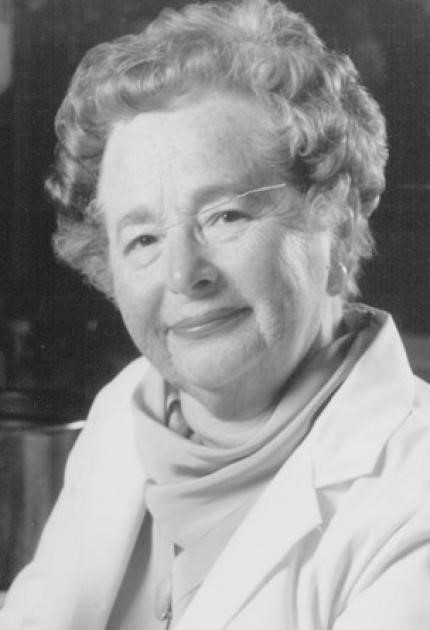
Gertrude Elion, image courtesy of the National Inventors Hall of Fame.

Elion was born in 1918 in New York City to immigrant parents. She grew up in Manhattan and the Bronx and from an early age showed a talent for academic work. She described herself as “a child with an insatiable thirst for knowledge and remember enjoying all of my courses almost equally.” At age 15, Elion attended Hunter College, graduating with high honors in chemistry at 19. Elion was inspired to enter the medical field from a young age, motivated by her grandfather’s death from stomach cancer.

After graduation from college Elion had difficulty getting work in a laboratory, as most did not hire female chemists. Finding only part-time employment as a lab assistant and substitute teacher, she entered New York University to pursue her master’s degree. She was the only woman in her graduate classes, and of this time in her life said: “I hadn’t been aware that any doors were closed to me until I started knocking on them.”

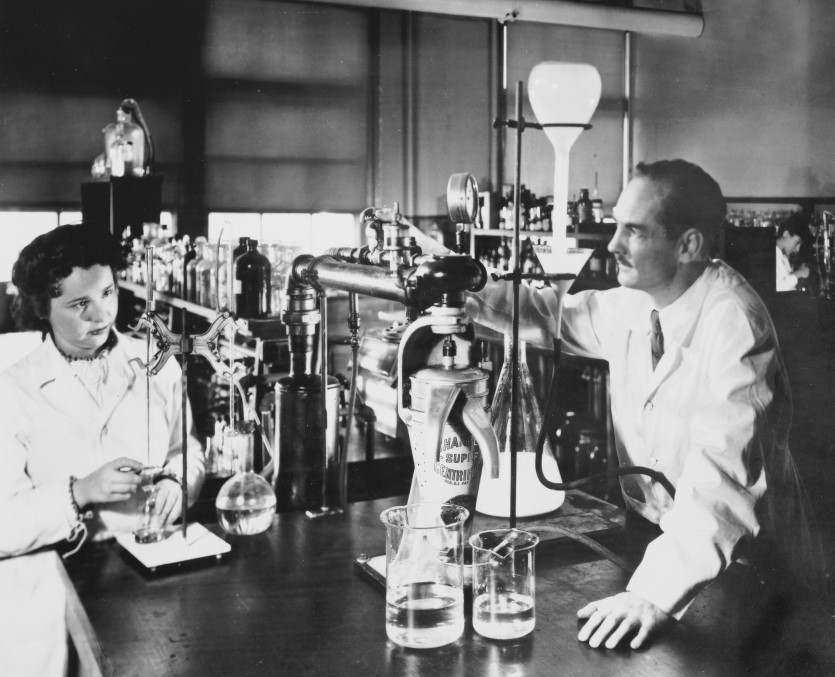
Laboratory

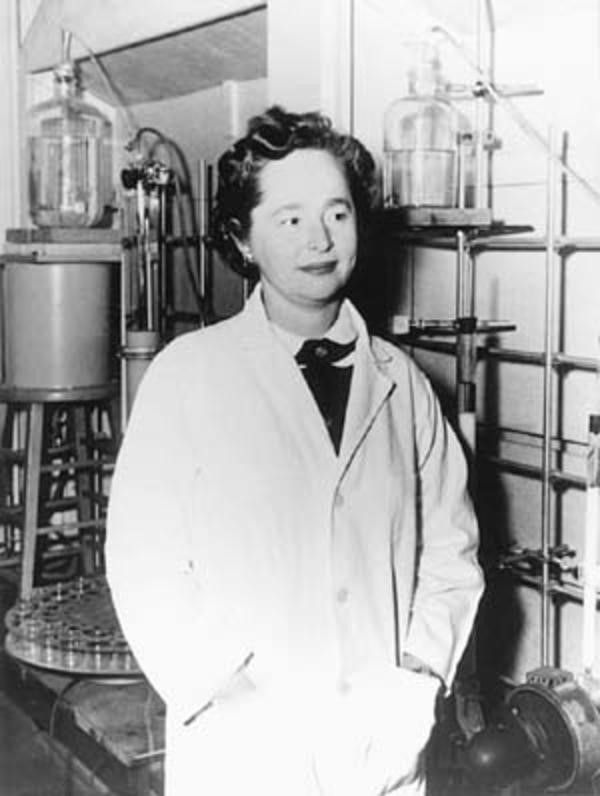
Gertrude Elion in laboratory circa 1950s. Image courtesy of GlaxoSmithKline Heritage Center, via the Jewish Women’s Archive.

The start of World War II drastically changed the job field for American women, offering up more opportunities as many men were called to the war cause. During this time, Elion began working fully in the pharmaceutical field, starting out at Burroughs-Wellcome in nucleic acid research in 1944. This position was the start of her 40-year collaboration with Dr. George Hitchings, who would become her scientific partner in developing new solutions to diseases.

Elion and Hitchings took an innovative approach in creating medicine, focusing on the study of the chemical composition of diseased cells. This was in contrast to the more mainstream process used in their industry, which involved reliance on trial-and-error methods. The pair instead analyzed the differences in biochemistry between normal cells and pathogens to create medications that would block viral infections. This method was known as “rational drug design,” and allowed for successful interference with cell growth.

Over the course of her career, Elion registered 45 patents in medicine, published 225 papers on her medical findings, and helped develop numerous medicines. Among them were effective drugs for treating leukemia, AIDS, gout, malaria, herpes, and treatments related to kidney transplants.

Gertrude and George

Gertrude Elion and George Hitchings in a laboratory, 1948. Image courtesy of GlaxoSmithKline and Jon Elion, via the Science History Institute.

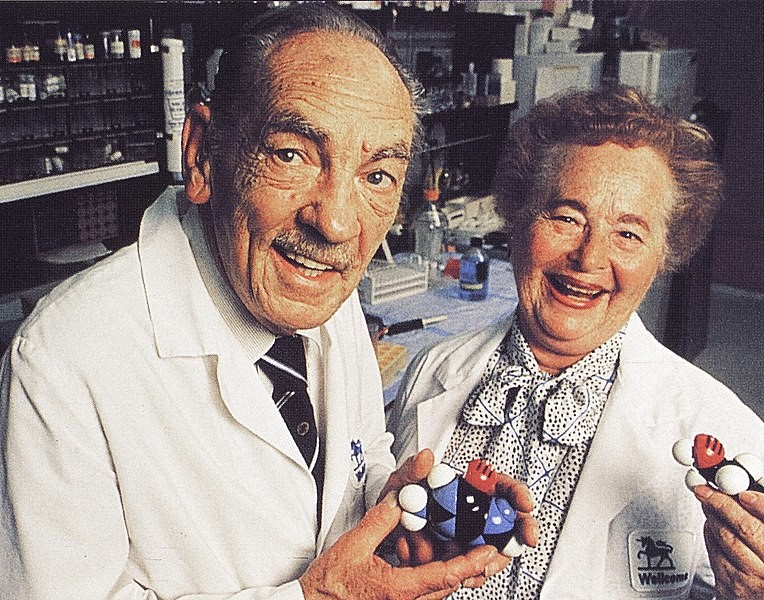
Colored

Gertrude Elion and George Hitchings 1988. Wikimedia Commons.

In 1983, Elion officially retired, but remained active in her field, continuing as a consultant and an adviser for the World Health Organization and American Association for Cancer Research.

In 1988 she was awarded the Nobel Prize along with Hitchings and Sir James Black, “for discoveries of important principles for drug treatment.” In 1991, she became the first woman inducted to the National Inventors Hall of Fame. Elion passed away in 1999.

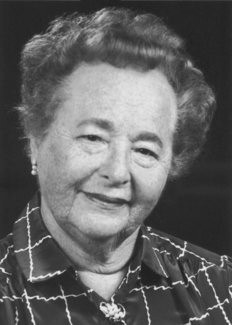
Gert

Gertrude Elion, image courtesy of the Nobel Prize Foundation.

Learn More

The Jewish Women’s Archive has an exhibit on Gertrude Elion as part of their “Women of Valor” series.

The Nobel Prize Foundation featured Gertrude Elion as part of their “Women who changed science” series. The Foundation also has a short autobiography from Gertrude Elion that describes her life in her own words.

Do you have a question about this story, or a personal experience to share? 

Use this form to send a message to the Charlie Clark Center for Local History.

Center For Local History - Blog Post Message Form

Do you have a question about this story, or a personal experience to share? Use this form to send a message to the Center for Local History.

"*" indicates required fields

This field is for validation purposes and should be left unchanged.

Share Your Story

April 23, 2020 by Web Editor

“The Lady with the Lamp” – Florence Nightingale

Post Published: April 15, 2020

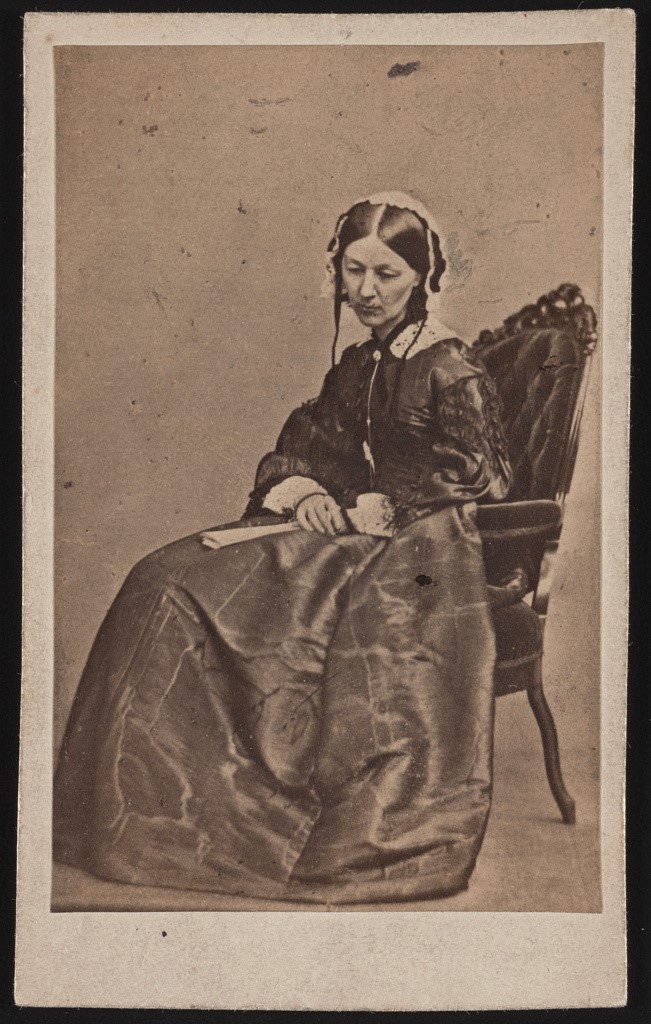
Florence Nightingale (1820-1910)

This week we're honoring the health care and public health people working tirelessly to protect our communities in the midst of the COVID-19 crisis.

Florence Nightingale is one of the pioneers of modern medicine. She is known particularly for the role she played in improving hospital sanitation, promoting social reform and founding the modern nursing profession.

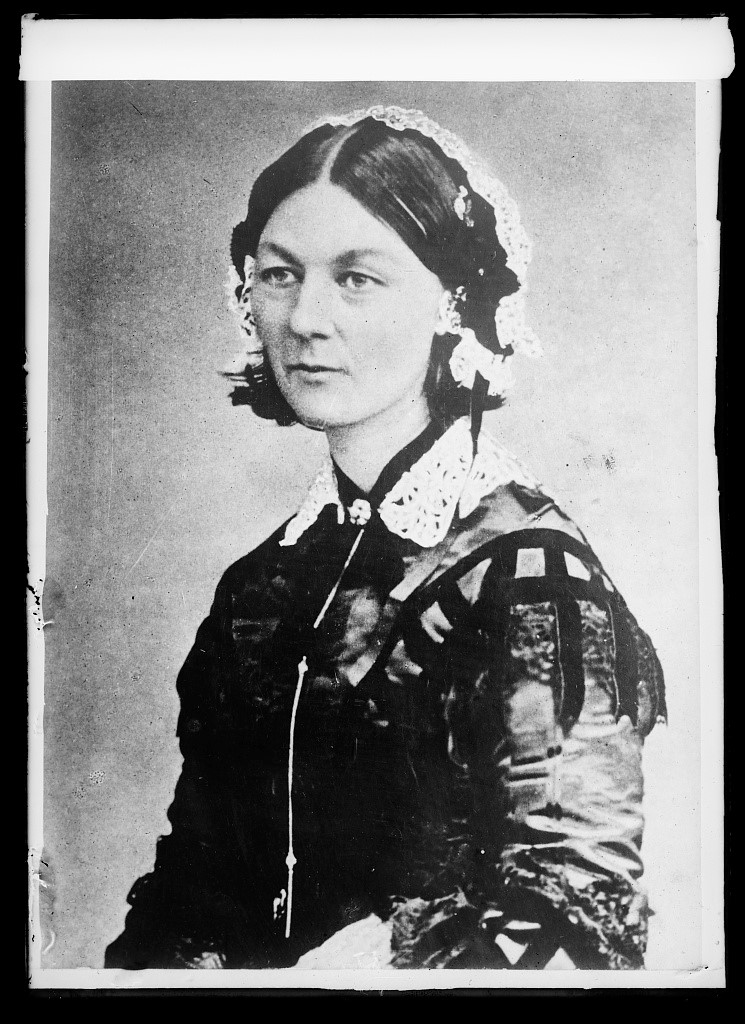
Florence Nightingale 1

Florence Nightingale, date unknown. Image from the Library of Congress.

Early Years

Nightingale was born on May 12, 1820, in Florence, Italy to English parents. The Nightingale family was very well-off, and Florence was homeschooled by her father, who was under the assumption that she would eventually marry a similarly wealthy man.

This plan went by the wayside when, as a teenager, Nightingale received a religious calling to help the poor and sick. From a young age, she had been active in philanthropy, serving the ill in the village neighboring her family’s home.

Though her parents disapproved of Nightingale's vision, they eventually agreed to send her to Germany to study. From there, she went on to train in Paris with the Sisters of Mercy before returning to England. This led her to take on a nursing job in the early 1850s at a Harley Street hospital for ailing “gentlewomen.” She excelled in this role and was eventually promoted to the hospital superintendent. During this time, she also volunteered at a hospital in Middlesex, where a cholera outbreak was exacerbated by unsanitary conditions. Nightingale instituted new hygiene practices there, which significantly lowered the death rate of the hospital.

Florence Nightingale 2

Florence Nightingale, 1854. Image courtesy of the Library of Congress.

The Kingdom of Hell

In 1853, England entered the Crimean War. After a series of scandals and complaints around battlefield medical care, the Secretary of War called on Nightingale to manage a group of nurses that would treat soldiers on site. She began her appointment on November 4, 1854, when she and 38 other nurses sailed to a British camp near Constantinople. The conditions they found shocked Nightingale, who dubbed it, “the kingdom of Hell.” The military hospital was set up on top of a large cesspool, which had tainted the water supplies, and the place was incredibly overcrowded. Patients were strewn about in disarray, and the most basic supplies and cleanliness protocols were absent. More soldiers were ill from infectious diseases than from injuries sustained on the battlefield.

The male doctors there initially resisted the all-female nursing team, as there had been no female nurses stationed in the Crimea up until this point, and refused to allow them to work. However, they eventually accepted the women into the fold as the number of patients began to overwhelm them.

The team of nurses transformed the military hospital under Nightingale’s leadership, bringing supplies, sanitary practices, and individualized care to their patients. In addition to improving the cleanliness of the hospital, they also established a proper hospital kitchen, laundry room, and classroom for the soldiers. Among Nightingale’s innovations was her insistence that the hospital have proper ventilation, which has influenced hospital design into the modern-day.

After arriving, the nurses brought the death rate at the hospital down from 40 percent to 2 percent. This period was also the origin of Nightingale’s nickname “the lady with the lamp” – she was known for carrying a lamp in the evenings to check on the conditions of the soldiers in her care.

Hospital

The Florence Nightingale Hospital near Constantinople. Image courtesy of the Library of Congress.

Beyond the Battlefield

Nightingale’s role in public health did not end when the war did, however. Upon returning to England, in 1856 she presented her wartime experiences and medical data to Queen Victoria and Prince Albert, which resulted in the formation of a Royal Commission to improve the health of the British Army. She then went on to establish the Army Medical College in 1859, and opened the Nightingale Training School at St. Thomas’ Hospital the following year.

During her career, Nightingale penned many books and pamphlets on the subject of nursing and managing safe hospital environments, such as “Notes on Nursing: What it is, and What it is Not.” She was also the first female member of the Royal Statistical Society, elected in 1858.

Nightingale’s impact also extended to the United States, where she was frequently consulted on how to best manage field hospitals during the Civil War, influencing medical volunteers such as Clara Barton.

Grave

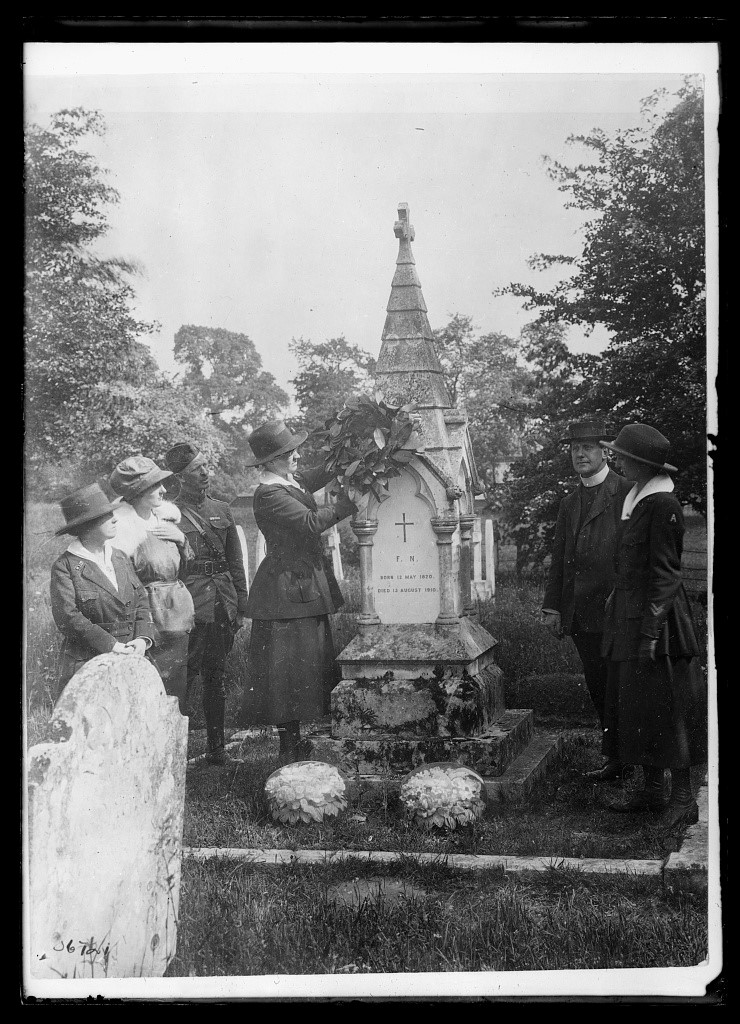
“Grave of Florence Nightingale near Ramsey, England. American Red Cross workers place wreath,” September 9, 1919. Image courtesy of the Library of Congress.

Legacy

Florence Nightingale died on August 13, 1910. Her work shaped modern nursing practices and set a precedent for medical treatment and policies today.

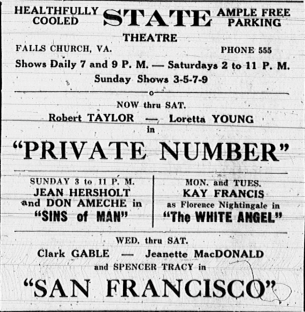
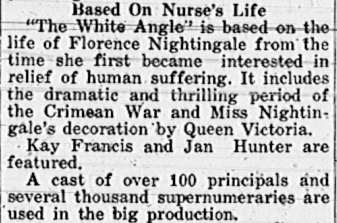
“The Lady with the Lamp's” legacy lives on in many forms, as a key figure in the development of public health practices, and a figure of inspiration: in 1936, a play based on her life, "The White Angel," was performed at the State Theatre in Falls Church.

Newspaper 1
Newspaper 2

Advertisements for a 1936 performance of “The White Angel,” a play based on Florence Nightingale’s life, held at the State Theatre in Falls Church. From The Northern Virginia Sun, August 13, 1936.

Learn More

The Library has numerous books about Florence Nightingale available on OverDrive:

“Florence Nightingale: The Angel of the Crimea, a Story for Young People,” by Laura E. Richards

“Florence Nightingale,” from the Famous People Great Events series, by Emma Fischel

“Nursing: What it is, and What it is Not,” by Florence Nightingale.

The Florence Nightingale Museum has a variety of online exhibits about Nightingale’s life and work.

The United Kingdom’s National Archives has a series of lesson plans that focus on Florence Nightingale’s legacy.

Do you have a question about this story, or a personal experience to share? 

Use this form to send a message to the Charlie Clark Center for Local History.

Center For Local History - Blog Post Message Form

Do you have a question about this story, or a personal experience to share? Use this form to send a message to the Center for Local History.

"*" indicates required fields
This field is for validation purposes and should be left unchanged.

Share Your Story

April 15, 2020 by Web Editor

The Old Bay-Eva Castle of Arlington

Post Published: April 9, 2020

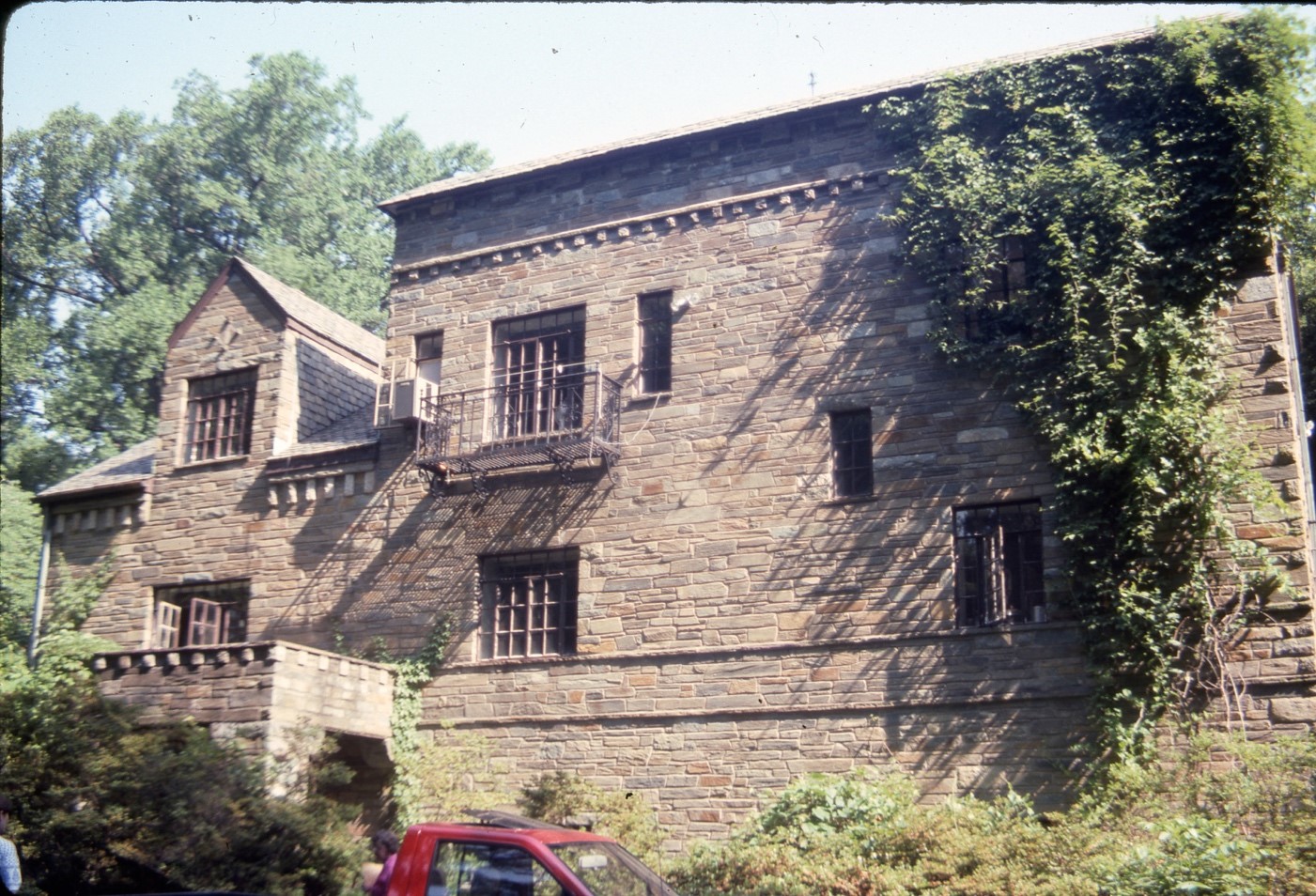
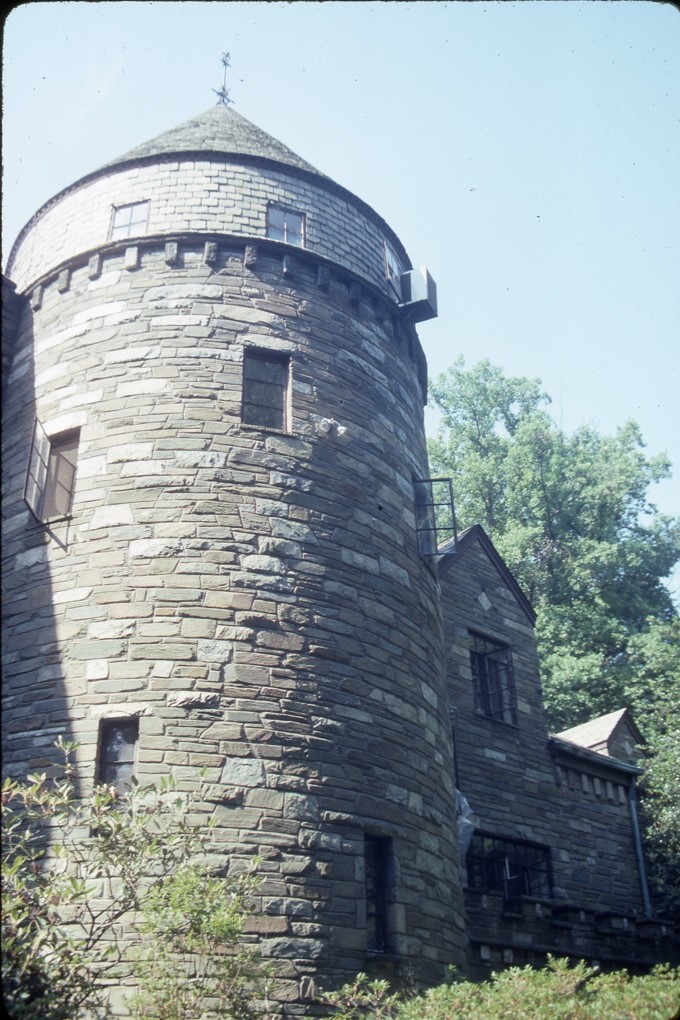
Arlington is home to many examples of interesting architecture, but the Bay-Eva Castle (also known as Jacobs Castle) stands as one of the most dramatic buildings to grace the County’s landscape.

Bayeva Castle 1

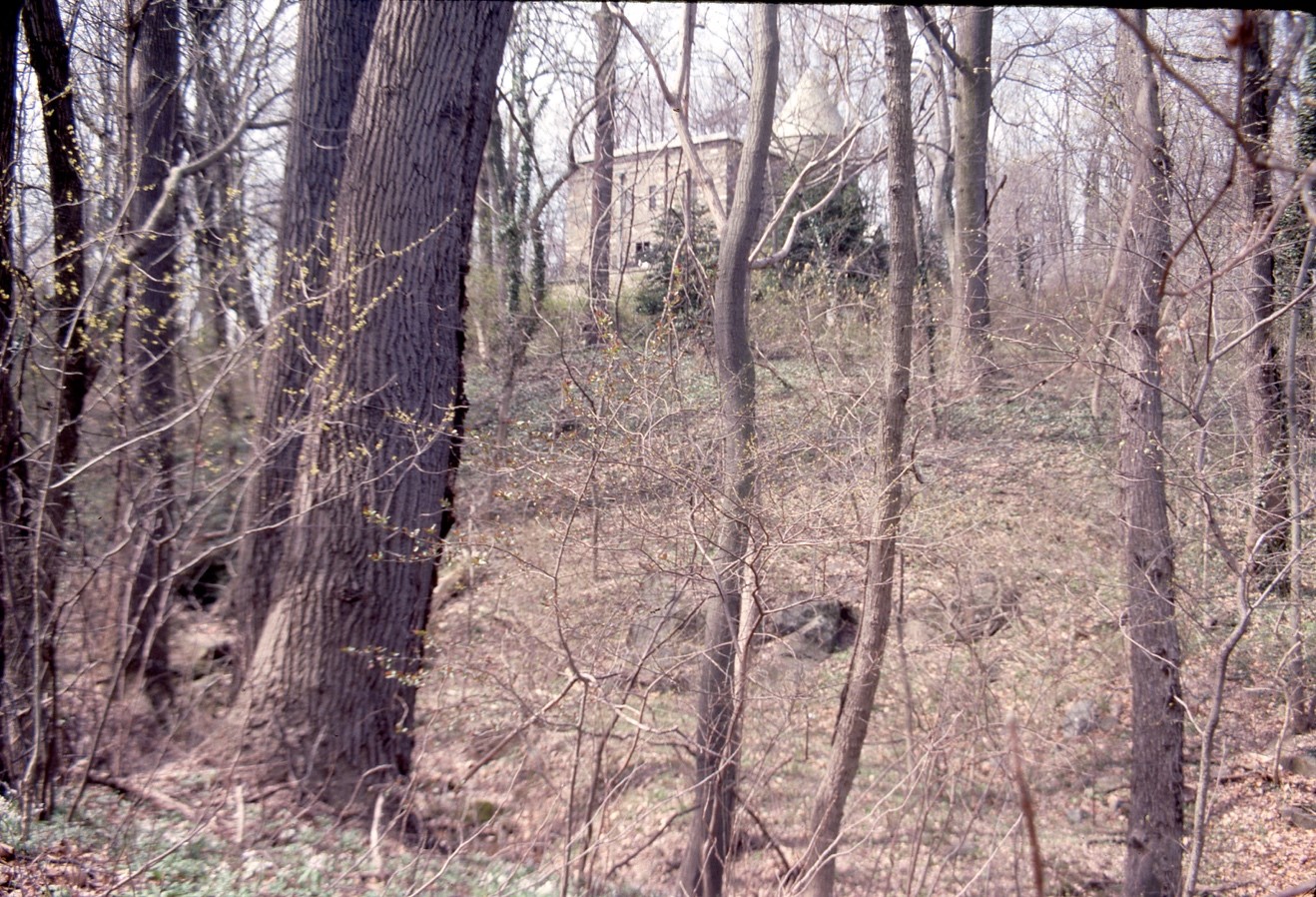
Overlooking the Potomac on a bluff of the Palisades near Rosslyn, in an area near what is now the Fort Bennett Park and Palisades Trail, the 9,200-square-foot fortress became well-known throughout the region.

The building was the home of obstetrician and gynecologist Dr. J. Bay Jacobs and his wife, Eva Harris Jacobs. Dr. Jacobs was a well-known physician and worked at the Georgetown and Arlington Hospitals. The location of the castle, halfway between those two localities, was perfect for the demands of his career and for access to the city. Eva Jacobs was also involved in the Arlington community as President of the Business and Professional Women’s Club and as the author of the historical novel “Feather on the Dart.”

The castle was designed after a trip the couple took to Bavaria in the 1930s, drawing inspiration from the sweeping turrets and stonework found in Bavaria's historic buildings. When the couple returned, they began construction in 1938, with ongoing additions and improvements being added into the 1950s.

The property the castle was built on was part of the former Thomas B. Dawson Estate, 81 acres that also included the Dawson Bailey House (now maintained by the County as part of the Dawson Terrace Community Center). The Jacobs family then bought 4 acres - what was called the “Spring lot” - from Thomas Dawson’s daughter Bessie Dawson in 1936.

Bayeva Castle 3

According to the Historical Marker Database, Mrs. Jacobs drew out the design for the home while sitting outside on a tree stump in the rain, sheltered by an umbrella. The outside of the castle took three months to cover with stone, and in some places, the stone walls were 18 inches thick. It was also constructed with a slate roof, copper gutters, and oak flooring.

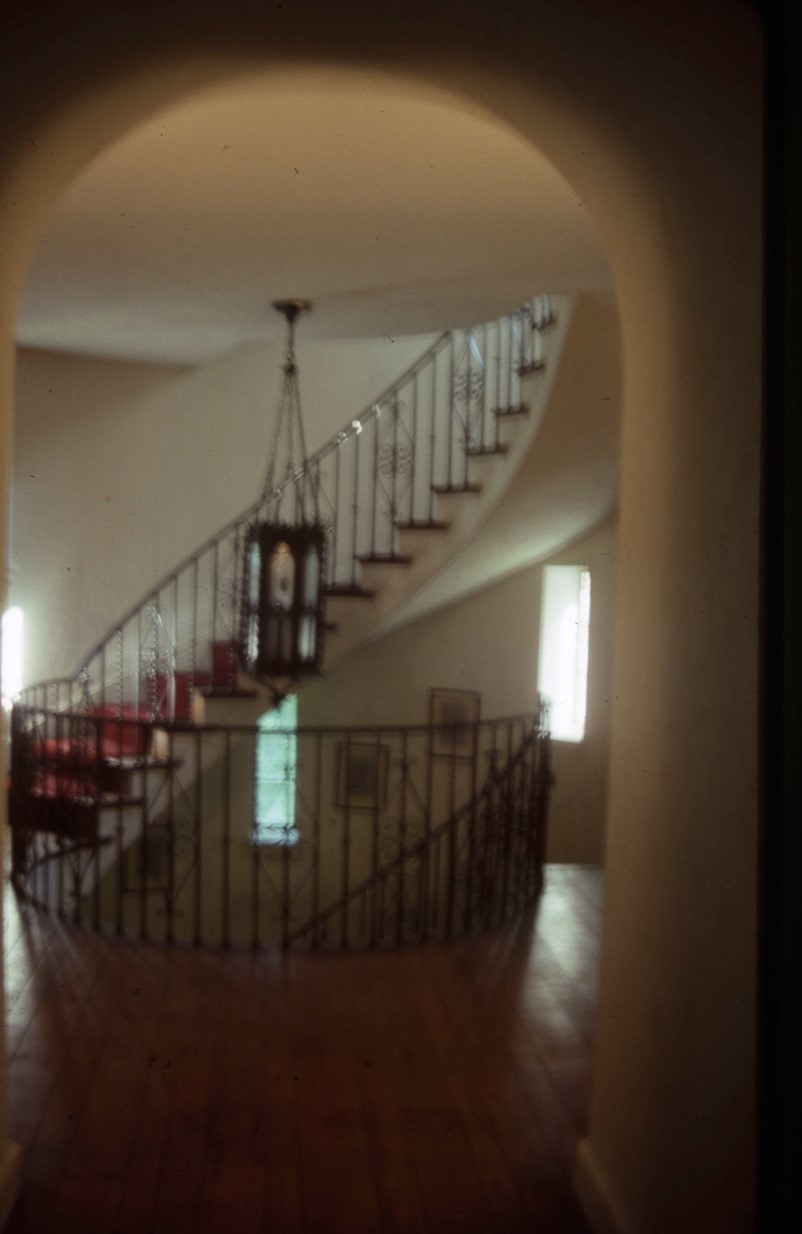
The abode included an indoor tiled fish pond, as well as a wrought iron staircase in the castle’s 35-foot turret, and flooring in the first-floor living room with a motif of carved butterflies in the shape of a bowtie. The turret also included an additional room that Eva Jacobs used as a studio space.

Bayeva Castle 7
Bayeva Castle 6

After the death of Eva Jacobs in 1979 and Dr. J. Bay Jacobs in 1988, the castle was deeded to the American College of Obstetricians and Gynecologists, and the antique furnishings were sold at auction. The property was later sold by the College to a developer, who had planned on developing the land into a community center. However, before these plans were realized, they went bankrupt and the property was foreclosed on.

According to The Arlingtonian, in the early nineties the castle was used as a collective house for a group of recent college graduates, who paid $1,000 in rent for the entire structure.

The castle was razed and demolished in November 1994.

Bayeva Castle 4

Many Arlington residents remember the castle as it stood, with many commenting on its “eerie” presence. In keeping with this reputation, when demolition workers were going through the house, the body of a baby was found in a small boarded passageway. This was explained to be one of the preserved bodies of stillborn babies Dr. Jacobs used in his teaching as an obstetrician, and no criminal charges were filed.

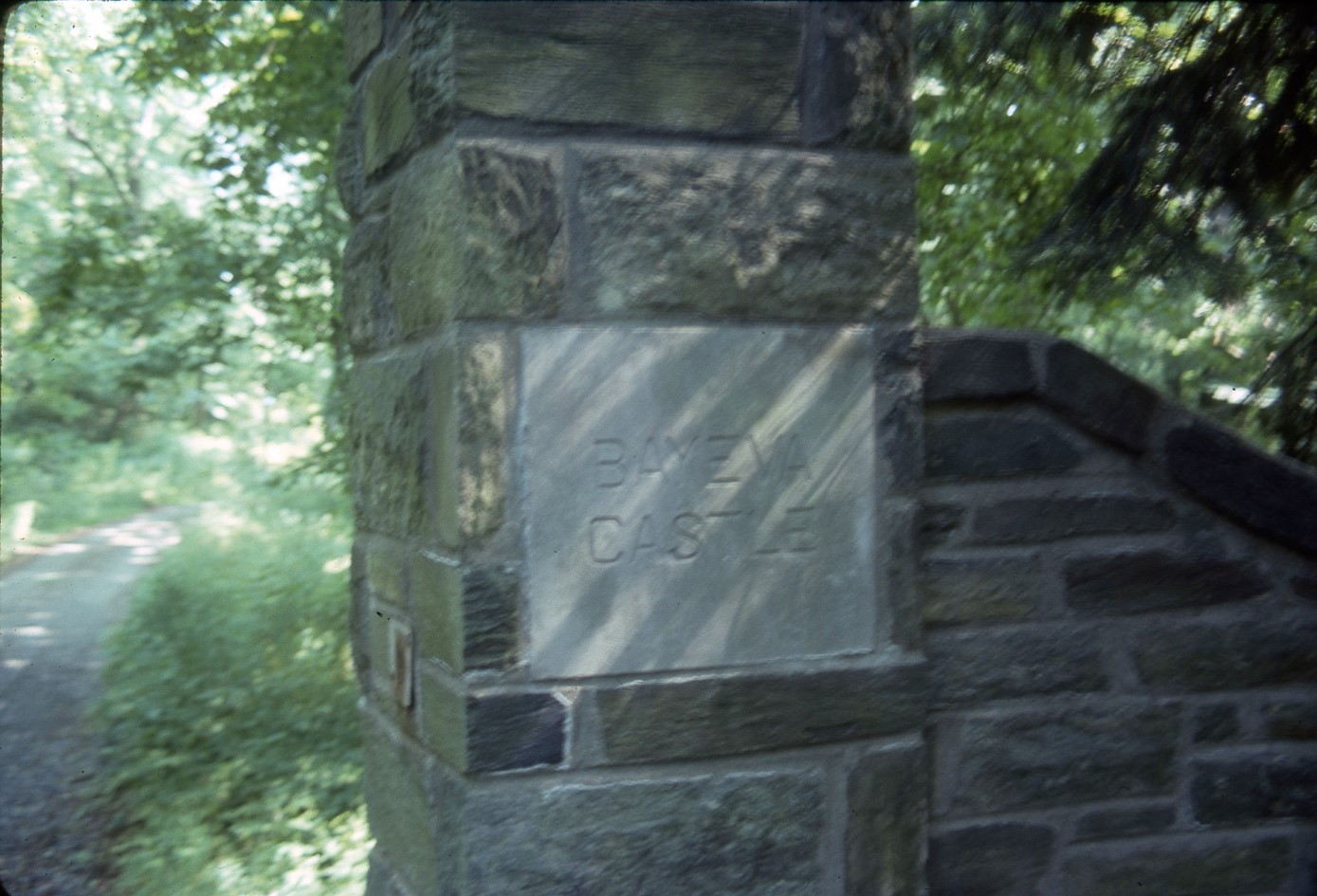
Today, a historical marker and a stone column bearing the Bay-Eva Castle name are the last remnants of the grand building that once stood on the bluff.

Bayeva Castle 9

Resources

The Historical Marker Database

The Arlingtonian

To learn more about Arlington's history, visit the Center for Local History on the first floor of the Central Library.

Do you have a question about this story, or a personal experience to share? 

Use this form to send a message to the Center for Local History.

Center For Local History - Blog Post Message Form

Do you have a question about this story, or a personal experience to share? Use this form to send a message to the Center for Local History.

"*" indicates required fields
This field is for validation purposes and should be left unchanged.

Share Your Story

April 9, 2020 by Web Editor

Writer, Suffragist, Feminist Icon: Louisa May Alcott

Post Published: April 1, 2020

Celebrate the 100th anniversary of the 19th Amendment with stories about the people and events that led to the passage of women’s suffrage in the United States.

Louisa May Alcott (1832-1888)

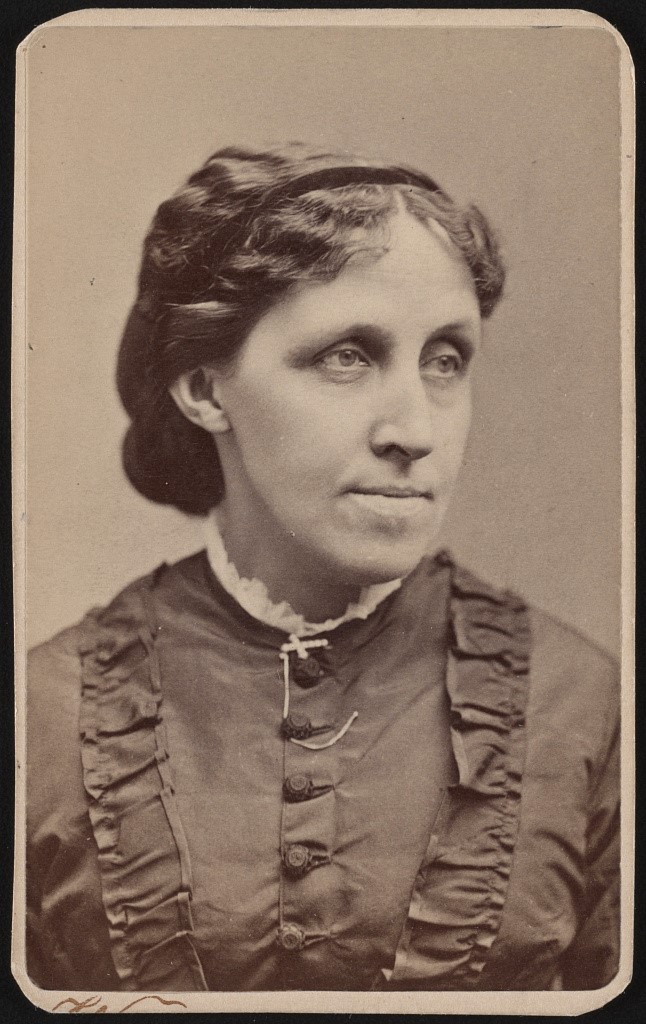
Author of the internationally renowned “Little Women,” Louisa May Alcott blazed a path for female authors and thinkers to follow. She was also a dedicated abolitionist, suffragist, and nurse.

Louisa May Alcott

“Louisa May Alcott, writer, abolitionist, and Civil War nurse,” ca. 1870. Image courtesy of the Library of Congress.

Early Life

Louisa May Alcott was born on November 29, 1832, in Germantown, Pennsylvania. Alcott and her three sisters – who would go on to inspire the central quartet of “Little Women” – spent their childhood in Concord, Massachusetts, where they were educated by their father, Bronson Alcott.

The Alcott’s had a somewhat unique childhood, growing up in part on a transcendentalist commune. The family held strong political convictions that influenced Louisa Alcott’s life in great measures, such as when she helped her parents hide escaped slaves traveling north on the Underground Railroad. The Concord community was also filled with radical thinkers who made up the Alcott’s social circles, including Margaret Fuller, Henry David Thoreau, Ralph Waldo Emerson, and Nathaniel Hawthorne.

Writing became an early passion for Alcott, who augmented her education with poetry writing, visits to Emerson’s library, nature excursions with Thoreau (about whom she also wrote the poem “Thoreau’s Flute”), and staged plays in the barn at Hillside House in Concord (now known as the Wayside).

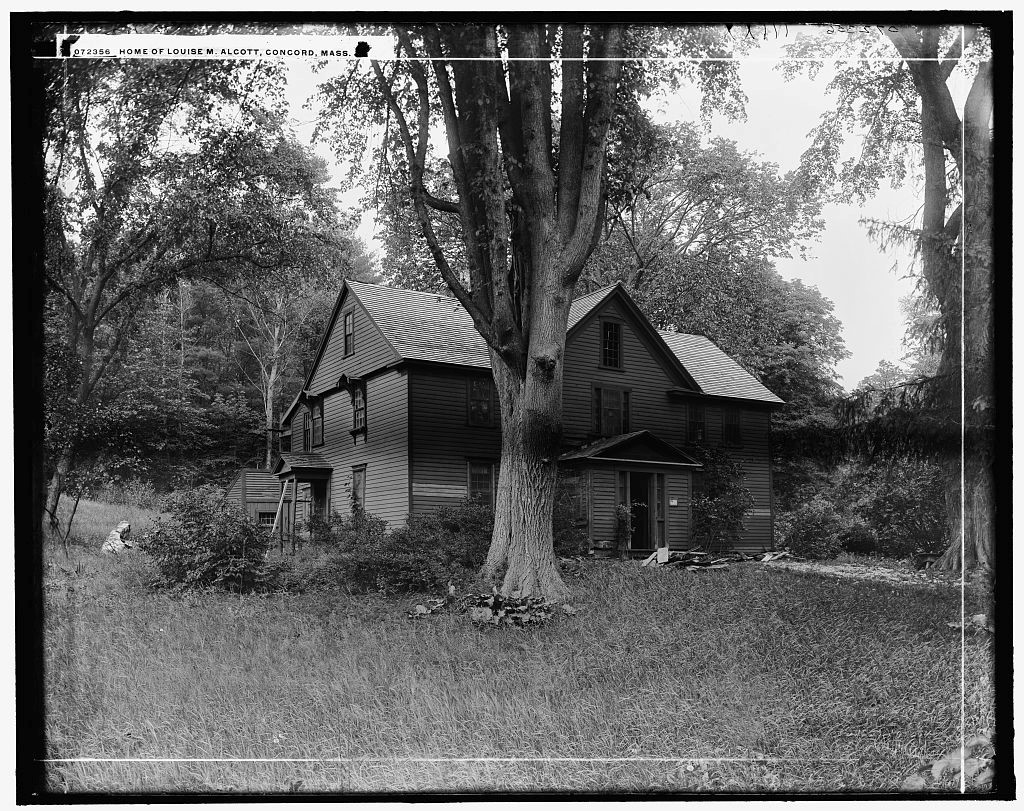
House

Orchard House, the childhood home of Louisa May Alcott and her sisters in Concord, Massachusetts. Image courtesy of the Library of Congress.

When Louisa was a teenager, the Alcott family faced years of poverty that worked their way into the stories of “Little Women.” This period encouraged Alcott to take matters into her own hands in a world that offered little to no fiscal opportunity for women outside of marriage.

Before publishing her own works, Alcott worked as a teacher, seamstress, governess, and household servant to make ends meet. Alcott then vowed: “I will make a battering-ram of my head and make my way through this rough and tumble world.”

Flower Fables and Other Early Works

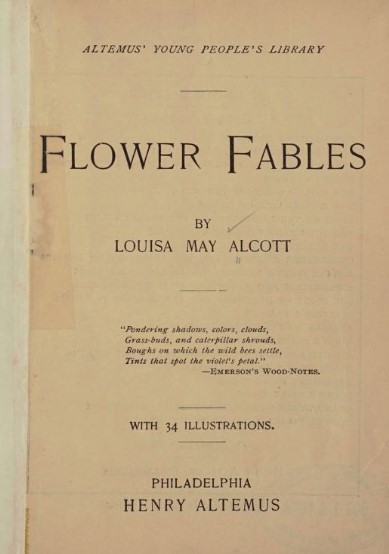
Alcott began her career with the publication of poetry and short stories. Some of these early works were signed “A.M. Barnard” and were categorized as “potboilers,” often lurid and violent tales – but they always featured female characters who were strong and independent. At age 22, Alcott achieved a major milestone with the publication of her first book, “Flower Fables.”

Flower Fables 1
Flower Fables 2

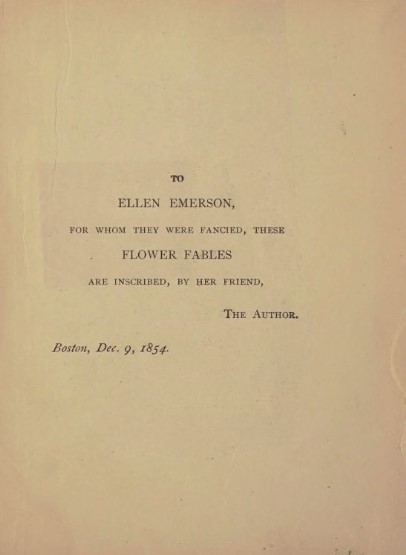
Cover and inscription of an 1898 edition of Louisa May Alcott’s first book, “Flower Fables.”  The book was dedicated to Ellen Emerson, daughter of Alcott’s friend Ralph Waldo Emerson. Images courtesy of the Library of Congress, where a fully scanned version of the text is also available.

Throughout her life, Alcott was involved with causes such as women’s suffrage and abolition, influenced by the many intellectuals who shared her home community. Alcott and her mother canvassed door-to-door in their community to encourage women to vote, and in 1879 Louisa was registered as the first woman to vote in the Concord school committee election.

As an adult, she also socialized with Frederick Douglass and Julia Howe, leaders in their respective causes. In 1861, after the start of the Civil War, Alcott enlisted as a nurse in a Union Hospital in Georgetown in Washington, D.C. Though she had to leave her assignment early due to typhoid fever, the time proved to be immensely influential. In 1863, she published “Hospital Sketches,” a memoir detailing her time as a nurse, inspired by the letters she wrote to her family during this time.

Little Women

Well into her career, at age 35, Alcott’s publisher asked her to pivot and write a “girls’ story.” This directive led Alcott to write her magnum opus, “Little Women,” which stands the test of time as a seminal American text. The 492 pages of “Little Women, Part I” were written in three months at the desk her father built for her at her childhood home of Orchard House.

The book became an instant hit, resonating with stories of domestic life and realistic depictions of women not typically seen in contemporary fiction.

Alcott published 30 books over the course of her life, cementing her in the pantheon of great American writers. She died on March 6, 1888, and is buried in Sleepy Hollow Cemetery in Concord.

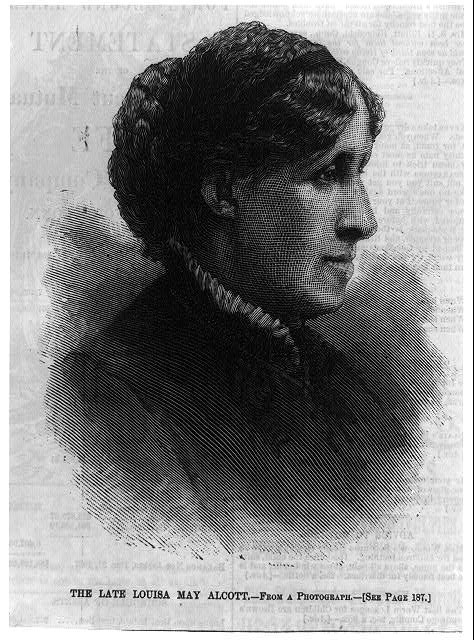
Portrait

“The Late Louisa May Alcott,” wood engraving after photo, 1888. Image courtesy of the Library of Congress.

Additional Resources

  • Read “Little Women,” available online at the Library.
  • Explore Louisa May Alcott’s Orchard House virtually.
  • Watch the 1994 or 2019 film adaptations of “Little Women,” available on streaming sites.

2020 marks the centennial of women’s suffrage in the United States. 

April 1, 2020 by Web Editor

Angel of the Battlefield: Humanitarian Clara Barton

Post Published: March 19, 2020

Clara Barton (1821-1912)

Celebrate the 100th anniversary of the 19th Amendment with stories about women who have used their voices and their votes to better their communities and help shape the United States.

pic3

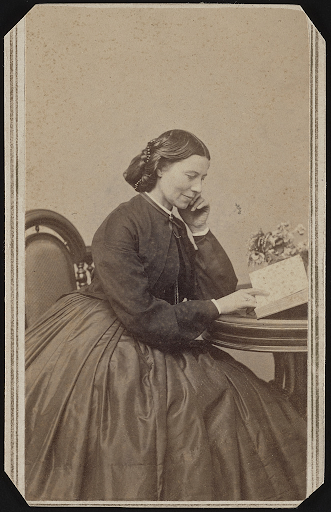
“Union Nurse Clara Burton,” photograph by C.R. Claflin, ca. 1865. Image courtesy of the Library of Congress. 

Clara Barton is an enduring symbol of humanitarianism for her work during the American Civil War, where she played a fundamental role in distributing much needed provisions and medical supplies to the Union Army. She was also renowned as an educator, nurse and a founder of the American Red Cross.

Barton was born on December 25, 1821, in Oxford, Massachusetts, the youngest of five children. She had her first experience in nursing while caring for her brother David and later became a teacher at age 18.

Early Career

At 24, she founded a school for children on the site of her brother’s mill and in 1852 she established the first free school in Bordentown, New Jersey. Barton resigned from her teaching position upon discovery that the school had hired a man at twice her salary. She left the post on the principle that she would never work for less than a man.

Following her teaching career, Barton began working as a recording clerk for the U.S. Patent Office in Washington, D.C., making her the first woman to hold the position. In line with her beliefs on the fundamental equality of women, she was paid $1,400 as a salary – the same as her male colleagues. After this milestone, however, she faced backlash. The then-Secretary of the Interior Robert McClelland opposed women serving in the government and demoted her to a copyist position at a lower salary.

pic4

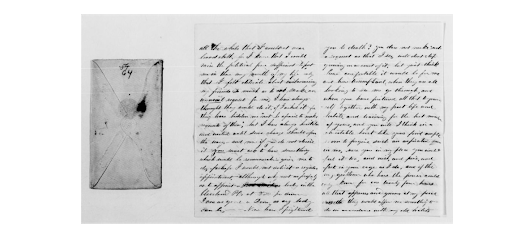
February 13, 1860, Letter from Clara Barton to her nephew Bernard Vassall, which discusses women’s oppression. Part of the Clara Barton Papers at the Library of Congress.

American Civil War

In 1861, like all Americans, Barton’s life changed with the start of the Civil War. She quit her post in government and dedicated herself to bringing supplies to Union soldiers in need. She started by taking supplies to the men of the 6th Massachusetts Infantry housed in the unfinished Capitol building, some of whom had been her students and her peers growing up.

Barton collected relief articles including clothing, assorted foods, and supplies for sick and wounded soldiers, and appealed to the public to garner more donations. She also read to soldiers in the camps, wrote letters and prayed with them.

pic1

Soldiers of the 6th Regiment Massachusetts volunteer militia, one of the groups that Clara Barton helped bring supplies during the Civil War. Image courtesy of the Library of Congress.

In 1862, she received official permission to transport supplies to battlefields and was present at every major battle in Maryland, Virginia and South Carolina. After the battle of Cedar Mountain in August 1862, Barton brought in a wagon load of supplies drawn by a four-mule team to the field hospital. Upon her arrival, the surgeon on duty commented: “I thought that night if heaven ever sent out a[n] … angel, she must be one – her assistance was so timely.” This led to Barton gaining the nickname “Angel of the Battlefield.”
Of her time on the battlefield, Barton said: “I may be compelled to face danger, but never fear it, and while our soldiers can stand and fight, I can stand and feed and nurse them."

Though she had no formal medical training, in 1864 she was named head nurse for one of General Benjamin Butler’s units. In the aftermath of the war, Barton was also involved in helping prepare former enslaved people for freedom, as well as marking graves, testifying to Congress about her experience in the war, and helping locate missing soldiers. To help the latter cause, she established the Office of Correspondence with Friends of the Missing Men, which she operated out of her home on 7th Street in Washington, D.C. The Office received and answered over 63,000 letters and identified over 22,000 missing men during its four years of operation. A tracing service similar to this operation would eventually become a crucial part of the operations of the Red Cross.
file

“Clara Barton. A wartime photograph by Brady,” ca. 1890-1910. Image courtesy of the Library of Congress.

Red Cross

After the war, Barton continued to serve her nation. After a visit to Europe, she was inspired by the Red Cross in Geneva, Switzerland, and lobbied to establish a branch in the United States. On May 21, 1881, the American Association of the Red Cross was formed, built up by Barton’s work writing pamphlets, lecturing and meeting with President Rutherford B. Hayes on the topic of support for the organization.

Barton was elected the group’s first president, and in 1882, the United States joined the International Red Cross. As its leader, Barton oversaw relief work for victims of the Johnstown Flood in 1889 and the Galveston Flood in 1900, among other events. She remained with the Red Cross until 1904, and that same year established the National First Aid Association of America.

pic

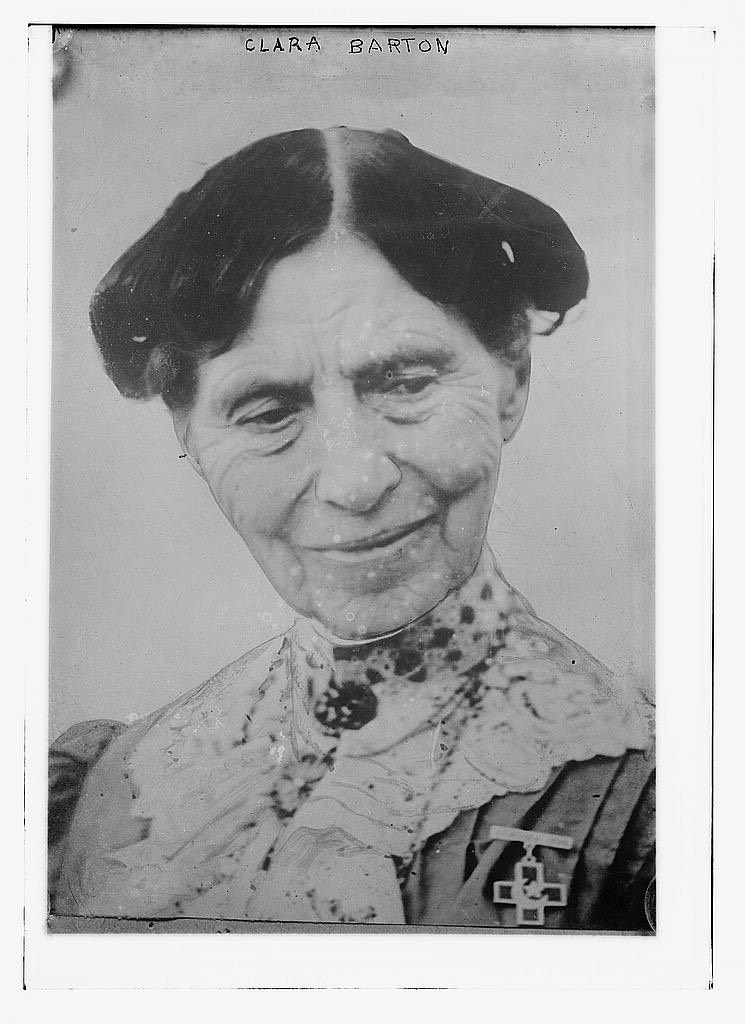
Clara Barton, ca. 1911. Image courtesy of the Library of Congress.

Later Years

Barton was also involved in civic causes including education, prison reform, women’s suffrage, and civil rights.

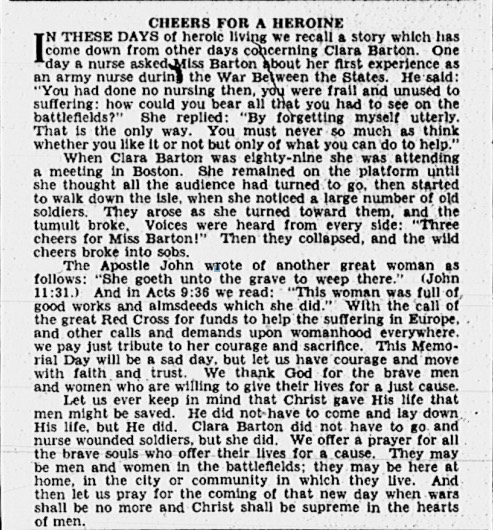
Barton died on April 12, 1912. Since her death, Barton has frequently been turned to as an example and reminder of American heroism, as in this newspaper article from May 31, 1940, written by The Northern Virginia Sun in the days leading up to World War II:

pic 5

March 19, 2020 by Web Editor

  • « Go to Previous Page
  • Page 1
  • Page 2
  • Page 3
  • Page 4
  • Page 5
  • Page 6
  • Interim pages omitted …
  • Page 9
  • Go to Next Page »

Footer

About Us

  • Mission & Vision
  • Charlie Clark Center for Local History
  • News Room
  • Get Email Updates

Administration

  • Policies
  • Library Staff
  • Job Opportunities
  • Propose a Program or Partnership

Support Your Library

  • Friends of the Library
  • Giving Opportunities
  • Donating Materials
  • Volunteer Opportunities

Our Mission

We champion the power of stories, information and ideas.

We create space for culture and connection.

We embrace inclusion and diverse points of view.


Download the Library App

Download the Library App

Arlington County | Terms & Conditions | Accessibility | Site Map
· Copyright © 2025 Arlington County Government ·