• Skip to primary navigation
  • Skip to main content
  • Skip to footer

Alert

Update: Elevator outages, maintenance and upgrades at Central Library More Info

Home - Arlington County Virginia - Logo
MENUMENU
  • Join Now
  • My Account
    • Login
    • My Checkouts
    • My Holds
    • My Lists
    • My Reading History
    • About Borrowing
    • About Holds
    • About My Account
  • Hours & Locations
    • All Hours & Locations
    • Holiday Closings
  • News
    • Library News
    • Director's Blog
    • Get Email Updates
  • Contact Us

Arlington Public Library

MENUMENU
  • Search
  • Collections
  • Library Services
  • Events
  • Community Engagement
  • Join Now
  • My Account
    • Login
    • About Borrowing
    • About Holds
    • About My Account
  • Hours & Locations
    • All Hours & Locations
    • Holiday Closings
  • News
    • Library Blog
    • Get Email Updates
  • Contact Us

News Archive

The Great Outdoors

Post Published: September 1, 2009

Swimming in Arlington
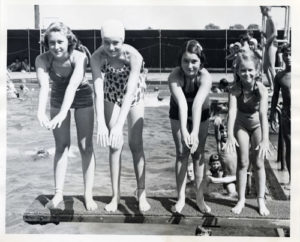
The young girls above are enjoying a rarity in Arlington County: swimming in an outdoor pool.

Although there are private swim clubs all over Northern Virginia, Arlington has only one outdoor public pool, at Upton Hill, which is part of the Northern Virginia Regional Park Authority, not the county.

Young people in Arlington were still able to learn to swim. The county was unique in that by 1968, there were indoor pools and instruction at every public senior and junior high school. However, swimming outside during the summer could be more difficult. The Department of Parks and Recreation tried to help with their summer day camp program. New in the summer of 1953, campers went biweekly to “the Marine Corps pool” and “the Middleburg pool” according to the annual report. That report specifically stated “[b]ecause of lack of facilities, swimming and golf are not a part of the Department’s sports activities.” Today, classes are still offered through the county – year-round, inside.

What About You?

Where did you go swimming in Arlington? Did you attend the county’s day camp? Do you know anything about “the Marine Corps pool” and “the Middleburg pool”? Let us know what you remember!
 

September 1, 2009 by Web Editor

Littlest Italy

Post Published: June 23, 2009

Quarries for Washington

Arlington is not known for its vibrant Italian community, but actually at one time there was a small section of the County known as “Little Italy.”

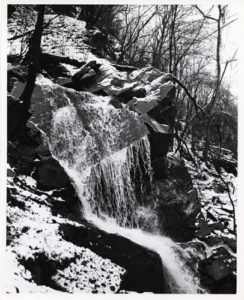
In the Marcey Creek ravine there once lived about twenty-four Italian and Sicilian quarrymen who worked the quarries on the Potomac Palisades near the mouth of Pimmit Run, Gulf Branch, Donaldson Run, Marcey Creek and Spout Run. These quarries once produced the building material for many structures in the Washington area.

Two types of stone were quarried: rubble to crush for use on streets and roads, and larger stones for construction. Among the buildings that used the stone included Georgetown University, St. Patrick’s Church, the Hains Point seawall, and St. Elizabeth’s Hospital. The last quarry closed in 1938.

In preparation for the George Washington Memorial Parkway’s construction in the mid 1950’s, the National Park Service acquired the quarry land, including the area known as “Little Italy” where the last three remaining quarry workers remained. The above photograph shows a waterfall in one of the quarries after it was turned into parkland.

Guiseppe (Josh) Conduci and his brother Carmelo (Carl) Conduci and Phillip Matoli had lived peacefully there after the quarries closed down, raising and selling flowers. Their only extravagance was pure olive oil for cooking. Friends stepped in to find homes for them, but forced to move from the only homes they had known for so many years was wrenching, and a sad ending to what was once Arlington’s early “Italian community.”

What About You?

Do you remember the quarries on the Potomac Palisades? Let us know what you remember!
 

June 23, 2009 by Web Editor

An Historic School

Post Published: May 12, 2009

From School to Historical Society

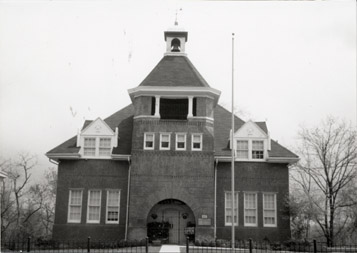
Hume School Arlington Historical Society

Driving along Arlington Ridge Road you pass an old two-story brick building with a bell tower which was once the Hume School.

Named for civic leader and philanthropist Frank Hume, it is the oldest remaining school building in Arlington.

Built in 1891, the land was purchased for $250 from Frank Hume, a successful wholesale grocer in Washington D.C., who later donated land for an adjacent playground as long as the building was used as a school. When the school was built it was the County’s newest school and attacked as an extravagance as it had three rooms, considered far too large for any “foreseeable” school population. Most schools at that time were one room only.

In 1958, when the school closed, the Hume heirs deeded the property to the Arlington Historical Society, along with a $10,000 donation from one of Frank Hume’s children to help with fundraising for a proposed museum to help preserve Arlington’s heritage. The result was the Arlington Historical Society Museum, which is run primarily by volunteers and has been open at least one day a week since its inception.

What About You?

What do you remember about Hume School? How have you interacted with the Historical Society? Let us know what you remember!
 

May 12, 2009 by Web Editor Tagged With: local history news

Don’t Touch that Dial—A Yule Blog from the Director

Post Published: December 18, 2008

Director's Blog

Do you hear what I hear?

As another holiday season has us in the grip (or gripe), I am reminded once again of the thing that still makes me tingle (and ring-ting-a-ling-a-ling, too). Seasonal music! The stuff that snuggles like a treasured knitted scarf. Those tunes that hibernate in your head only to spring, like Rudolph and his happy feet, at the first whiff (or taste?) of eggnog, pine and fruitcake.

Christmas music, long the Hallmark of Bing, Nat, Johnny, Rosie, Perry, Andy and Alvin got hip-ish when Elvis, the Beatles, the Beach Boys and others of their elk (er, ilk) started rocking around the Christmas tree. Then there were all of those Celtic, Brit-ic, medieval-ic rediscoveries. A British invasion of another sort. And today’s new age-ic global village brings its own brand of seasonal confection.

Now I’m not talking about Christmas novelty songs spawned by the likes of Dr. Demento, Stan Freberg and Root Boy Slim (“Christmas at K-Mart”). I am talking about the real thing here–timeless carols, “newly “interpreted” classics,” spiffed up and re-packaged to drive the dark away. Some of my happiest childhood memories are of listening to Christmas music. At our house in the mid-1960s, the latest Firestone Christmas music album was as eagerly anticipated as the Sears “Wish Book.” Hymns and jingles sung by the likes of Rise Stevens, Roberta Peters, Burl Ives, Robert Goulet, Mitch Miller and his gang, the Vienna Choir Boys, the New Christy Minstrels and the Young Americans. Stars of stage, studio and the small screen. Ghosts of Christmas past. For a buck a pop, these records, with their colored wrapping paper and big red bows screamed Christmas like nothing else. And I loved them.

Firestone stopped the series at No. 7. Maybe they felt they had nothing left to say? Maybe they felt that the whole series was a little played out (pun intended)? Besides, the times were changing. In the years covered by the series, 1962-1968, there had been three assassinations, marches for civil rights, an unpopular war, the Summer of Love. The world was too much with us. Time to put away childish things.

And yet, every year about this time I can’t help but scan the web for the latest in seasonal grooves. And then I find myself wondering, as I wander, what if Firestone were willing to issue an 8th and final “Best of Christmas” collection? Like Dylan’s basement tapes, masters from the vaults, what Christmas classics would I want to bring back, re-package, find new audiences for? So after some humming and hawing, my “Best Of” list, in Letterman order–plus two bonus tracks, in the spirit of giving. Firestone, are you listening?

10. “Good King Wenceslaus” – The Ames Brothers. From “There’ll Always Be a Christmas,” 1957, Taragon label. One of my all-time favorite carols and my all-time favorite cover. Dig the counter-tenorish “mark my footsteps my good page.” Nothing said Christmas at 6922 N. 29th St.like this recording. It still gives me chills.

9. “Personent Hodie.” Okay, I didn’t say I didn’t like this stuff, I only noted its proliferation. Lots of good versions, though I am partial to Anonymous 4‘s (“Legends of St. Nicholas”).

8. “Let it Snow” – Jo Stafford. Nothing says cool like Jo Stafford, who passed away this last July. Hip, sophisticated and oh-so-smooth.

7. “Sleigh Ride” – Arthur Fiedler and the Boston Pops. “Giddy-yap giddy-yap giddy-yap let’s go/Let’s look at the snow.” For a few hot minutes, I could imagine what it would be like to live in the New England countryside. And then I would come back down to earth. Great sound effects.

6. “Baby, It’s Cold Outside” – Ray Charles and Betty “Bebop” Carter. It just does not get any better than this.

5. “Caroling,Caroling/Happy Holiday” – Johnny Mathis. I’ll take anything by Johnny Mathis. He could sing the phone book and I would like it. An old style crooner with heart and soul.

4. “My Favorite Things” – John Coltrane. It gets on the list because of its lyrics (“snowflakes that stay on my nose and eyelashes”). And Coltrane spent a career recording multiple versions. I never tire of it. A 1960 release that introduced the Coltrane quartet with drummer Elvin Jones, pianist McCoy Tyner and bassist Steve Davis. Yes, I never get tired of this record.

3. “The Christmas Song” (“Chestnuts roasting…”) – Nat King Cole. Mel Torme wrote it but Nat owned it. ‘Nuf said.

2. “Wexford Carol” – Cambridge (Mass.) Revels. From “Christmas Day in the Morning.” I have never heard a version of this song that I didn’t like but picked this one because of its old-timey feel and spirit. Percussive and pure.
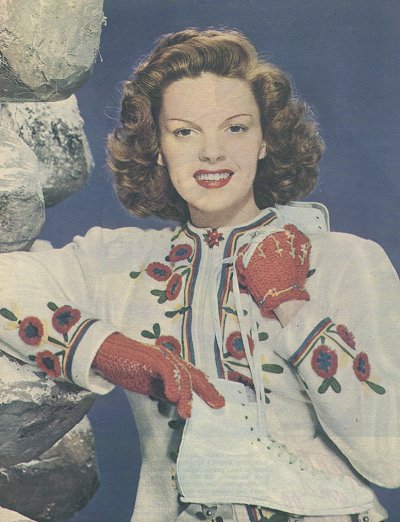
1. “Have Yourself a Merry Little Christmas” – Judy Garland. Introduced by Garland in the holiday classic “Meet Me in St. Louis.” Judy at her most limpid and luminous; future first husband Vincente Minelli at his most Minelli-ish. MGM really knew how to make movie musicals.

Bonus Tracks:
“Christmas Time is Here” – Vince Guaraldi. From the TV evergreen, “A Charlie Brown Christmas.” Still holds up after all these years.
The album “Light of the Stable” – Emmylou Harris. As crystalline pure today as it was when it was released almost 30 years ago. A classic from start to finish.

So click, spin or play your way into the holidays. And post a comment below with YOUR list of holiday favorites—be they musical, audio-visual, literary or memories of the most notable gifts ever given or received. Hanukah tunes? Eid? Kwanzaa?
And have yourself a merry little. . .

December 18, 2008 by Web Editor Tagged With: yule blog

The Old Oaken Bucket

Post Published: November 19, 2008

Oral histories are a vibrant and personal part of the Virginia Room's collection.

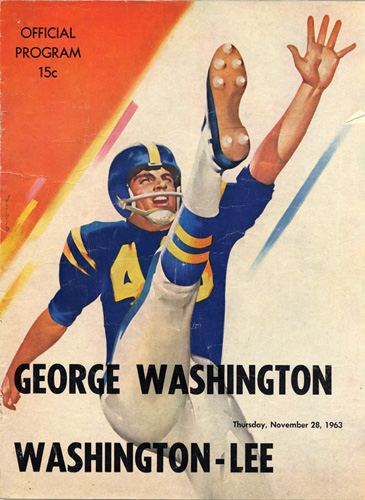
GW-WLgame 1963bl

Here, Barbara Ball Savage, a W & L alumnus, talks about one of Arlington's Thanksgiving traditions, the Old Oaken Bucket game.
This interview was conducted in February of 2000.

Barbara Ball Savage: The Oaken Bucket was very big between W & L and George Washington High School in Alexandria. And you could count on a few fights there every Thanksgiving morning because the tempers would get pretty high. I can remember Forest Tucker, the actor - do you remember who Forest Tucker was? He was a W & L graduate. He graduated with my sister-in-law as a matter of fact. And he would come back for that game, so I can remember him being there while I was in high school. But it was a big thing. Thanksgiving morning we would all bundle up and I swear the days were colder then than they are now. I can remember just freezing. And if it was down in Alexandria we would all pile in cars and go down there and go to that game. It was really a big thing for Arlington and Alexandria. And then we’d come home and the turkey would be just about ready because Mother had things ready. She’d have dinner on the table for 21, 22 people by 2:00 at the latest.[…]

And Thanksgiving was a wonderful time, and then we all went out in the back yard and played touch football. Everybody got in the games and played. Or, we’d finish raking the leaves…[s]o Thanksgiving was a very special day. But that football game, you’d talk about it for a month ahead of time, you know, how important that game was going to be.

What About You?

What do you remember about the Old Oaken Bucket game? What about other Arlington high school traditions? Let us hear from you!


November 19, 2008 by Web Editor

Protest!

Post Published: October 28, 2008

July 2, 2019 update: Staff from the Center for Local History were recently contacted by a former firefighter who was involved in the demonstrations described in this post. He told us that both police and firefighters are pictured in the photo.  In addition, he clarified that both fire and police did get a new contract that included a pay raise.

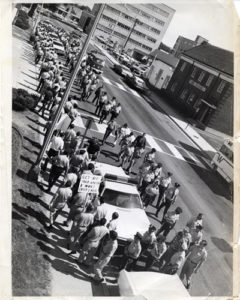
This photograph, taken on July 13, 1974, shows an Arlington County police officer and firefighter protest outside the courthouse after a County Board meeting.

police and firefighters marching, aerial view

A month earlier, the County Board had recommended an 8 percent pay raise for county police officers; the police, represented by the Arlington Policeman's Beneficiary Association, requested a 10.8 percent increase to keep up with the rising cost of living in the Washington, DC, area. At the board meeting on July 13th, representatives for the police and firefighters urged the County Board to reconsider, but to no avail. After the meeting, this protest was held. County police, along with all Virginia county employees cannot, by state law, strike.

However, Arlington's finest protested in another way. Throughout the month of July and the beginning of August, police officers dramatically reduced the amount of traffic tickets issued, about 75 percent. Many of those that were written were for "violations of state statutes" instead of "violations of county ordinance," so the fines collected would go to the state treasury. The county was losing about $7700 per week, and Arlington motorists were very happy.

The crisis was resolved in mid-August with a new contract for Arlington police and firefighters. Concessions were made on both sides, but the crisis spawned a movement within county employee groups to push for more open and flexible collective bargaining for county wages across all departments.

What About You?

Do you remember this protest? Let us hear from you!

To see more items like these, or to learn more about Arlington's history, visit the Center for Local History on the first floor of the Central Library.

Do you have a question about this story, or a personal experience to share? 

Use this form to send a message to the Center for Local History.

Center For Local History - Blog Post Message Form

Do you have a question about this story, or a personal experience to share? Use this form to send a message to the Center for Local History.

"*" indicates required fields

This field is for validation purposes and should be left unchanged.

Share Your Story

October 28, 2008 by Web Editor

Time Marches On

Post Published: September 23, 2008

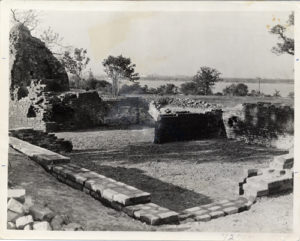
The ruins of Abingdon Plantation sit on a hill by a roadway in busy Ronald Reagan Washington National Airport.

The property began as a 6000 acre land grant to Robert Howson in 1669, which was traded to John Alexander for 6000 hogsheads of tobacco. A member of the Alexander family built the first part of the plantation house in 1746.

Abingdon Plantation was purchased in 1778 by John Parke Custis, stepson of George Washington, who wished to locate his young family close to Mount Vernon. The Custis family’s plans were cut short when John Custis died from camp fever at Yorktown in 1781. His widow, Eleanor Calvert Custis, married Dr. David Stuart, an Alexandria physician in 1783 and had 13 more children. The two oldest Custis girls, Elizabeth and Martha, resided with the Stuarts, while Nellie and George Washington Parke Custis grew up at Mount Vernon. The Stuarts returned the Abingdon Plantation to the Alexander family in 1792.

In the years following Abingdon Plantation was occupied by Union troops during the Civil War. The plantation’s productivity was hampered by the nearby development of several brick manufacturing companies and the region’s growing transportation needs, with the Washington Alexandria and Mount Vernon electric railway, the Richmond, Fredericksburg and Potomac Railroad and the Mount Vernon Memorial Highway (later GW Parkway) cutting into the land.

A fire destroyed the abandoned and deteriorating Abingdon home on March 5, 1930. In 1938 President Roosevelt selected the site for National Airport which opened in 1940. Today, the airport’s parking area surrounds the ruins of the main house, which can be seen by the nearby metro line. Visitors can see artifacts from the Abingdon house site in a special exhibit hall inside the airport, and the site is open to the public.

What About You?
Have you visited the Abingdon Plantation site? Let us hear from you!

September 23, 2008 by Web Editor

Everything Under the Sun

Post Published: July 8, 2008

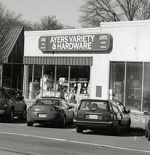
Ayers’ Variety & Hardware in Westover is a unique store; their specialty is everything. From screws to toys to lawn decorations to fishing line, if you need it, you can probably find it at Ayers’.

Ayers’ Hardware, as it is known to locals, was established by John W. Ayers, a World War II veteran from Georgia. He relocated to the Washington area while working for Woolworth’s in 1924, but opened up J. W. Ayers Five and Ten Cents Store in 1948. Ayers was known as the Mayor of Westover, handing out candy to neighborhood children, providing materials to classrooms in nearby elementary and middle schools, and becoming active in several civic groups in Arlington such as the Kiwanis Club and the Arlington Chamber of Commerce. He was active in the community by working for sidewalks and streetlights, and overseeing the Westover Christmas tree, Halloween dances and “Westover Days.” Ayers was a lynchpin of the community even after he turned over the store to his 32 employees in a profit-sharing plan in 1968.

Many were worried when Ayers died in 1976 that the store would disappear and the community spirit of Westover would fade. However, the Kaplan family bought Ayers Variety & Hardware in 1977 from the Ayers estate and has continued to stock it’s shelves with quirky and practical items at good prices. It still serves as an anchor for the small stretch of stores on Washington Boulevard near Walter Reed school, and is a distinctive part of the Arlington business landscape.

What About You?
What do you remember about J. W. Ayers or his store? Let us hear from you!

July 8, 2008 by Web Editor

Life During Wartime

Post Published: June 24, 2008

On May 24, 1861, Union troops came over the river to Arlington. At the time, Alonzo Hayes, Jr., lived with his widowed mother, Malvina, his two attractive older sisters, Annie and Mary, and his brother, William, in a two-story house at Sunnyside Farm, two miles from Aqueduct Bridge.

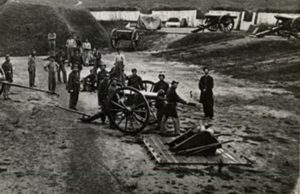
Company L, Second New York Artillery, at Fort C. F. Smith in August, 1865.

Sunnyside farm was adjacent to six Union forts protecting Washington and was occupied by a succession of Union troops. Fences and timber were removed to build forts and corduroy roads and for firewood. A stable with over 1,000 horses was built on their property and Union soldiers boarded in their home.

According to a 1975 Oral History interview by his granddaughter Mrs. Janet Hayes Baldwin, twelve-year-old Alonzo was hit in the heel by a stray shell from a Union fort across the river and limped for the rest of his days. Alonzo also caught smallpox from the troops but survived with no scarring. The family would entertain soldier visitors who were well-behaved but seemed to be homesick, but the widowed mother would sometimes send her daughters upstairs during those visits.

The site of Sunnyside Farm is now the Arlington Science Focus School and children still play on the lawn of Emily Hayes Park, which was donated to Arlington County by Janet Baldwin’s maiden aunt Emily Hayes.

The photograph above was marked for publication, and shows Company L, Second New York Artillery, at Fort C. F. Smith in August, 1865. The original is owned by the Library of Congress.

What About You?
Do you know about Civil War events in Arlington? Is there evidence of the war on your property? Let us hear from you!

June 24, 2008 by Web Editor

Arlington Analog Technology

Post Published: May 6, 2008

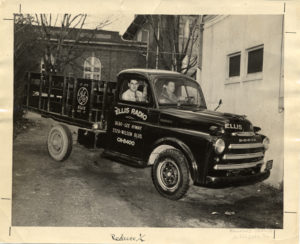
Ellis Radio and Television

Cleffie L. Ellis was born in Warren County, N.C. and moved to the Washington area in the 1930s, where he attended the old Capital Institute of Radio and Technology.

In 1937 he established Ellis Radio, later Ellis Radio and Television, in the Cherrydale section of Arlington. The shop also carried large household appliances.

Customers would come to view the new medium of television as well as attend demonstrations of household products. Mr. Ellis operated his store until 1988. In 1960 he founded Arlington Electronic Wholesalers.

What About You?

Do you have memories of Ellis Radio and Television or other early Arlington businesses? Please let us know!


May 6, 2008 by Web Editor

  • « Go to Previous Page
  • Page 1
  • Page 2
  • Page 3
  • Page 4
  • Interim pages omitted …
  • Page 7
  • Go to Next Page »

Footer

About Us

  • Mission & Vision
  • Charlie Clark Center for Local History
  • News Room
  • Get Email Updates

Administration

  • Policies
  • Library Staff
  • Job Opportunities
  • Propose a Program or Partnership

Support Your Library

  • Friends of the Library
  • Giving Opportunities
  • Donating Materials
  • Volunteer Opportunities

Our Mission

We champion the power of stories, information and ideas.

We create space for culture and connection.

We embrace inclusion and diverse points of view.


Download the Library App

Download the Library App

Arlington County | Terms & Conditions | Accessibility | Site Map
· Copyright © 2026 Arlington County Government ·