• Skip to primary navigation
  • Skip to main content
  • Skip to footer

Alert

Update: Courthouse Library is now open More Info

Alert

Update: Elevator outages, maintenance and upgrades at Central Library More Info

Home - Arlington County Virginia - Logo
MENUMENU
  • Join Now
  • My Account
    • Login
    • My Checkouts
    • My Holds
    • My Lists
    • My Reading History
    • About Borrowing
    • About Holds
    • About My Account
  • Hours & Locations
    • All Hours & Locations
    • Holiday Closings
  • News
    • Library News
    • Director's Blog
    • Get Email Updates
  • Contact Us

Arlington Public Library

MENUMENU
  • Search
  • Collections
  • Library Services
  • Events
  • Community Engagement
  • Join Now
  • My Account
    • Login
    • About Borrowing
    • About Holds
    • About My Account
  • Hours & Locations
    • All Hours & Locations
    • Holiday Closings
  • News
    • Library Blog
    • Get Email Updates
  • Contact Us

Homepage

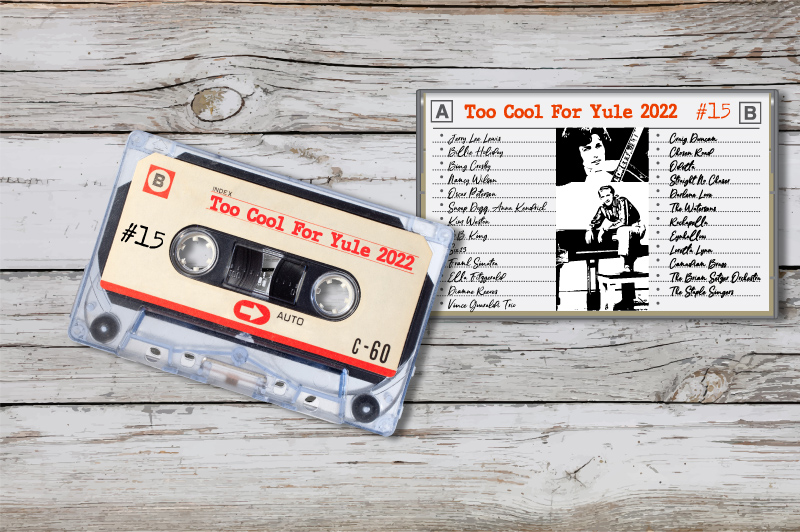
Too Cool for Yule, 2021

Post Published: November 29, 2021

Social Media Ads_Facebook

Since 2008, I have created a holiday playlist variously known as “Don’t Touch that Dial” or "Too Cool for Yule." (There is even a movement afoot to change the name to the “Ding a Ling Thing,” but I digress.)

Many years ago, I made mixtapes for my friends, my siblings, my work colleagues, and often, just for me. For those of you under the age of... fill in the blank... who might not have had the pleasure of methodically mining for nuggets in an LP collection, or waiting patiently by the radio for the hourly replay of the one tune that truly captures the essence of the person you are making the tape for, the mixtape can be a work of art. Each tape tells a story, and the best ones contain an eclectic blend of edgy and whimsical, happy and sad; a little silly, a little snappy and occasionally, a little sappy.

A couple of notes about this year’s edition. Each year I honor a few of the musicians who have left us. Charlie Watts of the Rolling Stones, Graeme Edge of the Moody Blues, Mary Wilson of the Supremes, and Don Everly, the last surviving member of the Everly Brothers, sadly made it to the list. (I wanted to honor Nanci Griffith but could not locate a suitable holiday song.)

Open playlist in Spotify

Listeners will find pop, jazz, instrumental, New Orleans, country, bluegrass, R&B, old school pop, The Chipmunks, and more. Perhaps my favorite is a bluesy tune by the inimitable Fats Domino, who wants to “Stop the Clock.” Wouldn’t we all.

The last words and notes go to Dave Frishberg, brilliant jazz pianist and satirist, musical mainstay of Schoolhouse Rock (“I’m Just a Bill"), who died November 17. His talk-singing of “You are There” touchingly sums it up for anyone who misses special someones.

As Year Two of the pandemic winds down, take a moment (or 5760 -- thank you, Alexa), grab a beverage, any kind will do, and enjoy “Too Cool for Yule 2021.”

And above all…

Stay safe, stay hopeful.

Diane Kresh
Director
Arlington Public Library

Scrawled signature of Diane Kresh

November 29, 2021 by Web Editor Tagged With: yule blog

Oral History: Don Tenoso

Post Published: October 14, 2021

Arlington-based Native American artist and educator

Arlington Voices the Oral History Collection

Oral histories are used to understand historical events, actors, and movements from the point of view of real people’s personal experiences.

Artist Don Tenoso is a prolific creator, known for his Lakota-style dollmaking that depicts Sioux culture. Tenoso came to the Washington, D.C., area in 1991 as the first artist-in-residence at the Smithsonian’s Natural History Museum, where he created new pieces and led demonstrations for the public.


Don Tenoso, Sioux Doll-maker and Puppeteer.

Don Tenoso, circa 1990 at the Smithsonian Museum of Natural History. Image courtesy of the Smithsonian Institution Archives.

Tenoso was born in Riverside, California, and is a member of the Hunkpapa, one of the seven bands of the Teton Lakota Nation and part of the Sioux-speaking indigenous population. Tenoso’s mother was born on the Standing Rock reservation in South Dakota, and he is a descendant of One Bull and Sitting Bull. His father was in the U.S. military during Tenoso’s early life and the family often moved around the country and abroad.

The following interview excerpts are from a 2008 oral history with Tenoso. At the time of this interview, he had lived in Arlington for about 14 years. In the full interview, which can be accessed in print at the Center for Local History, Tenoso also discusses his family and lineage, as well as tribal traditions and the Lakota language.

tenoso

Don Tenoso, circa 2005. Image courtesy of the University of Illinois Urbana-Champaign, where Tenoso was the university’s first artist-in-residence at the Native American House. 

Narrator: Don Tenoso
Interviewer: Tom Dickinson
Date: January 23, 2008
Note: The audio for this interview is currently unavailable.

Don Tenoso: I was the first artist-in-residence in the Natural History Museum. Prior to that they had brought me in for a three-day doll demonstration where they had taken one of the glass cases out of one of the Native halls there in Natural History at Smithsonian and by different artists coming in. Me, a Sioux doll maker, was invited to come up and do that. I guess they had spent like nine months trying to find me. I started dollmaking back in the seventies.

Anyway, in the eighties, ‘86 or so, ‘87, there was an article in American Indian Art magazine that was published about dolls. In ‘86 I believe it was, I had a one-man show down in Andrew Park, Oklahoma and they collected the International Crafts Board for four of my dolls.

So one of them got in that article and then the director over at education in the outreach program saw the doll and they said they wanted to find that guy.

Don Tenoso SIA-SIA2010-0383

Don Tenoso circa 1991 outside of the National Museum of Natural History with some of his works of art. The doll beside Tenoso is called “Iktorni,” or “trickster doll.” Image courtesy of the Smithsonian Institution Archives.

Tenoso beadwork

Leather holster created by Tenoso in 2006, covered in a beadwork design. Image courtesy of the British Museum, where the piece is held. 

Tom Dickinson: How did you get started doing this [art practice]?

DT: Actually I started when I was in New York. I went out there because I heard that C. W. Post [campus of Long Island University] had a scholarship for Natives who wanted it to be teachers. It turns out they didn’t so I went to the American Indian Community House there in New York.

Actually, backpedal a little bit. I was born in Riverside, California in 1960. In ‘63 we were in France. We were there when de Gaulle kicked us out. So my earliest memories are there when the French high school kids were throwing rocks at us on the playground. They would stone our bus. I remember flying out of there and the U.S. piling up all these brand new, big boxes and stuff and just setting them on fire. Big old wrecking balls smashing holes into runways as you flew out. I also got to see some whales as we flew, that’s how low they went across the ocean. You can see the spouts and little tails going across.

So from there we go to Oklahoma City, so I got to meet all these Natives. They used to call it Indian Territory which is sort of a penal colony for Native Americans starting back through Trail of Tears, Andrew Jackson and all of that stuff.

From there we went and lived in Rapid [City] back where my grandma lived, lot of relatives in Rapid City, South Dakota, in the Black Hills which is our sacred area, which actually by federal courts is still our property. But they offered us $10 million or $100 million or something but we still don’t take it. Because our sacred Wind Cave is there and that’s one of our origin stories. We came from there. The thing about Wind Cave you stand there one hour of the day and it blows your hair back.

So geologists say, “Yeah, there’s probably an underground stream - they haven’t found it yet - flowing and air displacement and that’s causing your hair to go that way.” The only thing is you come back some hours later, same day, and now it’s sucking your hair into the cave. “I guess there’s a tilting rock or something under there that messes with it.” We say that’s Mother Earth breathing, that’s where she breathes from.

Learn more: View a program from the 1992 exhibit Contemporary Plains Indian Dolls, which took place at the Southern Plains Indian Museum and Crafts Center in Anadarko, Oklahoma. The exhibit featured a piece by Don Tenoso (“Gourd Clain Dancer,” figure 10). 
 
This interview was conducted as part of The Many Faces of Arlington oral history project, which sought to document the County’s diverse population as a reflection on the 400th anniversary of the settlement of Jamestown by English colonizers. 

The goal of the Arlington Voices project is to showcase the Center for Local History’s oral history collection in a publicly accessible and shareable way.

The Arlington Public Library began collecting oral histories of long-time residents in the 1970s, and since then the scope of the collection has expanded to capture the diverse voices of Arlington’s community. In 2016, staff members and volunteers recorded many additional hours of interviews, building the collection to 575 catalogued oral histories.

To browse our list of narrators indexed by interview subject, check out our community archive. To read a full transcript of an interview, visit the Center for Local History located at Central Library.

October 14, 2021 by Web Editor

Oral History: J. Walter Tejada

Post Published: September 23, 2021

Community Activist; Arlington County Board Member from 2003 - 2015

Arlington Voices the Oral History Collection

Oral histories are used to understand historical events, actors, and movements from the point of view of real people’s personal experiences.

401px-Arlington_County_Board_Chair_J._Walter_Tejada_USE_THIS_ONE_(4251361999)

Walter Tejada’s County Board portrait, circa 2007.

In 2003, J. Walter Tejada became the first person of Latin American heritage to be elected to the Arlington County Board, or to any governing body in Northern Virginia.

Tejada served as County Board Chair in 2008 and 2013.

Tejada was born in El Salvador and immigrated to the United States at age 13, first settling with his family in Brooklyn, New York, and later moving to Trenton, New Jersey. After attending college and playing soccer at Keystone Junior College and Mercer College, he eventually moved to Arlington in 1987.

Tejada got his start as an activist and organizer after witnessing inequities faced by members of the Latinx community. He initially worked in groups addressing fair housing, job opportunities, and the League of United Latin American Citizens (LULAC). He also helped to establish a Salvadoran festival in Arlington, starting in 1995, focusing on Salvadoran culture.

Screenshot 2021-09-22 105027

The front page of El Pregonero, the official Spanish-language newspaper of the Roman Catholic Archdiocese of Washington, D.C., on March 13, 2003, following Tejada’s election to the County Board.

In 2003, Tejada was elected to the Arlington County Board in a special election following the death of Board member Charles P. Monroe. Tejada defeated longtime GOP activist Mike W. Clancy in the contest.

During his time on the board, Tejada continued to advocate for immigrant and Spanish-speaking communities, and served on numerous task forces and groups, including as chair on the governor’s Latino Advisory Commission.

Tejada

J. Walter Tejada speaking at the National Rally for Citizenship on the West Lawn of the Capitol on April 10, 2013. Image courtesy of C-SPAN.

Arlington_County_Board_2014

From left to right: County Board members J. Walter Tejada, John Vihstadt, Jay Fisette, Mary Hynes and Libby Garvey in 2014.

Since his time in County government, he was appointed to the Metropolitan Washington Airports Authority Board of Directors and is president of the Virginia Latino Leaders Council.

In the following oral history interview, conducted prior to his election to the County Board, Tejada discusses his childhood, coming to Arlington, and his early work in activism. In these excerpts from the interview, he discusses first impressions of the County and his work with LULAC’S Council 4609, which encompasses Arlington. 

This interview is available in full at the Center for Local History. Note: The audio for this interview is currently not available.  

Narrator: J. Walter Tejada 

Interviewer: Ingrid Kauffman

Date: October 27, 2000 

J. Walter Tejada: One of the things I saw when I lived in DC - actually, one of the first things I recognized was that - actually since I started visiting Robin [Liten-Tejada] when she went to school here -- is that DC had a much larger Latino population than New Jersey, and I liked that. Remember, I mentioned that when we lived in New York there weren't that many Salvadorans at all, even when we lived in New Jersey, there was one person that was Salvadoran, and he lived like 10 miles away. It was odd that I came here and suddenly there was a Salvadoran population. 

Ingrid Kauffman: What year was that? 

WT: 1987. I thought, “this is great.” There were some restaurants; I hadn't eaten pupusas for years, which is one of my favorite Salvadoran dishes, just like almost every day. I saw this and it really piqued my interest. In fact, it was a determining point why I ended up moving here, when we were talking about what we were going to do with our lives. I'd come to visit and see all this and I liked that. The climate here, so many people from different backgrounds, different perspectives and accents, cultural activities - to me, it was like a paradise for these activities. When I was working in D.C. I also saw that the Latino community was really - first of all, there was no political power. Then - the community - not all but certainly a good portion of the community finds itself in a very tough socio-economic situation.

WT: Three things [LULAC Council 4609] did were voter registration, citizenship, and leadership development. That part I liked because it made it so broad for different things. I decided I was going to be involved in that aspect, because we would promote meetings, forums, community forums, where elected officials or public officials would meet with the community to address issues of concern with the community, sort of like putting a little bridge into what needed - the issues of importance. I started, and I would go to places and grab chairs, move them around, set up the coffee machine, make sure donuts were there.  

We did forums on gang prevention activities, the educational system in Arlington, how it was being responsive to Latinos or not. We've done forums in the business community - what opportunities there could be to incorporate Latinos into the business world. We did citizenship workshops where we published that on a certain day people could come in with all their material that we would specify, like passport, proof of where they lived, proof where they worked, birth certificates for their kids, and helped them fill out these applications in order to apply to become citizens. We would have lawyer friends who would come and volunteer in these workshops so that we can help people.

The goal of the Arlington Voices project is to showcase the Center for Local History’s oral history collection in a publicly accessible and shareable way.

The Arlington Public Library began collecting oral histories of long-time residents in the 1970s, and since then the scope of the collection has expanded to capture the diverse voices of Arlington’s community. In 2016, staff members and volunteers recorded many additional hours of interviews, building the collection to 575 catalogued oral histories.

To browse our list of narrators indexed by interview subject, check out our community archive. To read a full transcript of an interview, visit the Center for Local History located at Central Library.

September 23, 2021 by Web Editor

Message from the Library Director on Masks and Social Distancing

Post Published: August 18, 2021

Effective Wednesday, Aug. 18, all individuals, age two and older, who enter Arlington Public Library buildings will be required to wear a mask, regardless of vaccination status.

We are taking this action to protect our community’s health and well-being due to the recent spike in cases of COVID-19 in our area. We also ask that you continue to maintain 6 feet of distance between yourself and people who don’t live in your household. These steps are consistent with actions being taken in Loudoun County, Fairfax and Alexandria library systems.

According to the Centers for Disease Control and Prevention (CDC), the Virginia Department of Health (VDH), and the Arlington County Public Health Division, COVID-19 continues to pose a risk, especially to individuals who are not fully vaccinated.

As always, thank you for your patience and cooperation as we strive to provide safe library services in this difficult time.

Diane

Scrawled signature of Diane Kresh

Diane Kresh
Director
Arlington Public Library

August 18, 2021 by Web Editor

Search Thousands of Historic Arlington Papers Online for Free

Post Published: June 21, 2021

Discover Arlington's history and browse newspaper content online from 1935 to 1978.

Chronicle

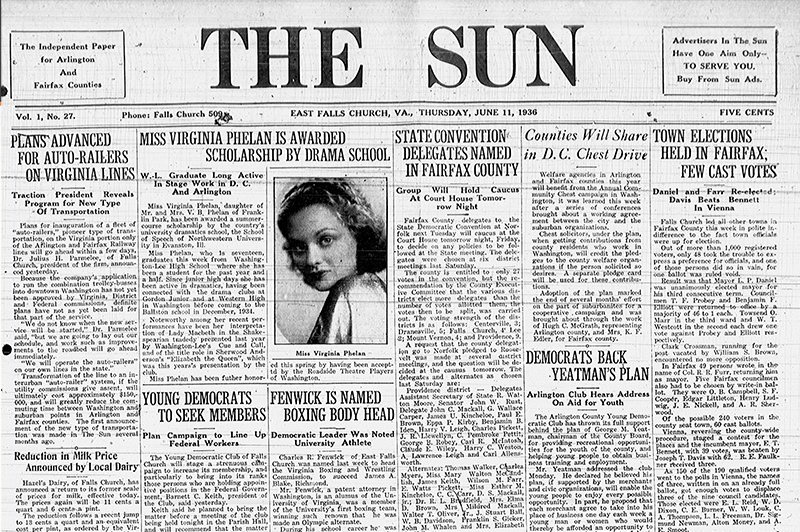
During the past year, Arlington Public Library’s Center for Local History (CLH) has been working with the Library of Virginia (LVA) to make five decades of Arlington research material available online.

Spanning the years from 1935 to 1978, the materials include historic articles, photos, and news clippings from four Arlington newspapers: the Columbia News, the Daily Sun, the Northern Virginia Sun and the Sun.

Previously, these publications were only available in the Center for Local History as microfilm and digital scans, which were not easily searchable.

These newspapers are a fantastic resource for historians, teachers, genealogists and anyone curious about Arlington's past through the eyes of local journalism.

“Delve deeper into your family history, find information on the transformation and growth of Arlington and discover more of its unique history,” said Arlington Public Library Director Diane Kresh.

The free news archive is 100% keyword searchable by location, date, title and issue and features a clipping feature that allows researchers to save an image or text block of an article.

To access the new source materials, visit the LVA ‘s Virginia Chronicle, which is a large online depository for historic newspapers from across the Commonwealth.


The CLH collects, preserves and shares historical documents that tell the history of Arlington County, its citizens, organizations, businesses and social issues. The CLH operates the Research Room at Central Library and the Community Archives program.

June 21, 2021 by Library Communications Officer

The History of Arlington’s Logo and Seal

Post Published: May 27, 2021

Arlington is currently in the process of changing its iconography. Let's take a look back at the previous versions of the Arlington Logo as the County begins the process of updating its visual identity.

Arlington County was formally designated in 1920, changing its name from Alexandria County in order to distinguish itself from the nearby City of Alexandria. The County initially used the Virginia state seal in official documents, which depicts the Roman goddess Virtus conquering Tyranny. It is accompanied by Virginia's state motto, “Sic Semper Tyrannis,” or “Thus Always to Tyrants.”

Office of Planning Letter

Example of usage of the Virginia state seal in County documents, circa 1958.

Arlington House

Around the mid-1960s, Arlington began using an unofficial County seal. However, the Commonwealth’s Attorney decided that the County Board did not have the authority to adopt a seal. The County Board subsequently authorized the use of a visual signature on documentation, but in 1969 declined to make it a seal based on this legal guidance. Because of this designation, then-County Manager Vernon Ford described the seal as a “decorative medallion.”

The unofficial seal featured Arlington House and the date 1801 in later versions. This was contested by Arlington history expert Eleanor Templeman. The date was chosen to represent the formal establishment of the County of Alexandria, but Templeman argued that it could be incorrectly interpreted as the date of construction of Arlington House, which commenced in 1802. The 1801 date prevailed, however, remaining on the County seal into the 1980s.

The main image on the seal, Arlington House, was the longtime home of Robert E. Lee, leader of the Confederate Army. The building was constructed by slave labor for George Washington Parke Custis, who was George Washington’s step-grandson and Lee’s father-in-law. After the start of the Civil War, the Lee family fled and the property was used by Union troops as a burial site, and the location would eventually become part of Arlington National Cemetery.

Since 1972, the site has formally been known as “Arlington House, the Robert E. Lee Memorial,” reinstating its ties to the Confederate leader. In 2020, legislation was proposed to remove Lee’s name from the historical site, citing the erasure of Black Americans who lived in slavery on the property.

74 State Seal
76 State Seal

Examples of use of the state seal and unofficial County seal, from 1974 and 1976.

The "A" Logo

In 1976, the County began using an unofficial logo in the form of a stylized “A,” with Arlington House also appearing on this image. The logo was designed by Susan Neighbors, a professional illustrator from Arlington, who produced five designs based on County guidance. These options were then voted on by the public at ballot boxes placed at the County libraries, and the “A” logo won the contest.

A Logo 79
A Logo 83

Example of the “A” logo used by the County starting in 1976. Image circa 1979 and 1983.

County Flag Design

In September 1982, the County set out to adopt an official design for the County flag, and the County Board adopted a resolution for a flag design competition and a Flag Selection Panel to choose the design. In March of 1983, the County released a call for entries for the design of the flag to the public. Design requirements included the use of blue and white colors, and the words “Arlington County, Virginia,” as well as “1920.”

One hundred and ten people submitted designs for the contest, and Harvey J. Wilcox was selected as the winner in April of 1983. Wilcox, a deputy general counsel for the Navy, had no formal design experience and came up with the design while homebound with the flu. His imagery reflected the County’s unofficial logo and seal with a depiction of Arlington House, accompanied by a white ring and sprays of dogwoods underneath. Yellow was chosen as the background color for the flag.

Harvey Wilcox Entry

Harvey Wilcox’s winning entry for the 1983 design contest.

After consulting with the Virginia Attorney General, who issued a different opinion than the one about 20 years prior, the County’s authority to have a flag was dependent on the County having a seal. So, Wilcox’s design then became the County seal, which would subsequently be presented on the County flag.

The inclusion of “1920” from the original design rules was also dropped for the final iteration, due in part to the issues that were raised by Templeman decades before. One of the issues was Arlington had multiple dates in its history that could be considered as equally significant in its history. The County seal and flag were officially adopted on June 18, 1983.

New County Seal 1
New County Seal 2

Examples of the new County seal on official documents and letterhead. Images from 1994 and the late 1990s.

The Future of the Logo

The next major step in Arlington’s formal iconography was when the County created and adopted an official logo in 2004. The logo came along with a redesign of the County website that same year and was designed by the D.C. office of Gensler Studio 585. Focus groups were held with design professionals, members of the business community, and members of the general public.

The resulting design was adopted in the summer of 2004, and, like the County seal, included a stylized representation of Arlington House, but the design drew some criticism. In a public poll of more than 1,000 responses conducted by the Arlington Sun Gazette, 81 percent opposed the new design, 15 percent supported it and 3 percent voted, 'it's OK, I guess.’ In October 2004, a petition was circulated calling for the removal of the logo, and it “even inspired a piece of folk art by an artist, who rendered the new logo in dead cicada shells."

County Logo 04

Arlington County’s logo, adopted in 2004.

The County seal and logo were then used concurrently, but for different outlined purposes. In general, the seal is used for items relating to the County Board and for more permanent items (such as the County flag, permanent signage, and certificates).

The logo is considered a marketing sign and is used on departmental materials (such as County vehicles and general correspondence). In 2007, the County sought public comment and issued an update to the seal due to persistent inconsistencies in its rendering. The update kept the same imagery on the seal, but restored the original “Arlington blue” and refined it for online use.

In September 2020, the County announced that it would adopt a process to develop a new logo and seal, moving away from imagery related to Arlington House in County iconography. In January 2021, a Logo Review Panel was assembled to review concept submissions from the community, and in April announced five options selected from a pool of more than 250 ideas.

Stay tuned to the County’s homepage to submit your art for the next round of logo design submissions.
Pre 2007 Graphic 1
Pre 2007 Graphic 2

A pre-2007 graphic file of the County seal and the updated version, which is still in use today.

Do you have a question about this story, or a personal experience to share? 

Use this form to send a message to the Charlie Clark Center for Local History.

Center For Local History - Blog Post Message Form

Do you have a question about this story, or a personal experience to share? Use this form to send a message to the Center for Local History.

"*" indicates required fields

This field is for validation purposes and should be left unchanged.

Share Your Story

May 27, 2021 by Web Editor

Arlington Council on Human Relations: Speaking Out

Post Published: May 20, 2021

Graphic image of a megaphone

Join us for a new series of stories from the Center for Local History highlighting members of our community who made a difference in ways that helped shape our history and created positive change.

Their voices were not always loud, but what they said or did had a significant impact on our community.

Arlington Council on Human Relations

On December 1, 1958, members of the public were invited to a meeting held at the Rock Springs Congregational Church. The meeting was organized by Pastor Sidney Lovett, as well as Hubert Beckwith and Paul Rilling, President and Executive Director respectively of the Virginia Council on Human Relations.

It was on that evening that the Arlington Council on Human Relations was formed.

123-1-1-1-7

Membership meeting letter from Dudley P. Babcock.

The purpose of the Council was to improve the economic, civic, and racial conditions in Arlington County. Affiliated with the Virginia Council on Human Relations and coordinating with other local, regional, and national agencies and organizations, the council sought to promote better understanding and communication while trying to lessen tensions between the different groups living and working within Arlington County’s borders.

The County at this time was strictly segregated. Not only were there “white” schools and “Black” schools, but playgrounds were segregated, theaters maintained separate seats for Blacks, and they couldn't stay at any motels or hotels in the County. Even the Arlington Hospital was segregated as there was only one maternity ward and no Black mother could have her baby there except in cases of emergency. Low-income housing was also an ongoing problem.

The Council formed committees to address these various issues. Months were spent writing letters to theatre owners, and picket lines were formed at theatres. Many meetings were held with various organizations and businesses. A joint meeting with Arlington Hospital was arranged.

123-1-1-1-6

1967 announcement from the Council of Human Relations of Arlington, Alexandria and Fairfax.

Change was slow, but the Council members persisted and while the struggles were sometimes bitter, progress was made. Arlington Public Schools began the process of desegregation, public playgrounds and theatres were integrated and some motels began to accept Black people. Black women were accepted in the maternity wing of Arlington Hospital, and lunch counters throughout the County were integrated. And all of this took place before the Civil Rights Act of 1964 was passed.

While the early 1960s was the most active period, the Council continued their social justice work throughout the 60s, focusing primarily on affordable housing and poverty issues.

123-1-1-2-22

1969 Council letter to Bernie Pony Rental.

Do you have a question about this story, or a personal experience to share? 

Use this form to send a message to the Charlie Clark Center for Local History.

Center For Local History - Blog Post Message Form

Do you have a question about this story, or a personal experience to share? Use this form to send a message to the Center for Local History.

"*" indicates required fields

This field is for validation purposes and should be left unchanged.

Share Your Story

May 20, 2021 by Web Editor

Cycling Through Arlington’s History

Post Published: May 13, 2021

May is National Biking Month, and to celebrate, let’s take a look at Arlington’s decades-long history of bicycle enthusiasm!

1939

The County Sheriff’s department and a local chapter of the VFW team up to form a bicycle safety club for youth in Arlington. According to a February 24, 1939 news article, the “bicycle rage of the [18]90s” was on the upswing, and conditions for cycling were hazardous on the local roads.

1941

The County issues a set of rules for regulating bicycle use.

Cyclists were required to carry a license and tag, and bicycles were not to be ridden “faster than is reasonable and proper.”

Picture1

Notice about bicycle laws from the October 17, 1941 issue of the Northern Virginia Sun. Image courtesy of Virginia Chronicle.

1950s

Bicycling remains a popular recreational activity in Arlington, though largely regulated to neighborhood street cycling alongside pedestrians.

1967

Arlington paves its first bicycle facility: a multi-use trail made of crushed limestone of about three miles along Four Mile Run. The trail opening included a ceremony at Bluemont Park, a performance by the Navy band, and cycling exhibitions.

This was also the first bicycle trail in the nation to be built with federal funds.

Picture4

Program from the opening of Arlington’s first bike trail. Image courtesy of the VA State Department of Conservation and Recreation via BikeArlington.

Picture5

A crowd gathers on bikes for a conservation event at Four Mile Run, circa the late 1960s. (214-9205)

1972

The Washington Area Bicyclists Association is formed, drawing members from the DMV region and advocating for improved bicycle facilities.

1973

The County completes its first commuter bikeway, connecting to the Spout Run Parkway and providing access to Rosslyn. Additionally, an eleven-member Bicycle Advisory Committee is established to advise on cycling-related issues and development.

Picture7

Children line up for bicycle safety inspection, run by the Arlington County Police Department, 1969.

1974

Arlington’s Master Bikeway plan is released, which calls for an 80-mile network of trails for commuter and recreational use.

1977

Metro stations debut in Arlington, which shapes the County’s transportation plan to include a bike trail along the route of I-66 and bicycle parking at the new stations.

1982

Custis Trail is completed, adding 8.5 miles of trail to the area.

Picture9

Map of County bike trails, 1977.

Bike underpass at Wilson Boulevard and Four Mile Run

Bike underpass at Wilson Boulevard and Four Mile Run. Date unknown. (210-0103)

1994

The Arlington Bicycle Transportation plan is adopted, and $7.3 million is eventually allocated to develop new bike trails, bicycle lanes, and bicycle parking.

2008

The County adopts the Bicycle Element, a new planning document focused on continuing bicycle development.

2010

Arlington launches Capital Bikeshare in partnership with the District of Columbia.

bike share

First generation Capital Bikeshare bicycles, February 2012 at Central Library.

Sources

Active Living and Biking: Tracing the Evolution of a Biking System in Arlington, Virginia, by Royce Hanson and Garry Young

Baseline Report – The State of Bicycling in Arlington, County publication

To learn more about Arlington's history, visit the Center for Local History on the first floor of the Central Library.

Do you have a question about this story, or a personal experience to share? 

Use this form to send a message to the Center for Local History.

Center For Local History - Blog Post Message Form

Do you have a question about this story, or a personal experience to share? Use this form to send a message to the Center for Local History.

"*" indicates required fields
This field is for validation purposes and should be left unchanged.

Share Your Story

May 13, 2021 by Web Editor

The Library Director’s 2020 Book List, Continued

Post Published: December 4, 2020

Reading in a Pandemic

“Salvation is certainly among the reasons I read. Reading and writing have always pulled me out of the darkest experiences in my life. Stories have given me a place in which to lose myself. They have allowed me to remember. They have allowed me to forget. They have allowed me to imagine different endings and better possible worlds.”

Roxane Gay, "Bad Feminist"

In late December last year, I compiled a list of books I intended to read in 2020.  As with most “to do” lists and resolutions, I began with good intentions. And then the pandemic hit and the books on my list no longer seemed adequate. My reading tastes shifted along with everything else in both my work and home life.

Photo of hand written notes of a book list.

I’ve always been a reader, but I began reading voraciously, as if I was running out of time.

Barely was a book closed before another opened. My hold list in the library catalog grew and grew and GREW. I created booklists on scraps of paper and in the margins of the arts and style sections of the newspaper. I listened faithfully to The Book Review Podcast from the New York Times.

And I read. All the time. More than 50 books in all, across genres and styles, dating from the 19th century to the present.

Diane's 2020 Pandemic Reading List
Photo of book covers.

There were many standouts. Long a fan of coming of age novels, I read five that will stick with me. Each of these authors is known for other, more famous books. These are worth a look for everyone who wants to revisit the trials of adolescence and early adulthood.

  • "Black Swan Green" by David Mitchell
  • "Rule of the Bone" by Russell Banks
  • "Red at the Bone" by Jacqueline Woodson
  • "Topeka School" by Ben Lerner
  • "My Losing Season" by Pat Conroy

I dipped into classics:

  • “Slaughterhouse Five“ by Kurt Vonnegut
  • “Bartleby the Scrivener” by Herman Melville
  • “Man’s Search for Meaning” by Victor Frankl
  • “Hiroshima” by John Hersey

And on the lighter side because I needed a dose of hopefulness, “A Wrinkle in Time,” by Madeleine L’Engle.

Photo of book covers.

Race was very much on the national mind and steered me toward:

  • “The Fire Next Time” by James Baldwin
  • “Just Mercy” by Bryan Stevenson
  • “Sula” by Toni Morrison
  • “The Yellow House” by Sarah M. Broom
  • “Your House Will Pay” by Steph Cha

The 100th anniversary of the 19th Amendment and women being granted the right to vote drew me to women’s issues more broadly. I read:

  • “No Visible Bruises” by Rachel Louise Snyder
  • “In the Dream House” by Carmen M. Machado
  • “Girl, Woman, Other” by Bernardine Evaristo

For the pure pleasure of superior plotting and writing, I’ll mention “Disappearing Earth” by Julia Phillips.

Photo of book covers.

And finally, the wonderful Arlington READS authors whose books we featured in our 2020 series, “We the People.” In a year of reinvention of Library programs and services, we Zoomed the author talks, part of our new now.

  • Roxanne Gay, author of ”Bad Feminist”
  • Alexis Coe, author of ”You Never Forget Your First"
  • Brooke Gladstone, author of “The Trouble with Reality: A Rumination on Moral Panic in our Time”
  • Elaine Weiss, author of “The Woman’s Hour: the Great Fight to Win the Vote”
  • David Brooks, author of “The Second Mountain: the Quest for a Moral Life”
  • Colson Whitehead, author of “The Nickel Boys”

And on a personal note, I discovered the joy (and ease) of audiobooks, especially when read by the author. What a delightful way to get lost in a story.

Diane's 2020 Pandemic Reading List

Reading was an anchor, a sure bet during months of uncertainty. With hours blending into days, into weeks and then months, I occasionally lost track of the day of the week, but never lost my place in a book. I had something to look forward to and there were always more books.

My stacks of books have not disappeared, and I am still adding holds in the Library catalog. At this moment, I am reading “Surviving Autocracy,“ by Russian-American journalist, translator and activist Masha Gessen, who I am excited to announce will be our first Arlington READS author in the new year.

In closing, thank you for your support of Arlington Public Library. It is a joy and an honor to serve this wonderful community.

Stay safe, stay hopeful and keep reading.

Diane

Scrawled signature of Diane Kresh

December 4, 2020 by Library Communications Officer Tagged With: Diane's Book Lists

A Year of Stories and Milestones in the Fight for Women’s Suffrage

Post Published: August 17, 2020

Celebrating the 19th Amendment

Celebrate the 100th anniversary of the 19th Amendment with stories about the people and events that led to the passage of women’s suffrage in the United States.

Executive Commitee

The executive committee of the National Woman’s Suffrage Association. Image courtesy of Encyclopedia Brittanica.

Over the course of the last year, the Center for Local History has collected the stories of the individuals and groups that helped lay the foundation for women’s suffrage in the United States.

As the Library commemorates the 100th anniversary of the 19th Amendment, a major milestone in enacting the democratic principles of our nation, read the stories detailing the people and events that led up to this historic moment.

January 8: The First Issue of The Women’s Journal

Womans Journal 3

Suffragist Margaret Foley distributing the Woman’s Journal and Suffrage News, 1913. Library of Congress Prints and Photographs Division.

The Woman’s Journal was a women’s rights publication that produced its first issue on January 8, 1870.  One of the most significant and popular publications of the women’s suffrage movement, it ran in various forms from 1870 to 1931. Founded by suffragist Lucy Stone and her husband Henry Browne Blackwell in Boston, Massachusetts, the Woman's Journal aimed to provide a broad segment of women with information on the women’s rights movement and the suffrage cause.

Read the rest of the story.

January 26: Zitkála-Šá

Zitkála-Šá 6

Image of Zitkála-Šá ca. 1921, courtesy of the Library of Congress

Nationally recognized as an author and activist, Zitkála-Šá was a vocal proponent for citizenship and voting rights for Native Americans. A Lyon Park resident later in life, she passed away on this date in 1938 and is buried in Arlington Cemetery.

Read the rest of the story.

March 10: Hallie Quinn Brown

Portrait of Hallie

Hallie Quinn Brown. Image courtesy of Wilberforce-Payne Unified Library.

Born on March 10, 1865, Hallie Quinn Brown was a preeminent educator, writer, public speaker, and activist in the causes of civil rights and suffrage throughout the 19th and 20th centuries. She was a president of the National Council of Colored Women and worked on political campaigns throughout her life.

Read the rest of the story.

May 4: Mabel Ping-Hua Lee

Mabel Lee

Dr. Mabel Lee, date unknown. Photo from the George Grantham Bain Collection, courtesy of the Library of Congress.

On May 4, 1912, Mabel Ping-Hua Lee made history when she led one of New York City’s major suffrage parades on horseback. Lee was an active suffragist and activist throughout her life despite the barriers around her – for example, Chinese women such as Lee herself would not be able to vote until the Chinese Exclusion Act was removed in 1943 and they could become citizens.

Read the rest of the story.

May 10: The 11th National Women’s Rights Convention

Horse Drawn Float

“Horse-drawn float declares National American Woman Suffrage Association’s support for Bristow-Mondell amendment.” Circa 1914. Image courtesy of the Library of Congress.

In 1866, the women’s suffrage movement experienced a significant change in its organization as the various groups leading the struggle toward women’s suffrage split over certain issues. Key among them was support for the 15th Amendment, (passed in 1869), which states that "The right of citizens of the United States to vote shall not be denied or abridged by the United States or by any State on account of race, color, or previous condition of servitude."

Read the rest of the story.

May 20: Nannie Helen Burroughs

Nannie 1920

Nannie Helen Burroughs photographed between 1900 and 1920. Image courtesy of the Library of Congress.

Nannie Helen Burroughs, who was a leading educator, feminist and suffragist in the Washington, D.C., area throughout the early 20th century, founded a school for girls and women and was an active member in her community.

Read the rest of the story.

July 16: Ida B. Wells

Ida B. Wells

Portrait of Ida B. Wells, circa 1893. Image courtesy of the National Park Service.

Ida B. Wells was an investigative journalist, activist, and suffragist who led an anti-lynching crusade in the United States in the 1890s. She was also one of the founders of the National Association for the Advancement of Colored People (NAACP).

Read the rest of the story.

September 23: Mary Church Terrell

Mary Church Terrell

Mary Church Terrell, photo taken between 1880 and 1900, printed later. Library of Congress Prints and Photographs Division.

Born on September 23, 1863, Mary Church Terrell was a D.C. suffragist who was a tireless champion of women’s rights and racial justice. She was the first president of the National Association of Colored Women, an active member of the National American Woman Suffrage Association, and was engaged in lawsuits related to civil rights well into her eighties.

Read the rest of the story.

October 17: Agatha Tiegel Hanson

Video of Agatha Tiegel Hanson, reminiscing [about her college experiences] with unnamed younger people. From the Gallaudet Archives. No transcript, undated.

Agatha Tiegel Hanson was the first female graduate (and valedictorian) of Gallaudet University and an early champion of both deaf and women’s rights. Hanson, who passed away on October 17, 1959, was instrumental in organizing women’s groups on Gallaudet’s campus and continued to advocate for equality throughout her life.

Read the rest of the story.

October 23: The National Woman’s Rights Convention

Womans convention 2

Lucy Stone, one of the Convention’s lead organizers and a speaker at the event.

On October 23, 1850, the first National Woman’s Rights Convention began in Worcester, Massachusetts. Amidst the ringing fervor of the mid-19th-century clarion call for expanding women’s rights – with the right to vote as its central tenet – this day would emerge as a significant step in solidifying the goals and action plan of the women’s suffrage movement in the United States.

Read the rest of the story.

November 14: The Night of Terror

Florence Youmans of Minnesota (left), clutching a suffrage propaganda banner, and Annie Arniel of Delaware (center), being approached in front of the White House gates by an unidentified policewoman, who appears to have seized Arniel's banner, while a third unidentified suffrage picket watches from behind her tri-color purple, white, and gold National Woman's Party flag, and a fourth picket looks away in a different direction.

Policewoman arrests Florence Youmans of Minnesota and Annie Arniel (center) of Delaware for refusing to give up their banners. June 1917. Library of Congress Prints and Photographs Division.

On November 14, 1917, a group of suffragists underwent a horrifying night of torture and abuse that would come to be known as the “Night of Terror.” On this day in history, 33 women protesters were taken to the Occoquan Workhouse in Fairfax County and subjected to brutal treatment by the prison’s guards in retaliation for the women’s ongoing peaceful protest for the right to vote.

Read the rest of the story.

November 26: Sojourner Truth

Sojouner Truth 2

Portrait of Sojourner Truth. Caption on portrait reads: "I sell the shadow to support the substance." Library of Congress Prints and Photographs Division.

November 26 marks the anniversary of the death of legendary suffragist and abolitionist Sojourner Truth. Born into slavery as Isabella Baumfree (sometimes written as Bomfree) in 1797, Truth was enslaved in Dutch-speaking Ulster County, New York, where she was bought and sold four times throughout her life.

Read the rest of the story.

December 10: Wyoming Day

Wyoming Day 2

“Scene at the Polls in Cheyenne,” 1888.
Library of Congress Prints and Photographs Division.

On December 10, 1869, the frontier territory became the first to explicitly grant women the right to vote when Governor John Campbell approved “An Act to Grant to the Women of Wyoming Territory the Right of Suffrage and to Hold Office.”

Read the rest of the story.

To learn more about Arlington's history, visit the Center for Local History on the first floor of the Central Library.

Do you have a question about this story or a personal experience to share? 

Use this form to send a message to the Center for Local History.

Center For Local History - Blog Post Message Form

Do you have a question about this story, or a personal experience to share? Use this form to send a message to the Center for Local History.

"*" indicates required fields
This field is for validation purposes and should be left unchanged.

Share Your Story

August 17, 2020 by Web Editor

  • « Go to Previous Page
  • Page 1
  • Interim pages omitted …
  • Page 9
  • Page 10
  • Page 11
  • Page 12
  • Go to Next Page »

Footer

About Us

  • Mission & Vision
  • Charlie Clark Center for Local History
  • News Room
  • Get Email Updates

Administration

  • Policies
  • Library Staff
  • Job Opportunities
  • Propose a Program or Partnership

Support Your Library

  • Friends of the Library
  • Giving Opportunities
  • Donating Materials
  • Volunteer Opportunities

Our Mission

We champion the power of stories, information and ideas.

We create space for culture and connection.

We embrace inclusion and diverse points of view.


Download the Library App

Download the Library App

Arlington County | Terms & Conditions | Accessibility | Site Map
· Copyright © 2026 Arlington County Government ·