• Skip to primary navigation
  • Skip to main content
  • Skip to primary sidebar
  • Skip to footer

Alert

Holiday: All library locations to close early at 5 p.m. on Nov. 25 and all day Nov. 26 & 27 in observance of Thanksgiving. More Info

Alert

Central Library garage will be closed Monday, Nov. 23 through Wednesday, Nov. 25 for maintenance. More Info

Alert

Update: No elevator service from garage & Quincy St. entrance closed during Central Library upgrades. More Info

Home - Arlington County Virginia - Logo
MENUMENU
  • Join Now
  • My Account
    • Login
    • My Checkouts
    • My Holds
    • My Lists
    • My Reading History
    • About Borrowing
    • About Holds
    • About My Account
  • Hours & Locations
    • All Hours & Locations
    • Holiday Closings
  • News
    • Library News
    • Director's Blog
    • Get Email Updates
  • Contact Us

Arlington Public Library

MENUMENU
  • Search
  • Collections
  • Library Services
  • Events
  • Community Engagement
  • Join Now
  • My Account
    • Login
    • About Borrowing
    • About Holds
    • About My Account
  • Hours & Locations
    • All Hours & Locations
    • Holiday Closings
  • News
    • Library Blog
    • Get Email Updates
  • Contact Us

News

Womens Work: Meet Dr. Knipling, Founder of the Outdoor Lab

Post Published: April 12, 2018

Seeking Hands-On Outdoor Experience

After World War II, developers transformed much of Arlington County’s open land into urban neighborhoods, destroying open meadows, forests, and other natural areas. By the mid-1960s, Dr. Phoebe Hall Knipling, Science Supervisor at Arlington Public Schools (and the first person to hold such a position in Virginia), encountered a major challenge to developing the district's science curriculum: her students’ lack of hands-on experiences with nature and wildlife.
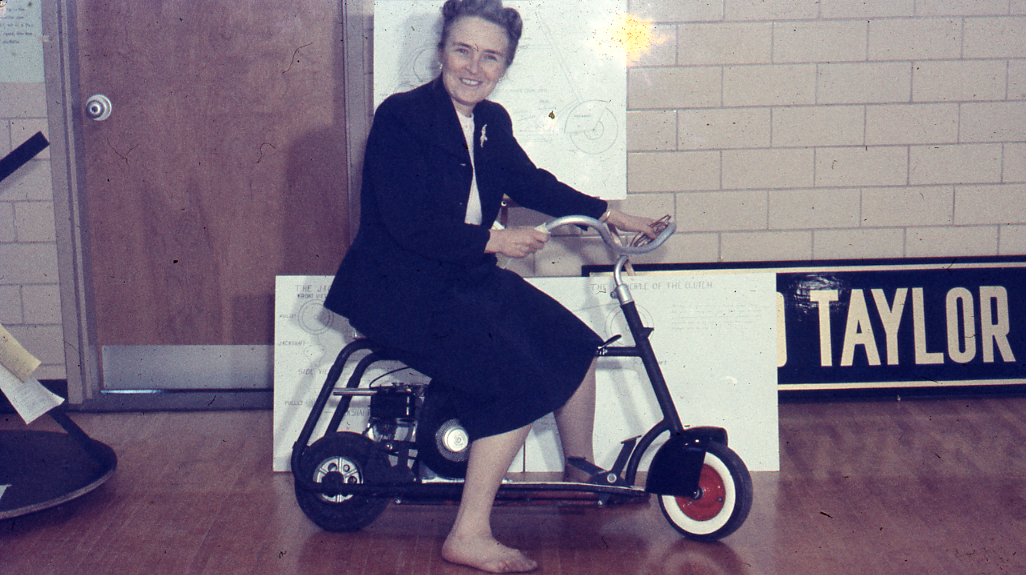
Dr. Phoebe Knipling riding a scooter at a science fair
Dr. Knipling at a student science fair

Beginning in the 1950s, Dr. Knipling worked hard to create a more engaging, participatory science curriculum. She started the school system’s annual science fair, a relatively new educational exercise at the time, and ran a summer science program to take students on excursions through natural areas outside the metropolitan area. But Dr. Knipling found it increasingly difficult to locate natural, relatively untouched areas close to Arlington for these field trips.

Dr. Knipling spent three years searching for an undisturbed area to reserve as an outdoor laboratory exclusively for Arlington County students to observe the forces of nature at work.

You can read more about Dr. Knipling and the Outdoor Lab, and view related archival material including additional photos, in the Center for Local History's online exhibit Women's Work: Stories of Persistence and Influence.
 

April 12, 2018 by Web Editor

The Story of Arlington Public School Desegregation

Post Published: January 11, 2018

Each January, the world remembers Dr. Martin Luther King, Jr. 

Best known for his efforts to eradicate racism and segregation, and for his philosophy of nonviolence, Dr. King's leadership of the Montgomery bus boycott led to "court cases around the nation that challenged and overturned the constitutionality of Jim Crow laws."

One of those places was Arlington - the first county in Virginia to desegregate public schools. This story is documented in Project DAPS, a database of archival materials related to the legal and moral battles that culminated on February 2, 1959. The Project DAPS database is culled from the Center for Local History's Community Archives and includes thousands of photos, documents, and recordings.

The following article was written by Center for Local History researchers and relies on many primary source documents held in the Project DAPS collection. A note to readers on some of the language used in the Project DAPS database and this article.


The Story of Segregation and Desegregation in Arlington

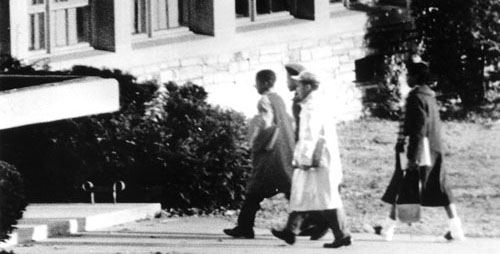
At 8:45 a.m. on February 2, 1959, four young students from the nearby Hall’s Hill neighborhood entered Stratford Junior High School in Arlington, Virginia.

black and white photograph of 4 black students entering Stratford Junior High in 1959

Ronald Deskins, Michael Jones, Lance Newman, and Gloria Thompson walked into Stratford Junior High School on February 2, 1959.

When they stepped into Stratford that day, they became the first students to desegregate a public school in the Commonwealth of Virginia.

Many Arlingtonians know that theirs was the first county in Virginia to desegregate. It is a point of pride. But it’s not the whole story.

It is a story that is sometimes difficult. One that offers few easy answers. It’s a story about how “desegregation” doesn’t necessarily mean the same thing as “integration.” It’s the story of how a coalition of primarily Black activists and white moderates spurred progress, sometimes haltingly, and often with great difficulty.

These two groups were not always in agreement, but together they were able—gradually, over several decades—to turn the tide of race relations in Arlington, reversing the oppressive rule of Jim Crow.

Education Under Jim Crow

Arlington, like all of Virginia—and the entire South—was a segregated society in the first half of the 20th century. A complex set of laws governed race relations, limiting the access of Black citizens to a variety of social services and businesses.

Together these laws were known as “Jim Crow” laws, a term that can be traced to a song popularized by the blackface entertainer Thomas D. Rice in the 1830s. After the end of Reconstruction, when Federal enforcement of racial equality ended in the South, Southern states began to establish new laws to keep the races separate.


Jim Crow in Arlington

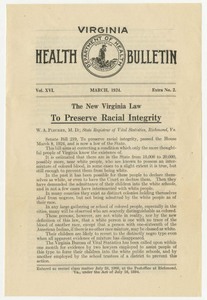
Front page of the Virginia Health Bulletin from March 1942, showing the headline "To Preserve Racial Integrity"

"The New Virginia Law to Preserve Racial Integrity," from Virginia Health Bulletin, vol. XVI, March 1924, Extra No. 2

In Virginia, Jim Crow took many forms. It was even enshrined in the new Constitution of the Commonwealth of Virginia, established in 1902. The new constitution disenfranchised many Black citizens by means of voting restrictions. In the section describing public schools, it stipulated that “White and colored children shall not be taught in the same school.”

Another important law was the Racial Integrity Act of 1924. This act was specifically designed to prohibit miscegenation, or “race-mixing.” It defined “whites” as only those people "who [have] no trace whatsoever of any blood other than Caucasian." To preserve whiteness, the act prevented marriage between whites and nonwhites, who were described in the law as “colored.” It required that every birth certificate issued in the Commonwealth state the race of each infant. It also required the forced sterilization of Virginia citizens found to be “mentally ill” or “mentally deficient.”

In addition to the Virginia Constitution and state laws like the Racial Integrity Act, Jim Crow took the form of numerous local ordinances as well as property covenants that prohibited selling homes in certain neighborhoods to “colored” citizens.


Black Public Education in Arlington County Before 1947

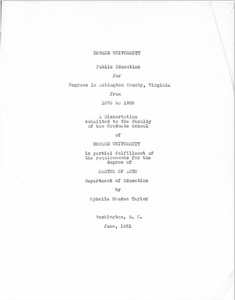
Typed front cover of a dissertation from 1951 on white paper

Public Education for Negroes in Arlington County, Virginia, from 1870 to 1950, Dissertation by Ophelia Braden Taylor, June 1951.

Prior to the Civil War, it had been illegal for Blacks to gather together for purposes of education, whether they were free or enslaved. For that matter, there had not been a system of public schools for white students either. Virginia had historically been opposed to public schools, as had most of the South. Private schools served the Commonwealth’s population of white elites.

After the Civil War, however, Virginia began to establish public schools. In 1870, Arlington County (then known as Alexandria County) established three public schools: the whites-only Columbia and Walker schools and the Arlington School for Negroes in Freedman’s Village, a settlement of freed former slaves on the federally seized grounds of Robert E. Lee’s Arlington plantation.

The history of Black public education in Arlington between 1870 and 1950 is told eloquently and in great depth in Ophelia Braden Taylor’s 1951 Public Education for Negroes in Arlington County, Virginia from 1870 to 1950, which she completed while working on a Master of Arts in Education at Howard University.

This document came to the Arlington Public Library’s Center for Local History as part of the papers of George Melvin Richardson, former principal of Hoffman-Boston Junior-Senior High School. It is an invaluable and thoroughly researched document that is almost certainly still the best history of the topic to date.


NAACP Advocacy for Better Schools

Until 1932, public education for people of color in Arlington was limited to primary school. Hoffman-Boston Junior High School (later Hoffman-Boston Junior-Senior High School) opened that year, allowing Black Arlingtonians to pursue secondary school within the county.

However, Hoffman-Boston was not accredited by the state until the 1950s, and its facilities were not up to the standards of the county’s whites-only schools. Many Black students still commuted to Washington, D.C. to get a secondary education.

As early as 1941, the Arlington chapter of the National Association for the Advancement of Colored People (NAACP) brought pressure to bear on the county School Board for better facilities. And in 1947, the NAACP brought a suit against Arlington County Public Schools, asserting that the education provided to Black students was not up to the standards of the white schools. The suit would lead to new investment in the county’s Black schools.


1941: Esther Cooper’s Campaign for Better Schools

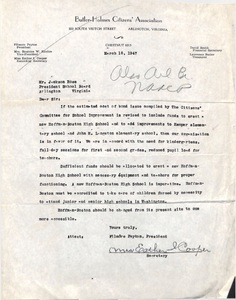
Unfolded, typewriter written letter on stationary bearing the Butler-Holmes Citizens Association letterhead, with pencil scrawl across the top that reads "Also ? ? NAACP"

Letter to Jackson Ross of the Arlington County School Board from Filmore Peyton, President, and Esther Cooper, Secretary, of the Butler-Holmes Citizens Association, dated March 18, 1947. The letter asks for additional funds from a county bond issue to finance the building of a new Hoffman-Boston High School and improvements to Kemper and Langston elementary schools.

Thirteen high school seniors graduated from Hoffman-Boston in 1941, the school’s first graduating class. In the seven years since these students had advanced to junior high, neither the junior high nor the high school had received accreditation from the state. The facilities in the former elementary school were limited, and teachers often had to teach multiple subjects. While the teachers at Hoffman-Boston were considered to be excellent educators, the school’s small faculty simply couldn’t offer the same variety of courses that the larger all-white Washington-Lee High School could.

Nearly three-quarters of Black students in Arlington who were of age to attend junior or senior high school were either attending schools in Washington D.C. or were not attending school at all.

Esther Cooper, president of the Arlington chapter of the NAACP, believed the School Board could and should do better. Cooper began to contact parents in the school district, urging them to pressure the School Board for changes. The Butler-Holmes Citizens’ Association soon joined the NAACP in pressuring the School Board for these reforms.

Throughout the decade, Cooper continually advocated for several improvements: separate buildings for the junior and senior high school programs; better facilities and more teachers to allow for a fuller curriculum; and accreditation for both the junior and senior high school programs.

In this 1947 letter from the Butler-Holmes Citizens’ Association, signed by Esther Cooper, we see these demands reiterated six years after her campaign initially began.


1950: Constance Carter v. School Board of Arlington County

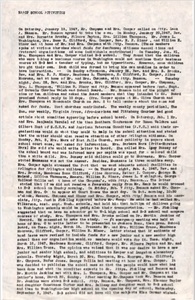
Densely typewritten page on legal paper, with fold creases

Narrative detailing activities of members of the Arlington Branch, NAACP, and other concerned citizens to compare white and African-American schools in Arlington and their legal actions regarding school equality.

In 1946, the District of Columbia school system announced that students from Arlington who attended D.C. schools would have to pay tuition. This presented a special difficulty to Arlington’s Black community. Black public schools in Arlington did not have the same resources as those of the county’s white schools or schools in the District. Moreover, the tuition represented a larger burden for most Black Arlingtonians, who made less on average than the county’s white citizens.

Urged on by the NAACP, the Arlington School Board agreed to pay tuition for the remainder of the year for Arlington students enrolled in D.C. schools. During the next few months, however, there were few signs that progress was being made toward improved facilities or offering more classes for Black students in the county.

On the opening day of the next school year, September 3, 1947, Constance Carter, a Black high school student in Arlington, arrived at the all-white Washington-Lee High School. Her mother, NAACP member Eleanor Taylor, accompanied her. Together they attempted to enroll Constance at the school, stating that Hoffman-Boston did not offer the classes she wished to take, including Spanish, typewriting, and physical education.

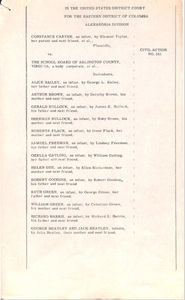
Typewritten page of a legal file on yellowing paper

Civil Action No. 331 in the United States District Court for the Eastern District of Columbia, Alexandria Division.

Washington-Lee principal Claude Richmond refused Carter’s request, citing the Commonwealth’s requirement that all public education be segregated. Carter and Taylor, represented by NAACP attorneys Spottswood W. Robinson III and Martin A. Martin, then filed a lawsuit against the county schools.

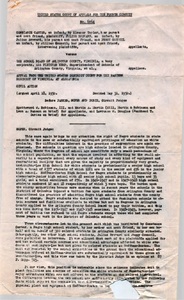
Typewritten first page of a legal opinion, on yellowing paper with numerous fold marks, and missing a chunk out of the bottom, obscuring section of the last 2 lines of the page.

Constance Carter v. The School Board of Arlington County, Virginia: Complaint and opinion, 1950. This is the May 31, 1950 opinion of Martin A. Soper, delivered May 31, 1950, overturning Albert Bryan's dismissal of Carter's 14th Amendment case.

Robinson and Martin saw this as a Fourteenth Amendment “equal protection” case. Although Supreme Court case Plessy v. Ferguson (1896) held that equal protection and equal rights are not abridged as long as public facilities and services are “separate but equal,” public education for Blacks in Arlington was demonstrably unequal. While the presiding District Judge Albert V. Bryan acknowledged the inequality of facilities and classes offered, he did not accept that this resulted from an intentional disparity. He ruled instead that it was a result of “defects of administration for administrative correction, not constitutional offenses for judicial interference."

Upon appeal, however, federal judge Martin A. Soper reversed the decision, ruling for Carter on May 31, 1950. He then ordered Judge Bryan to notify the School Board that they would be required to provide equal facilities for the county’s Black students.

In the next few years, the pay rate for Black teachers in Arlington was raised to meet that of white teachers, and money was earmarked for improvements to the facilities of Hoffman-Boston and other Black schools.


1954: Arlington in the Wake of Brown v. Board of Education

On May 17, 1954, the Supreme Court of the United States ruled on Brown v. Board of Education. In a unanimous decision, the court reversed the case law of Plessy v. Ferguson. Chief Justice Earl Warren, writing for the high court, held: “We conclude that in the field of public education the doctrine of ‘separate but equal’ has no place. Separate educational facilities are inherently unequal.”

Brown v. Board of Education sent shockwaves throughout the South, including Virginia. For some, especially in the Black community, it was hailed as a great victory. For others, largely white, it was seen as a threat to their very way of life.

In the capital of Richmond, U.S. Senator Harry Flood Byrd and his tightly controlled political machine began to gear up a program known as “Massive Resistance,” intended to defy the Supreme Court ruling by any means necessary, including shutting down the schools if need be. The state removed Arlington’s democratically elected School Board and installed a new board more sympathetic to the segregationist cause.

But there was another group at play in Arlington, one that proved instrumental in the story of desegregation: white racial moderates, who may not have minded segregation but didn’t want to lose their school system over it. In the end, they were pivotal in advancing the cause of desegregation over the objections of much of the appointed School Board.


1955: Massive Resistance

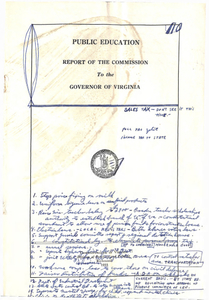
Front page of official report with state seal, hand written notes on the bottom half in blue pen, and various geometric doodles on the top half. Note include things like: "SALES TAX - DON'T SEE IT THIS TIME" "1. Stop price fixing on milk" "10. Workmans comp. law to cover those on civil defense"

A copy of the Gray Commission report ("Public Education Report of the Commission to the Governor of Virginia"), with notes handwritten on the front page regarding price-fixing and raising teacher salaries.

On the day of the Brown decision, Senator Harry F. Byrd issued a statement saying that the ruling would “bring implications and dangers of the greatest consequence. It is the most serious blow that has yet been struck against the rights of the states in a matter vitally affecting their authority and welfare.”

In 1955, the state released the Gray Commission Report on Public Education. The report was created by a group of politicians, lawyers, and academics from around the state selected by segregationist Governor Thomas B. Stanley. The commission advised getting rid of state laws requiring mandatory school attendance. No child should be required to attend an integrated school, they argued, against their parents’ wishes. Rather, the “parents of those children who object to integrated schools, or who live in communities wherein no public schools are operated, [should] be given tuition grants for educational purposes.” (Emphasis added.)

The Gray Report, in other words, recommended offering a back door, so that schools could be shut down rather than be forced to integrate. This policy was adopted, and the next year Governor Thomas Stanley pushed through a legislative agenda that included a law allowing the allocation of public school money for tuition grants to students attending segregation academies.

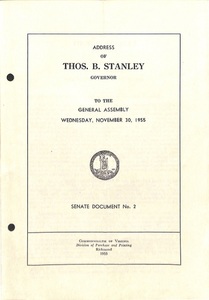
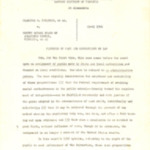
Cover page of Virginia State Senate document with the state seal, on yellow paper, and two holes punched on the left.

Address of Governor Thos. B. Stanley to the General Assembly submitting a bill for a referendum on holding a Constitutional Convention to amend Section 141 of the Constitution of Virginia. 4 pages

The blueprint also cut all state funding for and gave the governor authority to shut down any school system that desegregated. Together, the package of 13 segregationist statutes came to be known as the “Stanley Plan.”


Virginia’s top elected officials made it clear: they would shut down the schools before they would integrate.


Popular Opposition to Integration

It wasn’t just the Richmond power structure that was strongly opposed to getting rid of segregated schools. Many, if not most, white Virginians were opposed to desegregation in 1954. Here we have a selection of pro-segregation literature gathered locally primarily by Barbara Marx, a German-born NAACP member and activist who lived in Arlington during the 1950s.

A warning: The documents linked on this page contain some fairly vitriolic racism. Please be advised. They are included because it is impossible to fully understand segregation without understanding racism. Their inclusion on this site is in no way an endorsement of their content.

One thing that might be jarring for contemporary readers is the way that many of these documents rely strongly on Christian-inflected rhetoric. After all, many leaders of the Civil Rights movement were Christian ministers themselves. So why is this?

There is a long tradition of religious justification for racism that goes back to America’s history of slavery. Some have argued that Black people are the descendants of Canaan, the grandson of Noah who was cursed and cast out by his grandfather for his father Ham’s transgression. The descendants of Canaan were said to be cursed with eternal slavery.

The Old Testament has frequent mentions of slavery, and the idea of a people doomed to eternal slavery likely appealed to religious individuals looking for a justification for the institution of chattel slavery.

It is also important to remember that this literature was produced in the early 1950s, during the early years of the Cold War. The American Communist Party had been one of the most consistently racially progressive political organizations in the United States throughout the 1920s and 1930s. Many segregationists argued that integration was a Communist plan, a Soviet plot to destroy America from within. It was not uncommon for segregationists to describe the NAACP in particular as a Communist organization.

Christian Americanism was offered as a healthy alternative to Communist Atheism, and for this reason, Christian justifications of the racial order under Jim Crow were seen as a perfect rebuttal to Soviet criticisms of America’s system of racial apartheid.


Arlington School Board Reacts to the Brown Decision

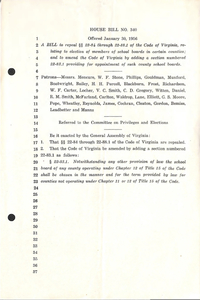
One page House Bill, printed in black ink on white paper with two punch holes on the left side.

House Bill No. 340 Offered. Bill to repeal 22-84 through 22-88.1 of the Code of Virginia relating to the election of members of school boards in certain counties. This bill was aimed at the elected members of the Arlington County School Board, disbanding the elected board and replacing it with one that was appointed.

Just ten days after the Brown decision, the Arlington County School Board called for a “Committee to Study Problems of Integration in the Arlington Public School District,” to look at how best to comply with the ruling. The committee included Black and white clergy, teachers, and three NAACP members: Edith Burton, Mary Shirley, and Geraldine Davis. Elizabeth Campbell, a white liberal and pro-integration member of the School Board headed the committee.

By January 1956, the committee had a preliminary plan in place to desegregate the school system. The committee’s proposal was not particularly bold or far-reaching. It favored only a small number of students desegregating the schools, at least at first. It was a conservative, incremental strategy.

It was also one that had the disadvantage of pleasing very few. Some integrationists, such as Virginia NAACP President E.B. Henderson, saw it as trying to do the minimum amount of integration legally required under Brown, to reassure the New York guarantors of an upcoming school bond issue.

On the other side was the Byrd machine in Richmond. Less than a month after the Integration Committee issued its plan, legislation was introduced in the General Assembly to strip Arlington County of the right to have an elected school board. At the time, Arlington was the only county in the country whose school board was popularly elected.

The bill passed, and in July, 1956, the Arlington School Board was replaced with a new group of appointees, chosen by the County Board. This new panel was considerably more sympathetic to the cause of segregation, with a membership that included few racial moderates and some outspoken segregationists.


Arlington’s Racial Moderates

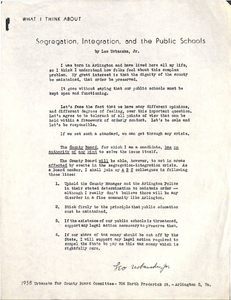
Copy of one page typed document on white paper, with darkened mimeograph marks in corners.

What I Think About Segregation, Integration, and the Public Schools, by Leo Ubanske. Document by County Board member Leo Urbanske stating his commitment to public schools and Arlington County.

Due to a particular set of historical circumstances, Arlington’s population differed from much of Virginia in terms of racial attitudes. Prior to the 1930s, the county had been primarily rural. The expansion of the federal government during the New Deal, followed by even more federal growth after America’s entry into World War II, quickly reshaped the county.

People from all over the country flocked to the Washington area for new jobs, and Arlington was an affordable place to live. The completion of the Pentagon in early 1943 made the military one of the largest employers in the county.

This influx included a large number of new residents from the less-segregated North. Likewise, the importance of the defense industry and the military to Arlington meant that more people had experienced some degree of desegregation already—executive orders signed by President Roosevelt in 1941 and President Truman in 1948 respectively barred racial discrimination by defense contractors and ended segregation within the military.

The result was that many white residents in Arlington could be called “racial moderates.” Many may not have minded segregated schools—and some may have indeed favored segregation—but they were far more concerned with the prospect of the public school system being closed down altogether.

Because Arlington’s economy was so dependent on the federal government, political participation was complicated. The Hatch Act of 1939 limited the participation of federal workers in partisan politics, so Arlington residents created “non-partisan” groups to advocate for local change, with names like “The Citizens Committee,” and “Arlingtonians for a Better County,” “ABC” as it came to be known.

Prior to the influx of newcomers, the public schools in Arlington had a poor reputation, and those who could manage sent their children to D.C. or boarding schools. When people from outside the South came to Arlington for government jobs, they wanted their children to have strong public schools, like the ones they grew up attending. Many supporters of ABC shared such memories. As a result, the group made school improvement a major issue.

Some ABC politicians viewed the threat of wholesale closure of the public school system to be an almost existential threat. It was due to an ABC campaign that Arlington won the right to have an elected school board in January of 1949. They did not appreciate the state taking that right away.

The new, appointed School Board would be repeatedly confronted with the fact that for many Arlingtonians, keeping the schools open was more important than maintaining segregation.


1956-1959: The Road to Stratford

By 1956, Virginia seemed in many ways to be no closer to desegregating its public schools than it had before Brown v. Board of Education. The NAACP decided it was time to put forward lawsuits to try to make the Commonwealth comply with Brown. The case of Clarissa Thompson v. the County School Board of Arlington was part of an effort to push Virginia school districts where segregation was most vulnerable. The case dragged on, however, bogged down in bureaucracy and legal back-and-forth.

Meanwhile, white racial moderates in the county formed the Arlington Committee to Preserve Public Schools, which later would grow into a statewide organization, the Virginia Committee to Preserve Public Schools. This organization was distinctly agnostic toward the issue of segregation and simply advocated against the closing of public schools, bringing pressure to bear on government officials.

On February 2, 1959, having exhausted all legal and bureaucratic maneuvers, Arlington Public Schools had no choice but to admit four Black pupils into the previously all-white Stratford Junior High School. Perhaps surprisingly, this occurred without protests or negative incident. The state did not shut down Arlington County Public Schools. It is largely remembered, as an oft-repeated headline described it, as “the day nothing happened.”


1956: Clarissa Thompson v. the County School Board of Arlington is filed

Page 1 of 13 page court filing, typewritten on legal paper

Court Case, Clarissa S. Thompson, et al. v. County School Board Of Arlington County, Virginia, et al, Civil 1341

As the second anniversary of the Brown decision approached, opponents of segregation in Arlington had seen almost no progress in the implementation of the ruling. Finally, on May 17, 1956—the second anniversary of the original Brown ruling—Virginia NAACP lawyer Edwin C. Brown filed suit against Arlington County’s School Board. The NAACP filed similar suits in Front Royal, Newport News, Norfolk, Charlottesville, and Warren County.

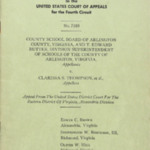
Cover of 17 page typewritten document on legal paper. Cover page is light green.

Brief On Behalf Of Appellees For Case No. 7310 In The United States Court Of Appeals For The United States District Court For The Eastern District Of Virginia, Alexandria Division

Suits were filed in these places because they had particular things in common—they were areas with low Black populations, with larger than average populations of white racial moderates, and where the Byrd machine was absent or not particularly powerful. These shared traits, the thinking went, meant that they might be more open to desegregation.

Clarissa Thompson, daughter of NAACP member Ethel Thompson, was the first name on the suit, but it was brought on behalf of several students, including the children of civil rights activists Lesley and Dorothy Hamm and the children of Barbara Marx, one of the few active white members of the Arlington NAACP.

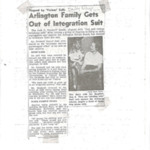
Newspaper clipping taped to white paper

Article from Daily News, "Arlington Family Gets Out of Integration Suit" June 4, 1956.

The child of another white family was initially named in the suit, but that family dropped out after two weeks after receiving telephoned threats. Barbara Marx, who had been in Nazi Germany as a young woman, was undeterred by similar threats.

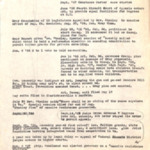
first page of two page typed document on white paper

Timeline and chronological series of events, court decisions, etc., relating to Arlington County and desegregation of public schools.

Federal Judge Albert Bryan, who had been the first judge on the Constance Carter case, ordered the schools to be integrated, but the particular wording of his injunction stated that the students could only come back to the court to seek enforcement of that order if they could prove that they had gone through all appropriate bureaucratic channels. This included the Commonwealth’s Pupil Placement Board, a body that had been created in Richmond that summer and had ultimate power over placement of students.

The case at that point was plunged into a complex set of appeals and bureaucratic red tape that would last two and a half years.


1958: Arlington Committee to Preserve Public Schools

As the NAACP pressed on with the Thompson case with repeated success, the moment was quickly approaching when the Commonwealth, to keep schools segregated, would have to use the only other tool at its disposal—closing the schools.

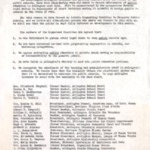
Single page typed list of agreements and members on white paper

Flyer: "To All Arlington Citizens": announcing the formation of the "interim Organizing Committee to Preserve Public Schools", May 11, 1958.

On May 1, 1958, the Arlington Committee to Preserve Public Schools, recently formed by a small group of white racial moderates and integrationists, issued a statement that expressed a willingness to “pursue every legal means to keep public schools open.” The group further expressed absolute agnosticism about the issue of segregation and a distrust of the idea of giving public funds to private education.

By the time of the following month’s meeting of the organization, the group numbered over 700 members.

Over the next few months, the organization served as an important point of communication for those opposed to closing schools, including concerned citizens, administrators, and a majority of the county’s parent-teacher associations.

The Arlington Committee to Preserve Public Schools was all white, and in limiting membership to white people it was able to gather and rally a disparate group of white racial moderates. Dr. O. Glenn Stahl, president of the organization, claimed that it represented:

a very broad segment of the population, including many, many people who much prefer to have segregation. Therefore it’s not an integrationist group. But it is concerned about keeping the public schools open and not letting the public schools be sacrificed in order to settle the question of integration.

By assembling a large group of racial moderates who were more concerned with keeping schools open than with one another’s views on integration, the Arlington Committee to Preserve Public Schools was able to exert pressure on local and state politicians. They made closing the schools—the “nuclear option” upon which Massive Resistance depended—a far less attractive option to the appointed county School Board and state officials.

While the NAACP used the courts to pressure the schools to desegregate, the Committee pressured the segregationist-leaning School Board to commit to keeping the schools open. The organization would soon grow into a statewide one, the Virginia Committee to Preserve Public Schools, which would use much the same strategy throughout the Commonwealth.

View more Arlington Committee to Preserve Public Schools documents on the Project DAPS site.


February 2, 1959

By January of 1959, the state had exhausted all its legal countermeasures to the Thompson case. Many Arlington parents were still worried that the School Board would choose to close the schools rather than desegregate. The final nail in the coffin of Massive Resistance came on January 19, when the Virginia Supreme Court struck down the school closure law, ruling that it violated the guarantee of a free public education in the Virginia Constitution.

On January 22, 1959, the School Board held a special meeting and announced that Stratford Junior High would be the first school to be desegregated.

Finally, on February 2, four students—Gloria Thompson, Ronald Deskins, Lance Newman (oral history), and Michael Jones (oral history)—walked up to Stratford just after the first bell at 8:45 a.m. The four students lived nearby but gathered at a single house that morning before walking the last bit together. Close to 100 police officers formed a cordon along the road leading to the school. The memory was still fresh of the angry white mobs that formed in Little Rock, Arkansas when that school was desegregated a little more than a year earlier.

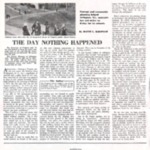
Single page magazine article with photo at the top left column

Article by David L. Krupsaw, Chairman of the Arlington County Board, "The Day Nothing Happened", The ADL Bulletin, February 1959.

Ultimately, the desegregation of Stratford arrived without incident. There were no angry mobs, no shouted words, no brickbats. Stratford principal Claude Richmond—the same man who, as principal of Washington-Lee, had turned away Constance Carter in 1947—welcomed the students. By all accounts, Richmond made every effort for the new students to feel welcome and safe.

Despite the police and reporters, it was essentially a normal day at school. The newsletter of the Anti-Defamation League, reporting on the desegregation of Arlington schools, ran the headline: “The Day Nothing Happened.” And that seems to have been the case, for the most part.


After Stratford

When four Black students entered Stratford Junior High School for the first time, it did not signal an end to segregation in Virginia, or even in Arlington. Desegregation is not integration. While Arlington had taken the first step by allowing a few students to break through the wall of segregation, most students would continue to attend largely segregated schools. Indeed, it wasn’t until 1971 that Arlington adopted a pupil-placement system that was sufficiently non-race-based to gain court approval.

Moreover, many places in Arlington still excluded Blacks, from lunch counters to taxis, and even the local hospital.


Desegregation is Not Integration

On December 27, 1962, Dr. Martin Luther King Jr. said in an address to a church conference in Nashville, “…desegregation alone is empty and shallow. We must always be aware of the fact that our ultimate goal is integration, and that desegregation is only a first step on the road to the good society.”

Desegregation and integration are two very different things. “Desegregation” occurs when a small opportunity allows some people past the wall of segregation. “Integration” occurs when a population reaches parity when the wall of segregation no longer exists.

Gloria Thompson, Michael Jones, Ronald Deskins, and Lance Newman entered Stratford Junior High School in 1959. Over the next few years, other schools would begin to desegregate. But it is important not to confuse that desegregation with integration. It took years before Arlington approached true integration of its public schools. It required not just gradual change over time but more advocacy, struggle, and at least one more major lawsuit.

Moreover, much of the county outside of the school system was still very much segregated. That, too, took time, campaigning, and organizing to change.

The documents collected here represent the reality of the segregation that persisted in Arlington years after Stratford: from bowling alleys to housing to the local hospital.

Single page typed sheet on white paper

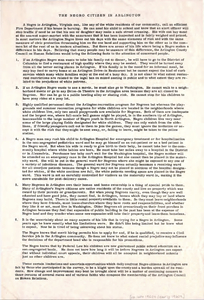
Broadside: The Negro Citizen in Arlington published by the American Council on Human Relations

A 1963 broadside titled “The Negro Citizen in Arlington” shows the true depth of the segregation that remained. Among the injustices that the document catalogs: all the movie theaters and drive-ins in Arlington were whites-only; there were no decent sit-down restaurants that allowed Blacks to eat in their dining rooms; the maternity ward at Arlington Hospital would not admit Black mothers.

The document closes with a defiant tone, pointing to the constant precarious state of Black life in Arlington, even in the face of growing legal equality:

It is the uncertainty about so many aspects of his life that is trying for a Negro in Arlington. Some years ago he knew exactly what his limitations were. He didn’t like being limited but he knew what to expect. Now he is tired of being unknowing about his status.

The Negro knows that merit hiring permits him to apply for and, if he is qualified, to receive a Civil Service job in the Arlington community. He does not know to what extent racial prejudice may influence the decisions of the department head who is responsible for his promotions.

The Negro knows that by Federal Law his children are now guaranteed public school education on a non-segregated basis. He does not know how long it will be before Negroes in Arlington can expect that without individual court appeals, their children will all be accepted in neighborhood schools just as other children are.


1959-1962: Desegregating Sports and Dances

Even with the schools technically desegregated, certain elements of day-to-day school life were still segregated. Dances and athletics, in particular, were for a period eliminated at all desegregated schools. Such activities were a particular source of fear for segregationists, as both put students’ bodies in close proximity.

For people who opposed integrated schools due to the racist specter of miscegenation—who feared that integrated schools threatened “racial purity” by encouraging mixed-race relationships—the idea of integrated sports, and especially integrated dances, was particularly worrisome.

This refusal to desegregate certain elements of school life, even in the face of Judge Bryan’s order, was supported by a Massive Resistance-era law passed in Richmond. School Board member and attorney L. Lee Bean read the law—Joint Resolution #97—during a School Board meeting on September 21, 1959: “No athletic team of any public free school should engage in any athletic contest of any nature within the State of Virginia with another team on which persons of the white and colored race are members…” The Board voted that day to cease all athletic events. The same day, they also voted to stop all school-sponsored dances.

The Board reinstated athletic programs for the 1961-1962 school year, but it was even longer before school dances came back. Meanwhile, other groups in Arlington provided space and opportunity for these important social functions for school children. In an oral history in the collection of the Arlington Public Library’s Center for Local History, School Board member James Stockard recalled that Mount Olivet United Methodist Church held dances during the school system’s ban.

In another oral history, Constance McAdam, who at the time worked in the county’s Department of Parks and Recreation, discussed a program of integrated dances for teenagers sponsored by the Parks department between 1959 and 1962. McAdam recalls “tension” at some events during the first few years—they even had the police come to keep an eye on things—but reported that the tensions dissipated to a degree over time.

Read related documents on the Project DAPS site.


1961: Drew Elementary Expansion

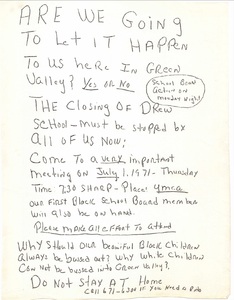
Hand written cover of 9 page packet including a notice about School Board Action

Packet of papers related to a July 1, 1971 meeting about the Drew Elementary desegregation plan. Include a statement from a group of local ministers, organizing phone list, and extracts from the board action.

Only a few years after the desegregation of Stratford, the next issue to divide the county over race and the school system came from what might seem an unlikely source: a portion of a planned bond issue to improve and expand Drew Elementary School in Arlington’s historically Black Nauck/Green Valley neighborhood.

In 1961, the School Board proposed that a section of an upcoming bond issue be put toward a 22-room addition to the extant Drew School and a consolidation of the Drew, Kemper, and Drew Annex schools, which were all in the same general neighborhood. The local NAACP, the Nauck Civic Association, and the Jennie Dean Community Center, among others, opposed the plan.

It might strike the reader as strange that the NAACP would in 1961 be spearheading an effort to oppose improvements to a Black school when, as recently as the Carter case in 1950, they had been suing the School Board for exactly that. But Brown v. Board of Education changed everything, especially the NAACP’s approach to how best to improve schooling for Black students.

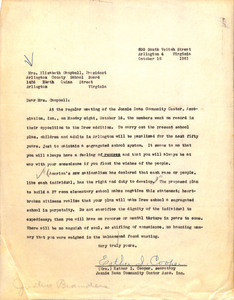
Typewritten letter on white paper with pencil markings

Letter from Esther Cooper, Jennie Dean Community Center Association, about opposition to Drew School expansion, October 18, 1961

Prior to Brown, the Plessy ruling was still the law of the land. “Separate but equal” was viewed, legally, as fair and constitutional and was used as a standard for judging whether a law or policy was legal under the 14th Amendment. Facing this reality, the NAACP’s best strategy was to prove that facilities and educational opportunities for Black students were unequal.

After Brown, however, the NAACP’s goals changed. Integration was seen as the best means to attain quality education for Black students—they could simply go to the schools that were already systemically better.

The Black communities in south Arlington were not completely unified around the rejection of the Drew Elementary expansion, however. For some in these communities, it seemed a good idea to improve and expand the neighborhood elementary school, even if it was segregated.

The NAACP responded with an education campaign. The expansion, the group argued, would make the school too large to be manageable, at almost 1,200 students. This was by far larger than any other elementary school in the county. They pointed to a recommendation from the National Educational Association that elementary schools should ideally be limited to around five hundred students. Even with 22 new rooms, they further argued, 1,200 students would result in an unmanageable number of students in each classroom.

Opponents of the expansion suggested an alternative: a new school to be built about a mile northeast of Drew on the site of Douglas Park. Because of its location, this new school would draw equally from nearby white and Black neighborhoods and would lessen the overcrowding of Drew and Kemper.

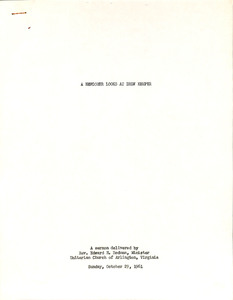
Front cover of 8 page sermon, typed on white paper

Typewritten Sermon, A Newcomer Looks at Drew-Kemper, Rev. Edward Redman, Unitarian Church of Arlington, October 29, 1961.

As the NAACP attempted outreach within the Black community, white allies of desegregation tried to spread the same message to white Arlingtonians. The Reverend Richard H. Redman, minister of the Unitarian Church of Arlington, delivered a sermon on the topic in October of 1961.

The movement against the Drew expansion found its most powerful white proponent in School Board member James Stockard. He went on record calling the expansion “discriminatory” and a “segregation move.” In one Board meeting, Stockard declared that if the plans for expansion went forward he would “have to exert [m]y full influence in this county toward defeat of the school bond issue.”

NAACP representative Robert Alexander called out in response, “At least there’s one Christian in the house!”

Ultimately, however, Stockard was outnumbered. The Board approved the measure, and when it went up for a vote before the county’s general population on November 7, 1961, the bond issue was approved. The county would move forward with plans for the Drew expansion.

Construction of the Drew expansion began in 1963.


1971: Desegregating Drew Elementary

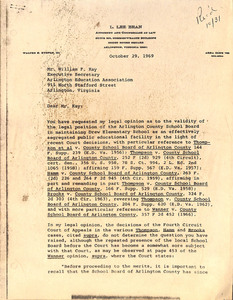
copy of first page of 6 page letter, typed on yellowing paper

Letter from an Arlington attorney, Lee Bean, to William F. Kay, executive secretary of the Arlington Education Association advising the validity of the Drew School's de facto segregation. Letter makes comparisons to many national and local court cases regarding segregation in public schools. October 19, 1969

By 1969, Arlington’s junior and senior high schools were all desegregated. Hoffman-Boston Junior-Senior High School had closed in 1964, and Black students were placed in formerly all-white schools. At the elementary school level, however, there were still two schools that were virtually entirely Black.

The recently expanded Drew Elementary School and Hoffman-Boston Elementary School were both located in Arlington’s largest Black community. There had only been a handful of white students who attended either school in the ten years after public schools in Arlington ostensibly desegregated, and those students were only placed in the schools after their parents had requested admission.

On December 11, 1969, a group of around thirty parents of Drew students met at the headquarters of the Arlington Community Action Program and decided to ask the School Board at its January meeting “why it [was] ignoring the law of the land.” Chief among the parents’ concerns was that students from Drew were having considerably more difficulty adjusting to desegregated junior high compared with other Black students in the county who had attended integrated elementary schools.

Lawyer Thomas R. Monroe and education expert Dr. Donald K. Sharpes were also in attendance and explained to the group that they had been pressing the issue of desegregating Drew with the School Board since May. They vowed to “exhaust all channels of communication” with the Board and, if that didn’t work, to sue. A community task force was set up to explore the issue with other Nauck residents.

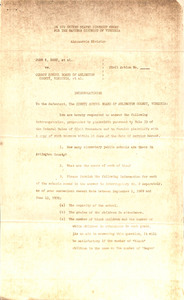
Front page of 5 page legal document, printed in black font on yellowing paper

John K. Hart, Et Al, vs. County School Board Of Arlington County, Virginia, Et Al, Interrogatories, June 1970

In May of 1970, feeling that the School Board was still not listening to the community’s concerns, ten parents filed a class-action suit on behalf of sixteen Drew students: John E. Hart et al. v. County School Board of Arlington County, Virginia.

Just a little more than a month before the trial, on June 28, 1971, the School Board announced that it had arrived at a plan to desegregate Drew and Hoffman-Boston. Students in grades one through six of the two schools would be bused to other elementary schools throughout the district.

Students would be assigned to new schools in a way that tried to keep the Black population of each school as nearly as possible to 11% of the school’s total enrollment. (At this time Black people were about 11% of Arlington’s population.)

This new plan was not satisfactory to many in the community who felt it was essentially a plan to bus-only the Black students. They argued that the plan put too much of the burden of desegregation on the same children who had already been forced to endure the indignities of segregation. This argument was pressed in an amended complaint before Judge Oren R. Lewis on August 10, 1971.

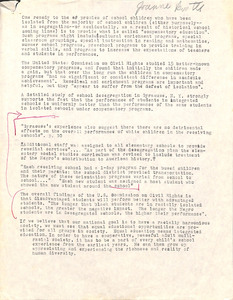
Copy of one page, typed document on white paper, with hand written notes. "Joanne Booth" handwritten at top of page but not clear if she is the author or recipient of document.

Letter/Document concerning remedy/remedies to the problem of school children who've been isolated from most other students their age because of segregation, zoning lines, etc. Advocates for a "compensatory education" program to help isolated students make up for time lost. unattributed and undated

Lewis was unconvinced. He quoted previous case law stating that whether or not the district could have closed down different schools was immaterial; the question was “whether the Board's decision is so unfair that it amounts to invidious discrimination in violation of the equal protection clause.”

Lewis saw no such “invidious discrimination” in the desegregation plan and ruled in the School Board’s favor. “If Arlington is to convert to a unitary system, and the Supreme Court has decreed that it must—there will of necessity be some busing. The limited busing of the Drew-Hoffman-Boston children, here required, risks neither the health of the children nor significantly impinges on the educational process.”

He further pronounced that “The Arlington County School Board has now fully complied with the Supreme Court decision in Brown…Arlington will have neither black nor white schools—just schools.”

This decision was upheld on appeal on May 1, 1972.


Conclusion

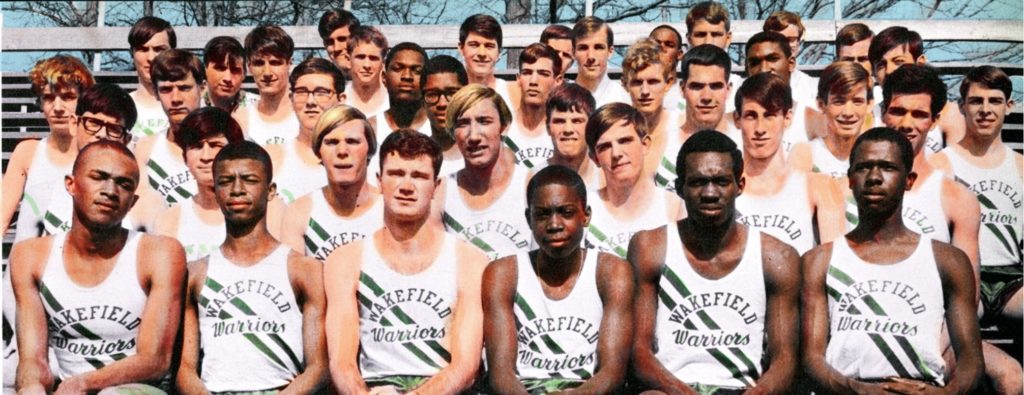
colorized photo of high school black and white boys sitting on the bleachers in track uniforms

Wakefield Warriors, 1968

Arlington desegregated and was the first public school system to do so in the Commonwealth of Virginia. This is often a point of pride for Arlingtonians, and rightly so.

But it is also important to remember that it took almost eighteen years of activism from the NAACP and Arlington’s Black communities to get to that point. And that it took almost five years for Arlington to desegregate their first school after Brown v. Board of Education.

Likewise, it took another twelve years after the desegregation of Stratford before Arlington had a desegregation plan in place sufficient for a court to consider it in compliance with Brown v. Board of Education.

The story told by the documents presented on this site is one that is complex and occasionally frustrating. But it is a story of progress. Not progress in the form of some slow, natural process, but the progress that was hard-won after years of pressure, political maneuvering, and lawsuits by the NAACP and other organizations within the community.

What is heartening is that this sort of pressure worked--that it changed minds and hearts and the material reality of Black students in the county.

It is also heartening to note the role of the white racial moderates in the county. The people who formed the Arlington Committee to Preserve Public Schools were not of one mind about desegregation. Some members were opposed to it. But they felt that keeping the public schools open was more important than maintaining segregation. The lesson here is that, with enough pressure and activism, the center can, indeed, be moved. That minds can be changed when you show them how they, too, have a stake in the decisions made.

We would love to hear from you. How does this story relate to your story?

We hope that this exhibit and these documents will become the start of a broader conversation about segregation in its many forms, about what integration truly means, and about race in Arlington County more broadly.


January 11, 2018 by Web Editor Tagged With: Hoffman-Boston

Librarian Mariela Aguilar Wins Award for “Clara Guevara”

Post Published: September 28, 2017

Congratulations!

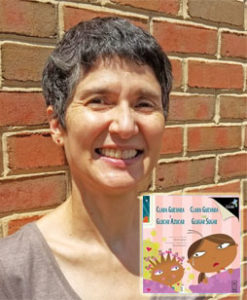
Photo of Mariela Aguilera with book cover of "clara guevara and glucar sugar" overlaidYouth Services librarian Mariela Aguilar’s bilingual book “Clara Guevara y Glúcar Azúcar – Clara Guevara and Glugar Sugar” (published by Editorial Costa Rica) has received the Fundación Leer/IBBY Costa Rica Cuentos de mi Tía Panchita literary award in the translation category.

The IBBY, or International Board on Books for Young People, is a non-profit organization which represents an international network of people from all over the world who are committed to bringing books and children together.

Mariela, who has type 1 diabetes, first created the character of Clara Guevara as a way to help children learn to live successfully with their own type 1 diabetes. Since then, Mariela has written many adventures for Clara, excerpts of which can be found on her blog.

“Clara Guevara y Glúcar Azúcar – Clara Guevara and Glugar Sugar” will represent Costa Rica in the 2018 catalog IBBY Honour List, along with two more books awarded in the illustration and creative writing categories.

The 2018 IBBY Honour List will be presented at the 36th IBBY International Congress in Athens, Greece, from Aug. 30-Sept.1, 2018.

September 28, 2017 by Web Editor

Remembering September 11: An Oral History Collection

Post Published: September 6, 2017

Paper cut sound waveform sign with shadow , and photo of September 11 memorial

In 2006, on the 5th anniversary of the 2001 terrorist attacks, the Center for Local History conducted a series of interviews with first responders and Arlingtonians about their experiences on Sept. 11, 2001, and the days that followed.

The three narrators who you’ll hear from in these clips – Gabriella Day-Dominiguez, Elizabeth Davis, and firefighter Dale Varnau – experienced the same events that day, and yet had uniquely personal responses to the tragedy shaped by their identities and roles within the community.

Transcripts:
NARRATOR: Elizabeth Davis
INTERVIEWER: Diane Gates
DATE: August 2, 2006

ED: Our neighborhood is very friendly people but nobody ever seems to talk to anybody else. But on that day everybody was outside of their house. So I was talking to my neighbors and they didn’t know anything and they were asking me and I didn’t know anything. So we ended up having a kind of a barbecue. Nobody really wanted to be alone. Everybody pulled a little bit of something out of their refrigerator and just gathered together.
DG: It was just impromptu
ED: Totally impromptu.
DG: When your neighbors had the cookout or got together to eat did people seem just quiet and somber. Was anyone crying? Were there people there who knew or wondered if they had a friend that was—
ED: There were a lot of people who knew somebody. I don’t think I knew anybody who knew anybody who had been hurt but there a lot of people who worked in the Pentagon or knew somebody who worked in the Pentagon. Even more than that there were people who knew somebody in New York. And at that point of course we didn’t know what was going on. You had no idea of head count. And the phones were so busy it was very hard to get through to people. So there was a lot of “I don’t know if this person is okay” going on.
But the one thing I noticed for the next, might have been two or three weeks, if you remember they had shut down every single plane everyplace, nothing was flying. So we’d be standing outside and you’d hear a plane go overhead and everybody stopped and everybody sort of cocked their head and just listened and you could tell they were thinking is this us or is this them and that wasn’t just the first day or so, that was two or three weeks.

NARRATOR: Gabriella Daya-Dominiguez
INTERVIEWER: Judy Knudsen
DATE: August 24, 2006

GD-D: My husband in the meantime, what was occurring with him at that moment was he was just entering his office. He was about 200 yards from the building. He saw the plane coming very low overhead. He saw it make a U turn and bank right into his building. At that point he said he knew that this was not an accident, this was an attack and all hell broke loose. The pandemonium in the city was already going on. First with the North Tower. People were just standing there staring. They weren’t really running, they were just watching. But by the second tower hitting people started running frantically.
GD-D: And then another twist of the story is the fact that my father is Arabic. I remember feeling a sense of dread that week. I couldn’t eat at all. I remember food tasted like paper. It was just hard to put something in my mouth and I’m not someone who loses my appetite easily. So it was deeply concerning. I felt that there was going to be an Arab backlash and I was worried about my father, although my father is not Muslim, he’s Christian. But it was an Arab group of terrorists that struck the buildings and I was worried about the perception that the world was going to have about Arabs at that time. I remember being terrified. I remember feeling like I didn’t want to talk to anybody. I was afraid to talk to anybody. I just didn’t know how to explain it.

NARRATOR: Dale Varnau
INTERVIEWER: Judy Knudsen
DATE: December 14, 2009

JK: Right. So after it’s over with, how long did it take you to…. I mean, some people were obviously very freaked out, didn’t recover so well, and I have talked to police and firemen. And some people did—Of course a lot of people internalize things, and you don’t know. I mean, how did you feel, say, afterwards, a few years afterwards? Obviously it still affects you.
DV: Yes. The first I-don’t-know-how-long, I was very angry. I was like, “Let’s go get the people that did this to us! This is America!” I’m very patriotic.
I didn’t notice it bothering me for about a year, but after a year I started, “Hey, I haven’t been sleepin’ that well. I’m startin’ to have nightmares about it, relivin’ it.” So it was pretty close to a year before I started feeling anything physical from it.
DV: And people I’ve talked to—you know, my brother’s a Vietnam vet, and he was like, “Well, I saw a hundred times worse.” “Yeah, well, you were trained for it, I wasn’t!” I was trained to fight fires, you know.
JK: Exactly.
DV: So yes, there was about a year delay for me. I knew other people that the next day had problems. There were a couple of guys that day, that while it was goin’ on, basically they wanted to say, “Okay, I’m done, I’m outta here,” and they wanted to go home right then. But it took about a year for it to really build up in me. I was kind of surprised, I guess this is the first time I’ve really talked about it in depth for a while, that I was starting to crack up a little bit a while ago. But yes, it had a delayed effect for me.

You can explore the entire September 11 oral history collection in the Center for Local History - VA 975.5295 A7243oh ser.5 - or read the transcripts online.

You can also explore our current display of letters, which were sent during the days and weeks after September 11, from children all over the county to Arlington rescue workers.

Photo: Arlington Ridge Rd Overlooking Pentagon – Public Memorial; Source: Photographs of the Arlington Historical Society, PG 230-6928

The goal of the Arlington Voices project is to showcase the Center for Local History’s oral history collection in a publicly accessible and shareable way.

The Arlington Public Library began collecting oral histories of long-time residents in the 1970s, and since then the scope of the collection has expanded to capture the diverse voices of Arlington’s community. In 2016, staff members and volunteers recorded many additional hours of interviews, building the collection to 575 catalogued oral histories.

To browse our list of narrators indexed by interview subject, check out our community archive. To read a full transcript of an interview, visit the Center for Local History located at Central Library.

September 6, 2017 by Web Editor Tagged With: September 11

Gardener Yu-hsin Hsu Wins County Volunteer Award

Post Published: April 24, 2017

The County Board will honor two volunteers on Tuesday, April 25 as the 2016 recipients of the Bill Thomas Outstanding Park Service Volunteer Award.

Yu-hsin Hsu, Library Garden Volunteer and Noreen Hannigan

Yu-hsin Hsu, Library garden volunteer, and Master Naturalist Noreen Hannigan

An ardent supporter of Arlington’s natural resources, Yu-hsin Hsu has volunteered with Long Branch Nature Center, the Arlington Central Library pollinator garden, the Natural Resources Management Unit and Arlington Regional Master Naturalists.

Yu-hsin became a volunteer in our gardens in early spring 2016. At that time, she happened to pass by the Library’s native pollinator garden, where she saw a staff member weeding. She offered to help, and has not stopped helping since – eventually taking over the care of the pollinator garden. (This garden is particularly special to Central Library staff, as it was created and nurtured by former coworker Lynn Kristianson, who died in 2015.)

Margaret Brown, Central Services Division Chief at the Library says of Yu-hsin: “She brings to the garden a spunky energy and perseverance, as well as a similar passion for educating others about the critical importance of pollinators and native plants. She is tireless in her efforts and selfless in her generosity.”

At Long Branch Nature Center, Yu-hsin has been invaluable as a Saturday animal care volunteer since fall 2013, logging about 160 hours and freeing up weekend staff to attend to visitor contact and other activities as well as directing other animal care volunteers in their tasks. In addition to animal care, Yu-hsin helps with invasive exotic plant removals and preparing for twice-yearly native plant sales at the center.

The final piece of Yu-hsin volunteering trifecta is her work with the Department of Parks and Recreation’s Natural Resources Management Unit, educating and involving children in the Remove Invasive Plants (RiP) program, volunteering at the native plant nursery, and with habitat restoration projects. She has also helped inventory County plants and animals through the annual National Geographic Bioblitz, and engages in other conservation and outreach activities through the Master Naturalist Program.

April 24, 2017 by Web Editor

An Important Note From the Library Director

Post Published: February 14, 2017

directorsblog_diversity2

To our patrons:

We live in interesting times.

Please be assured that Arlington Public Library remains committed to being a welcoming place that accepts all comers regardless of backgrounds, beliefs, origin, income status, and appearance.

We will continue to embrace inclusion and diverse points of view.
We will continue to inspire, to tickle your passion, to quench your thirst to know.
We will encourage you to ask why and why not?
We will continue to be a wellspring for ideas, for conversation, for disagreement, for enlightenment.
We will continue to educate and to provoke.
We will continue to create opportunities for increased understanding: of our world, of our community and of each other.
We will continue to honor truth and fairness, social justice and compassion.
We will stand up for each other and ask that bullies stand down.

We will do all of this as we have always done:

  • With good will and humor and kindness,
  • Through books and community programs,
  • Within our walls and outside in the community.

We may live in interesting times and we will be there for you.

Diane Kresh
Director, Arlington County Public Library


February 14, 2017 by Web Editor

Don’t Touch That Dial, 2016 Edition

Post Published: December 13, 2016

The Library Director’s Annual Yule Blog

Since 2008, each December I have created a mix tape of seasonal favorites.

They’ve been known variously as” Don’t Touch that Dial” (I imagine there will come a day in the not too distant future when readers will have no idea what I mean by this — perhaps those days are here?), “Too Cool for Yule” and “The Director’s Annual Yule Blog.”

There are many thousands of songs to choose from, across all genres, and putting together this annual list is one of the things I most look forward to.

cover: "Hanukkah Rocks"As with that first list, I observe two major criteria: I really like the song and (mostly) stay away from the purely goofy — barking dogs, flattened grandmas – (although this year, I couldn’t resist, “Gelt Melt” by The LeeVees in homage to Chanukah, the eight-day Festival of Lights that begins on Christmas Eve); and I include a version of “Have Yourself a Merry Little Christmas” – that wistful confection penned by Hugh Martin and Ralph Blane, and introduced by Judy Garland in the 1944 MGM musical Meet Me in St. Louis, directed by Garland’s soon-to-be-husband, Vincent Minnelli, one of the greatest directors of movie musicals. I don’t believe there is a singer who has not covered this song and while Garland is still the standard by which I measure any cover, Luther Vandross does a terrific job with it, cool and swinging, and makes me miss him all the more.


cover

And speaking of losses, in 2016 we said good bye to several giants of the music industry: Prince, David Bowie, Sharon Jones, Maurice White, Merle Haggard, Leon Russell, Glenn Frey, Leonard Cohen, Ralph Stanley and too many others gone too soon.

While not technically a holiday song of the “holly, jolly” variety, Cohen’s “Winter Lady” captures his essence as poet and troubadour. And Stanley’s “Christmas is Near” is grassy and old-timey. Which brings me to “Who Knows Where the Time Goes,” by British folk rocker Sandy Denny – haunting, lyrical, a perfect accompaniment to late year musings.


The Weepies Say I am You (cover)


I close with “The World Spins Madly On” by Indie folkies, The Weepies. Because this was 2016.


2016 Too Cool for Yule a vintage photograph of a child at christmas holding a candle


So click, spin or sing along.

And please consider posting a comment below to tell us what you think or to share your holiday favorite —be it musical, audio-visual, literary, traditional, or food-oriented. We would love to hear from you.

And while you’re at it, have yourself a merry little. . .


December 13, 2016 by Web Editor Tagged With: yule blog

Director’s Blog: The Right to Vote

Post Published: November 3, 2016

It was in Miss Barbara Nelson’s first grade class at Stewart-Tuckahoe that I first learned that the choices I made could affect the world.

polling place sign

It was November of 1960, and Miss Nelson asked the class to put our heads on our desks and, by a show of hands, vote for President.

She called John Kennedy’s name first and being new to this form of civic engagement, I peeked and saw one of my friends raise her hand – I followed her lead. A moment later, Miss Nelson asked how many were voting for Richard Nixon. Again, I peeked, saw how a second friend was voting, and promptly committed voter fraud. Miss Nelson shared the results, acknowledged that there had been an error but decided against a recount. I was spared.

I can’t say that was the beginning of my social consciousness but I was very interested in politics and government throughout my years in public school and at age 18, voted for the first time in November, 1972. It was a thrill and a sign (along with getting a driver’s license) that I had reached adulthood.

I’ve never missed an election since and when my two sons were little, I took them with me to help me cast my ballot, their reward: red, white and blue “I Voted” stickers. Years later, one of those boys stood in line with me to help me cast my vote for the first African-American President. The enormity of that moment was not lost on either one of us.


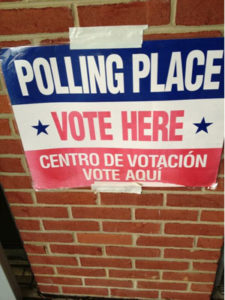
It’s a point of pride that Central Library is one of many polling locations.

Not because we’re a big facility with a large auditorium and a lot of free parking, but because our very existence as the public library is predicated on a belief that people have a right to know.

Free and unfettered access to information makes our democracy work by giving people the tools they need to pursue the lives they imagined. 

That is a sacred covenant that we, as librarians, never take for granted.

This election season has seemed exceptionally long and it’s no surprise that many (all?) of us are counting the days until it is over. To hasten its end (and it will end), however, is to pay insufficient attention to what voting is all about: taking a stand, making a commitment to oneself and others, being an active participant in the wider community.

Turn on the TV, open the newspaper, listen to the radio – we’re told that this election is more important than ever.

Not so. Every election is important and every vote counts. And it’s a privilege that for people in many parts of the world is not enjoyed.

On Tuesday, vote as if your life depends on it; it does.


November 3, 2016 by Web Editor Tagged With: Arlington Years

Voter Organization Focused on Local Issues for 93 Years

Post Published: October 27, 2016

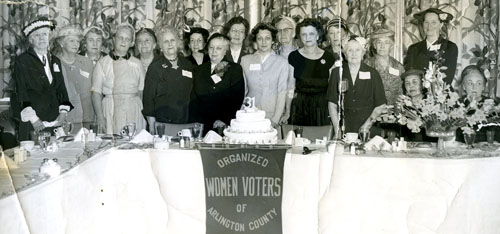
black and white photograph of Organized Women Voters

The Organized Women Voters of Arlington was founded in 1923, just three years after the 19th amendment to the U.S. Constitution extended the right to vote to women.

A decidedly non-partisan organization, the OWV was unique in its distinct attention to matters facing the County. In an interview with the Northern Virginia Sun in 1958, then-president Ms. Woolley stated she believed “that the Organized Women Voters of Arlington is the only women voters’ group in the United States that is concerned solely with matters of local interest.”

While the OWV’s objective was to “collect and disseminate political and civic information,” it also served an important role as a space for the improvement of women’s social position within the county. Many prominent female leaders from Arlington, including county board members and former state senator Mary Margaret Whipple, have been a part of this significant organization.

In an oral history recorded in 1983, former OWV President Mrs. Sue Renfro remembered a time early on in the organization’s history when the two functions of education and political support intersected:

“At the first meeting there was a Sheriff Fields that came to speak to the ladies since they were having the vote. And he promised them that he would do something for them, so they asked him would he be willing to make an appointment [appoint a woman, and he replied] “Well, yes, under the circumstances.”

So then they had the election. Sheriff Fields won, and he just seemed to forget about appointing a lady. And the ladies decided that they should go and inspect the jail.

So they made several trips to inspect the jail, and finally it was reported that the sheriff looked up one day and saw the committee coming again to inspect the jail and decided that he might just appoint one of them, and he appointed Mrs. Pauline Duncan.

… She was the first deputy woman sheriff in the Commonwealth of Virginia.”

In the photo above, attendees gather at the OWV’s 31st birthday luncheon in 1954.

These were high-profile events for the organization, and every year the group named a “Woman of the Year” from Arlington County. In 1938, First Lady Eleanor Roosevelt was an honored guest. Today, the Organized Women Voters still meets on the 4th Tuesday of every month from September through May at Essy’s Carriage House, to hear from candidates and county representatives.

Thank you to current president Nancy Renfro for the information regarding the organization’s current activities.


Learn More from the Center for Local History at the Central Library.

You can request to view materials in person from Record Group 17 – Records of The Organized Women Voters of Arlington County – or read the full interview excerpted above with Sue Renfro and Lillian Simms, cataloged as VA 975.5295 A7243oh ser.3 no.215.


October 27, 2016 by Web Editor

Library Director Receives Women of Vision Award

Post Published: June 29, 2016

Women of Vision

On June 28, Library Director Diane Kresh was honored with the 2016 Women of Vision Award by the Commission on the Status of Women.

Each year, the Commission honors women from the fields of government, business and the nonprofit world who have shown extraordinary leadership and commitment to the community.

2016 marks the 30th anniversary of the awards.

This year’s Women of Vision Awards also include Rebecca Carpenter, the founder and CEO of organic urban agriculture company Sprout, and Susan Senn, a former Arlington Public Schools teacher who now serves on the Executive Board for the Arlington Branch of the American Association of University Women.


Diane’s remarks highlight her passion for mentoring women in the workplace and supporting young people in our community, as well as the power of stories to connect us:

Good evening. Thank you Ingrid, Caroline and the Commission on the Status of Women. I am honored to be here in the company of all of you, including many former winners of this prestigious award, and my County colleagues, friends and family.

Diane Kresh at Women of Vision awards

photo courtesy of AED BizLaunch

Perhaps it is no coincidence that 42 years ago this month, I began working in a library. Growing up in Arlington in the early 1960’s, becoming a librarian was perhaps the furthest thing from my mind, in spite of a penchant for alphabetizing my baseball trading cards. In those pre-Title IX days, I lived for sports – especially softball – and a career in physical education seemed more likely. However, within a few years of that first library job, I earned my Masters in Library Science and joined a profession known for its advocacy on behalf of the disenfranchised and marginalized.

A few years ago, I was writing a blog post to promote our outstanding summer reading program for children and teens when I remembered an event that, as much as anything, contributed to a lifelong commitment to empowering the disempowered.

It occurred in Mrs. Cheatham’s 8th grade English class and arrived in the form of a Scholastic magazine short story. “Sucker” by celebrated novelist Carson McCullers (“The Heart is a Lonely Hunter” and “Ballad of the Sad Café”), described a cruel hurt inflicted on an orphaned teen-child, so gullible and starved for affection and acceptance that his hurt, suffered at the hands of an insensitive older cousin Pete, the story’s narrator, still takes my breath away, close to 50 years later. We have each of us probably known a Sucker; or at times, maybe, been one: the nerdy kid who tags along, always at a distance, grateful to be allowed to do that. The kind of kid who will do anything to fit in, be wanted, the kind of kid who is prone to hero worship and typically chooses the wrong hero, a hero unworthy of such devotion, and who, ultimately, inevitably will disappoint.

“Sucker” was my first brush with young adult fiction and the realization that those you most depend on are not always there for you. I read S.E. Hinton’s classic, “The Outsiders” later that same year, but didn’t pick up young adult fiction, again until shortly after I arrived at Arlington Public Library when I requested a reading list of core YA titles from our Youth Services staff. Be careful what you ask for. Although I got through only about half of the list, I was unnerved by the range of experiences these fictional heroes and heroines confronted in their still young lives: teen pregnancy, addiction, gender preference, bullying; teens facing moral dilemmas, teens facing death, teens facing the consequences of their own actions. Pretty heavy and mature stuff in stories that revealed how challenging and lonely it is for young people to come of age, now more than ever. Stories that reminded me of how important adults are in the lives of teens whether we are parents, mentors, neighbors, teachers, or librarians. How important it is to be that someone willing to listen at a time when a teen needs it most.

From the women I coach who are trying to lean in and have it all to the young people of our community who struggle to find their voices, the Library is a beacon, a safe haven, a clean, well-lighted place that says: we listen, you belong. I am grateful to Arlington County for granting me the opportunity to give back to a community that set me on my path with confidence and purpose. And I am grateful to the Advisory Commission on the Status of Women and their tireless advocacy for the social and economic interests of women.

I’ll close with a quotation from one of my heroes, Eleanor Roosevelt who knew something about public service and whose commitment to social justice and human rights and freedoms sets a bar that I aspire to reach. She also knew something about the power of women’s voices. Perhaps her words will resonate with some of you . . .

“A woman is like a tea bag – you never know how strong she is until she gets in hot water.”

Thank you.


Women of Vision awards are presented each year by the Arlington County Commission on the Status of Women as part of the celebration of Women’s History Month. The awards are given to individuals who demonstrate a strong commitment to women’s issues and have, over time, developed and communicated their vision for women and engaged community members and other leaders in order to realize this vision.


June 29, 2016 by Web Editor

  • « Go to Previous Page
  • Page 1
  • Interim pages omitted …
  • Page 21
  • Page 22
  • Page 23
  • Page 24
  • Page 25
  • Page 26
  • Go to Next Page »

Primary Sidebar

News

Holiday: All library locations to close early at 5 p.m. on Nov. 25 and all day Nov. 26 & 27 in observance of Thanksgiving.

The Shop will be closed Nov. 26 - 28. The … ... about Holiday: All library locations to close early at 5 p.m. on Nov. 25 and all day Nov. 26 & 27 in observance of Thanksgiving.

Read More News
See More Service Updates

Center for Local History

Large banner that reads, “Let there Be Peace on Earth” displayed near the Pentagon following the 9/11 terrorist attacks. Photo credit Diane Kresh. Charlie Clark Center for Local History, 133-01-02-01-130

Resilience and Community

September 11, 2001 "When terrorists slammed into … ... about Resilience and Community

Read More Local History

Director’s Blog

An American flag is draped over a portion of the Pentagon near where the structure was hit by a plane during the 9/11 attack. Photo credit Diane Kresh. Charlie Clark center for Local History, 133-01-02-01-107

On the 25th Anniversary of September 11

"Never Forget." When I hear that phrase today, … ... about On the 25th Anniversary of September 11

More Director's Blog

Footer

About Us

  • Mission & Vision
  • Charlie Clark Center for Local History
  • News Room
  • Get Email Updates

Administration

  • Policies
  • Library Staff
  • Job Opportunities
  • Propose a Program or Partnership

Support Your Library

  • Friends of the Library
  • Giving Opportunities
  • Donating Materials
  • Volunteer Opportunities

Our Mission

We champion the power of stories, information and ideas.

We create space for culture and connection.

We embrace inclusion and diverse points of view.


Download the Library App

Download the Library App

Arlington County | Terms & Conditions | Accessibility | Site Map
· Copyright © 2026 Arlington County Government ·