• Skip to primary navigation
  • Skip to main content
  • Skip to footer

Alert

Holiday: All library locations closed Fri., June 19, for Juneteenth. More Info

Alert

Update: Elevator outages, maintenance and upgrades at Central Library More Info

Alert

Storytimes Will “Take a Nap” through June 20 More Info

Home - Arlington County Virginia - Logo
MENUMENU
  • Join Now
  • My Account
    • Login
    • My Checkouts
    • My Holds
    • My Lists
    • My Reading History
    • About Borrowing
    • About Holds
    • About My Account
  • Hours & Locations
    • All Hours & Locations
    • Holiday Closings
  • News
    • Library News
    • Director's Blog
    • Get Email Updates
  • Contact Us

Arlington Public Library

MENUMENU
  • Search
  • Collections
  • Library Services
  • Events
  • Community Engagement
  • Join Now
  • My Account
    • Login
    • About Borrowing
    • About Holds
    • About My Account
  • Hours & Locations
    • All Hours & Locations
    • Holiday Closings
  • News
    • Library Blog
    • Get Email Updates
  • Contact Us

Web Editor

From Marching Bands to Indie Rock: The Story of Gerald Lewis Recording

Post Published: September 23, 2012

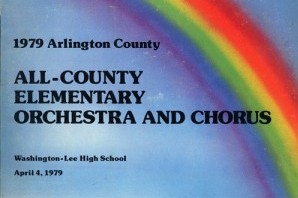
1979 Arlington County All-County Elementary Orchestra and Chorus album cover

In today’s music scene, it isn’t uncommon for those involved to wear many hats.

Artists crossover from performing to producing, find parallel careers in film, literature, and the visual arts with regularity. In earlier times, this phenomenon was less prevalent, excepting well-known performers such as Elvis and Frank Sinatra. Arlington’s own Gerald M. Lewis had a rich and varied career, being involved in many different aspects of music including performing, instruction, production, and recording.

From 1954-1979, Mr. Lewis served as a band director for Gunston and Stratford Junior High Schools, and Wakefield and Washington-Lee High Schools. At his home on 216 S. Pershing Drive, Lewis also owned and operated Gerald Lewis Recording. Housed in a mobile home adjacent to his residence, Gerald Lewis Recording was a mobile recording unit that offered him the ability to record performers and public events on location.

Operating from 1964-1991, a remarkably diverse customer base utilized Mr. Lewis’ recording service. Local Virginia and Maryland schools and churches recorded public events and concerts, including performances from high school marching bands and public speakers.

Local recording artists also took advantage of Lewis’ expertise. In 1985, Teen-Beat Records artists Unrest used the mobile studio to master their debut 7” single “So You Want To Be a Rock ‘n’ Roll Star”/ “Zelda” (Side A) – “The Hill” (Side B), which was also the first Teen-Beat vinyl release. Unrest band member and Teen-Beat impresario Mark Robinson recalls, “He [Lewis] essentially was the broker for Teen-Beat to press our first record. He put the master tape together, sent it to the pressing plant, etc. I paid him, and he paid the pressing plant. I found his number in the Yellow Pages. He also recorded and pressed up the Arlington All-County Orchestra record that I was on back in 4th or 5th grade, so I knew that this guy knew how to make a record.”

In 1996, Mr. Lewis and his wife Elizabeth, a music teacher at Wakefield High School, moved to Tennessee where he continued to be involved in music, directing, arranging, and playing trombone for the Pleasant Hill Ensemble until his passing in March of 2008, at the age of 82.

What about you?

Do you have any memories of Mr. Lewis or his recording services?
September 23, 2012 by Web Editor Tagged With: local history news

A Garden to Remember

Post Published: July 26, 2012

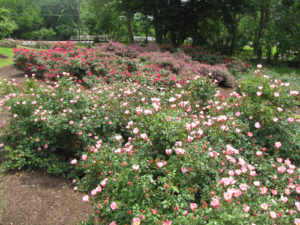
Photgraph by Pamela Powers

The Bon Air Memorial Rose Garden, located at the corner of N. Lexington  St. and Wilson Boulevard, was conceived by Nell Broyhill as a memorial for the many Arlingtonians who served and died in World War II.

In 1941, Ms.  Broyhill assembled a group of women from Arlington churches, civic groups and associations and formed the Arlington Rose Garden Association, now called the Arlington Rose Foundation. After ten years of fundraising they finally realized their dream when the rose garden opened on the grounds of what was then Arlington Hospital (now Virginia Hospital Center) in 1951.

Ten years later the garden was moved to Bon Air Park; the transfer was completed in 1964. Today the garden is maintained by the Arlington’s Department of Parks, Recreation and Community Resources. It contains approximately 135 different rose varieties and 2,500 plants on about one acre.

In the center of the garden is the famous Peace rose and the Veterans’ Honor ™ rose. The Peace rose is a yellow blend Hybrid Tea developed by Frances Meilland in France in 1935. When World War II began Meilland sent the rose to friends in Germany, Italy and the U.S. in the hopes of ensuring its survival. Called the Peace rose in the U.S. to commemorate the end of the war, it was formally introduced on April 19, 1945, the day Berlin fell.

The Veterans’ Honor ™ rose, a dark red hybrid tea rose, was created by Jackson and Perkins in 1999 to commemorate America’s veterans.

The Foundation sponsors an annual rose competition for growers. This year’s district competition, which includes 70 competitive categories, will be at held at Merrifield Garden Center- Fair Oaks location on September 22nd from  1 to 6 pm and September 23rd from  11am to 4 pm. See  www. arlingtonrose.org  for more details as well as for information about the Arlington Rose Foundation’s activities and rose advice.

Plans are also underway for a Bon Air Memorial Rose garden celebration day on Saturday, October 6. Along with docent-led tours, rose rooting classes and poetry inspired by roses, the legacy and unique gift that Ms. Broyhill bestowed to Arlington will be on prime display.

What About You?

What are your favorite memories of Bon Air Rose Garden? Or other wonderful rose gardens in Arlington?


July 26, 2012 by Web Editor Tagged With: local history news

Clarendon’s Trophy

Post Published: June 21, 2012

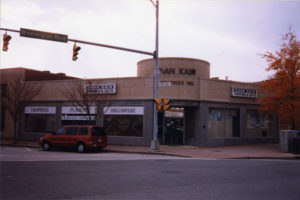
Dan Kan Trophies, 1998


The building at 3100 Washington Boulevard in Clarendon is a visually arresting structure.

This Streamline Moderne-style storefront was the home of Dan Kain Trophies, which was the store in Arlington for trophies, ribbons and plaques for many years. Although Dan Kain Trophies is now located in Merrifield in Fairfax County, it still has a major impact on the community; so much so that although the building is currently a restaurant called Lyon Hall, many Arlingtonians still call it the Dan Kain Building.

The Dan Kain Building, shown above in 1998, was constructed in the mid-1940s for Frank Lyon, who rented it out to a series of businesses selling appliances, electronics and finally furniture. In 1963, Dan Kain moved his trophy business, which he had established in his home, into the building, and Dan Kan Trophies stayed there for 40 years, providing not just Arlington but northern Virginia with signs, trophies and other materials for government and private groups. In 1973, ads appeared in the Washington Post for “Special Prices for Bowling Leagues.” With its specialized products, friendly service and unique home, Dan Kain Trophies became an institution.

In 1988, the County Board unanimously approved the Dan Kain Building as a Local Historic District. It is an excellent example of the Streamline Moderne style of architecture, with its lack of ornamentation, streamlining, and distinctive wrap around to North Highland Street. The interior was renovated in 2004, and Dan Kan Trophies, now owned by longtime employee Jim Preziotti, left Washington Boulevard to relocate to 2207 N. Pershing Drive.

A GSA federal contract in 2009 to make trophies and signs was an indication of the business’s continuing vitality. However, the economy’s downturn hurt Dan Kain Trophies; budgets set aside for trophies, medals and plaques were diminished as belts were tightened. When the Pershing Drive location was scheduled to be torn down in 2010, the business ended up moving to Merrifield, where rent is cheaper. However, Dan Kain Trophies is still in business, marking people’s milestones and helping preserve memories. And the building to which it is linked still stands proudly, still a vital part of Clarendon’s business district.

What about you?
What are your memories of Dan Kan Trophies and its building?

June 21, 2012 by Web Editor Tagged With: local history news

How to Preserve Arlington’s Past

Post Published: May 25, 2012

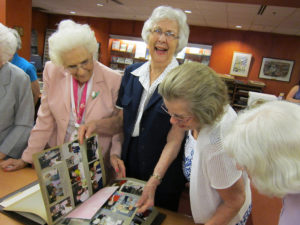
The Virginia Room at Central Library is the County’s official history archive.

But how does the Library keep a steady flow of history coming in? Donations, from people like you.

Scott McCaffrey of the Sun Gazette was on hand for a recent donation by the Potomac Women’s Club, just one of several civic groups that now has its newsletters, yearbooks and scrapbooks preserved for future generations of Arlington residents and researchers.

In the case of the Potomac Women’s Club, the records go back to the early 1950s and create a fascinating timeline of both dramatic changes in the County and the evolving influence of women’s organizations nationwide.

See more images from the Potomac Women’s Club donation.


Learn more about the Virginia Room and local history. 


May 25, 2012 by Web Editor Tagged With: local history news

Our Back Pages: Swillers Music

Post Published: May 14, 2012

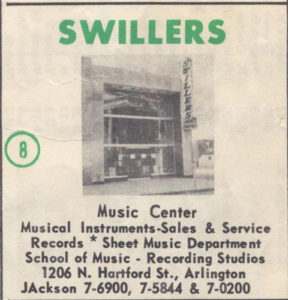
Serving as both a location to find the latest recorded music and a popular gathering spot, Swillers Music is still fondly remembered by longtime Arlington residents. 
Known over the years as Swillers Music, Swillers Music Center, or just Swillers, the store’s location in Clarendon at 1206 N. Hartford St. helped it become a magnet for residents looking for phonograph records of all genres. Turntables, televisions, radios, and related accessories were also kept in stock for the customer’s convenience.

Priding themselves on adding new merchandise on a near daily basis, many local residents found themselves visiting Swillers regularly, enjoying each other’s company, making new friends, or just passing the time. All of this seems quite fitting for a family owned business overseen by president Milton Swiller, vice president Anna Swiller, and treasurer Sydney Swiller.

The first listing for Swillers in an Arlington County directory appeared in 1948, while the last entry is from 1961.

 What About You?

 Do you have any recollections about Swillers Music?  If you do, please share in our comments section. Thanks.


May 14, 2012 by Web Editor Tagged With: local history news

From Our Archives: I Saw Lincoln Slain

Post Published: April 12, 2012

She found herself in Washington like millions before and since, a young woman from somewhere else—in this case Connecticut—quickly taken with her newfound closeness to the pomp of the Federal seat of government.

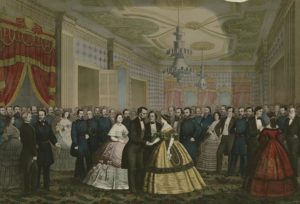
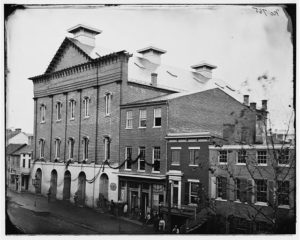
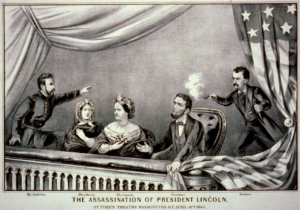
Back in 1865, Washington was also capital of a nation split by a brutal civil war entering its last months. Sarah Russell, a minister’s daughter, would twice see President Lincoln with her own eyes—at the White House on the evening of his second inauguration, March 4, and a few weeks later on Good Friday, April 14, Ford’s Theatre.

Currier & Ives

Jump ahead four decades to a roomy two-story home with picket fence on Lee Highway in the East Fall Church neighborhood.  Sarah Norton Russell Eastman (1847-1939), mother of two impressive young men and wife of a Union veteran, is placing her memories onto the modest lines of a composition book. Points of popular history supplement her recall and at times a fact or two come out wrong.

But it’s Mrs. Eastman’s brief glimpses of Lincoln, both in celebration and mortally wounded, that shine like well-kept heirlooms.

“His shirt was open showing blood on his chest.”

Arlington Public Library’s Virginia Room is home to the Eastman-Fenwick Collection, a large mix of personal papers, Civil War and World War I front-line correspondence, photographs, maps and other materials that include Sarah Eastman’s, and those of several generations including her granddaughter’s husband, Virginia delegate, state senator and gubernatorial candidate Charles R. Fenwick. The Arlington Democrat was a key proponent of regional mass transit and his name is attached to Metro’s Yellow Line span of the 14th Street Bridge.  Fenwick was also a political intimate of John and Robert Kennedy.

The Eastman-Fenwick House, 6733 Lee Highway, is still a family home.


----------------------------------------------------------------------------------------------------------------------------

A transcription of Sarah Eastman's account of seeing Abraham Lincoln during March and April 1865:


My Recollection of the Assassination of

President Abraham Lincoln.


In January 1865, before the close of the

Civil War, I came to Washington to live, and

witnessed many of the exciting scenes of

that period.


I saw President Lincolns second

Inauguration and helped dress my Sister to

ride in a float in the parade, which was

an impromptu affair. Thirteen girls dressed

in white with red white and blue, carrying

flags rode on the float.


That evening I attended the reception to

President Lincoln’ second inaugural reception

The President at the White House. At the

front door a certain number of persons were

admitted at a time, and when the door was

closed the crowd surging back actually

lifted me off the my feet. After entering, persons

passed through the hall into the Blue

Room, and after shaking hands with the

President and Mrs. Lincoln passed into

the East Room, making their exit through


[page 2]

one of the windows onto a platform extending

from the windowsill to the front fence, then

down a few steps to the pavement.


My father had been a minister in

Connecticut, and was opposed to the Theatre, so it

was after long urging and the argument that

Ford's Theatre, April 1865

General Grant was to be at the Theater with the

President that evening, that he gave his consent

to my going. I sat in the dress circle nearly

opposite the box in which the President was seated.

The play was Our American Cousin. When the

Presidential Party came in, Lord Dundreary was

just asking the conundrum [“]Why does a dog

wag his tail[?”], and after the applause given the

President he repeated it. The play went

on, then at a moment when the stage was

clear there was a pistol flash and John Wilkes

Booth jumped from the box in which the

President was sitting onto the stage. In jumping

his foot caught in the flag decorating the box

and he apparently sat for an instant on the stage.

Rushing across the stage, about in the middle,

he turned, brandishing a dagger that glistened

[page 3]

in the gas light, and calling out “Sic Semper Tyranus [sic]”

was gone into the alley where a boy was holding

his horse. Being familiar with the Theater he

knew how to arrange the passages so that nothing

would obstruct his course.


For a moment every one was dazed, there was

quiet, but almost immediately word spread

around The President has been shot. Then the

confusion was awful. Women fainted, some tried

to climb over the backs of chairs, men rushed on to

the stage, some climbed to the box with water,

Laura Keene came on the stage and with arms

outstretched implored the audience to be calm.

Twice she came out in that manner. After that

she was in the box with Mrs. Lincoln.


In going out I reached the top of the stairs just

as the President was being carried down on a

stretcher. Laura Keene was following calling

[“]Make way for Mrs. Lincoln,[“] who was crying

[“]Let me get the assassin, Oh take me to him.[“]

His shirt was open showing blood on his chest.

He was taken to a house opposite where he

died the next morning.


[page 4]

There was a plot to assassinate some of

the Cabinet that night. Secretary of State Seward

was attacked, on his sick bed, and seriously

injured, his Son having a tussle with the assassin.


Secretary of War Stanton was an intended

victim but was not found where the plotters

supposed him to be. General Grant who was

advertised to be at the Theater was suddenly

called out of the city.


Accompanying the President and Mrs. Lincoln

was Major Rathburn [sic] and Miss Harris – afterward

married.


There were six persons in the plot

Mrs. Surratt, at whose house on H St near 5th NW

their meetings were held, her Son John H. Surratt,

Payne, who attacked Secretary Seward, Harrold [sic],

Atzerolt [sic] and Mudd. After trial three were

executed  - hung – on the grounds of Old Capitol Prison.

(The ground now occupied by the New Senate Office  Bldg.)

Mrs. Surratt, Payne, Atzerolt. The others were

banished to Dry Tortugus [sic].


A few words about Miss Keene


[page 5]

The performance that evening was

advertised as a Benefit, also her last night.

The President, with a full house must have

been an incentive to do her best. She was

gowned in white satin brocaded with pink

roses and green leaves, cut with tight bodice,

low neck, short sleeves and full shirt, in

which she made a pleasing picture.


I quote from a program which I have preserved.


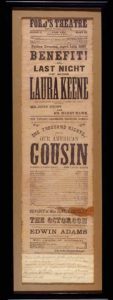
Playbill. Smithsonian Institution

Benefit and Last Night of Miss Laura Keene

the distinguished managerist [sic], authorist [sic] and

actress. Supported by John Doytt and

Henry [sic] Hawk, in Tom Taylors celebrated eccentric

comedy. As originally produced by Miss Keene

and performed by her upwards of 1000 nights

Entitled, Our American Cousin.


Copied into this book February 1905.

Sarah N. Eastman.

April 12, 2012 by Web Editor Tagged With: local history news

Tombstone Blues

Post Published: April 3, 2012

Almost Gone

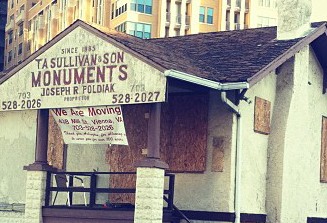
Tombstone store moves
Clarendon, April 2, 2012.

TA Sullivan & Son Monuments photo by Diane Kresh.


April 3, 2012 by Web Editor Tagged With: in Memoriam, local history news

Our Back Pages: Shreve’s in Cherrydale

Post Published: March 27, 2012

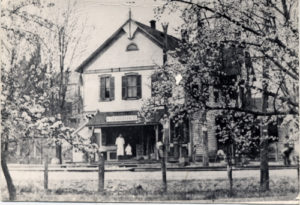
Shreve’s Store on Lee Highway in Cherrydale was the second general store in Cherrydale, the first being Nelson’s. In addition to being a store it was also, for a time, the Cherrydale Post Office.

Double track trolley lines in front of the store ran to Great Falls in one direction and Rosslyn in the other. The tracks, which followed what is now Old Dominion Drive, were removed in 1935.

According to an article in the Sun newspaper, there was a water trough for horses in front of the store, which was filled from a nearby pump. When the pump was eventually electrified, the horses were so scared by the new device they wouldn’t drink!

As Lee Highway was not paved in the early years, the Shreve family often hitched their own road grader to their horse to smooth out the street.

The photograph above was taken circa 1910.

What About You?

What do you remember or have heard about Shreve’s or other stores in Cherrydale? We want to know!

March 27, 2012 by Web Editor Tagged With: local history news

Last Dance

Post Published: February 16, 2012

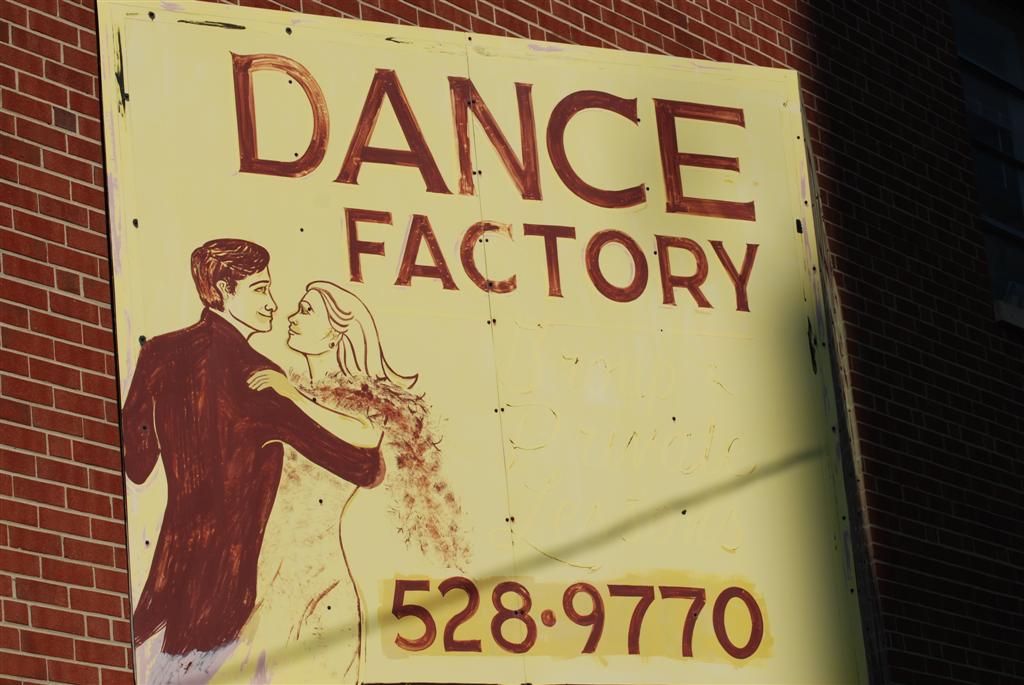
Old sign on North Fairfax, now gone.

Dance Factory

Arlington business sign, now replaced.

Photo taken by Diane Kresh on May 8, 2009, near Central Library.


February 16, 2012 by Web Editor Tagged With: in Memoriam

John Glenn, First Arlingtonian in Orbit

Post Published: February 14, 2012

To mark the passing of the hero of the American Space Age, we’re re-sharing our blog post from Feb. 14, 2012, written on the 50th anniversary of his first space trip to orbit the earth.

Glenn’s death at age 95 was announced Dec. 8, 2016.


Fifty years ago this month, on Feb. 20, 1962, John Glenn became the first Arlingtonian to orbit the Earth.

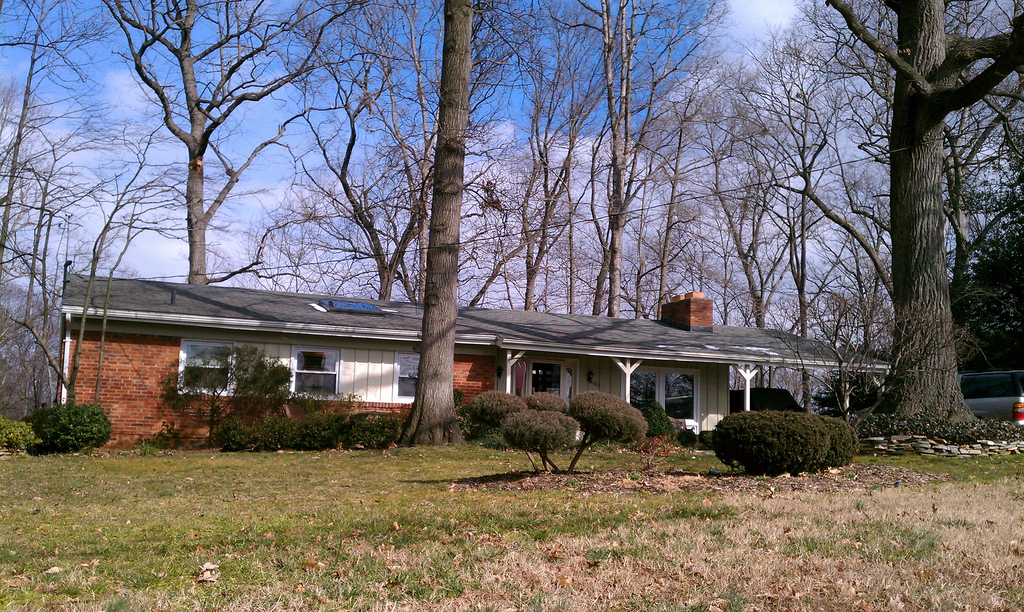
Glenn family home 1958-1963

While often celebrated for an Ohio pedigree on par with the Wright brothers of Dayton, New Concord’s favorite son was also among the wave of transients to settle in suburban Washington amid the Cold War-era build-up of jobs and conveniences.

A Marine test pilot, and veteran of both World War II and the Korean War, Glenn was commuting almost four hours a day between Maryland’s Patuxent Naval Air Station and a desk assignment in temporary offices on the National Mall.

He and his wife, Annie, and their two children were lured to Northern Virginia in 1958 by the promise of a good school district and “a beautiful tree-shaded hillside.”

Arlington real estate prices were already “high” for the times, Glenn later recalled in his autobiography, but not completely beyond reach of a junior officer’s annual income, roughly $10,000.

In fact, another Marine family joined the Glenns in building next-door ranch homes on quiet North Harrison Street.

They were not alone:  The county grew by almost 30,000 residents that decade, having more than doubled in population the previous ten years.

For John Glenn, already in his late 30s, and his wife, Annie, Arlington was a particularly idyllic pause in the series of moves typical of military families.

Their son, David, and, soon, his sister, Lyn, simply had to cross the street to get to class at Williamsburg Junior High School. Their father had only to point his used Studebaker across Chain Bridge or Memorial Bridge to be at work within minutes.

In the eyes of his new neighbors, Glenn was already on the road to modest TV-age celebrity, having recently set a transcontinental-flight speed record, followed by an appearance on “Name That Tune.”

When the newly formed NASA launched its search for the men to beat the Soviets into space, Glenn’s curiosity, patriotism and media savvy were a natural fit. Despite the obvious domestic sacrifices to come, he and Annie celebrated the news of his selection (and their 16th wedding anniversary) with dinner at McLean’s Evans Farm Inn.

 * * *

Astronaut headquarters and training were set for NASA’s Langley Research Center in Hampton, 180 miles of pre-I-95 driving from Arlington County. The other six men set to fly Project Mercury would have their families near the job but the Glenns weren’t ready to leave Northern Virginia after less than a year.

So they decided to remain in the new house with the bucolic backyard, while the astronaut-in-training went back to a long commute, this time returning home only on weekends.

His other quarters were those for Langley bachelors or hotel rooms near NASA business across the country. The Studebaker was replaced by a bookish new NSU Prinz that got 45 to 50 miles to the gallon–and the scorn of Glenn’s hot-rod-driving colleagues.

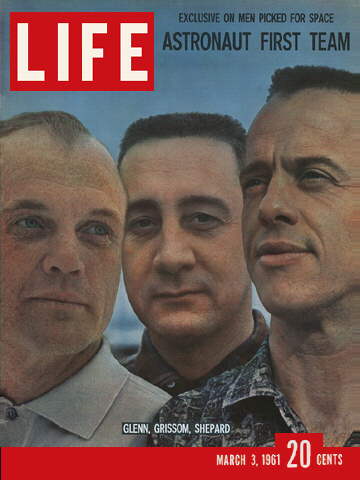
The expense of keeping the family in Arlington was no longer a concern, thanks to income from an exclusive contract with Life magazine. Each astronaut would get close to $70,000 for his story over the three years of the program. They would become household names long before blastoff.

But by the time Alan Shepard and Gus Grissom flew their arch-shaped, suborbital flights in 1961, the Mercury 7 program had become the story of also-rans. Yuri Gagarin and the Soviets made it to space and orbit first and the differences between the two programs weighed heavy on Americans.

NASA’s two flights each lasted roughly 15 minutes, while the second cosmonaut up, Gherman Titov, orbited Earth almost 18 times during an August 1961 mission that lasted more than a full day. A radio specialist in Arlington, Sgt. James Duffy, picked up Titov sending greetings to the American people in Russian.

The Glenn mission was set initially for December 1961 but weather and technical issues forced almost a dozen no-gos. The new Mercury-Atlas rocket remained on the pad at Cape Canaveral.

All the while, Annie Glenn and her children kept vigils by the television at North Harrison Street, as reporters and other rubberneckers waited outside. Newspapers readily printed the address.

After one five-hour countdown to frustration in January 1962, Vice President Lyndon Johnson was left to fume in his limousine down the street when Mrs. Glenn refused to open her home to a photo-op on a far larger scale than Life ever wanted.

Not only did Glenn burn up the telephone lines to Washington and Arlington in support of his wife’s decision, but he dared his superiors on threats to bump him from the mission.

Finally, Feb. 20, 1962 happened.

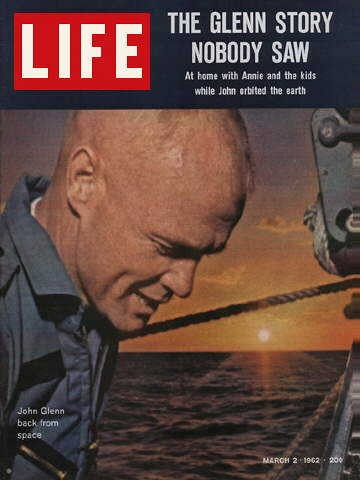
When John Glenn brought his Friendship 7 back to Earth after a sometimes harrowing five-hour flight of three orbits, he was America’s favorite son, the new Lindbergh. NASA had at last proven its capabilities for the world to see, especially the Soviets.

Despite the ensuing hoopla and hero’s travels, home for Glenn remained in Arlington. There were now distinct advantages for the space program’s best salesman to be a few minutes from the nation’s capital, whether it meant having a closer relationship with President Kennedy and his family, or being asked by a desperate State Department to host a last-minute goodwill barbecue for Gherman Titov.

At one point during the rainy cookout, the astronaut and cosmonaut sweated side-by-side in Glenn’s carport, trying to keep the charcoal under control.

Even Lyndon Johnson was welcomed at the house for Glenn’s 41st birthday party, staying well into the night.

But the push toward the moon and a new Manned Spaceflight Center near Houston meant a commute even beyond John Glenn’s endurance level. The family packed up for Texas in 1963, heading for a new community customized to the needs of celebrity space travelers.

Ultimately considered too valuable for a second space race launch, Glenn would have to wait for the shuttle

era to return to orbit. But his unmatched people skills eventually returned him to the Washington area for a quarter-century as U.S. senator.


John Glenn remains a part-time resident of the metropolitan D.C. area to this day and still visits his first spacecraft at the Smithsonian’s National Air and Space Museum.

February 14, 2012 by Web Editor

  • « Go to Previous Page
  • Page 1
  • Interim pages omitted …
  • Page 24
  • Page 25
  • Page 26
  • Page 27
  • Page 28
  • Interim pages omitted …
  • Page 40
  • Go to Next Page »

Footer

About Us

  • Mission & Vision
  • Charlie Clark Center for Local History
  • News Room
  • Get Email Updates

Administration

  • Policies
  • Library Staff
  • Job Opportunities
  • Propose a Program or Partnership

Support Your Library

  • Friends of the Library
  • Giving Opportunities
  • Donating Materials
  • Volunteer Opportunities

Our Mission

We champion the power of stories, information and ideas.

We create space for culture and connection.

We embrace inclusion and diverse points of view.


Download the Library App

Download the Library App

Arlington County | Terms & Conditions | Accessibility | Site Map
· Copyright © 2026 Arlington County Government ·