• Skip to primary navigation
  • Skip to main content
  • Skip to footer

Alert

Holiday: All library locations closed Fri., June 19, for Juneteenth. More Info

Alert

Update: Elevator outages, maintenance and upgrades at Central Library More Info

Alert

Storytimes Will “Take a Nap” through June 20 More Info

Home - Arlington County Virginia - Logo
MENUMENU
  • Join Now
  • My Account
    • Login
    • My Checkouts
    • My Holds
    • My Lists
    • My Reading History
    • About Borrowing
    • About Holds
    • About My Account
  • Hours & Locations
    • All Hours & Locations
    • Holiday Closings
  • News
    • Library News
    • Director's Blog
    • Get Email Updates
  • Contact Us

Arlington Public Library

MENUMENU
  • Search
  • Collections
  • Library Services
  • Events
  • Community Engagement
  • Join Now
  • My Account
    • Login
    • About Borrowing
    • About Holds
    • About My Account
  • Hours & Locations
    • All Hours & Locations
    • Holiday Closings
  • News
    • Library Blog
    • Get Email Updates
  • Contact Us

Web Editor

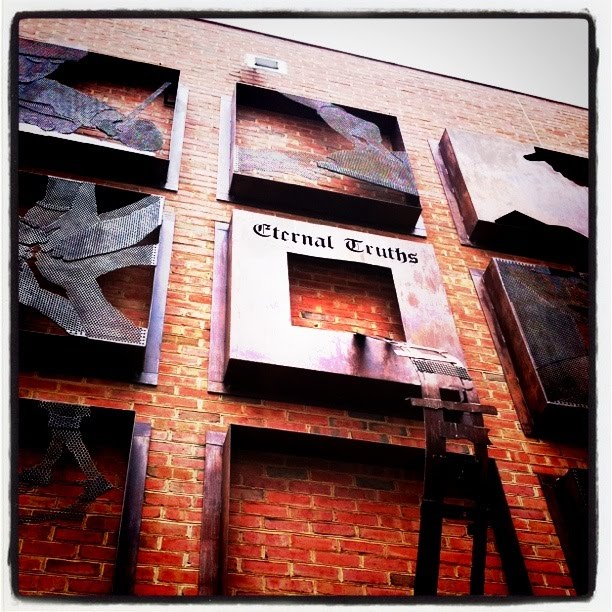
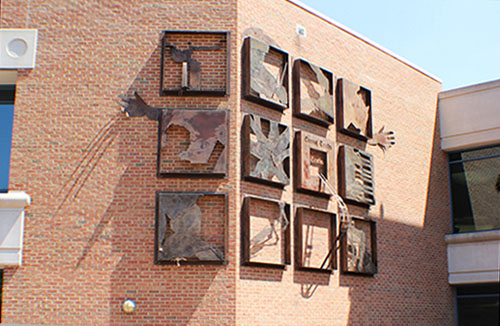
Eternal Truths

Post Published: February 1, 2012

Artist: Lisa Fedon

Installed: 1999 – 2000
Materials: Bronze plate, perforated plate, and rod anchored into a brick wall, finished with tortoise-shell patina
EternalTruthsfedon

On permanent display at Central Library.

The sculpture was fabricated of bronze (plate, perforated plate, and rod). The finish is dark tortoise shell patina. All of the work was completed at Ms. Fedon’s studio in Pennsylvania and then transported to Arlington. The sections are anchored into the brick walls.

The artist, Lisa Fedon of Pen Argyl, Pennsylvania, was chosen through a competitive process by a jury of community representatives, local artists, and staff from the Library and the Public Art section of the Arlington County Cultural Affairs Division.

In her design, Ms. Fedon combined images taken by local high school photography students with her own photographic record of “life in Arlington.” The sculpture is funded by monies raised raised in the Campaign for Excellence, by the Friends of the Arlington Public Library, and by other contributions.

Learn more about this piece from Arlington Public Art.
February 1, 2012 by Web Editor Tagged With: art permanent collection

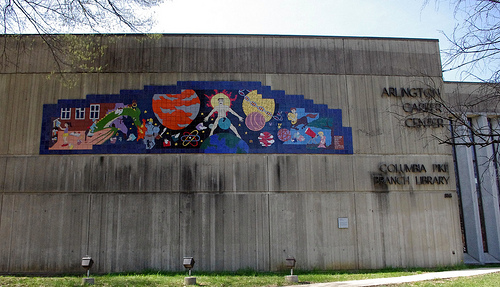
Triumph of Literature

Post Published: February 1, 2012

Artist: Alfred Ratinoff

Installed: 2000
Materials: Ceramic Tile

Created with ArtsWork students Jerryl Chandler, Brenda Keating, Julia Siple, Donna Xizo, Jerome Young and Jeannette Yue.

Triumph of Literature columbia pike

Permanently installed at the Columbia Pike Branch Library.

ArtsWork was a summer program for teens coordinated by Arlington Cultural Affairs from 2000 – 2003.


February 1, 2012 by Web Editor Tagged With: art permanent collection

Don’t Let Old Yearbooks Clutter Your Closets…

Post Published: January 2, 2012

Sandra Bullock and Shirley MacLaine were both cheerleaders, and Warren Beatty played football at Washington-Lee.

Katie Couric was a cheerleader at Yorktown.

Want to see their high school photos? The Virginia Room’s archive contains copies of many Arlington high school yearbooks–but not all of them.

Help us complete our archive – if you have an Arlington high school yearbook from any year between 1951 and 2010, consider donating it to the Virginia Room.

We’re looking for yearbooks in good condition (no mold or mildew please), but we don’t care if they include inscriptions. We also accept duplicates.

Walk-in donations are happily accepted. For more information, call 703-228-5965 or email staff.

January 2, 2012 by Web Editor

An Adventuress in Arlington

Post Published: December 23, 2011


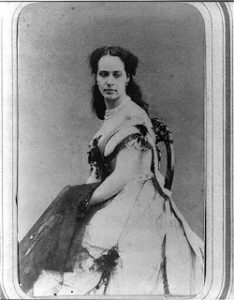
The story of Princess Agnes Salm-Salm mixes myth and fact. Agnes Elizabeth Winona Leclerc Joy was born in Franklin, Vermont, on December 25, 1844, the daughter of General William Leclerc Joy. Agnes is described as a beautiful red-haired Indian woman, who worked in a circus as an equestrienne and an actress in Cuba, rode with her husband and nursed troops during the Civil War, and helped found the Red Cross in Europe.

In 1861 Agnes came to visit her sister who was living in Washington, D.C., where her beauty and riding style drew attention and she became part of Washington society. In a visit to Fort Blenker, (renamed Fort Reynolds) which was located near Fairlington, she met monocoled Prussian Prince Felix Salm-Salm. Captain Louis Blenker’s 8th N.Y. Volunteer Infantry Regiment, made up of Germans, Hungarians, Poles and other Europeans, and known for their colorful uniforms, lavish entertainment and neat campsites, had been previously stationed at Camp Hunter’s Chapel located near Arlington United Methodist Church on South Glebe Road. Although Agnes spoke no German and the Prince spoke no English, they were immediately attracted to each other and married in July 1862.

Prince Salm-Salm participated with the 8th N.Y. Infantry in General Ambrose Burnside’s Mud March, in the Fredericksburg campaign, in January, 1863. Princess Agnes Salm-Salm greeted President Lincoln with a kiss when he came to visit the troops. Prince Felix and Col. Otto von Corvin tried to interest President Lincoln and Secretary of War Edwin Stanton in recruiting 20,000 German troops to come fight for the Union, but this idea was rejected because of logistics, expense and predictable public reactions to employing mercenary soldiers, as the British employed the Hessian soldiers during the American Revolution. When the Prince’s appointment as an officer to the 8th N.Y. expired in April 1863, Princess Agnes used her influence to have her husband appointed to 28th New York Volunteer Infantry Regiment in July 1864, where he served in Tennessee and Georgia.

In January 1866, Prince Felix and Princess Agnes went to Mexico, where Prince Felix served under Prince Maximillian’s French forces. The night before Maximillian’s execution Princess Agnes kneeled before Mexican President Benito Juárez and pleaded in vain to spare Maximillian’s life, a scene painted by Mexican painter Manuel Ocaranza.

In 1868 Prince Felix and Princess Agnes went to Europe. Prince Felix served in the Prussian Army was killed on August 18, 1870, in the Battle of Gravotte. Princess Agnes remained in Europe and died Germany on December 21, 1912. The image above of Princess Agnes is from the Library of Congress.

Bibliography:
Coffey, David. Soldier Princess: the Life and Legend of Agnes Salm-Salm in North America, 1861-1867. 2002.
Salm-Salm, Agnes Elizabeth W. Ten Years of My Life, 1876.

What about you? Do you know of interesting people or events in Civil War Arlington? The Virginia Room wants to know.

December 23, 2011 by Web Editor

Don’t Touch That Screen: Fourth Annual Good Tidings and Tunes Yule Blog

Post Published: November 26, 2011

Thoughts from Arlington County Native and Public Library Director, Diane Kresh.

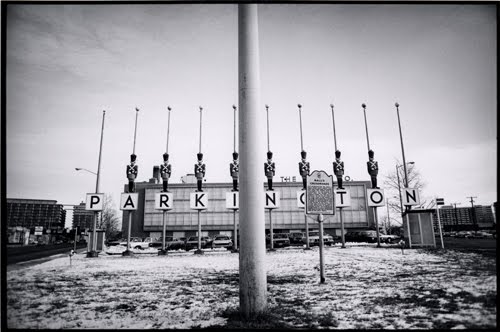
Each year, the Christmas season seems to arrive a little earlier. A few weeks ago, it was not yet Halloween and Macy's at Pentagon City was setting up its Christmas shop.

©Lloyd Wolf /Arlington Photographic Documentary Project

Ever the stickler for tradition, for me the season still begins with Santa's wave, signaling the end of the Macy's Day parade in New York and the start of the year-end count down. Only then do I allow myself to feel the gravitational pull toward my favorite songs of the season and reach for my sacks of little round discs (yes, I still have them) to drive the cold winter away.

So here are some of my favorites holiday songs. Let us know YOURS by posting a comment below. And celebrate the rest and best of the season, be it Christmas, Eid, Pongol, Hanukah, Kwanzaa, the Solstice or any other.

From our house to your house, for a bright 2012.

1. "The Wexford Carol" from "Songs of Joy & Peace, Yo Yo Ma & Friends," Alison Krauss, vocals. Spare and radiant.

2. "Merry Christmas Baby," title track from "Charles Brown and Friends." Bluesy and swinging; a perfect accompaniment to a warm cuppa cheer.

3. "Run Rudolph Run," Keith Richards. We know him as one half of the Glimmer Twins (Mick Jagger being the other), but what we didn't know, until he released his highly readable "Life" last year, is that as a child growing up in Kent, England, he wanted to be a librarian, saying that "The library was the only place around where I willingly obeyed the rules." Rocking and rollicking good fun, both this cover and the book between the covers.

4. "Santa Claus is Coming to Town," from Bill Evans' "Trio 64." (Evans, piano, Paul Motian--sadly he passed away Nov. 22, 2011, drums--and Gary Peacock, bass). A Dec. 18, 1963 session was likely the reason for this seasonal classic. Hardly album filler, it's a classic example of post-bop.

5. "Christmas Time is Here" from Shawn Colvin's "Holiday Songs and Lullabies." The Vince Guaraldi classic by one of my very favorite singers.

6. "Have Yourself a Merry Little Christmas" from She and Him's (Zooey Deschanel and M. Ward's) "A Very She & Him Christmas." This year's nominee for re-imagined standards, cue "zone out" on your iPod (or whatever device you have ) and chill after a long day of doing whatever it is you do to make the season bright. Zooey's singing voice is as deadpan sardonic as many of her best film performances ("The Good Girl," "All the Young Girls," both terrific and underrated films). She also duets with and marries Buddy the Elf.

7. "Greensleeves" by Mason Williams. The composer of "Classical Gas" (which he quotes in the middle of this piece and which I used as the soundtrack for a Super 8 film montage I made in high school), he was also a comedy writer for "The Smothers Brothers Comedy Hour" and introduced Steve Martin to the world. He was also the brains behind the Pat Paulsen for president candidacy in the turbulent election year of 1968. In the midst of assassinations, Chicago and Viet Nam, there was Pat Paulsen deadpanning for president and leaving all to wonder--was he or wasn't he?

8. "Baloo, Lammy (Hush My little Lamb)," from "Song of Solstice," featuring Sue Richards with the Jennifer Cutting Ocean Orchestra. A shout out to a former colleague of mine at the Library of Congress. Jennifer Cutting, one of the finest musicians I know. A winter solstice album for anyone who loves Celtic, Renaissance, classical and pop music.

9. "Dadme Albricias" from "Navidad Renacentista" by Capella De Minitrers/Carles Magraner. A sumptuous recording by the early music group formed in 1987 in Valencia, Spain. Dedicated to celebrating Valencian musical culture.

10. "Go Where I Send Thee" from "The Weavers' (Lee Hays, Pete Seegar, Fred Hellerman and Ronnie Gilbert) at Carnegie Hall." The gold standard for the folk music revival of the 1950's and 60's. Begun in 1948 out of the disbanded Almanac Singers (Seegar and Hellerman), the Weavers personified the unification of folk music and political activism. The concert in New York City on Christmas Eve 1955 was the group's sold-out triumphal return to the stage and a comeback of sorts for one of the few musical entities blacklisted during the McCarthy hearings. Seegar's "release" from television's blacklist didn't end however until the late 60s when he appeared on "The Smothers Brothers Comedy Hour" in 1968 (see number 7 above).

11. "Rise Up Shepherd and Follow," performed by the St. Olaf Choir on "Songs from My Heart: Choral Music of André Thomas." Gorgeous.

12. "All I Want for Christmas is You," from Mariah Carey's "Merry Christmas II You." Sans the Bieber (thankfully), the tune gets the Carey treatment: plenty o' sass and spunk.

13. "Mr. Santa," from Suzy Boggus's "Have Yourself a Merry Little Christmas." A holiday version of the popular hit "Mr. Sandman," penned by Pat Ballard, first recorded by the Chordettes (whose other big hit was "Lollipop") in 1954. Youngsters out there will recall the cover of "Mr. Sandman" by Emmylou Harris, Dolly Parton and Linda Ronstadt from "Trio."

14. "Sleigh Ride" by Steve Lawrence and Eydie Gorme. For the tuxedo clad Dino/Sammy/Frank-o-philes out there. Silly and fun.

15. "Winter Wonderland" from Rockapella's "Christmas." Bop shoo op.

16. "The Christmas Song" from the New York Latin Jazz Allstars off "Feliz Navidad." Roasting hot.

17. "What Are You Doing New Year's Eve," Patti LaBelle, "Christmas at Miss Patti's." Wistful and nuanced.

18. "Oublions l'an passé (Let's Forget the Old Year)," the Washington Revels featuring Riki Schneyer, from "Le Temps des Fetes." Spirited delivery of a traditional French Canadian tune authentically presented by the Washington Revels, under the musical direction of Elizabeth F. Miller. The Revels are dedicated to reviving and celebrating cultural traditions from across the glove through music, dance, storytelling, drama and ritual.

19. "Peace" by Norah Jones on "A Very Special Acoustic Christmas." Nice. Really, really nice...

20. "Star of Wonder," by the Roches on "We Three Kings." Shimmering harmony from a trio of quirky sibs.

Bonus Tracks!
21. "Carol." Chuck Berry. If the song title fits, include it.

22. "What's So Funny 'bout Peace Love and Understanding." Elvis Costello sings Nick Lowe on "Armed Forces." Nothing. Nothing at all.

November 26, 2011 by Web Editor Tagged With: yule blog

Arlington Rocks Pt. 4: United Mutation

Post Published: November 22, 2011

In punk rock lore, the Washington D.C. area scene has always occupied a unique and significant place in both the history and ongoing development of the genre. This is primarily due to the presence of Dischord Records and the bands most commonly associated with the storied label such as Minor Threat, Fugazi, Scream and countless others.

In many ways, Arlington’s own United Mutation represented a sort of highly idiosyncratic flipside to the Dischord coin, with an attitude and sound that refused to be pigeonholed. Mixing in many musical influences not normally associated with punk, from California-style psychedelia to near free-jazz soundscapes, the band proved to be adept composers as well as a visceral aural thrill.

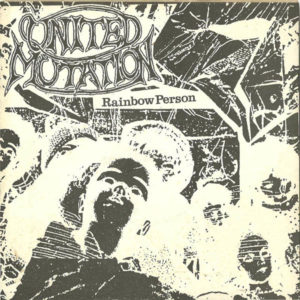
Live appearances were infrequent as the band preferred to hone their sound and songwriting, maintaining a steady rehearsal regimen. Centered around the Fox brothers, John and Jay, as well as their distinctive vocalist Mike Brown, the band released a number of tracks via EPs and 7” singles through their DSI Records imprint with Dischord in the early to mid-1980s. More recent compilation albums on vinyl and CD serve as definitive statements from the band, who have now been recognized by a league of new fans as one of the most original and uncompromising bands to come out of the Washington D.C. area punk movement.

Listen to United Mutation “Infinite Regression”, from the 1985 Rainbow Person E.P. (MP3)

What About You?

Have any of you heard United Mutation’s music or seen them back in the day? Let us know!

November 22, 2011 by Web Editor

Howard Larson, Librarian and Volunteer (1930-2011)

Post Published: November 14, 2011

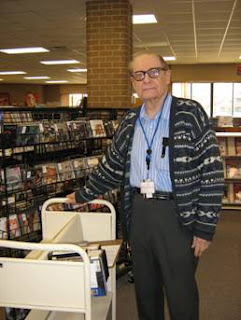
Howard
Howard Larson, 2010

Howard Larson, retired Library staff member turned Library volunteer, died this fall, at the age of 81. 

Charles Howard Larson grew up in rural northeastern Indiana, attended the University of Indiana and served in the Army during the Korean War. After being discharged from the Army, Howard and his wife Nancy moved to Washington D.C., and then to Arlington, where they raised daughters Martha and Barbara. Howard worked several jobs before settling in at the District of Columbia Central Personnel Office, from which he retired.

Howard Larson, retired Library staff member turned Library volunteer, died this fall, at the age of 81. 

Charles Howard Larson grew up in rural northeastern Indiana, attended the University of Indiana and served in the Army during the Korean War. After being discharged from the Army, Howard and his wife Nancy moved to Washington D.C., and then to Arlington, where they raised daughters Martha and Barbara. Howard worked several jobs before settling in at the District of Columbia Central Personnel Office, from which he retired.

It was then that he started his second career, as a member of the staff at the Aurora Hills Branch Library. After almost 20 years with the Library, Howard retired - but instead of leaving the Library behind, he became a volunteer.

Four days a week, Howard came in at 9:30 a.m. to process the router - the list of holds, or items that need to be pulled from the shelves and sent to another library for customer pick up. During tax season, Howard was also in charge of ordering and coordinating all of the paper tax forms. His careful attention to everything he did, combined with long personal relationships with many Aurora Hills patrons, made Howard a well loved and valuable part of the Library's team.

Howard was also a member of Western Presbyterian Church in Washington D.C., where his dedication to good food and drink led to their upstairs kitchen being named after him, and where it was a point of pride for him to shovel their sidewalks after the unprecedented snowstorms of 2009 and 2010.

The staff at Aurora Hills remember Howard similarly for his love of good coffee, and miss sharing it with him four mornings a week.

November 14, 2011 by Web Editor Tagged With: Volunteers: meet our volunteers

Memories of Queen City

Post Published: October 26, 2011

Did you miss last month's Arlington Reunion History Program on Queen City? 

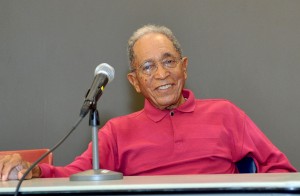
John Henderson grew up in Queen City

John Henderson grew up in Queen City

The Ballston-Virginia Square Patch sent a reporter to the program, and they have published an excellent recap:

In Queen City, a man sometimes didn't know he was poor until he was 27 years old, say some of those who lived there. The tight-knit African-American neighborhood no longer exists, but the community's spirit still survives in scattered memories.

Queen City was situated, based on different oral and written historical accounts, on a patch of land immediately west-southwest of where the Pentagon now stands and was the size of somewhere between two blocks to 16 blocks. In its place now is a sprawling intersection. The community was devastated and neighbors were dispersed in the name of progress.

"Queen City was not razed for the Pentagon building, but the overall Pentagon project. In order to accommodate the large number of individuals who would be commuting to and parking at the Pentagon on a daily basis, extensive accommodations had to be made for the automobile," author Claire Burke wrote in Arlington's Queen City. "The cloverleaf highway structure, which the Columbia Pike feeds into and is found to the west of the Pentagon, remains the exact location of Queen City. Therefore, Queen City was destroyed for Pentagon's needed transportation corridor, which eventually would come to include over thirty miles of highways and ramps, including twenty-one overpasses."

Originally the home of residents displaced by the federal government's closure of Freedman's Village -- a post-Civil War attempt to house freed and displaced slaves -- people in Queen City came from across the South. There, everyone knew each other, and each other’s business. Most families owned their own home, either a single-family home or a row house.

"A lot of them were built by local builders and a lot were built by the people themselves, the people who lived there," said John Henderson, who moved to Queen City with his stepfather from Charlotte, N.C. The houses lacked running water and indoor plumbing. But there was a spring along the southern wall of Arlington National Cemetery. "There was a large pear tree right over the spring," said Eddie Corbin, a former Queen City resident. "When they were ripe, they would fall into the spring. They were the best pears you ever tasted." Residents walked every day and filled two or three buckets of water to take back home, he said.

Life in Queen City

Henderson and Corbin recently shared their stories of Queen City at Arlington Central Library. This article is based on their stories.

Henderson remembers no doctor, no dentist and no undertaker in Queen City. People had to go into Washington for those services. The doctors, dentists and undertakers in Arlington only served the white community. There is some discrepancy on this in written and oral historical accounts.

Queen City residents could only go to two hospitals -- Freedman's Hospital, which would later become the Howard University Hospital, or the District of Columbia General Hospital. But not many people had vehicles. If someone had an emergency, they had to find a neighbor with a car.

Based on Henderson's recollection, Queen City proper had a church, a place that sold fish sandwiches, a gas station and a general store. About 16 blocks down the road, Henderson said, there was one barber shop, an ice cream shop, a grocery store, a fruit store, a post office, a brickyard and one pool hall. There, you would find one fire department and two shoe repair businesses -- one in a storefront, and another in the form of a man who found his customers on foot. There were three churches -- Mount Olive, Mount Sinai and the House of Prayer -- four gas stations, three auto repair shops, two bus lines and a trolley. People worked and shopped at these places. Women also found jobs as domestic servants and some men worked for the federal government and at the cemetery, Henderson said.

Originally, the nearest fire station was on Virginia Highway at 23rd Street, said Corbin, whose father had been a firefighter. "We needed one, so (the residents) had dinners and parties and whatnot and they bought an engine and built the fire station," he said.

Children walked to the black school, Hoffman-Boston Elementary, about three miles away in Johnson's Hill -- the community today known as Arlington View. The youngsters made a baseball field to play in and they made roller skates from things they found at the dump. They would skate across the 14th Street Bridge.

Young men from Queen City signed up for military service early on in World War II to avoid being drafted. Many families had ties to the military: Parents worked at different military installations, and older residents had fought in previous wars.

But then the military needed more.

A Community Lost

Plans for the Pentagon were approved in the summer of 1941, and construction was soon under way. A government surveyor came to Queen City a year before they started clearing people out, surveyed each house and recommended that residents make improvements. Building started at that time with little regard for residents and work happened around the clock.

Corbin remembers the construction of a large trench in the street from the future site of the Pentagon to Fort Myer. Afterward, he said, residents could not go out of their front gates. When the government did buy homes from the residents, it did not pay enough for the homeowners to build new houses in other black communities.

The relocation was devastating.

"Everyone who lived there was really separated. Some went to one area and some went to the other," Corbin said. "Uncle Sam put up trailers on Johnson's Hill and put up trailers in Green Valley." Green Valley is in the Nauck community in Arlington. "The trailer city was there for another four years," Henderson said. "People were put in what was called two-bedroom trailers." Corbin had five people in his family, so they had two trailers.

Many families went to live in these trailers because they did not have anywhere else to go -- the housing shortage in Washington caused by the war didn't help. The shortage was only made that much worse by segregation, which further narrowed an already extremely limited range of places to live.

The trailers were rough temporary housing. They were joined together by a boardwalk and sometimes the rats were so big you could feel them under the floorboards, Henderson said. "You would be standing on the boardwalk and the rat would come and your whole body would shake," he said.

There was also a communal building that housed bathrooms with showers.

"It was quite a trying time," Henderson said. "I think the love and association of people is what kept people together. I sometimes thank the Lord that I was raised in that community. People didn't have much money. The neighborhood itself, I don't remember anyone getting angry at anyone... just a wonderful way to grow up."

Henderson and Corbin both talked about how Mount Olive Church built it's new home after being evicted from the land it had been on in Queen City, thanks to the construction of the world's largest office building. The congregation brought some of the original bricks from Queen City to build the foundation of the new church. Boy Scout Troop 505 cleaned the bricks so they could be used. The community built the church and worshiped in a tent during its construction.

Queen City had been a strong community where even though there was not a lot of wealth, there was always enough food, clothing and support to go around. "It was a nice place to grow up," Henderson said.

That community was lost to make way for the Pentagon.

October 26, 2011 by Web Editor

Early Emergency Fire Response

Post Published: October 6, 2011

From an oral history with Walter R. De Groot:
“Like I said, Fillmore Gardens [an apartment complex in South Arlington] before that was done, there was kind of a farm area there.  The county didn’t pick up trash.  You burned your trash and if you had a lot of waste, limbs and stuff breaking off the trees or raking leaves in the fall, you just drug them out [and] what you would have called “curbed” them…most of them were just drainage ditches and folks just dragged them out in the street and set them on fire.  And I think that’s how some of those field fires got going; either kids deliberately set them or farmers just burning waste and just caught the field on fire.

An interesting thing I had to learn was sound of sirens.  Every fire house had a code and you heard like the sound of the fifth cycle up and down, up and down, and you had to count those.  As I recall, Clarendon was three.  If they didn’t get many people they turned the siren on again and it would cycle up and down…  If you heard the siren, you called the dispatcher and the dispatcher would just immediately spit out an address and hang up, he was so busy.

Then of course later on, a lot of the volunteer firemen company’s would buy radios and all the boys would have what they called scanners, and they’d pick up any of the radio messages.  And of course whatever units were being dispatched you’d pick that up, that’s not my company, forget it.”

Virginia Room Oral History Collection
Walter  R. De Groot, Series 3, # 103
2004-05

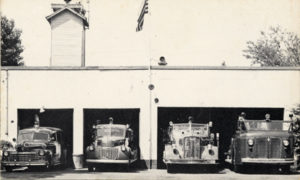
The photograph above is the Clarendon Volunteer Fire Department building and trucks, ca. 1951.

What About You?

What are your memories regarding Arlington’s Fire Department or large fires in your neighborhood?

October 6, 2011 by Web Editor Tagged With: local history news

Arlington Public Library Remembers

Post Published: September 6, 2011

Where were you on Sept. 11, 2001?

As the 10th anniversary of this epochal moment approaches, I find myself reflecting back on the day and its aftermath. My memory plays like a movie. It was a day just like any other canopied by an improbably blue sky.

My walk to work, a stop for carryout coffee, waves to store owners, a chat with two moms about my eldest son’s high school application process, arrival at the office around 8:30 a.m. Within minutes, a colleague stops in my doorway to announce that a plane has crashed into one of the towers of the World Trade Center. My first thought: a small aircraft, horribly off course. I get to the nearest television: a second plane hits the second tower. Fast forward: other planes, rumors of fires, explosions. I retraced my steps down the same street—no chats or waves to store owners, now. I retrieved my children from their Capitol Hill school. Our neighborhood eerily quiet. No planes flew overhead; my youngest son screamed as a helicopter broke the wall of silence.

The television and the Internet were vigilant companions, hypnotically replaying the crumbling towers, forming a backdrop to the family discussion. And the unforgettable images: of police and firefighters, of streets filled with fleeing office workers coated in white ash, of the rubble and the detritus of lives uprooted. My movie ends with me on the telephone with friends, some halfway around the world, reminders of the grace of humanity in the face of indiscriminate inhumanity.

The need to understand “why” attends any tragedy. How can we make sense of the incomprehensible; prevent something horrific from happening again? The Greeks created myths to embody their understanding of the world. William Shakespeare told us that past is prologue. Art and science allow us to explicate emotions, share dreams and aspirations, examine human folly, question existence, wonder. And libraries collect and make accessible the fruits of these labors.

Our nation’s founders understood how important free access to information is to a democracy. The Library of Congress received both a book collection and a collecting rationale from Thomas Jefferson. Benjamin Franklin helped establish the Library Company of Philadelphia, the nation’s first lending library. James Madison, author of the First Amendment, gave voice to one of the most important tenets of librarianship, intellectual freedom, when he wrote: “popular Government, without popular information, or the means of acquiring it, is but a prologue to a farce or a tragedy; or, perhaps, both. Knowledge will forever govern ignorance; and a people who mean to be their own governors must arm themselves with the power which knowledge gives.”

While no library has been immune to the aftershocks of the global economic meltdown, the challenges we face as information professionals are not limited to economics. The ubiquity of increasingly affordable mobile technology coupled with the rise of e-media presents exciting opportunities to deliver more content to library patrons where they are. Yet how do we keep up with the demands for both print—newspapers, magazines, books—and e-content? How do we maintain the balance between high tech and high touch so that patrons can help themselves and get help when they need it? How do we ensure patron privacy—and we must—when the more we know about our library users, their tastes and interests, the more helpful we can be? How can we have it all/do it all?

As professionals and managers of an institution dedicated to serving the public good, we will continue to evaluate what we do as we harness new tools and media that paradoxically enable us to connect with others and know more about the world we live in but present unprecedented challenges. The health of our community depends on our commitment to identify, experiment with and pursue the right solutions and balance and so does the health of our democratic way of life.

September 6, 2011 by Web Editor Tagged With: Arlington Years

  • « Go to Previous Page
  • Page 1
  • Interim pages omitted …
  • Page 25
  • Page 26
  • Page 27
  • Page 28
  • Page 29
  • Interim pages omitted …
  • Page 40
  • Go to Next Page »

Footer

About Us

  • Mission & Vision
  • Charlie Clark Center for Local History
  • News Room
  • Get Email Updates

Administration

  • Policies
  • Library Staff
  • Job Opportunities
  • Propose a Program or Partnership

Support Your Library

  • Friends of the Library
  • Giving Opportunities
  • Donating Materials
  • Volunteer Opportunities

Our Mission

We champion the power of stories, information and ideas.

We create space for culture and connection.

We embrace inclusion and diverse points of view.


Download the Library App

Download the Library App

Arlington County | Terms & Conditions | Accessibility | Site Map
· Copyright © 2026 Arlington County Government ·