• Skip to primary navigation
  • Skip to main content
  • Skip to footer

Alert

Update: Elevator outages, maintenance and upgrades at Central Library More Info

Home - Arlington County Virginia - Logo
MENUMENU
  • Join Now
  • My Account
    • Login
    • My Checkouts
    • My Holds
    • My Lists
    • My Reading History
    • About Borrowing
    • About Holds
    • About My Account
  • Hours & Locations
    • All Hours & Locations
    • Holiday Closings
  • News
    • Library News
    • Director's Blog
    • Get Email Updates
  • Contact Us

Arlington Public Library

MENUMENU
  • Search
  • Collections
  • Library Services
  • Events
  • Community Engagement
  • Join Now
  • My Account
    • Login
    • About Borrowing
    • About Holds
    • About My Account
  • Hours & Locations
    • All Hours & Locations
    • Holiday Closings
  • News
    • Library Blog
    • Get Email Updates
  • Contact Us

Web Editor

The Birth of the Internet: in Arlington and at the Library

Post Published: May 17, 2011

On Tuesday, May 17, the Arlington County Board honored the founders of ARPANet, which we now see as the beginning of the internet and the World Wide Web. As described on the County NewsRoom:

These scientists [who are being honored] worked, at the time, in Arlington, for ARPA -- the Advanced Research Projects Agency. ARPA later became DARPA, the Defense Advanced Research Projects Agency. Their work has had a profound effect on how we work and how we conduct our private lives.

Library staff demonstrated the Internet for
Senator Robb, Rep. Moran and County
Board Vice Chairwoman Ellen Bozman in 1995

But did you know that Arlington Public Library was also at the forefront of  implementing the internet in Arlington County? In August of 1995, with the help of a LibraryLINK grant, we installed our first internet terminals at Central - becoming the 3rd public library in Virginia to offer free Internet. According to an early Navigating the Internet at Arlington Central Library guide:

Arlington was one of eight libraries chosen to receive grants from MCI in the first year of their LibraryLINK community initiative to bring the information superhighway to "Main Street, USA." Grant money was used to install two public and one reference Internet workstation at Central Library for one year.

And in 1997, Arlington County's 'new and improved' website was launched (with explanation and help from Librarian Elizabeth Fry).
May 17, 2011 by Web Editor

Where is my Civil War Ancestor’s Camp?

Post Published: May 4, 2011

Union soldiers in Arlington wrote from geographic locations such as Arlington Heights and Hall's Hill. While the forts in the defenses of Washington are well-documented and photographed, it can be difficult to find information on temporary camps and hospitals. State and local historical organizations help piece together the "puzzle" of a Civil War ancestor's life after consulting on-line photographs and other sources available through the Library of Congress and National Archives and Records Administration.

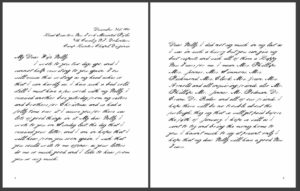
For example, on December 31, 1861, Iselin Roberts of the 4th NY Cavalry wrote a letter to "My Dear Wife Nelly" from Camp Hunters Chapel. Information from the Arlington Historical Society website http://www.arlingtonhistoricalsociety.org  and Arlington United Methodist Church historian Sara Collins locates this camp at Glebe Road and Columbia Pike, at the site of the Hunter's Chapel Methodist Church. The Union Army established a camp and appropriated church building materials. Hunters Chapel's successor, Arlington United Methodist Church, is two blocks away.

The New York State Museum and Veteran's Research Center website has a regimental history of the 4th NY Cavalry's service, including their journey to Fairfax Court House and onward to the First Battle of Bull Run/Manassas, and the writings of Gustavus Asche-Berg, "This Sorrowful War: A Veterinary Surgeon in the 1862 Shenandoah Valley Campaign."

Another New York regiment stationed at Hunter's Chapel, the 8th NY Infantry, also known as the German Rifles or Blenker's Division, was made up of German immigrants. The aristocratic military veterans of European wars in Blenker's Division impressed General-in-Chief George McClellan with their drilling practices and neat campsites. A book owned by Arlington Central Library, The Soldier's Pen: Firsthand Impressions of the Civil War by Robert E. Bonner contains soldiers' writings and drawings from the Gilder Lehrman Collection of New York City. A unique drawing of Camp Hunter's Chapel and drawings of other Northern Virginia locations by Private Henry Berckhoff of the 8th NY German Rifles can be found in this book and in a virtual exhibit on the Digital History website of the University of Houston.

What about you?

Do you have a Civil War ancestor who came to Arlington? Do you know of documents or images of the Civil War in the Northern Virginia area? The Virginia Room wants to know.


Transcribed text of letter from Iselin Roberts to wife Nelly

December 31, 1861
Headquarters New York Mounted Rifles
4th Calvary N.Y. Volunteers
Camp Hunter's Chapel, Virginia

My Dear Wife Nelly,

I wrote to you two days ago and I cannot help writing to you again. You will excuse the writing as my head aches so I can hardly see I have such a bad cold still I must have a few words with my Nelly. I received an nother Box yesterday from my Sisters and Brothers for Christmas and we had a jolly time over it I assure you for there was lots of good things in it. My Dear Nelly, I wrote to you on Sunday last the day that I received your letter and I am in hopes that I will hear from you soon again. I wish that you could write to me often as your letters do me so much good, and I like to hear from you so very much.

Dear Nelly, I did not say much in my last as I was in such a hurry but you can give my Best Respects and wish all of them a Happy New Years for me. I mean Mrs. Phillips, Mrs. Jenner, Mrs Simmons, Mrs. Richmond, Mrs. Clark, Mrs. Green, Mrs. Arnold and all inquiring friends, also Mr. Phillips, Mr. Jenner, Mr. Rodman, Dr. Crane, Dr. Baker and all of your friends. I hope there will be no trouble about the Furlough, they say that we will get paid the fifth of January. I hope we will as I want to try and bring the money home to you. I haven’t much to say at present, only I hope that my dear Nelly will have a good New Years.


Bibliography

  • Arlington Historical Society website http://www.arlingtonhistoricalsociety.org
  • Bonner, Robert E., The Soldier's Pen, Firsthand Impressions of the Civil War, New York: Hill and Wang, 2006.
  • Cooling, Benjamin Franklin III, Owen, Walton H. II, Mr. Lincoln's Forts: A Guide to the Civil War Defenses of Washington, Lanham MD: Scarecrow Press, 2010.
  • Digital History, University of Houston website: https://www.digitalhistory.uh.edu/ Virtual Exhibitions: Watercolor Sketchbook by Henry Berckhoff 8th NY German Rifles, Gilder Lehrman Collection GL1606 p.6 Morning Scene at Camp Hunter's Chapel, October 1861.
  • Gernand, Bradley E., A Virginia Village goes to War: Falls Church during the Civil War, Virginia Beach, VA: Donning Co. Publishers, 2002.
  • Gilder Lehrman Collection website: http://www.gilderlehrman.org
  • New York State Museum and Research Center https://nysm.nysed.gov/research-collections
  • Virginia Room Newsclipping Files – Civil War - Various categories Includes notes by Arlington United Methodist Church Historian Sara Collins, U.S. Sanitary Commission list of camps, lists of many Union regiments in Arlington.

May 4, 2011 by Web Editor

From Our Back Pages: All Work and No Play

Post Published: May 3, 2011

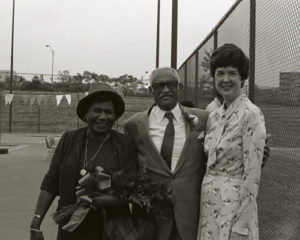
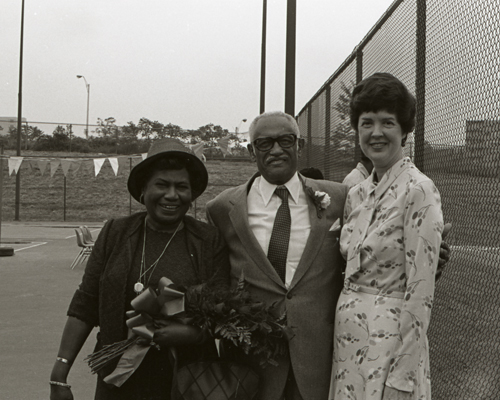
Earnest E. Johnson with his wife Mignon (left)
and an unknown friend in 1982

In 1949, Arlington established a formal Department of Recreation for the rapidly growing and developing county.

However, the classes, clubs and activities sponsored by the department mirrored the school system and were segregated.

In 1950, a formal “Negro Recreation Section” was created “with a special emphasis on sports.” Its director was Ernest E. Johnson, who was a central figure for African-Americans in Arlington who wished to participate in the Department’s programs.

Read more about Ernest E. Johnson and the eventual desegregation of the County’s Recreation Department on Our Back Pages.

May 3, 2011 by Web Editor

Our Back Pages: Walker Chapel

Post Published: April 2, 2011

Walker Chapel
Home to one of the earliest church congregations in Arlington County, the unique history of Walker Chapel is that of both change and tradition.

Located at the present address of 4102 North Glebe Road, the original Walker Chapel was built in 1871, six years after the end of the Civil War, and only a year after the end of Arlington County’s occupation by the Union Army.

April 2, 2011 by Web Editor

Walker Chapel

Post Published: April 1, 2011


Home to one of the earliest church congregations in Arlington County, the unique history of Walker Chapel is that of both change and tradition.

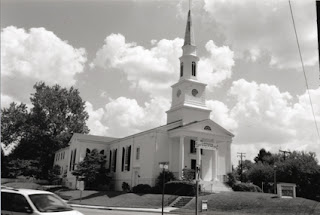
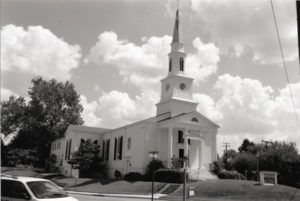
Located at the present address of 4102 North Glebe Road, the original Walker Chapel was built in 1871, six years after the end of the Civil War, and only a year after the end of Arlington County’s occupation by the Union Army. Initially a junior church of the Mount Olivet Circuit, the chapel was situated on land donated by Robert and James Walker, whose father David Walker was buried in the adjacent Walker (Family) Grave Yard. The original building was a single room frame structure with a small belfry and basement, seated near the upper part of the graveyard. A new church was built at the opposite end of the cemetery in 1903, with further additions taking place in 1952 and 1954, including the construction of an education and administrative building. The original chapel continued to be used for Sunday School classes prior to its demolition in 1930. The photograph above was taken in August, 1996, before the extensive renovations of 1999; the result is the stately white brick church that stands today.

What about you? Have you been to Walker Chapel? We’d love to hear from you.

April 1, 2011 by Web Editor Tagged With: local history news

All Work and No Play

Post Published: March 1, 2011

In 1949, Arlington established a formal Department of Recreation for the rapidly growing and developing county. However, the classes, clubs, and activities sponsored by the department mirrored the school system and were segregated. In 1950, a formal "Negro Recreation Section" was created "with a special emphasis on sports." Its director was Ernest E. Johnson, who was a central figure for African-Americans in Arlington who wished to participate in the Department's programs.

Johnson expanded the Negro Recreation Section to include classes for children in not only a variety of sports, but dance, theater, and music (including accordion classes), and community events like teen beauty pageants and parades. He was forward-thinking, documenting many of these activities in the early to mid-1950s with professional photographs; a collection of 78 of these images are held in the Community Archives. Johnson oversaw the development of Jennie Dean field and a new recreation center at Hoffman-Boston on S. Queen St. This center later became known as the Carver Center. Johnson's activities stretched beyond the Department of Recreation. He was the leader of Arlington's first African-American Cub Scout Pack (#589), chartered in April of 1952.

For the 1962-1963 fiscal year, the Negro Recreation Section was quietly changed to the Carver Section, with Johnson still as its supervisor. In 1964, the Negro Recreation Section disappeared in a department reorganization; Johnson became Supervisor of the Centers Section, overseeing "teen clubs, free classes, and meetings of non-Department sponsored clubs in the centers." With no fanfare at all, the county's Department of Recreation had become desegregated and Johnson was integrated into the department's existing administration.

Ernest Johnson continued to serve Arlington County, and on May 8, 1982, Arlington celebrated Ernest E. Johnson Day with a parade that ran from the Walter Reed Recreation Center to the Carver Recreation Center, a softball game that afternoon, a senior tea and a testimonial dinner that evening. A photograph from the event, showing Johnson (center) and his wife Mignon (left) is shown above. Johnson died in December 1992, after a life to service to the people of Arlington; his work let Arlington play.

What About You?

What are your memories of Arlington's Department of Recreation: classes, clubs, parks, and fields? We want to hear from you!

March 1, 2011 by Web Editor Tagged With: local history news

From Our Back Pages: Seag- WHO?

Post Published: February 4, 2011


Reserve Hill and George Saegmuller

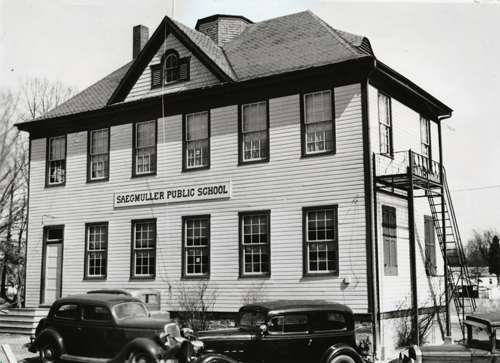
George Nicholas Saegmuller was a native of Germany who came to live in Washington in 1870. He was an inventor of scientific instruments including the Seagmuller Solar Attachment for use in surveying and a telescopic bore sight for heavy naval guns.

Saegmuller married Maria Jane Vandenberg {h} of “Reserve Hill” on Little Falls Road, and they lived in the family home there with Mrs. Saegmuller’s parents, eventually inheriting the property. The house is currently owned by the Knights of Columbus who use it as a meeting hall and headquarters.


February 4, 2011 by Web Editor

The Lyon’s Den

Post Published: January 9, 2011

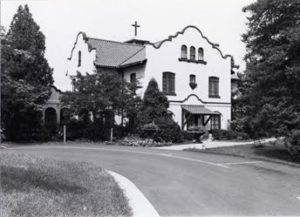
Lyonhurst, or Missionhurst as it is now known, is a Spanish Mission-style stucco house originally built in 1907 as a residence for Frank Lyon, an early developer in the County.

Lyon had traveled a great deal and was influenced by the Spanish missions he had seen in the American West. The house was built with large porches to catch the breeze in the hot summer weather, and he built a water tower on the property in the same Spanish style. The Lyon family was also one of the first to have electricity in the County. The house currently serves as the headquarters for the Immaculate Heart Mission Fathers.

Frank Lyon was a lawyer and social reformer who was the editor and later publisher of the Alexandria County Monitor. It was through this newspaper that he waged a campaign against the lawlessness that was rampant in the Rosslyn and Jackson City areas of the County in the early part of the 20th century. Lyon was also a prominent developer intent upon establishing the area as a residential community and who promoted increasing the powers of local government to thus broaden and strengthen the ability of the County to protect its citizens.  He developed additions to Clarendon and later developed both Lyon Park and Lyon Village.

What About You?

Do you have memories of the development of Lyon Park or Lyon Village?


January 9, 2011 by Web Editor

Too Cool for Yule: 3rd Annual Holiday Tunes from the Director, Part 3

Post Published: December 20, 2010


Director's Blog

And now we bring you the last part of the Library Director’s annual “Don’t Touch That Dial” holiday-music blog post, designed to chase the dark away.

2010, PART 3….

17. Happy Xmas (War Is Over) by John Lennon, The Harlem Community Choir, Yoko Ono & The Plastic Ono Band, from John Lennon & Yoko Ono Power to the People – The Hits (Remastered) 2010
John Lennon’s death is right up there with the Kennedy Assassination as two of the defining events of my life. Never a fan of Yoko (she broke up the Beatles)

18. A Holly Jolly Christmas by Burl Ives, from Have a Holly Jolly Christmas 1965
Good songs, goofy animation, grrrrreat characters: Hermey, the elf who wants to be a dentist, Yukon Cornelius, Charlie in the Box and his pals on the Island of Misfit Toys. CLASSIC!!!
[youtube=http://www.youtube.com/watch?v=sooHzHHh4kM?fs=1]

19. God Bless The Master, from Folk Songs Of The Four Seasons
. Folk poetry that blesses the Master, the Mistress, the House and Cattle, too. Powerful in its simplicity, the song closes every performance of Revels, a national arts organization founded in 1971 by musician, educator and author John Langstaff to celebrate the seasons through the power of traditional song, dance, storytelling and ritual from cultures around the world.

20. Santa’s Got a Brand New Bag by The Bobs, from Too Many Santas
The a cappella Bobs salute “the hardest-working man in show business, the great James Brown (May 5, 1933 – December 25, 2006).
[youtube=http://www.youtube.com/watch?v=5Ss0ww5o_8A?fs=1]

Bonus Tracks in Honor of Holiday Feasting

21. Nobody’s Fat in Aspen Christine Lavin, from Future Fossils 1984
Neo-folkie Lavin reveals the shallow, fallow under-girding the beautiful people. But it’s not a downer when sung by Lavin’s chirpy, quirky soprano. It makes the list because it references snow. And skiing.

22. He’s a Chubby Little Fellow by The Singing Cowboy Gene Autry, from Rudolph the Red Nosed Reindeer and Other Christmas Classics 2003
Creator of the Cowboy Code (“a cowboy must keep himself clean in thought, speech, action and personal habits”), Autry was famous for his Christmas classics, the most famous of which is the aforementioned Rudolph. But I liked this one better.
[youtube=http://www.youtube.com/watch?v=pCdcT_DY7ew?fs=1]

December 20, 2010 by Web Editor Tagged With: yule blog

Too Cool for Yule: Holiday Tunes from the Director, part 2

Post Published: December 19, 2010

This week we bring you the Library Director's annual “Don’t Touch That Dial” holiday-music blog post, designed to chase the dark away.

PART 2....

9. Angels We Have Heard On High by Indigo Girls from Holly Happy Days
Girls with guitars who have known each other since grade school and whose voices blend like a yogurt smoothie.

10. Santa Claus Is Coming To Town by The Pointer Sisters from A Very Special Christmas 1987
Silly, sassy and so much fun.

11. Have Yourself a Merry Little Christmas by Eddie Higgins Christmas Songs 2005
This year’s pick of my favorite Christmas pop song.

12. Greensleeves by Paul Desmond & The Modern Jazz Quartet
Recorded on Christmas Day 1971, by Paul Desmond and the Modern Jazz Quartet, the first and only time they played together.

13. The Christmas Waltz (Sammy Cahn/Jule Styne) by Peggy Lee from Christmas Carousel, 1960
For those who might remember only her woozy sounding pop charter of 1969, “Is That All There Is?", Peggy Lee (March 26, 1920 – January 21, 2002) was an American jazz and popular music singer, songwriter, composer and actress in a career spanning nearly seven decades. This track was recorded in 1960, at the height of her popularity.

14. Silver Bells by Dean Martin, from My Kind of Christmas, issued 2009
Okay, I needed someone to represent the SammyPerryAndyTonyBingFrankSteveandEdie spectrum, and settled finally on Dino, whose boozy on stage persona eclipsed a croony, real life hipness. Warm and easy; a recording that’s amore.

15. I've Got My Love to Keep Me Warm by Jo Stafford, from Happy Holidays - I Love the Winter Weather (Re-mastered)
I love, love LOVE Jo Stafford. Play this in any kind of weather. Repeatedly.

16. Last Christmas by Wham! From Music from the Edge of Heaven 1986
Before there was George Michael, paparazzi fodder, there was Wham, his and Andrew Ridgeley’s revival of teen pop. A great song; give it to someone special.


Stay tuned for Part 3, coming Monday night...

December 19, 2010 by Web Editor Tagged With: yule blog

  • « Go to Previous Page
  • Page 1
  • Interim pages omitted …
  • Page 27
  • Page 28
  • Page 29
  • Page 30
  • Page 31
  • Interim pages omitted …
  • Page 40
  • Go to Next Page »

Footer

About Us

  • Mission & Vision
  • Charlie Clark Center for Local History
  • News Room
  • Get Email Updates

Administration

  • Policies
  • Library Staff
  • Job Opportunities
  • Propose a Program or Partnership

Support Your Library

  • Friends of the Library
  • Giving Opportunities
  • Donating Materials
  • Volunteer Opportunities

Our Mission

We champion the power of stories, information and ideas.

We create space for culture and connection.

We embrace inclusion and diverse points of view.


Download the Library App

Download the Library App

Arlington County | Terms & Conditions | Accessibility | Site Map
· Copyright © 2026 Arlington County Government ·