• Skip to primary navigation
  • Skip to main content
  • Skip to footer

Alert

Holiday: All library locations closed Fri., June 19, for Juneteenth. More Info

Alert

Update: Elevator outages, maintenance and upgrades at Central Library More Info

Alert

Storytimes Will “Take a Nap” through June 20 More Info

Home - Arlington County Virginia - Logo
MENUMENU
  • Join Now
  • My Account
    • Login
    • My Checkouts
    • My Holds
    • My Lists
    • My Reading History
    • About Borrowing
    • About Holds
    • About My Account
  • Hours & Locations
    • All Hours & Locations
    • Holiday Closings
  • News
    • Library News
    • Director's Blog
    • Get Email Updates
  • Contact Us

Arlington Public Library

MENUMENU
  • Search
  • Collections
  • Library Services
  • Events
  • Community Engagement
  • Join Now
  • My Account
    • Login
    • About Borrowing
    • About Holds
    • About My Account
  • Hours & Locations
    • All Hours & Locations
    • Holiday Closings
  • News
    • Library Blog
    • Get Email Updates
  • Contact Us

Web Editor

Too Cool for Yule: 3rd Annual Holiday Tunes from the Director, in 3 Part Harmony

Post Published: December 18, 2010


Director's Blog

This week we bring you the Library Director’s annual “Don’t Touch That Dial” holiday-music blog post, designed to chase the dark away.

PART 1….

1. The Gloucestershire Wassail by Waverly Consort, from A Waverly Consort Christmas: Christmas From East Anglia To Appalachia –
What holiday is complete without some good old, wassailing? Take some apples, add some sugar and spice and you end up with something hot and nice.
[youtube=http://www.youtube.com/watch?v=SrZnZ6MZtVA?fs=1]

2. I Wonder As I wander/Noëls Anciens and
3. Coventry Carol by Musica Intima, from Nativité
Two a cappella classics from a Vancouver based ensemble. Breathtakingly beautiful.

4. Angelus Ad Virginem by The Boston Camerata, from Sing We Noel
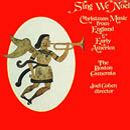
Founded the year of my birth, Boston Camerata is one of the oldest early music ensembles in the United States. The song is a medieval carol, with text that is a poetic version of the Hail Mary. Interesting Factoid from Wikipedia: AAV was the first piece of music sung at the annual Bracebridge Dinner, a lavish Christmas feast held for many years at the Ahwahnee Hotel in Yosemite National Park. The song, sung as the guests entered the dining room, was selected by Ansel Adams in 1929, who was director of the pageant at that time.

5. Good People All by Anonymous 4, from Wolcum Yule – Celtic and British Songs and Carols.
Luminous and pure in tone. Play repeatedly.

6. Zat You Santa Claus? by Buster Poindexter and His Banshees of Blue, from How Cool Is That Christmas
In which Buster Poindexter (alter ego of frontman David Johansen, of glam band New York Dolls fame) channels Louis Armstrong (August 4, 1901 – July 6, 1971), fabled New Orleans trumpeter and titanic entertainer.
[youtube=http://www.youtube.com/watch?v=aP8C_SUKQbs?fs=1]

7. Winter Wonderland by Aretha Franklin, from How Cool Is That Christmas
‘Retha swings in this 1964 rendition of the timeless classic. Sleigh bells ring. Are you listenin’???
[youtube=http://www.youtube.com/watch?v=svm0K7ykYbA?fs=1]

8. Good King Wenceslas by John Fahey, from Christmas Guitar, Vol. 1 1982
Local (Takoma Park, MD) folkie, bluesman and acoustic guitar innovator, John Fahey (February 28, 1939 – February 22, 2001) picks apart this medieval carol and creates an off brand holiday classic. A must in any serious music collection, holiday or otherwise.

And this is just the start of of 2010’s Yule Tunes from the Library Director’s collection! Check back on Monday and Tuesday for Part 2 and Part 3…
December 18, 2010 by Web Editor Tagged With: yule blog

Arlington’s Friday Night Lights

Post Published: November 2, 2010

Arlington and Fairfax have a football rivalry that goes back many years!

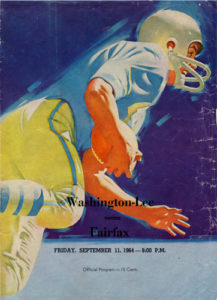
The insert to the game program for the Washington-Liberty (formerly Washington-Lee) Generals/Fairfax Rebels football game on Friday, Sept. 11, 1964, reads:

“The Generals are defending their Northern Virginia Championship tonight when they come up against their first and one of the toughest teams of the season – the Fairfax Rebels.

“Fairfax’s 18 returning lettermen that helped leave last year’s game scoreless will be W-L’s biggest headache. General Coach John Youngblood also feels Fairfax is going to have the heaviest team in the league.

“Coach Youngblood claims that depth is the team’s problem and that he will be depending on half a dozen men to play both ways… [b]ut Coach Youngblood is optimistic about the whole thing. ‘We will beat them if we can manage to get more points.'”

What About You?

What are your Arlington high school football memories? We want to hear from you!

November 2, 2010 by Web Editor

Haunted Arlington: Arlington’s X-files, Pt. 2

Post Published: October 1, 2010

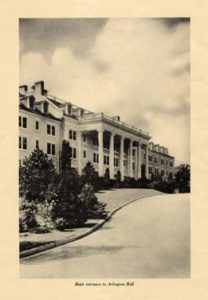
With Halloween lurking just around the corner, it seems only appropriate that we should rummage through some of Arlington’s own “X-Files” and blow the dust off of an incident alleged to have happened at Arlington Hall, a girls finishing school turned intelligence post.  Though anecdotal in nature, this recollection from an anonymous military policeman has much more detail than is the norm and is a fascinating story.

One evening, while on patrol, the policeman overheard various discussions on his police radio about a number of odd occurrences in a certain building. In fact, the building was one in which the policeman himself had previously heard strange noises while on duty. During the course of the evening, MPs assigned to the first floor desk in the building were hearing footsteps from the floor above. The footsteps had the characteristics of a person walking on a hard, wooden floor, and then stepping onto a carpeted, softer surface. After a supervisor was summoned to the scene, this activity was heard again, causing the supervisor and additional personnel to investigate the second floor, to no avail. At the same time, a second patrol which was en route to the scene, noticed what appeared to be a female figure clad in a floral print dress who repeatedly entered and exited an upstairs ladies bathroom, pausing to regard her reflection in front of a mirror. After observing this behavior, the patrol notified the MPs at the downstairs service desk, who again investigated the area in which this activity is alleged to have taken place, with a similar lack of results.

One would think that all of this is mysterious enough, but, it was later learned that the building in which this incident occurred was rumored to have been haunted by the ghost of a young woman from the time when Arlington Hall was a girls finishing school. Supposedly, after becoming pregnant by a stable hand, the young woman took her life out of fear of the embarrassment and shame that it would have brought to her family.

What about you?
Do you have a spooky tale to tell? Tell us about any hauntings or mysterious occurrences that you have encountered in Arlington.

October 1, 2010 by Web Editor

Clarendon Circle

Post Published: September 3, 2010

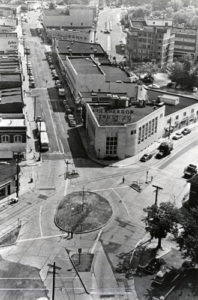
One of the busiest areas of Arlington can be found in Clarendon, where Washington Boulevard, Wilson Boulevard and Clarendon Boulevard all meet. In the early 1900s, the presence of the trolley in Clarendon led to an outgrowth of merchants and businesses in that neighborhood.

Although the names, owners and buildings themselves may have changed over time, what has remained constant is the steady parade of shoppers, pedestrians, and commuters that flock to the businesses and restaurants in Clarendon. Long before malls and multiplex cinemas became the mainstays of the present day consumer, customers packed the Ashton Theater, Little Tavern, Sears, and numerous other businesses in Clarendon.

Clarendon Circle was conceived around the time of the onset of World War I, when a parcel of land donated by Arthur J. Porter was used to make the circle.  Sometime in the late 1920s-early 1930s, the American Legion began construction on a War Memorial Monument in the center of the circle, supposedly using stones from a retaining wall from the Tomb of the Unknown Soldier, which was being dismantled at that time. After its dedication on November 11, 1931, the memorial remained at Clarendon Circle until 1940, when concerns about the structure being a possible traffic hazard resulted in its relocation to the Court House that same year. Eventually, in 1986, the memorial was returned to a spot very near its original location.

September 3, 2010 by Web Editor

Summertime and the Listening is Easy

Post Published: July 30, 2010

Summer’s here. . . I’m for that. Got my rubber sandals, got my straw hat.

Schools out for summer. Schools out. For. Ever. And the livin’ is easy. Can you surrey? Can you picnic?? You’re gonna need an ocean of calamine lotion. Good day sunshine; gonna make our own lighting. We’re barefootin; hot summer streets and the pavements are burning.


I sit around trying to smile but the air is so heavy and dry; back of my neck getting dirty and gritty. Well I feel that burning flame. Has high blood pressure got a hold on me? Went to the fortune teller to have my fortune read. Well there ain’t no cure for the summer time blues. Girls comb their hair in the rear view mirrors. I really dig those styles they wear. They`re out there a`havin` fun in that warm California sun.

The heat of the day begins to die; the faintest breeze comes drifting by. My fickle friend the summer wind.

Hot fun in the summertime. Sail on Sailor. Here are my favorite summer tunes:

1. School’s Out – Alice Cooper
2. Hot Fun in the Summer Time – Sly and the Family Stone
3. Stoned Soul Picnic – Laura Nyro
4. Summer in the City – Lovin’ Spoonful
5. Summertime Blues – Eddie Cochran
6. Cherry, Cherry – Neil Diamond
7. Heatwave – Martha Reeves and the Vandellas
8. Fortune Teller – Rolling Stones
9. Cruel Summer – Bananarama
10. Summer’s Here – James Taylor
11. Good Day Sunshine – Beatles (but you still can’t legally download them. Here’s “The Hit Crew”)
12. Starless Summer Night – Marshall Crenshaw
13. The Summer Wind /Madeleine Peyroux
14. Summertime – featuring Anita Baker, Cyrus Chestnut
15. California Sun – Dick Dale
16. California Girls – David Lee Roth
17. Poison Ivy – Coasters
18. Sail on Sailor – The Beach Boys
19. Barefootin’ – Wilson Pickett
20. Born to Run – Bruuuuuuuuuuuuce

Bonus: Popsicle – Jan and Dean

July 30, 2010 by Web Editor

Reed-Westover Project Earns Gold LEED Certification

Post Published: July 26, 2010

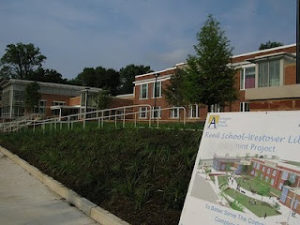
The Reed-Westover facility, new home of the Westover Branch Library, has been awarded Gold Certification in the Leadership in Energy and Environmental Design (LEED) program by the U.S. Green Building Council (USGBC).

In order to achieve a gold rating, buildings needs to receive 39 LEED points, through addressing issues of water efficiency, energy and atmosphere, materials and resources, and indoor environmental quality. The Reed Westover facility received 40 points from the USGBC.

The project also preserved a portion of the original brick school building. Although not part of the final LEED rating determination, reusing existing structures is one of the “greenest” techniques available as it reduces construction waste and eliminates the need to use new construction materials.

Read more about this great green honor, and the design and building strategies that were utilized.

July 26, 2010 by Web Editor

"An Arlington Entrepreneur"

Post Published: June 29, 2010


According to an article in the American Business Review in December 1929, Ruby Lee Minar was the “most successful woman in realty development in the country”: high praise at a time when there were few women in the workforce, much less in a profession dominated by men.

Ruby Lee was born in Montana in 1883 to a Baptist clergyman and his wife. They moved several times during her childhood and it is said that when her father was unable to officiate at Sunday morning services, Ruby Lee preached the sermon for him. She received her B.A. from Kalamazoo College and also received a Master’s Degree from the University of Chicago. She taught public speaking for a time and was chosen as Chair of the Women’s College Section of the Women’s Suffrage Party for the state of New Jersey. After marrying John Milton Minar, the couple settled in Washington, D.C. and it was there that her profession changed from teacher to real estate developer and entrepreneur.

At the close of WWI, Mrs. Minar had a savings account of only $200 in Liberty Bonds.  However, she invested the bonds in lots in Chevy Chase, MD, and four years later purchased a 400 acre tract in the County Club section of Arlington, naming it Lee Heights. She then successfully developed a three million dollar subdivision project and later went on to develop a number of other subdivisions. She accurately foresaw the time when Arlington would become a bedroom community of DC, and at one time her real estate office was the largest in the area.

Ruby Lee was elected the first president of the National Soroptimist Club in 1928. Soroptimist International is a worldwide organization for women in management and professions, working through service projects to advance human rights and the status of women. Today the Ruby Award, which honors women who are making extraordinary differences in the lives of other women, is named in her honor.

The Virginia Room holds the papers of the local Soroptimist Club, which is no longer active. The photograph above is of a parade in Lee Heights, circa 1950.

What about you?
Do you have memories of Lee Heights? We want to hear from you!

June 29, 2010 by Web Editor

George McQuinn: Arlington’s All-Star

Post Published: May 27, 2010

He has no plaque in Cooperstown and you won’t find a hometown field with his name. But back in the day, George Hartley McQuinn of Arlington, Va. could pick it with the best of them.

In 1938, just his first full season in the big leagues, he hit safely in 34 straight games for the lowly St. Louis Browns. Later, he hit .304 while playing for the New York Yankees.

Born in 1910, George McQuinn was a seven-time All-Star and a major leaguer for 12 years.  He helped win two American League pennants and a world championship ring as the unlikely spark for the 1947 Yankees. And at the end of each season, he came home to Arlington, where as a boy living near modern-day Ballston, George played ball with his five brothers. He was even named the first captain of the Washington-Lee baseball team.

Just before his final season in the big leagues, George bought himself a sporting goods store back home at 1041 N. Highland St. in Clarendon, gave it the winning brand “McQuinn’s,” and took an active role in running the place. He returned to the store for a year after his retirement following the 1948 season, but baseball wasn't finished with him yet. George managed various minor league teams, winning four championships with the Braves in Quebec. As time went on, he accepted part-time scouting positions for the Braves and then the Washington Senators while spending more time at his store and writing a concise but thorough “Guide to Better Baseball.”

Clarendon's downturn in the 1960s forced McQuinn to close his store, and he finally left baseball in 1972. He moved to Alexandria and became an apartment manager, spending more time with his family. George McQuinn died following a stroke on Christmas Eve 1978. He was 68 years old.

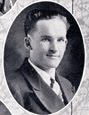
McQuinn was never voted into Cooperstown. But in the last spring of his life, he was inducted into the Virginia Sports Hall of Fame in Portsmouth. His official photograph shows him wearing the Yankees uniform.

To learn more about George McQuinn, read the full original article by Peter Golkin (from which the above local history blog post was adapted):

Arlington’s All-Star--George McQuinn

He has no plaque in Cooperstown and you won’t find a hometown field with his name. But back in the day, George Hartley McQuinn of Arlington, Va. could pick it with the best of them. Kids bought first basemen’s mitts bearing his name. And his bat also made an impression. In 1938, just his first full season in the big leagues, he hit safely in 34 straight games for the lowly St. Louis Browns.

George McQuinn was a seven-time All-Star and a major leaguer for 12 years.  He helped win two American League pennants and a world championship ring as the unlikely spark for the 1947 Yankees. And at the end of each season, he came home to Northern Virginia.

Born on May 29, 1910, McQuinn grew up learning the game on various fields around then-“Alexandria County.” One makeshift diamond required shooing cows from the Lacey pasture north of Washington Boulevard and west of Buchanan Street. More ball could be found on the future site of the Parkington Shopping Center, later Ballston Common.

“Baseball became my life very quickly,” McQuinn told the Washington Post’s Bob Levey in 1976. “We never had nine guys, only about seven or eight, but that didn’t make any difference. I used to play all spring and summer and go hunting and fishing all fall and winter. The other kids used to say, ‘You’re going to be a big leaguer.’ And I knew it in my heart.”

While George and his five brothers played in and around their Ballston neighborhood, their father was always somewhere nearby, driving the Fairfax-to-D.C. line for the Washington & Dominion rail line. Football and basketball also filled out the days but by high school, McQuinn’s grace in the field and at the plate stood out. He was named the first captain of the Washington-Lee baseball team.

Topping out at 5 foot 11 inches and about 165 pounds, McQuinn made up for average size with an impressive physical discipline and natural ease. Soon after graduation, he hit the semi-pro leagues and caught the eyes of Yankees scouts as a potential heir to another leftie, Henry Louis Gehrig.

“The Yankees were so much richer and better run than the rest of the teams,” McQuinn remembered. “I wouldn’t have minded playing in Washington before the home folks, but New York was kind of the ultimate. And everybody knew about Gehrig, oh, my yes.”

His contract with New York meant sharpening his game in farm towns like Wheeling, Albany, Binghamton and Scranton. But despite consistently hitting above .300, McQuinn couldn’t gain much traction toward reaching the Bronx. He was never even invited for a look at Yankees spring training. Why bother since the “Ironhorse” Gehrig would no doubt play day-after-day, season-after-season?

“I should have said sell me or trade me. There was no future in playing minor league ball behind Gehrig. But I didn’t,” McQuinn recalled. “Maybe that’s why when I finally did make the big leagues, it didn’t seem like so much of a thrill.”

Even without a request, the Yankees eventually cut McQuinn loose—twice in fact. Instead of apprenticing in the Bronx, his 1936 major league debut came on a conditional contract with Cincinnati, followed by one more year of promise with the Newark Bears back in the Yankees’ system.

Lacking a first basemen among many things, the St. Louis Browns grabbed McQuinn for 1938. The Yankees hadn’t bothered to protect him on their roster. In that first full rookie year, he rewarded the Browns’ faith hitting .324 along with 42 doubles, second in the American League. He was also second among first basemen in fielding.

By painful coincidence, McQuinn’s 34-game summer hitting streak ended during a trio of back-to-back-to-back doubleheaders in Philadelphia, just before the Browns visited the Bronx. A building cache of publicity for McQuinn was wiped out. At the same time no one, especially the Yankees, could have known that Gehrig had only a few more months left in baseball.

Despite some horrendous Browns season records (55 wins-97 losses in 1938, 43-111 in 1939), McQuinn generally thrived during his St. Louis years. But looking back, he couldn’t shake the trajectory of his career. “We’d finish last every year. I began to think God didn’t intend for me to become a Yankee.”

World War II took many ballplayers overseas, leveling pro fields across the United States. For the Browns in ’44, it meant their one claim to an American League pennant. McQuinn helped lead the way. Known to wear a brace for recurring back pain, he had failed two Selective Service System physicals. And by '44, he was considered too old for military induction. The Cardinals, who also shared Sportsman Park, would win the “Trolley Series” four games to two but McQuinn’s .438 average topped both teams and his would be the only Browns’ homer in Series history. The team became the Baltimore Orioles in 1954.

While George McQuinn spent the war playing ball among what was known as an "all 4-F infield," his younger brother Kenneth served in the Naval Reserves. A ship’s cook, he died  during the June 6, 1944 invasion of Normandy, leaving behind his wife and toddler son back in Arlington. Kenneth Warner McQuinn is among the names on the Clarendon memorial to Arlington’s war dead. Another brother, Army Staff Sgt. Charles McQuinn, was decorated for gallantry in France and Belgium.

At the end of the ’45 season, McQuinn found himself traded to the cellar-dwelling Philadelphia A’s. He later acknowledged being troubled by the Browns playing that year with a one-armed man, Pete Gray, in their outfield. With the A’s, McQuinn was plagued by chronic back pain and an anemic .225 batting average. Upon his release in the fall, A’s manager Connie Mack reportedly suggested: “George, you played one year too long.”

McQuinn was 36 years old, almost a senior citizen in pro ball. That January at their Virginia home, his wife Kathleen asked about spring training just weeks away. “Honey, what are you going to do? Baseball or work?”

McQuinn was jolted. “That word work. It hit me between the eyes,” he remembered.

Cold calls to several clubs failed to generate much interest. Then, saved for last, McQuinn reached out to new Yankees manager Bucky Harris. The aging first baseman would try to close the loop on his old dream of pinstriped glory. With the Bronx Bombers still haunted by the sudden end of the Gehrig era and hobbled by the war years, McQuinn said he knew how to get the Yankees back to the Series for the first time in four years.

As Harris later recalled, “Naturally I asked how and he said, ‘Sign me.’ Now I know McQuinn, and have known him for several years. I figured if he had enough confidence in himself to come to me like that I couldn’t lose trying him.”

McQuinn wouldn’t take the opportunity for granted. “How many times do you get to live a dream?” he asked in 1976. “I prepared for that season like I’d never prepared for anything else.”

Tenacity and dedication paid off in ‘47. McQuinn beat out four others for the starting job at first and hit .304 that year—second-best on the team. He drove in 80 runs and homered 13 times. At one point during the season, the Yankees notched a 19-game win streak. In October, they took a dramatic seven-game Series from the Dodgers. McQuinn made the cover of Sport magazine and writers declared him the “baseball Cinderella story of the year.” Joe DiMaggio said McQuinn was the key to the team.

“I made them forget Gehrig for a while, anyway,” McQuinn reflected later.

His career had almost ended before its remarkable comeback. But McQuinn was now also ready to  prepare for “work”—life after the game. He bought himself a sporting goods store back home at 1041 N. Highland St. in Clarendon, gave it the winning brand “McQuinn’s,” and took an active role in running the place. And he was still a Yankee—a world champion.

The 1948 season came quickly and despite all best hopes, there would be no second straight magical year in New York. McQuinn spent much of the season watching from the dugout. He hit .248 and he drove in just over half the runs of the previous year. His season ended with a failed pinch-hit appearance in Fenway Park. The defending world champions finished third, Harris lost his job and McQuinn was released in October. But it would be a different off-season from the one before.

Satisfied that he had nothing left to prove, McQuinn readily accepted retirement. He had appeared in 1,550 games, had 1,588 hits, a lifetime average of .276 and 135 homers. On the field, there were 13,414 put-outs, 1,074 assists and just 113 errors. Very solid numbers.

He returned to Arlington and the store on Highland full-time—for a year.

With the 1950s came the familiar baseball pangs. Now he would try managing in the minors, returning to familiar towns up into Canada and west to Idaho. In Quebec, where he also manned first on occasion, his Braves won four championships. But as a new decade approached, more time at home became his goal.

McQuinn eased into the part-time life of a scout for the Braves and later the Browns-like Washington Senators. “I knew I would never be a big league manager. I was just too easygoing,” he later told the Post.  With his lifetime of know-how and love for the game, McQuinn reached out to the next generation of coaches and players, writing a concise but thorough “Guide to Better Baseball.”

Northern Virginia kids and their parents still sought out the local celebrity-retailer. Phil Wood, then in grade school and now Washington’s noted baseball historian-broadcaster, recalls his own visit in the early ‘60s:

“George’s sporting goods store in Clarendon was a very short walk from my grandmother’s house. My dad took me in there once and introduced me to him. Now, my dad didn’t really know George McQuinn but George acted like they’d been friends for years. I was still in the single digits, but tall for my age and was actually switching to first base in Little League because of some knee issues. And George talked about how to choose the right mitt, and how much bigger they were than when he played (although they would get still bigger as the years went by). He was obviously a good businessman [and] knew how to charm the customers.”

By the mid-60s, Arlington’s once-vibrant shopping districts like Clarendon faced serious challenges from the new outlying malls. Parking issues, limited space and upkeep took their toll. McQuinn closed his store. A few years later he formally left baseball, retiring in 1972 from a scouting post with the Montreal Expos, Washington’s future Nationals.

McQuinn was living in Alexandria where his business and management skills went to use overseeing an apartment building just on Martha Custis Drive, just south of I-395.  He had time to watch his grandson play Little League and welcomed the occasional chance to talk about his own days on the ballfield.

George McQuinn died following a stroke on Christmas Eve 1978. He was 68 years old.

“I always regretted not looking him up again after the business closed,” Phil Wood says. “Especially when he passed away at a fairly young age. Good player, great glove man, and more of a power hitter than you might expect—lots of extra base hits.”

McQuinn was never voted into Cooperstown. But he was the first inductee of the Arlington Sports Hall of Fame when it was created in 1958 by the county's Better Sports Club. And in the last spring of his life, McQuinn was inducted into the Virginia Sports Hall of Fame in Portsmouth. His official photograph shows him wearing the Yankees uniform.

Do you have a question about this story, or a personal experience to share? 

Use this form to send a message to the Charlie Clark Center for Local History.

Center For Local History - Blog Post Message Form

Do you have a question about this story, or a personal experience to share? Use this form to send a message to the Center for Local History.

"*" indicates required fields

This field is for validation purposes and should be left unchanged.

Share Your Story

May 27, 2010 by Web Editor

Wendell Berry at Arlington Reads – Now with Video

Post Published: May 5, 2010

Watch video of the full program on vimeo.

The Real Deal arrived last night in Arlington.


It wasn’t the Beatles at Shea or Hendrix at Woodstock. Or even the Jonas Brothers at Times Square on New Year’s Eve. But it might have been. For when farmer-writer Wendell Berry slipped through the side door of the Central Library Auditorium, he caused an unprecedented eruption of goodwill and generosity, the likes of which he had never before witnessed. And neither had we.

So the evening began, our fifth annual Arlington Reads main event, presided over by a courtly storytelling philosopher who kept his audience both spellbound and hopeful. His messages were simple: keep faith with yourself, your community, your land—messages that have been lost in the haze of hubris and hucksterism.

He spoke of his influences — Wallace Stegner and other writers of place — and his progress as a writer. And he read from “The Memory of Old Jack” in a voice rich and sonorous, languid and unperturbed, sharing the excerpt about the ambiguity of leaving, the passing of the torch from the seasoned old to the barely formed young, like they did in the communities of bygone eras.

He told us to know and be proud of our space; to ignore what the educators tell us and to be from some place. To know the world through truly knowing what is familiar. To go back to biology, to touch, to feel and to value what is tangible. To stop using too much. To buy local. To exercise leadership from the bottom up. To understand that life is both lucky and luckless, something as a farmer he would know all too well. To know that to feel joy one must also feel pain. To value hard work, to be useful. To have hope, to look within ourselves for the strength and courage to beat back the false idol of bigger/better.

A class act – the real deal.

It has taken us five tries to get here, but with last night’s event we have finally created the Arlington Reads community that we have sought. It just took the right topic, the right persons, the right audiences, and the right time. Last night was absolutely Mr. Berry’s, but both he and Novella Carpenter have helped launch us on this path to transformative civic engagement.

It’s now up to us to look within ourselves and find the means to take the conversations we have been having during this season of Arlington Reads and pursue sustainable actions for the betterment of the whole community of Arlington.

We urge you to join us.

And we now know that one can not go wrong with any brand of Kentucky bourbon.

(Photos can be viewed on the Library’s Flickr collection.)

May 5, 2010 by Web Editor

Infamous Arlingtonian Mary Ann Hall

Post Published: April 30, 2010

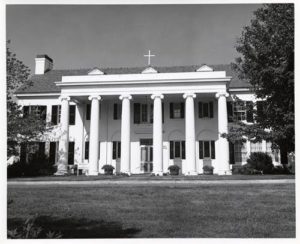
Rixey Mansion, now part of Marymount University, stands on the site of Mary Ann Hall’s country house.


Mary Ann Hall, sister of Bazil Hall, the farmer and slave owner for which Hall’s Hill (now Highview Park) was named, also owned property in Arlington which she used as a summer home and country house. The main building of Marymount University, Rixey Mansion, now occupies the site of Mary Ann’s farmhouse.

Mary Ann was a high-class madam in Washington where she ran a brothel (located at the foot of Capitol Hill) for over 40 years. She bought the lot and had the brothel built to her specifications, a substantial house with four stories containing 25 rooms and a basement.

When the construction for the National Museum of the American Indian began, professional archeologists were called in to interpret the site where her house stood. The results of the excavation showed that the quality of materials at the site was better than that of the surrounding neighborhood. Tableware was expensive and seeds and bones found showed a nutritional diet that included substantial amounts of beef, poultry and fish as well as turtle, and fruits such as coconuts and berries. Also found were dozens of corks and bottles which seemed to indicate Mary Ann’s fondness for champagne.

A successful business woman, in 1853 she was able to purchase a farm in Alexandria County (now Arlington) to which she gradually added through 1869. As she grew older she spent more time at the farm and turned over business matters to her younger sister Elizabeth.

District of Columbia court records show that when she died, Mary Ann Hall was worth $87,000 (about $2,000,000 today) with no debts. A list of her belongings included Belgian carpets, oil paintings, plush red furniture and an ice box as well as a large number of sheets, mattresses, blankets, feather pillows and comforters.

Mary Ann never married, had children or kept a diary. She left no collection of personal letters or business ledgers, so there is little known about her as an individual. However, her obituary in the Evening Star described her as a person of unquestioned integrity and a heart open to “appeals of distress and a charity that was boundless.”

After her death in 1886, she was buried in Congressional Cemetery. The inscription on her grave monument reads:

Truth was her motto
Her creed charity for all
Dawn is coming.

April 30, 2010 by Web Editor Tagged With: local history news

  • « Go to Previous Page
  • Page 1
  • Interim pages omitted …
  • Page 28
  • Page 29
  • Page 30
  • Page 31
  • Page 32
  • Interim pages omitted …
  • Page 40
  • Go to Next Page »

Footer

About Us

  • Mission & Vision
  • Charlie Clark Center for Local History
  • News Room
  • Get Email Updates

Administration

  • Policies
  • Library Staff
  • Job Opportunities
  • Propose a Program or Partnership

Support Your Library

  • Friends of the Library
  • Giving Opportunities
  • Donating Materials
  • Volunteer Opportunities

Our Mission

We champion the power of stories, information and ideas.

We create space for culture and connection.

We embrace inclusion and diverse points of view.


Download the Library App

Download the Library App

Arlington County | Terms & Conditions | Accessibility | Site Map
· Copyright © 2026 Arlington County Government ·