• Skip to primary navigation
  • Skip to main content
  • Skip to footer

Alert

Update: Elevator outages, maintenance and upgrades at Central Library More Info

Home - Arlington County Virginia - Logo
MENUMENU
  • Join Now
  • My Account
    • Login
    • My Checkouts
    • My Holds
    • My Lists
    • My Reading History
    • About Borrowing
    • About Holds
    • About My Account
  • Hours & Locations
    • All Hours & Locations
    • Holiday Closings
  • News
    • Library News
    • Director's Blog
    • Get Email Updates
  • Contact Us

Arlington Public Library

MENUMENU
  • Search
  • Collections
  • Library Services
  • Events
  • Community Engagement
  • Join Now
  • My Account
    • Login
    • About Borrowing
    • About Holds
    • About My Account
  • Hours & Locations
    • All Hours & Locations
    • Holiday Closings
  • News
    • Library Blog
    • Get Email Updates
  • Contact Us

Web Editor

Your Annual 2014 “Too Cool for Yule Blog” Mix

Post Published: December 4, 2014

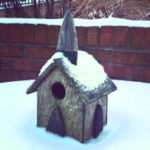
bird house in snow

This “Frozen” time of the year we bring you good cheer…
And queued a set of tunes
you’re just longing to hear.

There are songs to make you happy
and songs to make you dance.
Each lovingly selected by mood
or happenstance.

An unusual mix of carols and hits
We searched across genres to find out what fits.
You’ll find Elvis and Benny, Sufjan (Sufjan?)
and Kay.
We’ve made it easy — you just hit play.

Some pickin’, some new wavin’,
some ballading, some strumming
A swell bunch of cançons traditionals
to get you all humming.
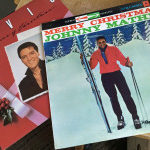
In this season of darkness, remember the light,
that shines bright within each of us and holds back the night.

From our “house” to your house,
we wish you the best.

And thank you for being our
Most Honored Guests.


The “Don’t Touch That Dial” Playlist 2014

Find the complete 2014 list in Spotify

 

Clausula (Domino) – Boston Camerata

Carol of the Bells –  John Fahey

Menorah Song – New York City Chanukah Ensemble

December – Kay Starr

Winter Weather – Peggy Lee with Benny Goodman 

Orchestra

Santa Bring My Baby Back (to Me) – Elvis Presley

Rock and Roll Christmas – George Thorogood and the Destroyers

‘Zat You Santa Clause –  Dr. Teeth from “The Muppets: A Green and Red Christmas”

Deck the Halls with Boston Charlie – Lambert, Hendricks & Ross

Let It Snow – Mandolin Christmas Music
Fum, Fum, Fum 

Cançons Traditionals Harmonitzades per a Cor a Capella

God Rest Ye Merry Gentlemen – Smokey Robinson & The Miracles 

Christmas Wrapping – The Waitresses


Sleigh Ride – The Ronettes


Silver Bells – Merengue Musicos de Navidad

God Bless the Child – Lou Rawls
Have Yourself a Merry Little Christmas – Diana Krall

Wexford Carol – Indiana Brass

Aud Lang Syne – Sufjan Stevens

This Little Light of Mine – Sweet Honey in the Rock

Bonus Track: Let it Go from “Frozen” – Idina Menzel

Bonus Track: Hanukkah in Santa Monica – Tom Lehrer
Bonus Track: Can I Interest You in Hannukkah – Stewart & Colbert

Got your own list or song suggestion?

Please share with a comment below.

Have your own photos to share from holiday’s past and present? Please post them on the Library Facebook page.
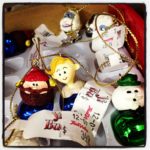
 

Yule Blogs past: 2008, 2009, 2010, 2011, 2012, 2013

All photos by Diane Kresh (except Kay Starr cover)
December 4, 2014 by Web Editor Tagged With: yule blog

Our Back Pages: Arlington’s Own Declaration of Civil Rights

Post Published: July 2, 2014

In observance of the fiftieth anniversary of the Civil Rights Act of 1964, we look back at a document from a few years earlier, for a glimpse of a still-segregated Arlington…

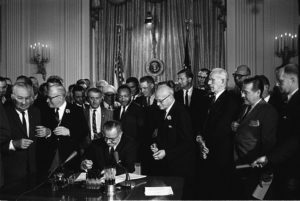
President Lyndon B. Johnson signs the Civil Rights Act of 1964 into law as various Civil Rights leaders look on, including the Reverend Martin Luther King, Jr. Photo courtesy of the LBJ Library, photo by Cecil Stoughton .

Today marks the 50th anniversary of the signing into law of the Civil Rights Act of 1964– one of the most important pieces of Civil Rights legislation of the twentieth century. The Civil Rights Act outlawed discrimination based on race, color, religion, sex, or national origin. Likewise, the Act outlawed racial segregation in public accommodations, and ended unequal application of voter registration requirements.

In observance of this landmark piece of legislation, we would like to share a transcription of “The Negro Citizen in Arlington,” a leaflet that was published by the Arlington Council on Human Relations, a multi-racial, multi-faith organization that advocated for Civil Rights for all Arlingtonians. 

Published just a little over a year after Arlington became the first school district in Virginia to desegregate, this document is a powerful reminder that despite those four students integrating Stratford Junior High in 1959, segregation in Arlington was still far from over. Many institutions in Arlington remained segregated, and this document specifically enumerates some of them: from sit-down restaurants and movie theaters, to maternity wards, to playgrounds and pony rides for children.

Item six contains one of the leaflet’s most powerful observations: “It is the uncertainty about so many aspects of his life that is trying for a Negro in Arlington. Some years ago he knew exactly what his limitations were. He didn’t like being limited but he knew what to expect. Now he is tired of being unknowing about his status.” In the years leading up to the passage of the Civil Rights Act in 1964, this was indeed the reality for many Blacks in the South.

This document powerfully evokes a time of both hope and deep uncertainty in the history of the Civil Rights Movement, when they had begun to affect positive outcomes on a local level, but those advances were tempered by lingering segregation, inconsistent statutes and enforcement, and the long historical shadow of Jim Crow.


THE NEGRO CITIZEN IN ARLINGTON

A Negro in Arlington, Virginia can, like any of the white residents of our community, call an efficient Fire Department if his house is burning. He can send his child to school and know that an alert officer will stop traffic if need be so that his son or daughter may make a safe street crossing. His wife can buy meat at the nearest super-market with the assurance that it has been inspected and is fairly weighed and priced. In most matters the Arlington Negro lives out his days with the same elements of risk and with the same measure of civic protection threatening him on the one hand and supporting him on the other as is the common lot of the rest of us in modern situations. But there are areas of his life where being a Negro makes a difference in his days. Believing that many people may be unaware of this difference, the Arlington County Council on Human Relations would bring the following facts to the attention of concerned people.

1.   If an Arlington Negro man wants to take his family out to dinner, he will have to go to the District of Columbia to find a restaurant of high quality where they may be seated. They would be turned away from all the better eating places in Arlington. If his family is in the mood for an informal meal, he may buy food to carry home at an Arlington Drive-in Restaurant but he cannot expect the kind of curb service which many white families enjoy at the end of a busy day. It is not clear to what extent restaurant restrictions are related to the legal ban on mixed seating in public and to what extent they are related to the prejudices of white patrons.

2.  If an Arlington Negro wants to see a movie, he must also go to Washington. He cannot walk to a neighborhood movie or go to any Drive-in Theatre in the Arlington area because they are all closed to Negroes. Nor can he go to a public bowling alley or skating rink. He cannot stop for his children to have pony rides at a pony lot.

3.  Highly qualified personnel direct the Arlington recreation program for Negroes but whereas the playgrounds and summer recreation programs for white children are located in the neighborhoods where white children live, only two small playgrounds are available for Negroes. Both of them are inadequate and the largest one, where full-scale ball games might be played, is in the southern tip of Arlington, inaccessible to the large number of Negro youth in North Arlington. Negro children live very near some of the large playing fields designated for white children. They can only watch from the sidelines. If friendly youngsters call out to them to join the games, they must ignore the invitation or accept it with the risk that they might be sent away, or, failing to leave, might be taken to the police station.

4.  A Negro man may rush his child to Arlington Hospital for emergency treatment or for hospitalization in the non-segregated pediatrics ward and he may go himself as an out-patient or as a bed patient in the Negro ward. But when his wife is ready to give birth to their baby, he cannot take her to the community hospital where white babies are born. He must take her miles away to a hospital in the District or in Alexandria. Perchance her baby can’t wait for the Washington hospital, the Negro mother will be attended as an emergency case in the Arlington Hospital but she cannot then be placed in the maternity ward. She will be put in the general ward for Negroes where she might be exposed to any one of a variety of infectious diseases. The general ward for Negroes actually becomes a receiving ward for all overflow patients because though a Negro may not be placed in sections of the hospital designated for whites, if the white sections are full, the white patients needing space are placed in the Negro ward. This ward is not as carefully controlled for visitors as the maternity ward is, making it the more unsuitable for post-delivery cases.

5.  Many Negroes in Arlington own their homes and home ownership is a thing of special pride to them. Many of Arlington’s Negro citizens are native residents of the county and live on property which was owned by their parents or grandparents. But when young Negroes marry, even though they are well educated and have good jobs, they cannot find, in Arlington, homes which they may buy or land where Negroes may build. There is little rental property available to them. So they must leave neighborhoods where they have friends, must leave churches where they have roots and responsibilities, and whether they like it or not, must live in Washington. Older Negroes sit precariously on their front porches in Arlington because they feel that expansion of public building in the past has been at the expense of Negro land and they ponder when some new expansion will take their property and leave them homeless.

6.  It is the uncertainty about so many aspects of his life that is trying for a Negro in Arlington. Some years ago he knew exactly what his limitations were. He didn’t like being limited but he knew what to expect. Now he is tired of being unknowing about his status.

The Negro knows that merit hiring permits him to apply for and, if he is qualified, to receive a Civil Service job in the Arlington community. He does not know to what extent racial prejudice may influence the decisions of the department head who is responsible for his promotions.

The Negro knows that by Federal Law his children are now guaranteed public school education on a non-segregated basis. He does not know how long it will be before Negroes in Arlington can expect that without individual court appeals, their children will all be accepted in neighborhood schools just as other children are.

These certain limitations and uncertain opportunities which daily confront Negro citizens in Arlington are felt by those who participated in the survey, to be a blight upon the county and a burden upon all of its residents. How change and improvement may best be brought about will be a matter of continuing concern to those persons of several races and of various faiths who compose the membership of the Arlington Council on Human Relations.

July 2, 2014 by Web Editor Tagged With: local history news

Director’s Blog: Vital Signs

Post Published: June 6, 2014

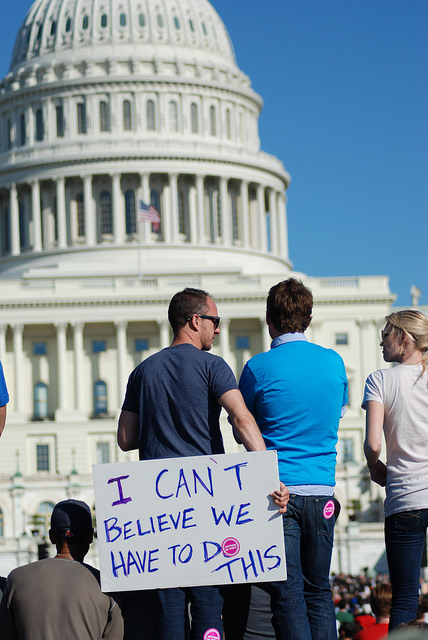
“We are Pride”

stonewall

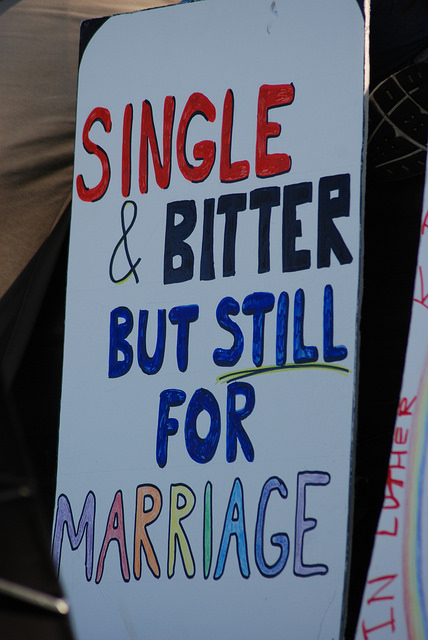
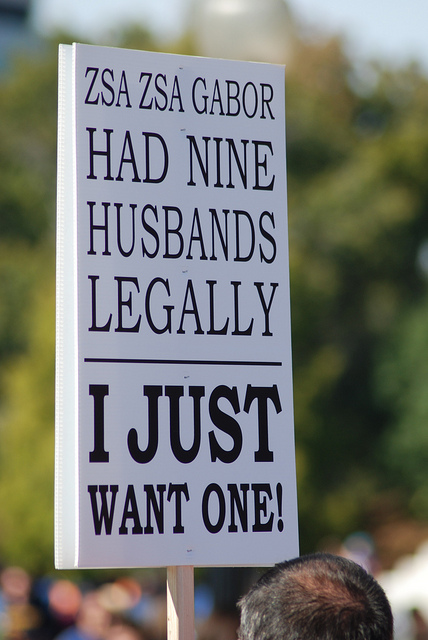
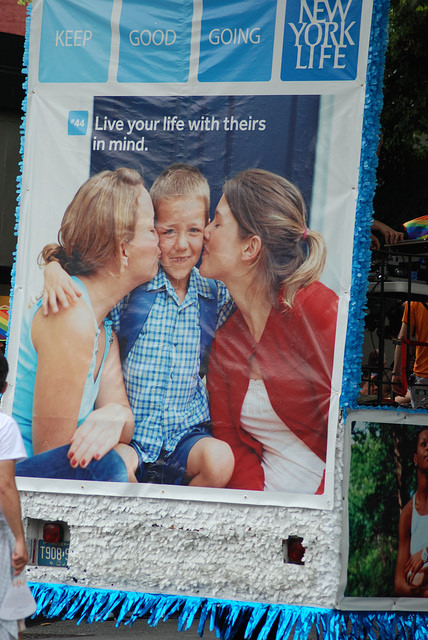
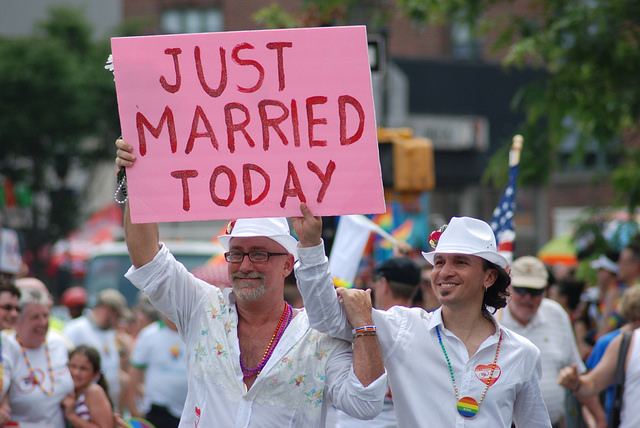
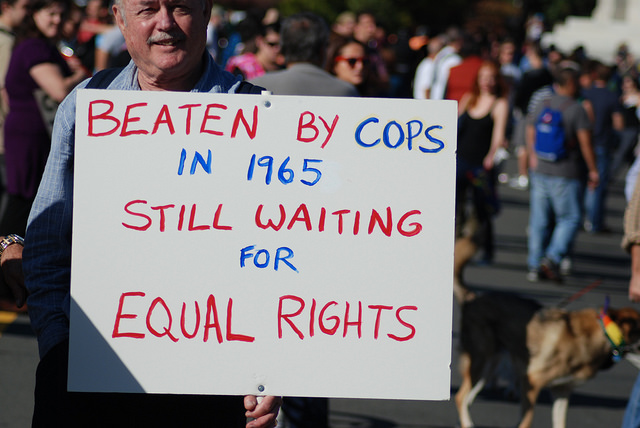
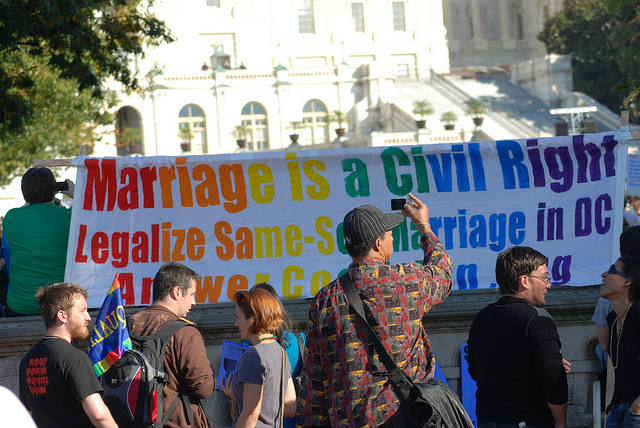
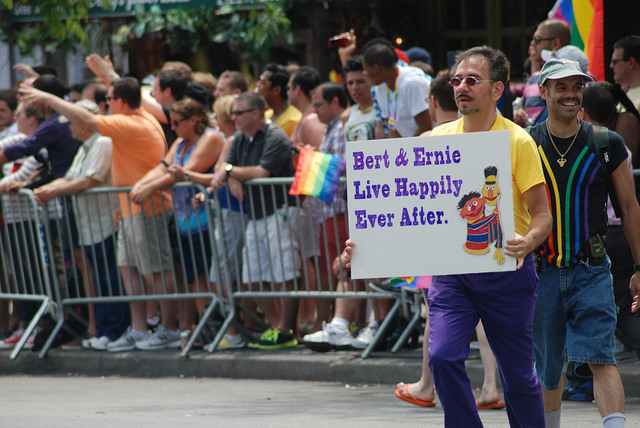
In celebration of Pride Month, Director’s Blog is featuring “Vital Signs,” a collection of my photographs chronicling the LGBT Movement over the last several years.

From a plaque commemorating the riots at the Stonewall Inn in New York City in the early morning hours of June 28, 1969, to the National Equality March on Oct. 11, 2009 to the oral arguments and landmark Supreme Court decisions handed down on June 26, 2013 and the victory parade in New York City five days later.

Every month is pride month in Arlington Public Library for we welcome, respect and accept all comers.

Happy Pride.

Explore the entire Vital Signs collection on Flickr


June 6, 2014 by Web Editor

Director’s Blog: Class of 2014

Post Published: May 13, 2014

Class of 2014

A couple of events–one past and one pending–have me engaged in a fair amount of self-reflection. First: the past event. Over the weekend, I attended the college graduation of my youngest son Nathaniel, a weekend filled with pageantry and tears (mine), memorialized by iPhone pics and Facebook posts. Diane and Nate

And in a few weeks, I will celebrate my 60th birthday, aka the pending event. A fact I find both irrefutable and troubling.

If you are anywhere close to this age, you’ll know that I grew up in an era–the 1960’s–when we were told never to trust anyone over the age of 30, forever branding youth with favor and fortune, a specialness that time couldn’t or wouldn’t taint. Except it did.

So here I am staring down number 60–a number I expected to reach thanks to good genes but did not expect to affect me very much. Except it does. So I’ve been thinking a lot about why that is and may have found the answer at my son’s graduation.

One of the most ritualistic of William & Mary’s commencement rituals occurs on Sunday, when the graduating seniors-–1300 of them this year – take their final walk as students across campus. The walk begins at the venerable Wren Building on “old campus” and wends its way to William & Mary Hall.

Roughly two thirds of the way, the students cross a wooden footbridge–Crim Dell Bridge –before they begin a final ascent through the woods to the Hall and their waiting families and friends. Apart from its picturesque setting which has made it the stuff of urban legends, the bridge symbolized to me a rite of passage as groups of seniors-cum-graduates joked and jostled their way across, posed for selfies, waved to distant cameras, and completed their journeys from childhood to adulthood.

The rest of the afternoon offered the usual in commencement fare with the usual mix of solemnity, jocularity and musicality, the latter courtesy of a fine William & Mary choir (I am partial to choral groups of all types). Some speeches dazzled and some humbled as each sounded the virtues of service, honor, purpose and community. Students were urged not to hold themselves back, to take their places in the world, to imagine what they could accomplish if they weren’t afraid.

In other words, calls to action to make a difference and change the world made to a group of young men and women who merely hours before one still thought of as… well… children.

Much is expected of the young and often it seems, not much of the old. Or what we commonly think of as old. Sixty usually qualifies. And pop culture–movies, television, and advertising–hasn’t helped. While it’s true that attitudes toward aging are changing (thanks to AARP, 50 is the new black), the advance of old age is generally not viewed as desirable and age discrimination, sadly, is alive and well.

What I discovered this past weekend, however, is that like much of life, it all boils down to choice. And like the newly minted graduates, I, too have choices. I can cross the bridge and embrace 60 and this next phase of my life full on with excitement and anticipation of the unknown or I can start to fold the tents, an option that is neither appealing nor likely.

One ritual I expected to experience over the weekend but didn’t is the graduation cap toss, emblematic of new beginnings. William & Mary, perhaps bowing to changing times and concerns for student safety (the corners of the mortarboard apparently hurt if they land on you) opted instead to launch several large green and gold (school colors) beach balls for the graduates to bat around before the ceremony came to its formal close.

Having no cap (or gown, for that matter), I’ll recall instead the toss of a famous knitted black and turquoise beret on the evening of Sept. 19, 1970.

I’m going to make it after all.


May 13, 2014 by Web Editor

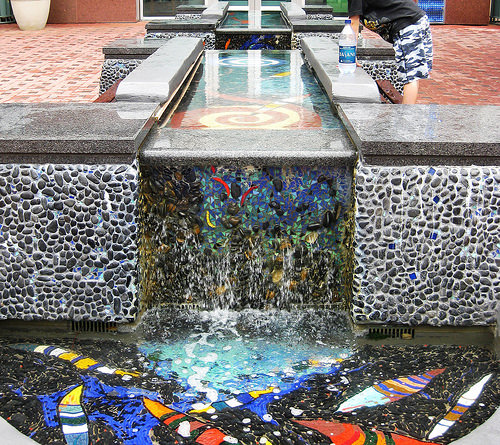
Down Stream

Post Published: March 14, 2014

Artist: Martha Jackson Jarvis

Installed: 2006
Materials: Ceramic, glass and stone mosaic fountain.

Down Stream at Shirlington

Permanently installed in front of the Shirlington Branch Library.

Learn more about this piece from Arlington Public Art.

March 14, 2014 by Web Editor Tagged With: art permanent collection

Local History: A Pentagon-less Arlington?

Post Published: March 6, 2014

Calling All Local History Fans…

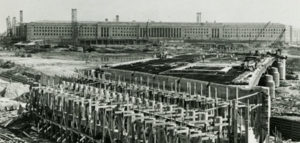
While answering a reference question, we came across this interesting passage describing President Franklin D. Roosevelt’s original plans for a War Department building in Arlington: 

…The new building in Arlington would not be the War Department’s permanent headquarters. Ultimately, the department would return to Foggy Bottom in Washington. “Now, my thought is that this new War Department building [in Arlington] would be built on extremely simple lines, and that when this emergency is over, and the War Department… reverts to a peacetime status, they will be able to come back here to their regular place,” he said…

As for the building in Arlington, Roosevelt said, it was perfectly suited for another pet project of his: He wanted a central home for the old files that now used up space in government offices around Washington. He had millions of records in mind, ranging from the individual files of three million Civil War soldiers to the public-land records charting the development of the great West to obscure State Department consular reports on the history of Mongolian ponies. “So I hope that this new building, when this emergency is over, will be used as a records building for the government,” Roosevelt said. – from “The Pentagon: A History” by Steve Vogel, p. 97

In other words, Roosevelt imagined a future where instead of the Pentagon, the area of Southwest Arlington would be home to the much smaller National Archives and Records Administration!

What do you think?

What would have happened to Arlington’s development – and history – if FDR’s vision had been carried out?

  • Would the smaller building have allowed the Queen City neighborhood, which was demolished to make room for Pentagon parking and car traffic, to have survived?
  • How would a smaller National Archives building have impacted neighborhood traffic patterns, or the planning of 395 and the metro lines?
  • Would Arlington and Arlington’s post WWII growth rate have changed?
  • What would have been the impact on military contractors, if the military headquarters had moved back to Foggy Bottom?

Share your thoughts in the comments!


Images of the Pentagon in the 1940s, from the Center for Local History collection:

[iframe width=”100%” scrolling=”no” url=”http://libcat.arlingtonva.us/iii/cpro/EmbedSlideShowPage.external?lang=eng&sp=l9&suite=def” frameborder=”0″]


March 6, 2014 by Web Editor

Virginia In Postcards: Eastman-Fenwick Collection

Post Published: January 27, 2014

Newly-Digitized Postcards Share a Glimpse of Bygone Virginia…

The Center for Local History has recently added two groups of early and mid-twentieth century postcards to our online collection.

Virginia postcardsVirginia in Postcards contains 80 postcards from the Eastman-Fenwick Family Papers and the personal postcard collection of Diane Salman. These have been digitized, both front and back (or recto and verso, as archivists sometimes call them) for a total of 160 images.

The first collection (Record Group 306) contains the personal postcards of Diane Salman, and consists of many postcards collected by her grandmother, Irene Andris Finlayson. Finlayson lived most of her life in Morgantown, West Virginia and died in 1954.

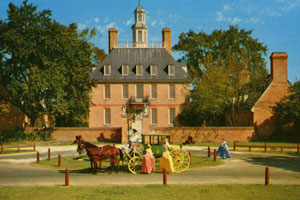
This collection is particularly interesting as it includes many paintings and lithographs of historical Virginia sites including the Royal Governor’s Palace in Williamsburg and the George Washington Masonic National Memorial in Alexandria.

Many also include handwritten messages (mostly from the 1910s) such as:

“Suppose you have heard from [?] that Frank and I are married. Write to me…”

The second collection of postcards (Record Group 60) from the Eastman-Fenwick Family collection are primarily from the 1950s, 1960s and 1970s.

These postcards are part of a much larger collection of personal papers and ephemera from four generations of two prominent Arlington families. Unlike the Salman collection, the Eastman-Fenwick postcards were not mailed but simply collected. They include striking photographs such as a locomotive charging through Ford, Virginia, and a large turkey farm in Highland County.


This project was completed with generous help from volunteers Peter Perry, Levertes Ragland, Sharad Shah, Cattleya Concepcion, and Justin Paulhamus.


January 27, 2014 by Web Editor

A Birthday Tale to Tell

Post Published: January 6, 2014

The King of Rock ‘n’ Roll Would Be 79 this Wednesday

Here’s a double trouble playlist, with a hit from the man himself and an alternative from pretenders to/contenders for the throne.


Elvis in central library

Mr. P makes his annual appearance in Central Library.

Elvis Presley – “That’s All Right” [Spotify/YouTube]

Howlin’ Wolf – “That’s All Right” [Spotify/YouTube]

Elvis Presley – “Mystery Train” [Spotify/YouTube]

Neil Young – “Mystery Train” [Spotify/YouTube]

Elvis Presley – “Blue Suede Shoes” [Spotify/YouTube]

Carl Perkins – “Blue Suede Shoes” – [Spotify/YouTube]

Elvis Presley – “Don’t Be Cruel” [Spotify/YouTube]

Cheap Trick – “Don’t Be Cruel” [Spotify/YouTube]

books on Elvis

Mr. P is comfortable in the 782.42166 section. Check out the definitive two-part Guralnick bio.

Elvis Presley – “Return to Sender” [Spotify/YouTube]

Rod Stewart with Booker T. & The MG’s – “Return To Sender” [Spotify/YouTube]

Elvis Presley – “Unchained Melody” [Spotify/YouTube]

The Righteous Brothers – “Unchained Melody” [Spotify/YouTube]

Elvis Presley – “Funny How Time Slips Away” [Spotify/YouTube]

Al Green – “Funny How Time Slips Away” [Spotify/YouTube]

Elvis Presley – “Heartbreak Hotel” [Spotify/YouTube]

Willie Nelson with Leon Russell – “Heartbreak Hotel” – [Spotify/YouTube]

Elvis Presley – “Can’t Help Falling in Love” [Spotify/YouTube]

Dead Moon – “Can’t Help Falling in Love” [Spotify/YouTube]

Elvis Presley – “Suspicious Minds” [Spotify/YouTube]

Fine Young Cannibals – “Suspicious Minds” [Spotify/YouTube]

And while you might not be able to rent a movie house just for yourself, let Jim Jarmusch and an iconic cast take you on the “Mystery Train” to Memphis, where you still can find some room down at the end of lonely street. 

Not a bad way to celebrate a birthday.

January 6, 2014 by Web Editor Tagged With: in Memoriam

The Annual Yule Blog: Rocking, Swinging Through the Holidays with APL

Post Published: December 5, 2013

Our Sixth Annual Yule Blog

EurosantaThe month of December is finally hereDK featured image square yule blogfeliz

The time of the season we bring you good cheer.

The tunes that we list we hope will amuse

So relax take a listen…  you

have nothing to lose.

Pick from bebop and pop

Or country and rock;

there’s piano and brass

plus a little cool jazz.

From our “house” to yours, we wish you the best

And thank you for being our most honored guests.


The “Don’t Touch That Dial” Playlist 2013


frostyElla Fitzgerald – “Have Yourself a Merry Little Christmas” (Spotify/Amazon/YouTube)

HappyJulie London – “I’ve Got My Love To Keep Me Warm” (Spotify/Amazon/YouTube)

Paul Simon – “Getting Ready For Christmas Day” (Spotify/Amazon/YouTube)

Daryl Hall & John Oates – “Jingle Bell Rock” (Spotify/Amazon/YouTube)

The Ronettes – “Frosty the Snowman” (Spotify/Amazon/YouTube)

Kurt Elling – “Cool Yule” (Spotify/Amazon/YouTube)

Carrie Underwood – “Do You Hear What I Hear” Spotify/Amazon/YouTube)

Emmylou Harris – “The First Noel” (Spotify/Amazon/YouTube)

Sufjan Stevens – “Come Thou Fount of Every Blessing” (Spotify/Amazon/YouTube)

John Fahey – “We Three Kings Of Orient Are” (Spotify/Amazon/YouTube)SantaLeeHighway

Watersons – “Here We Come A-Wassailing” (Spotify/Amazon/YouTube)

The Albion Band – “While Sheperds Watched” (Spotify/Amazon)

Jack Jezzro – Let It Snow! Let It Snow! Let It Snow! (Spotify/Amazon)

Marian McPartland – “God Rest Ye Merry Gentlemen” (Spotify/Amazon)

trikeCharlie Parker – “White Christmas” (Spotify/Amazon/YouTube)

Little Eva and Big Dee Irwin – “I Wish You A Merry Christmas” (Spotify/Amazon/YouTube)

Dinah Shore and Buddy Clark – “Baby, It’s Cold Outside” (Spotify/Amazon/YouTube)

Brenda Lee – “I’m Gonna Lasso Santa Claus” (Spotify/Amazon/YouTube)

Chuck Berry – “Merry Christmas Baby” (Spotify/Amazon/YouTube)

Grant Green – “My Favorite Things” (Spotify/Amazon/YouTube)

Fairport Convention – “Who Knows Where the Time Goes?” (Spotify/Amazon/YouTube)

Pittsburgh Symphony Brass – “Wexford Carol” (Spotify/Amazon/YouTube)

(All photos by Diane Kresh 2013)

Got your own list? Share it with a comment below.

Yule Blogs past: 2008, 2009, 2010, 2011, 2012


December 5, 2013 by Web Editor Tagged With: yule blog

Our Back Pages: A Taste of Home

Post Published: October 30, 2013

Vietnam in Clarendon

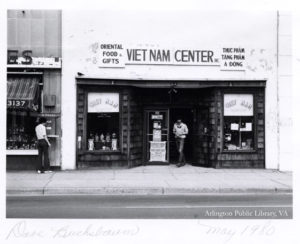
For a brief period in the late 1970s and early 1980s, a small area of Clarendon became a hub of activity for America’s newest immigrant group, the Vietnamese – and even gained international fame.

The Vietnam Center was one of many Vietnamese shops in Clarendon.

For the first half of the twentieth century, Clarendon had been Arlington’s shopping and social center, with stores, movie theaters, offices and restaurants populated by people who used buses and trolley lines.

But in the 1950s, Arlingtonians starting spreading out and relying on cars to get around — Parkington (a large parking garage in Ballston) for example, was built in the late 1950s. These more auto-dependent shoppers bypassed Clarendon, which had little to no parking, instead shopping at malls farther west and south. Businesses started folding or leaving the area, and by 1970, Clarendon was a shell of its former self.

In the early and mid-1970s, the first wave of refugees from Vietnam came to the United States.

Many of these “first-wave” immigrants were middle-class and managed to leave Vietnam with their savings and valuables to help them start a new life. Arlington’s immigrant-friendly attitude made the county appealing to these Vietnamese, and the empty storefronts in Clarendon represented an opportunity. Rent was cheap at only about two dollars per square foot, and as immigrant numbers increased with the fall of Saigon in 1975 there was a ready-made clientele, homesick and unsure in a new county.

By 1979, the 3100 block of Wilson Boulevard (near Clarendon Circle) was the business epicenter of what was usually called “Little Saigon” but was also known as the “Ho Chi Minh Trail,” “Mekong Delta” and “Saigon Strip.” These businesses, along with others on N. Hudson, N. Herndon and N. Highland Streets, sold products familiar to Vietnamese immigrants and provided services by Vietnamese businessmen who knew the language and culture. Vietnamese people came from as far away as Pennsylvania, Kentucky and Tennessee to Clarendon to get a taste of home.

Little Saigon’s importance was so vast that “Arlington” was spoken of as a specific destination by those in refugee camps in Southeast Asia.

It was not to last, however; metro was coming and it would change the face of Clarendon. The Clarendon station opened in December of 1979, and over the next five years, rents started to rise in this now prime real estate. Housing was also getting more expensive, driving recent immigrants farther west. Business owners realized they had to relocate or close; with the fall of Little Saigon in Clarendon came the rise of the Eden Center in Falls Church, further south on Wilson Boulevard near Seven Corners.

Today, the 3100 block of Wilson has many restaurants and shops, but the only sign this area was a little taste of home for thousands of Vietnamese refugees is Nam Viet Restaurant on N. Hudson Street.

The following Vietnamese businesses on the 3100 block of Wilson Boulevard were listed in the 1979 Haines Directory:

  • 3105: Pacific Oriental Department Store
  • 3107: Mekong Center
  • 3133: Far Eastern Food and Gift/Viet Nam Center
  • 3143: Kim Long [a general store]
  • 3147: Saigon Market
  • 3153: Vietnamese Custom Tailor
  • 3171: Kim Ngoc Food and Gift
  • The 1980 Haynes Directory added two more Vietnamese businesses:
  • 3103: Huong Que Restaurant
  • 3169: Saigon Souvenir and Jewelry

In the 2012 Haines Directory, no businesses with obvious Vietnamese links/names were listed for the 3100 block of Wilson.


October 30, 2013 by Web Editor

  • « Go to Previous Page
  • Page 1
  • Interim pages omitted …
  • Page 22
  • Page 23
  • Page 24
  • Page 25
  • Page 26
  • Interim pages omitted …
  • Page 40
  • Go to Next Page »

Footer

About Us

  • Mission & Vision
  • Charlie Clark Center for Local History
  • News Room
  • Get Email Updates

Administration

  • Policies
  • Library Staff
  • Job Opportunities
  • Propose a Program or Partnership

Support Your Library

  • Friends of the Library
  • Giving Opportunities
  • Donating Materials
  • Volunteer Opportunities

Our Mission

We champion the power of stories, information and ideas.

We create space for culture and connection.

We embrace inclusion and diverse points of view.


Download the Library App

Download the Library App

Arlington County | Terms & Conditions | Accessibility | Site Map
· Copyright © 2026 Arlington County Government ·