• Skip to primary navigation
  • Skip to main content
  • Skip to primary sidebar
  • Skip to footer

Alert

Holiday: All library locations closed Fri., June 19, for Juneteenth. More Info

Alert

Update: Elevator outages, maintenance and upgrades at Central Library More Info

Alert

Storytimes Will “Take a Nap” through June 20 More Info

Home - Arlington County Virginia - Logo
MENUMENU
  • Join Now
  • My Account
    • Login
    • My Checkouts
    • My Holds
    • My Lists
    • My Reading History
    • About Borrowing
    • About Holds
    • About My Account
  • Hours & Locations
    • All Hours & Locations
    • Holiday Closings
  • News
    • Library News
    • Director's Blog
    • Get Email Updates
  • Contact Us

Arlington Public Library

MENUMENU
  • Search
  • Collections
  • Library Services
  • Events
  • Community Engagement
  • Join Now
  • My Account
    • Login
    • About Borrowing
    • About Holds
    • About My Account
  • Hours & Locations
    • All Hours & Locations
    • Holiday Closings
  • News
    • Library Blog
    • Get Email Updates
  • Contact Us

Center for Local History Blog

Dedicated to collecting, preserving and sharing the history of the community.

Oral History: Getting Involved in Local Politics

Post Published: March 7, 2019

Arlington Voices the Oral History Collection

Interview with Ellen Bozman, Longest Serving County Board Member

Ellen Bozman is an important name in Arlington County. As the longest serving member of the Arlington County Board to date, Bozman supported countless causes that have made long lasting impacts on the county and Northern Virginia.

Born and raised in Illinois, Bozman came to Arlington after graduating from Northwestern University. She began her public service in Arlington with the League of Women Voters and served on other boards and committees until her run for County Board in 1974. During her time on the Board, Bozman saw significant changes in Arlington - its development, transportation, and citizens were very different when she retired in 1997 than they had been when she began 23 years earlier.

In this oral history clip, Bozman shares with interviews Edmund Campbell and Cas Cocklin her experiences working on other boards and committees before her first run as a Democrat-backed Independent candidate for the County Board:

NARRATOR: Ellen Bozman
INTERVIEWER 1: Edmund Campbell
INTERVIEWER 2: Cas Cocklin
DATE: May 15, 1987

EC: You ultimately became President of the League, did you?

EB: Yes. Those were busy years for the League and I was President from '63 to '65. Then, as you know, once you have been president of an organization, there's no readymade spot for you so you look around and you tend to do other things. Then I later chaired the Health and Welfare Council of Arlington and the Committee of One Hundred and finally in the early '70's chaired the Rock Springs Congregational Church Council. About that time, some of my friends jokingly said well since you've done a church council, you're ready to run for the Board.

CC: Had you ever given any thought prior to that to getting into politics?

EB: Only recently prior to that. And the change really came about when I served on the Planning Commission. Up until the time I served on the Planning Commission, I didn't think that, first of all, I thought of myself as an administrator rather than a politician. Secondly, I had been through some, I had been standing on the fringes and involved in some very, very tumultuous political times in Arlington.

EC: Such as?

EB: Well, when you go way back and I remember Barbara Riches who was on the School Board saying to me, "I don't care when they throw garbage on my front porch because I know they don't have anything more important they're doing." Very split community. Very difficult and personal political campaigns. A kind of atmosphere that I didn't think that I was ready or wanted to participate in. But times change.

To learn more about Ellen Bozman;s life and work, visit the Center for Local History's online exhibit, Women's Work.


The goal of the Arlington Voices project is to showcase the Center for Local History’s oral history collection in a publicly accessible and shareable way.

What is the oral history collection?

Oral history is a popular method of research used for understanding historical events, actors, and movements from the point of view of people’s personal experiences.

The Arlington Public Library began collecting oral histories of long-time residents in the 1970s, and since then the scope of the collection has expanded to capture the diverse voices of Arlington’s community. In 2016, staff members and volunteers recorded many additional hours of interviews, building the collection to 575 catalogued oral histories.

To browse our list of narrators indexed by interview subject, check out our community archive. To read a full transcript of an interview, visit the Center for Local History located at Central Library.

March 7, 2019 by Web Editor

Green Valley Pharmacy

Post Published: February 22, 2019

Dr. Leonard “Doc” Muse

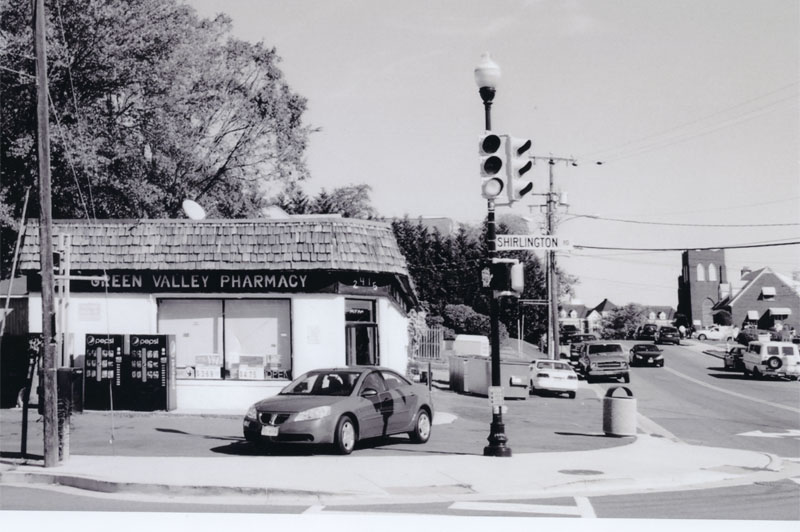
Have you traveled down Shirlington Rd in the Nauck neighborhood, and stopped for a snack at the one story, white, shingled building on the corner of Shirlington Rd and 24th Rd S?

Green Valley Pharmacy 2010

Established in 1952, the Green Valley Pharmacy is the first (and only) pharmacy and lunch counter in Arlington that would serve African American patrons during the Jim Crow era.

The man who opened the pharmacy was Dr. Leonard “Doc” Muse, a pharmacist and social activist. Muse was born in Florida in 1923 and after serving in World War II used his GI benefits to attend the Howard University School of Pharmacy. In 1952, he and his partner Waverly Jones bought the former Hyman’s Grocery and opened the Green Valley Pharmacy. The pharmacy served black and white customers, but mainly served as a neighborhood hub for Nauck- as a lunch counter, a drug store, and a first job for many young people in Green Valley. Doc provided free lunches for the hungry and free medications for those who could not afford their prescriptions.

In 2013, Green Valley Pharmacy was named as an Historic District by the Arlington County Board, and Muse himself was honored by the Arlington NAACP with the Community Appreciation Award. Muse’s commitment to social activism established him as a pillar of the Nauck community, positively influencing the young people of Green Valley and providing a social and political hub for the residents of Nauck.

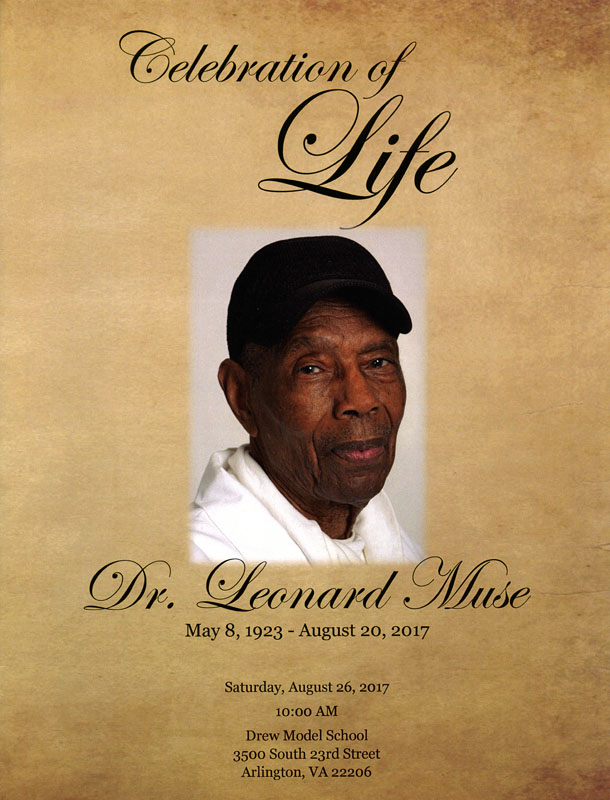
Dr. Leonard Muse died on August 20, 2017.

A celebration of life service was held in his honor at Drew Model School on Saturday, August. 27, 2017.

Memorial program for Dr. Leonard Muse, 8/26/2017

The photo of Green Valley Pharmacy was taken by Matthew Welborn in 2010, as part of a student photography contest, "Capturing Arlington," sponsored by the Center for Local History.

To see more items like these, or to learn more about Arlington's history, visit the Center for Local History on the first floor of the Central Library.

Do you have a question about this story, or a personal experience to share? 

Use this form to send a message to the Center for Local History.

Center For Local History - Blog Post Message Form

Do you have a question about this story, or a personal experience to share? Use this form to send a message to the Center for Local History.

"*" indicates required fields

This field is for validation purposes and should be left unchanged.

Share Your Story

February 22, 2019 by Web Editor

Cub Scout Pack 589 and Ernest Johnson

Post Published: February 14, 2019

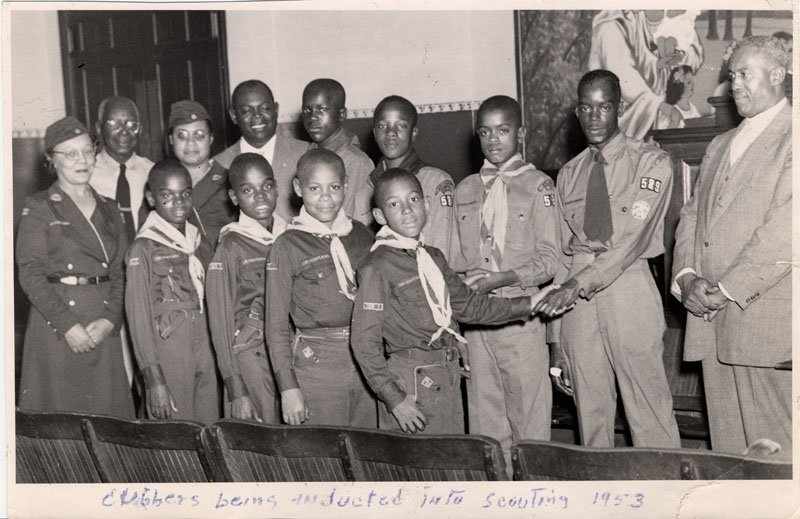
Cub Scout Pack #589 was one of Arlington’s first African American Cub Scout Packs, established in 1952 and founded by Ernest Johnson. 

black and white photo of group of young african american boys in cub scout uniforms with pack leaders

This photo shows the April 1953 induction of new pack members, with Johnson standing to the right.

Founding Cub Scout Pack #589 was part of Ernest Johnson's efforts to give African American children in segregated Arlington a variety of activities to help them grow and have fun. As the director of the Arlington Department of Parks and Recreation’s Negro Recreation Section, (founded in 1950), Johnson worked tirelessly to expand the Section’s sports, arts, and culture programs for African American children in the County. He oversaw the development of Jennie Dean Field and a new recreation center at Hoffman-Boston on S. Queen Street, known as the Carver Center. The Section also organized picnics, beauty pageants, and socials.

The County recognized Johnson’s abilities as an organizer and developer of programs, and when Arlington desegregated their Parks and Recreation facilities and programs in the spring of 1961, he became the Supervisor of the Centers Section, overseeing “teen clubs, free classes, and meeting of non-Department sponsored clubs in the centers.”

Johnson stayed with the Department until his retirement in 1982. Arlington then celebrated Ernest Johnson Day with a parade, softball game, and testimonial dinner.

Ernest Johnson's work for the County is remarkable in another way: he had the foresight to hire a professional photographer to attend many of the Negro Recreation Section’s activities.

To see more of these photographs, visit the Ernest Johnson Collection, Photograph Collection 218, in the Arlington Community Archives online.

February 14, 2019 by Web Editor

Oral History: Desegregation of Arlington’s Public Schools

Post Published: February 7, 2019

Arlington Voices the Oral History Collection

Interview with Dorothy Hamm, School Desegregation Activist

In honor of the 60th anniversary of the desegregation of Arlington County public schools, the Center for Local History presents an oral history clip from an interview with Dorothy Hamm, who lived in Arlington at the height of the battle to desegregate Arlington’s public schools, and was part of different lawsuits throughout the county to integrate not only the schools but restaurants, hospitals, and theaters.

In this clip from 1986, Hamm shared her experience trying to register her son for school at Stratford and her activity in lawsuits to desegregate public facilities in Arlington County.

Dorothy Hamm has been honored by the County with the naming of a new middle school in Cherrydale, the Dorothy Hamm Middle School, set to open in September 2019.

NARRATOR: Dorothy Hamm
INTERVIEWER 1: Edmund Campbell
INTERVIEWER 2: Cas Cocklin
DATE: February 21, 1986

Transcript:

EC: You recall the Supreme Court decision directing the desegregation of the public schools "with all deliberate speed" which was made in l954. After that time, you became rather active in the shall I call it the desegregation movement, did you not?

DH: Yes, I did. My reason for doing that was because I felt that with the Supreme Court's decision my two sons would have an opportunity to attend Stratford, an integrated school and I told them the meaning of the Supreme Court's decision, and I also told them that they would be going to Stratford. However, almost 2 years had passed, they still had not been permitted to attend; and this is why I really got involved.

EC: What did you do?

DH: On one occasion, my husband and I took our oldest son to Stratford in an attempt register him, and he was denied.  I was also one of the original plaintiffs in the suit of 14 parents and 22 children.

EC:  What suit was this?

DH:  This was the suit that was filed by the N.A.A.C.P. in May of 1956, 2 years after the Supreme Court's decision.

EC:  This was the suit, was it, in the federal court for the Eastern District of Virginia before Judge Albert Bryan?

DH:  Yes, it was.

EC:  And you were one of the original plaintiffs?

DH: That's right.

EC:  Did you take any other action at that time other than participate in that suit?  I mean were you involved in any other desegregation movements at that time?

DH:  Not really at that time.  They came just a little bit later my suits involving the theatres, the hospital, eating places and working places.

CC: May I ask, in these desegregation suits where the children were involved, what was the feeling of the children?  Were they truly indignant and anxious for equality of education or opportunities or was there any compulsion on the part of the parents requiring the children's cooperation?

DH: No, I think all the children were very eager to go.  All of the parents were very anxious for their children to attend the school because they felt this was a better opportunity for their children knowing that all of them had attended segregated schools.

For more information on desegregation in Arlington County and its schools, please visit Arlington Public Library’s Project DAPS website.

Photo of students and librarian in the library of Hoffman-Boston from the George Melvin Richardson Collection, 1950s: projectdaps.org/items/show/42


The goal of the Arlington Voices project is to showcase the Center for Local History’s oral history collection in a publicly accessible and shareable way.

What is the oral history collection?

Oral history is a popular method of research used for understanding historical events, actors, and movements from the point of view of people’s personal experiences.

The Arlington Public Library began collecting oral histories of long-time residents in the 1970s, and since then the scope of the collection has expanded to capture the diverse voices of Arlington’s community. In 2016, staff members and volunteers recorded many additional hours of interviews, building the collection to 575 catalogued oral histories.

To browse our list of narrators indexed by interview subject, check out our community archive. To read a full transcript of an interview, visit the Center for Local History located at Central Library.

February 7, 2019 by Web Editor

George Melvin Richardson

Post Published: February 7, 2019

Hoffman-Boston Principal, 1954-1965

Do you remember your first school field trip to visit the Smithsonian dinosaurs? 

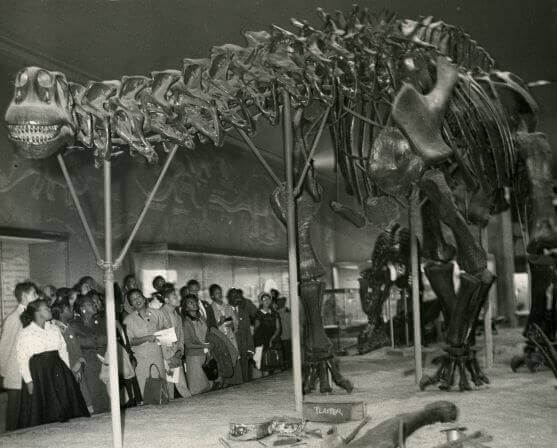
Photo of dinosaur skeleton at the Museum of Natural History with high school class from Hoffman-Boston

In this photo, a group of late 1950s/early 1960s Hoffman-Boston high school students examine the relics on display at the Museum of Natural History.

Their principal at Hoffman-Boston (the combined elementary, junior high, and senior high school for African American students) was George Melvin Richardson, a man of quiet authority and the ideal leader to cope with the complex issues then facing his school and the County.

Richardson was on the initial 1954 committee to study desegregation of the Arlington Public Schools, and principal of Hoffman-Boston from 1954 until the school was closed in 1965. Faced with inadequate classrooms and facilities, Richardson worked for years to improve and expand the school. Field trips such as the one pictured here helped to compensate for the lack of equipment and resources, and to educate students beyond the classroom.

As a resident of the Arlington View neighborhood, Richardson also worked to create the area’s Neighborhood Conservation Plan (one of the first in the county), and later served on the executive board for the Arlington Committee of 100.

George Melvin Richardson’s photographs, oral histories, papers and more can be found on the Center for Local History’s ProjectDAPS.org website, a repository for the Center’s collection of archival documents and photographs relating to the story of the desegregation of Arlington public schools.

View the George Melvin Richardson Collection in ProjectDAPS.org

February 7, 2019 by Web Editor

Rosslyn in the 1960s

Post Published: January 31, 2019

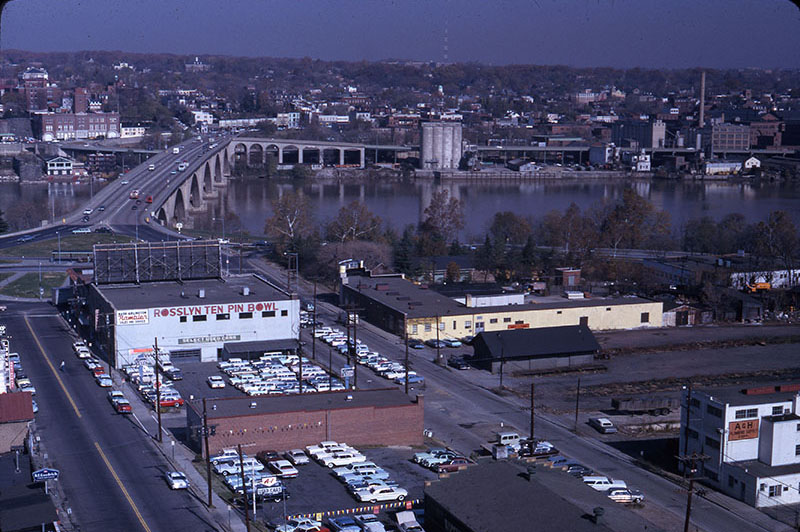
Do you remember Rosslyn Ten Pin Bowl or A & H Plumbing Supply CORP.?

Aerial photo of Rosslyn neighborhood taken looking over the Potomac river towards Georgetown

This image, taken in the 1960s, shows a time when Rosslyn was full of parking spaces, small businesses, and clear views of Key Bridge and Georgetown.

Like many Arlington neighborhoods, Rosslyn has undergone significant growth since this photo was taken. With its proximity to Washington, D.C., the neighborhood has naturally morphed into an urbanized hub, complete with skyscrapers, hotels, numerous restaurants and businesses. It even boasts the title for the third longest continuous span escalator in the world!

Do you remember Rosslyn in the 1960s, before the skyscrapers went up? Did you ever go bowling at Rosslyn Ten Pin Bowl?

To see more images from the “Arlington Photographs: Before and After, The Guy W. Starling Collection,” or to learn more about the history of Rosslyn, visit the Center for Local History on the 1st floor of Central Library.

January 31, 2019 by Web Editor

Where Were These Photos Taken?

Post Published: January 24, 2019

Can you guess the location of these images? 


Central Library Reference Desk, early 1960s, librarians speaks to young child


Central Library Reference Desk, early 1960s, librarian on phone

Here are a few clues:

  • The photos were taken in the early 1960s, shortly after the building was completed.
  • This building was the first publicly financed construction project for this County department, and has housed this department since the 1960s - although it underwent a major renovation in the early 1990s.
  • In 1995, the department installed the first public internet terminals with the help of a grant.

If you guessed that the photos feature Central Library, you are correct!

Although Central Library no longer looks the way it did in these photos, the spirit of the Library has remained the same – to serve the residents of Arlington County and create space for culture and connection.

To learn more about the history of Arlington Public Library visit The Center for Local History's online exhibit “Women’s Work.”

To see more photos from Arlington’s diverse history visit the Center for Local History, located on the 1st floor of Central Library.

January 24, 2019 by Web Editor

Neighborhood Activist Joan Cooper

Post Published: January 17, 2019

For nearly 50 years, community activist and Nauck resident Joan Cooper worked for change in her neighborhood. 

cooper020
cooper004c
Cooper
cooper019c

She also challenged others to make changes to improve the community, stating, “People have to realize, that we as community members have to do our job, too.”

During her active years Cooper helped to advocate for an integrated school system in Arlington County, drove individuals to drug and alcohol detox programs, helped patrol corner blocks of the Nauck neighborhood, and worked tirelessly to rid her streets of illicit narcotics.

“Be persistent, consistent, and insistent,” was her message, and in July 1992, through an initiative called “Crackdown on Drugs,” Cooper’s efforts and leadership on this campaign were recognized by then President George H.W. Bush, when he visited Drew Model School.

cooper003

In the same year, she was also named a Notable Woman of Arlington by the County’s Commission on the Status of Women.

To learn more about Joan Cooper, make an appointment to visit the Center for Local History.  located on the 1st floor of Central Library. To learn more about the Green Valley neighborhood you can also visit the the Green Valley Heritage Project page.

January 17, 2019 by Web Editor Tagged With: Green Valley

How To Prepare Tin Cans For Collection in 1943

Post Published: January 10, 2019

This colorful advertisement from 1943, produced by the Arlington County Salvage Committee, describes “To the Housewives of Arlington County” how to properly clean and prepare tin cans for recycling in order to aid war efforts during WWII.


Side one of the "How to prepare cans for collection" circular


side two is addressed "The the Houisewives of Arlington County"

The two sided circular, which “makes known to you the vital need of tin in the War effort,” is part of the Robert McAtee, (1913-2014) archival collection. Mr. McAtee, who lived in Arlington for most his life, and in the Maywood neighborhood for decades, owned Seven Corners Rentals on Leesburg Pike. McAtee was an active community historian who documented both his neighborhood and physical changes throughout Arlington county. Thanks to donors like Mr. McAtee, who spent a majority of his life collecting material culture about Arlington County, historians today are able to see the significant shifts and changes of the community over the last century.

To learn more about Robert McAtee, life in Arlington during WWII, or to see more items like this, visit the Center for Local History located on the 1st floor of Central Library.

January 10, 2019 by Web Editor

The Columbia News

Post Published: December 27, 2018

“What the old year has done for us is this; it has brought everything forward to the point where hope is real, and apt to blossom in full at any moment. It has turned hope into practical assurance. In this way we can say wholeheartedly to each other, and to the world at large – “Happy New Year!”


Clipping form The Columbia News

This January 1, 1945 message of hope was made during World War 2, from a short lived, hyper local newspaper called the Columbia News.

The Columbia News was published semimonthly in Arlington from 1941 - 1945, by Eugene Beard, starting on January 18, 1941. The Center for Local History holds the Vol. 1, No. 1 edition, some from 1944, and some from 1945. We are in the process of digitizing these holdings, and they will soon be available to view through the Library catalog. (The Library of Congress and the Library of Virginia also have some editions on microfilm.)

To see more historic newspapers like this one, visit us at the Center for Local History located on the 1st floor of Central Library.

December 27, 2018 by Web Editor

  • « Go to Previous Page
  • Page 1
  • Interim pages omitted …
  • Page 17
  • Page 18
  • Page 19
  • Page 20
  • Page 21
  • Interim pages omitted …
  • Page 35
  • Go to Next Page »

Primary Sidebar

News

All library locations will be closed for Juneteenth.

Holiday: All library locations closed Fri., June 19, for Juneteenth.

All Library locations and Arlington County … ... about Holiday: All library locations closed Fri., June 19, for Juneteenth.

Read More News
See More Service Updates

Center for Local History

Three men writing on squares of the AIDS Quilt.

New: Explore 2,800+ Arlington Courier Photos

Explore more than 2,800 photos of local life in … ... about New: Explore 2,800+ Arlington Courier Photos

Read More Local History

Director’s Blog

Arlington Public Library staff marching in the 2025 D.C. World Pride Parade.

Director’s Message: Pride Month

Words Matter Arlington Public Library … ... about Director’s Message: Pride Month

More Director's Blog

Footer

About Us

  • Mission & Vision
  • Charlie Clark Center for Local History
  • News Room
  • Get Email Updates

Administration

  • Policies
  • Library Staff
  • Job Opportunities
  • Propose a Program or Partnership

Support Your Library

  • Friends of the Library
  • Giving Opportunities
  • Donating Materials
  • Volunteer Opportunities

Our Mission

We champion the power of stories, information and ideas.

We create space for culture and connection.

We embrace inclusion and diverse points of view.


Download the Library App

Download the Library App

Arlington County | Terms & Conditions | Accessibility | Site Map
· Copyright © 2026 Arlington County Government ·