• Skip to primary navigation
  • Skip to main content
  • Skip to primary sidebar
  • Skip to footer

Alert

Holiday: All library locations to close early at 5 p.m. on Nov. 25 and all day Nov. 26 & 27 in observance of Thanksgiving. More Info

Alert

Central Library garage will be closed Monday, Nov. 23 through Wednesday, Nov. 25 for maintenance. More Info

Alert

Update: No elevator service from garage & Quincy St. entrance closed during Central Library upgrades. More Info

Home - Arlington County Virginia - Logo
MENUMENU
  • Join Now
  • My Account
    • Login
    • My Checkouts
    • My Holds
    • My Lists
    • My Reading History
    • About Borrowing
    • About Holds
    • About My Account
  • Hours & Locations
    • All Hours & Locations
    • Holiday Closings
  • News
    • Library News
    • Director's Blog
    • Get Email Updates
  • Contact Us

Arlington Public Library

MENUMENU
  • Search
  • Collections
  • Library Services
  • Events
  • Community Engagement
  • Join Now
  • My Account
    • Login
    • About Borrowing
    • About Holds
    • About My Account
  • Hours & Locations
    • All Hours & Locations
    • Holiday Closings
  • News
    • Library Blog
    • Get Email Updates
  • Contact Us

News

Fun in the Sun: Summers of Arlington’s Past

Post Published: July 22, 2020

Arlington may not come to mind when you think of a beachy oasis, but in the 1920s, we had one of the region’s premier beaches right here.

The Arlington Beach and Amusement Park opened on May 30, 1923, on the Potomac River in the area near the Fourteenth Street Bridge (then known as Long Bridge). For nearly a decade, this was a go-to spot on a hot Arlington day.
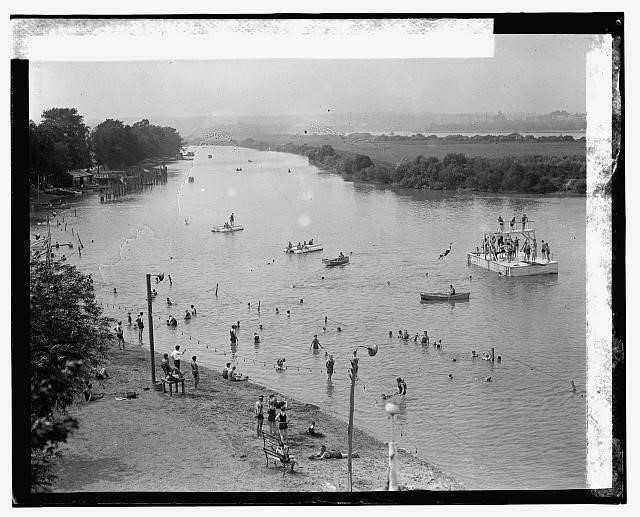
Beach in 1925

Arlington Beach, circa 1925. Image courtesy of the Library of Congress.

The beach was an immensely popular Arlington spot, with crowds of up to 12,000 during the most sweltering days, according to Arlington Magazine. The location featured both a sandy beach on the shores of the Potomac as well as bathhouses and the accompaniments of a full-scale amusement park: a merry-go-round, Ferris wheel, aerial swings, a rollercoaster called “The Whip,” and a ride called “The Dodgem.” Swimmers could use the beach’s diving board and swim at night under searchlights.
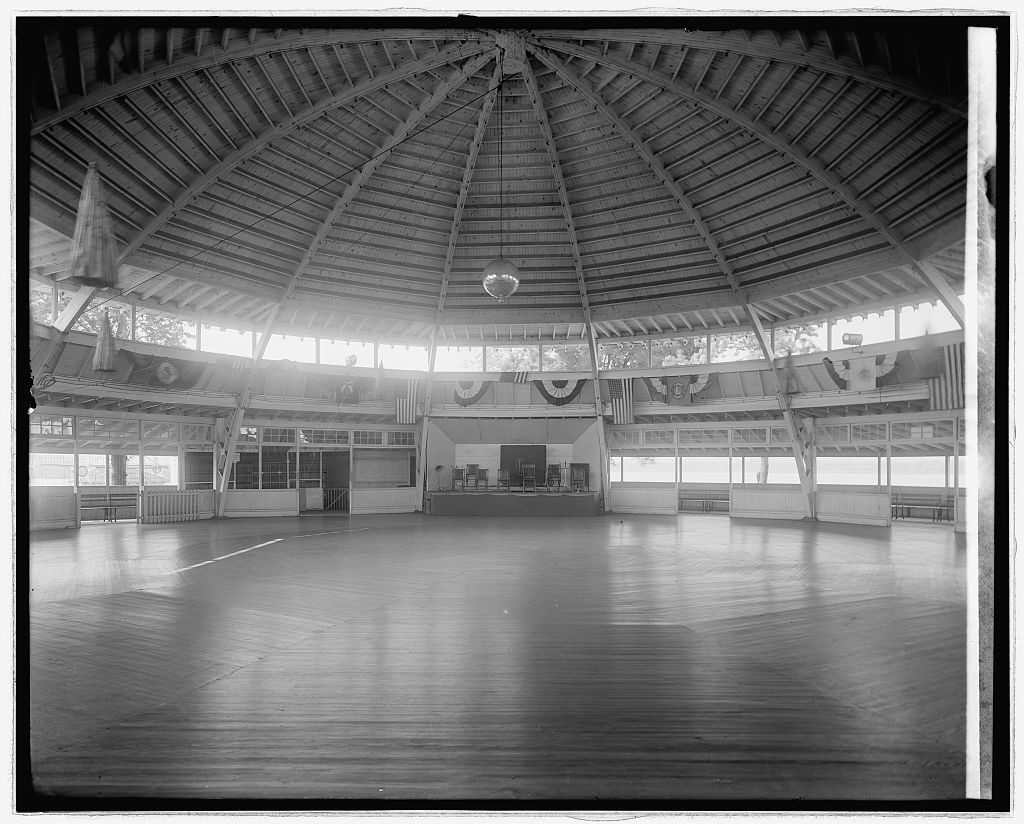
Dance Pavilion

Dance pavilion, Arlington Beach. Image courtesy of the Library of Congress.

The park’s dance pavilion was also one of its major draws in its opening season, providing a spot for people of all ages to spend summer evenings – the Washington Jazz Orchestra even performed here. In line with the rising car culture of the early 20th century, the park also advertised extensive parking facilities – important to draw customers from all around the region.

It’s notable that as popular as the Arlington Beach was, it was among the many segregated recreational areas in the County. Even though it was located near predominantly African American neighborhoods, including East Arlington and Queen City, the beach and amusement park were segregated for the duration of their existence.
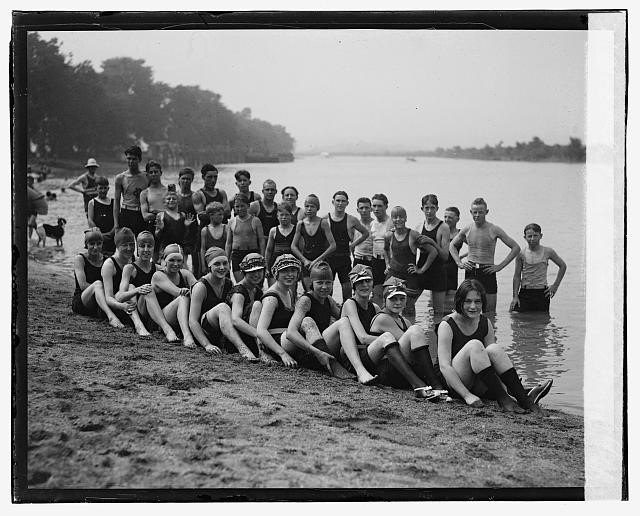
Beachgoers

Beachgoers at Arlington Beach, June 16, 1923. Image courtesy of the Library of Congress.

According to a research project on segregation in Arlington conducted by Lindsey Bestebreurtje at George Mason University: “County resident James ‘Jimmy’ Taylor recalled that Black children swam ‘in a creek on Route 50 called Blue Man Junction.’” African American Arlingtonians were also not permitted to use public pools, and the county’s first pool to allow African American children wouldn’t open up until the 1960s.

Interview with Ruth Jones

Center for Local History, Arlington Public Library · July 2017 - Arlington Beach - Ruth Jones

In a 1999 oral history interview with Ingrid Kauffman, Ruth Jones described going to the beach as a teenager. Born in March of 1913, Ruth began to visit Arlington Beach around 1927. Oral histories are used to understand historical events, actors, and movements from the point of view of real people’s personal experiences.

Narrator:  Ruth Jones
Interviewer: Ingrid Kauffman
Date: March 23, 1999

Ingrid Kaufman: And so can you tell us about Arlington Beach?

Ruth Jones: Well, I was just a young girl, 14 or 15 years old and I met my husband, well, he eventually was my husband.

IK: What was his name?

RJ: Raymond Jones. And he lived in Washington. And we started going to Glen Echo and to Arlington Beach and just having a good time for kids, you know. And so they had a roller coaster, a carousel.

IK: How much did that roller coaster cost?

RJ: Ten cents. A ride at your own risk. That’s the truth, too. It was rickety. After I came to Washington, it was only there for 2 years, 2 or 3 years, then they tore it down.

IK: They tore down the roller coaster?

RJ: Everything. And shut the beach down and all, to put the airport there.
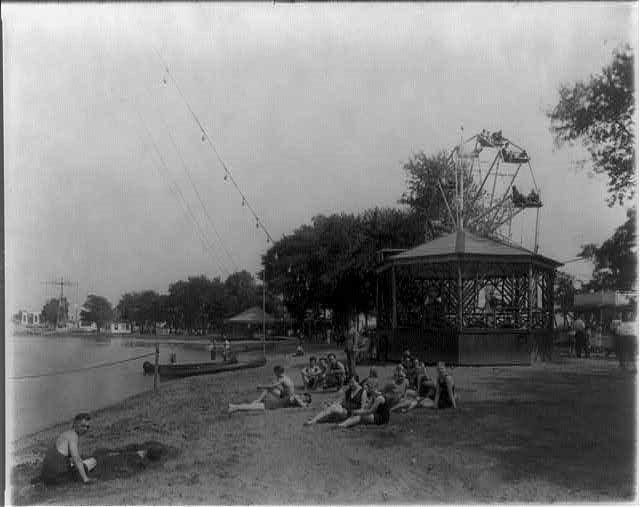
Waterfront

Along the waterfront, Arlington Beach, circa 1925. Image courtesy of the Library of Congress.

As Jones describes, the location was eventually compromised by the construction of the nearby Hoover Airport. The traffic at the airfield grew to include both passenger and mail air service, which provided disruptive to the festivities of the beachgoers and park attendees. The Hoover airfield was also notoriously dangerous – and the aviation industry notoriously unregulated at this point – so the proximity of the beach and park also became a safety issue.
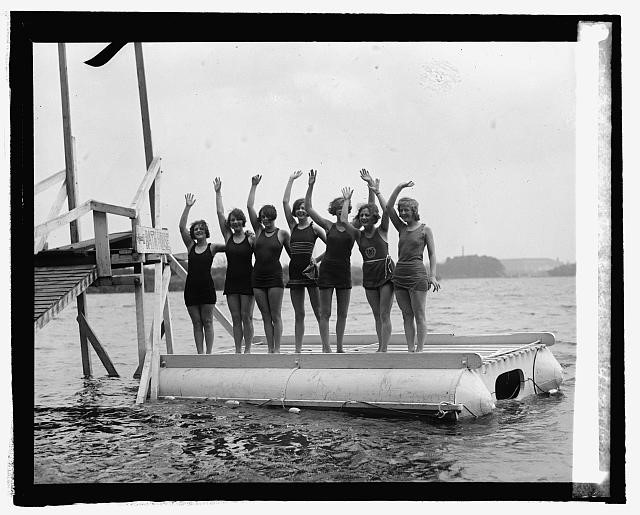
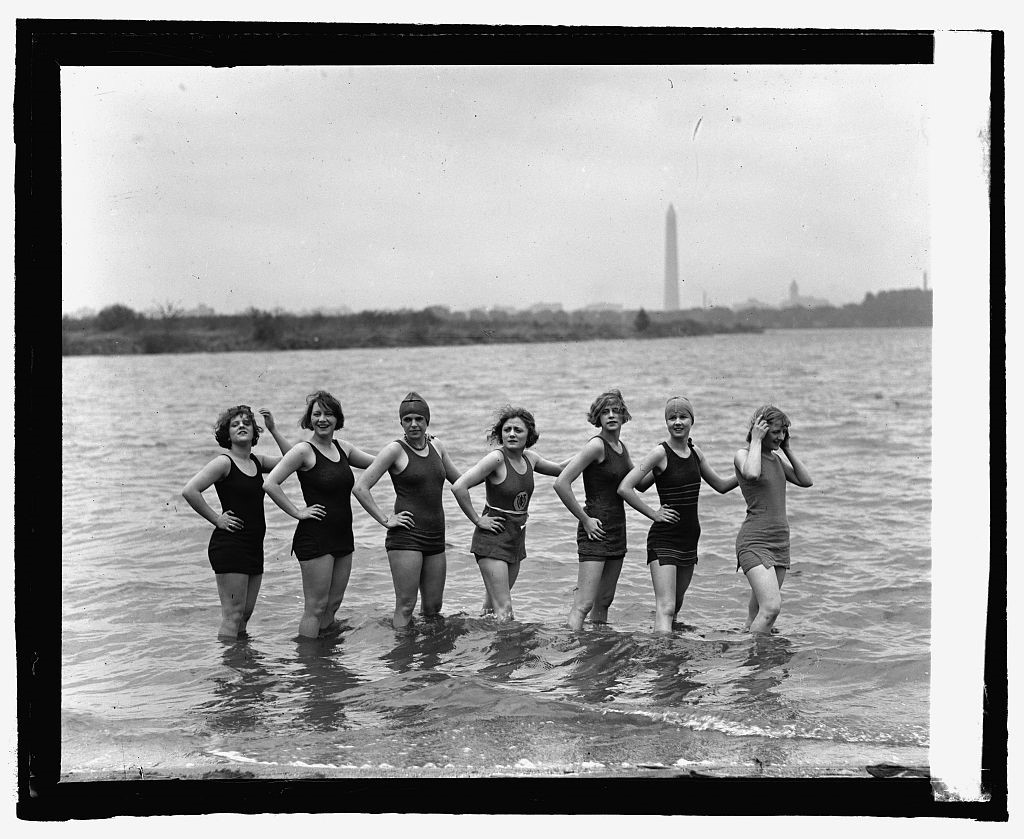
Girls 1
Girls 2

Girls from Keith’s [vaudeville circuit] at Arlington Beach, April 29, 1925. Image courtesy of the Library of Congress.

In 1929, the Washington Air Corporation bought the beach property in order to expand the Washington Airport, which later merged with the Hoover Airport as the Washington-Hoover Airport. However, with the construction of the Washington National Airport (now Ronald Reagan), the Washington-Hoover Airport closed. The former beach grounds were then purchased by the U.S. Department of War and became part of the Pentagon.
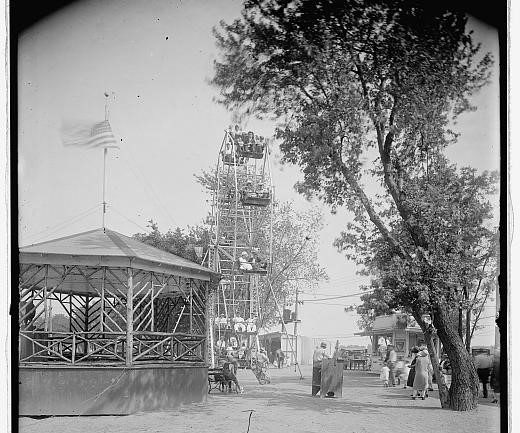
Amusement Park

Amusement park, Arlington Beach. Image courtesy of the Library of Congress.
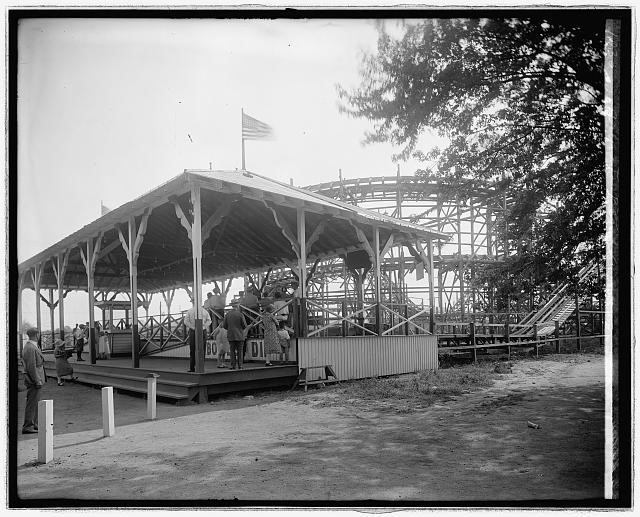
Rides at Arlington Beach

Rides at Arlington Beach. Image courtesy of the Library of Congress.

This article was expanded from previous articles on Arlington Beach from 2008 and 2017.

Do you have a question about this story, or a personal experience to share? 

Use this form to send a message to the Charlie Clark Center for Local History.

Center For Local History - Blog Post Message Form

Do you have a question about this story, or a personal experience to share? Use this form to send a message to the Center for Local History.

"*" indicates required fields

This field is for validation purposes and should be left unchanged.

Share Your Story

July 22, 2020 by Web Editor

This Week in 19th Amendment History: Ida B. Wells

Post Published: July 15, 2020

July 16, 1862: Ida B. Wells is Born

Celebrate the 100th anniversary of the 19th Amendment with stories about the people and events that led to the passage of women’s suffrage in the United States.

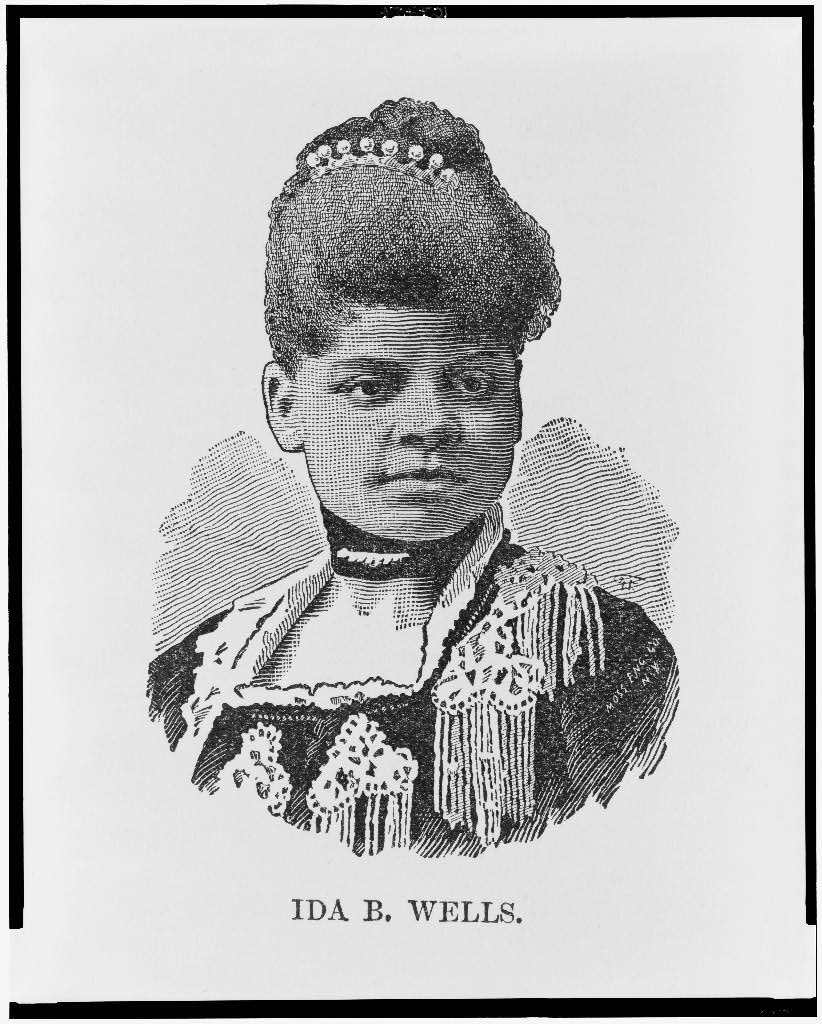
Ida B. Wells was an investigative journalist, activist, and suffragist who led an anti-lynching crusade in the United States in the 1890s. She was also one of the founders of the National Association for the Advancement of Colored People (NAACP).

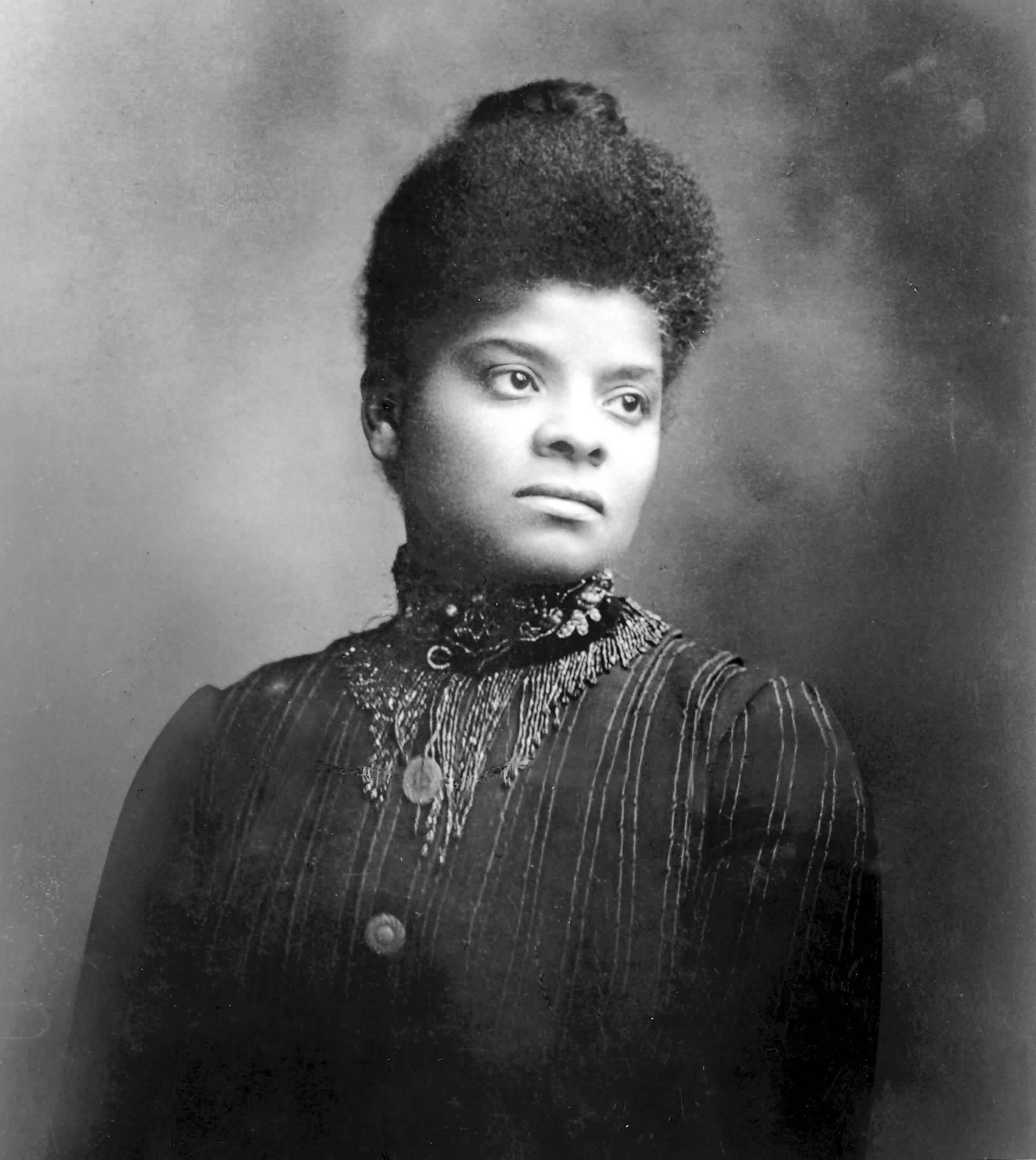
Ida B. Wells

Portrait of Ida B. Wells, circa 1893. Image courtesy of the National Park Service.

Early Life

Ida B. Wells was born into slavery on July 16, 1862, in Holly Springs, Mississippi, to James and Lizzie Wells. Following the conclusion of the Civil War, Wells’ parents became politically active as the country navigated Reconstruction. Ida's father, James, was a member of the Freedmen’s Aid Society, as well as one of the founders of Rust College in Holly Springs – one of 10 historically Black universities founded before 1868 that is still operating today. Encouraged to pursue her education, Ida later enrolled at Rust College but was ousted from her studies after a dispute with the university’s president.

Ida B. Wells 3

Image courtesy of the Library of Congress.

At only age 16, she lost both of her parents and her infant brother to a yellow fever epidemic that had decimated Holly Springs. Left with custody of her other siblings, Wells was able to convince a school administrator that she was 18, and began teaching to support her family. In 1882, she moved with her siblings to Memphis to live with an aunt, and there she continued to work as a teacher. She began classes at Fisk University in Nashville, where she would commute to by train. On one of these trips in May 1884, Wells – who had purchased a first-class ticket – was forced to move to a segregated car for African American passengers. Wells refused to move and was forced off of the train. Wells went on to sue the railroad and won a settlement in court.

Inspired by this incident, Wells pivoted her career toward writing about the topics of race and politics. Under the pseudonym “Iola,” Wells’ work was published in a number of Black-owned newspapers and periodicals. She also went on to hold shares of two newspapers: The Free Speech and Headlight, and Free Speech. All the while, she continued teaching in the segregated Memphis school system, of which she was also a vocal critic. Due to her vocal stance against segregation in the city and in the schools, as well as her criticism of the condition of schools, she was fired from her position.

People's Grocery Lynchings

In 1892, Wells’ journalistic focus took a turn. After the murder of a friend and two of his business associates at the hands of a lynch mob in Memphis, Wells began reporting on the epidemic of lynching in the South.

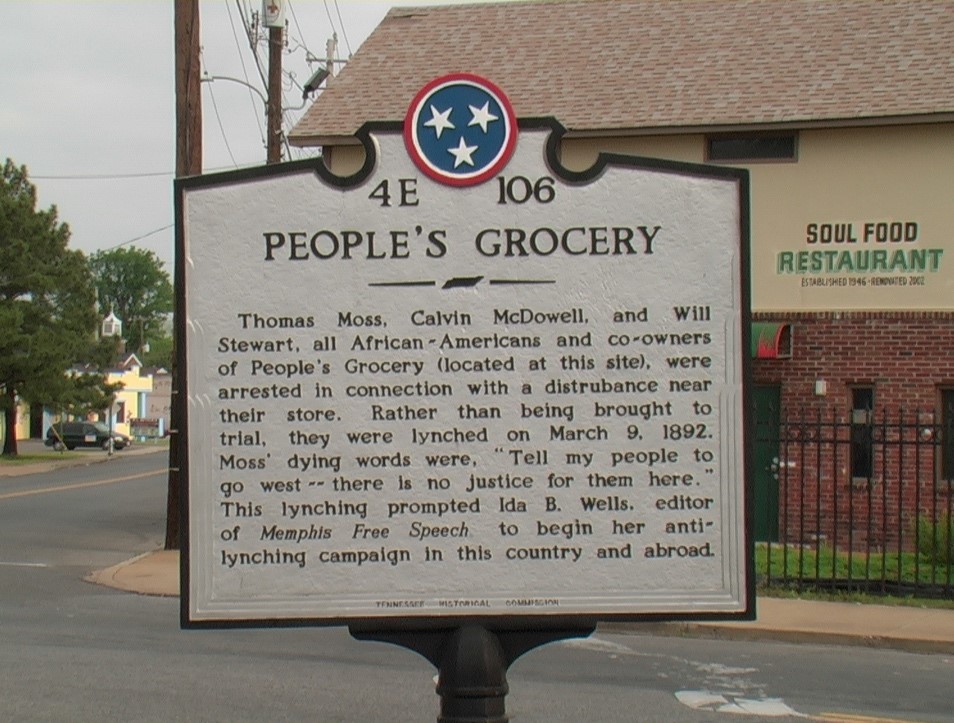
The three men, Thomas Moss, Calvin McDowell, and Will Stewart, had owned a storefront called People’s Grocery that was successfully competing with white businesses in the city. They were attacked and fought back, then were arrested, and subsequently dragged from jail by a white mob and lynched. This prompted Wells, who was also a godmother to Moss’ daughter, to write articles against lynching, and she frequently risked her own life to travel and learn more about killings that occurred in the region.

In 1898, she traveled to Washington, D.C., to present her anti-lynching campaign to then-president William McKinley.

People's Grocery Marker

A marker at the site of the 1892 People’s Grocery lynching. Image courtesy of the Lynching Sites Project, Memphis.

Wells faced violence herself over the course of her reporting – in response to one of her editorials, a white mob stormed her newspaper’s office and destroyed her property there. Wells was in New York at the time, but the incident led to her moving to Chicago, where she continued reporting on lynching for the New York Age; a newspaper helmed by T. Thomas Fortune, who had also been formerly enslaved. In 1892, she compiled her reporting on lynching into a book, titled “Southern Horrors: Lynch Law in All Its Phases.”

Attack on Wells Report

A report of the attack on Wells’ office in Memphis from the Washington Bee, June 11, 1892. Image courtesy of the Library of Congress.

Front Page Wells Book

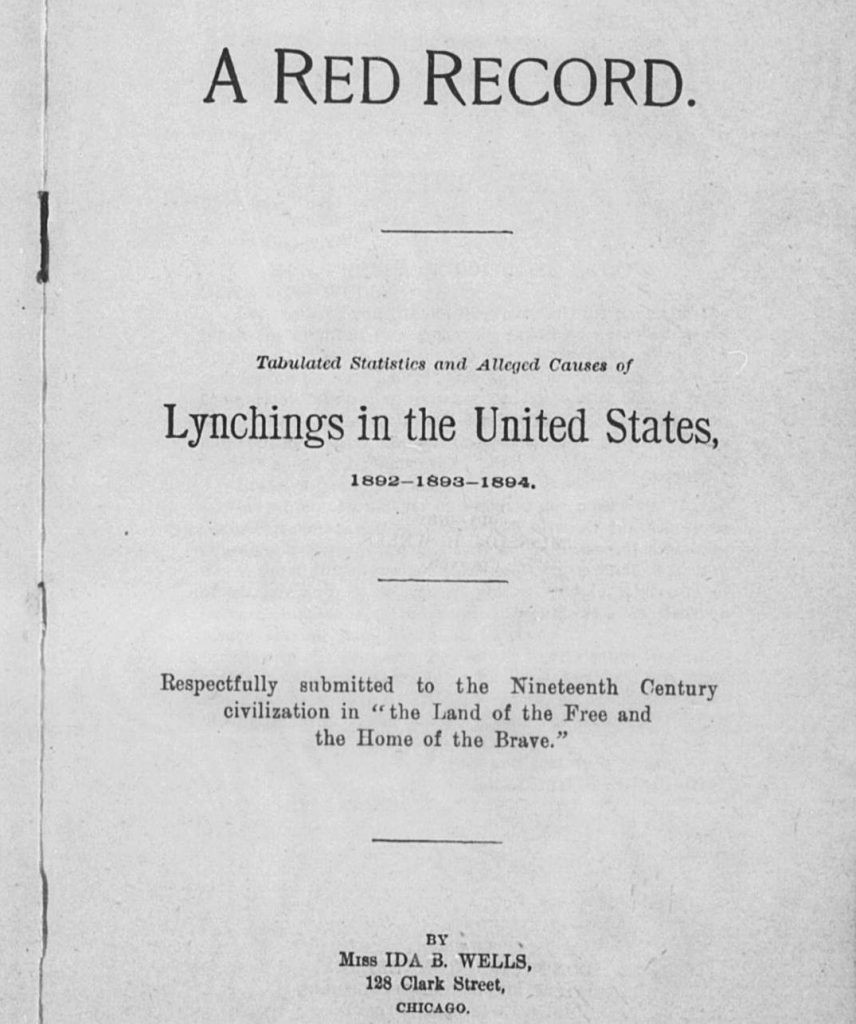
The front page of one of Wells’ books on lynching in the United States, published 1895. “A Red Record” was a follow-up to “Southern Horrors,” and included more statistics and case details. Image courtesy of the Library of Congress.

The Alpha Suffrage Club

In addition to her reporting work, Wells was a founding member of numerous civil rights groups including the National Association of Colored Women and the Negro Fellowship League. She also attended the founding conference of what would later become known as the National Association for the Advancement of Colored People (NAACP).

Wells’ work in advancing the suffrage cause was also prolific. In January 1913, she founded the Alpha Suffrage Club in Chicago, where she also served as president. The club aimed to promote city representatives who would best serve the Black community and who favored suffrage. The Alpha Suffrage Club was crucial in Illinois passing its Equal Suffrage Act on June 25, 1913, which granted women suffrage in the state.

As a result of their efforts, Wells and other members were invited to march in the 1913 Suffrage Parade in Washington, D.C. However, at the parade, Wells and the members of her group were asked to march at the back of the procession by the white parade organizers, to which Wells refused, joining in in the midst of the action.

Profile of Ida B. Wells

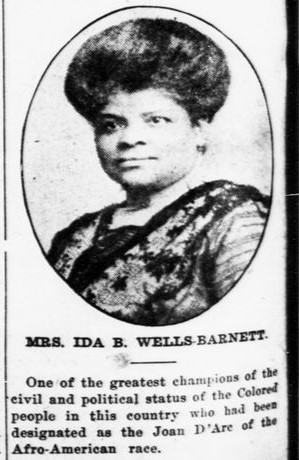
A profile of Ida B. Wells in Salt Lake City’s The Broad Ax, July 14, 1917. Image courtesy of the Library of Congress.

Legacy

Wells died in 1931 but continued her career and life as an activist until the end of her life. In 1929 and 1930, she ran for state senator but was defeated – however, simply running as an African American was unprecedented at the time and her campaign was revolutionary in and of itself.

Wells’ legacy has long been overlooked in the scope of women’s suffrage, civil rights activism, and the progression of investigative reporting in the country. Just this year, she was posthumously awarded the Pulitzer Prize, “For her outstanding and courageous reporting on the horrific and vicious violence against African Americans during the era of lynching.” She is also among those featured in the New York Times’ “Overlooked” project, which highlights individuals who previously were not given the space for an obituary. You can read their retroactive obituary for Wells on their website.

A monument has also been proposed to honor Wells in her longtime home of Chicago.

Ida B. Wells 2

Image courtesy of the League of Women Voters Chicago.

The Library has a number of resources to learn more about Ida B. Wells, as well as some of her original works:

By Ida B. Wells:

  • Mob Rule in New Orleans: Robert Charles and His Fight to Death
  • The Red Record
  • Southern Horrors: Lynch Law in All Its Phases
  • The Memphis Diary of Ida B. Wells

About Ida B. Wells:

  • Ida: A Sword Among Lions, by Paula Giddings
  • To Tell the Truth Freely: The Life of Ida B. Wells, by Mia Bay

2020 marked the centennial of the passage of the 19th Amendment. 

July 15, 2020 by Web Editor

Stories of Arlington’s Activists

Post Published: July 8, 2020

Arlington has a history of dedicated community members fighting against racism, prejudice, and injustice through protests, community organizing, and legal work.

Sitins

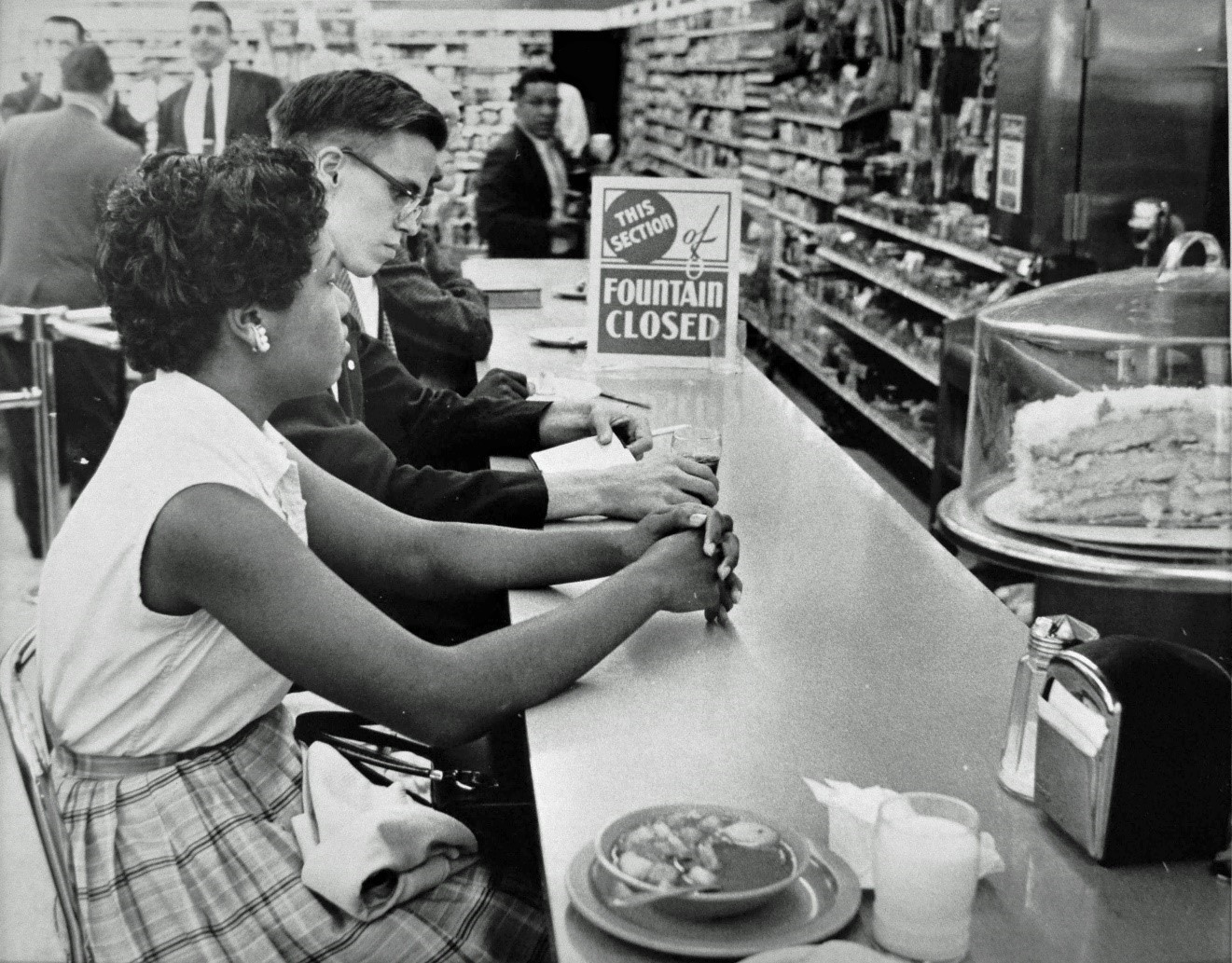
June 10, 1960, Gwendolyn Green (later Britt) and David Hartsough sit at the People’s Drug Store counter. Protests such as this happened at counters in seven locations in Arlington including two in Shirlington. DC Public Library, Star Collection, ©Washington Post. Read more about Shirlington.

Collected here are stories about some of those individuals and groups, told through documents donated to the Center for Local History. This is only a small sampling of stories that make up the history of Arlington’s activist community, and we are dedicated to telling the stories of those who have fought in Arlington’s continued struggles against inequalities.

The CLH invites you to play an active role in documenting our history by donating physical and/or digital materials for the Community Archives.

A Fight for Educational Equality: Civil Rights Activist Dorothy Hamm

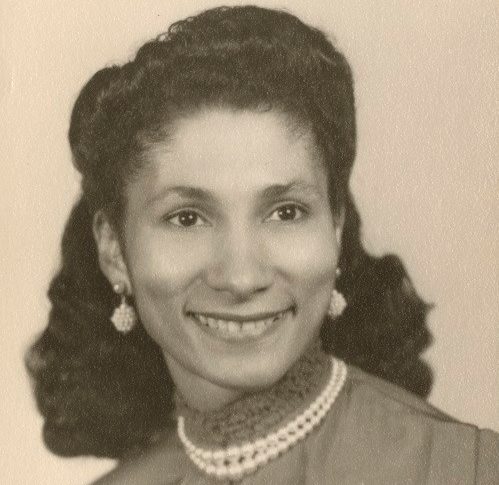
Dorothy Hamm was an Arlingtonian at the forefront of the civil rights movement and leader of the efforts to desegregate the county’s schools and theaters.

Dorothy Hamm Portrait

Image courtesy of Carmela Hamm, from the Library of Virginia.

Excerpt:

In 1956, Hamm, along with her husband, became plaintiffs in the first civil action case filed to integrate the Arlington Public School system. When no action towards integration had been taken a year after the suit was filed, Hamm and her husband took their oldest son, Edward Leslie Jr., to enroll at Stratford Junior High School. They, and other African-American students who attempted to enroll in the still segregated Arlington schools, were denied admission that year. In September 1957, a few days after the opening of the school year, crosses were burned on the lawns of two Arlington families, and at the Calloway United Methodist Church, a central location for organizers in the effort to desegregate the schools, and a site of workshops held by ministers, lawyers, and educators preparing parents and students for school integration.

Over the course of this process, Hamm recalled in interviews many experiences with discrimination and intimidation.

Read the rest of the story.

Oral History: Desegregation of Arlington’s Public Schools

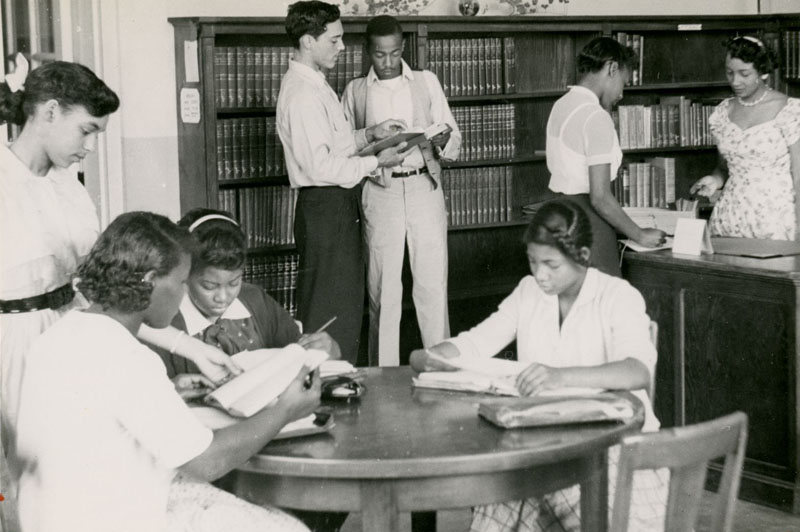
Two stories in this list chronicle the struggle to desegregate Arlington Public Schools told through oral history interviews, historical documents, and legal proceedings.

You can also learn more about the people and events that made up this historic effort in the library’s online exhibition, Project DAPS.

African American students reading in the library

African American students reading in the library.

Excerpt:

In this clip from 1986, Hamm shared her experience trying to register her son for school at Stratford and her activity in lawsuits to desegregate public facilities in Arlington County.

Dorothy Hamm has been honored by the County with the naming of a new middle school in Cherrydale, the Dorothy Hamm Middle School, which opened in September 2019.

Read the rest of the story.

The Story of Arlington Public School Desegregation

black and white photograph of 4 black students entering Stratford Junior High in 1959

Ronald Deskins, Michael Jones, Lance Newman, and Gloria Thompson walked into Stratford Junior High School on February 2, 1959.

Excerpt:

At 8:45 a.m. on February 2, 1959, four young students from the nearby Hall’s Hill neighborhood entered Stratford Junior High School in Arlington, Virginia.

When they stepped into Stratford that day, they became the first students to desegregate a public school in the Commonwealth of Virginia.

Many Arlingtonians know that theirs was the first county in Virginia to desegregate. It is a point of pride. But it’s not the whole story.

Read the rest of the story.

“If You Don’t Vote, You Don’t Count”

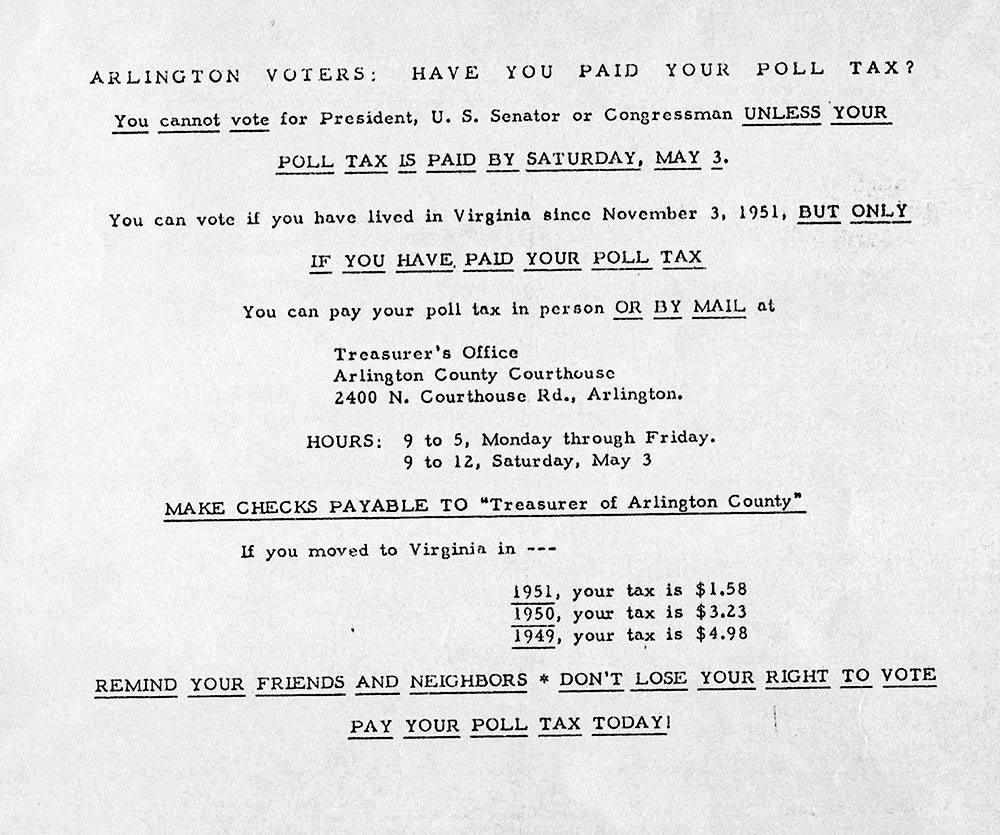
“If You Don’t Vote, You Don’t Count” looks at the poll taxes imposed to restrict voters and prevent African Americans from voting in the county, and the actions taken by local activists to combat this voter suppression.

1951 Flyer reminding voters to pay their 1951 Pol Tax

1951 flyer telling Arlington residents how to pay their poll tax in order to vote in the upcoming election.

Excerpt:

In 1876, after the Fifteenth Amendment granted African-Americans the right to vote, Virginia passed a poll tax to restrict African-American men from voting. Although this law was repealed in 1882, in 1901 the Virginia General Assembly called for a new constitution with the explicit purpose to secure the right of suffrage of the state's white men, and to take away the right to vote from anyone in the state who wasn't white.

The new constitution, which passed in 1902, reinstated the poll tax. This required voters to pay a tax of $1.50 six months prior to an election for each of the three years preceding an election. This disenfranchised approximately 90% of the black men and, counter to the intentions of those who had drafted the new constitution, nearly 50% of the white men who had previously been registered to vote in Virginia. The 1902 constitution also created an administrative structure that was difficult for any average citizen to navigate, further disenfranchising many poor men.

Read the rest of the story.

Our Back Pages: Arlington’s Own Declaration of Civil Rights

Next, read about efforts to continue the efforts of desegregation beyond the schools when a group of Arlington activists drafted their own Declaration of Civil Rights.

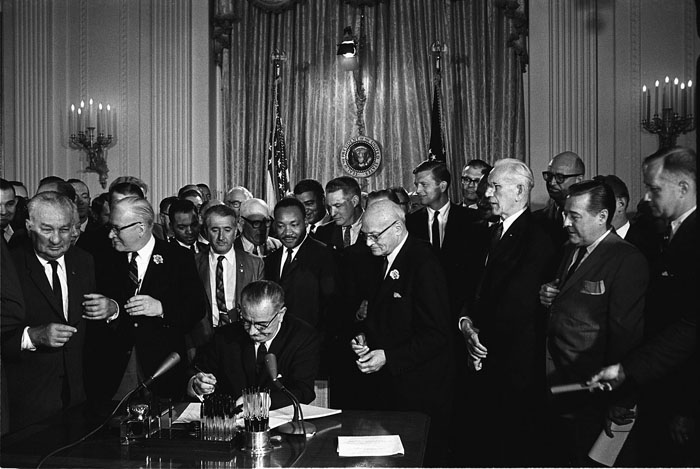
President Lyndon B. Johnson signs the Civil Rights Act of 1964 into law as various Civil Rights leaders look on, including the Reverend Martin Luther King, Jr. Photo courtesy of the LBJ Library, photo by Cecil Stoughton .

President Lyndon B. Johnson signs the Civil Rights Act of 1964 into law as various Civil Rights leaders look on, including the Reverend Martin Luther King, Jr. Photo courtesy of the LBJ Library, photo by Cecil Stoughton.

Excerpt:

Published just a little over a year after Arlington became the first school district in Virginia to desegregate, this document is a powerful reminder that despite those four students integrating Stratford Junior High in 1959, segregation in Arlington was still far from over. Many institutions in Arlington remained segregated, and this document specifically enumerates some of them: from sit-down restaurants and movie theaters to maternity wards, to playgrounds and pony rides for children.

Item six contains one of the leaflet’s most powerful observations: “It is the uncertainty about so many aspects of his life that is trying for a Negro in Arlington. Some years ago he knew exactly what his limitations were. He didn’t like being limited but he knew what to expect. Now he is tired of being unknowing about his status.” In the years leading up to the passage of the Civil Rights Act in 1964, this was indeed the reality for many Blacks in the South.

Read the rest of the story.

To learn more about Arlington's history, visit the Center for Local History on the first floor of the Central Library.

Do you have a question about this story or a personal experience to share? 

Use this form to send a message to the Center for Local History.

Center For Local History - Blog Post Message Form

Do you have a question about this story, or a personal experience to share? Use this form to send a message to the Center for Local History.

"*" indicates required fields
This field is for validation purposes and should be left unchanged.

Share Your Story

July 8, 2020 by Web Editor

Arlington Public Library Eliminates Overdue Fines

Post Published: July 7, 2020

Minimizing Barriers to Using the Library

As of July 1, Arlington Public Library eliminated overdue library fines to make the library’s collections accessible to all Arlingtonians and library patrons. The goal is to increase access to and minimize barriers for marginalized populations to use the library, particularly for youth and low-income patrons.

“Every member of our community has a right to library services and library fines and fees are known barriers to use. We are pleased that we can eliminate these long- standing barriers and continue our mission to reach everyone regardless of their socioeconomic background,” says Diane Kresh, Director of Arlington Public Library.

The elimination of fines will reduce the Library fine budget by an expected $155,000 in anticipated revenue to $10,000 in FY 2021. The $10,000 remains in the budget due to the continuation of replacement fees for lost items.

Borrowing

Patrons will be able to borrow an item for up to twelve weeks if no other patron has placed a hold or up to 3 weeks if another patron has a hold on the item.

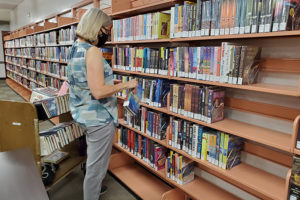
Library staffer adding back books to a shelf.

If the item is not returned at the end of the loan period, a grace period of twenty-eight days will come into effect. The patron will not accrue overdue fines during the twenty-eight days. If the item is not returned by the end of the grace period, the item is considered lost and a replacement fee will be charged. If a replacement fee is charged and the item is later returned, the fee is reversed. The replacement fee is dependent on the cost of the book.

Going forward, patrons who either lose or fail to return items to the Library will be assessed a replacement fee that will affect their ability to borrow, renew, place holds on materials, or log in to premium sites, such as Consumer Reports until the fee has been paid or the item has been returned.

Patrons with existing fines will still need to pay those. During the library closure, no fines were accrued for checked-out items.

Paying Fines

  • By phone at 703-228-5260; Monday through Friday between 9 a.m. - 2 p.m.
  • By mail with a check or money order mailed to Central Library, Attention: Circulation, 1015 N. Quincy St, Arlington, VA 22201
    • Please include the library card number with the payment and make the check payable to “Treasurer of Arlington County.”

To find out more about borrowing, loan periods and renewals, visit the accounts information page.

July 7, 2020 by Library Communications Officer Tagged With: news release archive

The Census: Then & Now

Post Published: June 25, 2020

The 2020 census is currently underway nationally – but what did the census look like in the past?

The U.S. census is a ten-year event in the United States, as stipulated in the constitution in Article I, Section 2, empowering Congress to carry out the census in “such manner as they shall by Law direct.” Every decade, each household gets a chance to count themselves, contributing data that determines nearly $1 trillion of funding that is distributed on the local level as well as congressional apportionment.

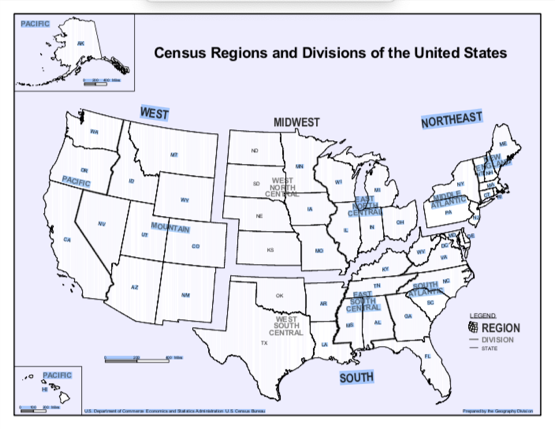
Census Regions Map

Image courtesy of the U.S. Census Bureau.

Early Censuses

The first U.S. census was taken in 1790 and counted 3.9 million residents in the whole of the country. The census has occurred every 10 years since – making it one of the very first and longest-lasting actions made by our early government. The early censuses were conducted by assistant U.S. marshals who were instructed to “make a just and perfect enumeration and description of all persons … according to the best of [their] ability.” Virginia is part of Region 3, Division 2, of the census’ designated statistical regions and is part of the South Atlantic group. Arlington was part of the first 1790 census, however, the residents of what is now Arlington County would have been counted under the regional designation of Fairfax County.

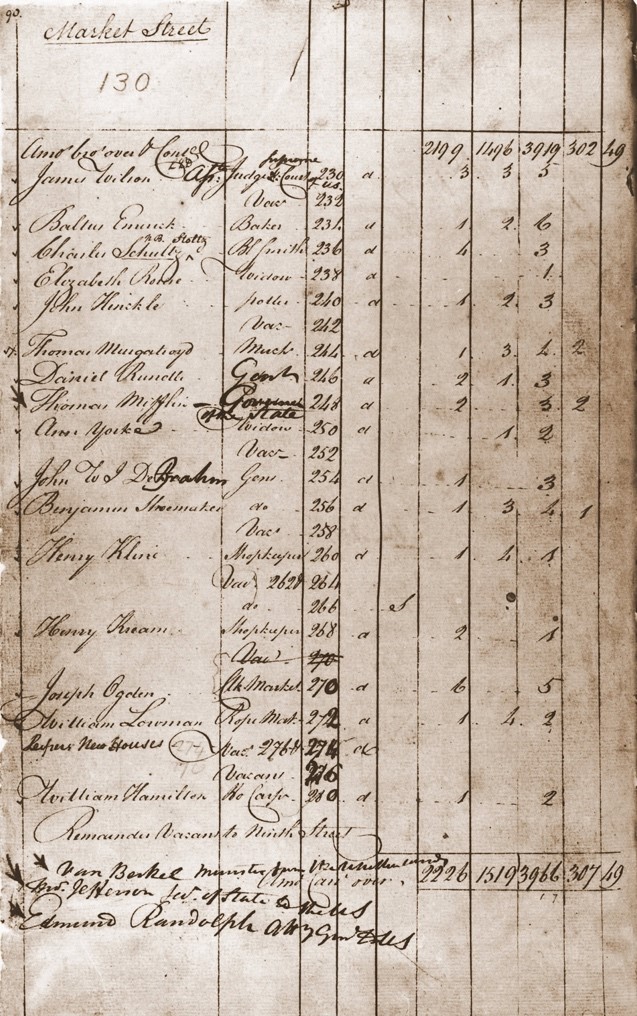
Census Records

A census enumerator’s records from the 1790 census. Image courtesy of the U.S. Census Bureau.

Although you can now take the census by multiple methods, early copies of the census were completed exclusively by paper. Early iterations of the census show a much different set of questions that are now included in a modern-day census.

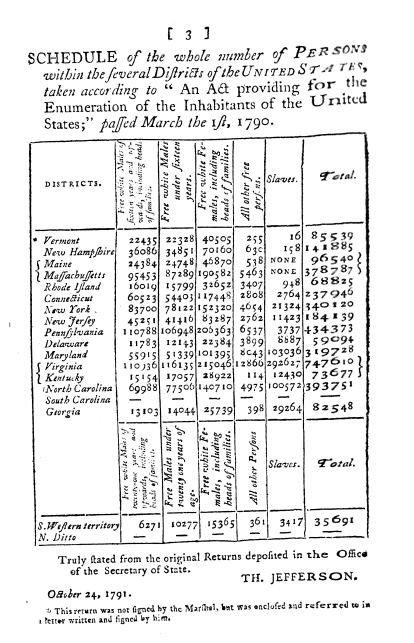
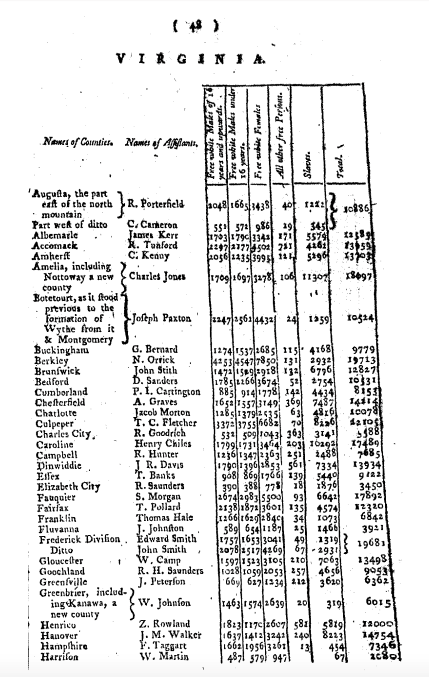
There were only six questions on the first census – the name of the white, male householder, and then the names of all the other people in the household, divided into these categories: Free white males who were at least 16 years old; free white males who were under 16 years old; free white females; all other free persons; and slaves, who under the constitution were counted as three-fifths of a person. These questions highlight the fundamental inequalities that determined life at this point in U.S. history and are cause to reflect on who was counted, how they were counted, and who got to do the counting – all important questions when evaluating census data from a historical lens.

1790 Census 1
1790 Census 2

Excerpts from the 1790 census highlighting Virginia. Image courtesy of the U.S. Census Bureau.

Changes to the Census

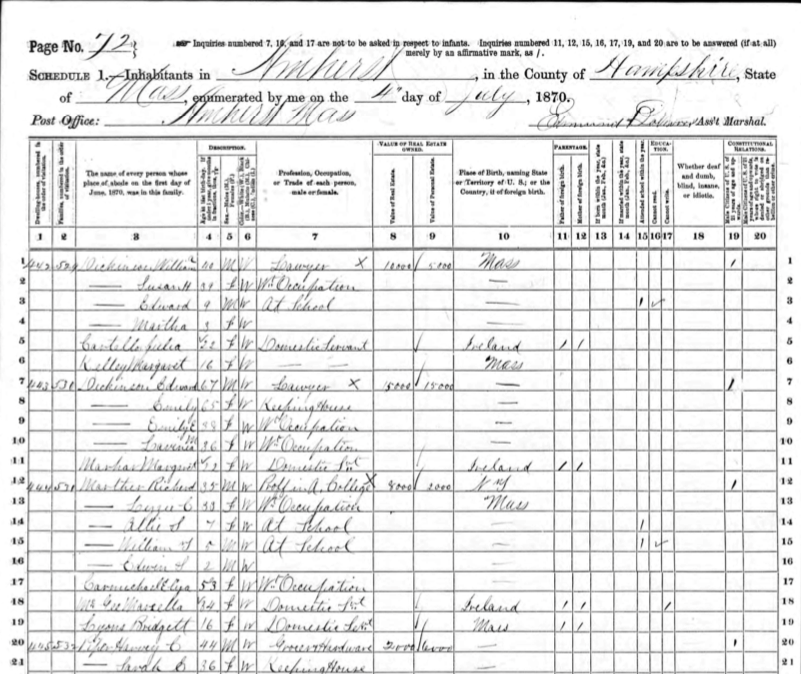
Over the years, the census has changed its format and its questions. The 1870 census was the first to eliminate what was called the “slave questionnaire,” and was reordered after the conclusion of the Civil War to only include schedules for "General Population," "Mortality," "Agriculture," "Products of Industry," and "Social Statistics."

The census only started counting Native Americans in 1860 and started including Native Americans living on reservations in 1890. Other racial categories on the census also developed into the latter half of the 19th century as immigration from non-European countries increased. These categories are an ever-developing part of the census and continue to diversify today. (For a more detailed look at how the U.S. census has historically measured race in the U.S., Science News has an overview of some of the key changes the census has seen.)

1870 Census

An example of an 1870 census schedule. Image courtesy of the U.S. Census Bureau.

Some other technical changes have occurred over the years as well: the 1810 Census collected economic data on the quantity and value of manufactured goods, expanding for the first time on the original six questions. In 1850, the census began collecting "social statistics,” such as information about taxes, education, crime, and value of estate, and mortality data. In 1940, in response to the devastation of the Great Depression, additional questions were asked of a sample of the population, including questions on internal migration, veteran status, and the number of children ever born to women. In recent decades, the census has turned toward more simplified forms – the 2000 census was the shortest since 1820, with only seven questions on the short form, and this trend has continued up to today.

Other changes over the years have included the methods of taking the census: the 1960 census was the first census to be mailed out to households and was the first year the census results were counted by computer. This year’s census is the first with the option to complete the form by phone or online.

Another historical development to this year’s census is it is the first to include a question about same-sex relationships, where respondents can identify as “same-sex husband/wife/spouse” or “same-sex unmarried partner.”

Census Taker 1920

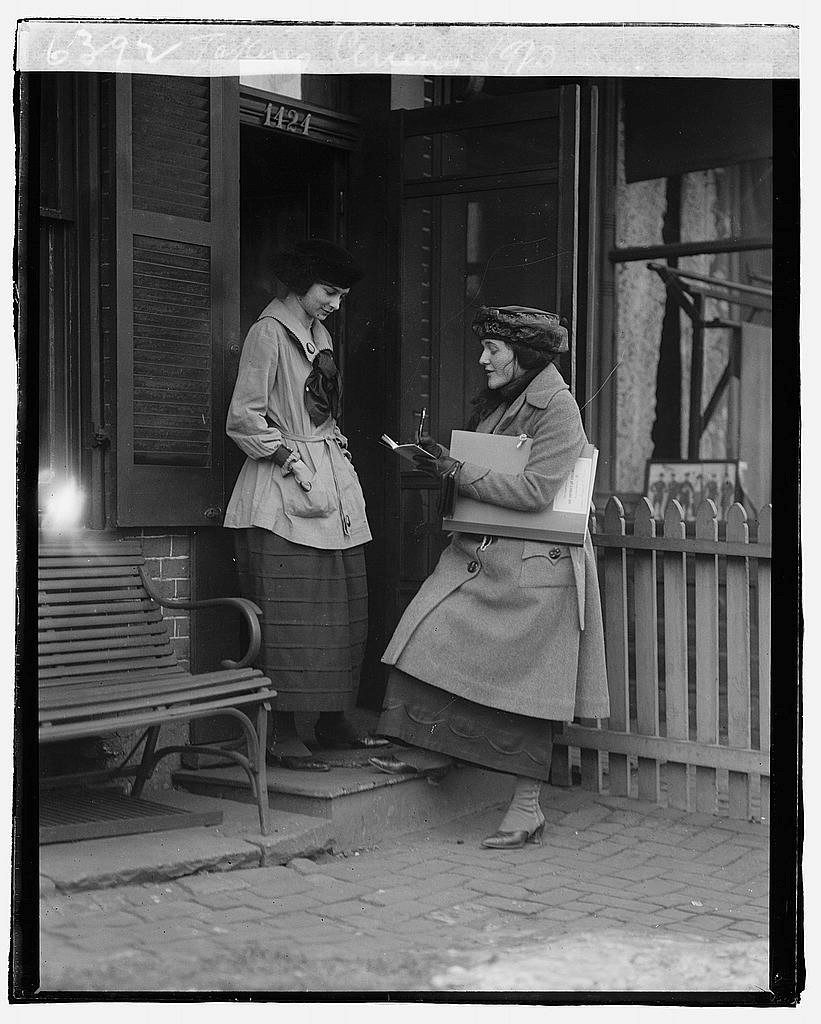
A census-taker circa 1920. Image courtesy of the Library of Congress.

Want to learn more? You can explore historical census data through the county going back to 2000. This site also includes maps and other data related to the history and demographics of Arlington. You can also search through historical census documents through the National Archives’ digital collections.

Do you have a question about this story, or a personal experience to share? 

Use this form to send a message to the Charlie Clark Center for Local History.

Center For Local History - Blog Post Message Form

Do you have a question about this story, or a personal experience to share? Use this form to send a message to the Center for Local History.

"*" indicates required fields
This field is for validation purposes and should be left unchanged.

Share Your Story

June 25, 2020 by Web Editor

A Change is Gonna Come: A Playlist for Black Lives Matter

Post Published: June 18, 2020

From the Library Director

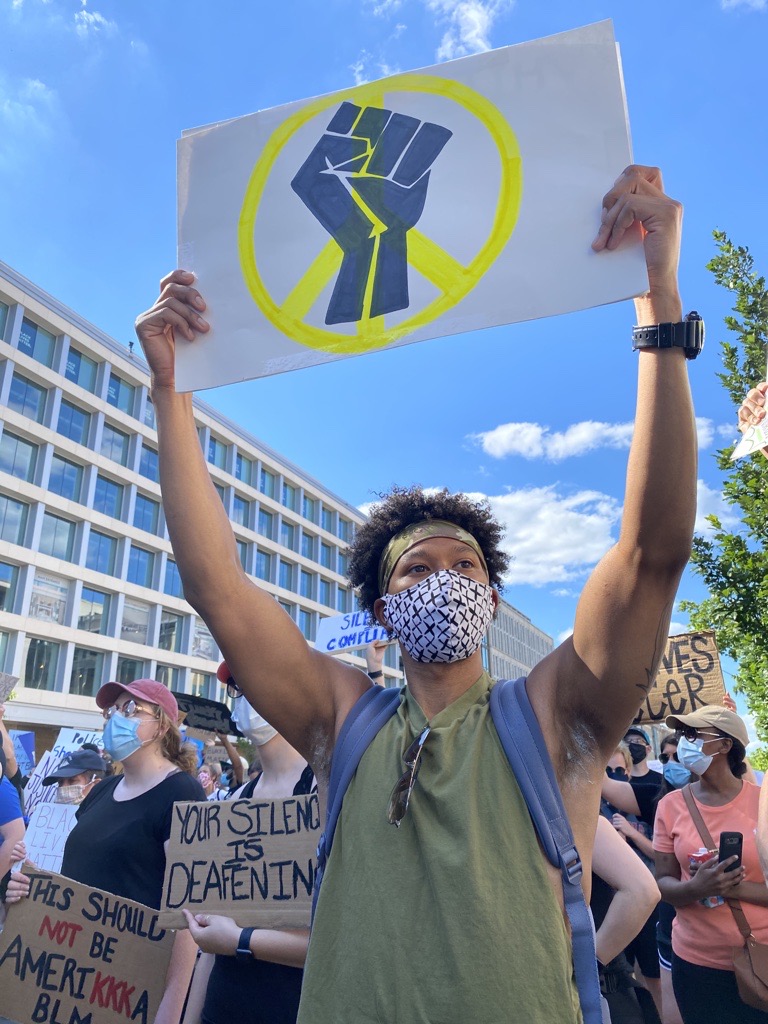
Signs

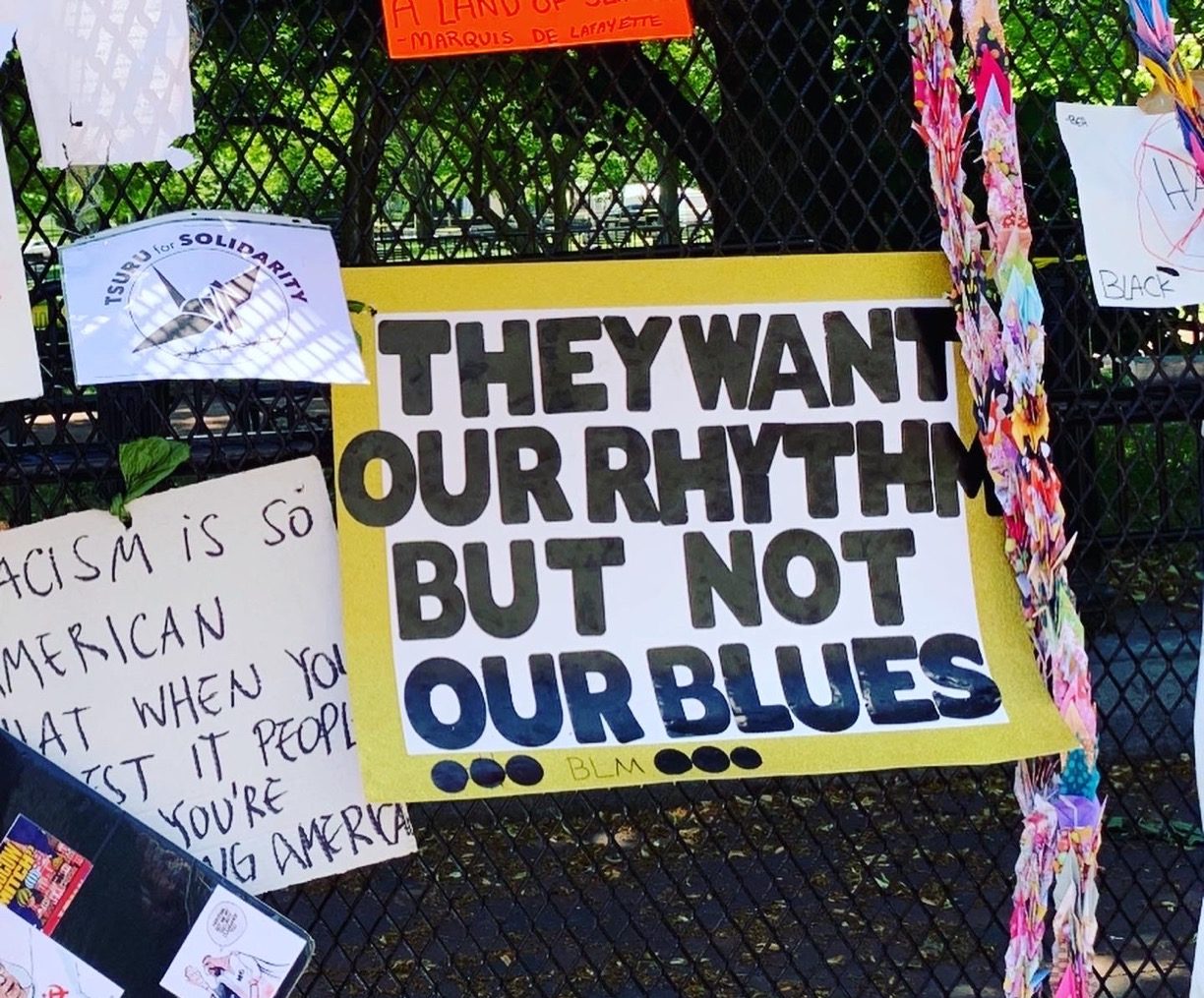
Sign photographed on the wall surrounding the White House at Black Lives Matter Plaza.

When I was attending Arlington Public Schools in the 1960s and early 1970s (Yorktown High School Class of 1972), I didn’t learn about Juneteenth, the date commemorating the emancipation of enslaved people in the United States. I didn’t learn about the 1921 Tulsa Race Massacre, either. And the study of literature by African-American authors had only just begun with works like “Blues for Mister Charlie” by James Baldwin.

As Director of Arlington Public Library, I have an opportunity each day to ensure dates in our history like those cited above are recognized and understood through our collections and programs and through modeling the Library’s values of acceptance and inclusion.

From time to time, we have created music playlists to capture a moment. Many of you are familiar with my annual holiday playlist. When the pandemic hit, we created “Dancing with Myself: Playlist for a Pandemic.”

Now, with conversations about race front and center across the nation, we turn again to music.

Music heals, music unites, and music can change minds.

Black Lives Matters

Black Lives Matter Plaza, June 7.

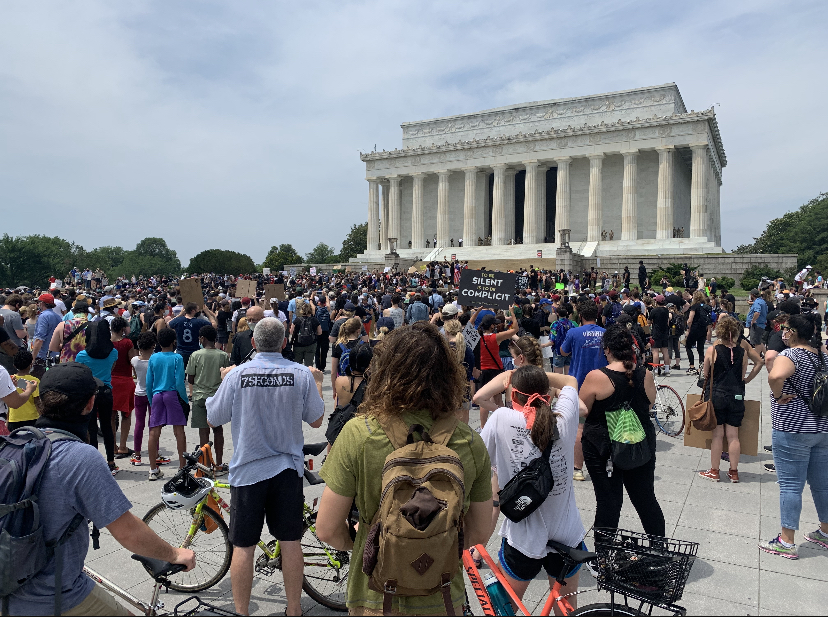
Lincoln Memorial

Protesters gathered at the Lincoln Memorial, June 6.

The late great First Lady of Soul, Aretha Franklin, who knew something about music, once said, “Music does a lot of things for a lot of people. It's transporting, for sure. It can take you right back, years back, to the very moment certain things happened in your life. It's uplifting, it's encouraging, it's strengthening.”

So with those words in mind ... press play and play it loud and proud.

Open playlist in Spotify

Diane K.

Scrawled signature of Diane Kresh

June 18, 2020 by Web Editor

Rediscover Shirlington

Post Published: June 18, 2020

Before European colonization, a Necostin Native American village was located on the land near the current Village at Shirlington shopping center.

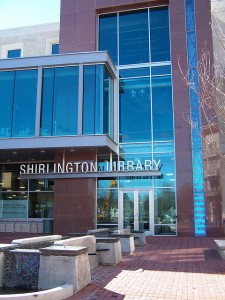
Shirlington Library

Shirlington Branch Library, circa 2007.

On January 21, 1705, William Struttfield, one of 48 original settlers who owned land in present-day Arlington, patented a 543-acre tract south of Four Mile Run that included what is now Shirlington. He sold the land to Colonel John Carlyle and it stayed in the Carlyle family into the mid-19th century.

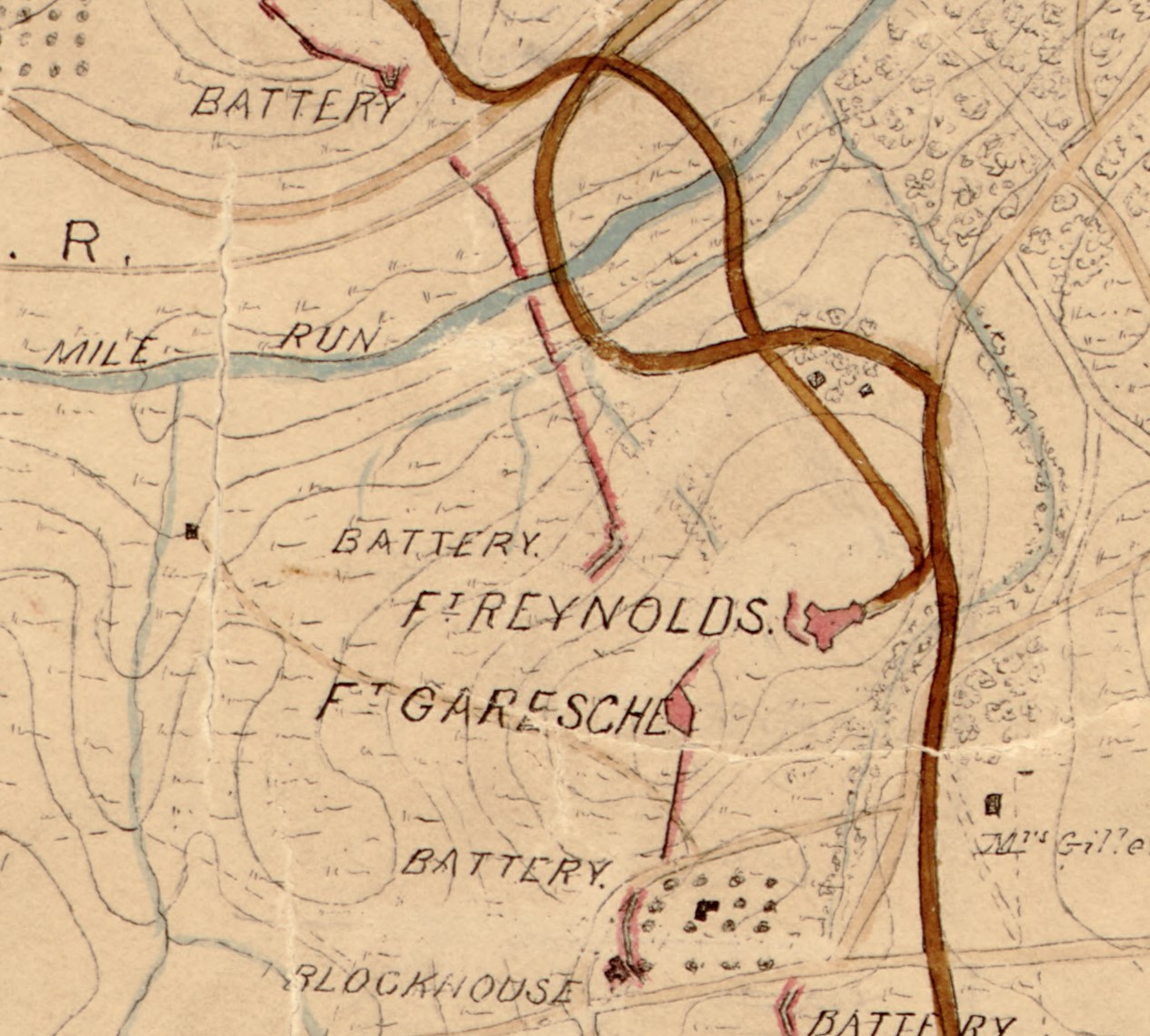
The hill southwest of present-day Shirlington served as a fortification within the Defenses of Washington that were erected by Union forces during the Civil War. Fort Blenker, later renamed Fort Reynolds, was built in 1861 and selected by the Union due to the view it afforded of the valley along Four Mile Run.

Shirlington Forts

Map of the Environs of Washington: Compiled from Boschkes’ Map of the District of Columbia and From Surveys of the U.S. Coast Survey showing the Line of Defenses of Washington as Constructed during the War from 1861 to 1865 Inclusive. The red arrow points to Fort Reynolds and the blue arrow points to the approximate present-day location of the Village at Shirlington. Source: Library of Congress.
Joseph Cherner, a Jewish immigrant from Russia with a successful car dealership and repair shop, considered opening an airport near Four Mile Run but decided to invest in a shopping center instead. He purchased 200,000 cubic yards of fill to raise the grade by as much as 13 feet, channelized two creeks, and constructed roads and alleyways through the property. Cherner attracted new businesses to the development by offering tenants very low rental rates in exchange for a percentage of the businesses’ profits. He combined the names of nearby Shirley Highway (Interstate 395) and Arlington to name the area. The proximity to this still-under-construction roadway was meant to promote traffic to the new shopping center.
The shopping center opened in December 1943, with a supermarket, gift shop, clothing cleaners, beauty parlor, and shoe repair shop in one-story storefronts of limestone and granite construction with Art Deco architectural detailing. The layout of the streets was as it is now, with the shops facing each other across a central median. More stores opened in 1944, including a Gulf filling station which is likely the extant gas station but with substantial changes

While stores allowed African Americans patrons to shop, they were barred from services, such as eating at lunch counters and restaurants and using leisure facilities. This was particularly difficult for residents of Fort Barnard Heights and Green Valley, the primarily African American communities next to the shopping center.

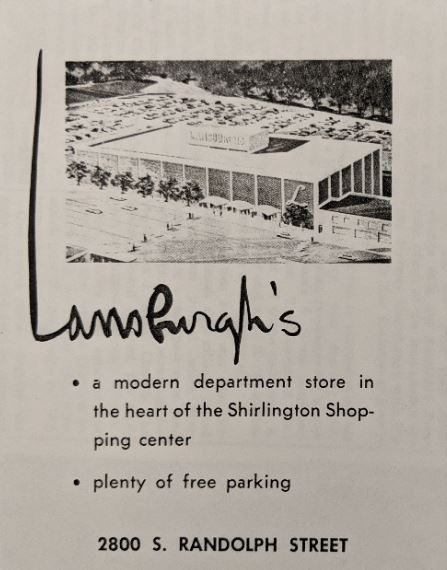
Following Joseph Cherner’s death in 1956, his wife Ruth (née Schlom) Cherner, assumed the role of the president of the Shirlington Corporation. She led the company through a land swap with Arlington County’s Property Yard in May 1957 that increased acreage at the north boundary of the Shirlington Business Center by seven acres. She became a prominent businesswoman in the Arlington real estate market. Lansburgh’s Department Store opened in September 1959 on the former Property Yard land and served as a new retail anchor for the shopping center.

1962 Arl Blu Book

Bird’s eye view rendering of Lansburgh’s Department Store at the Shirlington Shopping Center, 1962. Source: Arlington Blu Book, 1962, Center for Local History Archives, Arlington County Public Library.

In January 1960, the Nauck Citizens’ Association (a precursor to the present-day Green Valley Civic Association) proposed a business district along South Shirlington Road to offer services to people of color. This business area would include a motel, theater, restaurant, bowling alley, and office space for professional services. Lutrelle F. Parker, chairman of the Nauck Citizens’ Association, asserted that they did not intend for the business center to detract from desegregation efforts that were currently being undertaken throughout the south. Rather the citizens’ group aimed to supply necessary services to African American citizens until other commercial areas were desegregated.

In June 1960, spurred by protest movements across America, black and white college students held sit-ins at lunch counters around Arlington including Lansburgh’s Colonial Room and Woolworth’s lunch counter in Shirlington. Both businesses responded by closing their counters. After negotiations between demonstrators and business owners, Woolworth’s in Shirlington was the first lunch counter to desegregate on June 22, serving a group of black and white students. Woolworth’s action was followed that same day as Lansburgh’s, Kahn’s, Peoples, and Drug Fair desegregated their Arlington restaurants.

Sitins

June 10, 1960, Gwendolyn Green (later Britt) and David Hartsough sit at the People’s Drug Store counter. Protests such as this happened at counters in seven locations in Arlington including two in Shirlington. DC Public Library, Star Collection, ©Washington Post.

The popularity of Shirlington declined in the mid-1960s and into the 1970s with the opening of several new shopping centers. In the early-1970s, Shirlington Business Center saw the closure of many of its anchor retail stores. Jelleff’s closed in 1972, followed shortly by Lansburgh’s (which was replaced by Best Products) and the Shirlington Motor Company’s Ford dealership, both in 1973.

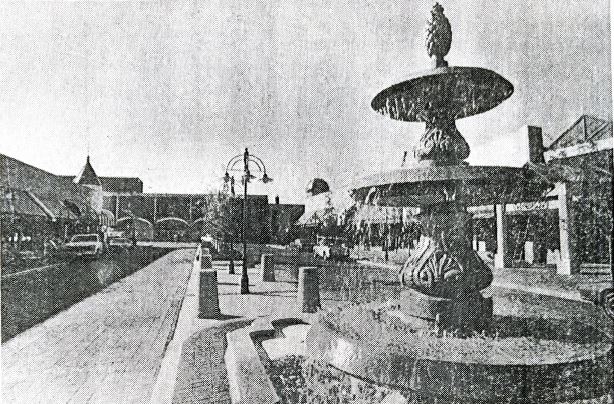
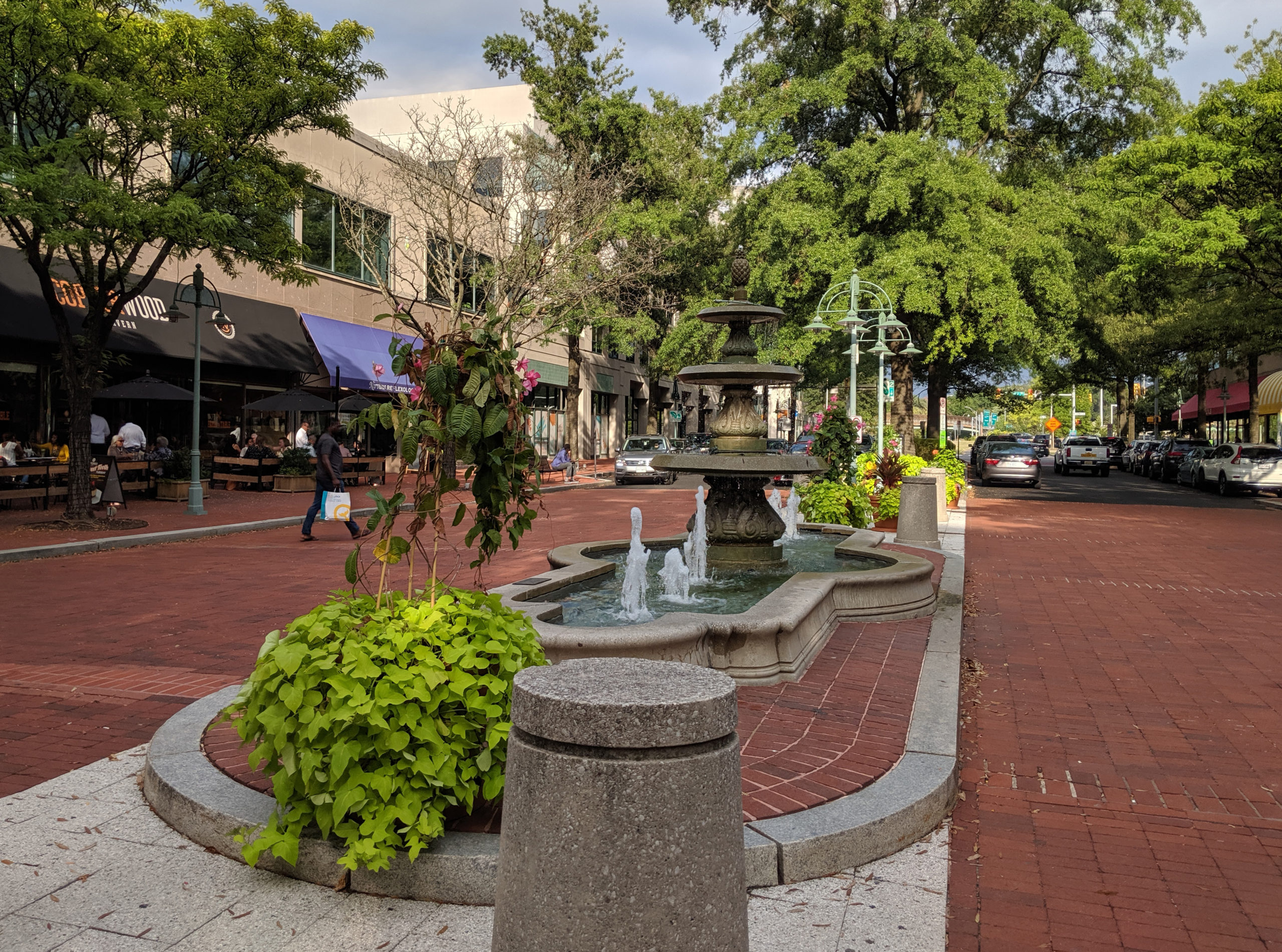
Several revitalizations were considered, including one featuring a manmade lagoon. The owners abandoned this project before construction began. In July 1982, a new $250-million renovation began, led by developer Oliver T. Carr. Carr’s plan called for up to 429,000 square feet of additional retail space and 694,000 square feet of office space in 8- to 12-story buildings. It also included the construction of a 400-room hotel and 590 condominium units. The limestone and granite façades of the existing buildings were reused while most of the ground level architecture and all the interiors were demolished. The 1987 finished design included copper turrets and domes crowning the buildings at the entrance off South Randolph Street, Victorian-era inspired street lighting, cut-throughs for increased pedestrian circulation, and a large Beaux-Arts fountain in the central median.

1986-11-1

Redesigned 28th Street South (renamed Campbell Avenue in 2007), 1986. Source: Benjamin Forgey, “In Shirlington, Main Street Revisited,” The Washington Star, November 1, 1986, Center for Local History Archives, Arlington County Public Library.

Federal Realty Investment Trust purchased what is now known as the ‘Village at Shirlington’ in 1996. In November 2006, the new Shirlington Town Center was unveiled, including the Shirlington Branch Library and a new location for the Signature Theatre Company. In July 2007, the County changed the name of 28th Street South to Campbell Avenue in honor of Edmund and Margaret Elizabeth Pfohl Campbell, who were instrumental in desegregating Arlington’s public schools. Elizabeth Campbell founded and was later president of WETA public broadcasting station, located in Shirlington.

Joseph and Ruth Cherner’s 1943 vision is still a destination shopping location in Arlington. The popularity of this neighborhood hub is evidence of the Cherners’ shrewd perception of the retail services the community needed.

IMG_20190906_173948

View of the Shirlington shopping complex looking east from the median on Campbell Avenue, 2019.  Source: Arlington County Historic Preservation Program.

"Preservation Today: Rediscovering Arlington" is a partnership between the Arlington Public Library and the Arlington County Historic Preservation Program.

Preservation Today: Rediscovering Arlington
Stories from Arlington’s Historic Preservation Program

Arlington’s heritage is a diverse fabric, where people, places, and moments are knitted together into the physical and social landscape of the County.

Arlington County’s Historic Preservation Program is dedicated to protecting this heritage and inspiring placemaking by uncovering and recognizing all these elements in Arlington’s history.

To learn more about historic sites in Arlington, visit the Arlington County Historic Preservation Program.

June 18, 2020 by Web Editor

Happy Pride…

Post Published: June 8, 2020

We Have Work To Do

Happy Pride. Or not really.

In one of those simple twists of fate, we celebrate the start of Pride Month as the nation-wide, largely peaceful assemblies against racial inequity enter their third week, in the midst of a global pandemic that has already claimed more than 400,000 lives, including more than 100 in Arlington.

And as if that were not enough, the forcible removal of a Pride flag from the DHS building at Sequoia last week by a visitor to that building is a reminder that we have work to do — as individuals, as a community, and as a nation — to promote and visibly demonstrate understanding and acceptance.

During my tenure as Library Director, I have been accused of promoting the “gay agenda” and “deviant sex” when our buildings have flown the Pride flag. We have been threatened with the destruction of Library property. And, perhaps saddest of all, we have discovered the defacing of library books - books acquired to explain to our young people that there are many kinds of families, and there is not one right way to love another person.

Being gay is not “a thing” to be derided and disrespected, any more than being black or brown or Muslim or female is a thing. It is who we are: as we are also parents, sports figures, artists, educators, law enforcement, elected leaders, citizens. Each of us has and will continue to make important contributions to our communities and to our nation. And we deserve to do so openly and without fear.

That is my wish for this month and every month.

Diane

Scrawled signature of Diane Kresh

Diane Kresh
Director
Arlington Public Library

June 8, 2020 by Web Editor

Rediscover The Arlington Post Office

Post Published: May 28, 2020

If you live in Arlington County, you have the Arlington Post Office in Clarendon to thank for the name of your street.

APO2

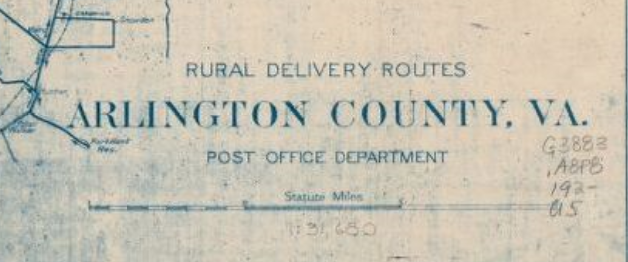
Arlington County Rural Delivery Routes, Library of Congress, 1920.

After the boom of World War I, Arlington’s previously bucolic countryside began to develop into small sleeper communities, off-shoots from Washington, D.C. The rural roadways of Arlington evolved organically, along with the neighborhoods. They took unexpected turns, dead-ended, and had different names from one end to the other, using local neighborhood names rather than official ones. Among the more than 200 duplicate roads in Arlington in 1930, there were eight Arlington Avenues and two Arlington Streets, five Cedar Streets, five Maple Streets, three Hamilton Avenues, and ironically, two First Streets.

Much of the County was served by rural mail delivery from the Georgetown post office in Washington, whose service was unreliable partly because of the disconnected, changing, and unpredictable Arlington street names. The U.S. Postal Service required clear enumeration systems for properties to provide dependable service, so Arlington established a committee of citizens to create a coherent street naming system. This also provided an opportunity for the County to create a unified sense of identity for all its residents.

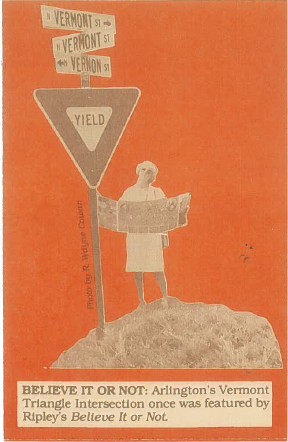
In September 1934, Arlington changed its street names to embrace an alphanumeric system which had latitudinal streets taking numeric names, and longitudinal streets taking alphabetical and syllable-based names. Since the County had not developed strictly along a grid system, many streets did not fall within this pattern, so some allowances were made for major thoroughfares whose names did not follow this standard.

This standardization of Arlington’s street names paved the way for a county-wide postal system, and within two years the sum of $200,000 was allocated for a new postal building whose service would cover everywhere from Georgetown to Glencarlyn. The land was purchased for $24,850 in August 1936 (equivalent to roughly $3.7 million in 2020) and by the end of that year designs for the building were already underway. Louis A. Simon, Supervising Architect of the Treasury, was the highest authority on the project; however, there were so many individual designers on the plans that no one author could be identified.

APO1

From a guide on Arlington’s complicated street system, Arlington County Department of Public Works “Arlington County Street Naming System,” September 1984.

The construction of the Post Office - first federal building in Arlington County - attracted a lot of attention. Thousands of people attended the May 1937 ceremony for the laying of the cornerstone after watching a 40-float parade. The Postmaster General, James Farley, and Arlington’s Congressman, Howard Smith, watched as the cornerstone was laid with same trowel that was used to lay the founding stone of the U.S. Capitol and Washington Monument.

The Sun noted on May 7, 1937, “The fact that Uncle Sam decided it was time to build us a ‘real’ post office means we are not the only ones who think we’re an important community.”

Construction moved quickly, and the office opened for business on December 13, 1937.

Boundary marker ceremony, 1937

Laying the cornerstone for the Arlington Post Office, S.I. Markle, 1937. Courtesy of the Arlington Historical Society.

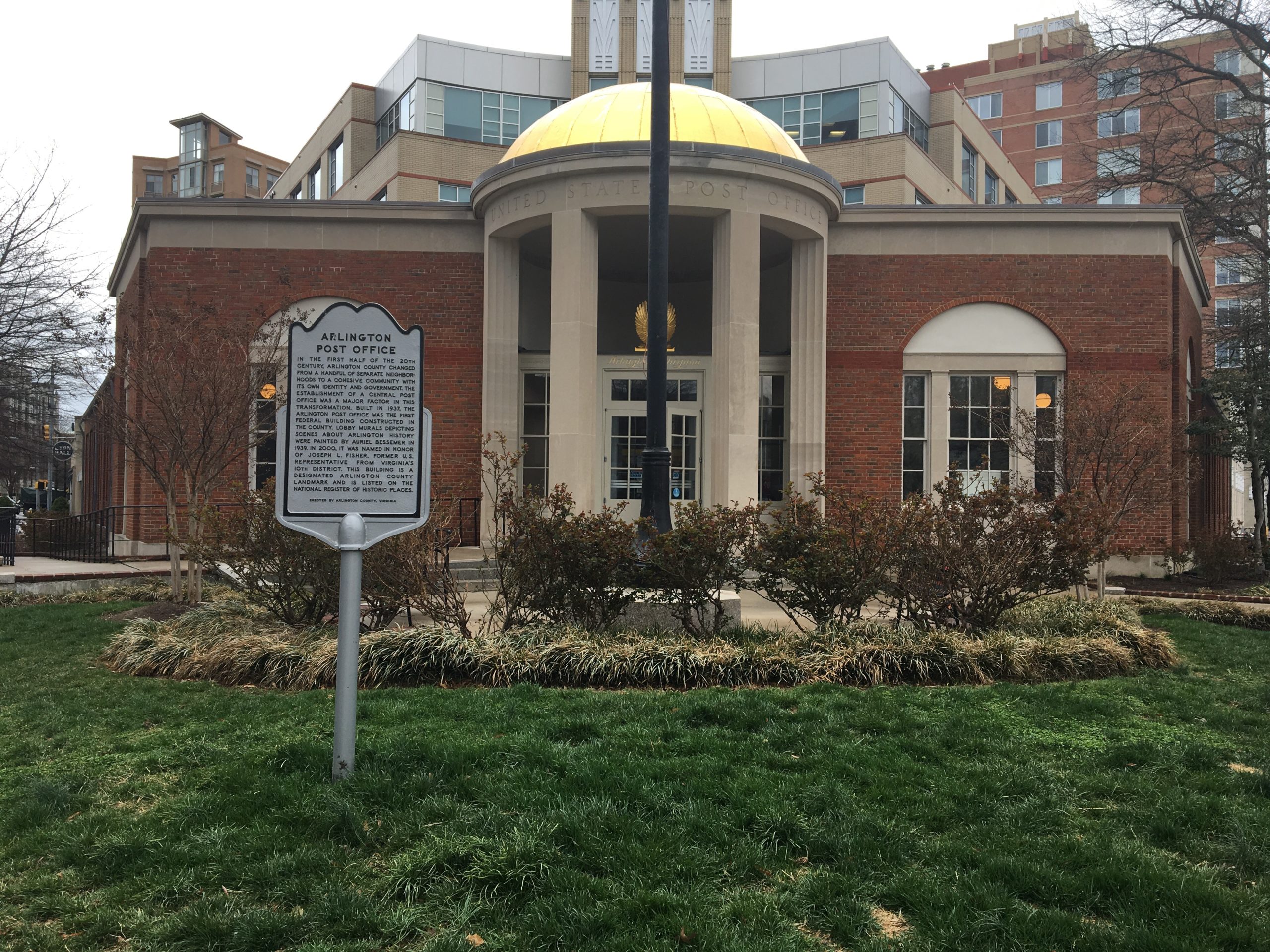
The architectural style of the Arlington Post Office (APO) is considered Georgian Revival, which is characterized by exaggerations and adaptations of the 18th-century Georgian style popular in New England. The Georgian style was denoted commonly by two-story rectangular buildings with five window/door openings on each floor and decorative embellishment around the central door.

The APO building is a common bond brick single-story with a full basement. The domed portico is a signature characteristic, flanked by stylized tri-partite (or Palladian) windows which are typical of Georgian design. The imposing throwback to classical architecture and the use of imposing fluted concrete columns at the entrance is typical of the 1930s style.

PO

Arlington Post Office, 2018, Historic Preservation Program Archive

After the Great Depression, the Federal government began to invest in many infrastructure systems, both to provide jobs and to improve national morale. Although the Federal Art Project of the Works Projects Administration (WPA) is the best-known New Deal-era funding program, the murals in the Arlington Post Office were funded by the Treasury Department’s Section of Fine Art (The Section) which had been established by President Roosevelt in October 1934. Roosevelt had been inspired by a friend to develop The Section modeled after a Mexican project which paid artists to paint murals in government buildings.

Over nine years, The Section paid for 1,309 murals and 332 sculptures for courthouses and post offices nationwide. These were meant to depict America’s values - hard work and simple lifestyles - to encourage people during an era of economic hardship.

"I, too, have a dream - to show people in the out of the way places, some of whom are not only in small villages but in corners of New York City - something they cannot get from between the covers of books -some real paintings and prints and etchings and some real music." - Franklin Roosevelt to Hendrik Willem Van Loon, January 6, 1938

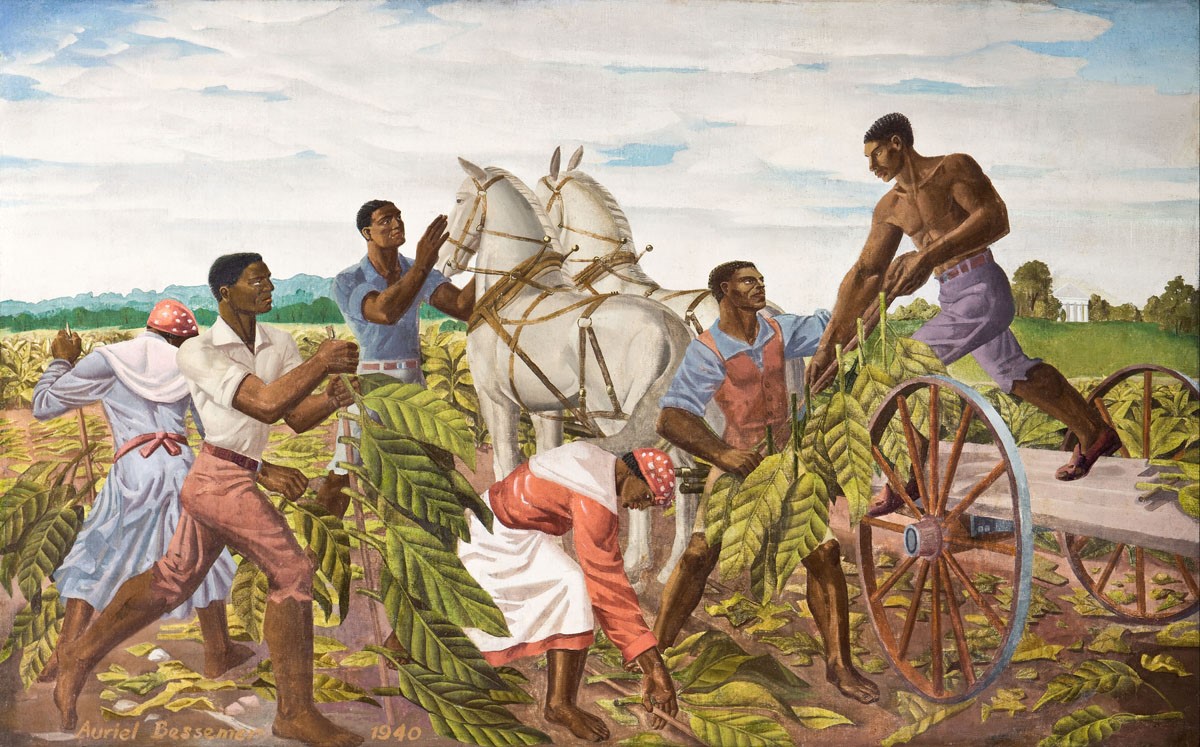
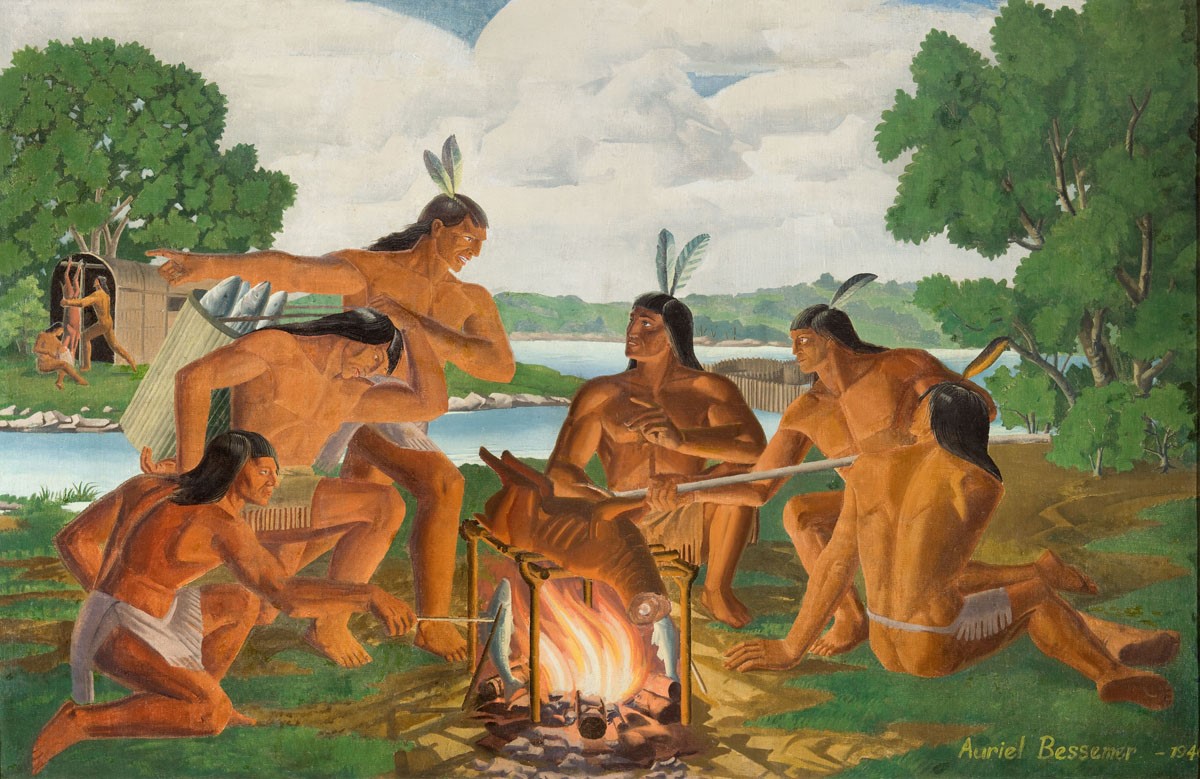
Auriel Bessemer won the national competition to paint the Arlington Post Office murals and based his images on local sites and occurrences. His painting style was characteristic of the Art Deco era. The scenes include picnicking at Great Falls, romanticized visualizations of the encounter of Native Americans and settlers, the lives of enslaved people in Virginia, and the apocryphal story of John Smith’s journey. Bessemer produced sanctioned work for the Federal Government, while also owning a progressive art gallery in Dupont Circle, Washington, D.C. and writing anti-fascist poetry, including the stanza “Prepare mankind, yet blind, for mutual slaughter.”

Tobacco picking

Auriel Bessemer, Tobacco Picking in the Late Colonial Era, 1940. Arlington Post Office Mural. 

Analostan

Auriel Bessemer, Early Indian Life on Analostan Island, 1940. Arlington Post Office Mural.

The Arlington Post Office, renamed for County Board chair and Congressman Joseph L. Fisher in the 2000s, became an Arlington County Local Historic District in October 1984, which provided it with protections from demolition and unregulated exterior alterations. It was added to the honorary National Register of Historic Places in February 1986 for its role in creating a single Arlington identity, and for its distinctive architecture. As Clarendon grew, the landscape changed around the APO, transforming a mid-century single-story commercial streetscape into a growing multi-use corridor. When a site plan project was proposed adjacent to the historic building and its 1946 commercial neighbor (originally the Scheff Store, then the Dan Kain trophy store, now Lyon Hall), the Local Historic District status of both historic buildings protected them during redevelopment.

The Arlington County Historical Affairs and Landmark Review Board (HALRB) helped preserve the single-story streetscape while allowing new development behind the historic buildings to provide commercial and residential density in the popular downtown area. During the development, the Keating Partners funded the restoration of the murals which were on display in the Arlington Public Library before they were returned to the post office.

Visit the original Arlington Post Office (once it is safe to) to patronize a mail center with an 83-year history, as well as to see the restored Treasury Department’s Section of Fine Art murals in place.

"Preservation Today: Rediscovering Arlington" is a partnership between the Arlington Public Library and the Arlington County Historic Preservation Program.

Preservation Today: Rediscovering Arlington
Stories from Arlington’s Historic Preservation Program

Arlington’s heritage is a diverse fabric, where people, places, and moments are knitted together into the physical and social landscape of the County.

Arlington County’s Historic Preservation Program is dedicated to protecting this heritage and inspiring placemaking by uncovering and recognizing all these elements in Arlington’s history.

To learn more about historic sites in Arlington, visit the Arlington County Historic Preservation Program.

May 28, 2020 by Web Editor

This Week in 19th Amendment History: Nannie Helen Burroughs

Post Published: May 21, 2020

May 20, 1961: Nannie Helen Burroughs Passes Away

Celebrate the 100th anniversary of the 19th Amendment with stories about the people and events that led to the passage of women’s suffrage in the United States.

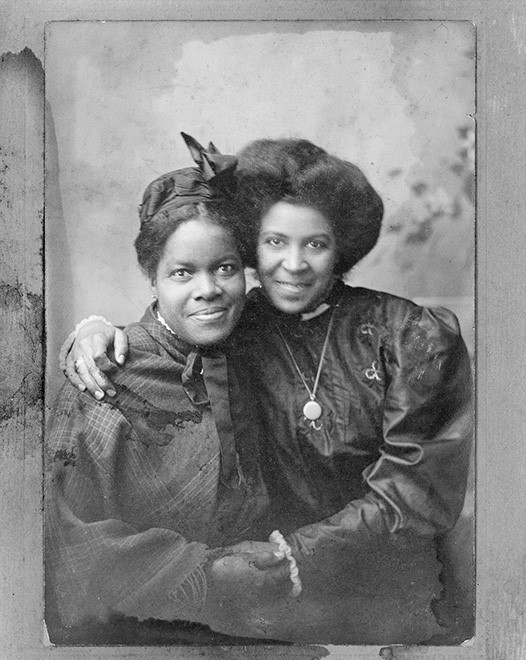
Nannie Helen Burroughs, who was a leading educator, feminist and suffragist in the Washington, D.C., area throughout the early 20th century, founded a school for girls and women and was an active member in her community.

Nannie Helen

Portrait of Nannie Helen Burroughs (left) and unidentified companion, ca. 1900. Image courtesy of the Library of Congress.

Early Life

Burroughs was born on May 2, 1879, in rural Orange, Virginia. Both of her parents were formerly enslaved, and her father passed away when Burroughs was a young girl. She and her mother subsequently moved to Washington, D.C., where Burroughs spent the majority of her childhood.

She was an exemplary student and graduated with honors from the M Street High School, now the Paul Laurence Dunbar High School. Though she excelled academically, she was denied a teaching job in the Washington, D.C., public school system – however, this setback would not hinder her goal to further the education of those in need.

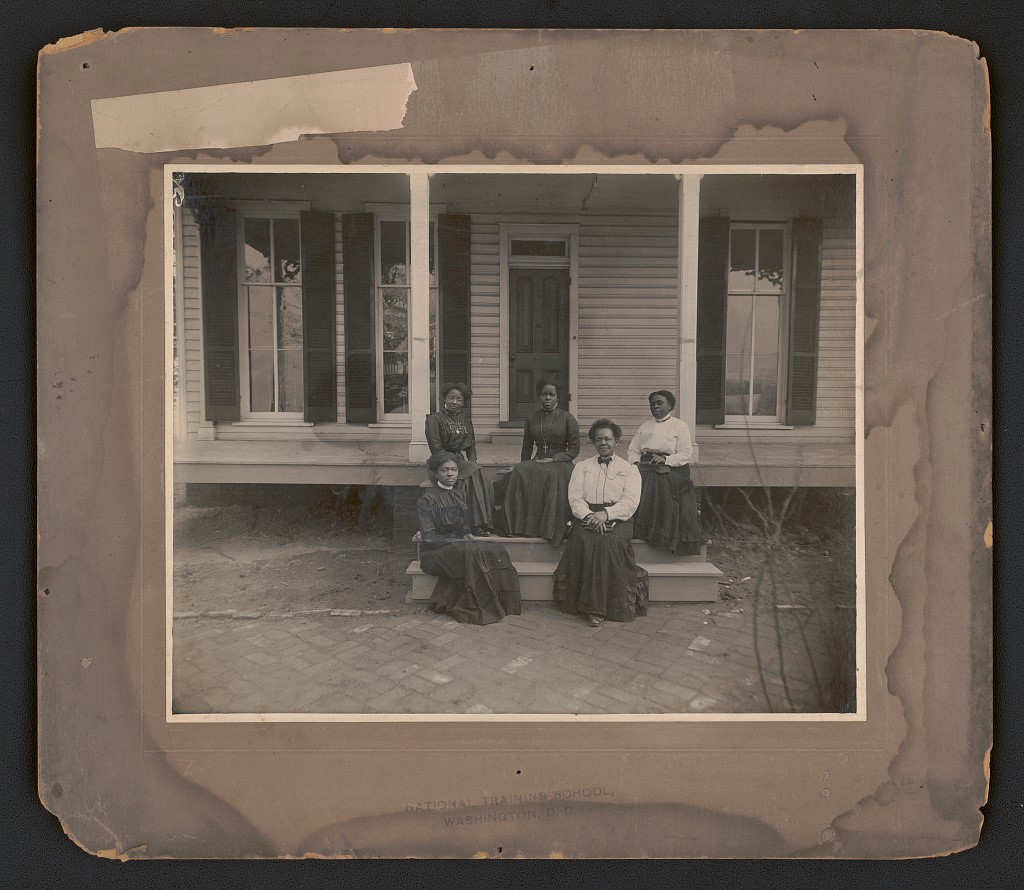
Nannie Training School

Nannie Helen Burroughs (center) and others at the National Training School in Washington, D.C., taken around 1909. Image courtesy of the Library of Congress.

Training School

Burroughs then decided to establish her own school to educate and train African American women who could not pursue a traditional educational path. Burroughs brought her proposal to the National Baptist Convention, and the organization decided to support her idea. The group bought six acres of land in the Lincoln Heights area of Northwest Washington, D.C., but this was only the beginning of her journey to open the school. Not wanting to rely on wealthy white donors, Burroughs gained the support of small donations from African American women and children to raise the funds to open the school. Once the fiscal matters were in order, Burroughs was able to open the National Training School for Women and Girls in 1909.

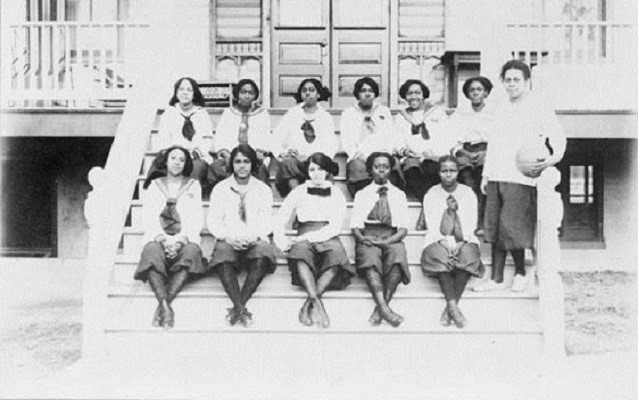
Originally operating out of a small farmhouse on the property, the school was popular and well-attended through the first half of the 20th century. The curriculum at the school was rigorous, including courses both vocational and academic, such as dressmaking, power machine operation, music, and physical education. Students could also participate in activities such as the school newspaper. Most of the students came from working-class backgrounds and hailed both from the Washington, D.C., area and other countries around the world.

Early supporters of the school included Black history scholar Dr. Carter G. Woodson and president of the National Association of Colored Women, Mary McCleod Bethune, who also spoke at the dedication ceremony. Burroughs outlined her goals for the school as training women for jobs both in and outside of the traditional female job sphere, and aiming for each student to become “the fiber of a sturdy moral, industrious and intellectual woman.” In 1928, the school saw an expansion, and a larger building – called Trades Hall – was constructed, with 12 classrooms, three offices, an assembly hall, and a print shop.

Basketball Players

Student basketball players at the National Training School for Women and Girls, between 1900 and 1920. Image courtesy of the Library of Congress.

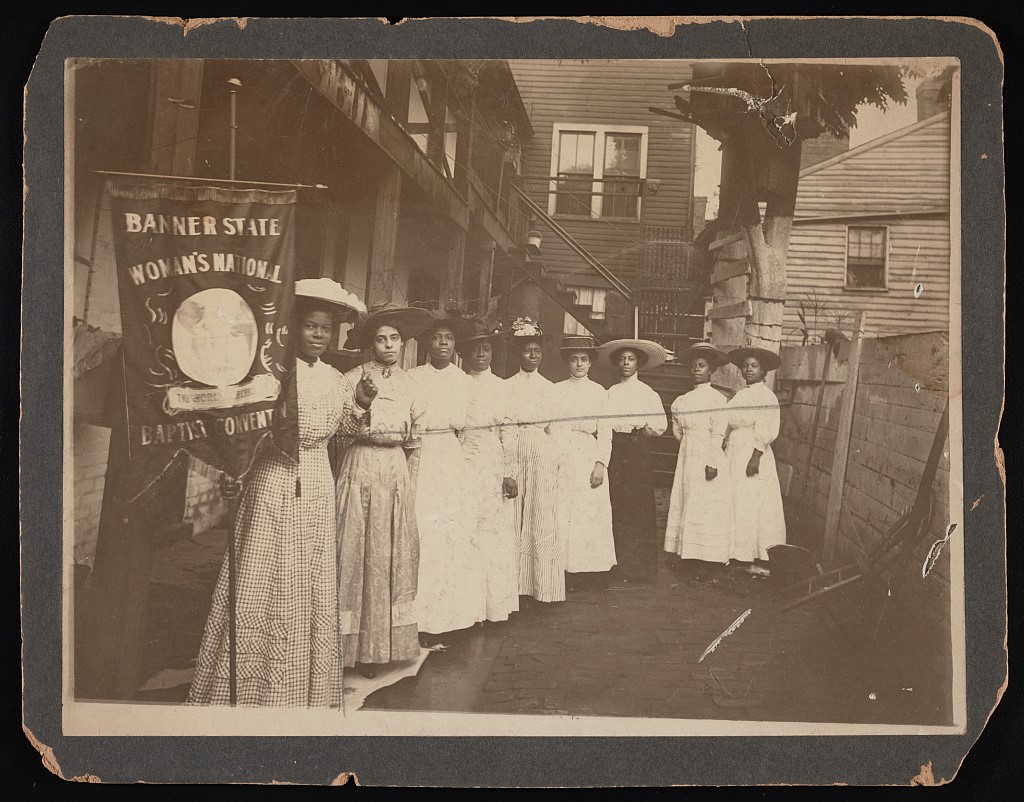
Woman’s Convention of the National Baptist Convention

At the same time as Burroughs lead her school and students, she was also an activist and advocate. Notably, she was involved in supporting greater civil rights and suffrage for African Americans and women. She wrote and spoke extensively on these topics, highlighting the need for African American and white women to work together to achieve the right to vote for all. She also emphasized that suffrage for African American women was key in protecting them in a persistently prejudiced and discriminatory society.

Starting early in her career, she was active in the Woman’s Convention of the National Baptist Convention, many of whose members were fellow suffragists and who discussed suffrage topics at their meetings. In 1900 she delivered a speech at the group’s annual meeting entitled “How Sisters Are Hindered from Helping,” and at the 1905 First Baptist World Alliance meeting in London, gave a speech called “Women’s Part in the World’s Work.” Burroughs also served as the corresponding secretary of the Woman’s Convention for 48 years and helped the organization grow its membership to 1.5 million by 1907.

Baptist Convention

“Nine African-American women posed, standing, full length, with Nannie Burroughs holding banner reading, Banner State Woman's National Baptist Convention.” Published between 1905 and 1915. Image courtesy of the Library of Congress.

Legacy

Throughout her life she also became part of the vibrant community of African American women suffragists, advocating for the cause alongside Coralie Franklin Cook, Anna Julia Cooper, Angelina Weld Grimké, Lucy Diggs Slowe, and Mary Church Terrell. African American women’s clubs were a strong network in Washington, D.C., and Burroughs was also active in these groups, including the National Association of Colored Women, the National Association of Wage Earners, and the Association for the Study of Negro Life and History.

Burroughs served as president of her school until her death on May 20, 1961, and three years later, the school changed its name to the Nannie Helen Burroughs School in her honor. Trades Hall now houses the Progressive National Baptist Convention and is a National Historic Landmark.

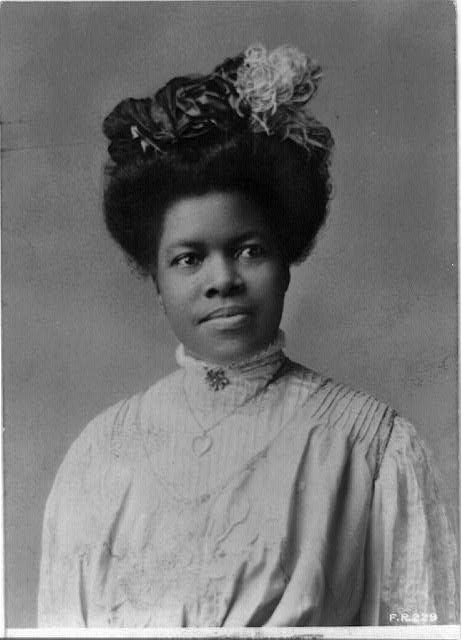
Nannie 1920

Nannie Helen Burroughs photographed between 1900 and 1920. Image courtesy of the Library of Congress.

2020 marked the centennial of the passage of the 19th Amendment. 

May 21, 2020 by Web Editor

  • « Go to Previous Page
  • Page 1
  • Interim pages omitted …
  • Page 15
  • Page 16
  • Page 17
  • Page 18
  • Page 19
  • Interim pages omitted …
  • Page 26
  • Go to Next Page »

Primary Sidebar

News

Holiday: All library locations to close early at 5 p.m. on Nov. 25 and all day Nov. 26 & 27 in observance of Thanksgiving.

The Shop will be closed Nov. 26 - 28. The … ... about Holiday: All library locations to close early at 5 p.m. on Nov. 25 and all day Nov. 26 & 27 in observance of Thanksgiving.

Read More News
See More Service Updates

Center for Local History

Large banner that reads, “Let there Be Peace on Earth” displayed near the Pentagon following the 9/11 terrorist attacks. Photo credit Diane Kresh. Charlie Clark Center for Local History, 133-01-02-01-130

Resilience and Community

September 11, 2001 "When terrorists slammed into … ... about Resilience and Community

Read More Local History

Director’s Blog

An American flag is draped over a portion of the Pentagon near where the structure was hit by a plane during the 9/11 attack. Photo credit Diane Kresh. Charlie Clark center for Local History, 133-01-02-01-107

On the 25th Anniversary of September 11

"Never Forget." When I hear that phrase today, … ... about On the 25th Anniversary of September 11

More Director's Blog

Footer

About Us

  • Mission & Vision
  • Charlie Clark Center for Local History
  • News Room
  • Get Email Updates

Administration

  • Policies
  • Library Staff
  • Job Opportunities
  • Propose a Program or Partnership

Support Your Library

  • Friends of the Library
  • Giving Opportunities
  • Donating Materials
  • Volunteer Opportunities

Our Mission

We champion the power of stories, information and ideas.

We create space for culture and connection.

We embrace inclusion and diverse points of view.


Download the Library App

Download the Library App

Arlington County | Terms & Conditions | Accessibility | Site Map
· Copyright © 2026 Arlington County Government ·