• Skip to primary navigation
  • Skip to main content
  • Skip to primary sidebar
  • Skip to footer

Alert

Update: Quincy St entrance closed during upgrades at Central Library. More Info

Home - Arlington County Virginia - Logo
MENUMENU
  • Join Now
  • My Account
    • Login
    • My Checkouts
    • My Holds
    • My Lists
    • My Reading History
    • About Borrowing
    • About Holds
    • About My Account
  • Hours & Locations
    • All Hours & Locations
    • Holiday Closings
  • News
    • Library News
    • Director's Blog
    • Get Email Updates
  • Contact Us

Arlington Public Library

MENUMENU
  • Search
  • Collections
  • Library Services
  • Events
  • Community Engagement
  • Join Now
  • My Account
    • Login
    • About Borrowing
    • About Holds
    • About My Account
  • Hours & Locations
    • All Hours & Locations
    • Holiday Closings
  • News
    • Library Blog
    • Get Email Updates
  • Contact Us

Center for Local History Blog

Dedicated to collecting, preserving and sharing the history of the community.

Oral History: An Interview with Lilli Vincenz

Post Published: June 15, 2017

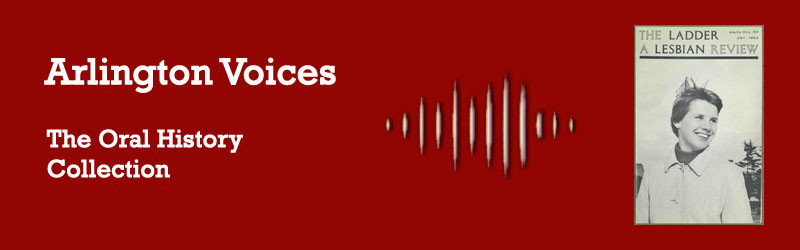
Arlington Voices: Lilli Vincenz

Dr. Lilli Vincenz came to the Washington, DC area in 1963 as a WAC (otherwise known as the Women’s Army Corps). After being outed as a lesbian and receiving a general discharge, Dr. Vincenz found a community and a calling in LGB activism.

She quickly became involved in the Mattachine Society of Washington, an important organization in the fight for local and national rights for gay and lesbian Americans. A dedicated community activist, Dr. Vincenz hosted a weekly open house for lesbian women from 1971 to 1979 and founded the Community for Creative Self Development, an empowerment program for the LGB community from 1992 to 2004.

In this audio clip, Dr. Vincenz shares her memories of protesting discrimination against gay and lesbian sexuality with the Mattachine Society.

Narrator: Lilli Vincenz
Interviewer: Diane Kresh
Interview Date: November 14, 2013

Transcript:

DK: Can you talk a little bit about the Mattachine Society?

LV: Oh, I loved it. Yeah. I went there immediate—and I felt so good. It was wonderful. I just loved it.

DK: Well, what did you love about it?

LV: I was free. And then the picketing started and I have that noted also in there. And it was so exciting that that was the most important thing for me. I’ve got to do this, because there’s all the lies that have been made for people who think that gay people are bad people socially. And well, nobody had really told people that it’s all right to be gay. But now, of course, we’re getting this quickly now that this—everywhere now we’re—

DK: Huge change.

LV: Another marriage, another marriage, they’re doing all that!

DK: Did you think that that would happen in your lifetime, those kinds of changes?

LV: Well, early on I didn’t think right away, but I only knew I had to be there. I had to do it, because so few people could do it. And I felt that I could do it.

For more information about Lilli Vincenz, see the Lilli Vincenz collection at the Library of Congress.


The goal of the Arlington Voices project is to showcase the Center for Local History’s oral history collection in a publicly accessible and shareable way.

From June 2017 – May 2018, we will post one oral history clip and transcript each month, focusing on Arlington’s history, culture and identity.

What is the oral history collection?

Oral history is a popular method of research used for understanding historical events, actors, and movements from the point of view of people’s personal experiences.

The Arlington Public Library began collecting oral histories of long-time residents in the 1970s, and since then the scope of the collection has expanded to capture the diverse voices of Arlington’s community. In 2016, staff members and volunteers recorded many additional hours of interviews, building the collection to 575 catalogued oral histories.

To browse our list of narrators indexed by interview subject, check out our community archive. To read a full transcript of an interview, visit the Center for Local History located at Central Library.
 

June 15, 2017 by Web Editor Tagged With: Oral History

Letters Home: Remembering World War I

Post Published: April 3, 2017

When World War I began in mid-August of 1914, it divided the global superpowers into Central and Allied Powers.

But it was not until after the sinking of the Lusitania in 1915 – and incessant pleas from the Allied Powers – that the United States officially entered World War I on April 6, 1917. Then soldiers from all over the United Sates, including Arlington, signed up to “do their part for the War effort.”

Because of new innovations in weaponry and chemical warfare, this was unlike any previous war; more than nine million soldiers perished, and approximately twenty-one million were wounded between 1914-1918.

Many Americans never returned home, but one who did make it back to Arlington was Edward G. Fenwick.

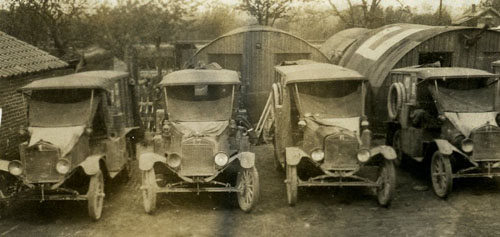
Fenwick served as an ambulance driver during World War I, and his journey through wartime Europe can be relived through his numerous personal correspondences.

Remy Belgium Fenwicks Car

Fenwick’s World War I Ambulance

Fenwick's letter home, page 1

Fenwick’s letter home, page 1

With letters addressed to his loved ones, including his beloved “Momsie,” the contents reveal an intimate look at life behind-the-scenes during war, and a soldier’s internal struggle to maintain a sense of normalcy and familiarity amidst a chaotic war-torn backdrop.

These wartime correspondences, as well as other family records can be found in the Eastman-Fenwick Family Personal Paper Collection at the Center for Local History.  The Eastman-Fenwick Collection details the history of this well-known Arlington family over four generations.  The collection is comprised of wartime letters, (both Civil War and World War I) economic records of the family, 19th century sermons, genealogical materials, and various postcards and correspondences.

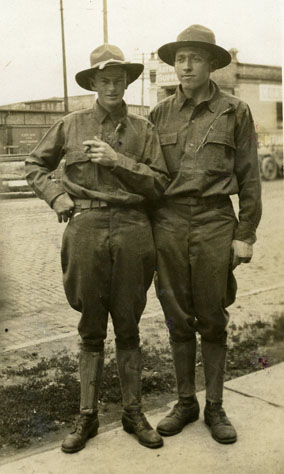
When Kristin Young, an Arlington County employee, discovered that the Center for Local History was going to showcase letters and photographs from World War I, she graciously loaned us a photograph of her grandfather, William Leo Diedrich for our exhibition.

William Leo Diedrich

William Leo Diedrich

Kristin’s grandfather served in France in 1917 and his personal diary quoted that he was “shot and gassed in October 1918.”  He survived the war but Kristin says, “My grandfather didn’t talk much about his service.  Nor did my uncles who served in WWII.  I can say that I am proud of my family’s tradition of service.”  In fact, Kristin is retired from the Navy Reserves.  She stated, “I’d like to think that I continued that tradition and hopefully made him proud.”

View the Center for Local History’s complete online World War I exhibit.

We also invite you to visit the Center for Local History’s Research Room at Central Library to see our World War I mini-exhibition, and to get an up-close-and-personal glimpse into this bygone wartime era.


The Center for Local history is happy to accept archival donations—please contact us through our webpage to speak to a staff member about your collection. 

The Center for Local History is a community driven archive which collects documents, photographs, and other archival records detailing Arlington’s diversified neighborhoods, groups and clubs, and residents.


April 3, 2017 by Web Editor

Exploring the Story of Desegregation in Arlington Public Schools

Post Published: February 2, 2017

"Project DAPS"

The richly documented story of public school desegregation in Virginia will be made accessible online by the County that led the way.

On Saturday, Feb. 25, in conjunction with the 2017 Feel the Heritage Festival, Arlington Public Library launches Projectdaps.org, a unique online exhibition and searchable database – built from thousands of photos, documents and recordings – surrounding the legal and moral battles that culminated with four courageous African American students taking their seats on Feb. 2, 1959 at Arlington’s Stratford Junior High School.

black and white photograph of black students entering Stratford Junior High in 1959

Ronald Deskins, Michael Jones, Lance Newman, and Gloria Thompson walked into Stratford Junior High School on February 2, 1959. Center for Local History, Arlington Public Library


“Project DAPS” (Desegregation of Arlington Public Schools) is culled from the holdings of the Library’s Community Archives in the Center for Local History (CLH) at Central Library.

The project explores the historic narrative starting with early integration efforts amid Arlington’s rapid growth of the 1940s. Many items were recently digitized for the first time.

In 2016, the Stratford school property was declared a local historic district. Library Director Diane Kresh says the timing was perfect for creating a “complementary and comprehensive digital collection to tell the story of this signal milestone in our rich community history.”

Because there are always more layers of history to find and examine, the CLH continually seeks community donations and oral histories, particularly as they relate to desegregation following the historic day at Stratford. To contribute, contact the CLH at 703-228-5966 or localhistory@arlingtonva.us.

This digital access project was completed using new FY2017 funding in the Department of Libraries budget dedicated to increasing public access to government records and archival materials.

The Center for Local History at Arlington Public Library is committed to collecting, preserving, and sharing the history of Arlington County. 


February 2, 2017 by Web Editor Tagged With: local history news

Voter Organization Focused on Local Issues for 93 Years

Post Published: October 27, 2016

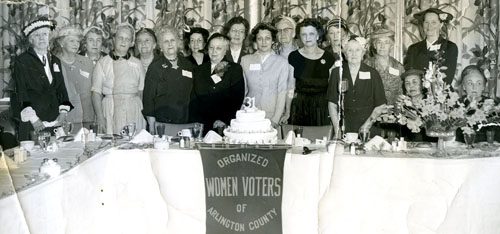
black and white photograph of Organized Women Voters

The Organized Women Voters of Arlington was founded in 1923, just three years after the 19th amendment to the U.S. Constitution extended the right to vote to women.

A decidedly non-partisan organization, the OWV was unique in its distinct attention to matters facing the County. In an interview with the Northern Virginia Sun in 1958, then-president Ms. Woolley stated she believed “that the Organized Women Voters of Arlington is the only women voters’ group in the United States that is concerned solely with matters of local interest.”

While the OWV’s objective was to “collect and disseminate political and civic information,” it also served an important role as a space for the improvement of women’s social position within the county. Many prominent female leaders from Arlington, including county board members and former state senator Mary Margaret Whipple, have been a part of this significant organization.

In an oral history recorded in 1983, former OWV President Mrs. Sue Renfro remembered a time early on in the organization’s history when the two functions of education and political support intersected:

“At the first meeting there was a Sheriff Fields that came to speak to the ladies since they were having the vote. And he promised them that he would do something for them, so they asked him would he be willing to make an appointment [appoint a woman, and he replied] “Well, yes, under the circumstances.”

So then they had the election. Sheriff Fields won, and he just seemed to forget about appointing a lady. And the ladies decided that they should go and inspect the jail.

So they made several trips to inspect the jail, and finally it was reported that the sheriff looked up one day and saw the committee coming again to inspect the jail and decided that he might just appoint one of them, and he appointed Mrs. Pauline Duncan.

… She was the first deputy woman sheriff in the Commonwealth of Virginia.”

In the photo above, attendees gather at the OWV’s 31st birthday luncheon in 1954.

These were high-profile events for the organization, and every year the group named a “Woman of the Year” from Arlington County. In 1938, First Lady Eleanor Roosevelt was an honored guest. Today, the Organized Women Voters still meets on the 4th Tuesday of every month from September through May at Essy’s Carriage House, to hear from candidates and county representatives.

Thank you to current president Nancy Renfro for the information regarding the organization’s current activities.


Learn More from the Center for Local History at the Central Library.

You can request to view materials in person from Record Group 17 – Records of The Organized Women Voters of Arlington County – or read the full interview excerpted above with Sue Renfro and Lillian Simms, cataloged as VA 975.5295 A7243oh ser.3 no.215.


October 27, 2016 by Web Editor

Public Shoe Store Donates Records to Center for Local History

Post Published: February 29, 2016

Farewell to an Arlington Landmark, 1938-2016

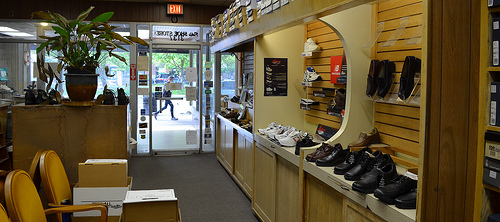
shoes in a shoe store

The Public Shoe Store in Clarendon, one of the oldest long-term businesses in Arlington, closed its doors on February 27.

S. H. “Doc” Friedman, the store’s owner and a podiatrist by training, has finally decided to retire after 78 years in the business [Arlnow.com]. Specializing in comfort shoes and custom fitting, it is one of the rare specialty stores of its kind left in the area and will certainly be missed by its many long-time customers.

“Doc” Friedman is donating the records of the Public Shoe Store, as well as the sign from the front of the store, to the Center for Local History at the Arlington Public Library.

In doing so, he is making sure that the Public Shoe Store’s place in the history of the community is preserved.

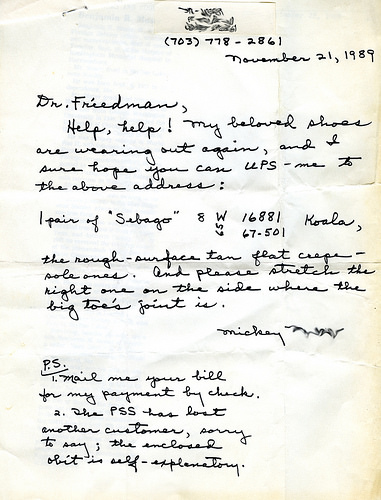
handwritten letter requesting shoes
Letter to 'Doc" Friedman from a loyal customer (click to enlarge)

Did you know that the Center for Local History collects historical business records as well as the records of Arlington organizations?

These records help tell the story of the development of the community and provide unique testimony to the achievements of your business or organization. Placing these records in an archival repository helps assure that they will be preserved and become part of the community’s collective memory.

If you have business or organizational records you would like to donate, please contact the Center for Local History at 703-228-5966, or email localhistory@arlingtonva.us.


February 29, 2016 by Web Editor Tagged With: local history news

Celebrate Black History: Hall’s Hill +150

Post Published: February 1, 2016

This year marks the 150th anniversary of the notable Hall’s Hill/High View Park neighborhood in north Arlington.

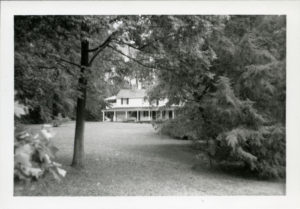
Bazil Hall home behind trees

Bazil Hall home, 1700 N. George Mason Dr., c. 1866

The name Hall’s Hill comes from Bazil Hall, an Alexandria (now Arlington) County farm owner in antebellum Northern Virginia.  Following the difficult Civil War years, Hall gradually broke up and sold his estate, including its noted rise, in small parcels to freed slaves, generally for $10-15 per acre.

Hall, according to a 1969 interview with Robert Nickerson, urged blacks to buy as much land as they could, saying a time would come when they would no longer be allowed to acquire such property. In Nickerson's words: "[H]e told the truth.”  In the 1890s, before enforced segregation kicked in, the lots were also advertised in the Washington Bee, the region's black newspaper.

In the early days of the Hall's Hill community, most residents had gardens and often raised chickens and hogs. In oral histories, they fondly described a life built around church, community and social activities. Block parties, sledding and the neighborhood baseball team, known as the Virginia White Sox, were just some of the pastimes.

"The Hill" is remembered as a place where you knew everyone and everyone knew you, and children understood that if they misbehaved in front of neighbors, their parents would soon hear of it.  A close-knit community, the people of Hall's Hill looked out for one another.

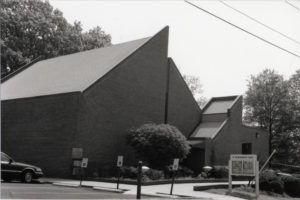
Mount Salvation Baptist Church

Mount Salvation Baptist Church

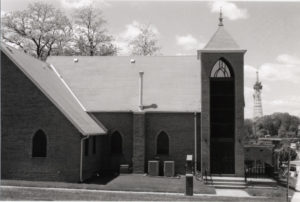
Bounded by Lee Highway (north), Glebe Road (east), North 17th Street (south) and George Mason Drive (west),  residents established many of their own stores, schools and houses of worship.  The churches in particular remain an ongoing source for social, cultural and religious enrichment.

Until the 1950s the neighborhood was separated from the adjacent white community by an 8-foot-high fence that ran between the backyards of blacks and whites.  Only a small part of the fence remains today. It can be seen from N. 17th Street.

Members of the community played  significant roles in the national and local Civil Rights movement of the 1950s and 60s, working to desegregate public schools, housing, theaters, hospitals, libraries and eating facilities.

Calloway Methodist Church

Calloway Methodist Church

Arlington County officially changed the neighborhood's name to High View Park in 1965. However, many long-time residents still prefer to call the area by its original name.

Today an aging population and changing demographics place the community on the brink of significant change, but as long as the stories of residents are collected, preserved, and celebrated, its history and significant contributions will be not be lost.

From an oral history with Welbe “Peggy” Earline Deskins done in 2003:

“I think it’s always important to… remember your roots and to remember where you started from… the why and how of everything.  I think that helps in your later life and it certainly helps other people as they’re coming along.

If you lose it all, [there] comes the time when there’s a whole race who just knows nothing.... You might have to even start out from the beginning, but when you do, if you have some references, then you know what to start with.

I think you should always... keep track of history... people were different in that time.  People helped each other a lot more.  People were a lot more open with each other, you know.  I mean you could run next door and get a cup of sugar you know...  it was just different.  And those are the kinds of things I think that help people to keep going and to prosper.”

February 1, 2016 by Web Editor Tagged With: local history news

Grant Helps Preserve Memories of “Little Saigon”

Post Published: January 7, 2016

The rich cultural history of Arlington’s “Little Saigon” community will be told through a new guide produced with a $9,000 grant from the Virginia Foundation for the Humanities.

January 7, 2016 by Web Editor Tagged With: local history news

Roadmap for Preserving, Sharing Arlington’s Past

Post Published: December 16, 2015

The County’s History Task Force—charged with creating a vision capturing, preserving and sharing online Arlington’s history – has made its final recommendations to the County Manager.

December 16, 2015 by Web Editor Tagged With: local history news

9/11: What Children Felt

Post Published: September 9, 2015

Note: We shared the basic contents of this post last year at this time. The reader response was so strong that we present it again. And we never forget.

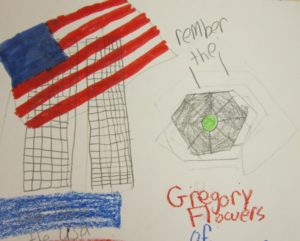
Fourteen years ago, young people from across the United States shared their gratitude, fear, patriotism and sorrow with the police and firefighters of Arlington Virginia.

a child's drawing of two tall buildings, the American flag and the Pentagon.Their unsolicited drawings and letters–preserved in the collections of Arlington Public Library’s Center for Local History–now show inevitable signs of age. Some of the young artists and writers no doubt have children of their own.

Sept. 11 letter

But the emotions of those grade schoolers and teens remain as fresh and powerful as the day they were put on paper and mailed from places like Renton, Wash., Toledo, Ohio, Clarksdale, Miss. and more locally Ashburn and the District.

The messages were welcomed and then saved. To preserve is to remember.

There are many ways to learn more and take part in the commemoration of Sept. 11, 2001 in Arlington:

  • Read or listen to the Center for Local History’s oral histories from first responders and others
  • Browse a collection of online resources
  • Watch the video interview by Library Director Diane Kresh with Pat Creed, co-author, “Firefight: Inside the Battle to Save the Pentagon on 9/11“
  • Visit the National 9/11 Pentagon Memorial


September 9, 2015 by Web Editor Tagged With: local history news

Remembering Arlington’s Freedman’s Village

Post Published: September 3, 2015

A new bridge to Arlington’s past

drawing of Freedmans Village BridgeOn Sept. 10, 2015, Arlington officials will formally dedicate “Freedmans Village Bridge,” the replacement overpass for Washington Boulevard at Columbia Pike.

The naming honor for the 19th century Arlington community of former slaves was approved by the state after a 2008 request from the County Board. Washington Boulevard is officially a state route.

freedmans village

The new bridge incorporates medallion images of the village, which was established as a model community by federal military officials on the captured property of Confederate General Robert E. Lee’s Custis-Lee estate in 1863. The village, which included housing, schools, a hospital and vocational facilities, was intended to be a temporary stopping point for the former slaves to establish themselves before moving on. Yet the community lasted and even thrived until 1900 when, after decades of trying, the government closed the village, persuading residents to accept payment to leave. Many found homes in other Arlington neighborhoods such as Hall’s Hill and Nauck.

Arlington TV spoke with Dr. Talmadge Williams in 2009 to explore the history and legacy of Freedman’s Village. Williams, an Arlington historian, educator and civil rights leader, died last year.

Although “Freedman’s Village” is now commonly spelled with the apostrophe, County preservation staff recommended that the bridge name not include the punctuation as a more accurate rendition of the name from when the community existed.

More than 28,000 residents of Freedman’s Village are buried in Section 27 of Arlington National Cemetery.


September 3, 2015 by Web Editor Tagged With: local history news

  • « Go to Previous Page
  • Page 1
  • Interim pages omitted …
  • Page 21
  • Page 22
  • Page 23
  • Page 24
  • Page 25
  • Interim pages omitted …
  • Page 36
  • Go to Next Page »

Primary Sidebar

News

Support library programs and collections and shop for amazing deals at the biannual FOAL book sale at Central Library.

2026 Fall Book Sale

October 22-25, score rare finds and amazing deals … ... about 2026 Fall Book Sale

Read More News
See More Service Updates

Center for Local History

Large banner that reads, “Let there Be Peace on Earth” displayed near the Pentagon following the 9/11 terrorist attacks. Photo credit Diane Kresh. Charlie Clark Center for Local History, 133-01-02-01-130

Resilience and Community

September 11, 2001 "When terrorists slammed into … ... about Resilience and Community

Read More Local History

Director’s Blog

An American flag is draped over a portion of the Pentagon near where the structure was hit by a plane during the 9/11 attack. Photo credit Diane Kresh. Charlie Clark center for Local History, 133-01-02-01-107

On the 25th Anniversary of September 11

"Never Forget." When I hear that phrase today, … ... about On the 25th Anniversary of September 11

More Director's Blog

Footer

About Us

  • Mission & Vision
  • Charlie Clark Center for Local History
  • News Room
  • Get Email Updates

Administration

  • Policies
  • Library Staff
  • Job Opportunities
  • Propose a Program or Partnership

Support Your Library

  • Friends of the Library
  • Giving Opportunities
  • Donating Materials
  • Volunteer Opportunities

Our Mission

We champion the power of stories, information and ideas.

We create space for culture and connection.

We embrace inclusion and diverse points of view.


Download the Library App

Download the Library App

Arlington County | Terms & Conditions | Accessibility | Site Map
· Copyright © 2026 Arlington County Government ·