• Skip to primary navigation
  • Skip to main content
  • Skip to primary sidebar
  • Skip to footer

Alert

Update: Elevator outages, maintenance and upgrades at Central Library More Info

Alert

Storytimes Will “Take a Nap” through June 20 More Info

Home - Arlington County Virginia - Logo
MENUMENU
  • Join Now
  • My Account
    • Login
    • My Checkouts
    • My Holds
    • My Lists
    • My Reading History
    • About Borrowing
    • About Holds
    • About My Account
  • Hours & Locations
    • All Hours & Locations
    • Holiday Closings
  • News
    • Library News
    • Director's Blog
    • Get Email Updates
  • Contact Us

Arlington Public Library

MENUMENU
  • Search
  • Collections
  • Library Services
  • Events
  • Community Engagement
  • Join Now
  • My Account
    • Login
    • About Borrowing
    • About Holds
    • About My Account
  • Hours & Locations
    • All Hours & Locations
    • Holiday Closings
  • News
    • Library Blog
    • Get Email Updates
  • Contact Us

Center for Local History Blog

Dedicated to collecting, preserving and sharing the history of the community.

Memories of Queen City

Post Published: October 26, 2011

Did you miss last month's Arlington Reunion History Program on Queen City? 

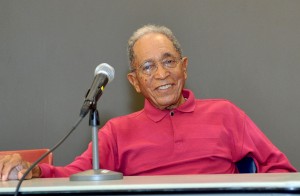
John Henderson grew up in Queen City

John Henderson grew up in Queen City

The Ballston-Virginia Square Patch sent a reporter to the program, and they have published an excellent recap:

In Queen City, a man sometimes didn't know he was poor until he was 27 years old, say some of those who lived there. The tight-knit African-American neighborhood no longer exists, but the community's spirit still survives in scattered memories.

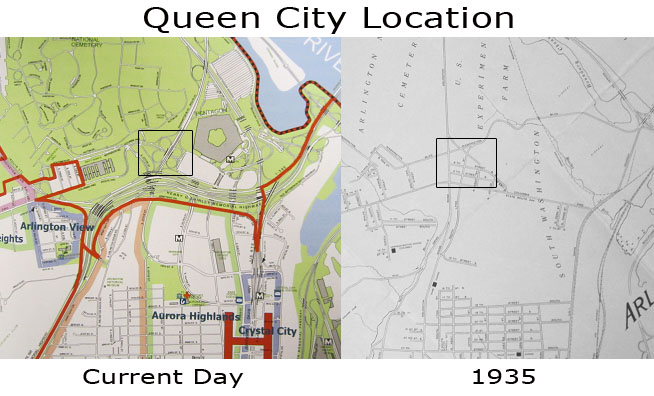
Queen City was situated, based on different oral and written historical accounts, on a patch of land immediately west-southwest of where the Pentagon now stands and was the size of somewhere between two blocks to 16 blocks. In its place now is a sprawling intersection. The community was devastated and neighbors were dispersed in the name of progress.

"Queen City was not razed for the Pentagon building, but the overall Pentagon project. In order to accommodate the large number of individuals who would be commuting to and parking at the Pentagon on a daily basis, extensive accommodations had to be made for the automobile," author Claire Burke wrote in Arlington's Queen City. "The cloverleaf highway structure, which the Columbia Pike feeds into and is found to the west of the Pentagon, remains the exact location of Queen City. Therefore, Queen City was destroyed for Pentagon's needed transportation corridor, which eventually would come to include over thirty miles of highways and ramps, including twenty-one overpasses."

Originally the home of residents displaced by the federal government's closure of Freedman's Village -- a post-Civil War attempt to house freed and displaced slaves -- people in Queen City came from across the South. There, everyone knew each other, and each other’s business. Most families owned their own home, either a single-family home or a row house.

"A lot of them were built by local builders and a lot were built by the people themselves, the people who lived there," said John Henderson, who moved to Queen City with his stepfather from Charlotte, N.C. The houses lacked running water and indoor plumbing. But there was a spring along the southern wall of Arlington National Cemetery. "There was a large pear tree right over the spring," said Eddie Corbin, a former Queen City resident. "When they were ripe, they would fall into the spring. They were the best pears you ever tasted." Residents walked every day and filled two or three buckets of water to take back home, he said.

Life in Queen City

Henderson and Corbin recently shared their stories of Queen City at Arlington Central Library. This article is based on their stories.

Henderson remembers no doctor, no dentist and no undertaker in Queen City. People had to go into Washington for those services. The doctors, dentists and undertakers in Arlington only served the white community. There is some discrepancy on this in written and oral historical accounts.

Queen City residents could only go to two hospitals -- Freedman's Hospital, which would later become the Howard University Hospital, or the District of Columbia General Hospital. But not many people had vehicles. If someone had an emergency, they had to find a neighbor with a car.

Based on Henderson's recollection, Queen City proper had a church, a place that sold fish sandwiches, a gas station and a general store. About 16 blocks down the road, Henderson said, there was one barber shop, an ice cream shop, a grocery store, a fruit store, a post office, a brickyard and one pool hall. There, you would find one fire department and two shoe repair businesses -- one in a storefront, and another in the form of a man who found his customers on foot. There were three churches -- Mount Olive, Mount Sinai and the House of Prayer -- four gas stations, three auto repair shops, two bus lines and a trolley. People worked and shopped at these places. Women also found jobs as domestic servants and some men worked for the federal government and at the cemetery, Henderson said.

Originally, the nearest fire station was on Virginia Highway at 23rd Street, said Corbin, whose father had been a firefighter. "We needed one, so (the residents) had dinners and parties and whatnot and they bought an engine and built the fire station," he said.

Children walked to the black school, Hoffman-Boston Elementary, about three miles away in Johnson's Hill -- the community today known as Arlington View. The youngsters made a baseball field to play in and they made roller skates from things they found at the dump. They would skate across the 14th Street Bridge.

Young men from Queen City signed up for military service early on in World War II to avoid being drafted. Many families had ties to the military: Parents worked at different military installations, and older residents had fought in previous wars.

But then the military needed more.

A Community Lost

Plans for the Pentagon were approved in the summer of 1941, and construction was soon under way. A government surveyor came to Queen City a year before they started clearing people out, surveyed each house and recommended that residents make improvements. Building started at that time with little regard for residents and work happened around the clock.

Corbin remembers the construction of a large trench in the street from the future site of the Pentagon to Fort Myer. Afterward, he said, residents could not go out of their front gates. When the government did buy homes from the residents, it did not pay enough for the homeowners to build new houses in other black communities.

The relocation was devastating.

"Everyone who lived there was really separated. Some went to one area and some went to the other," Corbin said. "Uncle Sam put up trailers on Johnson's Hill and put up trailers in Green Valley." Green Valley is in the Nauck community in Arlington. "The trailer city was there for another four years," Henderson said. "People were put in what was called two-bedroom trailers." Corbin had five people in his family, so they had two trailers.

Many families went to live in these trailers because they did not have anywhere else to go -- the housing shortage in Washington caused by the war didn't help. The shortage was only made that much worse by segregation, which further narrowed an already extremely limited range of places to live.

The trailers were rough temporary housing. They were joined together by a boardwalk and sometimes the rats were so big you could feel them under the floorboards, Henderson said. "You would be standing on the boardwalk and the rat would come and your whole body would shake," he said.

There was also a communal building that housed bathrooms with showers.

"It was quite a trying time," Henderson said. "I think the love and association of people is what kept people together. I sometimes thank the Lord that I was raised in that community. People didn't have much money. The neighborhood itself, I don't remember anyone getting angry at anyone... just a wonderful way to grow up."

Henderson and Corbin both talked about how Mount Olive Church built it's new home after being evicted from the land it had been on in Queen City, thanks to the construction of the world's largest office building. The congregation brought some of the original bricks from Queen City to build the foundation of the new church. Boy Scout Troop 505 cleaned the bricks so they could be used. The community built the church and worshiped in a tent during its construction.

Queen City had been a strong community where even though there was not a lot of wealth, there was always enough food, clothing and support to go around. "It was a nice place to grow up," Henderson said.

That community was lost to make way for the Pentagon.

October 26, 2011 by Web Editor

Early Emergency Fire Response

Post Published: October 6, 2011

From an oral history with Walter R. De Groot:
“Like I said, Fillmore Gardens [an apartment complex in South Arlington] before that was done, there was kind of a farm area there.  The county didn’t pick up trash.  You burned your trash and if you had a lot of waste, limbs and stuff breaking off the trees or raking leaves in the fall, you just drug them out [and] what you would have called “curbed” them…most of them were just drainage ditches and folks just dragged them out in the street and set them on fire.  And I think that’s how some of those field fires got going; either kids deliberately set them or farmers just burning waste and just caught the field on fire.

An interesting thing I had to learn was sound of sirens.  Every fire house had a code and you heard like the sound of the fifth cycle up and down, up and down, and you had to count those.  As I recall, Clarendon was three.  If they didn’t get many people they turned the siren on again and it would cycle up and down…  If you heard the siren, you called the dispatcher and the dispatcher would just immediately spit out an address and hang up, he was so busy.

Then of course later on, a lot of the volunteer firemen company’s would buy radios and all the boys would have what they called scanners, and they’d pick up any of the radio messages.  And of course whatever units were being dispatched you’d pick that up, that’s not my company, forget it.”

Virginia Room Oral History Collection
Walter  R. De Groot, Series 3, # 103
2004-05

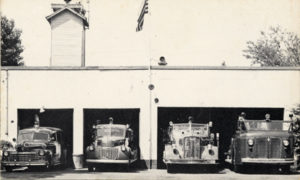
The photograph above is the Clarendon Volunteer Fire Department building and trucks, ca. 1951.

What About You?

What are your memories regarding Arlington’s Fire Department or large fires in your neighborhood?

October 6, 2011 by Web Editor Tagged With: local history news

Arlington History: Queen City

Post Published: August 23, 2011

On Monday, Sept. 19, 2011, The Virginia Room's Arlington Reunion History Program will host a community discussion on "Queen City," Arlington's black community after Freedman's Village and before the Pentagon, at the Central Library Auditorium, from 10:00 am - 12:00 p.m.

The original residents of Queen City were descendents of the residents of Freedman's Village, which had been established by the federal government during the Civil War as a home for displaced/freed slaves. A tightly knit African American community, Queen City was particularly focused on providing education for its children and was described by George Vollin, a former resident, as "a real happy, solid community."  

The neighborhood eventually disappeared when residents were displaced in 1941 as construction on the Pentagon and surrounding roads began:

"Queen City was not razed for the Pentagon building, but the overall Pentagon project. In order to accommodate the large number of individuals who would be commuting to and parking at the Pentagon on a daily basis, extensive accommodations had to be made for the automobile.

The cloverleaf highway structure, which the Columbia Pike feeds into and is found to the west of the Pentagon, remains the exact location of Queen City. Therefore, Queen City was destroyed for Pentagon's needed transportation corridor, which eventually would come to include over thirty miles of highways and ramps, including twenty-one overpasses."

-Claire Burke, Arlington's Queen City, p. 21

If you can't make it to the program, and would like to learn more, you can visit the Virginia Room, where the local history archive includes Arlington's Queen City, by Claire Burke.


If you missed this talk, the Ballston-Virginia Square Patch sent a reporter to the program, and published an excellent recap of the event.


August 23, 2011 by Web Editor

From Our Back Pages: Homes of Character

Post Published: August 22, 2011

Brumback Realty Company of Clarendon
Country Club Hills

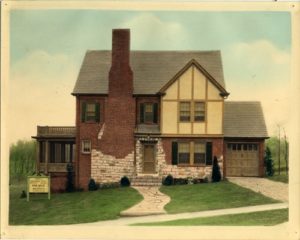
Brumback Realty Company of Clarendon, founded by a father with six sons, was a builder in Country Club Hills, in 1928-29.

Country Club Hills was developed from 126 acres of beautiful hills and wooded land, from the old Civil War era Grunwell estate, and commanded a view of Washington, D.C. One of their architects was A.F. Thelander, who designed and built his own home in Country Club Hills at Rock Spring Drive and Avondale Avenue, facing the Washington Golf and Country Club.

The English Tudor, Colonial, and Spanish style homes combined brick and stone and included two car garages, variegated tile roofs and copper gutters and flashing. The first 15 homes sold for an average of $20,000 in 1929.

The Virginia Room has some photos from Brumback Realty showing tastefully furnished interiors and the distinctive exteriors of homes that are still admired today.  

You can read more about Country Club Hills on Our Back Pages.

August 22, 2011 by Web Editor

Homes of Character

Post Published: August 18, 2011

Brumback Realty Company of Clarendon, founded by a father with six sons, was a builder in Country Club Hills in 1928-29. Country Club Hills was developed from 126 acres of beautiful hills and wooded land from the old Civil War era Grunwell estate and commanded a view of Washington, D.C. One of their architects was A.F. Thelander, who designed and built his own home in Country Club Hills at Rock Spring Drive and Avondale Avenue, facing the Washington Golf and Country Club.  The English Tudor, Colonial, and Spanish style homes combined brick and stone and included two car garages, variegated tile roofs and copper gutters and flashing. The first 15 homes sold for an average of $20,000 in 1929. The Virginia Room has some photos from Brumback Realty showing tastefully furnished interiors and the distinctive exteriors of homes that are still admired today.

The Virginia Room has a copy of Arlington Historical Society’s 1987 driving tour of Brumback Homes in Country Club Hills, Woodlawn, Woodmont, Lyon Park, Lyon Village and some individual streets.  The driving tour includes a quotation from Keith A. Brumback, President of Brumback Realty, Inc.  about the Burmback Policy of Doing Business:  “In my opinion, one of the most important and worthwhile lines of work any individual can undertake is that of providing families with attractive, comfortable homes in which all the joy of home-ownership can be experienced, without financial strain or worry on the family, and at the lowest possible price consistent with sound construction methods and good business practice.”

A Virginia Room Oral History interview of George and Frances Brumback provides more information on the Brumback Realty Company, the building of Country Club Hills and Mrs. Brumback’s career as a teacher at Cherrydale and Woodmont Elementary Schools.

What about you?  Do you live in a Brumback home?  Do you have any photos of your home and neighborhood? The Virginia Room wants to know.

August 18, 2011 by Web Editor Tagged With: local history news

From Our Back Pages: The Chain Bridge

Post Published: July 29, 2011


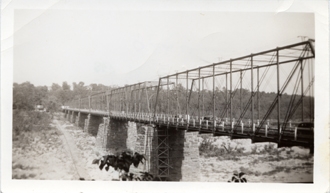
The first bridge to cross the Potomac in the Washington area was constructed in 1797 when Georgetown merchants built the “Falls Bridge” at the “Little Falls.”

The bridge was built to replace ferry service and was primarily used to drive cattle across to the Georgetown auction markets after the cattle had drunk heavily at Pimmit Run.

There have been eight bridges built on this site.  The original one was a covered wooden structure that collapsed in 1804, and the second was destroyed by floods after only 6 months. In 1810, a third bridge was constructed that was truly a “Chain Bridge,” the name by which all subsequent bridges have been known.

Read more about how the Chain Bridge got its name on Our Back Pages

July 29, 2011 by Web Editor

The Chain Bridge

Post Published: July 26, 2011

The first bridge to cross the Potomac in the Washington area was constructed in 1797 when Georgetown merchants built the “Falls Bridge” at the “Little Falls.” 

The bridge was built to replace ferry service and was primarily used to drive cattle across to the Georgetown auction markets after the cattle had drunk heavily at Pimmit Run.

There have been eight bridges built on this site.  The original one was a covered wooden structure that collapsed in 1804, and the second was destroyed by floods after only 6 months.  In 1810, a third bridge was constructed that was truly a “Chain Bridge,” the name by which all subsequent bridges have been known.  Two chains were made from four-foot links of wrought iron and suspended from massive stone towers at either shore.  The bridge itself was 136 feet long and 15 feet wide.

This was a toll bridge which reported $9,000 in collected tolls in 1810.  Tolls, thought to be high, were:

  • Four Horse Carriage: 1 ½ dollars
  • Two Horse Carriage:  1 dollar
  • Four Horse Wagon:  62 ½ cents
  • Two Horse Wagon:  37 ½ cents
  • Gig:  36 ½ cents
  • Man: 6 ½ cents

It was a relatively low bridge, and floods were a continuing problem.  The third, fourth, and fifth structures were all swept away by high water.

The present Chain Bridge, a simple continuous steel girder structure, was built in 1939 with a vertical clearance between the bridge and the river of 45 feet.  Nevertheless, in times of severe flooding, such as that experienced during Hurricane Agnes in 1972, the water level was so high that it became within a few feet of the bridge’s floor.


Do you remember Chain Bridge during the 1972 flooding?


July 26, 2011 by Web Editor Tagged With: local history news

Arlington Heritage: Eleanor Lee Templeman

Post Published: July 1, 2011

Much of what we know about the history of Arlington County is due to the work of Eleanor Lee Templeman, photographer, local historian, and author of several books on the history of the area.

Templeman, although born in 1907 in Washington DC, grew up in California. She moved back east to attend the Critcher School of Painting and Applied Arts, where she graduated in 1929. She subsequently worked as an artist and illustrator for the American Automobile Association and the US Geological Survey.

However, Templeman’s real passion lay in local history. She was a descendent of Richard Bland Lee, uncle to Robert E. Lee, and served as Secretary, Genealogist and Historian of the Society of Lees in Virginia at various points between 1947 and her death in 1990. She was heavily involved with the fights to preserve Fort Marcy, Fort Ethan Allen and Sulley Plantation, and at the time of her death was working with groups to preserve Abingdon Plantation, which is located on Reagan National Airport grounds.

It is Eleanor Lee Templeman’s bibliography, however, that has had such an effect on local historical research. Templeman was constantly writing articles on Arlington and Northern Virginia history for a variety of historical publications, co-authored Northern Virginia Heritage and was the sole author of Arlington Heritage: Vignettes of a Virginia County (seen above). Templeman did the majority of the photography for both books; these photographs are an invaluable resource, documenting important structures, roads, cemeteries and even large trees as they stood in the 1950s and 1960s, when Arlington was undergoing major development. Meant as a “then and now” type of book, her “now” has turned into our “then”.

Templeman was rewarded for her efforts with awards from Marymount University in 1975 and the American Association for State and Local History in 1983. She was the Organized Women Voters of Arlington’s Women of the Year in 1966. Here in the library, the Virginia Room holds multiple copies of Northern Virginia Heritage and Arlington Heritage, and the Arlington Community Archives has PG 900, her photographs from both books, and RG 23, her research and clipping files.

July 1, 2011 by Web Editor

Altha Hall "It’s All in a Name"

Post Published: June 3, 2011

Altha Hall

Altha Hall was originally built by a gentleman from Fairfax named Andrew Adgate Lipscomb II (born 1854), who later became Assistant District Attorney of the District of Columbia during President Grover Cleveland’s administration.

In 1886, not long after marrying his wife Lamar Rutherford, Lipscomb ordered construction in Arlington for a mansion to be modeled after one that had been long admired by his wife, a resident of Athens, Georgia. Actual Georgia pine was shipped by rail and used for the paneling and also for the forty-foot pillars, while hardware and fixtures from a castle in England were used on the front doors. Fine Italian marble was used to build the fireplaces and crystal chandeliers from Europe were also procured.

The Lipscombs moved into their mansion in 1889, having named it “Ruthcomb” as a composite of their names, Rutherford and Lipscomb.

After the death of Mr. Lipscomb, the property was sold in 1905 to Mr. and Mrs. Thaddeus Matthew Tyssowski of Washington. She was the former Alice Walton Green of Lewinsville, Virginia. Emulating the previous owners, the new occupants renamed the home “Altha Hall”, a combination of their names, Alice and Thaddeus. Mr. Tyssowski was a successful businessman and insurance company executive and his son, Colonel John Tyssowski, married Catherine Woodward. John later became Chairman of the Board of Directors of Woodward & Lothrop.

In 1921, the Tyssowski family sold Altha Hall to Dr. W.S. Benedict, who lived there for 14 years before moving to a country estate near Sterling, Virginia. The hall was then leased by Tyssowski to Miss Anna Payne, who held a nursery school and kindergarten there. The property was then sold in 1957 to a group of real estate investors who had the property rezoned from residential, in hopes of turning it into a potential apartment house site. During this time, the house was occupied by the Lentz family until its destruction in 1959.

Further information about Altha Hall can be found in the excellent book “Arlington Heritage: Vignettes of a Virginia County” by Eleanor Lee Templeman, which is available for checkout here at Central Library. The photograph above is from the booklet “A Brief History of Alexandria County, Virginia,” published under the auspices of the county Board of Supervisors, of which early area activist and official Crandall Mackey was a member.


What About You?

Do you remember Altha Hall? Did you ever visit the property? We want to hear from you!


June 3, 2011 by Web Editor

Central Library Goes Solar

Post Published: May 24, 2011

Beginning the first week of June 2011, Arlington County’s Department of Environmental Services will install solar panels on the roof of the Central Library to help reduce the facility’s "peak demand" energy usage, offset a portion of its electricity consumption, and ultimately save money.

The 60-kilowatts solar photovoltaic system will consist of 250 solar panels on the roof of the Central Library, in order to:

  • Collect sunlight during all seasons
  • Offset a portion of the building’s electrical consumption
  • Save approximately $14,000 in energy costs annually
  • Reduce the County’s CO2 emissions by about 100,000 pounds annually

As part of Fresh AIRE (Arlington Initiative to Reduce Emissions), the new solar photovoltaic system will contribute to Arlington’s goal to reduce the County government greenhouse gas emissions by 10 percent by 2012. Central Library is an ideal facility for a solar photovoltaic system, due to its large, flat roof that can easily collect sunlight, coupled with previous AIRE energy efficiency improvements.

This project is funded entirely by the American Recovery and Reinvestment Act (ARRA) of 2009, through the Energy Efficiency and Conservation Block Grant (EECBG) program administered by the U.S. Department of Energy.

Impact on Library Service:

  • The work will have little to no impact on access to Central Library or its services.
  • Construction is scheduled to begin in early June and will take approximately two months to complete, weather-permitting.
  • During the work, ten parking spaces in the north parking lot will be used for a six week period for storage and staging.
  • If additional parking spaces are needed, patrons will be given as much notice as possible.

Energy Improvements at Central Library

With one of the largest public library collections in Metro DC, Central Library runs the typical heating, cooling, ventilation (HVAC), lighting, and water heating equipment associated with a commercial building, as well as a robust public access computer center and office equipment for staff use.

A series of adjustments and retrofits to Central Library’s building systems over the last decade have:

  • Cut electricity consumption by 38 percent from 2000 to 2010
  • Saved over $90,000 in avoided electricity costs
  • Prevented nearly 580 metric tons in CO2 emissions - the same as taking 400 cars off the road or planting nearly 15,000 trees.

For more information about the solar panel installation, please contact Viswanadhan Yallayi at 703-228-0755 in the Arlington County Department of Environmental Services.

For details about Fresh AIRE and Arlington’s efforts to improve energy efficiency in County facilities, please contact John Morrill at 703-228-4426. Or visit http://www.arlingtonva.us/ and search “central library solar panels.”

May 24, 2011 by Web Editor

  • « Go to Previous Page
  • Page 1
  • Interim pages omitted …
  • Page 24
  • Page 25
  • Page 26
  • Page 27
  • Page 28
  • Interim pages omitted …
  • Page 35
  • Go to Next Page »

Primary Sidebar

News

LibraryFest: Happy 250!

July 18, enjoy free all-day fun at LibraryFest!

Join us for a free, all-day community … ... about July 18, enjoy free all-day fun at LibraryFest!

Read More News
See More Service Updates

Center for Local History

Three men writing on squares of the AIDS Quilt.

New: Explore 2,800+ Arlington Courier Photos

Explore more than 2,800 photos of local life in … ... about New: Explore 2,800+ Arlington Courier Photos

Read More Local History

Director’s Blog

Arlington Public Library staff marching in the 2025 D.C. World Pride Parade.

Director’s Message: Pride Month

Words Matter Arlington Public Library … ... about Director’s Message: Pride Month

More Director's Blog

Footer

About Us

  • Mission & Vision
  • Charlie Clark Center for Local History
  • News Room
  • Get Email Updates

Administration

  • Policies
  • Library Staff
  • Job Opportunities
  • Propose a Program or Partnership

Support Your Library

  • Friends of the Library
  • Giving Opportunities
  • Donating Materials
  • Volunteer Opportunities

Our Mission

We champion the power of stories, information and ideas.

We create space for culture and connection.

We embrace inclusion and diverse points of view.


Download the Library App

Download the Library App

Arlington County | Terms & Conditions | Accessibility | Site Map
· Copyright © 2026 Arlington County Government ·